Chapter 14: To rise or not to rise.

The opportunities for a large-scale slave revolt.
A casual observer of the 18th century Surinam slavery system might have predicted a development akin to that in Saint-Domingue. All the conditions for a large-scale rebellion by the black population seemed to be present in optima forma. Eugene Genovese has outlined the circumstances leading to a higher probability of slave revolt:
(1) The master-slave relationship had developed in the context of absenteeism and depersonalization as well as greater cultural estrangement of whites and blacks;
(2) economic distress and famine occurred;
(3) slaveholding units approached the average size of one hundred to two hundred slaves, as in the sugar colonies, rather than twenty or so, as in the Old South;
(4) the ruling class frequently split either in warfare between slaveholding countries or in bitter struggles within the slaveholding country;
(5) blacks heavily outnumbered whites;
(6) African born slaves outnumbered those born into American slavery (Creoles);
(7) the social structure of the slaveholding regime permitted the emergence of autonomous black leadership;
(8) the geographical, social and political environment provided terrain and opportunity for the formation of colonies of runaway slaves strong enough to threaten the plantation regime.”
It seems at first sight that the situation in Surinam fitted this model rather well.
Absenteism and cultural estrangement.
Absenteeism was rampant in Surinam. Apart from the earliest period, few Surinam planters lived on their estates. They preferred to reside in Paramaribo and in many instances, it took them days to reach their plantations by boat. Consequently, they were only dimly aware what went on there most of the time. The majority did not seem to be very interested anyway. They were driven by an animus revertendi, a desire to return to their homeland with their fortune made. In many instances, their eagerness for maximum profit overrode any humanitarian concerns they might have had. As the saying goes in Holland: what one does not know does not hurt. The Surinam plantation owners preferred not to know. After the Amsterdam stock-exchange crisis of 1773, the situation worsened. Many of the new plantation owners were Dutch investors, who had little knowledge of agriculture and who only tried to recoup their losses as much as possible. They gave free reign to callous administrators and directors. The latter, in the 17th and 18th centuries especially, were mostly recruited from the lower rungs of white society, in particular from the ranks of former soldiers and sailors. Accustomed to harsh discipline themselves and obliged to deliver a maximum crop by their patrons, they were not unduly bothered by altruistic feelings either. So, Surinam exhibited the classic features of too much absenteeism.
Just as important was the fact that masters and slaves had totally different cultures, with only limited influence on each other. This was partly the result of the fact that the bondsmen formed a large numerical majority and spent most of their time with little or no white supervision. However, it was also partly the result of a deliberate policy of the whites. Being such a tiny minority, they were in danger to be swallowed up by their subjects: biologically through miscegenation and culturally through ‘negroization’. Therefore, they strove to keep people of color apart from white society and to keep some cultural accomplishments exclusively their own, in particular those with a ‘boundary defining character’ (like language and religion). The whites jealously guarded these: they did not want their slaves to speak Dutch, or to become Christian. In later times, they relented a bit and saw some advantage in converting slaves to Christianity, but by then it did not matter anymore.
Economic distress.
Surinam has shown the characteristics of a volksplanting only for a very limited period. By the time slavery became entrenched, it was already clear that Surinam would be an exploitation colony par excellence, geared to produce commodities for the world market and largely oblivious to the needs of its own population. One result of this attitude was the fact that production for the home market was often neglected. This was the case with timber, for example: Surinam had an abundance of high quality wood, but people were often forced to import timber from the United States to build their houses. It was even more apparent in the production of food. All through the slavery era, there were plantations that specialized in the cultivation of victuals, but most of their products went to Paramaribo and they never produced sufficient quantities anyway. Especially during the early period, the lowland planters preferred to put all their energy into the cultivation of cash crops, hoping that they would be able to buy the foodstuffs they needed for their slaves at home or abroad. Often this was indeed possible, but when droughts, floods, or other calamities resulted in a particularly meager crop, the slaves went hungry. Some planters were even forced to let them fend for themselves in the forest. In the 18th century, the situation improved somewhat because the coffee grounds often produced more plantains than they had use for, but even then, many planters could buy only a minimal amount of food –just enough to keep their slaves from running away or being unable to work. The ‘frugality’ of the planters was even more visible in the distributions of ‘luxuries’ as meat, fish, salt, tobacco and clothes. These always had to be imported, which drove up the prices, and they were often unavailable when the trade routes were cut off during one of the many wars that plagued the Caribbean during this period. However, it was not only stinginess that withheld food and clothing from the slaves: in later times, many plantations fared so badly that they could hardly afford the barest necessities.
In the eyes of many people, even the inhabitants, 18th century Surinam was the epitome of a prosperous plantation colony. In the early part of the century, when the prices of the commodities it produced were high, this was indeed the reality. Money poured in and the planters were quick to spend it in the most conspicuous manner possible. The apparent prosperity made the planters eligible for ample credits and generous loans and this enabled them to maintain a high level of consumption a few decades longer. However, during the latter part of the 18th century, Surinam lived far above its station. The conditions for plantation agriculture were not exactly ideal. Land was plentiful, but land suitable for plantations was not and it had to be prepared by a costly procedure. Slaves were hard to come by and the fact that Surinam was located outside the main trade routes made them very expensive. As a result, the production costs compared unfavorably with those in other parts of the Caribbean, especially the French colony Saint-Domingue and (in later times) the Spanish colony Cuba. Fortunately, the Dutch market could absorb all of Surinam’s production (in fact much more).
In the 19th century, the number of plantations fell drastically and the remaining ones barely survived by a process of shifting to sugar, modernization of the production and much subsidy (mostly by hapless stockholders, who wasted the chance to invest their money more productively in the Netherlands). What it boils down to, is that Surinam has been a genuinely prosperous colony only during a few decades: it merely managed to give that impression a while longer because of high prices in the developing world market and the misuse of credit that was never paid back. Economically speaking, the situation of most Surinam plantations for most of the time was precarious and only in favorable circumstances the slaves were not victimized by this.

A predominance of large plantations.
During most of the slavery era, sugar plantations formed the majority of Surinam estates. They were condemned to a certain minimum size to make it possible to exploit an expensive sugar mill profitably. In the early period, when most of these mills were simple, animal-driven constructions, Surinam plantations could be small: a force of 10 to 20 slaves was not unusual. However, when water mills (and in later days steam mills) came in vogue, the production capacity increased and additional slaves were needed. Plantations with more than a hundred bondsmen became the norm in the 18th century. Even the coffee grounds, though much more flexible in the number of hands they employed, were comparatively large. In other plantation colonies, they were often relegated to marginal lands, but in Surinam, they took up some of the most fertile grounds, especially in the Commewijne district. Their overall size was somewhat smaller than that of sugar plantations, but they had more land under permanent cultivation. In the United States, planters owning more than 100 slaves tended to split up their holdings into several independent units, because it made supervision easier and the cotton plantations that predominated there hardly profited from the economies of scale. In Surinam, on the other hand, the few plantations specializing in cotton belonged to the largest in the colony.
While the coffee grounds lost terrain in the latter part of the slavery era, the remaining sugar estates grew in size steadily through a process of concentration: many 19th century estates boasted 200 to 400 slaves. Although this did not facilitate close supervision (which had never been a prime concern for many Surinam planters anyway), it made technological innovation -on a modest scale- possible. For the slaves, this process of concentration held little promise and they often protested the fusion of slave forces vehemently. With regard to the United States, it has often been maintained that the treatment of slaves was much better on small units than on larger ones. In Surinam, size seems to have made little difference. The slaves on large plantations were in some ways better off: they had less supervision and fewer problems to recruit the personnel for a large-scale rebellion.
A divided ruling class.
Surinam whites were divided in many ways. Their backgrounds were more diverse than anywhere else in the Caribbean. In all other plantation colonies, the citizens of the mother country made up a large majority of the white inhabitants. A take-over by another nation usually meant the substitution of most of the old planters by ambitious newcomers. In Surinam, Dutch planters indeed replaced most their English colleagues in the 17th century, but not because these were forced out. The Dutch wanted a strong and prosperous colony and welcomed everyone who could contribute to that. The varied backgrounds of the planters hardly ever posed a problem: Dutch, French, German, English, Scandinavian and Iberian planters all found their niche in Surinam society. However, since France and England were among the worst enemies of the Dutch Republic in the 17th and 18th centuries, the danger of a split along national lines in the ruling group always lurked in the background.
Religious differences also divided the white group. On the whole, Surinam exhibited a degree of religious tolerance that was quite remarkable for the age and the area, but some animosities remained. The largest minority, the Jews, had every reason not to challenge the status quo, because they could not expect a more favorable situation anywhere else in the region. It was different for the Catholics. Although they were no longer discriminated against openly in later years, they were mistrusted because of their alleged bias in favor of Catholic countries like France and Spain.
Class differences played an important role as well. Surinam was largely ruled by the planters and their allies. They provided the councilors for the courts and many higher civil servants and schemed to further their own ends (modest taxation for one). A small middle-class, consisting of traders and government employees, only took shape in the 19th century. Members of the lower classes (artisans, soldiers, sailors and blankofficieren), though numerous, were wholly dependent on the upper echelons and rarely stood up for their own rights. An exception was the mutiny against Governor Van Aerssen, but this was suppressed effectively.
Political differences were the most important. There was a continuous strive between the representatives of the planters and those of the Society of Surinam and the Dutch government, who vied for ultimate control. The first signs of this animosity could already be discerned during the 17th century, when the question arose who should substitute for an absent governor: the Commander (usually an outside appointee) or the members of the Court of Police. The earliest evidence of this fundamental opposition was the conflict over the defense of the colony in the aftermath of the attack by Jacques Cassard and his cronies. From then on, the relations remained strained. Sometimes they deteriorated so much that outside intervention was necessary to restore law and order. When the Dutch government took over control of the colony at the end of the 18th century, the planters were increasingly stripped of their power, the deathblow being given by the English occupancy during the Napoleonic Wars.
In the 17th and the beginning of the 18th century, the Caribbean was one of the main theaters of war: no European conflict went by undetected in these parts. The Napoleonic Wars in particular had serious repercussions. Though not the finest prize of the Caribbean, Surinam was worth plundering at the very least and the danger thereof was present during any conflict, whether the United Provinces were directly involved or not. The inhabitants of Surinam were painfully aware that their defenses were woefully insufficient –and so were the slaves, who patiently waited for a chance to break their shackles every time a conflict broke out. Surprisingly, they were often well informed about the events abroad.

Blacks outnumbering whites.
In few areas of the Caribbean, blacks have outnumbered whites so heavily as in Surinam. During the heighdays of slavery, there was less than one white for every 20 slaves. Only some of the smaller Caribbean islands, which were less vulnerable to slave revolt by virtue of their situation, topped this. Because of the uneven distribution of whites over the colony, this ratio rose to 70 : 1 in the plantation area. This made the supremacy of the whites an extremely shaky one, which did not escape the slaves. The possibilities for communication were limited, so in times of trouble a beleaguered master could not count on timely aid from the outside.
Africans outnumbering Creoles.
Surinam has exhibited the characteristics of a frontier society for an inordinately long time. Compared to the normal life cycle of plantation colonies, this meant that the first phase, the phase of building a stable society, took longer than normal. Although Surinam chose the road it was to travel in an early stage of its colonial evolution, the obstacles encountered (lack of settlers, lack of slaves, lack of funds) delayed the onset of the second phase, the phase of the mature and prosperous plantation colony, for a considerable period. Moreover, this phase had lasted only a few decades before clouds started to gather on the horizon. The last phase, the period of decline, dragged on for nearly a century, although most of that time the inhabitants remained optimistic about the possibilities of recovery.
The development of the demography of the slaves generally corresponds with the life cycle of the plantation colony. During the period in which the Surinam plantation area expanded, the slave population grew fast, in the absolute sense and in relation to the number of whites. Mortality was high and fertility extremely low. The sex ratio was skewed: males greatly outnumbered females. During the period of stabilization, the percentage of zoutwaternegers fell and although mortality remained at a fairly high level, the sex ratio became slightly more normal and fertility increased. The period of decline was ushered in by economic hardship and later accompanied by a ban on the transatlantic slave trade. The planters had to depend largely on natural increase to keep their slave force intact. The sex ratio became more balanced and fertility rose. Mortality declined as result of better treatment and improvements in medical knowledge, though it remained too high for a ‘third world population’ during the whole slavery era. Because of this evolution, the African-born bondsmen heavily outnumbered Creoles during the 17th and most of the 18th century. Only after the abolition of the transatlantic slave trade, this situation gradually changed.
The importance of this observation lies in the fact that African-born slaves were more apt to resist oppression and more willing to risk their lives to gain freedom, partly because they had less to lose. The Creoles tended to bide their time and to strike only when they were reasonably certain of success.
Black leadership.
Surinam provided excellent opportunities for the development of black leadership. Not on the plantations: though the bastiaans could wield a great deal of power, they were chosen primarily for their loyalty to their masters and their ability to make the slaves do their masters’ bidding. The struggle to survive in the jungle, on the other hand, allowed talented leaders to emerge. In Surinam, able warriors could amass a strong following and form a real threat to the continuance of white domination. Their main problem was that they did not connect very well with the majority of the slaves.

Possibilities for marronage.
In essence, Surinam was little more than a large jungle in which tiny groups of people carved out small and often only temporarily granted footholds. The forest always threatened to reclaim the plantations. Although the whites managed to tame the elements up to a certain point, they could never influence sufficiently those factors that made Surinam such an inhospitable place: the climate, with its predictable excesses of rain and unpredictable occasional droughts; the vermin that plagued the inhabitants regardless of skin color; the weeds against which a perennial war had to be waged; the soil whose fertility was often so precarious. The slaves suffered from these hardships as well, but the harsh environment also offered them opportunities to win their freedom. Once swallowed up by the jungle, they were hard to track down and they could always evade their white pursuers by retreating deeper into its recesses. Even when they chose to stay in the proximity of the plantations, the forest hid them comfortably. Thus, they could build up their communities relatively undisturbed. The jungle also gave the Maroons cover while they waged a guerrilla war against the colonists. If slaves and Maroons had joined forces and had striven in earnest to overthrow the supremacy of the whites, who knows what might have happened.
The obstacles to a large-scale slave revolt.
We have seen in the preceding chapter why the Maroons were not particularly eager to overrun the plantation area. This is one of the main reasons why no large-scale slave revolt ever shook Surinam. It is hardly likely that the slaves would have remained idle during an all-out Maroon attack. Whatever their initial objections to such an undertaking might have been, when forced to choose sides, most would have supported their own kind. Without the stimulus of such a Maroon offensive, however, the factors working against the outbreak of a slave revolt proved too strong. Moreover, the circumstances that favored the possibility of a successful rebellion only form half of the story. Although, for example, absenteeism and depersonalization of the relations between owners and slaves was prevalent and the cultural estrangement between whites and blacks was nowhere as large as in Surinam, but this may have had different consequences than Genovese postulated.
The slaves of Surinam were neglected by their masters in many ways, but on the other hand, they were not constantly bothered by them either. Consequently, they had a large measure of freedom to arrange their own affairs. Surely, they often had to work hard and the daylight hours belonged to the master, but the nights, holidays and Sundays were their own. The slaves could develop an independent culture with profound African influences. It set them apart from their overlords, it signaled a silent protest, but it also helped the slaves to adapt and it blunted the worst onslaughts of slavery on their psyche. The planters were reluctant to interfere in the social life of the slaves as well, so the slave community was, in fact, independent in many ways. To give up this satisfying social and cultural life for an uncertain and often dangerous existence in the jungle was the inevitable price of freedom: a price that was considered too high by many of the slaves.
The Surinam masters often failed to provide their slaves with sufficient provisions, let alone food that was varied and of good quality. As a result, many slaves went hungry from time to time. This would certainly have prompted them to rebel, if they would not have had ample opportunities to add to their diet themselves. In the eyes of the slaves, this did not absolve their owners of the duty to provide for them, but it made them less desperate to challenge masters who failed to do so. The slaves could get additional food by hunting, fishing, collecting shellfish and robbing other plantations (although the latter was not without risk). Moreover, they had their own gardens and fruit trees and they raised fowl (sometimes even -in secret- pigs). Many slaves were sorely tried by masters who neglected to furnish other necessities, especially clothes, but this usually did not inspire them to a spirited protest: the Surinam climate was mild enough to go without if the need arose.
 While the slave force of a large plantation might be strong enough to keep attackers at bay and even beat them in combat, it was seldom sufficient to stage a genuine revolt. For that, cooperation between slaves of different plantations was required and this was not easy to organize. There were always slaves ready to reveal a plot -either for material gain, or because they feared being dominated by other blacks even more than being dominated by whites.
Although the white colonists were divided in many ways, they were also very much aware of the precariousness of their situation and they tried their best to hide their differences as much as possible from the slaves. They were determined never to give the slaves a chance to set them up against each other and they usually cooperated loyally in case of any outside threat. Irreconcilable political differences, like the one that split the whites in Berbice (Patriots vs. Orangists) did not exist in Surinam.
Blacks may have greatly outnumbered whites, but this advantage was upset by two factors. Firstly, a large percentage of the black population was in no condition to wield any resistance: they were too young, too old, or too ill. A much larger percentage of the whites than of the blacks belonged to the category of ‘men capable of bearing arms’. Secondly, the whites managed to enlist the support of the Indians and did everything in their power to drive wedges in the black front, setting up the pacified against the not-pacified Maroons and runaway slaves, former slaves against Maroons, privileged slaves against their less favored colleagues, etc. On the whole, solidarity between the various groups of blacks was limited and the whites saw to it that it stayed that way.
Perhaps because of their scarcity, the Surinam whites had a lot of confidence in their Creole slaves, especially the Mulattoes. They deliberately tried to increase their loyalty by a preferential treatment. Also, the Creoles had good reason to fear the Africans because of their supposed magical powers and that distrust was mutual: Creoles were kept out of conspiracies as much as possible. In the 19th century, African runaways disliked the Creoles so much that they often killed any Creole who dared to enter their camp. The distrust between Africans and Creoles created another gap in the black front, which weakened it considerably. Moreover, for most of the slavery era the Creoles were not numerous enough to concoct their own revolts (which in the perception of Genovese were more sophisticated and therefore more dangerous).
Surinam slave society permitted the emergence of black leaders, but they were Maroon leaders. Their interest primarily lay with their own people, not with the black population in general. Most of them had little objection against slavery as such (they often treated the runaways that had drifted to their villages little better than slaves), but only to the fact that they had been degraded to slavery themselves, or had been mistreated. Once they had reached their goals -freedom, peace with the whites and a steady supply of European goods- they were quite willing to support the status quo.
The geographical situation of Surinam gave the slaves the possibility to withdraw from an unbearable situation individually, but at the same time it created so many obstacles that only the most desperate and the most brave ventured far into the hinterland. Runaways could fairly easy form independent communities beyond the grasp of the whites. The forest provided them with food and other necessities, but the Maroon societies continued to need the whites for many other goods (pots, knives, cloth, guns, gunpowder, etc), which made them less eager to drive their adversaries from the colony. Once the whites realized it was not a matter of conquer or be conquered, they learned to live with independent Bush Negro communities tucked away in the hinterland.
In Surinam, the situation was favorable for the articulation of various forms of protest: from sabotage and strikes to running away and small-scale revolts. However, these very same factors hampered a large-scale rebellion aimed at overthrowing the slavery system. The pressure was siphoned off the kettle in so many ways that the bursting point was never reached.
POSTED BY SK AT 1:24 PM
TUESDAY, DECEMBER 23, 2008
Chapter 13: The Maroons and their adversaries.

The development of the Maroon societies.
If history has taught us anything, it is that in some instances a small but ruthless minority can keep a large majority subordinated for a long time. However, this is a lot easier if these suborinates are not needed for production. In concentration camps the inmates were used for slave labor, but the main object was to eliminate them. Consequently, the Nazi overlords lost little by starving and terrorizing them and the threat of a violent death was ever present. The slaveholders in the New World could not go a similar route. It has often been maintained that it was economically most expedient to exploit the slaves mercilessly until they dropped dead from exhaustion (generally after about seven years) and then buy new ones. However, even if the average slave could give a mere seven years of service in some places during some periods, this was not the result of a deliberate strategy. Most slaves did not die from starvation or maltreatment, but from the ravages of contagious diseases –against which the masters were as powerless as their chattels. Few masters could afford to transform their slaves into walking zombies: they needed their energy, strength and even their wit for the work that had to be done.
The inevitable consequence was that they also had to cope with resistance. The Surinam planters, with their woefully inadequate force of supervisors, had to expect more resistance than other slaveholders. They were, however, fortunate in having an endless stretch of forest behind their estates, ready to swallow up the most intransigent slaves. It could be surmised that the formation of warlike Maroon societies meant an additional threat to the slavery system, but it turned out this was not the case. It is far more likely that the very presence of Maroon tribes in the hinterland helped to preserve the system, until external developments heralded its demise.
Most Surinam slaves fled alone or in small groups and many of them soon returned to their plantation, sadder and wiser. A considerable percentage of those who sought freedom did so mainly because they did not fit into the plantation community and by their departure removed a (potential) source of conflicts. Others were the (innocent) butts of their masters’ frustration and ran away to save their own skin, but did not want to leave their loved ones behind and hid nearby –sometimes even on the plantation itself. Aiding and protecting them also united the slave community. The last category of single runaways were the schuylders. They settled close to the plantations and lived mainly from stealing and from whatever food they could gather, or cultivate in secret. Because they needed companions to survive, strangers often congregated in small communities, but remained distrustful of each other.
Runaways preferred to join groups of the same ethnic background. Hazard, a fugitive from the plantation Cannewapibo, stumbled upon a Coromantine and an Abo village in the forest, which had no contact at all with each other, even though they were situated within walking distance. After a short stay in the Coromantine village, he felt no longer secure, because the inhabitants, 10 men and 3 women, continuously threatened to kill one another. He then moved to the Abo village, which counted 14 men and 3 women, but after a landsman of his had been slain, he preferred to surrender to the whites.
Sometimes, these groups were so keen on reinforcement that they accepted any newcomer, but if the slave in question belonged to a different nation, he was likely to become the scapegoat when trouble arose (often fights over women). Many escapees came, like Hazard, to the conclusion that it was safer to brave the ire of their master than to stay with belligerent weglopers. Jaba, who had been kidnapped, decided after nine long years to flee back to the whites, when her captors started quarreling amongst each other, resulting in the death of all the (20) slaves they had in their power.
Constant infighting undermined the stability of many wegloper communities. This is illustrated by the sad odyssey of Cartoes of Meulwijk (alias Voeyoereman). Cartoes fled his plantation because of continuous beatings. In the forest behind Meulwijk he met two other runaways: Cottica of Perou and Adam of Halle in Saxen. They took him to their cabin, but the peaceful cohabitation did not last long. Adam imagined that Cottica was a poisoner and killed him in his sleep. Thereafter, he took Cartoes to Upper Cottica where they met the Maroon leader Baron, who had just plundered a plantation. They participated in a few unsuccessful raids and later followed Baron to his village in Upper Cottica. They were attacked there by a patrol and the group, consisting of 13 men and 10 women, had to flee to the Commewijne. Baron argued with a Coromantee named Benbonwa and left with his wife and child. The remaining runaways established a village on the Patamaka River, Tammaroe wa Hey, which was situated so close to a military post that they could hear the soldiers felling trees. Benbonwa was killed by his companions because they feared that he was a poisoner. When the remaining runaways went to Upper Patamaka to clear provision grounds, they discovered a Coromantine village, led by Quamie, and settled there. After some time, Cartoes left the group in the company of Adam and Tekkie and they were later joined by Coridon. Cartoes abandoned them because he suspected they wanted to kill him and briefly sought the company of Profijt and Sambo of Vossenburg who, however, he considered a threat to his life as well. While he was fetching provisions with Profijt, Kwamie joined the little group. Cartoes mistrusted him too, so he moved again. Along the way he met Lont, also of Vossenburg, who told him that he had escaped from the Maroon stronghold Boekoe. They stayed together for a while, but Cartoes mistrusted Lont and he went back to Quamie, who had not gotten any friendlier in the meantime. Thereupon Cartoes decided to go to Perica alone, built a cabin and lived there peacefully for a while. When he was looking for food, he was nearly caught by a group of weglopers, but he managed to reach his cabin undetected. When he heard the axes of a patrol, he did not feel safe anymore and he returned to Patamaka, where he had to live off cabbes. In the end, he decided that the existence in the jungle was too demanding, so he swam across the Patamaka and surrendered to a group of Negroes on patrol. He told the Court of Police that he had never experienced any charity, neither in his own land, nor in Surinam, neither from blacks, nor from whites and he pleaded that he “shall be killed with no malicious thought, but that he shall be punished with a rope so he can go to his god with an easy death”. His wish was granted.
When larger groups of slaves ran away together, the situation was different. They often acted to preserve their community when it was threatened by measures of their master, for example attempts to put them together with the slaves of another plantation. Sometimes, their escape was merely a protest and they went back voluntary once they had been given proof that the hated decision had been overturned. In cases like this, the slaves often ran away unprepared and were glad to be able to return to their cherished home. When the whites remained obstinate, such a spontaneous protest could escalate into a full-fledged rebellion, as happened in Tempati. Sometimes, a whole slave force resolved to flee into the forest without any direct cause, either because of the influence of a strong leader who did not want to live in slavery anymore, or because the situation made it feasible. This was, for example, the case during periods of external warfare.
The Court of Police was well aware of this possibility and warned that in case of an enemy attack the slaves had to be kept under close surveillance “because there is not one negro, who does not know, that it is then the time for him, to free himself or to run away without peril and therefore two or three planters who are based close together must form a patrol with their Creoles on such occasions with orders to shoot all negroes found outside certain limits under their feet”. After the plunder of the colony by Jacques Cassard, the councilors observed how vulnerable the country was when the planters were forced to leave their estates “exposing those, as well as the women and children, to the good, or bad intentions of the slaves, who then being alone without supervision, or work get used to a libertine existence that makes them long for their freedom, and seek it, like the experience during the last attack has partly taught [us]”.
The first large concentrations of runaways formed after the massive defections during such emergencies. Many slaves owned by English planters made off when their masters lost the control over Surinam to the Dutch. The Indian Wars added more recruits to the nascent Maroon communities. Some observers claim that more than 700 slaves ran away during this period. The attack of Cassard also provided an ideal opportunity for gaining freedom to a large number of slaves, most of them recent arrivals. Bondsmen of one (or a few) plantations escaping together formed the cores of the various Maroon tribes. In the initial stages, they are likely to have accepted newcomers eagerly, especially females, for they were in need of reinforcement. Those newcomers will have been even more welcome if they were familiar: either slaves from neighboring plantations, or belonging to the same nation as the dominant group.
Evidence of this scenario is found in the names of many of the Bush Negro clans, which are copies of the ‘Negro name’ of the plantation most early members came from (a name that was usually derived from the name of a former owner). A prominent Djuka clan is named Pata (after Gerrit Pater, one of the richest planters of the 18th century, who owned the plantations La Jalousie and Beekhuizen). Another clan is named Ansoe, the Negro name of the plantation Meerzorg, derived from the name of former owner Paul Amsinq. The Pinasi clan got its name from the Negro name of the plantation Frederiksburg, which derived from L’ Espinasse. The Dominé clan was named after a plantation once owned by a minister. The Missidjan clan originated from Palmeniribo, called Missidjan by the slaves, after the wife of former owner Jonas Witzen. Legend tells that the slaves fled from the plantation after murdering this ‘Missi Jonas’ (whom they hung from a ring fastened to the kankantrie where the slaves were tied for a whipping). The murderers were worthless trackers and could not find their way to the Saramaka. They were taken in tow by some ‘Ansoe Negroes’ and brought to the Djuka Creek. Another part of the Djuka tribe, with Boston as the common ancestor, is called the Compagnie clan (compagnie being the designation for a group of shipmates).
The Saramaka have a clan called Kardoesoe. It was named after a trader called Cardoso, who brought a shipload of slaves to Surinam during the attack of Cassard and hid them in the forest of Poelepantje, from where they escaped. A part of the fugitives came from Angola and they congregated in a village and clan they called Kardoso. Nepveu remarked about these Maroons that they were rumored to be the descendants of a brother and sister. Though most inhabitants of this village were healthy and able-bodied, some were malformed and this was considered a punishment of the gods for the supposed incest. Other clan names also point to a group of weglopers from one plantation: the Papota clan very likely got its name from Papot, a well-known planter family; and the Nassy clan from another prominent family, of Jewish extraction.
Life was hard for the Maroons in the Surinam jungle. Many died from starvation, illness, or attacks of enemy runaways, hostile Indians, or patrols. The ones who survived did so because of their own resourcefulness and courage. The early Maroon communities, conscious of their vulnerable position, were therefore only willing to include newcomers who were ready to pull their own weight. The leaders of those early groups, meriting their position because of their capacities (although it probably helped if they represented the most numerous nation) were, in the words of Franklin Knight, “rigidly authoritarian and often needlessly cruel”. They had little choice if they wanted to survive: many slaves arrived at their premises believing that from now on they would have an easy life. They were to be bitterly disappointed, as Hurault discovered: “the rebel chiefs[were] indifferent and even hostile to the wellbeing of the mass of the slaves. They feared that the combativity of their troops would be reduced by parasites, desirous to escape the condition of slavery in order to be no longer forced to any work. Boni imposed heavy tasks on the escapees who reached him, years of hard work, before he trusted them with arms. Countless among them gave up and preferred to throw themselves at the mercy of their masters.”
Genovese has remarked that it was very difficult for the Maroon groups to avoid the parasitic existence that alienated them from the slaves. It was the tragedy of the Maroons in Surinam that they could not afford to retire so deeply into the jungle that the whites were unable to track them down, because they were dependant on their products. Although some groups had learned Indian crafts, they could not provide for all of their own needs. They were unable to weave cloth, work iron, or make gunpowder. They had to steal the necessary goods from the estates and consequently had to stay fairly close to the plantation area, within reach of the patrols. When they robbed the plantations, they could not avoid harming the interests of the slaves as well, especially since they were not above kidnapping women and children to swell their ranks.
The larger Maroon groups could not depend on the provisions they stole from the plantations, so it was “the manner of the Weglopers to plant in the environment where they settle here and there some provisions & make shelters”. They cultivated rice, cassava, tayer, yams and sometimes corn. The provision grounds were a vulnerable source of food. Often, these were discovered and destroyed by patrols and then the Maroons were forced to subsist on stolen food and cabbes until they could harvest anew. They satisfied their need for protein by hunting, fishing and sometimes trapping, though this might give away their presence as well. The provision guard of Cortenduur, who followed the trail of a couple of runaways, discovered two to three hundred snares. The commando pursuing the trail stumbled upon a big house with two guards in front who resisted capture fiercely. One surrendered aften having been cut several times, the other had to be shot. Their companions managed to escape. The patrollers found earthenware, bows and arrows, machetes, deer meat and fowl in the house, as well as pots with plantains buried in the ground.
Genovese has classified most of the 18th century Maroons as ‘restorationalist’ in worldview. This holds true for the Surinam Maroons in particular. Moreover, they never reached the ‘revolutionary’ stage, like most of their 19th century Caribbean counterparts. The reasons for this are threefold. Firstly, they could not afford to lose the source of European goods they so badly needed. Secondly, the strongest groups were able to force the whites to concede to a peace treaty that gave them a large measure of independence. Thirdly, the Creole slaves did not gain more influence among the Maroons, as they did in other parts of the New World. On the contrary, while Creoles seem to have made up a reasonable part of some Maroon groups in the 18th century [the famous ‘Claas villages’, for example, incorporated a ‘Papa village’ and a ‘Creole village’; and the slave woman Fortuna, who had been kidnapped by Maroons, reported that the ones she had met were “mostly Creoles”], during the 19th century, practically all Maroons were (recently imported) Africans. The restorationalist character of the Surinam Maroon tribes is illustrated by their culture, that, although an original Afro-American creation, displayed the most pervasive African influence to be found anywhere in the Caribbean.

The situation of the major Maroon tribes changed for the better when the authorities concluded peace treaties with them: with the Djuka in 1760, the Saramaka in 1762 and the so-called Bekoe-Musinga Maroons (nowadays called Matuari) in 1767. These tribes were known from then on as the Bevredigde Bosnegers (‘Satisfied’ or ‘Pacified’ Bush Negroes). The pact was signed on the plantation Auca (for this reason, the Djuka were called Aucaners by the colonists). According to Wolbers, the whites had to swear a blood-oath in the following manner: “Each party let a few drops of blood, which had been obtained by a small cut in the arm, fall into a calabash with pure spring water, in which a bit of dry earth was mixed. All those present had to drink from this, after a few drops had been sprinkled on the ground. Next their Gado-man or priest laid a curse over all, who would break this covenant”. The peace treaties drove a wedge between the ‘satisfied’ and the ‘not-satisfied’ Maroons and permitted the whites keep the latter in check.
The Pacified Bush Negroes were not easy to deal with. Governor Nepveu complained that the authorities suffered “continuously much harassment and teasing”. However, “considering our weakness one shall incessantly be forced to yield to them in everything, to keep the peace, however onerous it might be”. His successor Texier was no more optimistic: “the more one gives in to them, the bolder, more arrogant and more malicious they become”. Some Bush Negroes from Upper Suriname, for example, asked him for the freedom of a slave woman owned by the Society. She was old and useless, so in itself this was not a problem, but Texier was afraid to create a precedent since many of them still had relatives among the slaves. The whites had to treat them with severity “because then they are peaceful, humble, fearful and compliant, and behave with Respect & Submission”. In the end, they proved to be reliable allies though.
Indians and Maroons.
The early weglopers would probably have perished in large numbers if the Indians had not aided them. During the Indian War, they collaborated on many levels and one group of runaways even amalgamated with Indians to form the so-called Karboegers van de Coppename. Some groups of Indians also took in runaways in later times and intermarried with them. Since the former slaves were often stronger and more ferocious than their hosts, some of them rose to prominent positions within the Indian tribes. Nepveu claimed that they were not above abusing their Indian subjects.
The plantation slaves often had friendly relations with the free Indians who hunted and fished for the planters and these were frequently willing to guide them to a Maroon settlement. Some Indian groups had an amiable rapport with these settlements, partly because they needed them to obtain valued European products (which the runaways had taken along from the plantations). The proto-Saramaka enjoyed a mutually beneficial relationship with the Acouri Indians (a tribe that moved to the Brazilian side of the border in the middle of the 18th century and only returned to Surinam in the beginning of the 20th century). They married Acouri women and the Indians demonstrated them how to weave hammocks and how to make pots and baskets. They also taught them to fashion covers of woven cotton, which they sold in Paramaribo after the peace treaty. The Djuka did not know any of these handicrafts. In later years the tables were turned: the Indians became the easiest source for those western goods the Maroons could not do without: they traded cassava, cotton, roucou and the like for axes, machetes and iron pots. Sometimes, the Indians even received hammocks from the Saramaka. The whites were well aware of this symbiosis and they decided to stop trading with the Indians, who from then on could only get the desired products if they delivered a runaway, dead or alive.
Quite a few Indians were arrested for aiding runaways. Among them were Ariamono, an Indian captain, and his brother Jary. They had been caught with the help of the slave Tam, who had feigned that he wanted to flee to the Maroons. Ariamono testified in court that he and his brother had met runaways from Palmeniribo, led by Claas and Jankie, 15 years ago. These had escaped in 1712, with 20 persons. Claas and Jankie had established separate villages. Jary revealed that these Maroons had a lot of fowl and large provision grounds. One of their villages counted 80 adults, 12 adolescents and a couple of children, the other about a hundred people. The inhabitants of the most populous village had built a large house, which they used for ‘joelen’ (festivities), and many other houses. They had constructed traps for catching game, but had no bread. They came to fetch this in the Indian village, which was located about four days traveling. Both Claas and Jankie could speak the Indian language.
During the 18th century, the relations between Maroons and Indians deteriorated steadily. Partly because the Indians were seduced by the rewards the planters offered for hunting runaways; partly because the Maroons, in their search for guns and gunpowder, did not hesitate to overpower unsuspecting Indians and plunder their villages. The Indians were not very eager to attack a Maroon village, except when they were clearly in the majority: they feared the military prowess of their opponents too much. They were occasionally willing to guide patrols to Maroon hideouts and most of the lonely runaways they came upon were no longer welcomed into the tribe, but were delivered to the whites in return for goods and money.

Slaves and Maroons.
Despite the fact that their interests were not always parallel, many slaves had a lot of sympathy for the Maroons, which they showed in various ways. Bondsmen regularly warned Maroons for coming patrols. The Court of Police complained in 1717 that these bostochten often yielded little result “because of continuous correspondence with negroes of some plantations by which [the Maroons] are informed of ordered patrols”. On their part the Maroons were the cause that “many planters do not have the service of their slaves that should be, even less [they] can punish wrongdoers as merited”. The slaves rejoiced in the failures of the soldiers. Herlein noted that if patrols were sent out and “some of [the runaways]are bought back as prisoners, the Slaves all over the Country are very fearful, because one tells the other, and if the voyage ends unsuccessfully, then they are much prouder again”. After a successful bostocht against a Maroon tribe that by then already counted 800 members and had lived in freedom for so long that some of them had married children who had never seen a white, “there was much dismay among the Slaves of Zuriname”.
Slaves and Maroons sometimes cooperated admirably when the latter raided a plantation. During an attack on La Paix, it was apparent, according to the government, that the slaves had “agreed with the Weglopers and went with them voluntary, the attack having only been staged and continued to prevent the soldiers that were present to track the fleeing”. Not without danger to their own safety, weglopers situated their camps often in such a manner that “in one or two days the slaves from all sides reach it”, noted the government in 1772. After the disappearance of the slaves of Planteau and Picolet, Raad-Fiscaal Bernard Texier wrote that it is “undeniable that such a considerable force of slaves could not have been taken away with violence if there had been only a few well-intentioned among the bunch who had resisted, made noise and by their opposition had given as well the owner as the militia that was posted on the plantation the possibility to learn of the attack”.
There was not always friendly cooperation though: bloody confrontations between Maroons and slaves were frequent as well. The Maroons who attacked the plantation Marseille several times in 1774 were driven back by the slaves each time and pursued far into the forest. This brought Governor Nepveu to the conclusion that “when they have no correspondence at all with some of the most prominent slaves, the attack does not go that easy”. Many times the Maroons did approach plantation slaves beforehand, but got the cold shoulder. If they proceeded with the attack anyway, it could cost them dearly.
Sometimes, Maroons who tried to entice slaves to run away with them were lured into a trap, as happened in the following case. One day, the slave woman Jana of L’ Esperance came back from the field in a very agitated state. She grabbed her child, who was being cared for by an old woman, and wanted to make off with it. Her unusual behavior alarmed the other slaves, who brought her to the director. She confessed that she had been approached in the field by a runaway from the plantation, called Jupiter. He took her to the Bottel Creek, where two others were waiting. They tied her hands behind her back and wanted to take her with them, but she begged to be allowed to fetch her child first. They agreed to this and she promised that she would return to the same spot the next day with her child. As a precaution, they cut off half of her hair (probably to conduct wisiwith). At the designated moment, the director laid himself in ambush with some of his schutternegers. Jana and her child functioned as bait. However, the runaways must have noticed that something was wrong, for they did not show up.
The slaves had good reason not always to rejoice in the visits of Maroons. These frequently had only plunder and women on their mind. Not rarely, the plantation slaves were driven to a furious pursuit to save their loved ones from the hands of these ‘liberators’. They ocasionally asked bondsmen from adjoining plantations for help. In 1751, the slaves of Zorghoven, with the assistance of some of their colleagues from Onoribo, managed to free several children and two women from the clutches of a group of Maroons (at least one of them a survivor of the revolt on Bethlehem the year before). They killed three of the culprits. A group of ten armed slaves followed the trail of the remaining kidnappers, who still had 2 men, 5 women and 4 children in their power, but they were unable to retrieve them. The bondsmen were well aware that such a display of ‘loyalty’ merited a token of gratitude. The slaves of Marseille were rewarded by the authorities as well as by their owners, who resided in Holland. They were greatly hurt when it turned out that their heroism was forgotten soon.
Many of the slaves ‘liberated’ by Maroons were not exactly grateful for their deliverance. They were torn away from their familiar surroundings and found themselves in a situation of great uncertainty. They could depend on no one. The women, especially, were treated hardly better than slaves. They were taken as wives by the most influential Maroons, without having any say in the matter. Often, they were used as a kind of breeding mares by men desperate for offspring. Until they had been around long enough to earn the trust of their companions, the new recruits were forced to perform the heaviest and dirtiest work, which made the prospect of continued slavery lose much of its horror. Many of the new additions, especially the involuntary ones, tried their utmost to return to their plantations. Therefore, they were watched closely and killed on the slightest suspicion that they wanted to escape.
The Maroons had good reason not to allow anyone to return to the whites, even when the persons in question had come to them on their own initiative and had merely found the joys of freedom somewhat disappointing. Many of the returnees were willing to betray the Maroon hideouts in order to escape punishment, or revenge themselves. To avoid this possibility, the Maroons often made new recruits swear a solemn oath (sweri), enforced by the drinking of blood, that they would never betray their comrades, on the penalty of being stricken with instant death. Jupiter of the plantation Elk Het Zijn told the Criminal Court how he had been captured while on patrol and had been brought to Boekoe, the stronghold of the Maroon leader Boni. Because he refused to participate in raids, he was employed as a provision guard. When Boekoe was attacked by the Vrijcorps, he was grabbed in the provision grounds, together with Janconie of Roosenbeeck. The next day, the commander freed Janconie of his shackles and ordered him to lead them to Boekoe. Along the way, Janconie suddenly dropped dead (without having been touched in any way) and Jupiter attributed this to the fact that he had not kept his oath to Boni.

Captured runaways were put under heavy pressure to betray their fellows and since that sometimes meant the choice between a horrible execution and freedom plus a reward, some of them were willing to comply. Others only professed to cooperate, but in reality lured the soldiers on the wrong trail, so their comrades would have more time to flee. Markies, for example, had promised to guide a patrol and he brought it to two villages, which were both deserted. He said he would lead them to another one, but instead he steered the patrol though so many swamps that the commander, sergeant Krijgslaen, became suspicious. Markies tried to desert, but was caught and severely whipped. The chance to find the village was lost, however, and the soldiers decided to return. Markies later explained to the Court of Police that he had sworn never to betray his leader Coffy and when he was on the verge of breaking his oath, his “eyes had twisted” and he could not find the way anymore. The leaders of the patrol were of the opinion that he had led them astray on purpose and had tried to warn the Maroons, because when they stumbled upon a large barbacot along the way, with a fire still burning underneath, Markies had asked for a calabash of water in a very loud voice and had started to rattle his chains, whereupon a Negro, who had been hiding under the barbacot, jumped up and ran away. Markies claimed he had not been a wegloper but a schuylder. What further happened to Markies the story does not tell, but Profeyt of Wajampibo, who on a similar mission had been plagued by a “twist in his head” and had also not been able to find the right track anymore, was beheaded for his failure.
Since runaways often claimed to have been kidnapped by Maroons to save their life, whites were not very gullible when confronted with this claim. Even slaves who really had been dragged away by force had much trouble to prove their innocence. In 1771, the administrators of Rustlust, Kennedy and Backer, wrote a request to Governor Nepveu, begging clemency for some of the women of their plantation, who had been captured by a patrol under the command of Ensign Sebulo. Maroons had attacked the plantation in the expectation that the slaves would follow them willingly, but a great deception had awaited them. Though unarmed, the slaves had resisted with all their might and had even managed to free some of the maids who had already been overpowered and bound. After this feat, they had continued to work to the full satisfaction of the director, even though they were very sad about the loss of their women. When Sebulo visited the plantation during his patrol, the bondsmen had asked him if he had any suspicion against the slaves of Rustlust who had fallen into the hands of the Maroons and he had denied he had. The administrators requested that the women would be sent back to the plantation, for “what kind of impression will it give to the well-meaning, loyal and especially Creole slaves who shall have the misfortune to see everyone who is dear to them in this world confined this way on their return or capture and treated the same way as those who have conspired and plotted with the runaways”.
The peace treaties of the 1760’s included the provision that the ‘Pacified Maroons’ were obliged “to return all the slaves or slave women who might come to them or who are encountered in the forest to the whites without any distinction and to deliver them to the nearest magistrate or burgerofficier”. The Bush Negroes kept their part of the bargain, but they did not like it very much. They made it clear that they had little desire to hand over slaves who had fled because of cruel mistreatment and they wanted to make sure that the slaves they delivered would not be condemned to death, except when they were guilty of murder. The Saramaka Bush Negroes (who returned only two of the twenty slaves already residing in their midst) complained that the wails of abused slaves caused much “commotion and resistance” in their villages, especially among the women and children.
It should, however, not be presumed that the Bush Negroes were motivated by humanitarian reasons only. Not only could they use the labor of the fugitive slaves very well, but they also saw a perfect opportunity to manipulate and blackmail the whites. Often, absconders were kept in semi-thralldom for a considerable period and only handed over after much pressure and the payment of bribes by the whites. Ensign Daunitz, theposthouder (government representative) with the Saramaka, made himself very unpopular by reporting to the authorities that they had hidden a large number of runaways in the forest. Chief Etja even threatened to kill him, but he later relented and acknowledged that peace had only been saved by the mediation of Daunitz.
Runaway slaves were often treated as pawns by the Bush Negroes, who held out for the best bargain. This is illustrated by the behavior of the Bekoe-Musinga Bush Negroes. They were closely allied with the Saramaka, but had not shared in the presents distributed to the Saramaka chiefs, and consequently were not included in the peace treaty either. Although they were not yet pacified, they often visited the plantation of Mr. Planteau and consumed dram with the slaves. Because this led to frequent disturbances, Planteau forbade them further entrance. Moreover, Musinga was refused free passage over the Para River and was very annoyed about that. He proposed to the elite slaves of the plantation to come with him and they agreed. To prepare for the flight, the housemaids and the voetebooy hid the possessions of the master in the forest. The other slaves butchered all their fowl and took it along half roasted. Musinga forced the unwilling slaves to follow him with the help of some of his Maroons and the slaves who participated in the conspiracy. At the same time, Bekoe enticed the bondsmen belonging to the plantations of Picolet and Latterman to flee with him. The slaves of the latter he gave to the Saramaka chief Donkie. Musinga gave some of ‘his’ slaves to chief Quakoeof the village Coffy Sambo, who returned them to the whites without delay and pocketed a handsome fee (probably shared by Musinga). The same happened to some slaves who were donated to chief Samsam. In retaliation for these kidnappings, a patrol under the command of ensign Dorig burned down Musinga’s village, but it had already been deserted because a lukuman had predicted the attack. When a peace treaty was concluded with Bekoe and Musinga in 1767, they returned some of the remaining slaves as a token of goodwill, but these were, of course, not the most useful ones. Susanna, for example, realized very well that she was only handed over because she was “old and sick and cannot work”. The other stolen slaves were kept behind to toil in the provision grounds and only after urgent requests some of them were sent back.
Less prominent Bush Negroes also delighted in the possibility of harassing the whites. A Saramaka named Soesa had “received if not taken away”a slave “to spite the white”, had given him to an Aucaner and had taken another one in return. He refused to hand over this slave to the authorities on the pretext that he belonged to the Aucaner “which game these two have invented to elude restitution according to the peace treaty”. There was nothing the authorities could do, except to threaten Soesa that they would arrest him the moment he showed his face in the capital.
In 1721, the death penalty had been made obligatory for runaways (except when they had been driven away by abusive planters, or had been kidnapped by Maroons). After the peace treaties, the authorities faced a problem, because they had promised the Pacified Bush Negroes that returned slaves would not be punished with death unless they were “wrongdoers, murderers and poisoners”. However, they did not dare to send the runaways whose lives they had to spare back to the plantations, out of fear that they would incite the other slaves to rebellion. Therefore, they decided to keep them at the fortifications to work in chains for the rest of their lives and they paid the masters 200 guilders as indemnification. In 1788, when the worst dangers were over, the whites could afford to be more lenient: from then on, the death penalties would be reserved for proven murderers only. In 1828, it was ruled that runaways could only be condemned to death if they had drawn blood while resisting capture. Finally, in 1838 the following decree was issued: “The escape of a slave from the colony Suriname, with the apparent aim to remove himself from his lawful master, will be punished with forced labor on one of the Government Establishments, or the plantation of his master, for the time of ten years at most.” This penalty will not have inspired much fear in the slaves, but by this time, although some Maroons groups continued to plague the colony, the real danger had long passed.
It can be concluded that the existence of Maroon settlements in the hinterland had profound repercussions for the position of the slaves. On the one hand, it proved that their situation was not hopeless, which gave them solace; on the other hand, it added to the dangers already lurking in the jungle. The slaves could never be sure of acceptance among the Maroons and if they were unlucky, they might be taken for a spy and be killed without mercy. Even when they were accepted, they might very well have bartered one kind of slavery for another and they might be treated by their new masters just as heartlessly as by their former owners. After the conclusion of peace treaties with the major Maroon tribes, they were no longer welcome there. From then on, they were locked in between the plantation area and Bush Negro territory. Though the Bush Negroes certainly did not sympathize with cruel slaveholders, runaways could not trust them and many deemed it prudent to stay out of their reach. Consequently, they were often forced to stay much closer to the plantations than they would have preferred.
The war against the Maroons.
During the Indian War of the 1680’s, runaway slaves became a threat to the colony for the first time. Cornelis van Aerssen was the first governor to take the problem of the weglopers seriously. He concluded a peace treaty with a group led by Jermes in 1685. After that the position of the remaining weglopers was weakened so much that they quietly disappeared from the scene for several decades. Although individual attacks could endanger isolated plantations, the Maroons only became a problem to the colony again after their numbers had swollen considerably by runaways profiting from the chaos that ensued after the attack of the fleet of Jacques Cassard in 1712. By the middle of the eighteenth century, Maroons made up about 10% of the black population.
During the post-Cassard period, the number of patrols that were dispatched increased and the awareness of the danger the weglopers posed grew. Governor Temming wrote in 1722: ”the runways who are very numerous and are spread far and wide over the whole colony start to become very insolent, and not without reason they are feared on some plantations, yes even here in Paramaribo to the side of the new expansion: if I had some more soldiers here, I flatter myself to be able to root out this scum in due course”. During the reign of Governor De Cheusses (1728-1734) one patrol after the other was sent out and three decades later Pieter Brouwers gloated that ”by fire and by sword this brave Hero had them pursued into their holes, and if he had not been stopped, he would have gone to war in person; alas! Surinam may morn the loss of this Warrior up to this moment”. De Cheusses’ successors were even more burdened by the duty of fighting the Maroons: by the middle of the 18th century they made up about 10% of Surinam blacks.
To stimulate members of the Burgerwacht to search for weglopers more actively, Governor Van Scharphuys decided in 1691 to reward them with a hogshead of sugar for every fugitive they apprehended and he promised anyone who participated in a bostocht 50 pounds of sugar a day. The premium for catching a runaway increased steadily: first to five guilders, than to 300 pounds of sugar (= 15 guilders) if the captive had been hunted on purpose and 100 pounds if he had been caught by sheer luck. Still later, the reward rose to 25 guilders if the runaway was captured in the territory enclosed by the major rivers and 50 guilders if he was captured outside this area -to be paid by the owner. In 1717, it was decided by the Government and Court of Police that everyone was free to organize a commando, which would be rewarded with 1500 guilders for the discovery of one of the so-called Claas or Pedro villages and 600 guilders for the discovery of another Maroon settlement. Slaves or runaways who guided a patrol to a Maroon village were rewarded with freedom. At the height of the Maroon Wars, the fee for a captive rose to 150 guilders.
During the first stages of the Maroons Wars, they were fought mainly by the planters themselves. When a burgercapitein decided to assemble a patrol to track runaways or raiders, the planters in his division had either to participate themselves, or hire replacements. When most owners moved to Paramaribo, this left only the directors and blankofficieren as recruits and understandably, they were not very eager to risk their lives for the possessions of others. A few planters seemed to enjoy these expeditions: David Nassy, for example, led one patrol after the other and he trained Indians in the use of rifles when he could not persuade enough whites to enlist. However, by 1730 it had become clear that the militia could not handle the situation and regular soldiers were sent on patrol as well. The jungle patrols were extremely hard on the participants. Governor Nepveu wrote that the soldiers “melted like snow before the sunsine and those who are still alive carry around an impotent and miserable body”.
In the beginning of the 18th century, Governor De Cheusses was already well aware that it would be difficult to beat the Maroons: “while they don’t have to do anything, but hide about six behind trees here and there on the Route of our march, and from there shoot at our men, and then flee again further, since it will be impossible to discover them before they shoot, or to pursue them after the shooting, while they are in their Element there, and are very knowledgeable, and if one or two of our men are wounded in this manner, they will need bearers again, to traverse the forest”. Half a century later, Nepveu had similar reservations “even if there were 1000 yes 3000 men in those Forests, they could not do more than is done now, while it is impossible to engage them, if they want to retire, and the same with hungering them out even if one could suppose that one would find all their provision grounds, while they will never lack cabbes, wild fruits, fish and game”.
Despite this prevailing pessimism, patrol after patrol was dispatched. The soldiers experienced hell on earth. Van Sypesteyn explained: “Often they had to wade for hours and sometimes during half a day through the deep swamps, sinking to the hips in the swamp at every step, and obliged to carry the weapons and the ammunition on the head, to prevent them from getting wet. If the night fell, before they had reached a dry spot, then they were compelled to tie the hammocks to trees above the water or above the swamp, or to spend the night on a raft, which had been fashioned hastily from felled trunks … Sometimes it happened that, while they were wading through the swamp with the water reaching to their armpits, they were shot at by the ever-lurking bush negroes from a safe hideout, without being able to defend themselves much, because they, standing in the water, could not load their discharged rifles.”
Fortunately for the soldiers, the rebels had a constant shortage of guns, gunpowder and ammunition. According to Stedman, their shots often did not do much damage, because their rifles were loaded with small pebbles, buttons, or coins and they used a potsherd instead of a piece of flint for ignition. Sometimes, the Maroons were driven to attack military posts to obtain guns and ammunition, a risky venture that could go very wrong. Boni was rumored to make his own bullets.
Logistics was always the weak point for patrols. Governor Mauricius reported: “All the provisions have to be carried on the head by slaves and easily spoil in this heat. And everything depends on the loyalty of these slaves, who have been scraped together from all plantations, and usually are those which the owners or directors of the plantations want to get rid of. So it is usually the end of all patrols that one has to return for lack of provisions.” Governor Crommelin observed: “when a Load-carrying Negro has to carry provisions for four weeks for himself, one can easily understand that one cannot give him much to bear for the white Patrollers”.
Many of the Maroon villages were not that far away as the crow flies, but it often took weeks to reach them: “one reckons from Auka being a Jewish plantation, situated just below the Blue Mountain, at least 14 days travel, over Mountains, Creeks and Valleys, before one nears their Villages”, Thomas Pistorius observed. The Maroons usually situated their settlements in swampy areas, on the higher sand ridges. In the rainy season, they were practicably unreachable. During the rest of the year, they were well protected too. Some were surrounded by stakes, who functioned as man-traps: “From this we can see, that the Bush Negroes are not as simple as one thinks, and even shame us, while they do everything in their ability that is conductive to their Defense”, Governor Nepveu noted. One of the larger settlements was called Pennenburg, because “around the Village they had made double Diamonds, Crosswise over each other, in the manner of a Draught-board, with square holes, in which sharp pins had been put, which properly distributed, like a fence of Palisades, surrounded the Village”, wrote Pistorius. Boekoe had similar fences and was also protected by swivel-guns. When a village was attacked, the Maroons often did not defend themselves, but retired into the jungle, tried to hide their trail and brought their women, children and ‘house gods’, “in whom they have much confidence”, to safety.
Because of “bad judgement and fear” white soldiers were useless for battling Maroons. Moreover, the costs of dispatching so many patrols soon became prohibitive. Not infrequently, these amounted to more than 100.000 guilders for the average sojourn. Although a special cassa had been established for this purpose in 1749, it was emptied much quicker than it could be filled. It became increasingly clear to the whites that they could not win this war on their own.

From the beginning, they had put their hope on the abilities of the Indians. In 1690, for example, Governor van Scharphuys informed the Society that “fourteen days ago a troupe of 17 Coromantees have run away which [I] immediately have had pursued, but until now [I] got back no more than 8 of them the Indians have gone out in search of the rest who [I] hope return [with] good success”. Using Indians had its drawbacks though. The authorities observed in 1712 that weglopers had continuous contact with the Indians “who function as Instruments to debauch the Negroes on the plantations to Desertion”. Many runaways sought refuge with the Indians along the Saramacca and Coppename rivers and made ‘plantations’ for them. Later, the lure of rewards made the Indians more willing to track absconders, but they were put off by the fact that they often did not receive the promised premiums.
The bravery of the Indian warriors left much to be desired as well: “The Carib Indians are Lazy and Peaceful [and] fear the Weglopers a lot; they also don’t need any kargasoenen [trading goods] since they get enough kargasoenen from the Ruijlders [and don’t need] to barter for them, [they] also don’t want to do anything, and [they] would themselves not easily be able to find the places where those Weglopers hide”, Commander De Raineval complained. Governor De Cheusses was just as pessimistic. The Society should keep in mind “that the indians even though they knew some hideouts of the weglopers would never betray those, because it is a fearful people, and they would be afraid to be employed to point out these weglopers”. According to Teenstra, the Waraus were much better suited for hunting Maroons than the Caribs or the Arawaks and much less addicted to alcohol. The half-black Coppename Karboegers were deemed the most courageous. It was forbidden to trade with them to make sure they did not obtain guns. Governor Mauricius proposed in 1747 to ply them with gifts to get them on the side of the whites.
The battle against the Maroons could never be decided with the help of the Indians, so the colonists were forced to enlist Negro troops, who were much more suited to guerilla warfare. Slaves made up a valuable part of the various bostochten from the beginning, especially the schutternegersaccompanying their masters. A more or less typical expedition to the Sara Creek, for example, consisted of a lieutenant, an ensign, 40 planters, 37schutternegers and 83 carriers. The owners did not always like to see their slaves employed for this purpose. One of them complained to the Court of Police: “I do not give slaves to have them burn houses and to have them beaten with clubs as has been done here continuously for three years”. Other whites saw more possibilities.
Already in 1716, some colonists proposed that “The best and most loyal Negroes can be encouraged by favorable promises and compensation, and the service one would get from them, would in all probability have an even greater effect, than that of the Indians, because they are usually bolder”. Shortly after this, Commander De Raineval concluded: “Therefore, in my opinion, there will never be found a good remedy for this scandalous desertion, as with a group of freed Negro Creoles and Mulattoes, with four to five whites as their Chiefs, who could be divided [into]one group on the Upper Zuriname River and one group on the Upper Commewijne River, provided that first sufficient housing, provision grounds are made for them, the premiums for the catching and shooting of the maroons could be split, one half for the Mulattoes and Negroes and the other half for the whites … To animate and reassure these Mulattoes and Free Negroes one should supply those who had caught and killed a certain number of runaways with a wife to be paid for partly from their premium, and what was short from the public means of the land”. In this period, the authorities were not ready for these extreme measures yet. Governor Van de Schepper observed: “with regard to the Blacks one cannot Form a regular Corps and supply them all with guns, since this [is] too dangerous and would often lead to our own ruin, but most whites ordinarily whether on Patrol or otherwise take along two or three of their loyal slaves who they can trust supplied with riffles and use them”.
As the hostilities dragged on, the whites came to reason. The peace with some Maroon groups in the 1760’s had not ended the troubles with belligerent runaways. A new group under the command of Boni and his lieutenants Baron, Jolicoeur and Coromantin Codjo harassed the whites as never before. Governor Nepveu observed: “The terrible Insolences of these Negroes is without Example; however it appears that their principal goal is, to force us to make peace with them too, which is surely all the more questionable, since others will not fail to assemble in this Manner again from time to time: so this is an evil of which one cannot humanly speaking expect the end as long as one has Slaves”.
Since the expenses of fighting the insurgents nearly brought the colony to bankruptcy, Governor Nepveu concluded in 1769 that ‘if the slaves are made willing, they alone are able to track and catch runaways”. The best way to make slaves ‘willing’ was to promise them freedom. So three years later, the Governor and Court of Police decided to buy the freedom of 300 of the best slaves in the colony. Most of the candidates were eager to accept this opportunity. Only a few, owned by timber grounds in the Para, declined. These ‘Black Chasseurs’ (also called the Vrijcorps or Redi Moesoe) turned out to be singularly efficient and Governor Nepveu reported with glee that “the Negroes are incomparably more competent for this than Whites, and that one has always to expect much Benefit of them, provided one lets them act on their own without hindrances & without beings charged with Whites, for whom it is impossible to act with dexterity and obstinacy in the Forest, when it matters”.

The Maroons considered the Redi Moesoe traitors of the worst kind, but in the beginning, they wanted to give them a chance to defect. One chasseur reported to the Court of Police that he had been captured by the Maroons along with twelve comrades. Their captors had given them the choice to join them or die. Their leader Vigilant thereupon pronounced that they preferred to die and all of them were sentenced to death. The gun pointed at the survivor, however, failed twice and the Maroons regarded this as a sign from the gods. They killed his comrades with machetes, but decided to let him go, after whipping him soundly, cutting off an ear and shaving off his hair. Jupiter, the kidnapped slave of Elk Het Zijn, had witnessed this execution and later testified that the Maroons had brought the captives to their place of worship, had retracted their oath that they would not kill any Negro and had replaced it with an oath that from now on they would kill any chasseur that fell into their hands. The Redi Moesoe did not give quarter to the Maroons either. They gained some remarkable victories, the conquest of Boni’s stronghold Boekoe being the most remarkable.
During the height of the Boni War, Governor Nepveu finally found support for a favorite plan of his: the establishment of the so-called Cordon Pad around the inhabited part of the colony. The construction took from 1774 tot 1778. Kappler gave the following description: “The right branch of it stretched from the Suriname to the Commewijne, the left from the latter to the sea. The paths were about 80 feet wide and where they went through the forest, ditches four feet deep and 10 feet wide lay on both sides, in which the water seeping out of the forest gathered, and which discharged into the rivers and creeks. At a quarter of an hour distance of each other sentry posts and pickets were situated, which were partly manned from the main post, partly had a regular crew. The call-to-arms traveled the cordon pad from one end to the other in a few minutes.” In a way, the colonists had become the prisoners of their own former slaves.
In their desperation, the Surinam whites requested the help of the motherland and in 1773 the first contingent of State soldiers arrived under the command of Colonel Louis Henri Fourgeoud, who had gained valuable experience during the suppression of the Berbice rebellion in 1763. Nearly 2000 soldiers were sent to Surinam and when they left after five years of skirmishes only “a sad few hundred” were still alive. A minority had been killed in actual battle. Liquor and diseases had taken the heaviest toll. The debaucheries of the soldiers in Paramaribo, where they spent most of their time, angered the inhabitants and the fact that they had to bear a large part of the costs of the expedition did not please them very much either.
Colonel Fourgeoud was appointed the commander of all troops in Surinam, the soldiers of the Society included -thus surpassing the governor in importance. It is therefore not surprising that the relations between Colonel Fourgeoud and Governor Nepveu were strained from the beginning. Nepveu wanted the State troops to engage the Maroons whenever possible and to hunt them without mercy. Fourgeoud preferred a more restrained tactic. Nepveu complained that “with his Caresses, Benefactions, Promisses he tries to get [the Bush Negroes] on his side and on the other hand denigrates us with them”. Fourgeoud concentrated on destroying the provision grounds of the Maroons and in the end, this proved successful: desperately short of food and exhausted by the constant pursuit the remaining ‘unpacified’ Maroons (led by Boni) crossed the Marowijne River to French Guyana.
The troubles were not over though. Fortunately, the whites could depend on their new ‘pacified’ friends. When the Boni Maroons, in search of provisions and utensils and gunning for a similar peace treaty, returned to plunder the colony in 1788, the whites enlisted the help of the Djuka to suppress them. The Djuka were hesitant at first, but in 1792 a group led by captain Bambi attacked the village of Boni and killed him. This signaled the definitive end of the Boni Wars. Although a peace treaty was denied them, the Boni Maroons (nowadays called Aluku) were permitted to stay in Surinam as wards of the Djuka and they posed no longer a threat to colonial society. Other groups continued to trouble the plantations and until the last months of the slave era, patrols were dispatched to root them out, but although they remained a nuisance, they never constituted a real threat anymore.
For the whites it had been a bitter moment when they were forced to acknowledge that they could not defeat their rebellious slaves on their own. Coming to depend on their own former bondsmen to protect them was not an easy step, but it was a necessary one. The Bevredigde Bosnegerswere never happy with the situation they had been obliged to accept and up to this day have retained a deep suspicion of whites and their motives, but the peace between them and the colonial government endured, to the benefit of both. This is certainly more than can be said about the peace treaties with Maroons groups elsewhere.
POSTED BY SK AT 9:52 PM
THURSDAY, DECEMBER 11, 2008
Chapter 12: Resistance to slavery.
Heroes and villains: some views on slave resistance.

Resistance in all its forms was a popular subject for academics in the last decades and most writers about slavery indulged in lengthy discussions about it. For many of them the thought that slaves meekly accepted their lowly condition was unbearable and when they could not find clear signs of rebelliousness, they practically invented them. Sometimes, all acts of slaves that purposely or accidentally harmed the interests of the masters were taken as proof that a heroic struggle for the Dignity of Man was going on. From this perspective, suicide, laziness and stupidity all had revolutionary virtue.
Experts on slavery in the United States were hard pressed to come up with evidence of a heroic zeal among the slaves. A mere three or four abortive uprisings in a slave population of millions over a period of nearly 200 years do not constitute a very impressive record. Especially not, when one compares this with the rebellious attitude of the Caribbean bondsmen. With the help of an imaginative definition, Herbert Aptheker could dredge up several hundreds of ‘rebellions’ in the Old South, but most of them were no more than unsuccessful schemes and mere rumors. The crux of the matter is that many modern authors, most emphatically those of Marxist hue, find it hard to believe that slaves would have been able to live under such degrading conditions without a constant struggle against their oppressors. Unfortunately for them, the revolutionary potential of subjected peoples tends to be greatly overstated.
Eugene Genovese therefore warned against too simplistic a view: “Unable to challenge the system as such, unable to resist it frontally except on desperate occasions and then with little hope of success –they accepted what could not be avoided. In its positive aspect this accommodation represented a commitment, shared by most peoples, however oppressed, to the belief that a harsh unjust social order is preferable to the insecurities of no social order at all.” People with such harrowing experiences as the slaves soon learn to distrust all “utopian nostrumy”. Sidney Mintz voiced a similar opinion: “That slavery is inherently degrading, that it degrades both master and slave, goes almost without saying. But this does not mean that men are incapable of living in degraded conditions, nor does it guarantee that they will wage an unremitting struggle against them.”
For most black writers, however, it is unthinkable that the slaves will not have resisted with all their might -if not with violence, then in some other way. Orlando Patterson, for example, warned not to underestimate the capacity for playacting in the slaves. They may have fooled the slaveholders of the Old South by their contented appearance, but the ancient Greeks knew better: “Never once did they commit the lamentable error of those modern bourgeois historians who confuse the aggressive duplicity of the oppressed with a psychology of servile conformity”. For George Rawickevery slave contained a rebel, struggling to get out: “Man … do not move in their own behalf or make revolutions for light and transient reasons. Only when they no longer can stand the contradictions of their own personalities do they move in a sharp and decisive fashion. The victim is always in the process of becoming a rebel, because the contradictions demand this solution.”
Some slavery authors were so eager for displays of a revolutionary fervor by the slaves that they, in the words of Rice, were pushed into “a characteristically American double standard on the violence of the anti-slavery years into the assumption that violence was distasteful when used to defend slavery but excusable when used to attack it.” The most extreme representative of this position was C.L.R. James, who wrote about Haiti: “The massacre of the whites was a tragedy; not for the whites, for these old slave owners, those who burned a little powder in the arse of a Negro, who buried him alive for insects to eat, who were well treated by Toussaint, and who, as soon as they got the chance, began their old cruelties again: for these there is no need to waste one tear or one drop of ink. The tragedy was for the Blacks and the Mulattoes. It was not policy but revenge, and revenge has no place in politics.”
It is remarkable how blandly these authors condone the most vicious kinds of violence by black insurgents, even when aimed at their fellow slaves. Eugene Genovese, who in the beginning of the 1970’s warned the proponents of the ‘burn, baby, burn’ philosophy that it were the blacks who would be burned first and most, in his latest book on this subject not only defended the use of terror against whites, but also against blacks who were reluctant to revolt just because it was politically expedient.
One thing most slavery authors agreed on is the fact that the resistance of the slaves could hardly be called political. Eric Hobsbawn regarded slaves as “prepolitical beings in a prepolitical situation”. Their rebellions did not represent deliberate strategies to overthrow the system, according to Frederickson and Lash: ”They do not aim so much at changing the balance of power as at giving expression on the one hand to apocalyptic visions of retribution and on the other to an immediate thirst for vengeance directed more at particular individuals than at larger systems of authority.” This was even true for the Maroons. Genovese concluded that especially in the 18th century, when Africans predominated in the Maroon groups, their goals were ‘restorationalist’ in character (they wanted to recreate African communities) and only when Creoles gained more influence later in the century “the historical context of the slave revolts shifted decisively from attempts to secure freedom to attempts to overthrow slavery as a social system”. Only in Haiti, these attempts met with success.
Different groups had different ways of resisting. The Africans moved in a sudden and violent fashion: all or nothing, freedom or death. The Creoles chose an alternative approach: they knew the ropes, they could manipulate the rules and they could cleverly undermine the system by gnawing at its roots. This did not mean that they acted more ‘cowardly’: “the African predominance among the Maroons does not indict the Creoles for lack of militancy, but, rather, delineates different paths of struggle”, Genovese maintained.
In this context, some writers came to regard the whole way of life of the slaves as a constant, silent protest against their oppression. Consequently, the concept of culture as a form of resistance could develop. This view has some merit. If the ideal is that the slave is merely an extension of his master’s will, a working robot with no feelings, no ambitions, no pride, then the mere fact that slaves had a culture of their own contradicted this image and signified a manner of resisting the pervasive power of the master. Elkins disagreed with this view because of the pathology inherent in the culture of the slaves, which made clinging to this culture an unhealthy form of adaptation.
Some slavery authors opposed the unfavorable picture painted of slaves in the traditional literature so militantly, that they ended up too far on the other side of the fence. They created heroes where there were none. They claimed, for example, that just the ability to endure is a quality to admire -in a slave: “it is presumptuous in posterity to dismiss contemptuously the methods that enabled generations of slaves to endure their harsh lot in life and to snatch from it a few human satisfactions”, wrote Rose. Others bombarded common thugs and bloodthirsty maniacs into revolutionary heroes. “According to the myth, which does have a strong kernel of truth, every lower-class badman is a Robin Hood, avenging the poor and downtrodden and harassing the Man”, remarked Genovese. No doubt, when a slave killed a white or burned down his plantation (for whatever reason) he helped to undermine the system, but at the same time, these actions “strengthened the slaveholders’ self-esteem and sense of commanding a moral system”. Therefore, anarchistic violence was largely self-defeating.
The level of resistance encountered in the various slave societies largely depends on one's definition of resistance. However, overt slave resistance in the United States was slight by any definition. There were many obvious geographical, demographical and cultural reasons for this, but in the opinion of Stanley Elkins, they cannot explain this phenomenon satisfactorily. He pointed to the necessity of taking the influence of the slavery system on the psyche of the slaves into account. In the Old South this influence resulted in a certain degree of infantilization. Consequently, many of the American slaves displayed the traits of ‘Sambo’: “Sambo, the typical plantation slave, was docile but irresponsible, loyal but lazy, humble but chronically given to lying and stealing; his behavior was full of infantile silliness and his talk inflated with childish exaggeration. His relationship with his master was one of utter dependence and childlike attachment: it was indeed this childlike quality that was the very key to his being.”
On the whole, there was little sympathy for this theory, although some authors conceded that there might have been a few genuine Samboes around. Earl Thorpe wrote: “Any historian who denies that Sambo, often feigned, but sometimes genuine, was one side of the bondsman’s personality is probably guilty of being unrealistic. What is known about human behavior and totalitarian systems calls for a change in some aspects of the slave image which some Negro historians have favored. Since these were their immediate blood and cultural forbearers and in view of the overly narrow image of them which slavocracy projected, it is understandable that they sometimes have put great stress on the neater side of the bondsman’s personality and character. Thus, in reacting against one stereotype, they have been in danger of creating another one, equally false.”
It cannot be denied, as Roy Bryce-Laporte stressed, that the circumstances on the plantations had an “intense mortifying and dehumanizing impact”, but if the slaves had “fully succumbed to those conditions they would have all been zombified or psychologically dead”. On the other hand, he did not believe in the continuous resistance of the slaves, because then “they would have all been physically dead or absent by way of escape, exodus, or revolution”. Neither was the case, so they must have found a workable compromise. Few slaves wholeheartedly accepted their lowly position as their proper station in life. Most of them showed some resistance, actively or passively, but as Genovese remarked: “The practical question facing the slaves was not whether slavery itself was a proper relation, but how to survive it with the greatest degree of self determination.”

Resistance in Surinam.
An uneasy balance.
In the eyes of many slavery authors with a comparative perspective, Surinam slaves wrote one of the most ‘heroic chapters’ in the history of slave resistance. In Surinam alone, Maroons not only created viable communities in the interior, but they forced the colonial government to acknowledge their freedom and independence and they managed to survive as distinct tribes until this moment. Thousands, of slaves escaped into the jungle over the years. Most remarkable, however, is not the fact that so many ran away, but the fact that so many stayed on. The slaves of Surinam did not flee at the slightest provocation. The ties that bound them to the plantations were hard to severe. Many slaves were willing to undergo manifold deprivations in order to remain in their cherished community.
Even if they did not resist their overlords actively, the slaves were not totally helpless. The masters wanted their subjection and unfailing obedience, but first of all, they wanted their labor and they were willing to compromise their principles for a higher production. Consequently, they often ‘negotiated’ with their chattels. Sometimes this resulted in decisions that undermined their very authority (not to punish erring slaves, for example). As early as 1670, the Political Councilors reported that it had come to their notice that “sometimes some planters have negroes who rise up and rebel against their masters, and from fear of losing them do not dare to punish them or bring them in for punishment; [and] that some negroes having received freedom from their patrons wander around lazy and idle and thereby give other negroes a pretext to run away from their masters”. Therefore, the councilors demanded that planters who had been opposed by their slaves would be obliged to turn them over to the authorities for punishment.
There was a perennial tug of war between slaves and masters and although the latter had the power of violence and law at their side, they had to be careful not to lose the battle at the very beginning. Blom warned that slaves tried out any new master. The first few days of an administration were decisive: “When the negroes have gotten a new master, be it Planter or Administrator, the most daring often will try to reach their goal; but having failed once, they keep quiet from then on, and everyone bows to the orders of the Director; all is quiet, in order, and the plantation fares well; but if they succeed, these will play the master over the innocent negroes; make them work for them and serve them, everything is upset, and the plantation fares badly.”
In the opinion of Blom, the slaves should never be given the chance to ‘divide and conquer’. It was vitally important that the owner/administrator and the director never quarreled about the management of the plantation in public. Also, the grootmeester should never allow the house servants to report on the behavior of the director: “not that sometimes when one has taken a man of bad comportment as his Director, it would not be expedient for the Planter; when he is informed of this; but for reason that one can never trust such reports; that if [a slave] has found such a way to get the ear of his master, they will only look up to such a favorite, lose the awe they should have for the Director, and consider him a man, in whom their master has no confidence himself. Once a Director has lost the respect of the negroes, he is not able to govern such a plantation well, but even when he was totally wrong, and the negroes were wholly justified to complain, a Planter should not show his displeasure in front of the negroes.” When a grootmeester had reason to be dissatisfied, he should make the director account for his actions in private and complaining slaves deserved to be “punished immediately and without mercy”. Sometimes, this was exactly what happened. Given the isolation of many plantations and the heavy losses owners could sustain when they left a sadistic director in charge, they often had no choice, however, but to lend an ear to the grievances of the bondsmen.
Surinam slaves clung to the principle that they had certain modest, but inalienable rights and that their masters ought to respect these. Especially when they ignored the rules laid down by the government, the slaves were encouraged to rebel. The authorities could not dismiss justified complaints without courting the danger of widespread unrest, so they often felt obliged to placate the slaves, as they did in the following instance. Councilor Hatterman was dispatched to the plantation La Paix in 1772, when trouble arose between the slaves and the new owner (and former director) Jean Rivière, who accused each other of wrongdoing. He tried to pacify the bondsmen by offering them a soopje but remarked: “if we were in different Circumstances of Time, it would have been very necessary that of two or three of those Cockerels the head was cut off, because[I] attest never to have seen such impertinent Slaves”. Hatterman prevailed upon Rivière to appoint another director, but he refused because he had to satisfy his creditors. The Court of Police summoned Rivière and persuaded him to turn over the government of the plantation to someone else. The slaves were admonished about their misbehavior, but ‘at the request of their owner’ they were not to be punished, provided they promised to obey their new director.
So, even when the slaves were clearly in the wrong in the eyes of the mediators, they sometimes felt obliged to give in to them. When a plantation was located in a sensitive area, the leverage of the slaves was even greater, especially when they threatened to run away en masse: Mr. Tribulon of Timotibo had to promise his slaves 30 acres of new provision grounds and the distribution of the crops from it among them, before they gave in.
At other times, the whites refused to be blackmailed. Two councilors were dispatched to deal with the slave Prince, who was accused of opposing and threatening his director. According to Prince, the director had kicked in the door of a house where his sister lay to recuperate from a bad miscarriage she had suffered three weeks before. He had beaten her with a stick, from which she had still not recovered. Prince claimed to have merely tried to dissuade him. It turned out that the slaves had ample reason to be dissatisfied with the director and the investigators had the impression that they planned to kill him and run off. The accused vehemently denied any such intention. The wise gentlemen thereupon decided to urge the bondsmen to work harder “in the hope that in the future, like on other Plantations, they will receive their distributions”.
Not rarely, the masters themselves appealed to the authorities for help. Some of them were not able to keep their slaves in line and asked for military support to teach them a lesson. The events on the plantation Maalstroom provide an example. This estate had been sold to a new owner and the slaves believed that they would be delivered from the strict government of the old director Ranitz. They let it be known that they preferred Mr. Tekenburg as their new master. A wise choice, because Tekenburg was the owner of a plantation himself and administered several others, so he would have little time to interfere in the affairs of Maalstroom. But alas for the slaves, Tekenburg was on the verge of returning to Europe. The resistance of the slave force had been animated by the old hand Quamina, who “has had the authority over the plantation before [and who tried] to mount the throne again”. Although Ranitz showed himself willing to compromise, the unrest continued and he was forced to ask for assistance. A sergeant and six privates were sent to his aid. When the slaves found out that he intended to put the main culprits behind bars, they took off. Most of them were apprehended soon, but forty fugitives managed to evade their pursuers. Very worried now, Ranitz asked the Court of Police to investigate his behavior and two members arrived to examine the captured slaves. They concluded that these had earned most of the blame themselves and had them soundly whipped. This intervention proved successful, because several days later most of the runaways returned and discipline was restored.
It is undeniable that some directors and administrators had serious problems establishing their authority. Sometimes a thunderous speech by the owner worked miracles, but just as often, the authorities had to lend a hand. These were often hesistent to sent in the troops for fear of escalation. Therefore, they not only ispatched envoys to mediate, but gratefully accepted the intercession of slaves of neighboring plantations. When unrest occurred on Wajampibo (because the slaves refused to accept the authority of the newly appointed administrator Rotarius), the slaves of the adjoining plantation Vossenburg, who evacuated the desperate man to Paramaribo, offered to reason with them. This diplomatic gesture was much appreciated. They were received by Governor Nepveu, who was greatly impressed by their loyalty. Before they could commence their mission, however, the slaves of Wajampibo proved that they did not reject the authority of a master out of principle. When Maroons attacked the plantation, the bondsmen did not join them, but instead tracked the culprits down and caught two of them. Nepveu thereupon concluded that “they hold themselves very well and work well, but do not want to be commanded by Mr. Rotarius”. In the end, the mediation of the slaves of Vossenburg was obviously successful, because their colleagues of Wajampibo were reconciled with Rotarius, who no doubt returned to the plantation and wiser and milder man.
Masters who failed to establish their authority were not always supported, though. When the director of the plantation Cortenduur, J. Snebbeling, asked for replacement because he feared a plot against him, the Court was not convinced that his accusations had any foundation and pointed out that he had run into had similar trouble on other plantations.
In some cases, the government contemplated interference not because planters were too cruel, but because they were too lenient and spoiled their slaves. Governor Texier, for example, was seriously worried about the situation on the plantation Goed Accoord, which was about to be sold. “There is a considerable force of the best Creole Slaves … who however are not used to work very hard, who have been left to do what they pleased, and who have had Whites on the plantation but only Pro Forma, and because this had to be according to the laws of the Land; The administrators have had to use all this Leniency, to avoid upsetting these Slaves, who have always been considered a security against the enterprises of the Runaways for upper Commewijne; If these Slaves upon Sale fall into the hands of someone who wants to Compel them to more Work and another Way of Life by force and severity, one runs the Danger that they become obstinate, and start the same Game as those of La Paix in Cottica, who were like these formerly the bulwark of that river, until having been sold to Rivière, and having been treated badly by him, they started those Extremities that have been so harmful for the whole Colony, and of which the after-effects are still felt”. He needed not to have worried, because the plantation was bought by a former blankofficier, a friendly man who was well known to the slaves.
Although the masters tried to prevent it, the slaves often got the advantage by playing them against each other. If there were several owners, the opportunities multiplied, as is proven by the following case. Abraham Cores jr., married to Susanna van Ortena, reported to the Court of Police that his wife had inherited the plantation Crispinapie, together with Jan van Vliet. When he and his wife wanted to take possession of their new domain, the slaves (encouraged in their obstinacy by Van Vliet, he claimed) refused to acknowledge him as their master and every time he showed his face, he was treated with the utmost insolence. The Court sent two members to investigate and these found that the slaves wanted Jan van Vliet as their sole master. They stated categorically that they would rather die than work for Cores, who was reputed to be very cruel. They promised to be faithful slaves to any other master, but as long as Cores kept coming to the plantation, they would continue to run away. Cores gave in and offered Jan van Vliet the opportunity to buy him out in 10 to 12 years, which Van Vliet declined. He also refused to rent Cores’ part of the plantation, or even to administrate it. Therefore, the representatives of the Court advised to appoint a neutral director who was acceptable to all parties.
These examples support the impression that slaves were sometimes listened to, if they had ‘reasonable complaints’ and that in these cases their resistance was tolerated and appropriate measures were taken -sometimes even to the point of allowing slaves sometimes to see a ‘difference of opinion’ between their superiors. An illustration of this was given by Bartelink. In the 1850’s, he worked on the plantation Onoribo, where corporal punishments had been abolished. Wrongdoers were locked up during the night and it was his duty to release them at four o’ clock in the morning. Once, he overslept and only let them out an hour later. By then “it was however too late for the people to cook their meal and be ready in time to go to the field; they refused to come out. [The director] turned to me and gave me such a reprimand that the ground trembled.” Going without food did not absolve the slaves from the duty to work, though.
The bondsmen considered themselves rightfully entitled to annual distributions, sufficient food and the usual holidays, but most of the time material deprivations were not enough to unite them in a common protest, as the following example shows. One day, the slaves of the plantation Berlijn attacked the bastiaan when he tried to punish one of them. Thereafter they threatened the director with machetes and knives. They warned him that they would bash in his head and retreat into the forest when he did not mend his ways. To show their resolve, they went on a strike and the director was powerless to break it. Instead of going into the fields, they tended their provision grounds. The authorities could end this protest easily because there were only 38 able-bodied men on the plantation. The rest of the 200 slaves were women, children and seniors. It quickly turned out that the bondsmen had every right to be annoyed. They had not received their usual distributions in years (“not even something to cover their humbleness”) and they had not bothered to clear land for provisions now because the director had told them that he would take them to Nickerie, so they considered it a “useless occupation”. They complained that they had always worked well (they even did more than the landsmerken proscribed), yet, if they needed clothes, they had to buy them from the director with timber.
These slaves had quietly suffered material deprivations for years and only when their master threatened to move them, they revolted. With success: the transfer to Nickerie was canceled. Faced with the prospect of being forced to leave their familiar surroundings, many slave communities rebelled. The majority of them elected to follow the safest route: disappearing into the jungle.

Desertion.
Nowhere in the Caribbean were the circumstances so ideal for escaping the plantations as in Surinam. The estates were all situated along the rivers and creeks and extended only a couple of kilometers into the hinterland. Behind them, the unspoilt forest beckoned. Runaways merely had to cross the back dam of the plantation and they were swallowed up by a jungle so impenetrable that they could hide for years without being detected, even when they stayed close to home. If they ventured deeper into the interior, the chances that their masters would ever find them again evaporated. Therefore, it is no wonder that many dissatisfied slaves took this course.
Several hundreds of bondsmen ran away each year. Roughly two thirds of them returned to their plantations eventually, mostly voluntary. Often, they had only been hiding in the cane fields or the coffee grounds because they feared punishments, or because their tasks were too heavy. When the air cleared (of which they were often informed by friends who knew their whereabouts), they generally ventured back, hoping to come off with a light penalty. Other runaways lived, sometimes permanently, in the kapoewerie behind the plantations (these were called schuylders). Most of them kept in touch with their relatives and when they received notice that it was safe to return (for example because a vindictive director had been replaced), many of them did. The weglopers with the most courage and the least ties burned their bridges behind them. They went deeper into the jungle, grew their own food, enticed other slaves to join them, or kidnapped women to establish a family. When a large group absconded, or some smaller groups amalgamated, the first Maroon communities were formed. For their very survival, these waged an unremitting war against the whites.
Often, slaves had to be severely provoked before they decided to leave their plantation and their companions forever. Many famous Maroon leaders had been model slaves before an inexcusable act of cruelty drove them away. Hartsinck told the story of Quakoe, a captain of the Aucaners, who had been the property of Sara de la Parra. He hated her because “she had plagued him many Years, even though he had brought her many benefits, [and] as reward she wanted to cut off his Nose and Ears; this he could not endure, as he understood, that his countenance would be disfigured by this more or less, therefore he did not want to suffer this, having seen the bad figure of his companions, of which one was still with him, and consequently felt obliged, to leave for the Bushnegroes”.
Not only the valued ties of kinship and religion withheld them from running away merely to escape economic exploitation, the forest harbored untold dangers as well. Few slaves dared to flee during the wet season, because then it was very hard to find food and to get about. But even under more favorable circumstances, the runaways often went hungry and had to steal food from the plantations –a hazardous undertaking because they might be captured, or even be shot on sight. Other runaways were forced to live on roots and cabbes for months. Not a few decided to return and face retribution for this reason. If runaways succeeded in establishing provision grounds, there was a good chance that these would be discovered by patrols. The Indians, at first allies, later became enthusiastic bounty hunters, who turned in many fugitives.
Often, other runaways proved to be the most dangerous adversaries. A fugitive could never be assured of hospitality or acceptance. In the 18th century, many Maroon communities, except when they were desperately short of manpower, were reluctant to accept male strangers, especially when they were of different ethnic stock. In the 19th century, most new Maroon groups consisted almost wholly of recently imported Africans and did not hesitate to kill any Creole who dared to show his face. Many runaways therefore preferred to stay on their own.
These factors limited the number of (permanent) escapees considerably, but there were still enough to worry the whites seriously. Innumerable measures were taken to stem the tide, but generally with little effect. For example, the Court of Police decreed that slaves needed written permission from their master to leave the plantation, but there was hardly any control. It was pure coincidence when slaves without a pass were caught and the chances were good that these were not fleeing at all, but were just innocently visiting an adjoining plantation. It was all but impossible to keep slaves from congregating. The planters could hardly lock all of them up during the night and only notorious deserters were treated to a ball and chain.
When slavery was abolished in the French and English territories, many Surinam slaves crossed the waters to the Promised Land. Some were caught, like Dicky and Askaan, who had sneaked onto the English schooner Lady of the Night, but were discovered and delivered to the authorities by the captain. Another slave, owned by Mr. Camijn, was picked up on open sea, put on board of a ship and send back. What he had in mind is not clear; perhaps he believed the emancipated islands were close. Some runaways were captured near the Moravian mission post Saron while building a ship with which they planned to return to Africa. A few lucky ones did manage to reach freedom by the sea: Phillip and his companions escaped in a stolen schooner, despite the fact that guards had been posted.
Masters could do little to retrieve an escaped slave. They had to warn the militia and if the fugitive had committed a crime, or if a group had fled, a commando (patrol) was dispatched. In the absence of tangible success, the patrol usually returned quickly and then the escapee(s) would usually only be found by pure chance, as happened in the following cases. (1) Three slaves of the plantation Marseille discovered a small path in the kapoewerie behind their plantation one day. They followed it and found a cabin, inhabited by a man, his wife and their child. During the ensuing fight, the man was killed and the woman and child were taken prisoner. They were brought to the director of Marseille. The irony of the matter was that these runaways had lived for three years at a distance of only 15 minutes from the military post Vredenburg, where members of the Vrijcorpspatrolled daily. (2) The provision guard of Mon Affaire found some cut off plantains one day and discovered a path leading into the forest. He warned his master and three whites, accompanied by two slaves, went to investigate. After walking for two hours, they found a cabin with three schuylders. Two managed to escape, but the third was captured, wounded in several places. It turned out they had been living there for ten years (“which is unbelievable”). All the time, the captive had closely watched everything that happened on the plantation. He was clearly not very eager to return, because the director had to carry him from the forest hanging from a branch like a pig.
Sometimes the owner of a runaway placed an advertisement in the Surinaamse Courant, but this was only likely to have success if the culprit had chosen to stay in Paramaribo, hoping to disappear into the mass. Such advertisements went like these: (1) “The cooper negro with the name of Frederick, reddish of color and marked with G.K., belonging to the widow Rocheteau hiding himself in the city here and probably sometimes working on board of ships, a premium of fl. 50,- is promised to those who can give information on the aforementioned slave in the office of the undersigned so he can be apprehended”; (2) “For some time is absent from the plantation De Twee Kinderen a negress named PRINCESS, formerly belonging to the free ASTREA van SCHANTZENBACH, who catches her and delivers her to the undersigned or Mr. P.E. PEYREYRA in the Saramakka Street, will enjoy the premium of Hundred guilders: everyone being warned not to hide or keep the aforementioned negress.”
Surprisingly, not all masters were eager to reclaim their property. The Court of Police complained that many recaptured deserters incarcerated in Fort Zeelandia had not been retrieved by their owners. These were reluctant to pay the expenses of apprehension, detention and punishment, which could amount to more than the value of the slave. Therefore, it was decided that captives had to be reclaimed within six weeks, or they would be sent to Fort Nieuw Amsterdam to work in chains.
In some instances, a slave had been such a nuisance on the plantation that his owner was ambivalent about the advisability of getting him back, even if he was worth more than the costs. The director of De Eendracht, Mr. Jantzen, reported to his employer: “The Negro Toon is still with the posthouder [government representative with the Bush Negroes] on Sienaba who wants for him a Bounty of 23f & 4 jugs of dram, the Negro is outside danger for [I] have let the Negro Solieman already take out 1 Bullet and the other does not hurt him anymore, if Your Hon. desires that I pay the demanded Bounty for this, so [I] shall fetch the Negro, because if he comes to the fort it sometimes will cost more, and if he is fully recovered Your Hon. had better put him on a boat, that will be the best for the Villain because on the plantation the Negro will never do.”
Slaves who tried to win their freedom were often betrayed by their peers, out of spite or for gain. However, sometimes they would be aided and sheltered, most frequently by other slaves, but occasionally by a vrijneger (who often had an ulterior motive). For example, the free Negress Candace hid the runaway Quakoe (a plantation slave) for three months. He showed his appreciation by helping her husband, a mason, with his work. Candace pleaded for mercy in the Court, claiming poverty drove her to this deed.
The Moravian Brothers seemed to have a ‘good’ influence on slaves contemplating desertion. Convinced that they would receive a just reward for their loyal services in the afterlife and of course not wanting to lose their sheep to the forest, they urged the slaves to stay on the plantations and to try to better their circumstances peacefully. The planters greatly appreciated these sermons. Director Wohlfahrt of Breukelerwaard told a proud missionary that the EBG-influence had changed his slaves a lot, and for the better: “they were a very bad sort of Negroes, when I wanted to punish them in the past, they often ran into the forest in a whole group, now however, this does not happen anymore”.
The ease of escape may have kept the slavery system of Surinam from ruin, because it acted as a safety valve: the most rebellious elements, who might have become the leaders of an uprising, removed themselves from the premises. They also showed the other slaves that their situation was not hopeless, that there was always a way out when life in captivity became unbearable, as long as they were willing to take the risk. It was, however, not always the cream of the crop that made off. Undoubtedly, slaves will have been quite pleased to get rid of some of the worst troublemakers this way.
I have gathered information on about 500 slaves who had to appear before the Criminal Court for unwarranted absence. Most of them (86%) were males, as might be expected. However, contrary to what might be expected, only a minority (15%) could be classified as a nieuwe neger (they had been in the colony less than three years). Most of these did not know the slave language yet. Nearly a fifth of the recaptured slaves claimed to have been kidnapped by Maroons when they were in the forest and 8% (mostly females) said they had been dragged from their plantation by other slaves (males, of course) by force. These figures must be taken with a pinch of salt, since their life or limb depended on their desertion being classified as ‘involuntary’. Many of the absentees (17%) had not run into the forest, but had set forth in the direction of Paramaribo, trying to reach the Raad-Fiscaal, the Court of Police, or their grootmeester to complain about their situation. The majority absconded because of mistreatment. A considerable part (8%, usually nieuwe negers), claimed to have been mainly brutalized by fellow slaves, but with a share of 33%, whites certainly made up a major portion of the abusers. The rest of the slaves had been mistreated by black officers at the behest of the master. The grievances varied from stinginess (sometimes in an extreme degree: Prins of Mr. Ladesma received only two plantains a day) to tortures that shocked even the most hardened judges. Finally, 10% of the deserters had fled because they feared, or had been threatened with, punishment. In most of these cases, the slaves knew from bitter experience what they were running from, but Frinkie, a slave of the plantation Clifford Kockshoven, had never been beaten in his three years of thralldom and had immediately deserted when the director suggested it was time he got acquainted with the lash.
Most of these slaves had fled alone or in small groups, often in the spur of the moment. Consequently, they were ill-prepared for their new freedom and were often very glad to return to the safety of the plantation. It was different when a large group of slaves made off together. Although this could also be the result of a sudden panic (for example when a slave had killed his master during a fight and incited his fellows to run off with him because they might be held responsible as well), most escapes of this kind were carefully planned, and occasionally even advertised in advance. If they were sensible, the plotting slaves made sure they had some food stowed away to tide them over and waited for an occasion when the director would not be able to follow them right away, so most traces would have been lost when a patrol was finally sent in pursuit. Only a few of such planned mass desertions took place during the rainy season, because of the logistic problems. When the flight was not primarily meant as a protest, or as a way to obtain leverage for bargaining with the masters, it was hard to capture these groups of slaves again. They might develop into stable Maroon communities that the whites would get to know much more intimately than was good for them.

Violence against whites.
Because the facility of desertion removed the most dissatisfied, obstinate and ruthless bondsmen from the scene of possible confrontations, actual physical violence of plantation slaves against their master was comparatively rare. It seldom happened that a slave killed or seriously wounded a planter, but (perhaps because of this) these events were etched into the minds of the white inhabitants. In their conflict with Governor Mauricius, for example, the members of the Cabale dredged up attacks on planters that had taken place 40 years earlier, in order to demonstrate the dangers of living in the colony. When a planter was murdered, it usually happened in the heat of the moment. In 1752, Willem van Gorcum of the plantation Cipibo was killed by a slave in the field, who made off immediately. The other slaves had been too far away to prevent it.
The authorities tried to limit the possibilities for violence as much as possible, for example by ordering to keep guns away from slaves, or by forbidding the presence of a blacksmith’s shop on the plantations. Governor Nepveu warned against issuing guns to slaves on many occasions because “they run away with them and thus turn these weapons against us”. The masters had their own reasons to sabotage these measures, however. Many privileged slaves were allowed to possess guns to hunt and others were trained as schutternegers (marksmen) to accompany their masters on patrol. Add to this the incalculable number of axes, machetes and hoes, and it follows that the armament of the slaves was not exactly inferior to that of their masters.
Although the usual rumors about uprisings and killings also circulated in Surinam, most whites do not seem to have been very paranoid. They had little reason to fear overt violence from their own slaves: most slain whites were the victims of outsiders, although occasionally these outsiders were their own former chattels, who had come back to settle scores. Even then, their anger was usually reserved for specific persons. Malouet reported for example: “I have seen the mistress of the celebrated Baron, captain of the enemy maroons, who received from her revolting slave the most touching signs of respect and attachment. This negro only wanted his master, who had treated him with cruelty: he has come ten times on the terrain with the plan to burn everything down; but the mistress and her children were for him a safeguard he respected. He threw himself at their feet, embraced his little masters, and went away without doing any harm, when he saw that the master was absent.”
In rare instances, the white victims were not only killed, but tortured as well. During an attack on the plantation Welgevonden, owned by Abraham Meyer, his son fell into the hands of the attackers and was cruelly slaughtered: “the hands were cut off first, and then the throat, then the Breast was split open and the Heart taken out”. The same fate befell Mr. Hartdegen and in addition, his body was roasted over a fire, reported the Surinaamse Almanak in 1796. Whether it was eaten as well, the story did not tell, but there have been documented cases in which the remains of a slain white disappeared into the stomachs of his murderers. Kappler recounted how in 1832 a patrol in the Upper Commewijne region was ordered to bring some papers from Post Willem Frederik to Post Oranje (which was done every month). The patrol consisted of three soldiers. One corporal stayed behind to defecate and his comrades lost sight of him. He was never seen again. A year later, a group of weglopers attacked an Indian village and kidnapped a girl. The Indians asked for a patrol, which was duly sent. During their search, the soldiers discovered a large village and occupied it. In the debris, they found a uniform, a gun and a golden watch that had all belonged to the missing corporal. Their captives confessed that they had butchered and eaten him.
Like their counterparts elsewhere, the Surinam colonists suspected that their slaves lusted after white women and would kidnap and rape them whenever they got the opportunity. Few deserters seems to have entertained this ambition in real life, although there was a group, inhabiting a kind of ‘robbers den’ near Paramaribo, whose leader liked to indulge in fantasies of this kind. There is no proof that he ever acted them out. In some instances, women were indeed molested, however. When Maroons attacked the plantation of Cornelis Fok in the Para region, they “stripped the Wife of Fok naked (and God knows what they did to her) finally cut her in the cheek with a machete, and let her go”, lamented Cabalemember Salomon Duplessis. Since very few of the white women lived on plantations (most were safely tucked away in the capital), there was little chance that they would meet with a fate worse than death.
Poisoning.
Although not many Surinam slave masters honestly feared that one of their slaves would pick up an axe and crush their skull, many were apprehensive about the possibility of being poisoned. “Such suspicious directors then took a child five or six years old from the most influential slave family in their home, as a kind of hostage. Of everything they eat or drink, the child had to taste first. This way they believed to be protected against secret attacks”, Bartelink reported. Not only slave masters felt threatened. Raad-Fiscaal Jacobus van Halewijn wrote to the Society in 1742: “I have said to be endangered by many things, of which not the least is [that] the use of poison by many of the slaves, on whites, as well as blacks, has much increased lately because of overindulgence, and this tolerance has brought the slaves to an unbearable temerity, indeed in such a degree, that one nowadays does not stand, go or eat without fear, and because the investigation of the commited evil, and the punishment following that is vested in my office as Fiscaal, I am exposed more, than others.” Gouvernor Mauricius had a similar observation in 1745: “One of the greatest unpleasantnesses of this Land is, the continuous Fear, one has to live in, for the poison of the Slaves, which is more prevalent then ever. The Lord Commander with his wife and the Lord Collector Couderc, who is lodged with him for the time being, having been unable to find a house yet, have been on the verge of losing their Lives by a plate of soup, which already had been ladled out. Those who are guilty of this, were the Commander’s best and old house slaves. However constant and generous one might be, I confess that these cases scare one. And what can one do, as this Rabble does not fear death, and endures the cruelest torments with a laughing face. Also neither goodness nor badness helps and there are Examples of the most magnanimous masters, who nevertheless have been poisoned.”
Kappler noted that the poisons were all of vegetable origin and left little or no trace. It is likely that many a hated slave master gradually weakened and finally died without anyone imagining that he had been poisoned. Sometimes slaves suspected of such a misdeed were caught. In 1748, a woman was executed for an attempt to kill Mrs. Pater, a daughter of former Governor Van de Schepper and the wife of one of the most prosperous planters of the colony, by putting poison in her coffee. In most cases, the slaves who employed poisons did not aim to kill their master or mistress, but to harm them indirectly by destroying their most valuable property –their slave force. Lans (who did not believe that poisoning was as prevalent as many masters and slaves thought) wrote: “it is terrible, when on a plantation a poisoner hides who, either because of hatred against the master, or, as sometimes seems to be the case, merely because of a desire to do evil, by a kind of monomania, practices his disgusting art on the children”. Stedman also acknowledged poisoning as a plague and he described how the culprits sometimes went about: “they carry it under their nails, and by only dipping their thumb into a tumbler of water, which they offer as a beverage to the object of their revenge, they infuse a slow but certain death. Whole estates, as well as private families, have become the victims of their fury, and experienced their fatal vengeance, even putting to death scores of their own friends and relations, with the double view of depriving their proprietors of their most valuable possessions.” The same phenomenon has been observed in other colonies: McCloy, for example, noted that in Saint-Domingue the slaves “rarely attempted to poison the whites but endeavored to destroy their master’s wealth by killing off his slaves”.
It has never been proved conclusively that these mass poisonings really happened, let alone that they were solely done to hurt the masters in their wallets, but there can be no doubt that some planters suffered losses because their slaves poisoned others, usually because of private grievances. Some slavery writers would like to classify this kind of behavior as ‘resistance’. If one defines as resistance all actions that harm the interests of whites, this is accurate of course, but it is at the very least a sadistic and nihilistic kind of resistance. These same authors like to classify suicide, abortion and infanticide (as well as theft and arson) as forms of resistance as well. Sandew Hira modified this classification by calling these merely ‘defensive actions’, meant to end intolerable suffering. These kinds of ‘resistance’ were exclusively private and were never coordinated into a politically significant form of rebellion.

Destruction of property.
With so many possibilities for escape, suicide was relatively rare in Surinam. Most suicidal slaves killed themselves before reaching the colony: by jumping overboard, refusing to eat, or by swallowing their tongue. In Surinam, the suicides were mostly nieuwe negers, who often took their life only after an unsuccessful attempt to flee. Most Surinam victims died in an unspectacular way: by eating earth and rubbish. It is not even clear how many of them were genuine suicides and how many merely resorted to eating dirt because of a ravenous hunger. Sometimes, it took a year before they had wasted away. Serious suicides would have resorted to alternative measures long before that.
It was quite common that slaves committed suicide after a failed uprising. In Curacao, for example, most participants in the unsuccessful revolt of 1750 hurled themselves from the cliffs, or took their life in a cave nearby. In Surinam, however, this was relatively rare. The rebellious slaves of Bethlehem and Killestein Nova bravely faced their trial and subsequent execution. Only one, the mulatto Dirkje, took his own life. Even slaves caught after performing a capital crime (like murdering their master) seldom killed themselves, nor did most captured Maroons -even though they could expect a horrible execution and had ample opportunities to end their suffering before they fell into the hands of their pursuers. They preferred to show defiance. There were exceptions, of course: one runaway tried to kill himself with his rifle when he was about to be caught, but it blew up in his face and he was badly hurt. He was hung by the authorities.
Two groups of slaves were known for their propensity to commit suicide, but for very different reasons. The Ibo slaves (Calibaries) were easily discouraged, susceptible to depression and often killed themselves by hanging or eating dirt. They were notorious for this all over the Caribbean. For many planters, it was the main reason to avoid buying them. Coromantees killed themselves frequently also, but mostly because of hurt pride, for example when they were accused of a lowly crime, or were punished unfairly. The young slave Jacky of Katwijk, for example, was lashed because he had not rinsed the glasses properly. After this mortification, he went to his master’s room, put the muzzle of a hunting rifle in his mouth and pulled the trigger with his toe. From then on, no Negro dared to enter that room for fear of being haunted. In circumstances like these, Coromantees might just as well kill their master as themselves. When a punishment was deserved, however, they took it in stride.
Abortion was probably quite common in Surinam, but it took place in secrecy and it can hardly be called a form of resistance. Maybe some women aborted because they resented bringing another slave into the world, but most did it for purely private reasons and sometimes even at the instigation of their masters, who did not want to be burdened with rearing young slaves, or to be embarrassed by mulatto offspring. Infanticidewas also a hidden phenomenon. It was nearly impossible to prove whether a baby died from natural causes, or because it had been deliberately neglected or killed. It is undeniable, however, that some mothers were suspected by their master, or by other slaves, of having practiced infanticide. Most of the time, the slaves did not take kindly to this. When a mother killed her baby out of desperation, both the master and the Court often proved to be remarkably forgiving –much more so than her peers.
Slaves usually revenged themselves by manhandling their master’s property in different ways. Theft (as defined by the masters) was epidemic in plantation colonies. Surinam was no exception. On the plantations, the stealing of food was most prevalent. When the master failed to provide the necessities, the slaves had no scruples at all to add to their diet on their own initiative. All plantations had provision guards, to keep not only runaways and slaves belonging to adjoining plantations from plundering the provision grounds, but also their own comrades. Since most of these guards were were old men, they were easily circumvented. When caught stealing on another plantation, a slave might be in peril of his life, but on his own estate, he usually got off with a few lashes. In the city, the temptations were much larger. Few slaves were tormented by hunger there, so food was not their main target. [Although there were exceptions: when the supplies in Colonel Fourgeoud’s warehouse continued to dwindle mysteriously, pilfering soldiers were suspected, but in the end, two Negro boys were caught red-handed.] Paramaribo thieves were mostly after money and valuables.
Genovese has argued that by stealing slaves proved that the masters’ low opinion of them (as being a lazy, thievish, untrustworthy bunch) was correct and that they diminished their self-esteem by performing an act they considered morally wrong themselves. As far as Surinam goes, he was mistaken. Undoubtedly, some slaves may have felt ashamed of being forced to steal, but mainly because they had failed to get what was due to them in another way. Blom concluded, accurately in my view, that “stealing is nothing to be ashamed of among them, neither is the punishment they receive for this, when their theft is discovered”.
It may seem that arson was the easiest way revengeful slaves could get even. However, the number of cases of arson is astonishingly low. Upon reflection, this outcome is not so strange. It was indeed easy for a slave to set fire to the cane fields, but only if he planned to run away, because his master would be deprived of (part of) his income and as a result might no longer have been able to provide for his slaves, so they suffered along with him. Consequently, most of the cases of arson on plantations were the work of schuylders or Maroons. These either torched the place to keep the whites occupied while they made off with slaves and goods, or they deliberately burned the buildings down out of revenge, which was usually instigated by a fugitive from the estate. Sometimes, the plantation slaves cooperated with the attackers. The bastiaan of Halifax in the Perica region was accused of conspiring with Maroons to set fire to the buildings and lead away the slaves. The fire was kindled according to plan, but discovered in time and extinguished. The bastiaan was arrested. Plantation supervisors were certainly not paranoid about the danger of being smoked out: when in 1770 an enormous fire laid waste a large part of western Surinam, they believed Maroons had ‘unintentionally’ kindled it.
The inhabitants of Paramaribo were equally vulnerable, but they seemed not to have been unduly worried either. It took the authorities decades to ban the use of tras as roofing for houses and in later years they tried to abolish the use of shingles in vain. In 1832, a devastating fire destroyed a large part of the houses in the Jodenbreestraat, Heiligenweg, Steenbakkerijstraat and along the Waterkant, but even then the whites at first did not suspect foul play. One of the accomplices of the arsonists was later picked up on another charge and he revealed that the fire had been laid by Cojo (alias Andries), Mentor and Present, three young schuylders who hid in the Picorna forest near the capital and lived from theft. They had planned to use the chaos resulting from the fire to plunder to their heart’s content. The damage amounted to 800,000 guilders, so the culprits could expect little mercy: they were burned at the stake on the spot where they had started the fire (even though such vicious punishments had been formally abolished by this time).
Sabotage of work and utensils has been hailed as the most widespread form of resistance. It is, however, difficult to ascertain how much of this was deliberate and how much was the result of indifference, laziness, or ineptitude. The whites sometimes suspected sabotage. When Governor Van de Schepper complained about the dismal quality of the wheelbarrows sent over, the suppliers suggested that the slaves wrecked them on purpose, so they would not have to work so hard. Mostly, however, the masters meekly accepted these problems as the inevitable consequence of employing Negroes. The slaves had every reason not to exert themselves too much and since the masters often had no yardstick to measure their performance by, they usually got away with it. Only when whites engaged in the same job, it became apparent that the performance of the bondsmen was clearly substandard. Also, the slovenly work habits necessitated constant supervision, which the planters often found difficult to provide.
A special form of sabotage was the abuse of animals. Most of this was probably a form of venting frustrations, but sometimes there seems to have been a deliberate ploy to rob the master of valuable property -with a slim chance of being caught. The high mortality among the draught animals of the sugar mills may even have been primarily the result of neglect and abuse by the slaves, who knew very well that they were hard to replace. Slaves also regularly mistreated the animals grazing in the Gemeene Weide, because these wandered into their provision grounds. The Court of Police threatened them with heavy penalties, but also reminded the owners of their duty to fence their gardens properly.
Most sabotage took the form of foot-dragging, feigning illness (a route that did not hold much promise in Surinam though: often, a slave had to be near death before he was allowed entrance to the jaashuis), feigning excessive stupidity, etc. The masters were frequently at a loss and they either resolved to punish anyone they suspected of shirking work (with the result that they sometimes caused the death of a slave who was genuinely ill), or they resigned themselves to a less than optimal level of production.
Plantation uprisings.
Genuine plantation revolts were exceedingly rare in Surinam, considering the circumstances. In most cases, they were limited to one plantation and the rebels made little effort to enlist the help of the slaves of adjoining estates. This was caused by the fact that most of these uprisings were sudden outbursts of frustration and not bold, well-planned bids for freedom.
An example is the unrest on Palmeniribo in 1707. The slaves of this plantation rebelled against director Christiaan Westphal, who, according to their testimony, harassed them continuously. He had shot their pigs and goats (because these damaged the crops), destroyed their boats (because they used them without permission) and had even fired at them when they protested, hurting Charl. Finally, the slaves decided that enough was enough. They took their sabres, lances and guns and went to the director’s house, threatening to kill him. The intended victim was saved by other whites and the leaders of the rebellion were cruelly punished. Whether their complaints were justified did not interest the Court. Waly, Baratham, Mingo (three Creole brothers), Charl and Joseph were condemned to be “burned alive and during the burning, be pinched with glowing tongs, and so be killed in the most painful and prolonged manner”.
The severity of this penalty was brought on by three considerations. Firstly, the white officers of Palmeniribo had repeatedly complained about the insolent behavior of the slaves. Mingo had made a real spectacle of himself after he found his corjaer broken: “seeing this [he] trampled and stamped with his legs against the ground, and pressed his hat against his eyes with both hands, beating against his head with his fists repeatedly”. Charl had wanted the partner of another slave for a second wife, because his own wife was ill (which the director did not condone) and had beaten her and stolen her possessions out of jealousy. Secondly, the day before the aborted rebellion, twelve slaves had run away (eleven were caught again with considerable effort and one died). Thirdly, about the same time, all the slaves of the plantation of David Montesinos had absconded because of his strict government and they had taken everything belonging to the plantation with them. They had offered to come back on the condition that an honest man would be appointed as director, which the owner had been forced to concede to. In this tense situation, the slaves of Palmeniribo had overstepped the boundaries a bit too far and the Court decided to make an example of them.
Most conspiracies floundered. Especially when slaves of several plantations schemed together, they would often be found out long before the plot had matured, usually because they were betrayed by fellow slaves. An example is the failure, in 1771, of the conspiracy led by the bastiaan Frater of the plantation Driesveld, owned by the later Governor Bernard Texier. Frater gathered a group of slaves around him and made them swear a solemn oath to keep silent about his plans. He then proposed to kill the director, steal guns and and gunpowder and run away. One of the initiated, George, went directly to the carpenter David and revealed the plot. David warned the director, who put two of the conspirators in chains. Frater managed to escape, but was later apprehended at the Motkreek. Texier acknowledged that this could have ended badly “had it not been for the Loyalty of the Negro George who notwithstanding the Oath he had sworn with them, had made this known to the Whites at the first opportunity”. He considered Frater especially devious because “he will surely have used his Authority to seduce the others, particularly with regard to the Negro Pierrot, who has always been a good & loyal, but simple and very timid Negro”. While the other conspirators were executed, Pierrot only got a Spaanse Bok.
In many cases, personal grievances caused slaves to betray their fellows. Venus, for example, confessed to the Court of Criminal Justice that her husband Quamie had suggested to her and some others to run away. She claimed she had refused this because she did not want her child to be subjected to danger and she had little reason to complain about her master. She warned her shipmate and landsman Tromp, who informed their master of the plot. Together they went to the governor, who advised Tromp to invite Quamie and his accomplice Coffy for a drink behind the Government Palace. The governor had Quamie arrested there. It became clear during the investigation that Venus had been annoyed about the fact that her mate courted the new slave girl Truy. His intended already had a white lover, who showered her with presents, but she was not adverse to Quamie’s advances if he would buy her some skirts and other pieces of clothing. Quamie and Coffy paid with their life for Venus’ jealousy.

Bethlehem & Tempati.
Even when no betrayal was involved, an uprising might still fail, as is proven by occurrences in the Commewijne district in 1750. In this revolt, conspiritors from four plantations (Bethlehem, Killesteyn Nova, Hazard and Concordia) participated. The ‘brain’ behind the plot was a mulatto named Dirkje, owned by Killesteyn Nova, where chaos had reigned for a while. Dirkje was inspired by lofty visions, though he remained rather vague about the way to realize them. It appears he wanted to get control of the whole Commewijne district, kill all the whites who were guilty of mistreating slaves or resisted his authority and search for a ‘new land’ where he and his companions could live in peace. He did not manage to attract sufficient followers, so he sought the support of slaves from adjoining plantations. In Coridon of Bethlehem he found a willing ally.
Coridon was described by witnesses as the most influential slave on Bethlehem and he was undoubtedly someone with great capabilities. He had enjoyed the favor of his master Amand Thoma for a long time. Thoma had, for example, permitted him to have two wives and had even given him a recent addition to the slave force, the beautiful Bellona, for a spouse. Unfortunately, Thoma fell for her charms himself. Coridon’s two wives did not get along, so this was a good excuse for Thoma to take Bellona into his own bed. He also donated Coridon’s other wife to his rival Hector. Coridon would later maintain that he had not been jealous on account of Bellona and that “he had always brought her to his Master himself at night”. The fact that Thoma had given his other wife Bessolina to a fellow slave was a humiliation that was hard to swallow though. Furthermore, Coridon detested the woman Thoma had given him in exchange. Probably out of revenge, he got involved with his master’s favorite, the Bokkin(Indian woman) Eva.
Because of all this male attention, Eva soon found herself in a blessed condition and (according to the testimony of other slaves -which was however disputed by Eva) she was not sure who the father was. Coridon, fearing that he would be in grave danger if Eva bore a karboeger child, decided to get rid of his master. Faithful slaves warned Thoma repeatedly that Coridon plotted his demise, but he does not seem to have taken these ominous signs seriously until it was too late. By the time he resolved “to do away with him, which the negro shall have noticed”, Coridon was already deeply involved in the plot hatched by Dirkje. They had been able to brood out their plans undisturbed for about three months and were ready for action.
One evening, when Thoma was contentedly smoking a pipe in his living room, Coridon entered with a sledgehammer in his hands and bashed in his skull. Another slave, Gallien, killed the bookkeeper, who had been immersed in his work elsewhere. Thoma had not been a particularly humane master (he was bad-tempered and drank a lot) and most slaves were glad to be delivered of his tyranny. They dragged his lifeless body outside and vented all their pent-up frustrations on it. The corps was mauled with a whip and some slaves pushed it repeatedly into the dead mouth, saying “eat the whip now”.
After these murders, the slaves had no option but to run away. Not all of them were enthusiastic about the prospect of trading in the unpleasant but secure existence on the plantation for the uncertainties of living in the jungle. Slaves of Killesteyn Nova, armed with guns, had to change their minds for them. Eva steadfastly refused to come along, though. Coridon reluctantly speared her life, because he did not want to risk killing his own child. Some malinkers, who would be of no use in the jungle, were left behind as well. The other slaves made off with the spoils, consisting, among other goods, of 30 rifles and some casks of gunpowder. Brashly, they placed the cannon of the plantation on the riverbank to shoot at the vessels passing by.
The sounds of the cannon and the gunshots alarmed the neighbors, who hurried to the scene of the rebellion and immediately realized the danger of the situation. In all haste, a Christian and a Jewish patrol were assembled and started to track down the rebels. These were forced to leave behind their women and children in the kapoewerie behind Bethlehem, where they soon fell into the hands of the militia. Probably in an attempt to get food, the remaining rebels attacked the plantation Wederhoop on the Cassiwinica Creek, but they were repulsed and suffered several casualties.
The militia meanwhile reestablished order on the plantations. Contrary to the plan, most of the slaves of the other estates that were involved in the conspiracy did not join the rebels, but on suspicion of aiding and abetting them, eight slaves of Killesteyn Nova and six of Concordia were taken into custody. The commandoes soon tracked down the fugitives and during the first skirmish with the Christian patrol, the rebels suffered 15 casualties, while 31 were taken prisoner. The Jewish patrol was successful as well: first catching 12 rebels, some days later 15 more and finally another 12. One runaway was killed. The situation of the remaining rebels soon became hopeless: they were threatened from all directions, their best warriors were dead and they had no provisions. They tried to find refuge on other plantations, but were repulsed by the slaves there. In the end, 10 of them were captured on Onobo and 6 on Wajampibo. It was rumored that Coridon was among them, but this turned out to be premature: he was taken prisoner a few weeks later by slaves of Hazard.
At the trial, the arrested slaves were grouped into four categories: (1) those who “actually did the murder”; (2) those “who have known in advance”; (3) those who “have resisted in the forest”; and (4) those who “have been carried along out of fear”. For the accused that fell into the first three categories the death penalty was obligatory and it was executed with the usual ruthlessness. A total of 28 offenders paid with their lives: three were hung from a hook, among them Gallien and Pensé (who had helped to kill Thoma); two were burned to death over a slow fire, while being nipped with glowing tongs; three were broken on the wheel; the remaining were hung. Most executions took place a few days after the culprits had been caught. The trial of Coridon took months, however. He was interrogated at length, because the judges really wanted to know what had driven him. His execution was exemplary: after having been tortured in every “ordinary and extraordinary way” for hours, he was “torn apart alive by four Horses”. His head was cut off and displayed on a stake and the four parts of his body were hung at several places in the savanna to rot there as a warning for the other slaves. Dirkje did not await his fate: he hung himself in his cell a day before his execution. His body was hauled to the gallows and burned there. Thoma's son-in-law Isaac Godefroy received 5600 guilders compensation for the 28 executed slaves -half of what they were worth.
Most slaves belonging to the fourth category got off better. The Court merely tried to infuse them with a ”deadly fear”: they were decimated after a lottery. One of the losers was pardoned because of his youth. After the first execution, Governor Mauricius wrote that “it would be a good policy to be satisfied with the terror inspired by the first public execution here in Paramaribo, and to expedite the other condemned quietly in the river, or have them punished on the plantation: but the anger is too great”.
Eva, the causa proxima of all this trouble, escaped punishment. Soon afterwards she bore a light-colored child, “which is very conductive for her pardon”. She was a real enigma for Mauricius: “I have seen this Helena, who caused all this misfortune. A terribly ugly creature!” The real reason for this drama was not a mystery to him, though: the “detestable mingling of the Master with the loathsome refuse of his Black Slave”.
The aftermath of this tragedy was not devoid of hilarious events. Some months later, it came to light that a slave woman of Thoma, though cleared of guilt by the Court, had been whipped and branded because of an administrative error. This would have hardly been worth mentioning, if Governor Mauricius had not noticed something strange about her sentence: “the most absurd thing is that in the aforementioned Sentence the condemned is banished from the colony, on penalty of being broken on the wheel, and afterwards being sold to the English or others”.
The Commewijne uprising failed because of the inherent weaknesses of the plot and the strong opposition of the whites. Firstly, it had been planned carelessly: the rebels did not make sure that they had enough provisions, nor did they take care that the women and children were evacuated properly. Secondly, they could not depend on the other slaves. Even those who had been involved in the conspiracy did not deliver enough accomplices. Only a few slaves of Killesteyn Nova supported the rebels. Although almost all of the slaves of Bethlehem participated in the uprising, the majority of them did so reluctantly and only because they feared they would be blamed for Thoma’s death just as much as the killers. The slaves of Hazard and Concordia and most of those of Killesteyn Nova not only failed to participate, but in the end they also turned against Coridon and his men. Finally, it was remarkable that the militia acted so swiftly and decisively.
Perhaps the most fatal flaw in the plot was the fact that there was no common vision behind it. Dirkje had megalomanical plans that were shared by few and he was not a charismatic personality. Coridon was involved because of private grievances and his predicament elicited little sympathy with the other slaves. Like most would-be revolutionaries, Coridon did not hesitate to warn his companions that their only option was to fight to the end, but most of them were obviously not very motivated to risk their lives in battle.
The Tempati uprising of 1757 was more successful. It was an unplanned revolt that shook the colony in its vestiges and freed several hundreds of slaves. The Tempati area was dominated by timber grounds, whose slaves had gained extensive privileges because they had resisted Maroon attacks in the past. These included ample provision grounds and large flocks of fowl. They were also allowed to sell the remaining pieces of timber in Paramaribo for their own profit. One of the plantation owners, the Political Councilor Martin, made the fateful decision to move a few of his slaves to his sugar estate in the lowlands. The affected bondsmen begged him not to separate them from their loved ones, but Martin was adamant. On the advice of his director Bruyère, he even sent soldiers to take them away by force. When the slaves got wind of this, they rebelled. They attacked Bruyère, cut off his hand and wounded two soldiers. Joined by slaves from other plantations, they retired into the forest with an army of 150 warriors, accompanied by many women and children. The pursuing whites were overpowered and lost many casualties. These rebels, with some survivors of the Bethlehem uprising and other groups of runaways, later formed the Djuka.
Conclusion.
The slaves of Surinam did not accept their subjection meekly. They were conscious of their rights and when these were trampled upon, they were quick to retaliate. The most effective way was to flee into the jungle, either as a way of putting pressure on the planters, or as a bold move towards freedom. Although most of the runaways eventually returned to their plantation, hundreds of Maroons kept endangering the stability of the colony.
The slaves expressed their dissatisfaction in various ways -mostly by more or less individual protests, like malingering, feigning illness, sabotaging tools, abusing animals, etc. Though these could harm the interests of the planters considerably, they were not a menace to the slavery system as such. Even most plantation uprisings, who were rare anyway, did not present a real threat. Rebellious slaves could always retreat into the forest, so they were never obliged to make a ‘last stand’ against the militia that might have roused the other bondsmen to come to their aid. Consequently, the slave revolts always remained localized. Once swallowed up by the jungle, runaways might continue to harass the whites, but, with the exception of would-be dictators like Dirkje of Killesteyn Nova, it was not their objective to overthrow the Surinam slavery system by force.
---------
Judges, Masters, Diviners: Slaves’ Experience of Criminal Justice in Colonial Suriname
NATALIE ZEMON DAVIS
“Two negroes hanged,” John Gabriel Stedman wrote in his Suriname journal for March 9, 1776, and then two days later, among his purchases of“soap, wine, tobacco, [and] rum” and his dinners with an elderly widow, he records, “A negro’s foot cut off.”1 Stedman expanded on these events in the later Narrative of his years as a Dutch–Scottish soldier fighting against the Suriname Maroons: And now, this being the period of the [court] sessions, another Negro’s leg was cut off for sculking from a task to which he was unable, while two more were condemned to be hang’d for running away altogether. The heroic behavior of one of these men deserves particularly to be quotted, he beg’d only to be heard for a few moments, which, being granted, he proceeded thus––
“I was born in Africa, where defending my prince during an engagement, I was made a captive, and sold for a slave by my own countrimen. One of your countrimen, who is now to be my judge, became then my purchaser, in whose service I was treated so cruelly by his overseer that I deserted and joined the rebels in the woods . . .”
To which his former master, who as he observed was now one of his judges, made the following laconick reply, “Rascal, that is not what we want to know. But the torture this moment shall make you confess crimes as black as yourself, as well as those of your hateful accomplices.” To which the Negroe, who now swel’d in every vain with rage [replied, holding up his hands], “Massera, the verry tigers have trembled for these hands . . .and dare you think to threaten me with your wretched instrument? No, despise the greatest tortures you can now invent, as much as I do the pitiful wrech who is going to inflict them.” Saying which, he threw himself down on the rack, where amidst the most excruci ating tortures he remained with a smile and without they were able to make him utter a syllable. Nor did he ever speak again till he ended his unhappy days at the gallows.2
Stedman’s heroic runaway slave is given the sentimental expression so appreciated by English readers of his day, including an elevated translation of the lively Creole (Neger Engelsche, or Sranan as it is now called) that the African would actually have spoken before his judges.3 But Stedman did witness the event (he visited the man with the mutilated limb a few days later4) and his account includes some of the features of criminal justice that would be important for Suriname slaves in the eighteenth century: the link between judges and slave owners, the use of an extreme form of torture, the imposition of the death penalty for running away, and the memory of Africa.
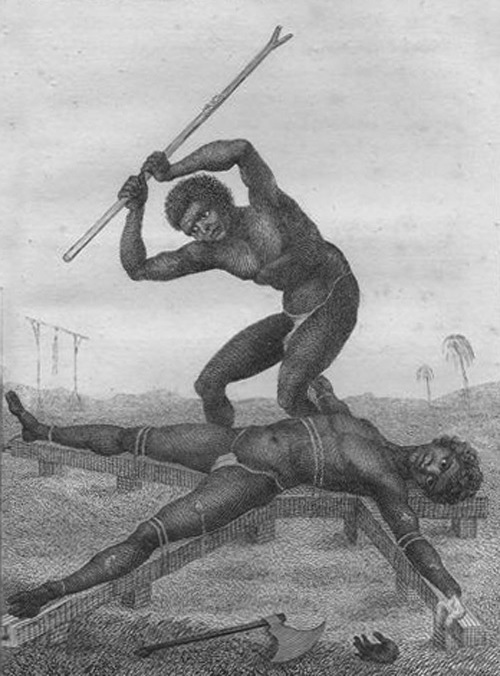
Figure 1. A runaway slave being executed on
the rack in 1776. Source: John Gabriel
Stedman, Narrative of a Five Years’ Expedition
against the Revolted Negroes of Surinam
(London: J. Johnson, 1796), vol. 2, facing
p. 296.
In this article I describe the varieties of criminal justice experienced by slaves in Suriname in the late seventeenth, eighteenth, and early nineteenth centuries, both those endured under their masters and the colonial government, and that which they created themselves on their plantations. I am addressing here certain gaps in the history of slavery in those centuries and also in the history of criminal law and prosecution. Studies of slavery in the Americas and the Caribbean, immensely rich as they have been, have described the disciplinary regimes on plantations and the harsh punishments meted out for revolt.5 The various law codes governing the status of slaves, their conduct, and the conduct of their owners toward them have been examined, Elsa Goveia’s West Indian Slave Laws of the 18th Century (1970) being the pioneering venture.6 But the whole cluster of activities considered as “crime” in regard to slavery, their detection, and their punishment—including the slaves’ own efforts at policing—have been little treated as such. Therefore, my intention in “Judges, Masters, Diviners” is to expand for Suriname the paths opened by Philip J. Schwarz in regard to slaves and the criminal law in Virginia; by Mindie Lazarus-Black in regard to slave laws, slave courts, and slave resistance in Antigua and elsewhere in the British Caribbean; and by Diana Paton in regard to the affirmation of masters’ power in the slave courts of Jamaica.7 As for the African past, innovative studies have unearthed continuities from or transformations of African beliefs and practices in the realms of slave healing, religion, and agriculture.8 I will go on here to suggest possible carry-overs or creolization in detecting, judging and punishing crime. Memory will play a role in my account: memories from the African societies from which slaves had been wrenched and memories of slave experience bequeathed to future generations.
Historians of European criminal law and prosecution have rarely made the crime and punishment of slaves in the colonies part of their story, even though most settlers and plantation owners and their law codes were European. Studies of the early modern Netherlands have taught us much about the experience of working people and the poor in the criminal courts there and about the reform of criminal law and public execution in the eighteenth and early nineteenth century, but have not extended themselves to comparison with the busy Dutch slave world.9 Cross-cultural reviews of colonial law tend to pick up the account in the nineteenth century where the “creating a docile, disciplined labor force” by imperial governments is discussed primarily in terms of “groups released from the control of masters, owners or chiefs.” With a longer historical perspective, Lauren Benton has incorporated polities with slave systems into her Law and Colonial Cultures, and they add much to her analysis of “legal pluralism.” 10 I hope “Judges, Masters, Diviners” will provide an example helpful for her approach and also suggest further ways to think about relations between the practice of criminal law in the slave colonies and in Europe during the early modern period.
Founded initially as an English settlement, Suriname had passed to the Dutch after the 1667 Treaty of Breda and was eventually owned by the chartered Society of Suriname, the Society’s shares being divided between the West India Company, the city of Amsterdam, and the well-born Sommelsdijck family. Under the sovereignty of the States-General, the “exalted” Directors of the Society oversaw the colony’s activities from the Netherlands, appointing the governor and sending him directives on the Dutch boats that plied the Atlantic during the sailing season.11
Around 1700, some 700 people of European origin were living in the town of Paramaribo and the plantations along the Suriname, Commewijne, and Cottica Rivers: Dutch, Portuguese Jews, Huguenots from France and the Netherlands and other places where they had taken refuge after the revocation of the Edict of Nantes, and English men and women who stayed on from the initial settlement. Some 8,500 people from Africa were producing sugar as slaves on the plantations, and already, approximately 1,000 more Africans had escaped to the rain forests to live as Maroons, sharing that space with indigenous Caribs, Arawaks and Wayanas.
By the 1780s, the European population had increased to approximately 2,000–3,000 persons, with Swedes, Germans, and Swiss added to the mix and with Portuguese and German Jews representing approximately a third of the settlers. To the sugar so arduously produced on the plantations had been added coffee, chocolate, cotton, and timber. The slave population raising these crops had multiplied sixfold to more than 50,000 people, and now some 5,000 Maroons were living in forest villages, divided into three tribes with their own kings and headmen.12
Although the word “criolo”—that is, born locally—was appearing more often next to a slave’s name on the plantation inventories after the middle of the eighteenth century, the majority of slaves were still born in Africa. From 1730 to 1780, more than 124,000 persons were transported to Suriname on the slave boats.13 Some had been brought up in the Central African kingdoms in Angola and the Kongo, where the Bantu Kikongo languages were spoken, others in the Akan and Asante kingdoms of the Gold Coast (present-day Ghana). Many more had come from the Slave Coast, that is, from the polities of the Gbe-speaking peoples along the Bight of Benin (in present-day Benin, Togo), such as the coastal kingdoms of Arda and Hueda and the powerful inland kingdom of Dahomey. Others yet were Yoruba-speakers from the ancient kingdom of Oyo and elsewhere west of the Niger River. Although some children were on board and survived the Middle Passage, most of the people crammed into the slave decks were in the preferred age range of fifteen to thirty-five.14
Let us first consider the notions of crime, its detection, and its punishment, which these Africans brought with them to Suriname—as well as we can know them from late seventeenth- and eighteenth-century sojourners and slavers among the farmers, merchants, fishermen, and warriors of the coastal kingdoms of west Africa. Our sources will be the memoirs and accounts of men such as Giovanni Antonio Cavazzi, Capuchin missionary to the kingdoms of Kongo and Angola in the mid-seventeenth century; Willem Bosman, factor for the Dutch West India Company on the Gold and Slave Coasts for fourteen years in the late seventeenth and early eighteenth centuries, and Ludewig Ferdinand Rømer, factor for the Danish West India and Guinea Company on the Gold Coast in the 1740s; William Snelgrave, who began as a young sailor on his father’s slaver in 1704 and then captained his own English slave boat on into the 1730s, and the surgeon John Atkins, who served on an English slave ship in the early 1720s; Olaudah Equiano, who lived as a boy among Igbo-speaking villagers in what is now southeastern Nigeria in the late 1740s and early 1750s until he was kidnapped and forced to endure the Middle Passage as a slave; and the Moravian Brother Christian Oldendorp, who in the late 1760s interviewed slaves on Saint Croix and other Danish islands about their African past.15
The actions named as “crimes” were murder, poisoning, witchcraft, theft, adultery (a serious crime in these polygynous societies), kidnapping, and major physical injury. “Trivial crimes” included beating someone, especially a young man beating another, and reviling another person, a troubling act in kingdoms where mutual deference and politeness were required in even a brief encounter. In some places lying could be punished as an offense.16
Along the whole range of the Guinea Coast and inland kingdoms, the gods were always drawn upon for divination and detection—not the high god who ruled more distantly over all, but one of the pantheon of responsive lesser gods, the voudun or orisha, who ruled realms of the sea or the air, were embodied in a special kind of tree or snake, or were more intimately connected to an ancestral spirit. The diviner’s rod or “fetish” as the Europeans called it, encapsulated the god’s presence, often a wooden rod filled with earth, oil, bones, feathers, hair, or other objects imbued with divine aura.
Seers/diviners were called in at the earliest stages of crime detection, including when the victim and others were unsure who had been the perpetrator. An Akan diviner could conjure the power of a god into some food or drink and leave it in place where it would entrap a thief whose identity was unknown. Death was usually assumed to be “unnatural,” that is, to have a source in some human or divine agency, and the dead person was asked to assist in uncovering it. To catch an unknown poisoner, as Olaudah Equiano remembered from his Igbo village, the diviner ordered the corpse to be carried toward the grave, whereupon instantly the bearers were compelled to run to a house in which the poisoner lived. In upper Guinea, among the Mende and Temne peoples of the Sierra Leone region, the bearers questioned the corpse about a possible witch or poisoner responsible for his or her death and were impelled toward a special bough if they hit upon a suspicious name.17 Meanwhile in the kingdom of Akim along the Gold Coast, an accuser alerted the village drummer to assemble the inhabitants and made his or her charge in public.18
Once accused of a crime—for example, theft, murder, adultery, poisoning, kidnapping—a person who wanted to establish his or her innocence had to go through a test with the diviner. The rite was sometimes witnessed by only the accusers and kin of the accused, other times it was enacted before many spectators. Three major ordeals were used. One combined oath-taking with imbibing a special drink or sometimes food. In an Akan polity along the Gold Coast, the accused took a drink before the diviner’s sacred rod, was smeared with supernaturally powerful ingredients, and then called on the god for death in various horrible ways if he or she was guilty. In the Kongo region, the nganga (the priest–diviner) prepared the drink of “purification” or “purging” from the red bark of an ordinarily poisonous tree; he then intoned before the gods and those present that an in nocent person would drink it and remain well.19 A second ordeal used heat to test the flesh of the accused. In Kongo, the diviner put a rock in a pot of boiling water, which the suspect had to remove; along the Sierra Leone River, the diviner might add a special bark to the boiling water to make it stronger; in a region of the Gold Coast, a cowrie shell had to be retrieved from a pot of boiling oil. If the person was guilty, the arm would become ulcerated.20 Yet a third ordeal put to test the suspect’s tongue. In the kingdom of Benin, the diviner passed a cock’s quill through the tongue of the accused; among the Akan on the Gold Coast, the diviner might use a sewing needle. Easy removal demonstrated innocence.21
In all these tests, we can see what leeway the diviner had in the choice of drink and ointment and their strength, the temperature of the water, and the size of the cock quill or needle and in the examination of the flesh or tongue afterward. Father Cavazzi reported that the nganga had met with both accused and accusers before the test ceremony and had negotiated gifts from each side. In the Sierra Leone region, the surgeon Atkins heard that the diviner made the “red water” used in the oath-test drink stronger or weaker depending upon what he had surmised about the guilt of the accused. Rømer, too, said that among the Akan, small gifts to the diviner affected the outcome for the suspect in cases such as theft, but in most instances the diviner must have been influenced by what he or she had learned about situation and the crime.22
 Figure 2. The hot water ordeal in Central Africa. Watercolor by Giovanni Antonio Cavazzi, “Missione evangelica al regno de Congo, 1665–1668”; courtesy Manoscritti Araldi, Collection of Michele Araldi, Modena, Italy. Reproduced in James H. Sweet, Recreating Africa. Culture, Kinship and Religion in the African-Portuguese World, 1441–1770 (Chapel Hill and London, University of North Carolina Press, 2003), 124.
A nice example of this is the choice of the river test along the Slave Coast in the kingdom of Hueda: the guilty person would sink, the innocent would swim. “They all swim well,” commented the Dutch observer Bosman, “I’ve never seen anyone convicted.”23 Clearly, the diviner knew when to allow this ordeal.
If found guilty, the person was given a sentence by the king and his council of great men, by a regional governor, or by a local headman and his advisors.24 The death penalty was possible in cases of murder and other crimes viewed as especially vicious, such as witchcraft, but it was by no means regularly pronounced. For adultery, death was the expected punishment for one of the many wives of a king or of a great governor and for her lover. A French ship-captain witnessed such an execution in the kingdom of Hueda in the 1720s: the man was burned to death, the woman was scalded with boiling water by other royal wives. But if adultery were committed by one of the wives of a rich merchant, a large payment to her husband could excuse her, whereas the wife of a simple farmer might be beaten and sent away and her lover’s property confiscated by the husband. Indeed, fines and compensatory payments were often the preferred penalty—very much higher if the victim had been a free person rather than a slave—and execution performed only in the absence of payment. Theft was almost always punished with payments: the restitution of the stolen goods and fines, adjusted to the ability of the person to pay. Thieves who could not pay were beaten. Kidnapping was sometimes repaid by the recompense of a male or female slave.25
And yet for all these crimes, one punishment was becoming more frequent: enslavement. In the past, exile had been a possible penalty for serious crime, which usually led to enslavement in Africa itself. But now the punishment involved the sale of the criminal to European slavers. In the somewhat exaggerated words of Francis Moore, a factor for the Royal African Company in Senegambia in the early 1730s. “Since this Slave-Trade has been us’d, all Punishments are chang’d into Slavery; there being an Advantage in such Condemnations, they strain very hard in order to get the Benefit of selling the Criminal. Not only Murder, Theft and Adultery are punish’d by selling the Criminal for a Slave, but every trifling Crime. . .”26
In the outer reaches of the kingdom of Benin decades later, Equiano’s Igbo villagers were selling to African traders not only their war captives, but also “such among us as had been convicted of kidnapping or adultery and some other crimes, which we esteemed heinous.”27 Although the large majority of slaves transported across the Atlantic continued to be captives of war or victims of kidnapping, persons condemned for a crime were among them, especially when they could not pay fines or make compensation.28
There were two memories the Africans would not have carried across the ocean. Few of them would have seen or heard of incarceration as punishment for crime among their own peoples. In their forts along the Guinea Coast, the Portuguese, Dutch, and other European traders might include a small improvised prison, but this was for offenders among their ranks or, on occasion, for a trouble-making African in their own circle, and was quite apart from the spaces reserved for captive slaves. The great rulers of the Songhay Empire were said to have used some form of confinement for political offenders in the late fifteenth and sixteenth century on an island near their palace at Gao. But, on the whole among the African polities, structures of incarceration for criminals were not built until the nineteenth century. Persons accused of crimes were kept from running away by their families in their compounds. Enclosurewas conceived rather as a setting for ritual exclusion, as when menstruating women had to live in a special hut.29
Furthermore, although the execution of persons condemned to death in kingdoms along the Guinea Coast and inland involved painful and prolonged torture and humiliation of the body (not to mention the degrading treatment of the corpses of war captives), branding and mutilation were rarely used as penalties for living persons. One of the few examples was emasculation, said to have been practiced on the royal eunuchs of the kingdom of Oyo because they had previously been engaged in incest, bestiality, or adultery with one of the king’s wives. Scarification of the face and body and piercing of the hair and lips were not “mutilation,” but rather ancient and honorable marks of identity, beauty, and status.30
The Africans purchased by European traders were kept in barracoons while awaiting the boats that would take them to the Americas; at Elmina Castle, the prisons were damp ground-floor rooms similar to those used for storing goods. “We pay two pence a day,” said a factor for the Dutch West India Company, “which serves to subsist them like our Criminals on Bread and Water.”31
The slave ship itself was a “portable prison,” in the phrase of one of its eighteenth-century defenders, a “floating dungeon” in the words of a critic, to which the slaves arrived in chains or ropes and branded with the name of the Company or the purchaser that owned them.32 The ship operated under instructions from the Company or other owner, who warned that precautions were required lest the crew be attacked by their African cargo, but who also insisted that the slave men and women “not be defiled or mistreated by any of the officers and crew members” (to quote from those given to a Zeeland ship, De Nieuwe Hoop).33 How these instructions were fulfilled depended upon the captain, his surgeons, and his sailors, the latter themselves often ill-paid and harshly disciplined. William Snelgrave, captain of many an English slave voyage, instructed his crews that “Negroes be kindly used,” as this was the best way to avoid revolts. Once the boat was well away from the coast, he allowed irons to be removed from the men, a practice reserved on many boats only for women and children. But any “disturbance” the “kindly” captain met with “severe” flogging and other punishment, and any attempt at mutiny was met with death.34
For the Africans, as is well known, the discipline and punishment of the “portable prison” were devastating, leading to death and suicide—in addition to the pain and humiliation of rape and the mortality caused by ill health and disease. But in the holds, other activities were taking place that created bonds and perhaps even a form of “justice” among the Africans. Although captains had sometimes acquired their human cargo from different ports or had arranged to have different language groups represented among their hundreds of slaves so as to minimize the danger of revolt, nonetheless there were always groups who shared a language (some were from the same family or village) or could understand related languages. A provisional pidgin was surely created, and some Africans from coastal regions knew the Portuguese pidgin that was current along the Guinea Coast. A sort of kinship was established among those chained or sleeping or working on the decks near each other: in Suriname survivors of the voyage recalled the tie afterward by the Sranan term sippi, shipmate.35
Leaders emerged among the captives, both on their own and created from the officers’ deck. The captains themselves appointed “quartermasters” or “bombas,” as they were called on the Danish ships: slaves who, they believed, would be cooperative and who, in return for extra provisions, would help organize the eating arrangements and oversee the crews washing the decks. Some of these leading men and women may have also been diviners or healers in their African communities. Ludewig Rømer actually recommended to Danish captains that women healers take over from the ship’s surgeons in the face of African illnesses such as worms, and that they be given oils and spices with which to prepare their remedies, while an English captain reported on the presence of “religious Priests” on his ships in the 1760s to 1780s and their role in urging insurrection. But all these leaders could have drawn on techniques that they knew, or improvised new ones to arbitrate and quiet the quarrels that broke out among men closely shackled or from tribes with grievances against each other.36
And one of the wives of the great King Agaja of Dahomey, sent off to slavery for having aggrieved him, found her place on the women’s deck of Captain Snelgrave’s galley Katherine in 1727. The Captain saw her as an agent of pacification of the “noise and clamor” of “the female captives who usually give us great trouble,” but I think we can perceive her as providing leadership and arbitration that was of service to the women as well.37 In such ways did the Middle Passage help survivors get started toward establishing their own justice one day on shore. ♦
Once docked in Paramaribo, cleaned and oiled for the auction block, purchased and branded again by a new owner, the African was rowed up one of the rivers to the plantation at which he or she would henceforth work and live. The plantation will be the site for my next discussion of “criminal justice” even though the people deciding on offenses and punishing offenders were authorized by property ownership (“domestic jurisdiction,” in the Roman law) rather than as agents of a “state.” Indeed, the courts of Suriname themselves had the mixed status of so many colonial governing institutions of the day: they were the creation of a chartered Society in the Netherlands, which owned the colony through purchase, while acting under the aegis of the States-General. (Already we can see that Suriname is a fitting illustration of Lauren Benton’s “legal pluralism.”)
In contrast with Louis XIV and his Code Noir, the States-General issued no edict governing the features of slave conduct, treatment, and religion in Dutch colonies. Rather the Suriname governor and the Court of Policy and Criminal Justice issued ordinances from time to time, spelling out the permissible limits for the punishment of slaves on the plantation. In their general form, they resemble the rulings on the master’s punitive power over slaves found in other Caribbean societies.38 Early in the colony’s existence, in the 1680s, the governor had prohibited owners from imposing death or mutilation on their slaves. The next major edict on the matter was more than seventy years later in 1759. No manager or white officer was to use rods on a slave, but only the customary local whips, with which they could give between twenty-five and fifty or at most eighty moderate strokes and only on the lower limbs. They were to order their black drivers to behave accordingly. Any heavier punishment could be given only at the order of the owner, who would place limits according to his or her own scruples. No slave should be threatened with being shot except in case of absolute self-defense. The penalty for violation was 300 Dutch guilders. A 1784 ordinance repeated these limitations and the penalty for violation, although it now forbade whipping a slave who had been hanged from his or her wrists from a tree.39
Fines were in fact imposed only when the killing of a slave was discovered and prosecuted (as we will see more fully), although excessive cruelty on a plantation could tarnish the reputation of an owner or manager. Still, when the governor proposed in 1762 that something more than a fine be instituted for beating a slave to death, the councilors on the Court of Policy and Criminal Justice, all of them plantation owners, demurred: “Athough no owner should ever arrogate the power over life and death over his slaves, it is nonetheless of the utmost importance that slaves should continue to believe that their masters possess that power. There would be no keeping them under control if they were aware that their masters could receive corporal punishment or be executed for beating a slave to death.”40 The law remained as it was.
Punitive practice varied on the plantations. Suriname was known throughout the Caribbean for the extravagant cruelty of plantation punishment. Observers’ accounts from Suriname in the late seventeenth through the eighteenth century talk of extended beatings with whips chosen for their sting, after which the open wounds were rubbed with lime juice and pepper, and of the “Spaansche Bok,” (the Spanish buck, as it was called), when the slave was whipped first on one side then the other, with hands tied around the knees and a stick holding him or her to the ground. The latter was declared illegal in Suriname only in 1828.41
Especially telling is a play written in 1760 or thereabouts, in Sranan and Dutch, by Pieter van Dyk, long-time manager of a coffee plantation on the Commewijne River. The play, The Life and Business of a Suriname Plantation Manager, was included in a book of instruction on the Creole language of Suriname, as part of Van Dyk’s effort to convince “owners and managers . . . to make [themselves] respected and loved, without committing the inhuman cruelties that sometimes become part of the work.” Van Dyk used the topos of the drunken plantation manager acting in the absence of the owner: the manager orders his black driver to beat a woman slave till her skin comes off her back for being late bringing his coffee and to give the Spanish buck to a male slave asking to get off work because of being sick and to another for picking unripe coffee beans. The manager ends up shooting and killing his hunter slave because he had failed to bring back game two days running and then had protested against being punished. Van Dyk’s cruel manager, a composite of actual cases, illustrates the conduct targeted by the ordinance of 1759.42
John Gabriel Stedman’s descriptions of what he saw during his Suriname years (1773–1777) included punishments ordered by owners and managers both. His book, written after his return to Europe and published only in 1796, was in part a defense of slavery as beneficent for Africans, as long as it was humanely conducted, and in part a ferocious attack on the cruel punishment of slaves. (Indeed, his vivid pictures of that punishment, some of them engraved for his Narrative by William Blake, were intended to arouse indignation against the perpetrators and empathy for the slaves.)43 It was not the simple fact of beating that bothered him: in the Netherlands, where he had grown up, he was accustomed to seeing servants and workers beaten by masters and mistresses, and he was glad that the “unmerciful whipping” of his own father had cured him of a boyish habit of petty stealing.44 While in Suriname, he beat his slaves, for example, for slipping their boat away from his boat on the Commewijne River, and he beat the soldiers under his command for theft.45
What he deplored for the plantation slaves was the excess in punishments and their inappropriate use. (Likewise he had earlier opposed the “despotick cruelty” of officers in his military unit back in the Netherlands, who executed or whipped soldiers through the streets for small infractions.46) One of his first sights in Suriname was a woman who had been given 200 lashes and forced to bear a heavy chain attached to her leg for months as punishment for having simply failed to meet her work quota. Visiting plantation Sporksgift, Stedman learned that his friend, the Scottish owner John MacNeil, had ordered the hamstringing of a handsome young slave because he had been running away from his work. On L’Espérance plantation, where Stedman’s military post was established, the manager departed after flogging a slave to death for having let another slave slip out of his hands to the woods. “His humane successor,” Stedman commented sarcastically, “began his reign by one morning flogging all the slaves of the estate, male and female, old and young . . . for having [over] slept their time about fifteen minutes.” Stedman then visited a neighboring plantation on the Commewijne only to come upon a young unclothed woman tied by her wrists to the branch of a tree, her back bleeding from 200 lashes given by the black drivers at the command of the manager– the punishment prohibited a decade later in the ordinance of 1784. “Her only Crime,” Stedman discovered, “had consisted in her firmly refusing to submit to the loathsome embraces of her despisable executioner, which his jealousy . . . construed to disobedience.”47
Of course, there were plantations where such practices were not found. Stedman singled out Mrs. Godefroy, the elderly widow with whom he often dined, as a model of the good proprietor. Born of English parents in Suriname in 1713, Elizabeth Danforth had outlived two husbands, who had left her sugar and coffee plantations with hundreds of slaves. Victor-Pierre Malouet, a French adminstrator of the nearby colony of Cayenne, visited her sugar plantation in 1777 and confirmed Stedman’s judgment: “the most serious punishment [for the slaves] is being prohibited from seeing their mistress and from being on her path when she passes by. Any one of them would prefer a hundred strokes of the whip to this excommunication.” Although it seems unlikely that Mrs. Godefroy’s slaves would describe their feelings in Malouet’s words, it may well be that Mrs. Godefroy had instituted on her plantations a policy of very limited use of whipping.48

Figure 3. The whipping of a slave with her
wrists tied to a tree in 1774. Source: Stedman,
Narrative, vol. 1, facing p. 326, engraved by
William Blake after a drawing by Stedman.
Mrs. Godefroy’s plantations were not shaken by slave up risings over the decades, and according to Malouet, her slaves actually kept Maroon incursions at bay. Such stability is one of the possible signs of a plantation conducted in a fashion at least tolerable to its workers. An example is Fauquemberg sugar plantation on the Commewijne during the almost twenty years (1750–1768) it was managed by a recently arrived Dutchman named Anthony Tielenius Kruythoff. The plantation had been founded in the early eighteenth century by a Dutch settler family, but by 1753 its owners were living in Amsterdam and Kruythoff was administering and running the estate himself. During his tenure, the slaves, roughly 190 in number, did not organize uprisings or escapes to the Maroons, nor did the Maroons attack the plantation. The birth rate was relatively high among the slave families, and a good number of the children lived to be young adults.49
Kruythoff was an officer in the Suriname militia and, with a troop of armed men, was called upon to quell slave uprisings along the Commewijne and to track escaped slaves in the rain forests. In the midst of slave rebellions in 1759, he blamed such resistance on masters and managers who overworked and underfed their slaves, threatening to shoot or behead them if they did not complete impossible tasks. He himself kept a close eye on the white driver at Fauquemberg and rewarded his slaves on occasion with gifts.50 I suggest that the tolerability of the regime at Fauquemberg and other such plantations goes beyond Kruythoff’s formulation: it emerged not just from the humane heart or practical concern for property of masters and managers, but from the systems of governance and justice organized among the slaves themselves. We have glimpses of such systems in reports from Jamaica and Antigua; here I would like to sketch out a fuller picture of the possible structures and practices of slave-initiated justice in Suriname.51
The African newcomers to a Suriname plantation took weeks and months to find their way among the slaves. Given a new name for use at least among the whites, assigned a place to live in the palm-leaf-covered ningre hosso (slave houses) and a work slot in the fields, buildings, waters, or houses of the plantation, the African gradually learned the local Creole tongue—Neger Engelsche or Sranan on the Christian plantations, Dju-tongo (or Saramaccan as it came to be called) on the Jewish ones. The discipline and punishment practices found on the Suriname plantations would have contrasted in some ways with what Africans would have observed in the multiple slave systems back home. On the one hand, the African owner could dispose of the life of his slaves without responsibility, at least in non-Islamic lands: for example, the great kings of Dahomey in the eighteenth century were being buried with hundreds of their slaves, while in the nearby kingdom of Benin, a person sentenced to death for a murder might offer a slave in his stead.52 On the other hand, even in those African societies in which slavery did not slide into a kin relation and which were “hierarchical [and] market oriented,” the exploitation of slave labor was not accompanied by so punitive a regime. I follow Martin Klein here, who found the harshest treatment of African slaves was at the moment of their capture and the early weeks of their “seasoning,” where they might be forced to sleep in chains. “[Even] in the most market oriented African systems,” says Klein, “slaves worked for their masters about half as much as in the U.S. South.”53
In Suriname, the figures of authority and prestige within the slave community prepared newcomers for the shock of the local regime.54 Such men and women were central to the institutions and procedures on the plantation—some carried over from Africa, others improvised or invented in Suriname—which helped slaves survive and sustain an independent cultural life, keeping peace among them and acting as buffers against or setting limits to the arbitrary power of the owner and the owner’s agents. These slave leaders gained their authority partly through their own doing, partly through the decision of the owner or manager.
Let us begin with the black driver, called negerofficier or zwarte officier (“black officer”) in Dutch and ningre bassia, or just bassia in Sranan. (Interestingly enough, the word bomba was sometimes used in Suriname for the black driver, thus carrying over a title familiar from the slave ship.)55 Up to now in my account, we have seen the black driver in Suriname with a whip in his hand, punishing the slaves at the command of his white superiors. But he was a complex figure, who had the ear of his superiors and, if he were to have any success at all, was trusted by his fellow slaves. A plantation with many slaves—say, 125 and higher— usually had two or even three bassias, whereas those with fewer slaves had only one. Appointed first as young men, the bassias either were creoles, that is, born in Suriname, or had arrived at the plantation at an early age, and they were virtually always the sons of black parents rather than of a black slave woman and a white man. Sometimes they were field workers or hunters, other times plantation craftsmen. At Fauquemberg, the field worker Cupido and the young creole Quimana appear as bassias in an inventory of 1753; a few years later, Quamina is the senior bassia together with the young fieldworker Bienpayé, the two of them holding those posts through 1768.56
A bassia had to combine the political skills of an African chief, learned from his father and/or the many other newcomers from Africa on the plantation, with creole savvy about what was necessary to tell their white bosses, to whom they spoke in Neger Engelsche or Dju-tongo. For a bassia to be acceptable to the slaves, it was said, he must never raise his whip to punish on his own behalf or ever be believed to be doing so. In Van Dyk’s play, the black driver beats only at the manager’s command, while begging his drunken superior to hold back from such harm: “Have mercy, master. I gave that woman a hundred lashes already.” He tries to help a slave wife free herself from the manager’s sexual demands, although he is unsuccessful in his efforts.57
The historical record presents bassias more forceful than Van Dyk’s respectful slave. As one white driver put it to his fellow officers, “Never trust a bassia, for his solidarity lies not with the plantation staff, but with the slaves.” A final weapon in the bassia’s hands was contact with the Maroons. In some instances, he was a major figure in resistance to the Maroons: this occurred when the slaves did not want any of their number, especially their women, to be kidnapped. In other instances, Maroon attacks on Suriname plantations were at the invitation of the bassias; and some of the mass escapes to the Maroons had bassias at their head.58 The bassia’s status is suggested in a painting made in 1707 or thereabouts by Dirk Valkenburg, an Amsterdam artist who was then bookkeeper and scribe for the sugar plantation Palmeniribo on the Suriname River. A religious dance is being performed in front of the slave houses, where some of the participants are possessed by the gods. The bassia stands tall and aloof, a European hat on his head and a small knife tucked into the strip of cloth around his hips.59 Of course, some bassias were seriously at odds with their co-slaves, and on occasion slaves accused the bassia of trying to poison one or more of their number.60
Putting pressure on the bassias from among the ranks of the slaves was an impressive group of skilled men and women, some born in Suriname, others youthful arrivals from Africa. The men were carpenters, coopers, bricklayers, and other plantation craftsmen, whose names appear directly below the black officers’ on the inventories. Such were the men the master or manager armed with rifles to accompany him and his white servants in search of runaways; this had the side-result of allowing the elite slaves to learn the location of Maroon trails. The women were cooks, knitters, and seamstresses, many of them also serving at the great house, their names appearing at the top of the lists of female slaves. (Amiba, the lead woman on one of the Jewish plantations, is actually called “officieresse”).

Figure 4. The bassia (black driver) surveys a slave dance at Palmeniribo plantation
Dirk Valkenburg, Slave Play in Suriname (ca. 1706–1707); National Gallery of
Denmark, Copenhagen, KMS376. © SMK Photo.
Some of these women had memories of African families where their mothers were co-wives; although there were surely quarrels among them, they helped sustain order and amity among the slave women, the field maids, and others. Sometimes, too, they had their own channels to the white bosses by which to seek favors or protection for their families and for other slave women.61
The third group of influential figures in the slave community were the religious specialists and healers, most born in Africa in the early generations, some born in Suriname. Every plantation had its healer or healers, whose knowledge of local plant lore, coupled with incantation, was more useful than the surgical implements kept in the plantation medical cabinet. Many plantations had a priest–diviner, known as a Lukuman in Sranan, or a priestess–diviner. Given the honorific name of Granman and Gran Mama, they called upon the gods and served humans in the ways we have seen in Africa.62
A few such sacred leaders were reputed throughout the colony. Granman Quassy was born in West Africa in the 1690s and spent his young manhood on a sugar plantation in Suriname. By the 1740s he was celebrated as healer, diviner, seer, and creator of obia, packets or amulets in which the various feathers, hair, shells, and other objects carried with them the presence and power of African gods., He was also the discoverer of a special bark that would bring down fever; transmitted to Linnaeus by a Swedish settler in Suriname, it was named Lignum Quassiae. Quassy toured to different plantations, whereas the priestess–diviner Gran Mama Dafina was consulted by her supplicants in her “secret chamber,” with its clay figures of persons and animals, its huge pot of water, and its live snakes—equipment similar to that found among the diviners of the Gbe-speaking peoples of the Slave Coast kingdoms.63

Figure 5. A woman diviner at work in Suriname, ca. 1830. Source: Pierre Jacques Benoit, Voyage a Surinam, 1839. fig. 36. Collectie Buku – Bibliotheca Surinamica
What kind of procedures of justice did slave leaders try to put in place on their plantations? Resistance to the master’s punitive regime could range from controlling the flow of information about slaves to the whites, on up to the threat or actuality of revolt. Discussion meetings were held to make plans. In Van Dyk’s play, the bassia meets together with a leading female house slave and several men; they call each other “master slaves,” “mastra negeri,” using the forms of customary politeness. They delegate one of the men to sneak away and inform the owner in Paramaribo about the brutality of the manager.64
We can eavesdrop on an actual meeting in 1707 at the sugar plantation of Palmeniribo with its 148 slaves, whose bassia we have just seen in Valkenburg’s painting. Mingo, a slave born in Kongo, had been preparing to visit his wife on another plantation, although the owner had forbidden him to do so. Whereupon the owner smashed Mingo’s canoe. Mingo then met with his brother Waly and several other blacks, who urged him to go the owner and demand compensation: “Mingo, you’re no man” [if you don’t do it], Waly said to him in Sranan, “Mingo jou no man.” “I am a man,” said Mingo. “You go then.” As it turned out Mingo’s mission coincided with other grievances on Palmeniribo, especially the owner’s revoking the previous owner’s grant of Saturdays free from work. Mingo led a delegation shouting “jou no meester voor mi.” An uprising ensued; some slaves escaped to the Maroons, others were prosecuted, but the slaves of Palmeniribo got their free Saturdays back.65
More significant was the justice established by the plantation slaves to arbitrate and provide punishment or compensation for offenses among themselves—offenses which, if they got to the ears of the manager or owner, would be punished by these whites; and offenses, such as poisoning and theft, which when they were brought to the notice of the Court of Policy and Crime, were prosecuted there, as will be described. As I put together what evidence we have, on those plantations that had a slave community with some coherence and effective leadership, the community preferred to deal first with its own offenders before deciding whether or not to yield them up to the owners or to the colonial court.
What were these offenses? Bad-mouthing another slave was surely one of them. The courteous language of address noted in the African kingdoms was carried over into the mixed Creole of Sranan and Saramacca. Whereas a black making a request to a white would say “Many thanks, Master, would you please give me that?” to another slave, he or she would say, “Thank you, thank you my dear beloved, I kiss your feet, do me that favor!” (“ Tangitangi, mi hatti-lobbi, mi boosi ju futu, du mi da plessiri”). The choice insult among slave men in Suriname was “you mama pima” (“your mother’s cunt”) and it aroused great anger.66 Early on, this kind of troublemaking had a Creole vocabulary to describe it, drawn both from an English and an African lexicography: lei, a takki lei, leiman (“lie,” “he’s talking lies,” “a liar”); kossi (“to scold,” “to curse”); gongossa, gongossaman (“slander,” “a slanderer”); kongro, kongroman (“malice,” “falsehood,” “a malicious person”).67
Another offense was theft, especially hateful among people who had so little that they could call their own and who put a high value on sharing. “The poorest Negro [in Suriname],” wrote Stedman, “having but an egg scorns to eat it alone, but were twelve others present and everyone a stranger, he would cut or break it in as many shares.” A stingy person was a “mombi”; a thief, a “furfurman,” was much worse. To protect one’s vegetable garden or one’s house from an intruder, Suriname slaves placed a kandu in front of it, an object made of rocks or sugar cane or some other material endowed with the threatening powers of a certain god: “All the fruits in my garden are being stolen; I’m going to put up a kandu” (“dem furfur tule janjam na mi plantasi, mi tann go putta kandu”).68 But the kandu’s power could not extend to everything, and thefts had to be dealt with.
Unacceptable sexual relations were yet another set of offenses. In regard to the sexual assaults and initiatives of the white male proprietor, manager, or driver, there was a limit to how much protection slave justice could provide, and slave men and women may not have always agreed on who should be protected first. In some actual cases and in Van Dyk’s play, the white man’s forcing sex on a married woman was viewed as the more serious violence, harming the wife and humiliating her husband. So Stedman told the story of a slave who harbored hopes for revenge for more than twenty years against a manager who had raped his mother and flogged his father when he came to her aid.69 Nonetheless, some slave mothers may have felt that protecting their unwed daughters was at least as important, unless they saw the sexual intimacy leading to favour for the family.
As for intimate relations among the slaves themselves, the African assessment may have persisted, that is, adultery strongly condemned, but “fornication”—to use the term of their European masters—tolerated as long as it occurred with persons approved by parents. Stedman (whose informants included his slave concubine and her mother) described the “passion of love” among slave husbands in Suriname as expressed in “the jealousy [they feel toward] their wives, to whom their resentment for incontinence is absolutely implacable.” But the sexual experience of the women before marriage, claimed Stedman, “gives the [slave husbands] no uneasiness.”70
The marital economy on the Suriname plantations differed from that remembered or recounted from African societies, where polygyny had been widespread and even a small farmer might take a second wife. On the plantations, male and female slaves existed in roughly the same number, with men often more numerous than women through the eighteenth century. In addition, the difference in power and prestige between the elite male slaves and the field hands was not so great as to make it easy for the former to possess more than one wife at a time. Polygyny was practiced among a minority of the Saramacca Maroons—the word “co-wife,” gambossa, is used among them by the late eighteenth century—and there were undoubtedly some examples on the plantations. But on the whole Stedman’s picture of the “happy” Suriname slave—marrying, divorcing, and remarrying by their own rules and rites—is the more characteristic one: “he never lives with a wife he does not love, exchanging her for another the moment he or she is tired.” Stedman went on to say that such serial marriage was less common among the Suriname slaves than it was in “a European state of matrimony.” In these circumstances, adultery could cause real trouble in the clustered households of the slaves’ quarters.71
Finally, there was physical harm, especially through poisoning, used to make someone ill or even to kill him or her. The desire to poison was fuelled by various grievances: revenge against someone who had stolen the affection of a lover or a husband or wife; envy of another’s status in the slave community; hostility against new arrivals, in the latter instance sometimes carried over from African political loyalties and conflicts. In 1757 a revolt began on a plantation called “La Paix” at the headwaters of the Commewijne because the owner wanted to transfer the slaves to another of his plantations downstream: the slaves feared they would be killed by poison and sorcery, as they claimed had happened to the last group of transferees. Indeed, poisoning was viewed with horror, for it was thought to be coupled with witchcraft: as healers drew on the gods to add force to their remedies, so poisoners drew on dangerous forces.
Some plantations had a wissiman, a sinister specialist in the harmful use of poisonous plants, the incantations that must accompany them, and the antidotes to the poison when called upon. A wissiman was always in danger of being denounced along with the person who sought his or her powers.72
When these offenses occurred or accusations were made about them, the slaves’ justice could go into action. Here we must piece together a scenario from what evidence we have from Suriname. A diviner—a lukuman—would start off to help find the guilty party, if no accusation had been made. As in African polities, the corpse being borne in its coffin was asked by the diviner for information about the source of his or her death: had he or she offended the gods? Had he or she been poisoned? If there were a murder behind the death, the coffin-bearers would be precipitated toward the evildoer. The Moravian Brother describing this practice in Suriname remarked that the “Obia man,” that is, priest–diviner, would have “already gained exact knowledge of who is guilty through his own research” and would have informed the coffin-carriers in advance.73 Granman Quassy, when called to a plantation to find a thief, divined with his gaze and with bird feathers. After inquiring about relations among the slaves, Quassy had each person walk by him while he turned the bundle of feathers in a glass; then he looked at each slave steadily in the face. “His pursuit suddenly made the heart visible,” according to one report.74
Once the accusation had been made and aired among the slaves, two ordeals to establish guilt or innocence are reported from Suriname, both variations on those used in the Guinea Coast kingdoms. In the kangra, the diviner smeared the person’s tongue with a paste from special herbs or leaves, then passed a chicken feather through it. If the feather went through easily he or she was innocent, if it did not, he or she was guilty.75 The oath-drink test was described among the Saramacca Maroons in cases of a person accused of murder or poisoning, and in all likelihood a version of it was used for some offenses on the plantations.76 Plunging the accused’s arm into hot or boiling water to retrieve a rock or some other object, which was found as an ordeal from the Gold Coast to Angola, was used to sort the guilty from the innocent among slaves in neighboring Brazil. Gran Mama Dafina of Suriname had a large pot of water in her sanctuary, and may well have used it for ordeals along with other kinds of divination.77 And then there was the river test used to establish innocence in the Slave Coast and Kongo: it was easy to arrange in Suriname and many of the slaves were good swimmers. In all these instances, a lukuman or diviner– priest on the plantation could seek information and listen to the gossip in the slave houses and adjust the scenario of the ordeal and the choice of ordeal accordingly.
Judgments in the wake of the ordeals would then be made, so I suggest,by the bassia in consultation with other important male and female slaves. It would resemble the slave tribunals described by a planter in Jamaica. “On many of the estates the headmen erect themselves into a sort of bench of Justice, which sits and decides privately, and without the knowledge of the whites, on all disputes and complaints of their fellow slaves.”78
Such a tribunal would not model itself on the Suriname Court Policy and Criminal Justice. Rather it would be a reworking of the council of the Guinea Coast kings with their great men or the meetings of village headmen and elders, but on the plantation with the addition of leading women—the cook, the senior house servants, the midwife—to the deliberations, not routinely found in African polities.79 In cases of insult and slander, theft, and adultery, the penalty would not ordinarily have been beating, the routine punishment of the master for such cases among slaves (“flogged Maria for cuckolding Solon . . . and stirring up Quarrels,” a Jamaica planter recorded in his diary in 1773). Rather the penalty would be compensation to the aggrieved, the African practice adjusted for Suriname; say, produce from one’s garden or a special garment or a bracelet or tobacco presented in a ceremony of abasement and accompanied by some sacrifice to the gods, or work services performed for the aggrieved party. The bassia’s whip must have sometimes been used as a threat to enforce the penalty, and actual beatings surely occurred in more serious cases. But it would have been difficult to carry out a major scourging unauthorized by the manager or master and keep it secret from them.
Poisoning and the associated sorcery were much more serious, feared all the more as one did not know whom the wissiman would strike next. In Africa, poisoning/witchcraft was punished by a cruel death or by being sold into slavery. In the rainforests of Suriname, the Saramacca Maroons, freely organizing their own justice, mutilated the sorcerer/poisoner’s body and then burned it. In Paramaribo the Court of Policy and Criminal Justice punished poisoning by death. On the plantations, then, the slave justice yielded the uncontrollable poisoner up to the authorities.80
The Court of Policy and Criminal Justice was composed of thirteen Protestant men, with the governor at its head; serving as its public prosecutor was an officer known as the Fiscaal, who was supposed to be educated in the law. The councilors, chosen for life by the governor from a slate elected by the settlers, were all prominent plantation owners, and only a small number of them had had any formal training in the law. Whereas Jan Jacob Mauricius, governor from 1742 to 1751, had studied both law and letters at Leiden, some of his predecessors and successors in that post and most of the councilors had never listened to law lectures either at that august faculty or at the university at Utrecht.81
Similarly to the courts in the Netherlands, the Suriname Court dealt with both matters of public order and criminal cases, and, as in the Netherlands, the sixteenth-century ordinances of Emperors Charles V and Philip II were the overall guide for criminal procedure. The Dutch republic retained these ordinances until the reforms of 1795–1809, that is, long after it had freed itself from imperial rule. In the Netherlands these codes, together with subsequent edicts and local regulations, allowed for harsher treatment of the poor than of the propertied in criminal procedure and punishment— especially of the vagrant poor. In the colonies such as Suriname, these codes, supplemented by the Roman law on slavery and subsequent local ordinances, allowed for an even greater gap between the treatment of slave and free, black and white in the course of criminal trial and punishment. Simply being a slave aggravated whatever offense one had committed. In the words of a jurist in Suriname’s neighboring colony Demerara: “[slaves] are more severely punished for the same offense than free men; their very condition, according to the criminalists, [is] supposed to communicate an aggravating quality to the offense.”82
The Court issued ordinances restricting the behavior of slaves in situations beyond the plantation.
1741: in Paramaribo, slaves must stand out of the way of white people on the streets; they must not carry canes or cudgels when they walk. They must not gamble or play dice among themselves and certainly not with white people; penalty for the slave players: being whipped along the streets of Paramaribo; for the white players: a fine. 1769: no slave, whether black or mulatto, is to go about wearing shoes and stockings or an extra large hat; penalty for repeated violation: the Spanish buck. 1750 and frequently afterward: slaves are forbidden to sing and dance publicly in the streets of Paramaribo or at funerals: penalty, the Spanish buck.
Interestingly enough, Governor Jean Nepveu, who signed the 1777 reissue of this ordinance, wrote in another place, “In Paramaribo, (the baljaaren [dancing] of slaves) was frequently prohibited altogether, and those caught at it were liable to severe punishment. But experience has taught that this has no effect, and even if it were punishable with death, this would probably only increase their desire for it. . .”83
Such infractions as these did not generate full trials before the Court, but were evidently dealt with and punished by prosecutor and the governor’s officers. The slave cases most frequently brought before the Court of Policy and Criminal Justice for prosecution were those to which the death penalty or bodily mutilation, such as an amputated leg or hamstringing, was attached. Records of 146 trials in which slaves were sentenced between 1730 and 1750 have been retrieved from the Suriname archives and studied by a scholar descended from an old Suriname planter family. These trials do not cover all the criminal charges against slaves in those years. The executioner’s list adds additional names, and other slaves could not be brought to trial because, as the governor’s journal indicated with regret, they had escaped to the rain forest and had not been recaptured. Still this collection of trials suggests what kinds of cases found their way from the plantations for judgment by the court. The largest single category, 36%, involved poisoning; 7% involved the murder of white people by other means; 6% involved the murder of other slaves; and 7% involved plotting or conspiring to murder. Another 12% involved theft, burglary or receiving stolen goods, probably in all cases the property of white people, and 11% involved slaves who had run away and been caught. Some 8% involved some form of rough treatment, insulting of, or impudence toward whites. Yet another 5% concerned plantation mischief, such as falsely accusing someone of poisoning or assisting Maroons during a plantation raid. In 8% of the cases, the remaining records did not include the offense. Of the slaves’ sentences, 82% (114 people) were condemned to death, at least a dozen of them by hanging from the gallows with a hook in their ribs.84
The slaves’ trials were conducted by the “extraordinary” procedure, as it was called in the Netherlands and in other Roman law countries. In the words once again of our jurist from nearby Demerara: “Extraordinary process is a summary mode of proceeding to avoid the delay of an ordinary criminal suit or process, which latter is conducted in the manner of a civil suit. It can only take place on the investigation of crimes which involve corporal punishment.”85
This procedure was rapid and without counsel, and made it simpler to order torture to obtain the desired confession when the legal proofs allowed it during the trial, and torture before execution to extract the names of accomplices. In Suriname the accused slave was taken to the prison at Fort Zeelandia and interrogated through a Sranan or Saramaccan translator by the prosecutor and two members of the Court; other witnesses to or parties affected by the crime were questioned as well. Lacking detailed information on the trials, we do not know whether the Court actually followed the rules of Dutch–Roman law that required a certain amount of incriminating testimony or evidence before torturing a slave in hope of confession, “the queen of proofs” and a necessary prelude to a sentence of execution. In Amsterdam, the courts did so, and presumably the Suriname Court lived up to such rules for white people accused of a serious crime. Whatever the case, the accused slave was more likely to be stretched on the rack or otherwise tortured in Suriname than an accused working man or vagabond in eighteenth-century Amsterdam.86

Figure 6. Hanging of a slave by a hook in his
ribs in 1773. Source: Stedman, Narrative,
vol. 1, facing p. 110, engraved by William
Blake after a drawing by Stedman.
How might the slave have responded to torture? The body in pain was part of most African ordeals and all European torture. But in the African ordeal, after the accused had sworn in an oath not to have done a certain act, the body itself spoke of guilt and innocence through festering or healing or vomiting or good digestion and other signs, whereas in the European torture, the pain was to induce a full verbal confession. Indeed, Stedman’s heroic slave refused under torture to give the Court the information it wanted—the whereabouts of the Maroons and their actions—and instead, as we saw, recounted his own story of being treated with unjust cruelty and then fell silent. (We recall, too, that this slave had been born in Africa, and would have been trained to endure pain during his youthful initiation ceremony.)
We have a clue to the slaves’ reaction. In 1745 the Court observed that neither torture nor the prospect of a painful death aroused horror and fear among slaves who had been accused of poisoning of persons or animals, for they believed that once dead, they would soon return free to their own land. (The Court was here giving a version of the belief that one part of the soul, the jeje, as it was called in Sranan, situated in the heart, would return to the ancestors or to an ancestral god at death; for some slaves in Suriname and elsewhere in the Americas—especially the “salt-water blacks,” who had been transported across the ocean—this also took the form of the soul’s return to the land of the ancestors.87) To instill fear, the Court proposed a new punishment for such poisoners and others “guilty of a death sentence . . . for extremely abominable offenses”: to have their ears and tongues cut away and to be condemned to work the land for the rest of their lives in chains at Fort Amsterdam or elsewhere in isolation—not only men separated from women, but each cut off from all society with other slaves.88
This dreadful proposal, inspired by Governor Mauricius, was much more punitive than the houses of correction to which some criminals were condemned in Amsterdam at the time. It seems not to have been put into effect, or if it was, it was short lived; in any case the governor was soon caught up in what he called a “cabal” of planters and was replaced in office in 1751.89 We can nonetheless reflect on the Court’s claim that slaves did not fear painful torture or death. Apart from youthful training to endure pain or beliefs about the destiny of the jeje, slaves may not have respected the procedure by which a personal confession was to be extracted through torture. Certainly the many Africans among them at that date would have found it a strange and dubious procedure of which their gods might disapprove.
Interestingly enough, by 1778, the Saramacca Maroons, who conducted their trials in the rain forest independently of the colonial government, had introduced torture to get a confession from people accused of sorcery and poisoning. The priest–diviner made his inquiries and then conducted ordeals as on the plantations; once a person had been found guilty of poisoning by the tongue ordeal or oath drink, he or she was asked why and how the murder was committed. If no answer was given, the person was strung by the thumbs from the branch of a tree, with the feet weighted down by a stone, and beaten by the victim’s kinfolk until a detailed confession was forthcoming. Execution followed.90
This procedure was almost certainly an adaptation in Suriname by Maroon Creoles. Many painful ways were used to put the body to the test and to punish it in the Guinea Coast polities and in the kingdoms of Central Western Africa, as we have seen, but torture to extract a confession is not known to have been one of them. Perhaps Christian missionaries in Kongo or Angola recommended to some of their princely converts the introduction of torture to coerce confession, but if so, it has left no certain traces in the sources.91 In Suriname, the Saramacca Maroons made peace with the colonial government in 1762 and settled down to elaborate their institutions. By the 1770s, most if not all their leading figures were creoles, and in order to deal with the dangerous figure of the sorcerer/poisoner, they took over a European mode of prosecution, drawing their method of torture from a punishment used on the plantations. Possibly, too, the insistence upon confession was not only a practical matter for future peace keeping among the Saramacca Maroons, but was also encouraged by the presence in their midst of the Moravian Brethren. The Brothers won very few converts to Christianity, but those who did abandon their old gods, such as the tribal chief Alabi, embraced the habit of confessing their past false beliefs and “superstitions.” Perhaps this style jumped the border to the devotees of the Afro-Suriname gods.92
I think we see here a divergence between the slave communities on the plantation and the Maroon communities in the rain forest. In the confined space of the slaves’ quarters, torture would have introduced endless disruption among them and would have been impossible to conduct without coming to the ears of the white driver, the manager, and the owner. Might as well stick to the kangra.
But let us turn to a divergence of greater import for the slaves: that between the penalty for a slave who murdered another slave or a white person and a free person who murdered a slave. We have no direct commentary from the slave community, but Stedman expressed indignation. The manager of the plantation L’Espérance, who flogged his neighbor’s slave to death in a frenzy of fury, was greeted with a civil suit for property loss, rather than a criminal suit: he was fined 1200 florins, 500 to the Court and 700 to the neighbor. Stedman noted about this and the killing of other slaves by managers or owners: “It [is] a rule in the colony of Surinam that by paying a fine of 500 florins per head, you are at liberty to kill as many Negroes as you please, with an additional price of their value should they belong to any of your neighbors, and then the murder first requires to be properly proved, which is extremely difficult in this country, where no slave’s evidence is admitted.”93
We can follow this disparity in the story of two murders, their investigation, and outcome: one of a black woman slave by the manager of her plantation, the other of a white plantation owner killed by his black bassia.
In 1743, Benjamin Pousset was the manager of Sinabo, a sugar plantation on Commetuane Creek off the Commewijne River, owned by a Suriname heiress who lived with her Dutch husband in the Netherlands. Pousset had been born in Utrecht and had been a surgeon by trade before coming to Suriname and settling there as manager of Sinabo. Now aged forty-two, he had buried his wife on the plantation five years earlier. Ninety-five slaves were working under his irascible command in the early fall of 1743, but thirty to forty slaves had died not long before. Given scanty provisions by Pousset and inadequate land for their own gardens, many were weak with hunger. And, as the slaves were to tell the story—the carpenter Antyn, the sugar boiler Jafet, and others— Pousset brutally beat the slaves until they were ill, ignoring them as they sickened and died, and even drowned a slave in a nearby creek as punishment. When crossed by his bassia, the cooper Isaac, Pousset replaced him with the malleable Coffy.94
Meanwhile Pousset developed a particular animus—a “pik,” the slaves said—toward the slave woman Serie, accusing her of being a poisoner and responsible for the deaths. Given 200 lashes, Serie still denied the accusation. Pousset ordered a slave woman to hold her to the ground under an orange tree while he burned her ankle and hands until she confessed. Although Serie begged for the torment to stop and screamed that she would rather he kill her, she still denied any guilt.
Pousset had all the slaves summoned from the fields and denounced Serie as a poisoner. The men and women shouted loudly in her defense: she had given no poison to anyone, but had rather brought ten children into the world for the plantation, several of them still alive. Whereupon Pousset beheaded Serie. He ordered his officers to bury the body and dispose of the head, but Serie’s son Sondag, the former bassia Isaac, and two other slaves took the head to Paramaribo and made a complaint to the public prosecutor.
An inquiry was begun by one of the councilors of the criminal court, Hendrik Talbot, owner of a nearby sugar plantation.95 Talbot’s official report, based on his interviews and examination of the plantation record books, confirmed the denial of food at Soribo, and suggests that he believed the stories of the slaves. The three white men who worked at the plantation—the bookkeeper, a miller, and a carpenter—confirmed Pousset’s ill-treatment of the slaves, and said that he had even bragged about it to them. But they insisted that they had not been present on the plantation at the time of the torture and murder of Serie.
In his interrogation, Pousset denied all wrongdoing, and claimed that the slaves “had it in for” him: some years ago, two of them had even tried to throw him into the sugar kettle. Meanwhile the testimony of slaves against white people had no status in the law: it could not counter Pousset’s denial and could not constitute the kind of “proof” that by the Criminal Code would justify torturing Pousset for a confession. The Court decided not to torture the manager about what he had done to the slave Serie, but was uneasy enough to delay his release until “further deliberation.” As the gods would have it, Pousset died in prison before they could meet.
The Pousset affair moved the public prosecutor to comment to the Directors of the Society of Suriname, “One breaks a slave’s neck here more easily than one drowns a dog back in the fatherland.” He went on to urge reconsideration of the Court’s frequent practice of dismissing the complaints of slaves and sending them back to their masters. Moreover, abusive managers were costly: the twenty-eight slaves that Pousset had let die of hunger deprived the absentee owner of Sinabo of some 12,000 guilders.96 The prosecutor did not discuss the Court’s predicament in regard to Serie’s murder: that Pousset could not be condemned on the basis of testimony from slaves alone. This feature of the law he evidently accepted without question. But his reaction to abuse on the plantation was surely part of the anxiety that finally led to the Court’s ordinance of 1759, which, as we have seen, spelled out the precise limits on the kinds of punishments that could be administered on the plantation.
The second murder illustrates the disparity between slave and master in regard to punishment. Similarly to Van Dyk’s play, it shows the dramatic mixture of social and personal grievance in the lives of slaves. The events took place in February 1750 at Bethlehem, a large plantation on the Commewijne River with approximately 200 slaves tending its coffee bushes. Its owner, Amand Thoma, was of Huguenot ancestry and had long been resident in the colony. A captain in the burger militia and an elder in the French Reformed Church, he was an active figure in local politics, part of the “cabal” of French planters currently challenging the authority of Governor Mauricius. Attentive to his coffee plantation, Thoma was not known as a brutal punisher: he was no Benjamin Pousset, about whose horrors he would have heard from Hendrik Talbot, godfather to one of Thoma’s children. But Thoma did run Bethlehem with a stern hand, arousing the resistance of the slaves by oppressive work schedules and demanding their labor even on Sundays. In late 1749, the bassia Coridon and other Bethlehem leaders began to plot an uprising and an escape with slaves from two nearby plantations “to seek another land.”
But there was more to their complaint. Aged almost sixty and a widower since 1738, Thoma summoned slave women to his bed at night, shifting wives from one man to another to placate the aggrieved husbands. His most important liaison was with Eva, one of the few Amerindian slaves still found on Suriname plantations in her day (a “bokkin,” as Thoma called her, using the settlers’ colloquialism for the indigenous population) and who by February was clearly pregnant. Coridon’s coconspirators later told two different stories about Eva and Coridon. By one, which seems the most likely, Eva was Coridon’s wife. By the other, the master had been calling Coridon’s wife Bellona to his bed, and Coridon had become intimate with Eva out of revenge. In either case, the bassia was jealous of Thoma and wanted Eva’s child to be his own. “If a black child is born,” he said to his fellow slaves, “the master will seek revenge.” On the evening of February 21, 1750, Coridon entered Thoma’s room and killed him while he sat smoking; another slave, Gallien, killed the plantation scribe at his writing desk.97
The plantation was plundered, and all the slaves but the heavily pregnant Eva and a few old people fled Bethlehem to join escapees from the other two plantations. Pursued through the rain forest by many militiamen, a number of the men and women were found, including Gallien, and finally weeks later Coridon himself. Coridon was interrogated in Paramaribo on April 9, and seems to have offered a somewhat improbable testimony that was intended to protect Eva and show the master up as a scoundrel. “The bokkin Eva was not at all guilty and he had no part in her pregnancy.” Nor was he greatly jealous, he claimed, when his master brought his wife Bellona to his bed all the time. His jealousy had been aroused when the master had taken another wife, Bessolina, from him and given her to a black named Hector.98
The captured slaves were summarily questioned and executed, some hanged from the gallows by a chain in their ribs, others burned alive, others broken on the rack. As for Coridon, he was tortured and then his body was pulled apart by four horses on June 17, 1750.99 The executioner would have been a black slave: “the publick executioner . . . in this country [is] always a black,” said Stedman, who would have known that in Amsterdam the public executioner, although still subject to popular infamy, had become a rather well-paid public official. In the colonies, the infamous status of the executioner deepened: in Saint Domingue, for instance, he was always a slave condemned to die, who had been given the chance to live as a hangman. Stedman noted the “commiseration” of the executioner in one of the punishments he witnessed, and perhaps Coridon’s executioner also regarded him with sorrow.100
What then was Coridon’s legacy? Not Eva’s child, who was born of a color that indicated that Thoma was the father. But Samsam, one of his coconspirators, who a year later led a Maroon raid on a Commewijne plantation shouting, “The whites must know that [one of those] who killed Thoma still lives.”101
What legacy might there be from my Suriname account? I have told a story of criminal justice in Suriname, stressing the perceptions and experience of the slaves and the adaptation and reworking of laws and legal practices from Africa and from the Netherlands. Within a framework of “legal pluralism,” three systems coexisted: the well-known punitive regime of masters on the plantation, the public regime of the colonial government, and the relatively hidden world of slave justice, for whose workings I have suggested evidence. In interpreting the latter, I have refrained from characterizing the oath–ordeal tests as simply a primitive stage in an evolutionary scheme, in which the pattern of torture for confession is a higher stage of judicial practice (as it had been conceived to be in Europe after the thirteenth century). Rather I regard the oath–ordeal tests as an alternative possibility. From the slaves’ point of view, an inquisition/torture procedure was not necessarily more just than accusation/ordeal. As the prosecutor conducted interrogations, so the diviner made inquiries before deciding upon an ordeal, and there was much room in interpreting its outcome.
Moreover, the body under the pain of torture d id not produce information for slave justice superior to that of the ordeal.102 The Christian Equiano used the charged term “law of retaliation” in recalling the practices of compensation that his own father had prescribed among the Igbo, for example, giving a slave man or woman to compensate for a kidnapped son.103 Considering other forms of compensation, that is, material objects and services, I put them in another light, as a means to sustain peace within the slave community.
As a second possible legacy of my Suriname account, I would like to switch the geographical perspective for a moment. Let us turn away from the slaves’ experience and the workings of colonial criminal justice with its codes imported from Europe, and ask whether we can detect any influence from colonial legal practices on the criminal law and thought in the mother country. By the mid-eighteenth century, calls for reform of inequalities in the criminal law, judicial procedures, and punishments were heard in the Netherlands as elsewhere in Europe. Were any of them inspired by inequities, cruelties, or inefficacies perceived in the slave colonies?
Information about the activities of the Suriname High Court of Policy and Criminal Justice and of events on the plantations was certainly available in the Netherlands. The Directors of the Society of Suriname received full reports from the Governor and the court prosecutor in Paramaribo; many Dutch had sons and daughters living in Suriname as settlers; Dutch absentee owners of plantations received news from their administrators and managers, not to mention reports sent to the Amsterdam financial houses, which were increasingly holding mortgages on Suriname plantations after the mid-eighteenth century. Suriname settlers were back and forth on every boat between Paramaribo and Amsterdam, some of them with a slave or two in their entourage. Granman Quassy, finally manumitted,made a visit himself to the Netherlands in 1775–1776 and brought back with him the May 1776 ordinance of the Estates General providing that after a stay of six months with his or her master in the Netherlands, a slave was declared free and could return to the colony a free person.104 John Gabriel Stedman returned to Amsterdam in 1777 after his military stint in Suriname, and some months later began to write the account of his years there; he, too, was a source of information about cruel punishment and its asymmetries.105
Yet when we look at references to slavery in Dutch legal texts, we find a curious silence in regard to the plantations in Dutch colonies. For example, in the early eighteenth century, Gerard Noodt, noted for his humanist and rational perspectives on the Roman law, used the prohibition by Diocletian and Maximianus of bargaining in criminal cases to attack a similar practice in the Netherlands: bailiffs, and sometimes even judges, were extorting fees from suspects by which those wealthy enough to pay them could stop prosecution. But a few years earlier, when Noodt wrote his commentary on the right of a slave owner to be reimbursed according to the Lex Aquilea if someone kills his slave, he made no reference to the judicial practices in the slave world currently in the hands of his countrymen.106
Especially interesting are Noodt’s lectures on Book 48 of the Digest at the University of Leiden, in which he attacked the use of judicial torture in contemporary Europe (if he included the topic in his 1717 lectures, Jacob Greenwood from Suriname was among his listeners). Torture had been used against slaves alone in the Roman Republic, and was extended to free persons only under the Empire. But, said Noodt, it was in opposition to natural law and was also a poor form of proof. People bore pain differently; torturers applied their tools differently. And it was unjust, in that it was ordered to discover the truth and to decide whether a penalty should be imposed, but it was often a crueler punishment than what came after. “Therefore it is better that a man should be condemned after being found guilty through witnesses, and absolved if not. For it is better [here Noodt was using a standard phrase in Roman law] to absolve a bad person than to punish an innocent one.”107
In this remarkable lecture, Noodt went beyond the critique of judicial torture by the Utrecht professor Antonius Matthaeus in his 1644 De Criminibus, published just as the Dutch capture of Elmina on the African Coast was facilitating the Dutch West Indies Company’s participation in the slave trade and the delivery of slaves to Dutch sugar plantations in Brazil. Matthaeus’ assessment was pioneering as a legal text and widely read, but he did allow for torture in cases of high treason and to compel the naming of accessories in very serious crimes.108 Both Matthaeus and Noodt, in urging a better way to conduct criminal trials, stayed firmly within the boundaries of Europe.
Cesare Beccaria’s celebrated Dei Deliti e delle Pene (On Crimes and Punishments) of 1764 appeared in Dutch translation in 1768, and sparked much debate in the Netherlands, as elsewhere, with its critique of judicial torture and the death penalty.109 Slavery appeared twice in Beccaria’s argument. After affirming that the “convulsions of pain” made it more difficult to uncover the truth from the face of an accused person, he added, “these truths were known to the Roman legislators, for whom the use of torture was to be limited to slaves, who were denied the status of persons.” Then again, in his refutation of the value of the death penalty, he pointed out how much more effective was the prospect of “the penalty of perpetual slavery” (“la pena di schiavitù perpetua”) as a deterrent to crime than the sudden extinction of death. “A man who sees a great number of years ahead of him, or even the rest of his life, to be spent in slavery (schiavitù) and suffering in the sight of his fellow citizens . . will make a useful comparison between all of this, the uncertain outcome of his crimes, and the brief time during which he would be able to enjoy their fruits.”110
Beccaria had in mind an expansion of European institutions—the remnants of domestic and galley-rowers’ slavery in eighteenth-century Italy and the workhouse/prisons developing in his own day—rather than the hereditary slavery and lives of persons of African descent working on plantations owned by Europeans.111 A similar indifference or inattention to the colonial slave experience is found in the Dutch response to Beccaria’s arguments and in the writings of those Patriots urging enlightened penal reform. For instance, Bavius Voorda, Professor at Leiden, proposed major limits on the use of judicial torture (although by no means its complete abolition) as well as other reforms in his massive 1792 study of the Criminal Code of Philip II, which was still current in the Netherlands. He referred to individual cases and ordinances, to important commentaries on Roman–Dutch law, including Matthaeus, and to French criminalists who urged moderate reform, but he drew nothing from the criminal cases or legal practice of the slave colonies. Voorda’s learned discussion of the initial use of torture in Roman law only on slaves remains tied to the distant past; his commentary on the distinctions made in the Roman law between the status of the “Great” and that of ordinary burghers is confined to the Netherlands and Europe and does not stretch to the free and unfree in the Dutch colonies.112
In 1798, in the heady days of the revolutionary Batavian Republic, judicial torture was abolished in the Netherlands. It was a first step toward the penal reform that in the next years would, among other changes, make free persons, irrespective of their status, more equal in the course of criminal prosecution. But given the pattern we have been following, it does not seem surprising that little or no thought was made of extending these changes to the colonies, or at least not to the slave populations there. Indeed, a year earlier, when a representative to the National Assembly proposed the abolition of slavery in the colonies with a delay of fifteen years, he got little support: the expectation of abolition might enflame a destructive uprising among the slaves and bring damage to owners and to trade and industry in the motherland.113
Suriname planters were surely relieved to learn that abolition would not be foisted on them, as it was for a time on the planters in the neighboring French colony of Cayenne. One of the most enlightened of Suriname settlers, the learned physician David Nassy, published a book in Paramaribo in 1799 entitled Le Principe de l’Égalité parmi les Hommes (The Principle of Equality of Men). A supporter of the Patriots, he argued that equality of rights was not determined by one’s birth, wealth, or religion, and defended the granting of citizenship to the Jews by the Batavian Republic, which, although it had been mandated in 1796, was still the subject of polemic in the Netherlands. Yet in an earlier text of recommendations, Nassy had excepted black slaves from that equality, “for until they have arrived at a certain degree of civilization, the idea of liberty and equality catapults them into an intoxication, which passes only after they have destroyed everything.” Masters were wrong, however, in the “horrible punishments” they wrought on their blacks; instead they should give their slaves proper care so as to prolong their lives and to multiply births among them.114
As for the penal reforms in the Netherlands, they seem not to have been transferred with any dispatch to the Dutch colonies on the “Wild Coast,” as it was called. In 1795, the charter of the Society of Suriname was revoked, and supervision of all the Dutch colonies in the West Indies and along the African coast was given to a governmental Committee for the Affairs of the Colonies. Its supervisory role was soon interrupted by the British seizure of Dutch colonies in the Caribbean so as to keep them out of the hands of the French: in Suriname, English authorities exercised control for almost twenty months in 1799 through 1802 and then again in 1804 through 1815.115 While collecting whatever moneys they could, the English sought information about the local institutions and then left them pretty much as they were. Regarding criminal justice, a long-time inhabitant reported in 1805, “for a capital crime, torture is used when a confession is lacking, though a specific authorization is required.”116
The barrister Jabez Henry can give us further clues to the situation in Suriname, as he served from 1813 to 1816 as commissioner for England over the courts of Demerara, Essequibo, and Berbice, which were adjacent to Suriname and were ceded to England in 1814. Henry found these Dutch colonies still following the Criminal Ordinance of Philip II. “The code formed by the Batavian Republic,” he said, “was not acted upon or considered as law at Demerara.” At least the use of judicial torture had stopped there: “the application of the torture . . . to extort confession and complete the proof is now clearly inadmissible,” he wrote, although judges were permitted to use methods such as solitary confinement on bread and water to encourage confession from a recalcitrant accused. When Henry returned to England in 1816, hoping “to effect something in favor of the Negro population in the Dutch colonies,” he especially stressed as a serious problem the continued inadmissibility of the evidence of slaves. White people simply could not be convicted in any case involving a slave.117
A similar situation seems to have prevailed in Suriname. Judicial torture eventually was discontinued, but the bulk of the Criminal Ordinance and the asymmetries in the regard to the testimony and punishment of slaves remained in force. A new criminal code was sent to Suriname only in 1869, six years after emancipation.118 The answer to our initial question, then, is that the practices of criminal justice in regard to slaves in the colonies did not inspire commentary or calls for reform in the Netherlands. Indeed, they operated as a negative counterexample. Dutch commitment to the institution of slavery and racist beliefs served to bracket off that world as one that need not be reformed.
Finally, let us return to Suriname and consider the legacy of the experiences of criminal justice for its slaves and their descendants. We will be led on our path by the curiosity, quest, and imaging of a free man of color, the artist Gerrit Schouten. He was born in Paramaribo in 1779, descendant on his mother’s side of a black grandmother, Bettie van Hannibal, who had been born free shortly after the manumission of her parents. In a long enduring concubinage with a Dutch settler, Bettie had given birth to two children. Her son, Philip Samuel Hanssen, became a law student at Leiden in 1776, the first person of color from Suriname to enroll at that celebrated university; in the next years, he had the chance to hear Bavius Voorda and others expound on the criminal and civil law. Bettie’s daughter, Susanna Johanna Hanssen, was a woman of presence, with talent at the clavichord; she caught the eye of Hendrik Schouten, a young poet and writer from Amsterdam, who had come to Suriname in the mid-1760s. In 1772, Susanna Hanssen and Hendrik Schouten were wed, a marriage that prompted much talk among the settlers: “Schouten, married to the niece of the very rich black woman Nanette Samson,” Governor Nepveu recorded in his journal. Susanna’s family was accustomed to scandal, however: her great-aunt Elizabeth Samson, owner of several plantations, had petitioned all the way to the States-General in the Netherlands in 1764 to win the right for a free black Christian to marry a white Christian. The young Hanssen-Schouten couple kept links with both sides of the family: their oldest son Gerrit was named after his Amsterdam grandfather, while the “very rich black” Nanette Samson was godmother to their two daughters.119
Gerrit Schouten grew up in a household that was a center of intellectual ferment in Paramaribo, his father being a founder of the Society of Suriname Friends of Letters, of which both the lawyer Philip Hanssen and the physician David Nassy were members.120 In such a milieu, Gerrit received encouragement when he turned to art as his calling. By 1812, he was so recognized locally that he was asked to design the monument for the tomb of Suriname’s former Dutch governor Friderici. One of his earliest and most enduring interests, however, was investigating the life of slaves and representing it in dioramas.121 Out of delicately worked painted paper and bits of bamboo and the like emerged tent-boats, with the black rowers at their oars; plantations with slaves working at different tasks, the slave houses clearly shown along with the other dwellings; and a remarkable series of slave dances. In two dance dioramas there are figures that appear to be the black bassia, present but not dancing with the rest.122
In Dirk Valkenburg’s painting of more than a century before, the bassia was a prominent and dignified figure, but dressed as the other slaves; in Schouten’s dioramas, he is still barefoot but wears as ceremonial garb a European uniform. This is reminiscent of the uniforms given by the Suriname government in the late eighteenth century to the tribal chiefs of Maroon groups with whom they had made peace, to indicate their status as official go-betweens.123 Schouten’s image reflects a period when a substantial majority of the slaves were creoles, and the bassia was strengthening his claims to be both an intermediary between master and slave and also a judge and arbitrator of disputes among the slaves.
If the uniformed bassia at the slave dance is a generic figure, we are well informed about the precise identity of three slaves in one of Schouten’s late pictures: Cojo, Mentor, and Present, sentenced to death for setting a huge fire in Paramaribo and other crimes in 1832. By that date Schouten had a close connection with the law: Judge Lammens, president of the Criminal Court, had been an early purchaser of his paintings, and then as a sixty-year old widower in 1827, the judge had married Schouten’s twenty-three- year old daughter, born to the artist and his wife, also a woman of color.124 Although Schouten’s house in Paramaribo was not one of those burned down in the conflagration of 1832, he could follow the story behind the crime as it unfolded, much of it in public pronouncements and hearings.

Figure 7. Slave dance with the bassia in uniform, 1819. Gerrit Schouten,
Slavendans, diorama; Tropenmuseum, Amsterdam, Coll. nr. 6371-c. Reproduced
in Clazien Medendorp, Gerrit Schouten (1779–1839) (Amsterdam: Koninklijk
Instituut voor de Tropen and Paramaribo: Stichting Surinaams Museum, 1999),
fig. 28.
A group of slaves, most of them from Paramaribo households, had run away from their owners for fear of punishment after petty losses or small misdeeds. Cojo, a creole approximately thirty years of age, had lost a couple of pennies while buying bread and feared that Missie Peggie Smith, his free black owner with a temper “like a fury,” would give him the Spanish buck. Seven escapees finally ran into each other in the thick bush west of Paramaribo and set up camp there. The first arrivals were Cojo, the twenty-year-old Present, also a creole, and Mentor, about the same age, but born in Africa (although the slave trade had been prohibited by the Dutch government in 1814, smuggling continued apace). The other four ranged in age from the sixty-year-old African Tom and the twenty-five-year-old creole Winst to two teen-aged boys. After committing thefts and setting small fires at nearby plantations, Cojo, Present, and Mentor returned to Paramaribo. The great fire of September 3 grew out their plan to set a small fire in the store of the Jewish tradesman Moses Nunes Montsanto, and steal food during the confusion. Thefts, break-ins, and local fires in the next few weeks led the townspeople to suspect that the great conflagration had been arson rather than an accident. Finally, the teen-ager Frederik was apprehended in the bush near their escapees’ camp. Interestingly enough, the bassias and the slave-watchmen at a neighboring plantation cooperated in his capture; they had decided to turn him in rather than to protect him. The others were then rounded up and imprisoned, and in October the trials began.125
The trial was conducted by the extraordinary process of the old Criminal Code, but with important differences from the eighteenth century. There is no sign that torture was used to extract testimony. Indeed, at one session, when Mentor and Cojo were being questioned together, the African Mentor exclaimed to Cojo in Sranan, “Speak! The whites already know everything, so speak the truth.” The examinations proceeded with greater care than in the Coridon case of eighty years before. “Confrontations” among the slaves, both those accused and others, were held on points of disagreement about events. Cojo even had a confrontation with a free black woman: Cojo said she had given him a hat, Frederika van Puyman said he had stolen it.
No confrontations were held with a white person, however, and no white persons were questioned about the previous punishment of their slaves, although an accused slave accomplice died during the inquiry after being given the Spanish buck by his master, a punishment illegal since 1828. Slave testimony in regard to a white person was still inadmissible.126
What is especially interesting, is that a new story emerged in the course of the interrogations, perhaps planted by the questions of the prosecutor, but also sprouting from seeds in the minds of the slaves. Cojo had initially explained the Paramaribo fire as a diversion to cover the stealing of food, but as he was later testifying before two judges of the Court, he suddenly added that he had wanted to set a fire in Missie Peggie’s house because she punished him. He then expanded: he and his fellows had hoped that once much of the city had been burned to ash and they could become well supplied ith weapons, they would overcome the whites, drive them away, and make themselves masters of the land. The African Tom knew of an abandoned plantation on the Suriname River where they could set themselves up.127
The activities of Cojo, Mentor, and their fellows in Paramaribo— snitching turkeys, pieces of cloth, garments and the like, and then trying to sell them—do not resemble the planning of serious conspirators behind an uprising. Maybe there had been such musings during the long nights at their camp in the bush, or maybe the dream had emerged during their days in prison, prompted by the suspicions of their interrogators. At any rate, the story took hold and was called upon in the severity of the judge’s sentence. There was no prior torture, no stretching on the rack as Stedman had witnessed in the 1770s, but the penalties were still public spectacle—and a huge crowd was to gather to watch the early morning executions on January 26, 1833: whites, free blacks, and slaves. Cojo, Mentor, and Present were to be burned alive on stakes near the house of Montsanto, where the fire had been set. Tom and Winst had been back in the camp during that evening, but they were guilty as runaways, had participated in thefts and burglary, and had supported the conspiracy; they were to be beaten in public and then hanged, their severed heads to be displayed on pikes, their bodies to be buried under the gallows. (Such display after execution had been ended in Europe in 1800 or thereabouts.128) The sixteen-year old Frederik and the fourteen-year-old Christiaan were given lighter sentences because of their youth: to be beaten in public and then to spend the next fifteen years of their lives working the land in chains at Fort New Amsterdam or another military establishment.129
Judge Lammens seems to have been haunted by the three slaves he had sentenced to be burned alive and wanted to capture their image before they died. Or perhaps it was Gerrit Schouten himself who suggested he get their likeness. On January 24, two days before their execution, Schouten visited Cojo, Mentor, and Present and made ink portraits of each of them. The men sat patiently and calmly, unclothed for two hours, while Schouten did his work. Each one has his own distinctive appearance, Mentor being shown with his African markings on his forehead and nose. The three appear engaging rather than sinister, tentative or quizzical rather than fierce. Schouten portrayed human beings, not just dastardly criminals.130

Figure 8. Present, Cojo, and Mentor, two days before their execution for arson in
1833. Gerrit Schouten, Present, Cojo, Mentor (1833), ink on paper, Surinaams
Museum Bibliotheek. Reproduced in Medendorp, Schouten, fig. 22 and cat. 179.
Judge Lammens kept the ink drawings closed away in his memoirs to the end of his days. But the public could view Schouten’s pictures of Cojo, Mentor, and Present lithographed in a book entitled The Black Slaves of Suriname, published in the Netherlands in 1842. Its author was Marten Douwes Teenstra, a firm Christian and abolitionist, who spent the years 1828–1834 in Suriname and whose post there gave him familiarity with every step in the conflagration case; some of his belongings were even stolen by the gang. Within a few months of the executions, Teenstra had published a booklet in Paramaribo summarizing the whole affair and its testimonies and sentences, which he then included together with the pictures of the slaves in his later volume. He thought the crimes of the guilty slaves “horrible” and deserving of the death sentence ordered by the court, but denounced the slave system with its outrageous punishments administered by masters on the plantations as responsible for such brutal behavior. He found Cojo an angry, hardened man, but also “handsome and wellfavored”; if he had been a Christian and a free man, he would have had a different destiny. Still, Teenstra was struck by the slaves’ response in Sranan to the pastor who urged them to pray to Jesus for forgiveness. Indifferent to the Christian message, Cojo said “O alla bakkra moese dedé toe,” “Oh, all the white people must die some day, too.” And Present, holding his chained hands up to the stone window frame, affirmed “These stones must one day break.”131
Natalie Zemon Davis
Natalie Zemon Davis is Henry Charles Lea Professor of History Emerita from
Princeton University and Adjunct Professor of History at the University of Toronto
< nz.davis@utoronto.ca>. Among her many publications are The Return of Martin
Guerre (Harvard University Press, 1983), Fiction in the Archives: Pardon Tales
and their Tellers in Sixteenth-Century France (Stanford University Press, 1987),
The Gift in Sixteenth-Century France (University of Wisconsin Press, 2000), Slaves
on Screen: Film and Historical Vision (Vintage Canada and Harvard University
Press, 2000), and Trickster Travels: A Sixteenth-Century Muslim Between Worlds
(Hill and Wang, 2006). This article was originally presented in a shorter version as
the 2010 John Ll. J. Edwards Lecture for the Centre of Criminology, University of
Toronto, and she is grateful to colleagues there for their discussion. She thanks Sara
Beam, William A. Christian, Jr., Colin Dayan, Malick Ghachem, Linda Heywood,
Martin Klein, Paul Lovejoy, Melanie Newton, Rebecca J. Scott, and John
K. Thornton for their valuable advice, although none of them is responsible for any
errors in this essay. Her research assistant, Kate Creasey, was of great help in tracking
down sources in the history of Dutch law.
.
1. John Gabriel Stedman, The Journal of John Gabriel Stedman 1744–1797, ed. Stanbury
Thompson (London: Mitre Press, 1962), 164.
2. I am quoting here from the excellent published edition of Stedman’s Narrative, drawn
from the 1790 manuscript of this text: John Gabriel Stedman, Narrative of a Five Years
Expedition against the Revolted Negroes of Surinam, ed. Richard and Sally Price
(Baltimore and London: Johns Hopkins University Press, 1988), 480–82 (hereafter
Narr90). I have reproduced here the eighteenth-century spelling found in the manuscript,
but not its capitalization and punctuation. The published version of 1796, sometimes considerably
edited by the publisher, is in this instance quite faithful to the original manuscript:
John Gabriel Stedman, Narrative, of a Five Years’ Expedition against the Revolted Negroes
of Surinam, in Guiana on the Wild Coast of South America; from the year 1772 to 1777, 2
vols. (London: J. Johnson, 1796), 2: 208–10 (hereafter Narr96).
3. For an introduction to and further bibliography on the Creole languages of Suriname,
see Eithne B. Carlin and Jacques Arends, eds., Atlas of the Languages of Suriname (Leiden:
KITLV, 2002) and Natalie Zemon Davis, “Creole languages and their uses: the example of
colonial Suriname,” Historical Research 82 (2009): 268–84.
4. Stedman, Journal, 164 (March 22, 1776).
5. Evidence and discussion of slave crime and punishment are found in several sections of
Philip Morgan’s splendid Slave Counterpoint, Black Culture in the Eighteenth-Century
Chesapeake and Lowcountry (Chapel Hill and London: University of North Carolina
Press, 1998), 261–67, 385–98, 468–73. An example of material on crime and law in regard
to slaves in nineteenth-century east Africa is Frederick Cooper, Plantation Slavery on the
East Coast of Africa (New Haven and London: Yale University Press, 1977), 164–67.
6. Elsa V. Goveia, The West Indian Slave Laws of the 18th Century, Chapters in
Caribbean History 2 (Barbados: Caribbean Universities Press, first edition 1970, reprinted
1973). Alan Watson, Slave Law in the Americas (Athens and London: University of
Georgia Press, 1989) is a useful examination of diverse legal codes and ordinances by a
specialist in Roman law, although the author’s lack of familiarity with the actual social
and legal practice in the various American colonies leads him to make deductions from
7. Philip J. Schwarz, Twice Condemned: Slaves and the Criminal Laws of Virginia, 1705–
1865 (Baton Rouge: Louisiana State University Press, 1988) and Slave Laws in Virginia
(Athens and London: University of Georgia Press, 1996); Mindie Lazarus-Black, “Slaves,
Masters, and Magistrates: Law and the Politics of Resistance in the British Caribbean,
1736–1834,” in Contested States. Law, Hegemony and Resistance, ed. Mindie
Lazarus-Black and Susan F. Hirsch (New York and London: Routledge, 1994), 252–81;
Mindie Lazarus-Black, Legitimate Acts and Illegal Encounters. Law and Society in
Antigua and Barbuda (Washington and London: Smithsonian Institution Press, 1994);
and Diana Paton, “Punishment, Crime, and the Bodies of Slaves in Eighteenth-Century
Jamaica,” Journal of Social History 34 (2001): 923–54. Also see Jane Landers, Black
Society in Spanish Florida (Urbana and Chicago: University of Illinois Press, 1999),
chap. 8, 183–201, “Crime and Punishment.”
8. For example, Sharla M. Fett, Working Cures. Healing, Health, and Power on Southern
Slave Plantations (Chapel Hill and London: University of North Carolina Press, 2002);
James H. Sweet, Recreating Africa: Culture, Kinship, and Religion in the
African-Portuguese World, 1441–1770 (Chapel Hill and London: University of North
Carolina Press, 2003); José C. Curto and Paul E. Lovejoy, eds., Enslaving Connections.
Changing Cultures of Africa and Brazil during the Era of Slavery (Amherst, N.Y.:
Humanity Books, 2004; and Linda M. Heywood and John K. Thornton, Central Africans,
Atlantic Creoles, and the Foundation of the Americas, 1585–1660 (Cambridge:
Cambridge University Press, 2007), chap. 4, 169–226.
9. Sjoerd Faber, Strafrechtspleging en Criminaliteit te Amsterdam, 1680–1811. De nieuwe
Menslievendheid (Arnhem: Gouda Quint, 1983); Florike Egmond, Underworlds: Organized
Crime in the Netherlands 1650–1800 (Oxford: Polity Press, 1993); and Pieter Spierenburg,
The Spectacle of Suffering. Executions and the Evolution of Repression: From a
Preindustrial Metropolis to the European Experience (Cambridge: Cambridge University
Press, 1984).
10. Sally Engle Merry, “Colonial and Postcolonial Law,” in Blackwell Companion to Law
and Society, ed. Austin Sarat (Malden, MA and Oxford: Blackwell Publishing, 2004), 569–
88, quotations 572, 574; and Lauren Benton, Law and Colonial Cultures: Legal Regimes in
World History 1400–1900 (Cambridge and New York: Cambridge University Press, 2002).
11. A still useful general introduction to Suriname is R. A. J. van Lier, Frontier Society. A
Social Analysis of the History of Surinam (The Hague: Martinus Nijhoff, 1971); and on its
governing structure, G.W. van der Meiden, Betwist Bestuur. Een eeuw strijd om de macht in
Suriname, 1651–1753 (Amsterdam: De Bataafsche Leeuw, 1987). Valuable eighteenthcentury
sources are Jan Jacob Hartsinck, Beschryving van Guiana, 2 vols. (Amsterdam,
1770; facsimile edition, Amsterdam: S. Emmering, 1974), 521–962; David Nassy, Essai historique
sur la colonie de Suriname, 2 vols. (Paramaribo: n. p. [sic for Amsterdam: Hendrik
Gartman], 1788).
12. On the population of Suriname, see Nationaal Archief, The Netherlands (hereafter
NA), Sociëteit van Suriname (hereafter SocSur), 228, f. 391v (census of 1701); Nassy,
Essai historique, 2: 39, note a; National Archives, Kew, United Kingdom (hereafter
NAUK). WO/146, 1v–3v, census figures 1794–1798.
13. Johannes Postma, “Suriname and its Atlantic Connections,” in Riches from Atlantic
Commerce. Dutch Transatlantic Trade and Shipping, 1585–1817, ed. Johannes Postma
and Victor Enthoven (Leiden and Boston: Brill, 2003), 306, table 11.5.
14. Johannes Postma, The Dutch in the Atlantic Slave Trade 1600–1815 (Cambridge:
Cambridge University Press, 1990), 228–32, 257, table 10.13; 395–401, appendix 19.
Willem Bosman, A New and Accurate Description of the Coast of Guinea, Divided into
the Gold, the Slave, and the Ivory Coast. . . Written Originally in Dutch. . . and now faithfully
done into English (London: James Knapton and Daniel Midwinter, 1705), 364.
15. Giovanni Antonio Cavazzi, Descrição Histórica dos Três Reinos do Congo, Matamba
e Angola, trans. Graciano Maria de Leguzzano, 2 vols. (Lisbon: Junta de Investigações do
Ultramar, 1965). The Capuchin Cavazzi was a missionary priest in the Kongo and Angola
from1654 to 1667; his Istorica descrizione was first published in Italian in Bologna in 1687.
Bosman, Description, A2v; Postma, Dutch, 64, 136, 363–65. Ludewig Ferdinand Rømer, A
Reliable Account of the Coast of Guinea (1760), trans. Selena Axelrod Winsnes (Oxford:
Oxford University Press, 2000); Rømer served as agent at Fort Christiansborg in present-day
Accra from 1739 to 1749. William Snelgrave, A New Account of Some Parts of Guinea, and
the Slave Trade (London: James, John, and Paul Knapton, 1734), A3r, 165. John Atkins, A
Voyage to Guinea, Brasil, and the West-Indies; In His Majesty’s Ships, The Swallow and
Weymouth (London: Caesar Ward and Richard Chandler, 1735); Atkins’ voyage took
place in 1721–1723 (255–65). The Interesting Narrative of the Life of Olaudah Equiano,
or Gustavus Vassa, the African. Written by Himself was first published in London in
1789; I am using here the ninth edition, published in 1794: Olaudah Equiano, The
Interesting Narrative and Other Writings, ed. Vincent Carretta (London and New York:
Penguin Books, 2003). Equiano’s self-description as having been born in Africa was put
into question by Vincent Carretta in 1999, after his discovery of two documents giving
Gustavus Vassa’s birthplace as South Carolina. Critical discussion by Paul Lovejoy and
others on the provenance and functions of these two documents and on the character of
Equiano’s description of Igbo life confirm his birth in what is now southeastern Nigeria.
For a review of the evidence and the bibliography, see James Sweet, “Mistaken
Identities? Olaudah Equiano, Domingos Álvares, and the Methodological Challenges of
Studying the African Diaspora,” American Historical Review, 134 (2009): 279–81, 301–4.
Christian Oldendorp, History of the Mission of the Evangelical Brethren on the
Caribbean Islands of St,. Thomas, St. Croix, and St. John, ed. J. J. Bossard, trans. Arnold
R. Highfield and Vladimir Barac (Ann Arbor: Karoma Publishers, 1987). Oldendorp’s
charge was to write a history of the missions and their current state; he spent seventeen
16. Paul Lovejoy, Transformations in Slavery. A History of Slavery in Africa, 2nd ed.
(Cambridge: Cambridge University Press, 2000), 4, 86. Bosman, Description, Letter 10,
155; Letter 11, 167–77; Letter 18, 341; Letter 19, 357. Equiano, Narrative 35, 37.
Heywood and Thornton, Central Africans, 59. Samuel Johnson, The History of the
Yorubas from the Earliest Times to the Beginning of the British Protectorate, ed. O.
Johnson (London: Routledge, Kegan Paul, 1921), 101. Samuel Johnson was a Yoruba
and Christian minister in Oyo in Nigeria. His book, completed in 1897, was based on
Yoruba oral traditions and extensive interviews. European observers do not comment on
the general meaning of “crime” in African societies they visited, that is, on whether
“crime” was thought to pollute a community or put it at odds with the gods and on whether
African general understandings of “crime” resembled those with which they were familiar in
17. Bosman, Description, Letter 10, 148; Equiano, Narrative, 42–43; Oldendorp, History,
176–77; and John Matthews, A Voyage to the River Sierra-Leone, on the Coast of Africa . . .
By John Matthews, Lieutenant in the Royal Navy; during his residence in that country in the
years 1786, 1786, and 1787 (London: B. White and Son and J. Sewell, 1788), 123–24.
18. Jean Barbot, A Description of the Coasts of North and South-Guinea, and of Ethiopia
Inferior, vulgarly Angola in A Collection of Voyages and Travels, 3rd. ed. (London: printed
by Awnsham and John Churchill for Henry Lintot and John Osborn, 1746), 5: 301. The
French Huguenot Barbot was an agent for the Compagnie du Sénégal and made voyages
to the Guinea Coast in 1678–79 and 1681–82. After the revocation of the Edict of
Nantes, he moved to England, where he finished this book shortly before his death in
1713. It was first published by the Churchills in 1732. For an evaluation of the reliability
of Barbot’s work, see Robin Law, “Jean Barbot as a Source for the Slave Coast of West
Africa,” History in Africa 9 (1982): 155–73.
19. Bosman, Description, Letter 10, 149–50. A similar procedure in Sierra Leone: a person
accused of causing another’s death by poison was allowed to escape to the headman of a
nearby village, where he or she proclaimed innocence and asked for a draught test as proof.
The person, wearing only plantain leaves, was placed on a high chair in public, given a little
rice or cola nuts, and then required to drink several quarts of “red water.” If the accused survived,
vomiting up the rice or cola nuts unchanged, and survived other ordeals as well, he or
she was proved innocent. Cavazzi, Descrição, 1: 102–6; Atkins, Voyage, 52–53 on the “red
water” test; and Matthews, Voyage, 125–26. A full description of the “red water” test is
given by the physician Thomas Winterbottom, An Account of the Native Africans in the
Neighbourhood of Sierra Leone, 2 vols. (London: John Hatchard and J. Mawman, 1803),
1: 129–32. Oldendorp, History, 172–73. Rømer described an ordeal in Accra where the
god was present in a specially stuffed snake skin; the accused took some dough placed
on the skin and swallowed it saying, “If I have stolen this or that, then let [the god] kill
me” (Rømer, Account, 100–101). In Loango, a “poison ordeal” was administered by the
mwene nkisi, the religious figure who presided over shrines in different parts of the kingdom
(Heywood and Thornton, Central Africans, 106. The “poison ordeal,” known as benge, was
still being administered to attest to innocence or guilt among the Nzakara people in the
Central African Republic in the 1960s (Anne Retel-Laurentin, Oracles et ordalies chez les
Nzakara [Paris and The Hague: Mouton, 1969], 25–31, 72–84).
20. Sweet, Recreating Africa, 122–24; Cavazzi, Descrição, 1:109; Matthews, Voyage,
134–35; Rømer, Reliable Account, 101; and Oldendorp, History, 101 (“the suspect must
attempt to lift a red hot iron ring out of a pot three times with his bare hands”). Cavazzi
reported an additional version of the heat test in the Kongo, the mbau, where a hot iron
was placed on different parts of the body; if the accused was innocent, the heat would
not hurt the skin; a person whom the diviner wanted to help would be given a special ointment
to protect him or her (Descrição, 1:104).. Rømer observed the bodily heat ordeal
among the Akan—drawing a glowing knife over the arm (p. 101)—while a slave from
the Loango region reported to Oldendorp that a diviner there used “a red hot knife,” rubbed
along the suspect’s leg (p. 173).
21. Bosman, Description, Letter 21, 450–52; and Rømer, Reliable Account, 101. Bosman
also witnessed an eye test while he was visiting the kingdom of Benin: a diviner put “green
juice” into the eyes of the accused; if the eyes became red and inflamed, he or she was guilty
(451). Matthews reported an eye test from Sierra Leone: the diviner splashed water from a
pot over which pepper had been suspended into the eyes of the accused. If the accused was
guilty, the eyes would be covered with white film and sight would be lost (Matthews,
Voyage, 134–35.
22. Cavazzi, Descrição, 1: 104. Atkins, Voyage, 52–53; and Rømer, Account, 101.
23. Bosman, Description, Letter 19, 359; and Barbot, Description, 5:337–38. Bosman
also describes a river test in more dangerous waters in the Kingdom of Benin (Letter 21,
452).
24. Description of such assemblies for judgment can be found in Cavazzi, Descrição, 1:
155–58; Bosman, Description, Letter 11, 165–67; Letter 19, 357, 359; and Equiano,
Narrative, 33; his father was one of the local elders or “Embrenché,” “who decided disputes
and punished crimes . . . The proceedings were generally short.”
25. Bosman, Description, Letter 10, 155; Letter 11, 167–77; Letter 12, 201; Letter 19,
352; Letter 21, 442, 449–50, 452; Jean-Baptiste Labat, Voyage du Chevalier Des
Marchais en Guineée, isles voisines, et à Cayenne, Fait en 1725, 1726, 1727, 4 vols.
(Paris: Saugrain, 1730), 2: 81; Snelgrave, New Account, 158; Atkins, Voyage, 204–205,
216–17; 231–32; Equiano, Narrative, 33; Oldendorp, History, 172, 177; A.F.C. Ryder,
“Dutch Trade on the Nigerian Coast during the Seventeenth Century,” Journal of the
Historical Society of Nigeria 3 (1965): 201; and Lovejoy, Transformations, 89.
26. Jan Vansina, “Confinement in Angola’s Past,” in A History of Prison and Confinement
in Africa, ed. Florence Bernault (Portsmouth, NH: Heinemann, 2003), 62; Francis Moore,
Travels into the Inland Parts of Africa (London: Edward Cave, 1738), 42; and Ryder,
“Dutch Trade,” 196.
27. Equiano, Narrative, 37.
28. Snelgrave, New Account, 158; Atkins, Voyage, 176–77; Oldendorp, History, 177;
Lovejoy, Transformations, 88–89; and Heywood and Thornton, Central Africans, 223.
29. Vansina, “Confinement,” 57–59, 61–62; Thierno Bah, “Captivity and Incarceration in
Nineteenth-Century West Africa,” in History of Prison, ed. Bernault, 70–71, 76; and Arnold
W. Lawrence, Trade Castles and Forts in West Africa (London: Cape, 1963), 190; in the
mid-eighteenth century, the Cape Coast Castle, belonging to the English Company of
Merchants, included a room to be used as a “prison for criminals,” adjacent to rooms for
artisans and for soldiers. On the hut for menstruating women: Bosman, Description,
Letter 12, 210; and Equiano, Narrative, 42.
30. Examples of extreme cruelty in execution in the kingdom of Axim in Bosman,
Description, Letter 11, 169; in the kingdom of Hueda, Letter 19, 357–58; William Smith,
A New Voyage to Guinea (London: John Nourse, 1744), 204; and among the Amina people
of the Gold Coast region, punishing an adulterous woman of high status, Oldendorp,
History, 172. Vansina, “Confinement,” 61; in the 1640s, the Queen Njinga of Kongo instituted
mutilation of the genitals as punishment for infidelity among her male consorts, “but
this is a unique case, and the queen subsequently abandoned this practice.” On emasculation
as punishment of the royal eunuchs of Oyo, see Johnson, History, 60 and Robin Law, The
Oyo Empire c. 1600-c.1836. A West African Imperialism in the Era of the Atlantic Slave
Trade (Oxford: Clarendon Press, 1977), 70. Barbot claims that male adulterers near the
Gold Coast European settlement of Little Comendo had one of their ears cut off
(Description, 5:300). On marks of scarification and their meaning, see Oldendorp,
History, 169–70; Johnson, History, 104–9; and Paul Lovejoy, “Scarification and the Loss of
History in the African Diaspora,” in Activating the Past: History and Memory in the Black
Atlantic World, ed. Andrew H Apter and Lauren H. Derby (Newcastle upon Tyne:
Cambridge Scholars, 2010), 99–138. Visiting Yorubaland in 1828, Richard Lander reported
that men found guilty of very serious robbery had their scarification cut off and replaced by
the scarification of another people, after which they were driven to the coast and sold to slave
traders (Richard Lander, Records of Captain Clapperton’s Last Expedition to Africa, 2 vols.
[London: Frank Cass, 1967], 1: 283–84). This is a single and late mention, however; there is
no indication of such facial disfigurement in the descriptions that come from Caribbean
observers in the eighteenth century.
31. Bosman, Description, Letter 19, 364; Postma, Dutch, 237–38; Lawrence, Trade
Castles, 158; and Robin Law, Ouidah. The Social History of a West African Slaving
‘Port’1727–1892 (Athens: Ohio State University Press and Oxford: James Curry, 2004),
139–40.
32. “Portable prison” in Alexander Geddes, An Apology for Slavery: or Six Cogent
Arguments against the Immediate Abolition of the Slave Trade (London: J. Johnson
and R. Faulder, 1792); “floating dungeon” in James Stanfield, The Guinea Voyage, A
Poem in Three Books (London: James Phillips, 1789). Stanfield was a critic of the
slave trade, who had made such a voyage. Both men are quoted by Marcus Rediker,
The Slave Ship. A Human History (New York: Viking, 2007), 45 and 370, n. 12.
Bosman, Description, Letter 19, 364. Robert Harms, The Diligent. A Voyage through
the Worlds of the Slave Trade (New York: Basic Books, 2002), 250–53. and Law,
Ouidah, 141–44. On the prison features of the Danish slave ship Fredensborg, departing
from Fort Christiansborg in Accra in 1768 with 260 slaves, see Leif Svalesen, The Slave
Ship Fredensborg, trans. Pat Shaw and Selena Winsnes (Bloomington and Indianapolis:
Indiana University Press, 2000), 92, 105.
33. Postma, Dutch, Appendix 8, 366–67. Similarly, the instructions of the Danish Guinea
Company to the captain of slave boats read: “It is recommended to the Captain that the greatest
importance is attached to the conservation of the slaves. He shall personally and
frequently see to it that the officers ensure their proper treatment on board the ship, and that
no member of the crew strikes or kicks them” (Svalesen, Fredensborg, 102).
34. Snelgrave, New Account, 163, 168–73. Harms, Diligent, 314–15 on different practices
in regard to shackling male slaves once the boat was on the high seas: “perhaps the most
common practice . . . was to watch the captives closely and reward the ones who seemed
most cooperative by removing their shackles.” The captain of the Fredensborg punished
the slaves involved in a planned rebellion by beatings and by placing them in both ankle
and wrist irons connected to long chains (Svalesen, Fredensborg, 114).
35. Snelgrave, New Account, 187, warning another ship captain “that he had on board so
many Negroes of one town and language.” Equiano, Narrative, 56–57; Rediker, Slave Ship,
276–79, 303–6; and Bosman, Description, Letter 9, 130–31. According to the linguist
Norval Smith, “it is well known that West African Pidgin Portuguese was spoken on the
Gold Coast until the 18th century . . . and on the Slave Coast even longer” (“Pernambuco
to Surinam 1654–1665,” in Spreading the Word. The issue of diffusion among the
Atlantic Creoles, ed. Magnus Huber and Mikael Parkvall (Westminster: University of
Westminster Press, 1999), 293. Rømer speaks of “Negro-Portuguese terms” during his
years at Fort Christiansborg (Reliable Account, 164–65). Winterbottom, Account, 1: 211–
12; and Christian Ludwig Schumann, Saramaccanisch Deutsches Wörter-Buch (1778; hereafter
SD Wörter-Buch), in Die Sprache der Sarmakkaneger in Surinam, ed. Hugo
Schuchardt (Amsterdam: Johannes Müller, 1914), 102: “sippi, skippi Schiff,
”
36. Harms, Diligent, 315–16; Svalesen, Fredensborg, 86; Rømer, Reliable Account, 199;
and Rediker, Slave Ship, 270–73, 307.
37. Snelgrave, New Account, 97–106.
38. The classic introductory text is Goveia, West Indian Slave Laws. Further description of
laws regarding masters’ treatment of slaves in Jamaica in Diana Paton, “Punishment,” 926–
27; in Antigua and the Leeward Islands in Lazarus-Black, Legitimate Acts, 33–34; and in the
British Caribbean more generally in Lazarus-Black, “Slaves,” 258–59. On the importance of
masters being specifically forbidden to “torture” their slaves in the French Code Noir of
1695, see the major study of Malick Ghachem, “Prosecuting Torture: The Strategic Ethics
of Slavery in Pre-Revolutionary Saint-Domingue (Haiti),” 985–1029, in this same issue of
Law and History Review. Article 42 of the Code Noir reads: “Pourront pareillement les
Maîtres, lorsqu’ils croiront que leurs Esclaves l’auront mérité, les faire enchaîner et les
faire battre de verges, ou de cordes, leur deffendant de leur donner la torture, ni de faire
aucune mutilation de membres . . . ”
39. Van Lier, Frontier Society, 128; and J. A. Schiltkamp and J. Th. de Smidt, eds., West
Indisch Plakaatboek. Plakaten, Ordonnantiën en andere Wetten, uitgevaardigd in Suriname
1667–1816 (hereafter Plakaten), 2 vols. (Amsterdam: S. Emmering, 1973), no. 556, articles
15–17 (December 27, 1759); no. 876, articles 13–14 (August 31, 1784).
40. Van Lier, Frontier Society, 134, quoting from the minutes of the High Court of Policy
and Criminal Justice, September 29, 1762.
41. Petrus Dittelbach, Verval en Val der Labadisten (Amsterdam: Daniel van den Dalen,
1692), 55; J.D. Herlein, Beschryvinge van de Volk-Plantinge Zuriname (Leeuwarden:
Meindert Injema, 1718), 112; Hartsinck, Beschryving, 916; Van Lier, Frontier Society,
127; Goveia, West Indian Slave Laws, 51; and Alex van Stipriaan, Surinaams Contrast.
Roofbouw en overleven in een Caraïbische plantagekolonie 1750–1863 (Leiden: KITLV,
1993), 371–73.
42. Pieter van Dyk, “Het Leeven en Bedryf van een Surinaamsze Directeur, met de
Slaaven, op een Koffi-Plantagie,” in Nieuwe en Nooit Bevoorens Geziene onderwyzinge
in het Bastert Engels, of Neeger Engels (Amsterdam: Widow of Jacobus van Egmont, n.
d. [ca. 1765]) reprinted with English translation in Jacques Arends and Matthias Perl,
43. Stedman’s defense of slavery as an institution, as long as it is humanely conducted, in
Stedman, Narr90, 168–74, 533–36; and Narr96, 1: 201–7, 2: 279–81. For an insightful discussion
of the character and impact of Stedman’s pictures of punishment in the setting of late
eighteenth-century sensibility and theories of the sublime, see Mario Klarer, “Humanitarian
Pornography: John Gabriel Stedman’s Narrative of a Five Years Expedition Against the
Revolted Negroes of Surinam (1796),” New Literary History 36 (2005): 559–87.
44. John Gabriel Stedman, “The Progress of Modern Ambition, or the Outlines of a
Military Life, being a genuine Narrative founded on facts by John Gabriel Stedman Esq,”
James Ford Bell Library, University of Minnesota, MS 1772oSt, 2r-v. Stedman was glad
that he was “unmercifully whipped” by his father for his petty thefts as a boy as it “cured
[him].” Sent from the Netherlands to Scotland at age eleven to live with his uncle,
Stedman was neglected by his uncle and got into mischief with “bad companions,” breaking
into the church to steal the parson’s pigeons and getting into street fights. Here he was beaten
once again, “sometimes for things actually done, sometimes for not”(3r-v).
45. Stedman, Journal, 132 (August 27, 1773), 143 (January 29, 1774), 145 (March 7,
1774), and 150 (April 17, 1774).
46. Stedman, “Progress,” 28r-v.
47. Stedman, Narr90, 39, 94–96, 264–68; Narr96, 1:15, 94, 325–29 (the editor changed
Stedman’s “despisable executioner” to “detestable executioner”; Journal, 150 (April 17 and
23, 1774), 152 (June 29, 1774), and 185 (September 7, 1776).
48. Stedman, Narr90, 94, 366; Narr96, 1:93, 2:59. NA, Suriname Oud Notarieel Archief
(hereafter SONA), Burgerlijke Stand, Reformed marriages, vol. 1, p. 262. G. Debien and J.
F.Kraal, “Esclaves et plantations de Surinam vus par Malouet, 1777,” West-Indische Gids 36
(1955): 57–58. Pierre-Victor Malouet (1740–1814) served as an administrator in the colony
of Saint Domingue for several years and then for a time in Guyane. He wrote of Mrs.
Godefroy’s plantation also in his Collection de Mémoires et Correspondances officielles
sur l’Administration des Colonies, Et notamment sur la Guiane française et hollandaise,
5 vols. (Paris: Baudouin, l’an X [1802]), 3:43: “J’avois vu chez madame Geoffroy cing
cens esclaves ne connoître d’autre bonheur que celui de la servir, et son atelier gémissant
sur le sort d’un domestique qu’elle avoit par punition chassé de sa presence.”
49. I am making a major study of this plantation over several decades in my current book
Braided Histories: Four Generations of a Slave Family in Colonial Suriname. The documents
being analysed here are NA, SONA 194, pp. 950–990; SONA 202, pp. 605–43,
and SONA 695, pp. 497–516. Fauquemberg was sold to a new owner in 1768, who was
unable to finance his purchase properly; Kruythoff was replaced by a succession of managers,
and in early 1772 the most important male slaves fled the plantation for the
Maroons (SONA, 240, pp. 587–612).
50. Wim Hoogbergen, The Boni Maroon Wars in Suriname (Leiden: E. J. Brill, 1990),
34–35; and Harry van den Bouwhuijsen, Ron de Bruin, and Georg Horeweg, Opstand in
Tempati, 1757–1760 (Utrecht: Instituut voor Culturele Antropologie te Utrecht, 1988),
13–16, 64.
51. For the existence of “courts that slaves convened among themselves” in Jamaica,
Antigua, and other places in the British West Indies, see Lazarus-Black, “Slaves,” 260–
61. Philip Schwarz makes interesting speculation about the slaves of Virginia “develop
[ing] their own customary law . . . rules to which slaves commonly attempted to bind themselves,
as opposed to those regulations to which masters tried to force slaves’ conformity.”
But he considers that the slaves “obviously could not transfer the laws and judicial institutions
of their homelands to the New World “(Slave Laws, 52–53). I will be here considering
“judicial” practices and processes among the slaves, some of them carried over in
adapted form from Africa.
52. Bosman, Description, Letter 13, 231 (burial of slaves with kings in Gold Coast polities);
and Letter 21, 450. On the burial of slaves with the king of Dahomey and other royal
sacrifice of slaves, see Melville J. Herskovits, Dahomey. An Ancient West African Kingdom,
2 vols. (New York: J. J. Augustin, 1938), 2:53–55. Burial of the “life-slaves” with the king
of the Akim along the Gold Coast in Rømer, Account, 184.
53. Martin A. Klein, Slavery and Colonial Rule in French West Africa (Cambridge and
New York: Cambridge University Press, 1998), chap. 2, especially 1–15, quotations
drawn from 2, 5, 13. Klein’s evidence moderates the harsher and more schematic view of
Claude Meillassoux in his pioneering Anthropologie de l’esclavage. Le ventre de fer et d’argent
(Paris: Presses Universitaires de France, 1986), 117–18, 270–72. Klein’s view is consistent
with the overall picture of slave regimes in Africa given by Paul Lovejoy,
“Relationships of Dependency, 1600–1800,” in Transformations in Slavery. A History of
Slavery in Africa, 2nd ed. (Cambridge: Cambridge University Press, 2000), 112–39.
54. Oldendorp, History, 220; and Stedman, Narr90, 175; and Narr96, 1:207.
55. Van Dyk gives the Neger Engelsche bassia for the Dutch word officier (“Leeven,”
168, 174); a 1798 language book gives basja and basian for the Sranan and bastiaan for
the Dutch translation (G. C. Weygandt, Gemeenzaame Leerwyze om het Basterd of
Neger-Engelsche [Paramaribo: W. W. Beeldsnyder, 1798], 137–38). The word is connected
with the Dutch baas. Hartsinck, Beschryving, 916 (“bomba”).
56. On the black drivers, see Stipriaan, Surinaams Contrast, 276–83; Gert Oostindie,
Roosenburg en Mon Bijou. Twee Surinaamse plantages, 1720–1870 (Dordrecht and
Providence: Foris Publications, 1989), 67, 105–106, 165–66; Rudi Otto Beeldsnijder,
“Om werk van jullie te hebben”: Plantageslaven in Suriname 1730–1750 (Utrecht:
Instituut voor Culturele Antropologie te Utrecht, 1994), chap. 7; NA, SONA 194,
pp. 982, 984; SONA 202, pp. 632–33; and SONA 695, p. 509. Of the many plantation
inventories I have examined, I have found only one, La Confiance on the Suriname
River, where in 1752 one of the two bassias was described as “mulat” (NA, SONA 193,
pp. 855–70).
57. Stipriaan, Surinaams Contrast, 278; and Van Dyk, “Leeven,” 166, 184–85, 18–88.
Thomas Pistorius, Korte en Zakelyke Beschryvinge van de Colonie van Zuriname
(Amsterdam: Theodorus Crajenschot, 1763), 90: the black officer must not be malicious
or arrogant. Weygandt, Gemeenzaame Leerwyze, 138.
58. Stipriaan, Surinaams Contrast, 277–78; Hoogbergen, Boni Maroon Wars, 26, 33, 69,
89–90, 132–33. The slave revolt on the Danish island of St. John had black drivers or bombas
in its leadership.
59. Dirk Valkenburg, Slave Play in Suriname (ca. 1797), Den kongelige Maleri-og
Skulptursamling, Statens Museum for Kunst, Copenhagen, KMS inv. 376. On
Valkenburg’s stay in Suriname and on the Winti dance being portrayed in the painting,
see Natalie Zemon Davis, Women on the Margins. Three Seventeenth-Century Lives
(Cambridge, MA: Harvard University Press, 1995), 190–91.
60. For example, during the period from 1730 to 1750, five slaves on the plantation
Vlammenburg on the Commewijne River claimed their bassia was a poisoner. In 1735,
on the sugar plantation Crawassibo on the Commewijne with 133 slaves, the bassia
Mingo was accused of poisoning a female field slave. He claimed that earlier she had dissimulated
serious illness, and therefore when she had become actually ill, she was not
taken seriously, and she died. Although Mingo’s story was believed by the court, it is
clear that he was not on good terms with his co-slaves. Beeldsnijder, Plantageslaven, chap. 7;
http://archiefsuriname.com/geschiedenis/plantages/boven-commewijnerivier/crawassibo
(accessed July 7, 2010). The Nationaal Archief Suriname had this website in July 2010. Since
that date, the website has been suspended for reconstruction. The date at which the website will
be reopened and its new address are still unknown (email letters from Audrey Koenders and
Tanya Sitaram of the Nationaal Archief Suriname, December 8–10, 2010). Readers seeking
further information about material derived from this website can contact me.
61. Oostindie, Roosenburg, 100–107, 164–66; Oldendorp, History, 225–26; NA, SONA,
202, pp. 632, 634–35; and SONA, 228, pp. 9–37 (“Amiba officieresse”). On the “slave mistress”.
. . “who acquiesced to her master’s demands but also used the privileges she wrested
from her master to benefit her enslaved compatriots,” see Trevor Burnard, Master, Tyranny,
and Desire. Thomas Thistlewood and His Slaves in the Anglo-Jamaican World (Chapel Hill
and London: University of North Carolina Press, 2004), 228–29.
62. Hartsinck, Beschryving, 904; Stedman, Narr90, 521; Narr96, 2: 262–63; and Nassy,
Essai historique, 2:64–69. Using an example from the 1820s, Humphrey Lamur has
suggested that the role of driver and priest were combined (Stipriaan, Surinaams
Contrast, 282). This may well be the case some of the time in the nineteenth century,
when diviners were reacting to the increase in Christian missionary actitivity on the plantations,
but in the eighteenth century, what evidence we have suggests these are ordinarily separate
63. Frank Dragtenstein, “Trouw aan de Blanken.” Quassie van Nieuw Timotibo, twist en
strijd en de 18de eeuw in Suriname (Amsterdam: KIT Publishers, 2004); Stedman, Narr90,
581–82; Narr96, 2: 346–48; Natalie Zemon Davis, “Stedman’s Suriname Book in Sweden,”
in Vänskap over Gränser. En Festkrift till Eva Österberg, eds. Kenneth Johansson and Marie
Lindstedt Cronberg (Lund: Historiska institutionen, Lunds Universitet 2007), 85–86; and
Nassy, Essai, 2: 69–70.
64. Van Dyk, “Leeven,” 205–6.
65. Margot van den Berg, “‘Mi no sal tron tongo’: Early Sranan in court records, 1667–
1767,” Master’s thesis, University of Nijmegen, 2000, 43–45; available on her website
http://home.hum.uva.nl/oz/vandenbergm/ (accessed December 5, 2010). Nationaal Archief
Suriname web site, Plantations, “Palmeniribo aan de Surinamerivier,” http://archiefsuriname.
com/geschiedenis/plantages/surinamerivier/palmeniribo (accessed July 7, 2010; see note 60
above); and J. M. Van der Linde, Surinaamse Suikerheren en hun Kerk (Wageninen: H.
Veenman and Sons, 1966), 126–27. The previous owner of Palmeniribo, the former governor
Jan van Scharphuisen, was Reformed, but the plantation was adjacent to those with Jewish
proprietors; communication among adjacent slave populations may have led to Saturday
being viewed as a day free from work. In any case, Scharphuisen acknowledged Saturdays
off in his testament of 1699. Palmeniribo then passed to Scharphuisen’s niece, the daughter
of a Reformed pastor, and to her husband, Jonas Witsen of Amsterdam. In 1706 Witsen
sent Dirk Valkenburg to the plantation as “book-keeper, scribe, and painter,” and the painter
must have been an important figure during the uprising.
66. Christian Ludwig Schumann, Neger-Englisches Wörterbuch (1783), as quoted in
Arends and Perl, Creole Texts, 16; and Margot van den Berg and Jacques Arends, “Court
Records as a Source of Authentic Early Sranan,” in Creoles, Contact and Language
Change: Linguistics and Social Implications, eds. G. Escure and A. Schwegler
(Amsterdam and Philadelphia: John Benjamins Publications, 2004), 22.
67. Van Dyk, Bastert Engels, 119; Jean Nepveu, “Annotations op de Surinaaamsche
Beschrijvinge van Anno 1718” (1770), in Arends and Perl, Creole Texts, 79; Schumann,
SD Wörter-buch, 24, 78, 79, 83; and Johannes Andreas Riemer, “Wörterbuch zur
Erlernung der Saramakka-Neger-Sprache (1779),” in Arends and Perl, Creole Texts, 287,
306, 314.
68. Stedman, Narr90, 524; Narr96, 2:265; Schumann, SD Wörter-buch, 65–66, 75–76,
89; and Riemer, “Wörterbuch,” 284, 301, 325. On theft among slaves in other plantation
societies, see Burnard, Master, 164–66, 200; and Morgan, Slave Counterpoint, 113.
69. Van Dyk, “Leeven,” 184–85, 189, 196–98: Filida is forced to have sex with the manager,
and her husband is flogged at his orders. The husband weeps while being whipped
“saying [the manager] had raped his wife” and then swallows his tongue to commit suicide.
Filida accuses the master “you killed my husband so I could be your whore” and escapes
from the plantation. Stedman, Narr90, 271; Narr96, 1:335; Narr90, 529: “If a Negro and
his wife have never so great an attachment to each other, the woman, if handsome, must
yield to the loathsome embraces of a rascally manager, or see her husband cut to pieces
by the whip for daring to think of preventing it”; and Narr96, 2: 273. Bouwhuijsen et al.,
Opstand, 115: a Maroon, explaining why slaves run away, includes among the reasons
that the drunken manager “kisses our wives,” “soent [sic for zoent] onse wijven.” And
see below, Coridon’s murder of the owner Thoma in conflict over his wife.
70. Stedman, Narr90, 526; and Narr96, 2:268: the editor has cut Stedman’s whole phrase
from the manuscript, which in the published version reads “they are also susceptible of the
tender passion, and jealousy in their breasts has produced the most dreadful effects.”
71. Stipriaan, Surinaams Contrast, 314–15, 315, table 46; Oostindie, Roosenburg, 133,
table 2; Stedman, Narr90, 536 (Stedman adds that such separation happened less often
among the slaves than among married couples in Europe); and Narr96, 2:281. On polygyny
among the Saramacca Maroons, see Schumann, SD Wörter-buch, 66; Sally Price, Cowives
and Calabashes, 2nd ed. (Ann Arbor: University of Michigan Press, 1993), chap. 3, 77–78;
and Richard Price, Alabi’s World (Baltimore and London: Johns Hopkins University Press,
1990), 382–83 (Price’s research on the Saramacca Maroons leads him to conclude that “the
proportion of adult men who, at any given time had two or more wives [was] closer to 20
percent”). The word for “co-wife” does not appear in the Neger Engelsche vocabularies for
kinship drawn by Van Dyk from the plantations or by Weygandt from slaves and free blacks
also associated with Paramaribo. On the general picture: Barbara Bush, Slave Women in
Caribbean Society 1650–1838 (Kingston: Heinemann Publishers; Bloomington and
Indianapolis: Indiana University Press; London: James Curry, 1990), 84–102. On the picture
in different regions: Bernard Moitt, Women and Slavery in the French Antilles 1635–1848
(Bloomington and Indianapolis: Indiana University Press, 2001), 25–33 on gender imbalance
in the slave trade (gender ratio is roughly equal or a slight predominance of men
until the late eighteenth century); mention of some polygamy in Saint-Domingue in the
late eighteenth century, when women were beginning to outnumber men on some plantations
(32, 84). In Jamaica: Burnard, Master, 162–64 (slave Maria has serial lovers or marriages).
In Antigua, Lazarus-Black, Legitimate Acts, 87–88. In Barbados: Hilary McD Beckles,
Natural Rebels: A Social History of Enslaved Black Women in Barbados (New
Brunswick: Rutgers University Press, 1989), 118–21; and Hilary McD Beckles, Centering
Woman. Gender Discourse in Caribbean Slave Society (Kingston: Ian Randle Publishers;
Princeton: Markus Wiener Publishers; Oxford: James Currey Publishers, 1999), 3–8: in
Barbados, exceptionally among Caribbean slave societies, female slaves were more numerous
than male already in the seventeenth century, and Beckles finds a mixture of polygynous
and monogamous unions there.
72. Hartsinck, Beschryving, 778; Opstand, 9; Wim Hoogbergen, “The History of the
Suriname Maroons,” in Resistance and Rebellion in Suriname: Old and New (Studies in
Third World Societies Publication 43 (Williamsburg VA: Department of Anthropology, college
of William and Mary, 1990), 77; Stedman, Narr90, 525; Narr96, 2:266–67; and Price,
Alabi’s World, 159.
73. Johannes Andreas Riemer, “Riemers Mitteilungen über die Freineger und ihre Sitten
und Gewohnheiten,” in Die Mission der Brüdergemeine in Suriname und Berbice im achtzehnten
Jahrhundert, 3 vols., ed. Fritz Staehelin (Paramaribo: C. Kersten for the
Missionsbuchhandlung in Herrnhut, 1913), vol. 3, part 2, 267–68; and Price, Alabi’s
World, 375. Equiano noted in his description of the corpse impelling the coffin-bearers
toward the guilty party, which he had seen in his Igbo village, that “[it] is still used by
the negroes in the West Indies” (Interesting Narrative, 42, 245 n. 69). It was also practiced
among slaves in Antigua, [ Mrs. Flannagan], Antigua and the Antiguans. A Full Account of
the Colony and its Inhabitants from the Time of the Caribs to the Present Day. 2 vols.
(London: Saunders and Otley, 1844; reprint London Spottiswoode: Ballantyne, 1967) 2:
66–67
74. Hartsinck, Beschryving, 906; Nassy, Essai historique, 2:74; Stedman, Narr90, 582;
Narr96, 2 : 346; and Dragtenstein, Quassie, 33.
75. Schumann, SD Wörter-buch, 76; Riemer, “Wörterbuch,” 301–2; Riemer, “Mitteilungen,”
in Staehelin, Mission, vol. 3, part 2, 265–66; and Price, Alibi’s World, 373–74.
76. Riemer, “Mitteilungen,” in Staehelin, Mission, vol. 3, part 2, 266: “Schwurtrank”
(oath-drink).
77. Sweet, Recovering Africa, 120–23; and Nassy, Essai historique, 2: 69–70.
78. Quoted by Dennis Forsythe, “Race, Colour and Class in the British West Indies,” in
The Commonwealth Caribbean into the Seventies, ed. A. W. Singham (Montreal: McGill
University Centre for Developing-Area Studies and Washington D. C.: Howard
University Committee on Caribbean Studies, 1975), 21.
79. See also the role assigned the cook Lukresia in Van Dyk, “Leeven,” 205 (Lukresia at
the slave meeting); 216–17 (Lukresia’s important role when the owners finally arrive). An
example of women having a formal voice in local governance in African polities is found
in provincial towns in Yorubaland. As described by Samuel Johnson (History, 77), “The
Iyalode, i.e. queen of the ladies, is a title bestowed upon the most distinguished lady in
the town . . . Some of these Iyalodes command a force of powerful warriors, and have a
voice in the council of the chiefs.” Possibly the Iyalode participated in the decisions regarding
punishment. Robin Law does not mention the Iyalodes in his study of the Kingdom of
Oyo, although he does talk of the Iya Oba, or King’s Mother, at court, who sometimes
served as a regent during the king’s minority (Oyo Empire, 70–71). Catherine
Coquery-Vidrovitch discusses African queens and gives several examples of women who
served as chiefs in different parts of black Africa. She also calls attention to the power
women could acquire in those societies that were matrilineal (Les Africaines. Histoire des
femmes d’Afrique noire du XIXe au XXe siècle [Paris: Editions Desjonquères, 1994],
chap. 4, 64–81). Women diviners, when called upon for an ordeal, also played an important
part in criminal justice in African polities. Most often, however, the councils deciding on
punishment seem to have been composed of men.
80. Staehelin, Mission, vol. 3, part 1, 337–38; Riemer, “Mitteilungen,” in ibid., vol. 3, part
2, 270–72; Hoogbergen, Boni Maroon Wars, 45, 66, 188; and Price, Alabi’s World, 159–62,
373 n. 38 Example of slaves on plantation Jaglust denouncing one of their numbers to the
owner as a poisoner; the owner decided to sell him for the good price of 1000 guilders rather
than turning him over to the government for prosecution (Stipriaan, Surinaams Contrast,
281). The yielding up of poisoners by their co-slaves to plantation authorities is suggested
by an article in the plantation ordinance of 1759: it prohibited managers from initiating
an inquiry on their own of “witchcraft or poisoning (wissi off vergift), of which one black
accuses another out of revenge and without proof”; the manager must instead report such
rumors to the owner (Plakaten, no. 556, art. 17 [December 27, 1759]).
81. Hartsinck, Beschryving, 824–26, 875, 882–84; Nassy, Essai historique, 2: 31; Van
Lier, Frontier Society, 47; and Van der Meiden, Betwist Bestuur, 91–92. Searching the register
of the University of Leiden, I found twenty-five men from Suriname signing up for
studies in law during the entire eighteenth century. Some of them, such as Samuel Paul
Pichot (inscribed 1733), were from major plantation families and played an important role
in the government, others not (Guillaume Du Rieu, ed. Album Studiosorum Academiae
Lugduno Batavae MDLXXV-MCCCCLXXV [The Hague: Martin Nijhoff, 1875]). Ten students
from Suriname registered for studies in law at the University of Utrecht during the
eighteenth century (Gert Oostindie and Emy Maduro, Antillianen en Surinamers in
Nederland, 1634/1667–1954 [Dordrecht: Foris Publications, 1986], 30). In 1821, the
English barrister Jabez Henry commented on the judicial expertise of those administering
the criminal law in neighboring Demerara, Essequibo, and Berbice, which had passed to
the British in 1814 and which he had observed as commissioner there: “The persons called
upon by the constitution of the Dutch colonies . . . to be familiar with the corpus juris [and]
to lead the prisoner through the labyrinth of a criminal process . . . are seldom versed either
in the law or the language in which it was written”, Report on the Criminal Law at
Demerara and in the Ceded Dutch Colonies (London: Henry Butterworth, 1821), 70.
82. Simon van Leeuwen, Commentaries on the Roman-Dutch Law (first published in 1664
as Het Rooms-Hollands-Regt) (London: Joseph Butterworth and J. Cooke, 1820), book 5,
chaps. 27–29, 660–89. The criminal ordinance of Philip II, as used in the Netherlands, is
published in French and Dutch in Bavius Voorda, De Crimineele Ordonnantien van
Koning Philips van Spanje . . . Verzeld van eene Verhandling over het Verstand van de
Ordonnantie (Leiden: Honkoop and van Tiffelen, 1792), 55–74. The criminal ordinance
of Philip II, as used in the Netherlands and the Dutch colonies, is published in English translation
by Jabez Henry, Report on the Criminal Law at Demerara and includes “General
Observations” by Henry in which the status of slaves is discussed; quotation from p. 66.
Antonius Matthaeus, On Crimes. A Commentary on Books XLVII and XLVIII of the
Digest (1644), trans. M. L. Hewett and B. C. Stoop (Capetown and Johannesburg: Juta &
Co., 1987), 1:34: “to abuse someone is not very serious, but the person involved makes it
a serious offense, e.g., if a slave abused his master.” An overview of Netherlands’ criminal
law with special reference to the town of Mechelen/Malines: Louis Th. Maes, Vijf Eeuwen
Stedelijk Strafrecht. Bijdrage tot de Rechts- en Cultuurgeschiedenis der Nederlanden
(Antwerp: De Sikkel and The Hague: Martinus Nijhoff, 1947). Two excellent studies of
the criminal law in action and crimes in the Netherlands are Faber, Strafrechtspleging and
Egmond, Underworlds.
83. Plakaten, no. 400 (May 9, 1741), no. 485 (February 6, 1750); no. 701 (May 17, 1769),
no. 489 (February 26, 1750), and no. 778 (August 15, 1777). Van Lier, Frontier Society,
139–40, 145–46 (quoting Governor Jean Nepveu from his “Annotaties op het werk van
J. D. Herlein”).
84. Beeldsnijder, Plantageslaven, chap. 12. Of the slaves who could not be recaptured for
trial, most of them were accused of being part of an uprising and then escaping; of the rest,
7% of this group were accused of poisoning, 3% of theft. On the cruelty of the punishments,
see also Van Lier, Frontier Society, 136.
85. Voorda, Crimineele Ordonnantien, 354–61, commenting on Article 32 on the conducting
of criminal trials by “extraordinary process.” Henry, Report, 29 note, commenting
on Article 32 on “Extraordinary Process.” Also see, J.E.A. Boomgaard, Misdaad en Straf
in Amsterdam . . . 1490–1552 (Zwolle: Uitgeverij Waanders, 1992), 50–51; and Faber,
Strafrechtspleging, 30–33.
86. On the essential role of torture in judicial procedures in late medieval and early modern
Europe, see Edward Peters, Torture, expanded edition (Philadelphia: University of
Pennsylvania Press, 1996), chap. 2, 40–73. On the use of judicial torture in the
Netherlands, see Egmond, Underworlds, 28 and, especially Faber, Strafrechtspleging, chap
8, “Tortuur.” Egmond mentions a range in torture methods from thumbscrews to the rack.
Faber distinguishes between what was called “small torture” (“flogging a person until he
speaks the truth”) and the less frequently used “great torture” of the rack (112–13; 117,
Table 8). Although still a part of judicial procedure in the late seventeenth and eighteenth
century in Amsterdam, torture was used in a minority of cases (132–35, 134, Table 9). In
Suriname, the torture described by Stedman seems to be the practice in the majority of
cases against slaves, and the choice of the rack more appropriate, as flogging was a routine
part of much plantation life.
87. Hartsinck, Beschryving, 912; Van Dyk, “Leeven,” 237; Schumann, SD Wörter-buch,
73; Stedman, Narr90, 516; Narr96, 2: 258; Charles J. Wooding, Evolving Culture: A
Cross-Cultural Study of Suriname, West Africa and the Caribbean (Washington, D. C.:
University Press of America, 1981), chap. 4, 85–112 on the concept of the soul; Price,
Alabi’s World, 309–10; and Davis, Women, 185–86, 324 n. 182.
88. Plakaten, 449 (December 22, 1745).
89. Already in 1743, Governor Mauricius had written the Society of Suriname about
impracticality of the death sentence: the slaves were not afraid of death, and their owners
were unwilling to turn them over in death sentence cases when their capital investment in
the slave was more important to them than the slave’s offense. Mauritius was already thinking
of new forms of confinement and public work for the slaves (NA, SocSur, Brieven und
Papieren 271, 217v, as quoted in Beeldsnijder, Plantagesleven, chap. 12). On correctional
institutions as criminal prisons in eighteenth-century Amsterdam, see Pieter Spierenburg,
“From Amsterdam to Auburn: An Explanation for the Rise of the Prison in
Seventeenth-Century Holland and Nineteenth-Century America,” Journal of Social
History 20 (1987): 442–48.
90. Riemer, “Mitteilungen,” in Staehelin, Mission, vol. 3, part 2, 267–68 and Price, Alibi’s
World, 374–75. In addition, Schumann includes the word “asempreh” in his Saramaccan–
German dictionary and defines it as “a kind of torture: a cord with a knot is bound around
the head and tightened very firmly in order to compel a malefactor to confession” (SD
Wörter-buch, 49).
91. Torture to extract a confession is mentioned in none of the descriptions of criminal
proceedings in Africa used for this article. I have consulted the specialists Paul Lovejoy,
Linda M. Heywood, and John K. Thornton on this matter, and they do not know of any mention
of it in the many sources they have used. Paul Lovejoy points to examples of torture for
punishing slaves and in the killing of slaves in ceremonies, but finds “nothing relating to
” He notes that this “absence of evidence” does not prove “that it was not important
some place” or did not occur “on occasion,” but it “suggests it didn’t happen” (email of
June 28, 2010). Linda Heywood and John Thornton comment, “our impression is that while
Central Africans might use torture as a punishment (or certainly they had cruel and painful
punishments), we don’t find evidence of it as a device for inquiry, or to obtain confessions.
We have to add a proviso, though, these there was a very deep interpenetration of European
ideas into Central Africa, especially in Angola. We suspect without proof that the Portuguese
may well have used torture as a technique of inquiry, and that this may have also been the
case among the African traditional authorities closest to them. But having said that, we can
think of no specific examples of it” (email of July 11, 2010). I am grateful to Professors
Lovejoy, Heywood, and Thornton for their kind assistance.
92. The missionary efforts of the Moravian Brethren among the Sarmaccan Maroons is
fully described in the Richard Price’s excellent Alabi’s World. On Alabi’s description of
his past wrong beliefs and efforts to pacify the gods, see 120, 135, 266–67. In 1777, a
young Saramaccan, believing it necessary to pacify his snake god, poisoned three children.
He aroused suspicion by his agitated conduct in the presence of the slow death of the third
child, and was seized by the child’s relatives. He refused to undergo the kangra ordeal,
promised to confess, and then, urged by the Christian captain Alabi, finally did so. If he
made this decision to escape torture, it did not help, for the tribal council turned him over
to the relatives for execution, which they did in slow steps over a period of three days
(160–62).
93. Stedman, Narr90, 266–67, Narr96, 1: 327–28; and Journal, 153 (April 17, 1775).
According to Stedman, the manager of L’Espérance was George Frederik Ebbers, brutally
punitive toward his own slaves for trying to run away. One of them had succeeded in escaping,
was captured on a neighboring plantation, and was brought back by two armed slaves
belonging to that plantation. When the runaway slave slipped out of their grasp and escaped
again into the woods, Ebbers took out his anger on one of the two slaves who had brought
him back. Shortly afterward, Ebbers became the manager of the Roosenberg sugar plantation,
where there was again controversy about his conduct in regard to the slaves
(Oostindie, Roosenburg, 83–84, 184). He died in good repute in the Reformed Church in
1788 (NA, SONA, Burgerlijke Stand 28, Churchbook,http://www.nationaalarchief.nl/koloniaal_
suriname/dbase_gereformeerden/database/zoeken [accessed December 6, 2010]). For
other reports of the murder of slaves by owners at which Stedman expressed indignation
at either the mildness of the penalty or the impossibility of proof in the case because the
testimony of slaves against whites was not accepted: Stedman, Narr90, 115, 340–41, and
Narr96, 1:126, 2:25–27
94. The details on the conduct of Benjamin Pousset and his murder of the slave Serie
come from the interrogations about the events for the Court of Policy and Criminal
Justice: NA, SocSur, Brieven und Papieren 272, 825r–866r. The case is also discussed by
Beeldsnijder, Plantagesleven, chap. 12. On the burial of Pousset’s wife at Sinabo in
1738, NA, SONA, Burgerlijke Stand 23, deacon’s accounts http://www.nationaalarchief.
nl/koloniaal_suriname/dbase_gereformeerden/database/zoeken (accessed December 6,
2010). More detail on the plantation Sinabo and summary of an inventory in November
1743 at http://archiefsuriname.com/geschiedenis/plantages/commetuanekreek/sinabo
(accessed July 15, 2010; see note 60 above).
95. Hendrik Talbot was born in The Hague and had moved as a young man to Suriname
by 1708, when he married Maria Brugman, born in Amsterdam, but living in Suriname.
By 1737, Talbot was the owner of Slootwijk sugar plantation on Commetuane Creek off
the Commewijne. He died in 1766.http://archiefsuriname.com/geschiedenis/plantages/
commetuanekreek/slootwijk (accessed July 15, 2010; see note 60 above). NA, SONA,
Burgerlijke Stand 9, Churchbook; 26, Greatbook . http://www.nationaalarchief.nl/koloniaal_
suriname/dbase_gereformeerden/database/zoeken (accessed December 6, 2010)
96. NA, SocSur, Brieven und Papieren 273, 94 r-v (Jacob Halewijn van Werden to the
Society of Suriname Directors, January 1, 1744), as cited in Beeldsnijder, Plantagesleven,
chap. 12.
97. This account of Amand Thoma, the uprising on the Bethlehem plantation, and
Thoma’s murder and its aftermath has been compiled from NA, SocSur, Journal 201, 10–
19, 396–98, 408, 412–16, 429, 435, 473; and Van der Meiden, Betwist Bestuur, 103,
110–12; http://archiefsuriname.com/geschiedenis/plantages/commewijnrivier/bethlehem
(accessed July 16, 2010; see note 60 above): Thoma purchased Bethelem in 1737. NA,
SONA, Burgerlijke Stand 9, Churchbook, 258, 1719: Amand Thoma and his wife Marie
Croes received as members of the Reformed Church; baptisms of their children, 1720, 1722,
1725 (godparents Hendrik Talbot and his wife, 1727); 23, deacon’s register, death of
Marie Croes, 1738 http://www.nationaalarchief.nl/koloniaal_suriname/dbase_gereformeerden/
database/zoeken (accessed December 6, 2010). “The term Bokken is a name given in the
Dutch colonies to Indian peoples” (Hartsinck, Beschryving, 8, Index).
98. NA, SocSur, Journal 201, 435.
99. Ibid, 416, 473; and Van der Meiden, Betwist Bestuur, 111.
100. Stedman, Narr90, 102–3; Narr96, 1: 108. Spierenberg, Spectacle, chap. 2, especially
29–41. Gene Ogle, “Slaves of Justice: Saint Domingue’s Executioners and the Production of
Shame,” Historical Reflections/Reflexions historiques 29 (2003): 275–93.
101. NA, SocSur, Journal 201, 406; Van der Meiden, Betwist Bestuur, 111. The Maroon
attack led by Samsam on September 17, 1751 was on Zorghoven plantation on the
Commewijne River.
102. Legal–anthropological studies of African judicial process in the 1950s and 1960s
give an interesting picture of the workability of oaths and ordeals as one procedure within
the larger frame of customary law (T. Olawale Elias, The Nature of African Customary
Law (Manchester: Manchester University Press, 1956), 222–36; Max Gluckman, ed.,
Ideas and Procedures in African Customary Law (London: Published for the International
African Institute by the Oxford University Press, 1969), especially chap. 5, 153–66,
William A. Shack, “Guilt and Innocence: Problem and Method in the Gurage Judicial
”
103. Equiano, Interesting Narrative, 33.
104. Long before 1776, there had been the principle that a slave was free once in the
Netherlands: in the words of the jurist Simon van Leeuwen in 1664, “With respect to persons,
every one is free among us by their birth; and slavery, unknown among us and not
in use: so that in order to protect natural liberty, slaves who are brought here from other
countries are declared to be free as soon as they reach the limits of our countries, notwithstanding
their masters” (Commentaries, Book 1, art. 4, 28). In fact, to be realized,the slave
had to petition the government for that freedom with the aid of the master; and that rarely
happened (Alison Blakeley, Blacks in the Dutch World [Bloomington and Indianapolis:
Indiana University Press, 1993], 226). The Suriname boat lists found in the Governor’s notebooks
give the names of persons returning with their slaves from the Netherlands (e.g., NA,
SocSur, Journal 201, p. 450 [1750]; 205, pp. 908–909 [1765]; 206, p. 603 [1769]. Therefore,
the Edict of 1776 at least placed a time limit on how long an owner could hold a person
enslaved in the Netherlands. For the Edict, see Oostindie and Maduro, Antillianen en
Surinamers, 15–16. On Quassy’s role, Dragtenstein, Quassie, 75, 100–101. On the status
of slaves in France, see the important book by Sue Peabody, There Are No Slaves in
France: The Political Culture of Race and Slavery in the Ancien Regime (New York:
Oxford University Press, 1996).
105. Stedman lived in Amsterdam until 1784, when he moved to England with his Dutch
wife. He freed his personal slave Quaco, whom he had brought from Suriname after a year
and six weeks. He did not complete the manuscript of the Narrative until 1790, and, after its
publication in London in 1796, the translation in Dutch did not appear until 1799, but he was
discussing it and showing his Suriname drawings, which included drawings of torture, to
local people in 1778. His journal for the years 1777–1778 does not show him frequenting
circles of men of the law, but he did dine with the Governor. .Journal, 203, 214, 216,
219, 237.
106. G.C. J. J. Van den Bergh, The Life and Work of Gerard Noodt (1647–1725). Dutch
Legal Scholarship Between Humanism and Enlightenment (Oxford: Clarendon Press, 1988),
173–74, 217–21; and Gerard Noodt, Opera Omnia, 2 vols. (Leiden: Elias Luzac, 1760), 1:
144; 2: 530–31.
107. Van den Bergh, Noodt, 280–81. Noodt was still giving lectures in 1724, a year before
his death (95). Du Rieu, Album Studiosorum, 861: “Jacobus Groenewout, Surinamensis,”
aged 20, registers for studies in Law, Dec, 1718. This is Jacob Greenwood, from one of
the English settler families that stayed on after the colony passed to the Dutch. On torture in
Roman law, see Peters, Torture, chap. 1, 11–39.
108. Van der Bergh, Noodt, 281, n. 56; Antonius Matthaeus, De Criminibus ad Lib. XLVII
et XLVIII Dig. Commentarius, 5th ed. (Antwerp: Franciscus Grasset, 1761), book 48, title16,
“De Questionibus,” 696–728, especially chap. 5, 724–28: “whether torture is a legitimate
mode of searching the truth.” There were critics of judicial torture in the Netherlands before
Matthaeus, such as the exiled Remonstrant preacher Johannes Grevius, whose Tribunal
reformatum was published in Frankfurt in 1624 (Peters, Torture, 82; Spierenburg,
Spectacle, 189). But Matthaeus was a pioneer in a major legal text on criminal law.
Postma, Dutch, 18–22.
109. Cyrille Fijnaut, “Cesare Beccaria in de Noordelijke Nederlanden,” Delikten en
Delinkwent 20 (1990): 214–26.
110. Cesare Beccaria, Dei Delitti e delle Pene con una raccolta di lettere e documenti
relativi alla nascita dell’opera e alla sua fortuna nell’Europa del Settecento, ed. Franco
Venturi (Turin: Giulio Einaudi, 1965), chap. 16, Della tortura, 42; chap. 28, Della Pena
di Morte, 64–67. Cesare Beccaria, On Crimes and Punishments and Other Writings, ed.
Aaron Thomas and Jeremy Parzen (Toronto, Buffalo and London: University of Toronto
Press, 2008), 35, 53–55. Thomas and Parzen sometimes translate “schiavitù” as “penal servitude,”
but Beccaria uses the same word throughout. The Dutch translation uses the word
“slavernij” (Verhandeling over de misdaden en straffen [Amsterdam: Gerrit Bom, 1768]; I
am grateful to Ton Bruins of the Bijzondere Collecties of the University of Amsterdam
Library for checking this edition for me.)
111. Steven Epstein, Speaking of Slavery. Color, Ethnicity, and Human Bondage in Italy
(Ithaca and London: Cornell University Press, 2001), xii–xiii, 49–50.
112. Fijnaut, “Beccaria,” 219–20; and Voorda, Crimineele Ordonnantien . . .Verhandling
[new pagination begins with the Verhandling], chap. 1, 37–40, 59, 83–84, 103, 154, 195.
Among the French criminalists cited by Voorda throughout his Appendix, 479–504, is
Daniel Jousse. Jousse (1704–1781) had stronger reservations about Beccaria’s proposals
than Voorda, especially in regard to Beccaria’s views on the role of judges, but Jousse
argued that the use of torture in the first stage of questioning, that is, to get a confession,
was not a necessary instrument of justice (Antoine Astaing, “Le refus du dogmatisme et
du pyrrhonisme: la preuve pénale dans la Traité de la justice criminelle de France,
(1771),” in Daniel Jousse: un juriste au temps des lumières 1704–1781, ed. Corinne
Leveleux-Teixeira [Limoges: Presses universitaires de Limoges, 2007], 71–83).
113. Faber, Straftsrechtspleging, 146–47; Egmond, Underworlds, 28; Louise Rayar and
Stafford Wadsworth, trans. The Dutch Penal Code (Littleton, CO: Fred B. Rothman,
1997), 2–4; Simon Schama, Patriots and Liberators. Revolution in the Netherlands 1780–
1813 (London: Collins, 1977), 260–61; G. Graaf Schimmelpenninck, Rutger Jan
Schimmelpenninck en eenige gebeurtenissen van zijnen tijd, 2 vols. (The Hague and
Amsterdam: De Gebroeders Van Cleef, 1845), 1:136–38.
114. David Nassy, Memoire sur les moyens d’ameliorer la Colonie de Suriname
(ms.,1795), 232–5, 30–31; and NA, Eerste Afdeling, Inv. 8 (microfilm HM 2/7760,
Central Archives for the History of the Jewish People, Hebrew University of Jerusalem).
Nassy had sent this memoir to the Directors of the Society of Suriname just as it was
being replaced by a single governmental Committee for the Affairs of the Colonies,
which would supervise all the Dutch colonies in the West Indies and on the African
Coast. David Nassy, Lettre-Politico-Theologico-Morale sur les Juifs. Dans laquelle on
dévéloppe le Principe de l’Egalité parmi les Hommes (Paramaribo: A. Soulage Jr., n.d.
[1799]), x, xxxiv, xlii;.and Nassy, Essai historique 1:59.
115. Cornelis Ch. Goslinga, The Dutch in the Caribbean and in Surinam 1791/5–1942
(Assen/Maastricht: Van Gorcum 1990), chap 5, 163–202.
116. F. van Heshuysen, “Memoire sur la Forme du Gouvernement de Surinam et de la
Nature de chaque Employ,” March 21, 1805, in NAUK, WO1/148, 557 (“au deffaut de confession”).
As for the Jews, full civil rights, allowing them to hold an office on the Court and
other important functions, were not extended to them along with all citizens “no matter what
their creed or colour” in Suriname until 1825 (Van Lier, Frontier Society, 94).
117. Henry, Criminal Law, i, 13, 66–68, 74, 94. Jabez Henry, The Judgment of the Court
of Demerara in the Case of Odwin v. Forbes (London: S. Sweet, 1823), 10 note: “when the
Law of Holland is referred to . . . [it is] . . . the ancient law . . . which still prevails in the
Dutch colonies, which never admitted the Code Napoléon or that of the Batavian
” Johannes van der Linden, Institutes of the Laws of Holland, trans. Jabez
Henry (London: J. and W. T. Clarke, J. M. Richards, J. Ridgeway, 1828), 523 on abolition
of torture, and alternate means at the judge’s proposal; 523 note: Henry’s comment on the
practice of French judges of confining a reluctant prisoner in secret on bread and water.
Jabez Henry (1775–1835) was a barrister of the Middle Temple.
118. Van Lier, Frontier Society, 137.
119. NA, SONA, Burgerlijke Stand, Churchbook 10, pp. 35, 86, 139, 170; Testaments,
37,193 r-v (will of Hendrik Schouten, ill, son of Gerrit Schouten of Amsterdam, August
30, 1768); NA, SocSur, Journal 207, p. 523. Album Studiosorum, 1121. and Cynthia
McLeod, Elisabeth Samson. Een Vrije Zwarte Vrouw in het Achttiende-Eeuwse Suriname
(The Hague: Uitgeverij Conserve, 1996), 40–49, 92–101.
120. Letterkundige Uitspanningen van het Genootschap de Surinaamsche Lettervrienden.
Four volumes of the periodical of the Friends of Letters were published in Paramaribo by
W. H. Poppelmann from 1785 through 1787. Hendrik Schouten and the planter-poet Paul
François Roos were the founding spirits; the names of Philip Hanssen and David Nassy
first appear on the list of members in volume 2.
121. On Gerrit Schouten’s life and especially his work, see the splendid book by Clazien
Medendorp, Gerrit Schouten (1779–1839). Botanische tekeningen en diorama’s uit
Suriname (Amsterdam: Koninklijk Instituut voor de Tropen and Paramaribo: Stichting
Surinaams Museum, 1999). Schouten also created dioramas of the lives of the Caribs and
Arawaks and, from the 1820s on, watercolors of the plants of Suriname.
122. Medendorp, Schouten, 26, fig. 4; 67–70, 146–57. African dance scenes are reproduced
and described in detail on p. 64, fig. 28; and pp. 146–50. The uniformed figures
appear in fig. 28 and plate XV on p. 147. An independent colored lithograph by
Benjamin Farre, A Scene in Dutch Guiana in 1826, also has a barefoot figure in uniform
watching the scene (66, fig. 30).
123. Staehelin, Mission, 3, part 2, 217; and Price, Alabi’s World, 228, 410–11.
124. Medendorp, Schouten, 17, 31.
125. The details on the arson case of 1832 are all derived from the documents and texts
printed by Marten Douwes Teenstra, De Negerslaven in de Kolonie Suriname en de
Uitbreiding van het Christendom onder de Heidensche Bevolking (Dordrecht: H.
Lagerweij, 1842), chapter 4, 177–304. Cojo’s “Mistress Peggie” was the free black
M. M. Smith, who leased Cojo from his actual owner, D. M. Sanchez (271).
126. Teenstra, Negerslaven, 239, 240–41, 245, 255–57.
127. Ibid., 251–53.
128. Spierenburg, Spectacle, 190.
129. Teenstra, Negerslaven, 287–93, 301 (on the large number of spectators). Two other
slaves, who had served as fences for the stolen goods, were given sentences similar to that of
the teen-agers. A Swiss plantation manager, who had been living in Suriname since 1823,
wrote home to his parents about the executions: “This sentence, which will appear frightful
to all civilized people, is necessary here, when one considers how few in number we white
people are, and that we are dealing with beings without instruction, almost brutes, for whom
any sentiment in the soul is unknown and who respond only to physical pain. The goal was
to make an impression on the multitude [of slaves].” Marc Warnery, “Seul au milieu de 128
nègres.” Un planteur vaudois en Guyane hollandaise au temps de l’esclavage. Lettres à ses
parents, 1823–1835, ed. Thomas David, Olivier Pavillon, and Janick Marina Schaufelbuehl
(Lausanne: Éditions d’en bas, 2008), 209.
130. Medendorp, Schouten, 53–54, fig. 22. Teenstra, Negerslaven, 296.
131. Medendorp, Schouten, 53–54. The manuscript of Lammens’ memoirs, with the original
of Schouten’s signed portraits, is in the Surinaams Museum. The lithographed pictures
appear, without credit to Schouten, together with Teenstra’s picture of the big fire, as the
frontispiece of the 1842 Negerslaven. Teenstra’s initial booklet was entitled
Bijzonderheden betrekkelijk den Brand te Paramaribo, in den nacht van den 3den op den
4den September 1832 (Paramaribo: J. J. Engelbrecht, April 1833). Among the many subscribers
to the booklet were Judge Lammens and Gerrit Schouten’s brother Hendrik Schouten
(Negerslaven, 181, 185–86). On Teenstra’s comments on and quotations from the slaves
and on Teenstra’s Christian and abolitionist sentiments, see Negerslaven, 287, note, 297,
301–4.
This article was originally published in Law and History Review, Volume 29, Special Issue 04 (November 2011), pp. 925-984. Copyright © the American Society for Legal History, Inc. 2011 : http://www.cambridge.org/
It was placed on this website with the kind permission of Natalie Zemon Davis and Linda Nicol, Permissions Manager Cambridge University Press, Edinburgh Building, Shaftesbury Road, Cambridge CB2 8RU, United Kingdom.
The opportunities for a large-scale slave revolt.
A casual observer of the 18th century Surinam slavery system might have predicted a development akin to that in Saint-Domingue. All the conditions for a large-scale rebellion by the black population seemed to be present in optima forma. Eugene Genovese has outlined the circumstances leading to a higher probability of slave revolt:
(1) The master-slave relationship had developed in the context of absenteeism and depersonalization as well as greater cultural estrangement of whites and blacks;
(2) economic distress and famine occurred;
(3) slaveholding units approached the average size of one hundred to two hundred slaves, as in the sugar colonies, rather than twenty or so, as in the Old South;
(4) the ruling class frequently split either in warfare between slaveholding countries or in bitter struggles within the slaveholding country;
(5) blacks heavily outnumbered whites;
(6) African born slaves outnumbered those born into American slavery (Creoles);
(7) the social structure of the slaveholding regime permitted the emergence of autonomous black leadership;
(8) the geographical, social and political environment provided terrain and opportunity for the formation of colonies of runaway slaves strong enough to threaten the plantation regime.”
It seems at first sight that the situation in Surinam fitted this model rather well.
Absenteism and cultural estrangement.
Absenteeism was rampant in Surinam. Apart from the earliest period, few Surinam planters lived on their estates. They preferred to reside in Paramaribo and in many instances, it took them days to reach their plantations by boat. Consequently, they were only dimly aware what went on there most of the time. The majority did not seem to be very interested anyway. They were driven by an animus revertendi, a desire to return to their homeland with their fortune made. In many instances, their eagerness for maximum profit overrode any humanitarian concerns they might have had. As the saying goes in Holland: what one does not know does not hurt. The Surinam plantation owners preferred not to know. After the Amsterdam stock-exchange crisis of 1773, the situation worsened. Many of the new plantation owners were Dutch investors, who had little knowledge of agriculture and who only tried to recoup their losses as much as possible. They gave free reign to callous administrators and directors. The latter, in the 17th and 18th centuries especially, were mostly recruited from the lower rungs of white society, in particular from the ranks of former soldiers and sailors. Accustomed to harsh discipline themselves and obliged to deliver a maximum crop by their patrons, they were not unduly bothered by altruistic feelings either. So, Surinam exhibited the classic features of too much absenteeism.
Just as important was the fact that masters and slaves had totally different cultures, with only limited influence on each other. This was partly the result of the fact that the bondsmen formed a large numerical majority and spent most of their time with little or no white supervision. However, it was also partly the result of a deliberate policy of the whites. Being such a tiny minority, they were in danger to be swallowed up by their subjects: biologically through miscegenation and culturally through ‘negroization’. Therefore, they strove to keep people of color apart from white society and to keep some cultural accomplishments exclusively their own, in particular those with a ‘boundary defining character’ (like language and religion). The whites jealously guarded these: they did not want their slaves to speak Dutch, or to become Christian. In later times, they relented a bit and saw some advantage in converting slaves to Christianity, but by then it did not matter anymore.
Economic distress.
Surinam has shown the characteristics of a volksplanting only for a very limited period. By the time slavery became entrenched, it was already clear that Surinam would be an exploitation colony par excellence, geared to produce commodities for the world market and largely oblivious to the needs of its own population. One result of this attitude was the fact that production for the home market was often neglected. This was the case with timber, for example: Surinam had an abundance of high quality wood, but people were often forced to import timber from the United States to build their houses. It was even more apparent in the production of food. All through the slavery era, there were plantations that specialized in the cultivation of victuals, but most of their products went to Paramaribo and they never produced sufficient quantities anyway. Especially during the early period, the lowland planters preferred to put all their energy into the cultivation of cash crops, hoping that they would be able to buy the foodstuffs they needed for their slaves at home or abroad. Often this was indeed possible, but when droughts, floods, or other calamities resulted in a particularly meager crop, the slaves went hungry. Some planters were even forced to let them fend for themselves in the forest. In the 18th century, the situation improved somewhat because the coffee grounds often produced more plantains than they had use for, but even then, many planters could buy only a minimal amount of food –just enough to keep their slaves from running away or being unable to work. The ‘frugality’ of the planters was even more visible in the distributions of ‘luxuries’ as meat, fish, salt, tobacco and clothes. These always had to be imported, which drove up the prices, and they were often unavailable when the trade routes were cut off during one of the many wars that plagued the Caribbean during this period. However, it was not only stinginess that withheld food and clothing from the slaves: in later times, many plantations fared so badly that they could hardly afford the barest necessities.
In the eyes of many people, even the inhabitants, 18th century Surinam was the epitome of a prosperous plantation colony. In the early part of the century, when the prices of the commodities it produced were high, this was indeed the reality. Money poured in and the planters were quick to spend it in the most conspicuous manner possible. The apparent prosperity made the planters eligible for ample credits and generous loans and this enabled them to maintain a high level of consumption a few decades longer. However, during the latter part of the 18th century, Surinam lived far above its station. The conditions for plantation agriculture were not exactly ideal. Land was plentiful, but land suitable for plantations was not and it had to be prepared by a costly procedure. Slaves were hard to come by and the fact that Surinam was located outside the main trade routes made them very expensive. As a result, the production costs compared unfavorably with those in other parts of the Caribbean, especially the French colony Saint-Domingue and (in later times) the Spanish colony Cuba. Fortunately, the Dutch market could absorb all of Surinam’s production (in fact much more).
In the 19th century, the number of plantations fell drastically and the remaining ones barely survived by a process of shifting to sugar, modernization of the production and much subsidy (mostly by hapless stockholders, who wasted the chance to invest their money more productively in the Netherlands). What it boils down to, is that Surinam has been a genuinely prosperous colony only during a few decades: it merely managed to give that impression a while longer because of high prices in the developing world market and the misuse of credit that was never paid back. Economically speaking, the situation of most Surinam plantations for most of the time was precarious and only in favorable circumstances the slaves were not victimized by this.
A predominance of large plantations.
During most of the slavery era, sugar plantations formed the majority of Surinam estates. They were condemned to a certain minimum size to make it possible to exploit an expensive sugar mill profitably. In the early period, when most of these mills were simple, animal-driven constructions, Surinam plantations could be small: a force of 10 to 20 slaves was not unusual. However, when water mills (and in later days steam mills) came in vogue, the production capacity increased and additional slaves were needed. Plantations with more than a hundred bondsmen became the norm in the 18th century. Even the coffee grounds, though much more flexible in the number of hands they employed, were comparatively large. In other plantation colonies, they were often relegated to marginal lands, but in Surinam, they took up some of the most fertile grounds, especially in the Commewijne district. Their overall size was somewhat smaller than that of sugar plantations, but they had more land under permanent cultivation. In the United States, planters owning more than 100 slaves tended to split up their holdings into several independent units, because it made supervision easier and the cotton plantations that predominated there hardly profited from the economies of scale. In Surinam, on the other hand, the few plantations specializing in cotton belonged to the largest in the colony.
While the coffee grounds lost terrain in the latter part of the slavery era, the remaining sugar estates grew in size steadily through a process of concentration: many 19th century estates boasted 200 to 400 slaves. Although this did not facilitate close supervision (which had never been a prime concern for many Surinam planters anyway), it made technological innovation -on a modest scale- possible. For the slaves, this process of concentration held little promise and they often protested the fusion of slave forces vehemently. With regard to the United States, it has often been maintained that the treatment of slaves was much better on small units than on larger ones. In Surinam, size seems to have made little difference. The slaves on large plantations were in some ways better off: they had less supervision and fewer problems to recruit the personnel for a large-scale rebellion.
A divided ruling class.
Surinam whites were divided in many ways. Their backgrounds were more diverse than anywhere else in the Caribbean. In all other plantation colonies, the citizens of the mother country made up a large majority of the white inhabitants. A take-over by another nation usually meant the substitution of most of the old planters by ambitious newcomers. In Surinam, Dutch planters indeed replaced most their English colleagues in the 17th century, but not because these were forced out. The Dutch wanted a strong and prosperous colony and welcomed everyone who could contribute to that. The varied backgrounds of the planters hardly ever posed a problem: Dutch, French, German, English, Scandinavian and Iberian planters all found their niche in Surinam society. However, since France and England were among the worst enemies of the Dutch Republic in the 17th and 18th centuries, the danger of a split along national lines in the ruling group always lurked in the background.
Religious differences also divided the white group. On the whole, Surinam exhibited a degree of religious tolerance that was quite remarkable for the age and the area, but some animosities remained. The largest minority, the Jews, had every reason not to challenge the status quo, because they could not expect a more favorable situation anywhere else in the region. It was different for the Catholics. Although they were no longer discriminated against openly in later years, they were mistrusted because of their alleged bias in favor of Catholic countries like France and Spain.
Class differences played an important role as well. Surinam was largely ruled by the planters and their allies. They provided the councilors for the courts and many higher civil servants and schemed to further their own ends (modest taxation for one). A small middle-class, consisting of traders and government employees, only took shape in the 19th century. Members of the lower classes (artisans, soldiers, sailors and blankofficieren), though numerous, were wholly dependent on the upper echelons and rarely stood up for their own rights. An exception was the mutiny against Governor Van Aerssen, but this was suppressed effectively.
Political differences were the most important. There was a continuous strive between the representatives of the planters and those of the Society of Surinam and the Dutch government, who vied for ultimate control. The first signs of this animosity could already be discerned during the 17th century, when the question arose who should substitute for an absent governor: the Commander (usually an outside appointee) or the members of the Court of Police. The earliest evidence of this fundamental opposition was the conflict over the defense of the colony in the aftermath of the attack by Jacques Cassard and his cronies. From then on, the relations remained strained. Sometimes they deteriorated so much that outside intervention was necessary to restore law and order. When the Dutch government took over control of the colony at the end of the 18th century, the planters were increasingly stripped of their power, the deathblow being given by the English occupancy during the Napoleonic Wars.
In the 17th and the beginning of the 18th century, the Caribbean was one of the main theaters of war: no European conflict went by undetected in these parts. The Napoleonic Wars in particular had serious repercussions. Though not the finest prize of the Caribbean, Surinam was worth plundering at the very least and the danger thereof was present during any conflict, whether the United Provinces were directly involved or not. The inhabitants of Surinam were painfully aware that their defenses were woefully insufficient –and so were the slaves, who patiently waited for a chance to break their shackles every time a conflict broke out. Surprisingly, they were often well informed about the events abroad.
Blacks outnumbering whites.
In few areas of the Caribbean, blacks have outnumbered whites so heavily as in Surinam. During the heighdays of slavery, there was less than one white for every 20 slaves. Only some of the smaller Caribbean islands, which were less vulnerable to slave revolt by virtue of their situation, topped this. Because of the uneven distribution of whites over the colony, this ratio rose to 70 : 1 in the plantation area. This made the supremacy of the whites an extremely shaky one, which did not escape the slaves. The possibilities for communication were limited, so in times of trouble a beleaguered master could not count on timely aid from the outside.
Africans outnumbering Creoles.
Surinam has exhibited the characteristics of a frontier society for an inordinately long time. Compared to the normal life cycle of plantation colonies, this meant that the first phase, the phase of building a stable society, took longer than normal. Although Surinam chose the road it was to travel in an early stage of its colonial evolution, the obstacles encountered (lack of settlers, lack of slaves, lack of funds) delayed the onset of the second phase, the phase of the mature and prosperous plantation colony, for a considerable period. Moreover, this phase had lasted only a few decades before clouds started to gather on the horizon. The last phase, the period of decline, dragged on for nearly a century, although most of that time the inhabitants remained optimistic about the possibilities of recovery.
The development of the demography of the slaves generally corresponds with the life cycle of the plantation colony. During the period in which the Surinam plantation area expanded, the slave population grew fast, in the absolute sense and in relation to the number of whites. Mortality was high and fertility extremely low. The sex ratio was skewed: males greatly outnumbered females. During the period of stabilization, the percentage of zoutwaternegers fell and although mortality remained at a fairly high level, the sex ratio became slightly more normal and fertility increased. The period of decline was ushered in by economic hardship and later accompanied by a ban on the transatlantic slave trade. The planters had to depend largely on natural increase to keep their slave force intact. The sex ratio became more balanced and fertility rose. Mortality declined as result of better treatment and improvements in medical knowledge, though it remained too high for a ‘third world population’ during the whole slavery era. Because of this evolution, the African-born bondsmen heavily outnumbered Creoles during the 17th and most of the 18th century. Only after the abolition of the transatlantic slave trade, this situation gradually changed.
The importance of this observation lies in the fact that African-born slaves were more apt to resist oppression and more willing to risk their lives to gain freedom, partly because they had less to lose. The Creoles tended to bide their time and to strike only when they were reasonably certain of success.
Black leadership.
Surinam provided excellent opportunities for the development of black leadership. Not on the plantations: though the bastiaans could wield a great deal of power, they were chosen primarily for their loyalty to their masters and their ability to make the slaves do their masters’ bidding. The struggle to survive in the jungle, on the other hand, allowed talented leaders to emerge. In Surinam, able warriors could amass a strong following and form a real threat to the continuance of white domination. Their main problem was that they did not connect very well with the majority of the slaves.
Possibilities for marronage.
In essence, Surinam was little more than a large jungle in which tiny groups of people carved out small and often only temporarily granted footholds. The forest always threatened to reclaim the plantations. Although the whites managed to tame the elements up to a certain point, they could never influence sufficiently those factors that made Surinam such an inhospitable place: the climate, with its predictable excesses of rain and unpredictable occasional droughts; the vermin that plagued the inhabitants regardless of skin color; the weeds against which a perennial war had to be waged; the soil whose fertility was often so precarious. The slaves suffered from these hardships as well, but the harsh environment also offered them opportunities to win their freedom. Once swallowed up by the jungle, they were hard to track down and they could always evade their white pursuers by retreating deeper into its recesses. Even when they chose to stay in the proximity of the plantations, the forest hid them comfortably. Thus, they could build up their communities relatively undisturbed. The jungle also gave the Maroons cover while they waged a guerrilla war against the colonists. If slaves and Maroons had joined forces and had striven in earnest to overthrow the supremacy of the whites, who knows what might have happened.
The obstacles to a large-scale slave revolt.
We have seen in the preceding chapter why the Maroons were not particularly eager to overrun the plantation area. This is one of the main reasons why no large-scale slave revolt ever shook Surinam. It is hardly likely that the slaves would have remained idle during an all-out Maroon attack. Whatever their initial objections to such an undertaking might have been, when forced to choose sides, most would have supported their own kind. Without the stimulus of such a Maroon offensive, however, the factors working against the outbreak of a slave revolt proved too strong. Moreover, the circumstances that favored the possibility of a successful rebellion only form half of the story. Although, for example, absenteeism and depersonalization of the relations between owners and slaves was prevalent and the cultural estrangement between whites and blacks was nowhere as large as in Surinam, but this may have had different consequences than Genovese postulated.
The slaves of Surinam were neglected by their masters in many ways, but on the other hand, they were not constantly bothered by them either. Consequently, they had a large measure of freedom to arrange their own affairs. Surely, they often had to work hard and the daylight hours belonged to the master, but the nights, holidays and Sundays were their own. The slaves could develop an independent culture with profound African influences. It set them apart from their overlords, it signaled a silent protest, but it also helped the slaves to adapt and it blunted the worst onslaughts of slavery on their psyche. The planters were reluctant to interfere in the social life of the slaves as well, so the slave community was, in fact, independent in many ways. To give up this satisfying social and cultural life for an uncertain and often dangerous existence in the jungle was the inevitable price of freedom: a price that was considered too high by many of the slaves.
The Surinam masters often failed to provide their slaves with sufficient provisions, let alone food that was varied and of good quality. As a result, many slaves went hungry from time to time. This would certainly have prompted them to rebel, if they would not have had ample opportunities to add to their diet themselves. In the eyes of the slaves, this did not absolve their owners of the duty to provide for them, but it made them less desperate to challenge masters who failed to do so. The slaves could get additional food by hunting, fishing, collecting shellfish and robbing other plantations (although the latter was not without risk). Moreover, they had their own gardens and fruit trees and they raised fowl (sometimes even -in secret- pigs). Many slaves were sorely tried by masters who neglected to furnish other necessities, especially clothes, but this usually did not inspire them to a spirited protest: the Surinam climate was mild enough to go without if the need arose.
While the slave force of a large plantation might be strong enough to keep attackers at bay and even beat them in combat, it was seldom sufficient to stage a genuine revolt. For that, cooperation between slaves of different plantations was required and this was not easy to organize. There were always slaves ready to reveal a plot -either for material gain, or because they feared being dominated by other blacks even more than being dominated by whites.Although the white colonists were divided in many ways, they were also very much aware of the precariousness of their situation and they tried their best to hide their differences as much as possible from the slaves. They were determined never to give the slaves a chance to set them up against each other and they usually cooperated loyally in case of any outside threat. Irreconcilable political differences, like the one that split the whites in Berbice (Patriots vs. Orangists) did not exist in Surinam.
Blacks may have greatly outnumbered whites, but this advantage was upset by two factors. Firstly, a large percentage of the black population was in no condition to wield any resistance: they were too young, too old, or too ill. A much larger percentage of the whites than of the blacks belonged to the category of ‘men capable of bearing arms’. Secondly, the whites managed to enlist the support of the Indians and did everything in their power to drive wedges in the black front, setting up the pacified against the not-pacified Maroons and runaway slaves, former slaves against Maroons, privileged slaves against their less favored colleagues, etc. On the whole, solidarity between the various groups of blacks was limited and the whites saw to it that it stayed that way.
Perhaps because of their scarcity, the Surinam whites had a lot of confidence in their Creole slaves, especially the Mulattoes. They deliberately tried to increase their loyalty by a preferential treatment. Also, the Creoles had good reason to fear the Africans because of their supposed magical powers and that distrust was mutual: Creoles were kept out of conspiracies as much as possible. In the 19th century, African runaways disliked the Creoles so much that they often killed any Creole who dared to enter their camp. The distrust between Africans and Creoles created another gap in the black front, which weakened it considerably. Moreover, for most of the slavery era the Creoles were not numerous enough to concoct their own revolts (which in the perception of Genovese were more sophisticated and therefore more dangerous).
Surinam slave society permitted the emergence of black leaders, but they were Maroon leaders. Their interest primarily lay with their own people, not with the black population in general. Most of them had little objection against slavery as such (they often treated the runaways that had drifted to their villages little better than slaves), but only to the fact that they had been degraded to slavery themselves, or had been mistreated. Once they had reached their goals -freedom, peace with the whites and a steady supply of European goods- they were quite willing to support the status quo.
The geographical situation of Surinam gave the slaves the possibility to withdraw from an unbearable situation individually, but at the same time it created so many obstacles that only the most desperate and the most brave ventured far into the hinterland. Runaways could fairly easy form independent communities beyond the grasp of the whites. The forest provided them with food and other necessities, but the Maroon societies continued to need the whites for many other goods (pots, knives, cloth, guns, gunpowder, etc), which made them less eager to drive their adversaries from the colony. Once the whites realized it was not a matter of conquer or be conquered, they learned to live with independent Bush Negro communities tucked away in the hinterland.
In Surinam, the situation was favorable for the articulation of various forms of protest: from sabotage and strikes to running away and small-scale revolts. However, these very same factors hampered a large-scale rebellion aimed at overthrowing the slavery system. The pressure was siphoned off the kettle in so many ways that the bursting point was never reached.
POSTED BY SK AT 1:24 PM
TUESDAY, DECEMBER 23, 2008
Chapter 13: The Maroons and their adversaries.
The development of the Maroon societies.
If history has taught us anything, it is that in some instances a small but ruthless minority can keep a large majority subordinated for a long time. However, this is a lot easier if these suborinates are not needed for production. In concentration camps the inmates were used for slave labor, but the main object was to eliminate them. Consequently, the Nazi overlords lost little by starving and terrorizing them and the threat of a violent death was ever present. The slaveholders in the New World could not go a similar route. It has often been maintained that it was economically most expedient to exploit the slaves mercilessly until they dropped dead from exhaustion (generally after about seven years) and then buy new ones. However, even if the average slave could give a mere seven years of service in some places during some periods, this was not the result of a deliberate strategy. Most slaves did not die from starvation or maltreatment, but from the ravages of contagious diseases –against which the masters were as powerless as their chattels. Few masters could afford to transform their slaves into walking zombies: they needed their energy, strength and even their wit for the work that had to be done.
The inevitable consequence was that they also had to cope with resistance. The Surinam planters, with their woefully inadequate force of supervisors, had to expect more resistance than other slaveholders. They were, however, fortunate in having an endless stretch of forest behind their estates, ready to swallow up the most intransigent slaves. It could be surmised that the formation of warlike Maroon societies meant an additional threat to the slavery system, but it turned out this was not the case. It is far more likely that the very presence of Maroon tribes in the hinterland helped to preserve the system, until external developments heralded its demise.
Most Surinam slaves fled alone or in small groups and many of them soon returned to their plantation, sadder and wiser. A considerable percentage of those who sought freedom did so mainly because they did not fit into the plantation community and by their departure removed a (potential) source of conflicts. Others were the (innocent) butts of their masters’ frustration and ran away to save their own skin, but did not want to leave their loved ones behind and hid nearby –sometimes even on the plantation itself. Aiding and protecting them also united the slave community. The last category of single runaways were the schuylders. They settled close to the plantations and lived mainly from stealing and from whatever food they could gather, or cultivate in secret. Because they needed companions to survive, strangers often congregated in small communities, but remained distrustful of each other.
Runaways preferred to join groups of the same ethnic background. Hazard, a fugitive from the plantation Cannewapibo, stumbled upon a Coromantine and an Abo village in the forest, which had no contact at all with each other, even though they were situated within walking distance. After a short stay in the Coromantine village, he felt no longer secure, because the inhabitants, 10 men and 3 women, continuously threatened to kill one another. He then moved to the Abo village, which counted 14 men and 3 women, but after a landsman of his had been slain, he preferred to surrender to the whites.
Sometimes, these groups were so keen on reinforcement that they accepted any newcomer, but if the slave in question belonged to a different nation, he was likely to become the scapegoat when trouble arose (often fights over women). Many escapees came, like Hazard, to the conclusion that it was safer to brave the ire of their master than to stay with belligerent weglopers. Jaba, who had been kidnapped, decided after nine long years to flee back to the whites, when her captors started quarreling amongst each other, resulting in the death of all the (20) slaves they had in their power.
Constant infighting undermined the stability of many wegloper communities. This is illustrated by the sad odyssey of Cartoes of Meulwijk (alias Voeyoereman). Cartoes fled his plantation because of continuous beatings. In the forest behind Meulwijk he met two other runaways: Cottica of Perou and Adam of Halle in Saxen. They took him to their cabin, but the peaceful cohabitation did not last long. Adam imagined that Cottica was a poisoner and killed him in his sleep. Thereafter, he took Cartoes to Upper Cottica where they met the Maroon leader Baron, who had just plundered a plantation. They participated in a few unsuccessful raids and later followed Baron to his village in Upper Cottica. They were attacked there by a patrol and the group, consisting of 13 men and 10 women, had to flee to the Commewijne. Baron argued with a Coromantee named Benbonwa and left with his wife and child. The remaining runaways established a village on the Patamaka River, Tammaroe wa Hey, which was situated so close to a military post that they could hear the soldiers felling trees. Benbonwa was killed by his companions because they feared that he was a poisoner. When the remaining runaways went to Upper Patamaka to clear provision grounds, they discovered a Coromantine village, led by Quamie, and settled there. After some time, Cartoes left the group in the company of Adam and Tekkie and they were later joined by Coridon. Cartoes abandoned them because he suspected they wanted to kill him and briefly sought the company of Profijt and Sambo of Vossenburg who, however, he considered a threat to his life as well. While he was fetching provisions with Profijt, Kwamie joined the little group. Cartoes mistrusted him too, so he moved again. Along the way he met Lont, also of Vossenburg, who told him that he had escaped from the Maroon stronghold Boekoe. They stayed together for a while, but Cartoes mistrusted Lont and he went back to Quamie, who had not gotten any friendlier in the meantime. Thereupon Cartoes decided to go to Perica alone, built a cabin and lived there peacefully for a while. When he was looking for food, he was nearly caught by a group of weglopers, but he managed to reach his cabin undetected. When he heard the axes of a patrol, he did not feel safe anymore and he returned to Patamaka, where he had to live off cabbes. In the end, he decided that the existence in the jungle was too demanding, so he swam across the Patamaka and surrendered to a group of Negroes on patrol. He told the Court of Police that he had never experienced any charity, neither in his own land, nor in Surinam, neither from blacks, nor from whites and he pleaded that he “shall be killed with no malicious thought, but that he shall be punished with a rope so he can go to his god with an easy death”. His wish was granted.
When larger groups of slaves ran away together, the situation was different. They often acted to preserve their community when it was threatened by measures of their master, for example attempts to put them together with the slaves of another plantation. Sometimes, their escape was merely a protest and they went back voluntary once they had been given proof that the hated decision had been overturned. In cases like this, the slaves often ran away unprepared and were glad to be able to return to their cherished home. When the whites remained obstinate, such a spontaneous protest could escalate into a full-fledged rebellion, as happened in Tempati. Sometimes, a whole slave force resolved to flee into the forest without any direct cause, either because of the influence of a strong leader who did not want to live in slavery anymore, or because the situation made it feasible. This was, for example, the case during periods of external warfare.
The Court of Police was well aware of this possibility and warned that in case of an enemy attack the slaves had to be kept under close surveillance “because there is not one negro, who does not know, that it is then the time for him, to free himself or to run away without peril and therefore two or three planters who are based close together must form a patrol with their Creoles on such occasions with orders to shoot all negroes found outside certain limits under their feet”. After the plunder of the colony by Jacques Cassard, the councilors observed how vulnerable the country was when the planters were forced to leave their estates “exposing those, as well as the women and children, to the good, or bad intentions of the slaves, who then being alone without supervision, or work get used to a libertine existence that makes them long for their freedom, and seek it, like the experience during the last attack has partly taught [us]”.
The first large concentrations of runaways formed after the massive defections during such emergencies. Many slaves owned by English planters made off when their masters lost the control over Surinam to the Dutch. The Indian Wars added more recruits to the nascent Maroon communities. Some observers claim that more than 700 slaves ran away during this period. The attack of Cassard also provided an ideal opportunity for gaining freedom to a large number of slaves, most of them recent arrivals. Bondsmen of one (or a few) plantations escaping together formed the cores of the various Maroon tribes. In the initial stages, they are likely to have accepted newcomers eagerly, especially females, for they were in need of reinforcement. Those newcomers will have been even more welcome if they were familiar: either slaves from neighboring plantations, or belonging to the same nation as the dominant group.
Evidence of this scenario is found in the names of many of the Bush Negro clans, which are copies of the ‘Negro name’ of the plantation most early members came from (a name that was usually derived from the name of a former owner). A prominent Djuka clan is named Pata (after Gerrit Pater, one of the richest planters of the 18th century, who owned the plantations La Jalousie and Beekhuizen). Another clan is named Ansoe, the Negro name of the plantation Meerzorg, derived from the name of former owner Paul Amsinq. The Pinasi clan got its name from the Negro name of the plantation Frederiksburg, which derived from L’ Espinasse. The Dominé clan was named after a plantation once owned by a minister. The Missidjan clan originated from Palmeniribo, called Missidjan by the slaves, after the wife of former owner Jonas Witzen. Legend tells that the slaves fled from the plantation after murdering this ‘Missi Jonas’ (whom they hung from a ring fastened to the kankantrie where the slaves were tied for a whipping). The murderers were worthless trackers and could not find their way to the Saramaka. They were taken in tow by some ‘Ansoe Negroes’ and brought to the Djuka Creek. Another part of the Djuka tribe, with Boston as the common ancestor, is called the Compagnie clan (compagnie being the designation for a group of shipmates).
The Saramaka have a clan called Kardoesoe. It was named after a trader called Cardoso, who brought a shipload of slaves to Surinam during the attack of Cassard and hid them in the forest of Poelepantje, from where they escaped. A part of the fugitives came from Angola and they congregated in a village and clan they called Kardoso. Nepveu remarked about these Maroons that they were rumored to be the descendants of a brother and sister. Though most inhabitants of this village were healthy and able-bodied, some were malformed and this was considered a punishment of the gods for the supposed incest. Other clan names also point to a group of weglopers from one plantation: the Papota clan very likely got its name from Papot, a well-known planter family; and the Nassy clan from another prominent family, of Jewish extraction.
Life was hard for the Maroons in the Surinam jungle. Many died from starvation, illness, or attacks of enemy runaways, hostile Indians, or patrols. The ones who survived did so because of their own resourcefulness and courage. The early Maroon communities, conscious of their vulnerable position, were therefore only willing to include newcomers who were ready to pull their own weight. The leaders of those early groups, meriting their position because of their capacities (although it probably helped if they represented the most numerous nation) were, in the words of Franklin Knight, “rigidly authoritarian and often needlessly cruel”. They had little choice if they wanted to survive: many slaves arrived at their premises believing that from now on they would have an easy life. They were to be bitterly disappointed, as Hurault discovered: “the rebel chiefs[were] indifferent and even hostile to the wellbeing of the mass of the slaves. They feared that the combativity of their troops would be reduced by parasites, desirous to escape the condition of slavery in order to be no longer forced to any work. Boni imposed heavy tasks on the escapees who reached him, years of hard work, before he trusted them with arms. Countless among them gave up and preferred to throw themselves at the mercy of their masters.”
Genovese has remarked that it was very difficult for the Maroon groups to avoid the parasitic existence that alienated them from the slaves. It was the tragedy of the Maroons in Surinam that they could not afford to retire so deeply into the jungle that the whites were unable to track them down, because they were dependant on their products. Although some groups had learned Indian crafts, they could not provide for all of their own needs. They were unable to weave cloth, work iron, or make gunpowder. They had to steal the necessary goods from the estates and consequently had to stay fairly close to the plantation area, within reach of the patrols. When they robbed the plantations, they could not avoid harming the interests of the slaves as well, especially since they were not above kidnapping women and children to swell their ranks.
The larger Maroon groups could not depend on the provisions they stole from the plantations, so it was “the manner of the Weglopers to plant in the environment where they settle here and there some provisions & make shelters”. They cultivated rice, cassava, tayer, yams and sometimes corn. The provision grounds were a vulnerable source of food. Often, these were discovered and destroyed by patrols and then the Maroons were forced to subsist on stolen food and cabbes until they could harvest anew. They satisfied their need for protein by hunting, fishing and sometimes trapping, though this might give away their presence as well. The provision guard of Cortenduur, who followed the trail of a couple of runaways, discovered two to three hundred snares. The commando pursuing the trail stumbled upon a big house with two guards in front who resisted capture fiercely. One surrendered aften having been cut several times, the other had to be shot. Their companions managed to escape. The patrollers found earthenware, bows and arrows, machetes, deer meat and fowl in the house, as well as pots with plantains buried in the ground.
Genovese has classified most of the 18th century Maroons as ‘restorationalist’ in worldview. This holds true for the Surinam Maroons in particular. Moreover, they never reached the ‘revolutionary’ stage, like most of their 19th century Caribbean counterparts. The reasons for this are threefold. Firstly, they could not afford to lose the source of European goods they so badly needed. Secondly, the strongest groups were able to force the whites to concede to a peace treaty that gave them a large measure of independence. Thirdly, the Creole slaves did not gain more influence among the Maroons, as they did in other parts of the New World. On the contrary, while Creoles seem to have made up a reasonable part of some Maroon groups in the 18th century [the famous ‘Claas villages’, for example, incorporated a ‘Papa village’ and a ‘Creole village’; and the slave woman Fortuna, who had been kidnapped by Maroons, reported that the ones she had met were “mostly Creoles”], during the 19th century, practically all Maroons were (recently imported) Africans. The restorationalist character of the Surinam Maroon tribes is illustrated by their culture, that, although an original Afro-American creation, displayed the most pervasive African influence to be found anywhere in the Caribbean.
The situation of the major Maroon tribes changed for the better when the authorities concluded peace treaties with them: with the Djuka in 1760, the Saramaka in 1762 and the so-called Bekoe-Musinga Maroons (nowadays called Matuari) in 1767. These tribes were known from then on as the Bevredigde Bosnegers (‘Satisfied’ or ‘Pacified’ Bush Negroes). The pact was signed on the plantation Auca (for this reason, the Djuka were called Aucaners by the colonists). According to Wolbers, the whites had to swear a blood-oath in the following manner: “Each party let a few drops of blood, which had been obtained by a small cut in the arm, fall into a calabash with pure spring water, in which a bit of dry earth was mixed. All those present had to drink from this, after a few drops had been sprinkled on the ground. Next their Gado-man or priest laid a curse over all, who would break this covenant”. The peace treaties drove a wedge between the ‘satisfied’ and the ‘not-satisfied’ Maroons and permitted the whites keep the latter in check.
The Pacified Bush Negroes were not easy to deal with. Governor Nepveu complained that the authorities suffered “continuously much harassment and teasing”. However, “considering our weakness one shall incessantly be forced to yield to them in everything, to keep the peace, however onerous it might be”. His successor Texier was no more optimistic: “the more one gives in to them, the bolder, more arrogant and more malicious they become”. Some Bush Negroes from Upper Suriname, for example, asked him for the freedom of a slave woman owned by the Society. She was old and useless, so in itself this was not a problem, but Texier was afraid to create a precedent since many of them still had relatives among the slaves. The whites had to treat them with severity “because then they are peaceful, humble, fearful and compliant, and behave with Respect & Submission”. In the end, they proved to be reliable allies though.
Indians and Maroons.
The early weglopers would probably have perished in large numbers if the Indians had not aided them. During the Indian War, they collaborated on many levels and one group of runaways even amalgamated with Indians to form the so-called Karboegers van de Coppename. Some groups of Indians also took in runaways in later times and intermarried with them. Since the former slaves were often stronger and more ferocious than their hosts, some of them rose to prominent positions within the Indian tribes. Nepveu claimed that they were not above abusing their Indian subjects.
The plantation slaves often had friendly relations with the free Indians who hunted and fished for the planters and these were frequently willing to guide them to a Maroon settlement. Some Indian groups had an amiable rapport with these settlements, partly because they needed them to obtain valued European products (which the runaways had taken along from the plantations). The proto-Saramaka enjoyed a mutually beneficial relationship with the Acouri Indians (a tribe that moved to the Brazilian side of the border in the middle of the 18th century and only returned to Surinam in the beginning of the 20th century). They married Acouri women and the Indians demonstrated them how to weave hammocks and how to make pots and baskets. They also taught them to fashion covers of woven cotton, which they sold in Paramaribo after the peace treaty. The Djuka did not know any of these handicrafts. In later years the tables were turned: the Indians became the easiest source for those western goods the Maroons could not do without: they traded cassava, cotton, roucou and the like for axes, machetes and iron pots. Sometimes, the Indians even received hammocks from the Saramaka. The whites were well aware of this symbiosis and they decided to stop trading with the Indians, who from then on could only get the desired products if they delivered a runaway, dead or alive.
Quite a few Indians were arrested for aiding runaways. Among them were Ariamono, an Indian captain, and his brother Jary. They had been caught with the help of the slave Tam, who had feigned that he wanted to flee to the Maroons. Ariamono testified in court that he and his brother had met runaways from Palmeniribo, led by Claas and Jankie, 15 years ago. These had escaped in 1712, with 20 persons. Claas and Jankie had established separate villages. Jary revealed that these Maroons had a lot of fowl and large provision grounds. One of their villages counted 80 adults, 12 adolescents and a couple of children, the other about a hundred people. The inhabitants of the most populous village had built a large house, which they used for ‘joelen’ (festivities), and many other houses. They had constructed traps for catching game, but had no bread. They came to fetch this in the Indian village, which was located about four days traveling. Both Claas and Jankie could speak the Indian language.
During the 18th century, the relations between Maroons and Indians deteriorated steadily. Partly because the Indians were seduced by the rewards the planters offered for hunting runaways; partly because the Maroons, in their search for guns and gunpowder, did not hesitate to overpower unsuspecting Indians and plunder their villages. The Indians were not very eager to attack a Maroon village, except when they were clearly in the majority: they feared the military prowess of their opponents too much. They were occasionally willing to guide patrols to Maroon hideouts and most of the lonely runaways they came upon were no longer welcomed into the tribe, but were delivered to the whites in return for goods and money.
Slaves and Maroons.
Despite the fact that their interests were not always parallel, many slaves had a lot of sympathy for the Maroons, which they showed in various ways. Bondsmen regularly warned Maroons for coming patrols. The Court of Police complained in 1717 that these bostochten often yielded little result “because of continuous correspondence with negroes of some plantations by which [the Maroons] are informed of ordered patrols”. On their part the Maroons were the cause that “many planters do not have the service of their slaves that should be, even less [they] can punish wrongdoers as merited”. The slaves rejoiced in the failures of the soldiers. Herlein noted that if patrols were sent out and “some of [the runaways]are bought back as prisoners, the Slaves all over the Country are very fearful, because one tells the other, and if the voyage ends unsuccessfully, then they are much prouder again”. After a successful bostocht against a Maroon tribe that by then already counted 800 members and had lived in freedom for so long that some of them had married children who had never seen a white, “there was much dismay among the Slaves of Zuriname”.
Slaves and Maroons sometimes cooperated admirably when the latter raided a plantation. During an attack on La Paix, it was apparent, according to the government, that the slaves had “agreed with the Weglopers and went with them voluntary, the attack having only been staged and continued to prevent the soldiers that were present to track the fleeing”. Not without danger to their own safety, weglopers situated their camps often in such a manner that “in one or two days the slaves from all sides reach it”, noted the government in 1772. After the disappearance of the slaves of Planteau and Picolet, Raad-Fiscaal Bernard Texier wrote that it is “undeniable that such a considerable force of slaves could not have been taken away with violence if there had been only a few well-intentioned among the bunch who had resisted, made noise and by their opposition had given as well the owner as the militia that was posted on the plantation the possibility to learn of the attack”.
There was not always friendly cooperation though: bloody confrontations between Maroons and slaves were frequent as well. The Maroons who attacked the plantation Marseille several times in 1774 were driven back by the slaves each time and pursued far into the forest. This brought Governor Nepveu to the conclusion that “when they have no correspondence at all with some of the most prominent slaves, the attack does not go that easy”. Many times the Maroons did approach plantation slaves beforehand, but got the cold shoulder. If they proceeded with the attack anyway, it could cost them dearly.
Sometimes, Maroons who tried to entice slaves to run away with them were lured into a trap, as happened in the following case. One day, the slave woman Jana of L’ Esperance came back from the field in a very agitated state. She grabbed her child, who was being cared for by an old woman, and wanted to make off with it. Her unusual behavior alarmed the other slaves, who brought her to the director. She confessed that she had been approached in the field by a runaway from the plantation, called Jupiter. He took her to the Bottel Creek, where two others were waiting. They tied her hands behind her back and wanted to take her with them, but she begged to be allowed to fetch her child first. They agreed to this and she promised that she would return to the same spot the next day with her child. As a precaution, they cut off half of her hair (probably to conduct wisiwith). At the designated moment, the director laid himself in ambush with some of his schutternegers. Jana and her child functioned as bait. However, the runaways must have noticed that something was wrong, for they did not show up.
The slaves had good reason not always to rejoice in the visits of Maroons. These frequently had only plunder and women on their mind. Not rarely, the plantation slaves were driven to a furious pursuit to save their loved ones from the hands of these ‘liberators’. They ocasionally asked bondsmen from adjoining plantations for help. In 1751, the slaves of Zorghoven, with the assistance of some of their colleagues from Onoribo, managed to free several children and two women from the clutches of a group of Maroons (at least one of them a survivor of the revolt on Bethlehem the year before). They killed three of the culprits. A group of ten armed slaves followed the trail of the remaining kidnappers, who still had 2 men, 5 women and 4 children in their power, but they were unable to retrieve them. The bondsmen were well aware that such a display of ‘loyalty’ merited a token of gratitude. The slaves of Marseille were rewarded by the authorities as well as by their owners, who resided in Holland. They were greatly hurt when it turned out that their heroism was forgotten soon.
Many of the slaves ‘liberated’ by Maroons were not exactly grateful for their deliverance. They were torn away from their familiar surroundings and found themselves in a situation of great uncertainty. They could depend on no one. The women, especially, were treated hardly better than slaves. They were taken as wives by the most influential Maroons, without having any say in the matter. Often, they were used as a kind of breeding mares by men desperate for offspring. Until they had been around long enough to earn the trust of their companions, the new recruits were forced to perform the heaviest and dirtiest work, which made the prospect of continued slavery lose much of its horror. Many of the new additions, especially the involuntary ones, tried their utmost to return to their plantations. Therefore, they were watched closely and killed on the slightest suspicion that they wanted to escape.
The Maroons had good reason not to allow anyone to return to the whites, even when the persons in question had come to them on their own initiative and had merely found the joys of freedom somewhat disappointing. Many of the returnees were willing to betray the Maroon hideouts in order to escape punishment, or revenge themselves. To avoid this possibility, the Maroons often made new recruits swear a solemn oath (sweri), enforced by the drinking of blood, that they would never betray their comrades, on the penalty of being stricken with instant death. Jupiter of the plantation Elk Het Zijn told the Criminal Court how he had been captured while on patrol and had been brought to Boekoe, the stronghold of the Maroon leader Boni. Because he refused to participate in raids, he was employed as a provision guard. When Boekoe was attacked by the Vrijcorps, he was grabbed in the provision grounds, together with Janconie of Roosenbeeck. The next day, the commander freed Janconie of his shackles and ordered him to lead them to Boekoe. Along the way, Janconie suddenly dropped dead (without having been touched in any way) and Jupiter attributed this to the fact that he had not kept his oath to Boni.
Captured runaways were put under heavy pressure to betray their fellows and since that sometimes meant the choice between a horrible execution and freedom plus a reward, some of them were willing to comply. Others only professed to cooperate, but in reality lured the soldiers on the wrong trail, so their comrades would have more time to flee. Markies, for example, had promised to guide a patrol and he brought it to two villages, which were both deserted. He said he would lead them to another one, but instead he steered the patrol though so many swamps that the commander, sergeant Krijgslaen, became suspicious. Markies tried to desert, but was caught and severely whipped. The chance to find the village was lost, however, and the soldiers decided to return. Markies later explained to the Court of Police that he had sworn never to betray his leader Coffy and when he was on the verge of breaking his oath, his “eyes had twisted” and he could not find the way anymore. The leaders of the patrol were of the opinion that he had led them astray on purpose and had tried to warn the Maroons, because when they stumbled upon a large barbacot along the way, with a fire still burning underneath, Markies had asked for a calabash of water in a very loud voice and had started to rattle his chains, whereupon a Negro, who had been hiding under the barbacot, jumped up and ran away. Markies claimed he had not been a wegloper but a schuylder. What further happened to Markies the story does not tell, but Profeyt of Wajampibo, who on a similar mission had been plagued by a “twist in his head” and had also not been able to find the right track anymore, was beheaded for his failure.
Since runaways often claimed to have been kidnapped by Maroons to save their life, whites were not very gullible when confronted with this claim. Even slaves who really had been dragged away by force had much trouble to prove their innocence. In 1771, the administrators of Rustlust, Kennedy and Backer, wrote a request to Governor Nepveu, begging clemency for some of the women of their plantation, who had been captured by a patrol under the command of Ensign Sebulo. Maroons had attacked the plantation in the expectation that the slaves would follow them willingly, but a great deception had awaited them. Though unarmed, the slaves had resisted with all their might and had even managed to free some of the maids who had already been overpowered and bound. After this feat, they had continued to work to the full satisfaction of the director, even though they were very sad about the loss of their women. When Sebulo visited the plantation during his patrol, the bondsmen had asked him if he had any suspicion against the slaves of Rustlust who had fallen into the hands of the Maroons and he had denied he had. The administrators requested that the women would be sent back to the plantation, for “what kind of impression will it give to the well-meaning, loyal and especially Creole slaves who shall have the misfortune to see everyone who is dear to them in this world confined this way on their return or capture and treated the same way as those who have conspired and plotted with the runaways”.
The peace treaties of the 1760’s included the provision that the ‘Pacified Maroons’ were obliged “to return all the slaves or slave women who might come to them or who are encountered in the forest to the whites without any distinction and to deliver them to the nearest magistrate or burgerofficier”. The Bush Negroes kept their part of the bargain, but they did not like it very much. They made it clear that they had little desire to hand over slaves who had fled because of cruel mistreatment and they wanted to make sure that the slaves they delivered would not be condemned to death, except when they were guilty of murder. The Saramaka Bush Negroes (who returned only two of the twenty slaves already residing in their midst) complained that the wails of abused slaves caused much “commotion and resistance” in their villages, especially among the women and children.
It should, however, not be presumed that the Bush Negroes were motivated by humanitarian reasons only. Not only could they use the labor of the fugitive slaves very well, but they also saw a perfect opportunity to manipulate and blackmail the whites. Often, absconders were kept in semi-thralldom for a considerable period and only handed over after much pressure and the payment of bribes by the whites. Ensign Daunitz, theposthouder (government representative) with the Saramaka, made himself very unpopular by reporting to the authorities that they had hidden a large number of runaways in the forest. Chief Etja even threatened to kill him, but he later relented and acknowledged that peace had only been saved by the mediation of Daunitz.
Runaway slaves were often treated as pawns by the Bush Negroes, who held out for the best bargain. This is illustrated by the behavior of the Bekoe-Musinga Bush Negroes. They were closely allied with the Saramaka, but had not shared in the presents distributed to the Saramaka chiefs, and consequently were not included in the peace treaty either. Although they were not yet pacified, they often visited the plantation of Mr. Planteau and consumed dram with the slaves. Because this led to frequent disturbances, Planteau forbade them further entrance. Moreover, Musinga was refused free passage over the Para River and was very annoyed about that. He proposed to the elite slaves of the plantation to come with him and they agreed. To prepare for the flight, the housemaids and the voetebooy hid the possessions of the master in the forest. The other slaves butchered all their fowl and took it along half roasted. Musinga forced the unwilling slaves to follow him with the help of some of his Maroons and the slaves who participated in the conspiracy. At the same time, Bekoe enticed the bondsmen belonging to the plantations of Picolet and Latterman to flee with him. The slaves of the latter he gave to the Saramaka chief Donkie. Musinga gave some of ‘his’ slaves to chief Quakoeof the village Coffy Sambo, who returned them to the whites without delay and pocketed a handsome fee (probably shared by Musinga). The same happened to some slaves who were donated to chief Samsam. In retaliation for these kidnappings, a patrol under the command of ensign Dorig burned down Musinga’s village, but it had already been deserted because a lukuman had predicted the attack. When a peace treaty was concluded with Bekoe and Musinga in 1767, they returned some of the remaining slaves as a token of goodwill, but these were, of course, not the most useful ones. Susanna, for example, realized very well that she was only handed over because she was “old and sick and cannot work”. The other stolen slaves were kept behind to toil in the provision grounds and only after urgent requests some of them were sent back.
Less prominent Bush Negroes also delighted in the possibility of harassing the whites. A Saramaka named Soesa had “received if not taken away”a slave “to spite the white”, had given him to an Aucaner and had taken another one in return. He refused to hand over this slave to the authorities on the pretext that he belonged to the Aucaner “which game these two have invented to elude restitution according to the peace treaty”. There was nothing the authorities could do, except to threaten Soesa that they would arrest him the moment he showed his face in the capital.
In 1721, the death penalty had been made obligatory for runaways (except when they had been driven away by abusive planters, or had been kidnapped by Maroons). After the peace treaties, the authorities faced a problem, because they had promised the Pacified Bush Negroes that returned slaves would not be punished with death unless they were “wrongdoers, murderers and poisoners”. However, they did not dare to send the runaways whose lives they had to spare back to the plantations, out of fear that they would incite the other slaves to rebellion. Therefore, they decided to keep them at the fortifications to work in chains for the rest of their lives and they paid the masters 200 guilders as indemnification. In 1788, when the worst dangers were over, the whites could afford to be more lenient: from then on, the death penalties would be reserved for proven murderers only. In 1828, it was ruled that runaways could only be condemned to death if they had drawn blood while resisting capture. Finally, in 1838 the following decree was issued: “The escape of a slave from the colony Suriname, with the apparent aim to remove himself from his lawful master, will be punished with forced labor on one of the Government Establishments, or the plantation of his master, for the time of ten years at most.” This penalty will not have inspired much fear in the slaves, but by this time, although some Maroons groups continued to plague the colony, the real danger had long passed.
It can be concluded that the existence of Maroon settlements in the hinterland had profound repercussions for the position of the slaves. On the one hand, it proved that their situation was not hopeless, which gave them solace; on the other hand, it added to the dangers already lurking in the jungle. The slaves could never be sure of acceptance among the Maroons and if they were unlucky, they might be taken for a spy and be killed without mercy. Even when they were accepted, they might very well have bartered one kind of slavery for another and they might be treated by their new masters just as heartlessly as by their former owners. After the conclusion of peace treaties with the major Maroon tribes, they were no longer welcome there. From then on, they were locked in between the plantation area and Bush Negro territory. Though the Bush Negroes certainly did not sympathize with cruel slaveholders, runaways could not trust them and many deemed it prudent to stay out of their reach. Consequently, they were often forced to stay much closer to the plantations than they would have preferred.
The war against the Maroons.
During the Indian War of the 1680’s, runaway slaves became a threat to the colony for the first time. Cornelis van Aerssen was the first governor to take the problem of the weglopers seriously. He concluded a peace treaty with a group led by Jermes in 1685. After that the position of the remaining weglopers was weakened so much that they quietly disappeared from the scene for several decades. Although individual attacks could endanger isolated plantations, the Maroons only became a problem to the colony again after their numbers had swollen considerably by runaways profiting from the chaos that ensued after the attack of the fleet of Jacques Cassard in 1712. By the middle of the eighteenth century, Maroons made up about 10% of the black population.
During the post-Cassard period, the number of patrols that were dispatched increased and the awareness of the danger the weglopers posed grew. Governor Temming wrote in 1722: ”the runways who are very numerous and are spread far and wide over the whole colony start to become very insolent, and not without reason they are feared on some plantations, yes even here in Paramaribo to the side of the new expansion: if I had some more soldiers here, I flatter myself to be able to root out this scum in due course”. During the reign of Governor De Cheusses (1728-1734) one patrol after the other was sent out and three decades later Pieter Brouwers gloated that ”by fire and by sword this brave Hero had them pursued into their holes, and if he had not been stopped, he would have gone to war in person; alas! Surinam may morn the loss of this Warrior up to this moment”. De Cheusses’ successors were even more burdened by the duty of fighting the Maroons: by the middle of the 18th century they made up about 10% of Surinam blacks.
To stimulate members of the Burgerwacht to search for weglopers more actively, Governor Van Scharphuys decided in 1691 to reward them with a hogshead of sugar for every fugitive they apprehended and he promised anyone who participated in a bostocht 50 pounds of sugar a day. The premium for catching a runaway increased steadily: first to five guilders, than to 300 pounds of sugar (= 15 guilders) if the captive had been hunted on purpose and 100 pounds if he had been caught by sheer luck. Still later, the reward rose to 25 guilders if the runaway was captured in the territory enclosed by the major rivers and 50 guilders if he was captured outside this area -to be paid by the owner. In 1717, it was decided by the Government and Court of Police that everyone was free to organize a commando, which would be rewarded with 1500 guilders for the discovery of one of the so-called Claas or Pedro villages and 600 guilders for the discovery of another Maroon settlement. Slaves or runaways who guided a patrol to a Maroon village were rewarded with freedom. At the height of the Maroon Wars, the fee for a captive rose to 150 guilders.
During the first stages of the Maroons Wars, they were fought mainly by the planters themselves. When a burgercapitein decided to assemble a patrol to track runaways or raiders, the planters in his division had either to participate themselves, or hire replacements. When most owners moved to Paramaribo, this left only the directors and blankofficieren as recruits and understandably, they were not very eager to risk their lives for the possessions of others. A few planters seemed to enjoy these expeditions: David Nassy, for example, led one patrol after the other and he trained Indians in the use of rifles when he could not persuade enough whites to enlist. However, by 1730 it had become clear that the militia could not handle the situation and regular soldiers were sent on patrol as well. The jungle patrols were extremely hard on the participants. Governor Nepveu wrote that the soldiers “melted like snow before the sunsine and those who are still alive carry around an impotent and miserable body”.
In the beginning of the 18th century, Governor De Cheusses was already well aware that it would be difficult to beat the Maroons: “while they don’t have to do anything, but hide about six behind trees here and there on the Route of our march, and from there shoot at our men, and then flee again further, since it will be impossible to discover them before they shoot, or to pursue them after the shooting, while they are in their Element there, and are very knowledgeable, and if one or two of our men are wounded in this manner, they will need bearers again, to traverse the forest”. Half a century later, Nepveu had similar reservations “even if there were 1000 yes 3000 men in those Forests, they could not do more than is done now, while it is impossible to engage them, if they want to retire, and the same with hungering them out even if one could suppose that one would find all their provision grounds, while they will never lack cabbes, wild fruits, fish and game”.
Despite this prevailing pessimism, patrol after patrol was dispatched. The soldiers experienced hell on earth. Van Sypesteyn explained: “Often they had to wade for hours and sometimes during half a day through the deep swamps, sinking to the hips in the swamp at every step, and obliged to carry the weapons and the ammunition on the head, to prevent them from getting wet. If the night fell, before they had reached a dry spot, then they were compelled to tie the hammocks to trees above the water or above the swamp, or to spend the night on a raft, which had been fashioned hastily from felled trunks … Sometimes it happened that, while they were wading through the swamp with the water reaching to their armpits, they were shot at by the ever-lurking bush negroes from a safe hideout, without being able to defend themselves much, because they, standing in the water, could not load their discharged rifles.”
Fortunately for the soldiers, the rebels had a constant shortage of guns, gunpowder and ammunition. According to Stedman, their shots often did not do much damage, because their rifles were loaded with small pebbles, buttons, or coins and they used a potsherd instead of a piece of flint for ignition. Sometimes, the Maroons were driven to attack military posts to obtain guns and ammunition, a risky venture that could go very wrong. Boni was rumored to make his own bullets.
Logistics was always the weak point for patrols. Governor Mauricius reported: “All the provisions have to be carried on the head by slaves and easily spoil in this heat. And everything depends on the loyalty of these slaves, who have been scraped together from all plantations, and usually are those which the owners or directors of the plantations want to get rid of. So it is usually the end of all patrols that one has to return for lack of provisions.” Governor Crommelin observed: “when a Load-carrying Negro has to carry provisions for four weeks for himself, one can easily understand that one cannot give him much to bear for the white Patrollers”.
Many of the Maroon villages were not that far away as the crow flies, but it often took weeks to reach them: “one reckons from Auka being a Jewish plantation, situated just below the Blue Mountain, at least 14 days travel, over Mountains, Creeks and Valleys, before one nears their Villages”, Thomas Pistorius observed. The Maroons usually situated their settlements in swampy areas, on the higher sand ridges. In the rainy season, they were practicably unreachable. During the rest of the year, they were well protected too. Some were surrounded by stakes, who functioned as man-traps: “From this we can see, that the Bush Negroes are not as simple as one thinks, and even shame us, while they do everything in their ability that is conductive to their Defense”, Governor Nepveu noted. One of the larger settlements was called Pennenburg, because “around the Village they had made double Diamonds, Crosswise over each other, in the manner of a Draught-board, with square holes, in which sharp pins had been put, which properly distributed, like a fence of Palisades, surrounded the Village”, wrote Pistorius. Boekoe had similar fences and was also protected by swivel-guns. When a village was attacked, the Maroons often did not defend themselves, but retired into the jungle, tried to hide their trail and brought their women, children and ‘house gods’, “in whom they have much confidence”, to safety.
Because of “bad judgement and fear” white soldiers were useless for battling Maroons. Moreover, the costs of dispatching so many patrols soon became prohibitive. Not infrequently, these amounted to more than 100.000 guilders for the average sojourn. Although a special cassa had been established for this purpose in 1749, it was emptied much quicker than it could be filled. It became increasingly clear to the whites that they could not win this war on their own.
From the beginning, they had put their hope on the abilities of the Indians. In 1690, for example, Governor van Scharphuys informed the Society that “fourteen days ago a troupe of 17 Coromantees have run away which [I] immediately have had pursued, but until now [I] got back no more than 8 of them the Indians have gone out in search of the rest who [I] hope return [with] good success”. Using Indians had its drawbacks though. The authorities observed in 1712 that weglopers had continuous contact with the Indians “who function as Instruments to debauch the Negroes on the plantations to Desertion”. Many runaways sought refuge with the Indians along the Saramacca and Coppename rivers and made ‘plantations’ for them. Later, the lure of rewards made the Indians more willing to track absconders, but they were put off by the fact that they often did not receive the promised premiums.
The bravery of the Indian warriors left much to be desired as well: “The Carib Indians are Lazy and Peaceful [and] fear the Weglopers a lot; they also don’t need any kargasoenen [trading goods] since they get enough kargasoenen from the Ruijlders [and don’t need] to barter for them, [they] also don’t want to do anything, and [they] would themselves not easily be able to find the places where those Weglopers hide”, Commander De Raineval complained. Governor De Cheusses was just as pessimistic. The Society should keep in mind “that the indians even though they knew some hideouts of the weglopers would never betray those, because it is a fearful people, and they would be afraid to be employed to point out these weglopers”. According to Teenstra, the Waraus were much better suited for hunting Maroons than the Caribs or the Arawaks and much less addicted to alcohol. The half-black Coppename Karboegers were deemed the most courageous. It was forbidden to trade with them to make sure they did not obtain guns. Governor Mauricius proposed in 1747 to ply them with gifts to get them on the side of the whites.
The battle against the Maroons could never be decided with the help of the Indians, so the colonists were forced to enlist Negro troops, who were much more suited to guerilla warfare. Slaves made up a valuable part of the various bostochten from the beginning, especially the schutternegersaccompanying their masters. A more or less typical expedition to the Sara Creek, for example, consisted of a lieutenant, an ensign, 40 planters, 37schutternegers and 83 carriers. The owners did not always like to see their slaves employed for this purpose. One of them complained to the Court of Police: “I do not give slaves to have them burn houses and to have them beaten with clubs as has been done here continuously for three years”. Other whites saw more possibilities.
Already in 1716, some colonists proposed that “The best and most loyal Negroes can be encouraged by favorable promises and compensation, and the service one would get from them, would in all probability have an even greater effect, than that of the Indians, because they are usually bolder”. Shortly after this, Commander De Raineval concluded: “Therefore, in my opinion, there will never be found a good remedy for this scandalous desertion, as with a group of freed Negro Creoles and Mulattoes, with four to five whites as their Chiefs, who could be divided [into]one group on the Upper Zuriname River and one group on the Upper Commewijne River, provided that first sufficient housing, provision grounds are made for them, the premiums for the catching and shooting of the maroons could be split, one half for the Mulattoes and Negroes and the other half for the whites … To animate and reassure these Mulattoes and Free Negroes one should supply those who had caught and killed a certain number of runaways with a wife to be paid for partly from their premium, and what was short from the public means of the land”. In this period, the authorities were not ready for these extreme measures yet. Governor Van de Schepper observed: “with regard to the Blacks one cannot Form a regular Corps and supply them all with guns, since this [is] too dangerous and would often lead to our own ruin, but most whites ordinarily whether on Patrol or otherwise take along two or three of their loyal slaves who they can trust supplied with riffles and use them”.
As the hostilities dragged on, the whites came to reason. The peace with some Maroon groups in the 1760’s had not ended the troubles with belligerent runaways. A new group under the command of Boni and his lieutenants Baron, Jolicoeur and Coromantin Codjo harassed the whites as never before. Governor Nepveu observed: “The terrible Insolences of these Negroes is without Example; however it appears that their principal goal is, to force us to make peace with them too, which is surely all the more questionable, since others will not fail to assemble in this Manner again from time to time: so this is an evil of which one cannot humanly speaking expect the end as long as one has Slaves”.
Since the expenses of fighting the insurgents nearly brought the colony to bankruptcy, Governor Nepveu concluded in 1769 that ‘if the slaves are made willing, they alone are able to track and catch runaways”. The best way to make slaves ‘willing’ was to promise them freedom. So three years later, the Governor and Court of Police decided to buy the freedom of 300 of the best slaves in the colony. Most of the candidates were eager to accept this opportunity. Only a few, owned by timber grounds in the Para, declined. These ‘Black Chasseurs’ (also called the Vrijcorps or Redi Moesoe) turned out to be singularly efficient and Governor Nepveu reported with glee that “the Negroes are incomparably more competent for this than Whites, and that one has always to expect much Benefit of them, provided one lets them act on their own without hindrances & without beings charged with Whites, for whom it is impossible to act with dexterity and obstinacy in the Forest, when it matters”.
The Maroons considered the Redi Moesoe traitors of the worst kind, but in the beginning, they wanted to give them a chance to defect. One chasseur reported to the Court of Police that he had been captured by the Maroons along with twelve comrades. Their captors had given them the choice to join them or die. Their leader Vigilant thereupon pronounced that they preferred to die and all of them were sentenced to death. The gun pointed at the survivor, however, failed twice and the Maroons regarded this as a sign from the gods. They killed his comrades with machetes, but decided to let him go, after whipping him soundly, cutting off an ear and shaving off his hair. Jupiter, the kidnapped slave of Elk Het Zijn, had witnessed this execution and later testified that the Maroons had brought the captives to their place of worship, had retracted their oath that they would not kill any Negro and had replaced it with an oath that from now on they would kill any chasseur that fell into their hands. The Redi Moesoe did not give quarter to the Maroons either. They gained some remarkable victories, the conquest of Boni’s stronghold Boekoe being the most remarkable.
During the height of the Boni War, Governor Nepveu finally found support for a favorite plan of his: the establishment of the so-called Cordon Pad around the inhabited part of the colony. The construction took from 1774 tot 1778. Kappler gave the following description: “The right branch of it stretched from the Suriname to the Commewijne, the left from the latter to the sea. The paths were about 80 feet wide and where they went through the forest, ditches four feet deep and 10 feet wide lay on both sides, in which the water seeping out of the forest gathered, and which discharged into the rivers and creeks. At a quarter of an hour distance of each other sentry posts and pickets were situated, which were partly manned from the main post, partly had a regular crew. The call-to-arms traveled the cordon pad from one end to the other in a few minutes.” In a way, the colonists had become the prisoners of their own former slaves.
In their desperation, the Surinam whites requested the help of the motherland and in 1773 the first contingent of State soldiers arrived under the command of Colonel Louis Henri Fourgeoud, who had gained valuable experience during the suppression of the Berbice rebellion in 1763. Nearly 2000 soldiers were sent to Surinam and when they left after five years of skirmishes only “a sad few hundred” were still alive. A minority had been killed in actual battle. Liquor and diseases had taken the heaviest toll. The debaucheries of the soldiers in Paramaribo, where they spent most of their time, angered the inhabitants and the fact that they had to bear a large part of the costs of the expedition did not please them very much either.
Colonel Fourgeoud was appointed the commander of all troops in Surinam, the soldiers of the Society included -thus surpassing the governor in importance. It is therefore not surprising that the relations between Colonel Fourgeoud and Governor Nepveu were strained from the beginning. Nepveu wanted the State troops to engage the Maroons whenever possible and to hunt them without mercy. Fourgeoud preferred a more restrained tactic. Nepveu complained that “with his Caresses, Benefactions, Promisses he tries to get [the Bush Negroes] on his side and on the other hand denigrates us with them”. Fourgeoud concentrated on destroying the provision grounds of the Maroons and in the end, this proved successful: desperately short of food and exhausted by the constant pursuit the remaining ‘unpacified’ Maroons (led by Boni) crossed the Marowijne River to French Guyana.
The troubles were not over though. Fortunately, the whites could depend on their new ‘pacified’ friends. When the Boni Maroons, in search of provisions and utensils and gunning for a similar peace treaty, returned to plunder the colony in 1788, the whites enlisted the help of the Djuka to suppress them. The Djuka were hesitant at first, but in 1792 a group led by captain Bambi attacked the village of Boni and killed him. This signaled the definitive end of the Boni Wars. Although a peace treaty was denied them, the Boni Maroons (nowadays called Aluku) were permitted to stay in Surinam as wards of the Djuka and they posed no longer a threat to colonial society. Other groups continued to trouble the plantations and until the last months of the slave era, patrols were dispatched to root them out, but although they remained a nuisance, they never constituted a real threat anymore.
For the whites it had been a bitter moment when they were forced to acknowledge that they could not defeat their rebellious slaves on their own. Coming to depend on their own former bondsmen to protect them was not an easy step, but it was a necessary one. The Bevredigde Bosnegerswere never happy with the situation they had been obliged to accept and up to this day have retained a deep suspicion of whites and their motives, but the peace between them and the colonial government endured, to the benefit of both. This is certainly more than can be said about the peace treaties with Maroons groups elsewhere.
POSTED BY SK AT 9:52 PM
THURSDAY, DECEMBER 11, 2008
Chapter 12: Resistance to slavery.
Heroes and villains: some views on slave resistance.
Resistance in all its forms was a popular subject for academics in the last decades and most writers about slavery indulged in lengthy discussions about it. For many of them the thought that slaves meekly accepted their lowly condition was unbearable and when they could not find clear signs of rebelliousness, they practically invented them. Sometimes, all acts of slaves that purposely or accidentally harmed the interests of the masters were taken as proof that a heroic struggle for the Dignity of Man was going on. From this perspective, suicide, laziness and stupidity all had revolutionary virtue.
Experts on slavery in the United States were hard pressed to come up with evidence of a heroic zeal among the slaves. A mere three or four abortive uprisings in a slave population of millions over a period of nearly 200 years do not constitute a very impressive record. Especially not, when one compares this with the rebellious attitude of the Caribbean bondsmen. With the help of an imaginative definition, Herbert Aptheker could dredge up several hundreds of ‘rebellions’ in the Old South, but most of them were no more than unsuccessful schemes and mere rumors. The crux of the matter is that many modern authors, most emphatically those of Marxist hue, find it hard to believe that slaves would have been able to live under such degrading conditions without a constant struggle against their oppressors. Unfortunately for them, the revolutionary potential of subjected peoples tends to be greatly overstated.
Eugene Genovese therefore warned against too simplistic a view: “Unable to challenge the system as such, unable to resist it frontally except on desperate occasions and then with little hope of success –they accepted what could not be avoided. In its positive aspect this accommodation represented a commitment, shared by most peoples, however oppressed, to the belief that a harsh unjust social order is preferable to the insecurities of no social order at all.” People with such harrowing experiences as the slaves soon learn to distrust all “utopian nostrumy”. Sidney Mintz voiced a similar opinion: “That slavery is inherently degrading, that it degrades both master and slave, goes almost without saying. But this does not mean that men are incapable of living in degraded conditions, nor does it guarantee that they will wage an unremitting struggle against them.”
For most black writers, however, it is unthinkable that the slaves will not have resisted with all their might -if not with violence, then in some other way. Orlando Patterson, for example, warned not to underestimate the capacity for playacting in the slaves. They may have fooled the slaveholders of the Old South by their contented appearance, but the ancient Greeks knew better: “Never once did they commit the lamentable error of those modern bourgeois historians who confuse the aggressive duplicity of the oppressed with a psychology of servile conformity”. For George Rawickevery slave contained a rebel, struggling to get out: “Man … do not move in their own behalf or make revolutions for light and transient reasons. Only when they no longer can stand the contradictions of their own personalities do they move in a sharp and decisive fashion. The victim is always in the process of becoming a rebel, because the contradictions demand this solution.”
Some slavery authors were so eager for displays of a revolutionary fervor by the slaves that they, in the words of Rice, were pushed into “a characteristically American double standard on the violence of the anti-slavery years into the assumption that violence was distasteful when used to defend slavery but excusable when used to attack it.” The most extreme representative of this position was C.L.R. James, who wrote about Haiti: “The massacre of the whites was a tragedy; not for the whites, for these old slave owners, those who burned a little powder in the arse of a Negro, who buried him alive for insects to eat, who were well treated by Toussaint, and who, as soon as they got the chance, began their old cruelties again: for these there is no need to waste one tear or one drop of ink. The tragedy was for the Blacks and the Mulattoes. It was not policy but revenge, and revenge has no place in politics.”
It is remarkable how blandly these authors condone the most vicious kinds of violence by black insurgents, even when aimed at their fellow slaves. Eugene Genovese, who in the beginning of the 1970’s warned the proponents of the ‘burn, baby, burn’ philosophy that it were the blacks who would be burned first and most, in his latest book on this subject not only defended the use of terror against whites, but also against blacks who were reluctant to revolt just because it was politically expedient.
One thing most slavery authors agreed on is the fact that the resistance of the slaves could hardly be called political. Eric Hobsbawn regarded slaves as “prepolitical beings in a prepolitical situation”. Their rebellions did not represent deliberate strategies to overthrow the system, according to Frederickson and Lash: ”They do not aim so much at changing the balance of power as at giving expression on the one hand to apocalyptic visions of retribution and on the other to an immediate thirst for vengeance directed more at particular individuals than at larger systems of authority.” This was even true for the Maroons. Genovese concluded that especially in the 18th century, when Africans predominated in the Maroon groups, their goals were ‘restorationalist’ in character (they wanted to recreate African communities) and only when Creoles gained more influence later in the century “the historical context of the slave revolts shifted decisively from attempts to secure freedom to attempts to overthrow slavery as a social system”. Only in Haiti, these attempts met with success.
Different groups had different ways of resisting. The Africans moved in a sudden and violent fashion: all or nothing, freedom or death. The Creoles chose an alternative approach: they knew the ropes, they could manipulate the rules and they could cleverly undermine the system by gnawing at its roots. This did not mean that they acted more ‘cowardly’: “the African predominance among the Maroons does not indict the Creoles for lack of militancy, but, rather, delineates different paths of struggle”, Genovese maintained.
In this context, some writers came to regard the whole way of life of the slaves as a constant, silent protest against their oppression. Consequently, the concept of culture as a form of resistance could develop. This view has some merit. If the ideal is that the slave is merely an extension of his master’s will, a working robot with no feelings, no ambitions, no pride, then the mere fact that slaves had a culture of their own contradicted this image and signified a manner of resisting the pervasive power of the master. Elkins disagreed with this view because of the pathology inherent in the culture of the slaves, which made clinging to this culture an unhealthy form of adaptation.
Some slavery authors opposed the unfavorable picture painted of slaves in the traditional literature so militantly, that they ended up too far on the other side of the fence. They created heroes where there were none. They claimed, for example, that just the ability to endure is a quality to admire -in a slave: “it is presumptuous in posterity to dismiss contemptuously the methods that enabled generations of slaves to endure their harsh lot in life and to snatch from it a few human satisfactions”, wrote Rose. Others bombarded common thugs and bloodthirsty maniacs into revolutionary heroes. “According to the myth, which does have a strong kernel of truth, every lower-class badman is a Robin Hood, avenging the poor and downtrodden and harassing the Man”, remarked Genovese. No doubt, when a slave killed a white or burned down his plantation (for whatever reason) he helped to undermine the system, but at the same time, these actions “strengthened the slaveholders’ self-esteem and sense of commanding a moral system”. Therefore, anarchistic violence was largely self-defeating.
The level of resistance encountered in the various slave societies largely depends on one's definition of resistance. However, overt slave resistance in the United States was slight by any definition. There were many obvious geographical, demographical and cultural reasons for this, but in the opinion of Stanley Elkins, they cannot explain this phenomenon satisfactorily. He pointed to the necessity of taking the influence of the slavery system on the psyche of the slaves into account. In the Old South this influence resulted in a certain degree of infantilization. Consequently, many of the American slaves displayed the traits of ‘Sambo’: “Sambo, the typical plantation slave, was docile but irresponsible, loyal but lazy, humble but chronically given to lying and stealing; his behavior was full of infantile silliness and his talk inflated with childish exaggeration. His relationship with his master was one of utter dependence and childlike attachment: it was indeed this childlike quality that was the very key to his being.”
On the whole, there was little sympathy for this theory, although some authors conceded that there might have been a few genuine Samboes around. Earl Thorpe wrote: “Any historian who denies that Sambo, often feigned, but sometimes genuine, was one side of the bondsman’s personality is probably guilty of being unrealistic. What is known about human behavior and totalitarian systems calls for a change in some aspects of the slave image which some Negro historians have favored. Since these were their immediate blood and cultural forbearers and in view of the overly narrow image of them which slavocracy projected, it is understandable that they sometimes have put great stress on the neater side of the bondsman’s personality and character. Thus, in reacting against one stereotype, they have been in danger of creating another one, equally false.”
It cannot be denied, as Roy Bryce-Laporte stressed, that the circumstances on the plantations had an “intense mortifying and dehumanizing impact”, but if the slaves had “fully succumbed to those conditions they would have all been zombified or psychologically dead”. On the other hand, he did not believe in the continuous resistance of the slaves, because then “they would have all been physically dead or absent by way of escape, exodus, or revolution”. Neither was the case, so they must have found a workable compromise. Few slaves wholeheartedly accepted their lowly position as their proper station in life. Most of them showed some resistance, actively or passively, but as Genovese remarked: “The practical question facing the slaves was not whether slavery itself was a proper relation, but how to survive it with the greatest degree of self determination.”
Resistance in Surinam.
An uneasy balance.
In the eyes of many slavery authors with a comparative perspective, Surinam slaves wrote one of the most ‘heroic chapters’ in the history of slave resistance. In Surinam alone, Maroons not only created viable communities in the interior, but they forced the colonial government to acknowledge their freedom and independence and they managed to survive as distinct tribes until this moment. Thousands, of slaves escaped into the jungle over the years. Most remarkable, however, is not the fact that so many ran away, but the fact that so many stayed on. The slaves of Surinam did not flee at the slightest provocation. The ties that bound them to the plantations were hard to severe. Many slaves were willing to undergo manifold deprivations in order to remain in their cherished community.
Even if they did not resist their overlords actively, the slaves were not totally helpless. The masters wanted their subjection and unfailing obedience, but first of all, they wanted their labor and they were willing to compromise their principles for a higher production. Consequently, they often ‘negotiated’ with their chattels. Sometimes this resulted in decisions that undermined their very authority (not to punish erring slaves, for example). As early as 1670, the Political Councilors reported that it had come to their notice that “sometimes some planters have negroes who rise up and rebel against their masters, and from fear of losing them do not dare to punish them or bring them in for punishment; [and] that some negroes having received freedom from their patrons wander around lazy and idle and thereby give other negroes a pretext to run away from their masters”. Therefore, the councilors demanded that planters who had been opposed by their slaves would be obliged to turn them over to the authorities for punishment.
There was a perennial tug of war between slaves and masters and although the latter had the power of violence and law at their side, they had to be careful not to lose the battle at the very beginning. Blom warned that slaves tried out any new master. The first few days of an administration were decisive: “When the negroes have gotten a new master, be it Planter or Administrator, the most daring often will try to reach their goal; but having failed once, they keep quiet from then on, and everyone bows to the orders of the Director; all is quiet, in order, and the plantation fares well; but if they succeed, these will play the master over the innocent negroes; make them work for them and serve them, everything is upset, and the plantation fares badly.”
In the opinion of Blom, the slaves should never be given the chance to ‘divide and conquer’. It was vitally important that the owner/administrator and the director never quarreled about the management of the plantation in public. Also, the grootmeester should never allow the house servants to report on the behavior of the director: “not that sometimes when one has taken a man of bad comportment as his Director, it would not be expedient for the Planter; when he is informed of this; but for reason that one can never trust such reports; that if [a slave] has found such a way to get the ear of his master, they will only look up to such a favorite, lose the awe they should have for the Director, and consider him a man, in whom their master has no confidence himself. Once a Director has lost the respect of the negroes, he is not able to govern such a plantation well, but even when he was totally wrong, and the negroes were wholly justified to complain, a Planter should not show his displeasure in front of the negroes.” When a grootmeester had reason to be dissatisfied, he should make the director account for his actions in private and complaining slaves deserved to be “punished immediately and without mercy”. Sometimes, this was exactly what happened. Given the isolation of many plantations and the heavy losses owners could sustain when they left a sadistic director in charge, they often had no choice, however, but to lend an ear to the grievances of the bondsmen.
Surinam slaves clung to the principle that they had certain modest, but inalienable rights and that their masters ought to respect these. Especially when they ignored the rules laid down by the government, the slaves were encouraged to rebel. The authorities could not dismiss justified complaints without courting the danger of widespread unrest, so they often felt obliged to placate the slaves, as they did in the following instance. Councilor Hatterman was dispatched to the plantation La Paix in 1772, when trouble arose between the slaves and the new owner (and former director) Jean Rivière, who accused each other of wrongdoing. He tried to pacify the bondsmen by offering them a soopje but remarked: “if we were in different Circumstances of Time, it would have been very necessary that of two or three of those Cockerels the head was cut off, because[I] attest never to have seen such impertinent Slaves”. Hatterman prevailed upon Rivière to appoint another director, but he refused because he had to satisfy his creditors. The Court of Police summoned Rivière and persuaded him to turn over the government of the plantation to someone else. The slaves were admonished about their misbehavior, but ‘at the request of their owner’ they were not to be punished, provided they promised to obey their new director.
So, even when the slaves were clearly in the wrong in the eyes of the mediators, they sometimes felt obliged to give in to them. When a plantation was located in a sensitive area, the leverage of the slaves was even greater, especially when they threatened to run away en masse: Mr. Tribulon of Timotibo had to promise his slaves 30 acres of new provision grounds and the distribution of the crops from it among them, before they gave in.
At other times, the whites refused to be blackmailed. Two councilors were dispatched to deal with the slave Prince, who was accused of opposing and threatening his director. According to Prince, the director had kicked in the door of a house where his sister lay to recuperate from a bad miscarriage she had suffered three weeks before. He had beaten her with a stick, from which she had still not recovered. Prince claimed to have merely tried to dissuade him. It turned out that the slaves had ample reason to be dissatisfied with the director and the investigators had the impression that they planned to kill him and run off. The accused vehemently denied any such intention. The wise gentlemen thereupon decided to urge the bondsmen to work harder “in the hope that in the future, like on other Plantations, they will receive their distributions”.
Not rarely, the masters themselves appealed to the authorities for help. Some of them were not able to keep their slaves in line and asked for military support to teach them a lesson. The events on the plantation Maalstroom provide an example. This estate had been sold to a new owner and the slaves believed that they would be delivered from the strict government of the old director Ranitz. They let it be known that they preferred Mr. Tekenburg as their new master. A wise choice, because Tekenburg was the owner of a plantation himself and administered several others, so he would have little time to interfere in the affairs of Maalstroom. But alas for the slaves, Tekenburg was on the verge of returning to Europe. The resistance of the slave force had been animated by the old hand Quamina, who “has had the authority over the plantation before [and who tried] to mount the throne again”. Although Ranitz showed himself willing to compromise, the unrest continued and he was forced to ask for assistance. A sergeant and six privates were sent to his aid. When the slaves found out that he intended to put the main culprits behind bars, they took off. Most of them were apprehended soon, but forty fugitives managed to evade their pursuers. Very worried now, Ranitz asked the Court of Police to investigate his behavior and two members arrived to examine the captured slaves. They concluded that these had earned most of the blame themselves and had them soundly whipped. This intervention proved successful, because several days later most of the runaways returned and discipline was restored.
It is undeniable that some directors and administrators had serious problems establishing their authority. Sometimes a thunderous speech by the owner worked miracles, but just as often, the authorities had to lend a hand. These were often hesistent to sent in the troops for fear of escalation. Therefore, they not only ispatched envoys to mediate, but gratefully accepted the intercession of slaves of neighboring plantations. When unrest occurred on Wajampibo (because the slaves refused to accept the authority of the newly appointed administrator Rotarius), the slaves of the adjoining plantation Vossenburg, who evacuated the desperate man to Paramaribo, offered to reason with them. This diplomatic gesture was much appreciated. They were received by Governor Nepveu, who was greatly impressed by their loyalty. Before they could commence their mission, however, the slaves of Wajampibo proved that they did not reject the authority of a master out of principle. When Maroons attacked the plantation, the bondsmen did not join them, but instead tracked the culprits down and caught two of them. Nepveu thereupon concluded that “they hold themselves very well and work well, but do not want to be commanded by Mr. Rotarius”. In the end, the mediation of the slaves of Vossenburg was obviously successful, because their colleagues of Wajampibo were reconciled with Rotarius, who no doubt returned to the plantation and wiser and milder man.
Masters who failed to establish their authority were not always supported, though. When the director of the plantation Cortenduur, J. Snebbeling, asked for replacement because he feared a plot against him, the Court was not convinced that his accusations had any foundation and pointed out that he had run into had similar trouble on other plantations.
In some cases, the government contemplated interference not because planters were too cruel, but because they were too lenient and spoiled their slaves. Governor Texier, for example, was seriously worried about the situation on the plantation Goed Accoord, which was about to be sold. “There is a considerable force of the best Creole Slaves … who however are not used to work very hard, who have been left to do what they pleased, and who have had Whites on the plantation but only Pro Forma, and because this had to be according to the laws of the Land; The administrators have had to use all this Leniency, to avoid upsetting these Slaves, who have always been considered a security against the enterprises of the Runaways for upper Commewijne; If these Slaves upon Sale fall into the hands of someone who wants to Compel them to more Work and another Way of Life by force and severity, one runs the Danger that they become obstinate, and start the same Game as those of La Paix in Cottica, who were like these formerly the bulwark of that river, until having been sold to Rivière, and having been treated badly by him, they started those Extremities that have been so harmful for the whole Colony, and of which the after-effects are still felt”. He needed not to have worried, because the plantation was bought by a former blankofficier, a friendly man who was well known to the slaves.
Although the masters tried to prevent it, the slaves often got the advantage by playing them against each other. If there were several owners, the opportunities multiplied, as is proven by the following case. Abraham Cores jr., married to Susanna van Ortena, reported to the Court of Police that his wife had inherited the plantation Crispinapie, together with Jan van Vliet. When he and his wife wanted to take possession of their new domain, the slaves (encouraged in their obstinacy by Van Vliet, he claimed) refused to acknowledge him as their master and every time he showed his face, he was treated with the utmost insolence. The Court sent two members to investigate and these found that the slaves wanted Jan van Vliet as their sole master. They stated categorically that they would rather die than work for Cores, who was reputed to be very cruel. They promised to be faithful slaves to any other master, but as long as Cores kept coming to the plantation, they would continue to run away. Cores gave in and offered Jan van Vliet the opportunity to buy him out in 10 to 12 years, which Van Vliet declined. He also refused to rent Cores’ part of the plantation, or even to administrate it. Therefore, the representatives of the Court advised to appoint a neutral director who was acceptable to all parties.
These examples support the impression that slaves were sometimes listened to, if they had ‘reasonable complaints’ and that in these cases their resistance was tolerated and appropriate measures were taken -sometimes even to the point of allowing slaves sometimes to see a ‘difference of opinion’ between their superiors. An illustration of this was given by Bartelink. In the 1850’s, he worked on the plantation Onoribo, where corporal punishments had been abolished. Wrongdoers were locked up during the night and it was his duty to release them at four o’ clock in the morning. Once, he overslept and only let them out an hour later. By then “it was however too late for the people to cook their meal and be ready in time to go to the field; they refused to come out. [The director] turned to me and gave me such a reprimand that the ground trembled.” Going without food did not absolve the slaves from the duty to work, though.
The bondsmen considered themselves rightfully entitled to annual distributions, sufficient food and the usual holidays, but most of the time material deprivations were not enough to unite them in a common protest, as the following example shows. One day, the slaves of the plantation Berlijn attacked the bastiaan when he tried to punish one of them. Thereafter they threatened the director with machetes and knives. They warned him that they would bash in his head and retreat into the forest when he did not mend his ways. To show their resolve, they went on a strike and the director was powerless to break it. Instead of going into the fields, they tended their provision grounds. The authorities could end this protest easily because there were only 38 able-bodied men on the plantation. The rest of the 200 slaves were women, children and seniors. It quickly turned out that the bondsmen had every right to be annoyed. They had not received their usual distributions in years (“not even something to cover their humbleness”) and they had not bothered to clear land for provisions now because the director had told them that he would take them to Nickerie, so they considered it a “useless occupation”. They complained that they had always worked well (they even did more than the landsmerken proscribed), yet, if they needed clothes, they had to buy them from the director with timber.
These slaves had quietly suffered material deprivations for years and only when their master threatened to move them, they revolted. With success: the transfer to Nickerie was canceled. Faced with the prospect of being forced to leave their familiar surroundings, many slave communities rebelled. The majority of them elected to follow the safest route: disappearing into the jungle.
Desertion.
Nowhere in the Caribbean were the circumstances so ideal for escaping the plantations as in Surinam. The estates were all situated along the rivers and creeks and extended only a couple of kilometers into the hinterland. Behind them, the unspoilt forest beckoned. Runaways merely had to cross the back dam of the plantation and they were swallowed up by a jungle so impenetrable that they could hide for years without being detected, even when they stayed close to home. If they ventured deeper into the interior, the chances that their masters would ever find them again evaporated. Therefore, it is no wonder that many dissatisfied slaves took this course.
Several hundreds of bondsmen ran away each year. Roughly two thirds of them returned to their plantations eventually, mostly voluntary. Often, they had only been hiding in the cane fields or the coffee grounds because they feared punishments, or because their tasks were too heavy. When the air cleared (of which they were often informed by friends who knew their whereabouts), they generally ventured back, hoping to come off with a light penalty. Other runaways lived, sometimes permanently, in the kapoewerie behind the plantations (these were called schuylders). Most of them kept in touch with their relatives and when they received notice that it was safe to return (for example because a vindictive director had been replaced), many of them did. The weglopers with the most courage and the least ties burned their bridges behind them. They went deeper into the jungle, grew their own food, enticed other slaves to join them, or kidnapped women to establish a family. When a large group absconded, or some smaller groups amalgamated, the first Maroon communities were formed. For their very survival, these waged an unremitting war against the whites.
Often, slaves had to be severely provoked before they decided to leave their plantation and their companions forever. Many famous Maroon leaders had been model slaves before an inexcusable act of cruelty drove them away. Hartsinck told the story of Quakoe, a captain of the Aucaners, who had been the property of Sara de la Parra. He hated her because “she had plagued him many Years, even though he had brought her many benefits, [and] as reward she wanted to cut off his Nose and Ears; this he could not endure, as he understood, that his countenance would be disfigured by this more or less, therefore he did not want to suffer this, having seen the bad figure of his companions, of which one was still with him, and consequently felt obliged, to leave for the Bushnegroes”.
Not only the valued ties of kinship and religion withheld them from running away merely to escape economic exploitation, the forest harbored untold dangers as well. Few slaves dared to flee during the wet season, because then it was very hard to find food and to get about. But even under more favorable circumstances, the runaways often went hungry and had to steal food from the plantations –a hazardous undertaking because they might be captured, or even be shot on sight. Other runaways were forced to live on roots and cabbes for months. Not a few decided to return and face retribution for this reason. If runaways succeeded in establishing provision grounds, there was a good chance that these would be discovered by patrols. The Indians, at first allies, later became enthusiastic bounty hunters, who turned in many fugitives.
Often, other runaways proved to be the most dangerous adversaries. A fugitive could never be assured of hospitality or acceptance. In the 18th century, many Maroon communities, except when they were desperately short of manpower, were reluctant to accept male strangers, especially when they were of different ethnic stock. In the 19th century, most new Maroon groups consisted almost wholly of recently imported Africans and did not hesitate to kill any Creole who dared to show his face. Many runaways therefore preferred to stay on their own.
These factors limited the number of (permanent) escapees considerably, but there were still enough to worry the whites seriously. Innumerable measures were taken to stem the tide, but generally with little effect. For example, the Court of Police decreed that slaves needed written permission from their master to leave the plantation, but there was hardly any control. It was pure coincidence when slaves without a pass were caught and the chances were good that these were not fleeing at all, but were just innocently visiting an adjoining plantation. It was all but impossible to keep slaves from congregating. The planters could hardly lock all of them up during the night and only notorious deserters were treated to a ball and chain.
When slavery was abolished in the French and English territories, many Surinam slaves crossed the waters to the Promised Land. Some were caught, like Dicky and Askaan, who had sneaked onto the English schooner Lady of the Night, but were discovered and delivered to the authorities by the captain. Another slave, owned by Mr. Camijn, was picked up on open sea, put on board of a ship and send back. What he had in mind is not clear; perhaps he believed the emancipated islands were close. Some runaways were captured near the Moravian mission post Saron while building a ship with which they planned to return to Africa. A few lucky ones did manage to reach freedom by the sea: Phillip and his companions escaped in a stolen schooner, despite the fact that guards had been posted.
Masters could do little to retrieve an escaped slave. They had to warn the militia and if the fugitive had committed a crime, or if a group had fled, a commando (patrol) was dispatched. In the absence of tangible success, the patrol usually returned quickly and then the escapee(s) would usually only be found by pure chance, as happened in the following cases. (1) Three slaves of the plantation Marseille discovered a small path in the kapoewerie behind their plantation one day. They followed it and found a cabin, inhabited by a man, his wife and their child. During the ensuing fight, the man was killed and the woman and child were taken prisoner. They were brought to the director of Marseille. The irony of the matter was that these runaways had lived for three years at a distance of only 15 minutes from the military post Vredenburg, where members of the Vrijcorpspatrolled daily. (2) The provision guard of Mon Affaire found some cut off plantains one day and discovered a path leading into the forest. He warned his master and three whites, accompanied by two slaves, went to investigate. After walking for two hours, they found a cabin with three schuylders. Two managed to escape, but the third was captured, wounded in several places. It turned out they had been living there for ten years (“which is unbelievable”). All the time, the captive had closely watched everything that happened on the plantation. He was clearly not very eager to return, because the director had to carry him from the forest hanging from a branch like a pig.
Sometimes the owner of a runaway placed an advertisement in the Surinaamse Courant, but this was only likely to have success if the culprit had chosen to stay in Paramaribo, hoping to disappear into the mass. Such advertisements went like these: (1) “The cooper negro with the name of Frederick, reddish of color and marked with G.K., belonging to the widow Rocheteau hiding himself in the city here and probably sometimes working on board of ships, a premium of fl. 50,- is promised to those who can give information on the aforementioned slave in the office of the undersigned so he can be apprehended”; (2) “For some time is absent from the plantation De Twee Kinderen a negress named PRINCESS, formerly belonging to the free ASTREA van SCHANTZENBACH, who catches her and delivers her to the undersigned or Mr. P.E. PEYREYRA in the Saramakka Street, will enjoy the premium of Hundred guilders: everyone being warned not to hide or keep the aforementioned negress.”
Surprisingly, not all masters were eager to reclaim their property. The Court of Police complained that many recaptured deserters incarcerated in Fort Zeelandia had not been retrieved by their owners. These were reluctant to pay the expenses of apprehension, detention and punishment, which could amount to more than the value of the slave. Therefore, it was decided that captives had to be reclaimed within six weeks, or they would be sent to Fort Nieuw Amsterdam to work in chains.
In some instances, a slave had been such a nuisance on the plantation that his owner was ambivalent about the advisability of getting him back, even if he was worth more than the costs. The director of De Eendracht, Mr. Jantzen, reported to his employer: “The Negro Toon is still with the posthouder [government representative with the Bush Negroes] on Sienaba who wants for him a Bounty of 23f & 4 jugs of dram, the Negro is outside danger for [I] have let the Negro Solieman already take out 1 Bullet and the other does not hurt him anymore, if Your Hon. desires that I pay the demanded Bounty for this, so [I] shall fetch the Negro, because if he comes to the fort it sometimes will cost more, and if he is fully recovered Your Hon. had better put him on a boat, that will be the best for the Villain because on the plantation the Negro will never do.”
Slaves who tried to win their freedom were often betrayed by their peers, out of spite or for gain. However, sometimes they would be aided and sheltered, most frequently by other slaves, but occasionally by a vrijneger (who often had an ulterior motive). For example, the free Negress Candace hid the runaway Quakoe (a plantation slave) for three months. He showed his appreciation by helping her husband, a mason, with his work. Candace pleaded for mercy in the Court, claiming poverty drove her to this deed.
The Moravian Brothers seemed to have a ‘good’ influence on slaves contemplating desertion. Convinced that they would receive a just reward for their loyal services in the afterlife and of course not wanting to lose their sheep to the forest, they urged the slaves to stay on the plantations and to try to better their circumstances peacefully. The planters greatly appreciated these sermons. Director Wohlfahrt of Breukelerwaard told a proud missionary that the EBG-influence had changed his slaves a lot, and for the better: “they were a very bad sort of Negroes, when I wanted to punish them in the past, they often ran into the forest in a whole group, now however, this does not happen anymore”.
The ease of escape may have kept the slavery system of Surinam from ruin, because it acted as a safety valve: the most rebellious elements, who might have become the leaders of an uprising, removed themselves from the premises. They also showed the other slaves that their situation was not hopeless, that there was always a way out when life in captivity became unbearable, as long as they were willing to take the risk. It was, however, not always the cream of the crop that made off. Undoubtedly, slaves will have been quite pleased to get rid of some of the worst troublemakers this way.
I have gathered information on about 500 slaves who had to appear before the Criminal Court for unwarranted absence. Most of them (86%) were males, as might be expected. However, contrary to what might be expected, only a minority (15%) could be classified as a nieuwe neger (they had been in the colony less than three years). Most of these did not know the slave language yet. Nearly a fifth of the recaptured slaves claimed to have been kidnapped by Maroons when they were in the forest and 8% (mostly females) said they had been dragged from their plantation by other slaves (males, of course) by force. These figures must be taken with a pinch of salt, since their life or limb depended on their desertion being classified as ‘involuntary’. Many of the absentees (17%) had not run into the forest, but had set forth in the direction of Paramaribo, trying to reach the Raad-Fiscaal, the Court of Police, or their grootmeester to complain about their situation. The majority absconded because of mistreatment. A considerable part (8%, usually nieuwe negers), claimed to have been mainly brutalized by fellow slaves, but with a share of 33%, whites certainly made up a major portion of the abusers. The rest of the slaves had been mistreated by black officers at the behest of the master. The grievances varied from stinginess (sometimes in an extreme degree: Prins of Mr. Ladesma received only two plantains a day) to tortures that shocked even the most hardened judges. Finally, 10% of the deserters had fled because they feared, or had been threatened with, punishment. In most of these cases, the slaves knew from bitter experience what they were running from, but Frinkie, a slave of the plantation Clifford Kockshoven, had never been beaten in his three years of thralldom and had immediately deserted when the director suggested it was time he got acquainted with the lash.
Most of these slaves had fled alone or in small groups, often in the spur of the moment. Consequently, they were ill-prepared for their new freedom and were often very glad to return to the safety of the plantation. It was different when a large group of slaves made off together. Although this could also be the result of a sudden panic (for example when a slave had killed his master during a fight and incited his fellows to run off with him because they might be held responsible as well), most escapes of this kind were carefully planned, and occasionally even advertised in advance. If they were sensible, the plotting slaves made sure they had some food stowed away to tide them over and waited for an occasion when the director would not be able to follow them right away, so most traces would have been lost when a patrol was finally sent in pursuit. Only a few of such planned mass desertions took place during the rainy season, because of the logistic problems. When the flight was not primarily meant as a protest, or as a way to obtain leverage for bargaining with the masters, it was hard to capture these groups of slaves again. They might develop into stable Maroon communities that the whites would get to know much more intimately than was good for them.
Violence against whites.
Because the facility of desertion removed the most dissatisfied, obstinate and ruthless bondsmen from the scene of possible confrontations, actual physical violence of plantation slaves against their master was comparatively rare. It seldom happened that a slave killed or seriously wounded a planter, but (perhaps because of this) these events were etched into the minds of the white inhabitants. In their conflict with Governor Mauricius, for example, the members of the Cabale dredged up attacks on planters that had taken place 40 years earlier, in order to demonstrate the dangers of living in the colony. When a planter was murdered, it usually happened in the heat of the moment. In 1752, Willem van Gorcum of the plantation Cipibo was killed by a slave in the field, who made off immediately. The other slaves had been too far away to prevent it.
The authorities tried to limit the possibilities for violence as much as possible, for example by ordering to keep guns away from slaves, or by forbidding the presence of a blacksmith’s shop on the plantations. Governor Nepveu warned against issuing guns to slaves on many occasions because “they run away with them and thus turn these weapons against us”. The masters had their own reasons to sabotage these measures, however. Many privileged slaves were allowed to possess guns to hunt and others were trained as schutternegers (marksmen) to accompany their masters on patrol. Add to this the incalculable number of axes, machetes and hoes, and it follows that the armament of the slaves was not exactly inferior to that of their masters.
Although the usual rumors about uprisings and killings also circulated in Surinam, most whites do not seem to have been very paranoid. They had little reason to fear overt violence from their own slaves: most slain whites were the victims of outsiders, although occasionally these outsiders were their own former chattels, who had come back to settle scores. Even then, their anger was usually reserved for specific persons. Malouet reported for example: “I have seen the mistress of the celebrated Baron, captain of the enemy maroons, who received from her revolting slave the most touching signs of respect and attachment. This negro only wanted his master, who had treated him with cruelty: he has come ten times on the terrain with the plan to burn everything down; but the mistress and her children were for him a safeguard he respected. He threw himself at their feet, embraced his little masters, and went away without doing any harm, when he saw that the master was absent.”
In rare instances, the white victims were not only killed, but tortured as well. During an attack on the plantation Welgevonden, owned by Abraham Meyer, his son fell into the hands of the attackers and was cruelly slaughtered: “the hands were cut off first, and then the throat, then the Breast was split open and the Heart taken out”. The same fate befell Mr. Hartdegen and in addition, his body was roasted over a fire, reported the Surinaamse Almanak in 1796. Whether it was eaten as well, the story did not tell, but there have been documented cases in which the remains of a slain white disappeared into the stomachs of his murderers. Kappler recounted how in 1832 a patrol in the Upper Commewijne region was ordered to bring some papers from Post Willem Frederik to Post Oranje (which was done every month). The patrol consisted of three soldiers. One corporal stayed behind to defecate and his comrades lost sight of him. He was never seen again. A year later, a group of weglopers attacked an Indian village and kidnapped a girl. The Indians asked for a patrol, which was duly sent. During their search, the soldiers discovered a large village and occupied it. In the debris, they found a uniform, a gun and a golden watch that had all belonged to the missing corporal. Their captives confessed that they had butchered and eaten him.
Like their counterparts elsewhere, the Surinam colonists suspected that their slaves lusted after white women and would kidnap and rape them whenever they got the opportunity. Few deserters seems to have entertained this ambition in real life, although there was a group, inhabiting a kind of ‘robbers den’ near Paramaribo, whose leader liked to indulge in fantasies of this kind. There is no proof that he ever acted them out. In some instances, women were indeed molested, however. When Maroons attacked the plantation of Cornelis Fok in the Para region, they “stripped the Wife of Fok naked (and God knows what they did to her) finally cut her in the cheek with a machete, and let her go”, lamented Cabalemember Salomon Duplessis. Since very few of the white women lived on plantations (most were safely tucked away in the capital), there was little chance that they would meet with a fate worse than death.
Poisoning.
Although not many Surinam slave masters honestly feared that one of their slaves would pick up an axe and crush their skull, many were apprehensive about the possibility of being poisoned. “Such suspicious directors then took a child five or six years old from the most influential slave family in their home, as a kind of hostage. Of everything they eat or drink, the child had to taste first. This way they believed to be protected against secret attacks”, Bartelink reported. Not only slave masters felt threatened. Raad-Fiscaal Jacobus van Halewijn wrote to the Society in 1742: “I have said to be endangered by many things, of which not the least is [that] the use of poison by many of the slaves, on whites, as well as blacks, has much increased lately because of overindulgence, and this tolerance has brought the slaves to an unbearable temerity, indeed in such a degree, that one nowadays does not stand, go or eat without fear, and because the investigation of the commited evil, and the punishment following that is vested in my office as Fiscaal, I am exposed more, than others.” Gouvernor Mauricius had a similar observation in 1745: “One of the greatest unpleasantnesses of this Land is, the continuous Fear, one has to live in, for the poison of the Slaves, which is more prevalent then ever. The Lord Commander with his wife and the Lord Collector Couderc, who is lodged with him for the time being, having been unable to find a house yet, have been on the verge of losing their Lives by a plate of soup, which already had been ladled out. Those who are guilty of this, were the Commander’s best and old house slaves. However constant and generous one might be, I confess that these cases scare one. And what can one do, as this Rabble does not fear death, and endures the cruelest torments with a laughing face. Also neither goodness nor badness helps and there are Examples of the most magnanimous masters, who nevertheless have been poisoned.”
Kappler noted that the poisons were all of vegetable origin and left little or no trace. It is likely that many a hated slave master gradually weakened and finally died without anyone imagining that he had been poisoned. Sometimes slaves suspected of such a misdeed were caught. In 1748, a woman was executed for an attempt to kill Mrs. Pater, a daughter of former Governor Van de Schepper and the wife of one of the most prosperous planters of the colony, by putting poison in her coffee. In most cases, the slaves who employed poisons did not aim to kill their master or mistress, but to harm them indirectly by destroying their most valuable property –their slave force. Lans (who did not believe that poisoning was as prevalent as many masters and slaves thought) wrote: “it is terrible, when on a plantation a poisoner hides who, either because of hatred against the master, or, as sometimes seems to be the case, merely because of a desire to do evil, by a kind of monomania, practices his disgusting art on the children”. Stedman also acknowledged poisoning as a plague and he described how the culprits sometimes went about: “they carry it under their nails, and by only dipping their thumb into a tumbler of water, which they offer as a beverage to the object of their revenge, they infuse a slow but certain death. Whole estates, as well as private families, have become the victims of their fury, and experienced their fatal vengeance, even putting to death scores of their own friends and relations, with the double view of depriving their proprietors of their most valuable possessions.” The same phenomenon has been observed in other colonies: McCloy, for example, noted that in Saint-Domingue the slaves “rarely attempted to poison the whites but endeavored to destroy their master’s wealth by killing off his slaves”.
It has never been proved conclusively that these mass poisonings really happened, let alone that they were solely done to hurt the masters in their wallets, but there can be no doubt that some planters suffered losses because their slaves poisoned others, usually because of private grievances. Some slavery writers would like to classify this kind of behavior as ‘resistance’. If one defines as resistance all actions that harm the interests of whites, this is accurate of course, but it is at the very least a sadistic and nihilistic kind of resistance. These same authors like to classify suicide, abortion and infanticide (as well as theft and arson) as forms of resistance as well. Sandew Hira modified this classification by calling these merely ‘defensive actions’, meant to end intolerable suffering. These kinds of ‘resistance’ were exclusively private and were never coordinated into a politically significant form of rebellion.
Destruction of property.
With so many possibilities for escape, suicide was relatively rare in Surinam. Most suicidal slaves killed themselves before reaching the colony: by jumping overboard, refusing to eat, or by swallowing their tongue. In Surinam, the suicides were mostly nieuwe negers, who often took their life only after an unsuccessful attempt to flee. Most Surinam victims died in an unspectacular way: by eating earth and rubbish. It is not even clear how many of them were genuine suicides and how many merely resorted to eating dirt because of a ravenous hunger. Sometimes, it took a year before they had wasted away. Serious suicides would have resorted to alternative measures long before that.
It was quite common that slaves committed suicide after a failed uprising. In Curacao, for example, most participants in the unsuccessful revolt of 1750 hurled themselves from the cliffs, or took their life in a cave nearby. In Surinam, however, this was relatively rare. The rebellious slaves of Bethlehem and Killestein Nova bravely faced their trial and subsequent execution. Only one, the mulatto Dirkje, took his own life. Even slaves caught after performing a capital crime (like murdering their master) seldom killed themselves, nor did most captured Maroons -even though they could expect a horrible execution and had ample opportunities to end their suffering before they fell into the hands of their pursuers. They preferred to show defiance. There were exceptions, of course: one runaway tried to kill himself with his rifle when he was about to be caught, but it blew up in his face and he was badly hurt. He was hung by the authorities.
Two groups of slaves were known for their propensity to commit suicide, but for very different reasons. The Ibo slaves (Calibaries) were easily discouraged, susceptible to depression and often killed themselves by hanging or eating dirt. They were notorious for this all over the Caribbean. For many planters, it was the main reason to avoid buying them. Coromantees killed themselves frequently also, but mostly because of hurt pride, for example when they were accused of a lowly crime, or were punished unfairly. The young slave Jacky of Katwijk, for example, was lashed because he had not rinsed the glasses properly. After this mortification, he went to his master’s room, put the muzzle of a hunting rifle in his mouth and pulled the trigger with his toe. From then on, no Negro dared to enter that room for fear of being haunted. In circumstances like these, Coromantees might just as well kill their master as themselves. When a punishment was deserved, however, they took it in stride.
Abortion was probably quite common in Surinam, but it took place in secrecy and it can hardly be called a form of resistance. Maybe some women aborted because they resented bringing another slave into the world, but most did it for purely private reasons and sometimes even at the instigation of their masters, who did not want to be burdened with rearing young slaves, or to be embarrassed by mulatto offspring. Infanticidewas also a hidden phenomenon. It was nearly impossible to prove whether a baby died from natural causes, or because it had been deliberately neglected or killed. It is undeniable, however, that some mothers were suspected by their master, or by other slaves, of having practiced infanticide. Most of the time, the slaves did not take kindly to this. When a mother killed her baby out of desperation, both the master and the Court often proved to be remarkably forgiving –much more so than her peers.
Slaves usually revenged themselves by manhandling their master’s property in different ways. Theft (as defined by the masters) was epidemic in plantation colonies. Surinam was no exception. On the plantations, the stealing of food was most prevalent. When the master failed to provide the necessities, the slaves had no scruples at all to add to their diet on their own initiative. All plantations had provision guards, to keep not only runaways and slaves belonging to adjoining plantations from plundering the provision grounds, but also their own comrades. Since most of these guards were were old men, they were easily circumvented. When caught stealing on another plantation, a slave might be in peril of his life, but on his own estate, he usually got off with a few lashes. In the city, the temptations were much larger. Few slaves were tormented by hunger there, so food was not their main target. [Although there were exceptions: when the supplies in Colonel Fourgeoud’s warehouse continued to dwindle mysteriously, pilfering soldiers were suspected, but in the end, two Negro boys were caught red-handed.] Paramaribo thieves were mostly after money and valuables.
Genovese has argued that by stealing slaves proved that the masters’ low opinion of them (as being a lazy, thievish, untrustworthy bunch) was correct and that they diminished their self-esteem by performing an act they considered morally wrong themselves. As far as Surinam goes, he was mistaken. Undoubtedly, some slaves may have felt ashamed of being forced to steal, but mainly because they had failed to get what was due to them in another way. Blom concluded, accurately in my view, that “stealing is nothing to be ashamed of among them, neither is the punishment they receive for this, when their theft is discovered”.
It may seem that arson was the easiest way revengeful slaves could get even. However, the number of cases of arson is astonishingly low. Upon reflection, this outcome is not so strange. It was indeed easy for a slave to set fire to the cane fields, but only if he planned to run away, because his master would be deprived of (part of) his income and as a result might no longer have been able to provide for his slaves, so they suffered along with him. Consequently, most of the cases of arson on plantations were the work of schuylders or Maroons. These either torched the place to keep the whites occupied while they made off with slaves and goods, or they deliberately burned the buildings down out of revenge, which was usually instigated by a fugitive from the estate. Sometimes, the plantation slaves cooperated with the attackers. The bastiaan of Halifax in the Perica region was accused of conspiring with Maroons to set fire to the buildings and lead away the slaves. The fire was kindled according to plan, but discovered in time and extinguished. The bastiaan was arrested. Plantation supervisors were certainly not paranoid about the danger of being smoked out: when in 1770 an enormous fire laid waste a large part of western Surinam, they believed Maroons had ‘unintentionally’ kindled it.
The inhabitants of Paramaribo were equally vulnerable, but they seemed not to have been unduly worried either. It took the authorities decades to ban the use of tras as roofing for houses and in later years they tried to abolish the use of shingles in vain. In 1832, a devastating fire destroyed a large part of the houses in the Jodenbreestraat, Heiligenweg, Steenbakkerijstraat and along the Waterkant, but even then the whites at first did not suspect foul play. One of the accomplices of the arsonists was later picked up on another charge and he revealed that the fire had been laid by Cojo (alias Andries), Mentor and Present, three young schuylders who hid in the Picorna forest near the capital and lived from theft. They had planned to use the chaos resulting from the fire to plunder to their heart’s content. The damage amounted to 800,000 guilders, so the culprits could expect little mercy: they were burned at the stake on the spot where they had started the fire (even though such vicious punishments had been formally abolished by this time).
Sabotage of work and utensils has been hailed as the most widespread form of resistance. It is, however, difficult to ascertain how much of this was deliberate and how much was the result of indifference, laziness, or ineptitude. The whites sometimes suspected sabotage. When Governor Van de Schepper complained about the dismal quality of the wheelbarrows sent over, the suppliers suggested that the slaves wrecked them on purpose, so they would not have to work so hard. Mostly, however, the masters meekly accepted these problems as the inevitable consequence of employing Negroes. The slaves had every reason not to exert themselves too much and since the masters often had no yardstick to measure their performance by, they usually got away with it. Only when whites engaged in the same job, it became apparent that the performance of the bondsmen was clearly substandard. Also, the slovenly work habits necessitated constant supervision, which the planters often found difficult to provide.
A special form of sabotage was the abuse of animals. Most of this was probably a form of venting frustrations, but sometimes there seems to have been a deliberate ploy to rob the master of valuable property -with a slim chance of being caught. The high mortality among the draught animals of the sugar mills may even have been primarily the result of neglect and abuse by the slaves, who knew very well that they were hard to replace. Slaves also regularly mistreated the animals grazing in the Gemeene Weide, because these wandered into their provision grounds. The Court of Police threatened them with heavy penalties, but also reminded the owners of their duty to fence their gardens properly.
Most sabotage took the form of foot-dragging, feigning illness (a route that did not hold much promise in Surinam though: often, a slave had to be near death before he was allowed entrance to the jaashuis), feigning excessive stupidity, etc. The masters were frequently at a loss and they either resolved to punish anyone they suspected of shirking work (with the result that they sometimes caused the death of a slave who was genuinely ill), or they resigned themselves to a less than optimal level of production.
Plantation uprisings.
Genuine plantation revolts were exceedingly rare in Surinam, considering the circumstances. In most cases, they were limited to one plantation and the rebels made little effort to enlist the help of the slaves of adjoining estates. This was caused by the fact that most of these uprisings were sudden outbursts of frustration and not bold, well-planned bids for freedom.
An example is the unrest on Palmeniribo in 1707. The slaves of this plantation rebelled against director Christiaan Westphal, who, according to their testimony, harassed them continuously. He had shot their pigs and goats (because these damaged the crops), destroyed their boats (because they used them without permission) and had even fired at them when they protested, hurting Charl. Finally, the slaves decided that enough was enough. They took their sabres, lances and guns and went to the director’s house, threatening to kill him. The intended victim was saved by other whites and the leaders of the rebellion were cruelly punished. Whether their complaints were justified did not interest the Court. Waly, Baratham, Mingo (three Creole brothers), Charl and Joseph were condemned to be “burned alive and during the burning, be pinched with glowing tongs, and so be killed in the most painful and prolonged manner”.
The severity of this penalty was brought on by three considerations. Firstly, the white officers of Palmeniribo had repeatedly complained about the insolent behavior of the slaves. Mingo had made a real spectacle of himself after he found his corjaer broken: “seeing this [he] trampled and stamped with his legs against the ground, and pressed his hat against his eyes with both hands, beating against his head with his fists repeatedly”. Charl had wanted the partner of another slave for a second wife, because his own wife was ill (which the director did not condone) and had beaten her and stolen her possessions out of jealousy. Secondly, the day before the aborted rebellion, twelve slaves had run away (eleven were caught again with considerable effort and one died). Thirdly, about the same time, all the slaves of the plantation of David Montesinos had absconded because of his strict government and they had taken everything belonging to the plantation with them. They had offered to come back on the condition that an honest man would be appointed as director, which the owner had been forced to concede to. In this tense situation, the slaves of Palmeniribo had overstepped the boundaries a bit too far and the Court decided to make an example of them.
Most conspiracies floundered. Especially when slaves of several plantations schemed together, they would often be found out long before the plot had matured, usually because they were betrayed by fellow slaves. An example is the failure, in 1771, of the conspiracy led by the bastiaan Frater of the plantation Driesveld, owned by the later Governor Bernard Texier. Frater gathered a group of slaves around him and made them swear a solemn oath to keep silent about his plans. He then proposed to kill the director, steal guns and and gunpowder and run away. One of the initiated, George, went directly to the carpenter David and revealed the plot. David warned the director, who put two of the conspirators in chains. Frater managed to escape, but was later apprehended at the Motkreek. Texier acknowledged that this could have ended badly “had it not been for the Loyalty of the Negro George who notwithstanding the Oath he had sworn with them, had made this known to the Whites at the first opportunity”. He considered Frater especially devious because “he will surely have used his Authority to seduce the others, particularly with regard to the Negro Pierrot, who has always been a good & loyal, but simple and very timid Negro”. While the other conspirators were executed, Pierrot only got a Spaanse Bok.
In many cases, personal grievances caused slaves to betray their fellows. Venus, for example, confessed to the Court of Criminal Justice that her husband Quamie had suggested to her and some others to run away. She claimed she had refused this because she did not want her child to be subjected to danger and she had little reason to complain about her master. She warned her shipmate and landsman Tromp, who informed their master of the plot. Together they went to the governor, who advised Tromp to invite Quamie and his accomplice Coffy for a drink behind the Government Palace. The governor had Quamie arrested there. It became clear during the investigation that Venus had been annoyed about the fact that her mate courted the new slave girl Truy. His intended already had a white lover, who showered her with presents, but she was not adverse to Quamie’s advances if he would buy her some skirts and other pieces of clothing. Quamie and Coffy paid with their life for Venus’ jealousy.
Bethlehem & Tempati.
Even when no betrayal was involved, an uprising might still fail, as is proven by occurrences in the Commewijne district in 1750. In this revolt, conspiritors from four plantations (Bethlehem, Killesteyn Nova, Hazard and Concordia) participated. The ‘brain’ behind the plot was a mulatto named Dirkje, owned by Killesteyn Nova, where chaos had reigned for a while. Dirkje was inspired by lofty visions, though he remained rather vague about the way to realize them. It appears he wanted to get control of the whole Commewijne district, kill all the whites who were guilty of mistreating slaves or resisted his authority and search for a ‘new land’ where he and his companions could live in peace. He did not manage to attract sufficient followers, so he sought the support of slaves from adjoining plantations. In Coridon of Bethlehem he found a willing ally.
Coridon was described by witnesses as the most influential slave on Bethlehem and he was undoubtedly someone with great capabilities. He had enjoyed the favor of his master Amand Thoma for a long time. Thoma had, for example, permitted him to have two wives and had even given him a recent addition to the slave force, the beautiful Bellona, for a spouse. Unfortunately, Thoma fell for her charms himself. Coridon’s two wives did not get along, so this was a good excuse for Thoma to take Bellona into his own bed. He also donated Coridon’s other wife to his rival Hector. Coridon would later maintain that he had not been jealous on account of Bellona and that “he had always brought her to his Master himself at night”. The fact that Thoma had given his other wife Bessolina to a fellow slave was a humiliation that was hard to swallow though. Furthermore, Coridon detested the woman Thoma had given him in exchange. Probably out of revenge, he got involved with his master’s favorite, the Bokkin(Indian woman) Eva.
Because of all this male attention, Eva soon found herself in a blessed condition and (according to the testimony of other slaves -which was however disputed by Eva) she was not sure who the father was. Coridon, fearing that he would be in grave danger if Eva bore a karboeger child, decided to get rid of his master. Faithful slaves warned Thoma repeatedly that Coridon plotted his demise, but he does not seem to have taken these ominous signs seriously until it was too late. By the time he resolved “to do away with him, which the negro shall have noticed”, Coridon was already deeply involved in the plot hatched by Dirkje. They had been able to brood out their plans undisturbed for about three months and were ready for action.
One evening, when Thoma was contentedly smoking a pipe in his living room, Coridon entered with a sledgehammer in his hands and bashed in his skull. Another slave, Gallien, killed the bookkeeper, who had been immersed in his work elsewhere. Thoma had not been a particularly humane master (he was bad-tempered and drank a lot) and most slaves were glad to be delivered of his tyranny. They dragged his lifeless body outside and vented all their pent-up frustrations on it. The corps was mauled with a whip and some slaves pushed it repeatedly into the dead mouth, saying “eat the whip now”.
After these murders, the slaves had no option but to run away. Not all of them were enthusiastic about the prospect of trading in the unpleasant but secure existence on the plantation for the uncertainties of living in the jungle. Slaves of Killesteyn Nova, armed with guns, had to change their minds for them. Eva steadfastly refused to come along, though. Coridon reluctantly speared her life, because he did not want to risk killing his own child. Some malinkers, who would be of no use in the jungle, were left behind as well. The other slaves made off with the spoils, consisting, among other goods, of 30 rifles and some casks of gunpowder. Brashly, they placed the cannon of the plantation on the riverbank to shoot at the vessels passing by.
The sounds of the cannon and the gunshots alarmed the neighbors, who hurried to the scene of the rebellion and immediately realized the danger of the situation. In all haste, a Christian and a Jewish patrol were assembled and started to track down the rebels. These were forced to leave behind their women and children in the kapoewerie behind Bethlehem, where they soon fell into the hands of the militia. Probably in an attempt to get food, the remaining rebels attacked the plantation Wederhoop on the Cassiwinica Creek, but they were repulsed and suffered several casualties.
The militia meanwhile reestablished order on the plantations. Contrary to the plan, most of the slaves of the other estates that were involved in the conspiracy did not join the rebels, but on suspicion of aiding and abetting them, eight slaves of Killesteyn Nova and six of Concordia were taken into custody. The commandoes soon tracked down the fugitives and during the first skirmish with the Christian patrol, the rebels suffered 15 casualties, while 31 were taken prisoner. The Jewish patrol was successful as well: first catching 12 rebels, some days later 15 more and finally another 12. One runaway was killed. The situation of the remaining rebels soon became hopeless: they were threatened from all directions, their best warriors were dead and they had no provisions. They tried to find refuge on other plantations, but were repulsed by the slaves there. In the end, 10 of them were captured on Onobo and 6 on Wajampibo. It was rumored that Coridon was among them, but this turned out to be premature: he was taken prisoner a few weeks later by slaves of Hazard.
At the trial, the arrested slaves were grouped into four categories: (1) those who “actually did the murder”; (2) those “who have known in advance”; (3) those who “have resisted in the forest”; and (4) those who “have been carried along out of fear”. For the accused that fell into the first three categories the death penalty was obligatory and it was executed with the usual ruthlessness. A total of 28 offenders paid with their lives: three were hung from a hook, among them Gallien and Pensé (who had helped to kill Thoma); two were burned to death over a slow fire, while being nipped with glowing tongs; three were broken on the wheel; the remaining were hung. Most executions took place a few days after the culprits had been caught. The trial of Coridon took months, however. He was interrogated at length, because the judges really wanted to know what had driven him. His execution was exemplary: after having been tortured in every “ordinary and extraordinary way” for hours, he was “torn apart alive by four Horses”. His head was cut off and displayed on a stake and the four parts of his body were hung at several places in the savanna to rot there as a warning for the other slaves. Dirkje did not await his fate: he hung himself in his cell a day before his execution. His body was hauled to the gallows and burned there. Thoma's son-in-law Isaac Godefroy received 5600 guilders compensation for the 28 executed slaves -half of what they were worth.
Most slaves belonging to the fourth category got off better. The Court merely tried to infuse them with a ”deadly fear”: they were decimated after a lottery. One of the losers was pardoned because of his youth. After the first execution, Governor Mauricius wrote that “it would be a good policy to be satisfied with the terror inspired by the first public execution here in Paramaribo, and to expedite the other condemned quietly in the river, or have them punished on the plantation: but the anger is too great”.
Eva, the causa proxima of all this trouble, escaped punishment. Soon afterwards she bore a light-colored child, “which is very conductive for her pardon”. She was a real enigma for Mauricius: “I have seen this Helena, who caused all this misfortune. A terribly ugly creature!” The real reason for this drama was not a mystery to him, though: the “detestable mingling of the Master with the loathsome refuse of his Black Slave”.
The aftermath of this tragedy was not devoid of hilarious events. Some months later, it came to light that a slave woman of Thoma, though cleared of guilt by the Court, had been whipped and branded because of an administrative error. This would have hardly been worth mentioning, if Governor Mauricius had not noticed something strange about her sentence: “the most absurd thing is that in the aforementioned Sentence the condemned is banished from the colony, on penalty of being broken on the wheel, and afterwards being sold to the English or others”.
The Commewijne uprising failed because of the inherent weaknesses of the plot and the strong opposition of the whites. Firstly, it had been planned carelessly: the rebels did not make sure that they had enough provisions, nor did they take care that the women and children were evacuated properly. Secondly, they could not depend on the other slaves. Even those who had been involved in the conspiracy did not deliver enough accomplices. Only a few slaves of Killesteyn Nova supported the rebels. Although almost all of the slaves of Bethlehem participated in the uprising, the majority of them did so reluctantly and only because they feared they would be blamed for Thoma’s death just as much as the killers. The slaves of Hazard and Concordia and most of those of Killesteyn Nova not only failed to participate, but in the end they also turned against Coridon and his men. Finally, it was remarkable that the militia acted so swiftly and decisively.
Perhaps the most fatal flaw in the plot was the fact that there was no common vision behind it. Dirkje had megalomanical plans that were shared by few and he was not a charismatic personality. Coridon was involved because of private grievances and his predicament elicited little sympathy with the other slaves. Like most would-be revolutionaries, Coridon did not hesitate to warn his companions that their only option was to fight to the end, but most of them were obviously not very motivated to risk their lives in battle.
The Tempati uprising of 1757 was more successful. It was an unplanned revolt that shook the colony in its vestiges and freed several hundreds of slaves. The Tempati area was dominated by timber grounds, whose slaves had gained extensive privileges because they had resisted Maroon attacks in the past. These included ample provision grounds and large flocks of fowl. They were also allowed to sell the remaining pieces of timber in Paramaribo for their own profit. One of the plantation owners, the Political Councilor Martin, made the fateful decision to move a few of his slaves to his sugar estate in the lowlands. The affected bondsmen begged him not to separate them from their loved ones, but Martin was adamant. On the advice of his director Bruyère, he even sent soldiers to take them away by force. When the slaves got wind of this, they rebelled. They attacked Bruyère, cut off his hand and wounded two soldiers. Joined by slaves from other plantations, they retired into the forest with an army of 150 warriors, accompanied by many women and children. The pursuing whites were overpowered and lost many casualties. These rebels, with some survivors of the Bethlehem uprising and other groups of runaways, later formed the Djuka.
Conclusion.
The slaves of Surinam did not accept their subjection meekly. They were conscious of their rights and when these were trampled upon, they were quick to retaliate. The most effective way was to flee into the jungle, either as a way of putting pressure on the planters, or as a bold move towards freedom. Although most of the runaways eventually returned to their plantation, hundreds of Maroons kept endangering the stability of the colony.
The slaves expressed their dissatisfaction in various ways -mostly by more or less individual protests, like malingering, feigning illness, sabotaging tools, abusing animals, etc. Though these could harm the interests of the planters considerably, they were not a menace to the slavery system as such. Even most plantation uprisings, who were rare anyway, did not present a real threat. Rebellious slaves could always retreat into the forest, so they were never obliged to make a ‘last stand’ against the militia that might have roused the other bondsmen to come to their aid. Consequently, the slave revolts always remained localized. Once swallowed up by the jungle, runaways might continue to harass the whites, but, with the exception of would-be dictators like Dirkje of Killesteyn Nova, it was not their objective to overthrow the Surinam slavery system by force.
---------
Judges, Masters, Diviners: Slaves’ Experience of Criminal Justice in Colonial Suriname
NATALIE ZEMON DAVIS
“Two negroes hanged,” John Gabriel Stedman wrote in his Suriname journal for March 9, 1776, and then two days later, among his purchases of“soap, wine, tobacco, [and] rum” and his dinners with an elderly widow, he records, “A negro’s foot cut off.”1 Stedman expanded on these events in the later Narrative of his years as a Dutch–Scottish soldier fighting against the Suriname Maroons: And now, this being the period of the [court] sessions, another Negro’s leg was cut off for sculking from a task to which he was unable, while two more were condemned to be hang’d for running away altogether. The heroic behavior of one of these men deserves particularly to be quotted, he beg’d only to be heard for a few moments, which, being granted, he proceeded thus––
“I was born in Africa, where defending my prince during an engagement, I was made a captive, and sold for a slave by my own countrimen. One of your countrimen, who is now to be my judge, became then my purchaser, in whose service I was treated so cruelly by his overseer that I deserted and joined the rebels in the woods . . .”
To which his former master, who as he observed was now one of his judges, made the following laconick reply, “Rascal, that is not what we want to know. But the torture this moment shall make you confess crimes as black as yourself, as well as those of your hateful accomplices.” To which the Negroe, who now swel’d in every vain with rage [replied, holding up his hands], “Massera, the verry tigers have trembled for these hands . . .and dare you think to threaten me with your wretched instrument? No, despise the greatest tortures you can now invent, as much as I do the pitiful wrech who is going to inflict them.” Saying which, he threw himself down on the rack, where amidst the most excruci ating tortures he remained with a smile and without they were able to make him utter a syllable. Nor did he ever speak again till he ended his unhappy days at the gallows.2
Stedman’s heroic runaway slave is given the sentimental expression so appreciated by English readers of his day, including an elevated translation of the lively Creole (Neger Engelsche, or Sranan as it is now called) that the African would actually have spoken before his judges.3 But Stedman did witness the event (he visited the man with the mutilated limb a few days later4) and his account includes some of the features of criminal justice that would be important for Suriname slaves in the eighteenth century: the link between judges and slave owners, the use of an extreme form of torture, the imposition of the death penalty for running away, and the memory of Africa.

Figure 1. A runaway slave being executed on
the rack in 1776. Source: John Gabriel
Stedman, Narrative of a Five Years’ Expedition
against the Revolted Negroes of Surinam
(London: J. Johnson, 1796), vol. 2, facing
p. 296.
In this article I describe the varieties of criminal justice experienced by slaves in Suriname in the late seventeenth, eighteenth, and early nineteenth centuries, both those endured under their masters and the colonial government, and that which they created themselves on their plantations. I am addressing here certain gaps in the history of slavery in those centuries and also in the history of criminal law and prosecution. Studies of slavery in the Americas and the Caribbean, immensely rich as they have been, have described the disciplinary regimes on plantations and the harsh punishments meted out for revolt.5 The various law codes governing the status of slaves, their conduct, and the conduct of their owners toward them have been examined, Elsa Goveia’s West Indian Slave Laws of the 18th Century (1970) being the pioneering venture.6 But the whole cluster of activities considered as “crime” in regard to slavery, their detection, and their punishment—including the slaves’ own efforts at policing—have been little treated as such. Therefore, my intention in “Judges, Masters, Diviners” is to expand for Suriname the paths opened by Philip J. Schwarz in regard to slaves and the criminal law in Virginia; by Mindie Lazarus-Black in regard to slave laws, slave courts, and slave resistance in Antigua and elsewhere in the British Caribbean; and by Diana Paton in regard to the affirmation of masters’ power in the slave courts of Jamaica.7 As for the African past, innovative studies have unearthed continuities from or transformations of African beliefs and practices in the realms of slave healing, religion, and agriculture.8 I will go on here to suggest possible carry-overs or creolization in detecting, judging and punishing crime. Memory will play a role in my account: memories from the African societies from which slaves had been wrenched and memories of slave experience bequeathed to future generations.
Historians of European criminal law and prosecution have rarely made the crime and punishment of slaves in the colonies part of their story, even though most settlers and plantation owners and their law codes were European. Studies of the early modern Netherlands have taught us much about the experience of working people and the poor in the criminal courts there and about the reform of criminal law and public execution in the eighteenth and early nineteenth century, but have not extended themselves to comparison with the busy Dutch slave world.9 Cross-cultural reviews of colonial law tend to pick up the account in the nineteenth century where the “creating a docile, disciplined labor force” by imperial governments is discussed primarily in terms of “groups released from the control of masters, owners or chiefs.” With a longer historical perspective, Lauren Benton has incorporated polities with slave systems into her Law and Colonial Cultures, and they add much to her analysis of “legal pluralism.” 10 I hope “Judges, Masters, Diviners” will provide an example helpful for her approach and also suggest further ways to think about relations between the practice of criminal law in the slave colonies and in Europe during the early modern period.
Founded initially as an English settlement, Suriname had passed to the Dutch after the 1667 Treaty of Breda and was eventually owned by the chartered Society of Suriname, the Society’s shares being divided between the West India Company, the city of Amsterdam, and the well-born Sommelsdijck family. Under the sovereignty of the States-General, the “exalted” Directors of the Society oversaw the colony’s activities from the Netherlands, appointing the governor and sending him directives on the Dutch boats that plied the Atlantic during the sailing season.11
Around 1700, some 700 people of European origin were living in the town of Paramaribo and the plantations along the Suriname, Commewijne, and Cottica Rivers: Dutch, Portuguese Jews, Huguenots from France and the Netherlands and other places where they had taken refuge after the revocation of the Edict of Nantes, and English men and women who stayed on from the initial settlement. Some 8,500 people from Africa were producing sugar as slaves on the plantations, and already, approximately 1,000 more Africans had escaped to the rain forests to live as Maroons, sharing that space with indigenous Caribs, Arawaks and Wayanas.
By the 1780s, the European population had increased to approximately 2,000–3,000 persons, with Swedes, Germans, and Swiss added to the mix and with Portuguese and German Jews representing approximately a third of the settlers. To the sugar so arduously produced on the plantations had been added coffee, chocolate, cotton, and timber. The slave population raising these crops had multiplied sixfold to more than 50,000 people, and now some 5,000 Maroons were living in forest villages, divided into three tribes with their own kings and headmen.12
Although the word “criolo”—that is, born locally—was appearing more often next to a slave’s name on the plantation inventories after the middle of the eighteenth century, the majority of slaves were still born in Africa. From 1730 to 1780, more than 124,000 persons were transported to Suriname on the slave boats.13 Some had been brought up in the Central African kingdoms in Angola and the Kongo, where the Bantu Kikongo languages were spoken, others in the Akan and Asante kingdoms of the Gold Coast (present-day Ghana). Many more had come from the Slave Coast, that is, from the polities of the Gbe-speaking peoples along the Bight of Benin (in present-day Benin, Togo), such as the coastal kingdoms of Arda and Hueda and the powerful inland kingdom of Dahomey. Others yet were Yoruba-speakers from the ancient kingdom of Oyo and elsewhere west of the Niger River. Although some children were on board and survived the Middle Passage, most of the people crammed into the slave decks were in the preferred age range of fifteen to thirty-five.14
Let us first consider the notions of crime, its detection, and its punishment, which these Africans brought with them to Suriname—as well as we can know them from late seventeenth- and eighteenth-century sojourners and slavers among the farmers, merchants, fishermen, and warriors of the coastal kingdoms of west Africa. Our sources will be the memoirs and accounts of men such as Giovanni Antonio Cavazzi, Capuchin missionary to the kingdoms of Kongo and Angola in the mid-seventeenth century; Willem Bosman, factor for the Dutch West India Company on the Gold and Slave Coasts for fourteen years in the late seventeenth and early eighteenth centuries, and Ludewig Ferdinand Rømer, factor for the Danish West India and Guinea Company on the Gold Coast in the 1740s; William Snelgrave, who began as a young sailor on his father’s slaver in 1704 and then captained his own English slave boat on into the 1730s, and the surgeon John Atkins, who served on an English slave ship in the early 1720s; Olaudah Equiano, who lived as a boy among Igbo-speaking villagers in what is now southeastern Nigeria in the late 1740s and early 1750s until he was kidnapped and forced to endure the Middle Passage as a slave; and the Moravian Brother Christian Oldendorp, who in the late 1760s interviewed slaves on Saint Croix and other Danish islands about their African past.15
The actions named as “crimes” were murder, poisoning, witchcraft, theft, adultery (a serious crime in these polygynous societies), kidnapping, and major physical injury. “Trivial crimes” included beating someone, especially a young man beating another, and reviling another person, a troubling act in kingdoms where mutual deference and politeness were required in even a brief encounter. In some places lying could be punished as an offense.16
Along the whole range of the Guinea Coast and inland kingdoms, the gods were always drawn upon for divination and detection—not the high god who ruled more distantly over all, but one of the pantheon of responsive lesser gods, the voudun or orisha, who ruled realms of the sea or the air, were embodied in a special kind of tree or snake, or were more intimately connected to an ancestral spirit. The diviner’s rod or “fetish” as the Europeans called it, encapsulated the god’s presence, often a wooden rod filled with earth, oil, bones, feathers, hair, or other objects imbued with divine aura.
Seers/diviners were called in at the earliest stages of crime detection, including when the victim and others were unsure who had been the perpetrator. An Akan diviner could conjure the power of a god into some food or drink and leave it in place where it would entrap a thief whose identity was unknown. Death was usually assumed to be “unnatural,” that is, to have a source in some human or divine agency, and the dead person was asked to assist in uncovering it. To catch an unknown poisoner, as Olaudah Equiano remembered from his Igbo village, the diviner ordered the corpse to be carried toward the grave, whereupon instantly the bearers were compelled to run to a house in which the poisoner lived. In upper Guinea, among the Mende and Temne peoples of the Sierra Leone region, the bearers questioned the corpse about a possible witch or poisoner responsible for his or her death and were impelled toward a special bough if they hit upon a suspicious name.17 Meanwhile in the kingdom of Akim along the Gold Coast, an accuser alerted the village drummer to assemble the inhabitants and made his or her charge in public.18
Once accused of a crime—for example, theft, murder, adultery, poisoning, kidnapping—a person who wanted to establish his or her innocence had to go through a test with the diviner. The rite was sometimes witnessed by only the accusers and kin of the accused, other times it was enacted before many spectators. Three major ordeals were used. One combined oath-taking with imbibing a special drink or sometimes food. In an Akan polity along the Gold Coast, the accused took a drink before the diviner’s sacred rod, was smeared with supernaturally powerful ingredients, and then called on the god for death in various horrible ways if he or she was guilty. In the Kongo region, the nganga (the priest–diviner) prepared the drink of “purification” or “purging” from the red bark of an ordinarily poisonous tree; he then intoned before the gods and those present that an in nocent person would drink it and remain well.19 A second ordeal used heat to test the flesh of the accused. In Kongo, the diviner put a rock in a pot of boiling water, which the suspect had to remove; along the Sierra Leone River, the diviner might add a special bark to the boiling water to make it stronger; in a region of the Gold Coast, a cowrie shell had to be retrieved from a pot of boiling oil. If the person was guilty, the arm would become ulcerated.20 Yet a third ordeal put to test the suspect’s tongue. In the kingdom of Benin, the diviner passed a cock’s quill through the tongue of the accused; among the Akan on the Gold Coast, the diviner might use a sewing needle. Easy removal demonstrated innocence.21
In all these tests, we can see what leeway the diviner had in the choice of drink and ointment and their strength, the temperature of the water, and the size of the cock quill or needle and in the examination of the flesh or tongue afterward. Father Cavazzi reported that the nganga had met with both accused and accusers before the test ceremony and had negotiated gifts from each side. In the Sierra Leone region, the surgeon Atkins heard that the diviner made the “red water” used in the oath-test drink stronger or weaker depending upon what he had surmised about the guilt of the accused. Rømer, too, said that among the Akan, small gifts to the diviner affected the outcome for the suspect in cases such as theft, but in most instances the diviner must have been influenced by what he or she had learned about situation and the crime.22
 Figure 2. The hot water ordeal in Central Africa. Watercolor by Giovanni Antonio Cavazzi, “Missione evangelica al regno de Congo, 1665–1668”; courtesy Manoscritti Araldi, Collection of Michele Araldi, Modena, Italy. Reproduced in James H. Sweet, Recreating Africa. Culture, Kinship and Religion in the African-Portuguese World, 1441–1770 (Chapel Hill and London, University of North Carolina Press, 2003), 124.
A nice example of this is the choice of the river test along the Slave Coast in the kingdom of Hueda: the guilty person would sink, the innocent would swim. “They all swim well,” commented the Dutch observer Bosman, “I’ve never seen anyone convicted.”23 Clearly, the diviner knew when to allow this ordeal.
If found guilty, the person was given a sentence by the king and his council of great men, by a regional governor, or by a local headman and his advisors.24 The death penalty was possible in cases of murder and other crimes viewed as especially vicious, such as witchcraft, but it was by no means regularly pronounced. For adultery, death was the expected punishment for one of the many wives of a king or of a great governor and for her lover. A French ship-captain witnessed such an execution in the kingdom of Hueda in the 1720s: the man was burned to death, the woman was scalded with boiling water by other royal wives. But if adultery were committed by one of the wives of a rich merchant, a large payment to her husband could excuse her, whereas the wife of a simple farmer might be beaten and sent away and her lover’s property confiscated by the husband. Indeed, fines and compensatory payments were often the preferred penalty—very much higher if the victim had been a free person rather than a slave—and execution performed only in the absence of payment. Theft was almost always punished with payments: the restitution of the stolen goods and fines, adjusted to the ability of the person to pay. Thieves who could not pay were beaten. Kidnapping was sometimes repaid by the recompense of a male or female slave.25
And yet for all these crimes, one punishment was becoming more frequent: enslavement. In the past, exile had been a possible penalty for serious crime, which usually led to enslavement in Africa itself. But now the punishment involved the sale of the criminal to European slavers. In the somewhat exaggerated words of Francis Moore, a factor for the Royal African Company in Senegambia in the early 1730s. “Since this Slave-Trade has been us’d, all Punishments are chang’d into Slavery; there being an Advantage in such Condemnations, they strain very hard in order to get the Benefit of selling the Criminal. Not only Murder, Theft and Adultery are punish’d by selling the Criminal for a Slave, but every trifling Crime. . .”26
In the outer reaches of the kingdom of Benin decades later, Equiano’s Igbo villagers were selling to African traders not only their war captives, but also “such among us as had been convicted of kidnapping or adultery and some other crimes, which we esteemed heinous.”27 Although the large majority of slaves transported across the Atlantic continued to be captives of war or victims of kidnapping, persons condemned for a crime were among them, especially when they could not pay fines or make compensation.28
There were two memories the Africans would not have carried across the ocean. Few of them would have seen or heard of incarceration as punishment for crime among their own peoples. In their forts along the Guinea Coast, the Portuguese, Dutch, and other European traders might include a small improvised prison, but this was for offenders among their ranks or, on occasion, for a trouble-making African in their own circle, and was quite apart from the spaces reserved for captive slaves. The great rulers of the Songhay Empire were said to have used some form of confinement for political offenders in the late fifteenth and sixteenth century on an island near their palace at Gao. But, on the whole among the African polities, structures of incarceration for criminals were not built until the nineteenth century. Persons accused of crimes were kept from running away by their families in their compounds. Enclosurewas conceived rather as a setting for ritual exclusion, as when menstruating women had to live in a special hut.29
Furthermore, although the execution of persons condemned to death in kingdoms along the Guinea Coast and inland involved painful and prolonged torture and humiliation of the body (not to mention the degrading treatment of the corpses of war captives), branding and mutilation were rarely used as penalties for living persons. One of the few examples was emasculation, said to have been practiced on the royal eunuchs of the kingdom of Oyo because they had previously been engaged in incest, bestiality, or adultery with one of the king’s wives. Scarification of the face and body and piercing of the hair and lips were not “mutilation,” but rather ancient and honorable marks of identity, beauty, and status.30
The Africans purchased by European traders were kept in barracoons while awaiting the boats that would take them to the Americas; at Elmina Castle, the prisons were damp ground-floor rooms similar to those used for storing goods. “We pay two pence a day,” said a factor for the Dutch West India Company, “which serves to subsist them like our Criminals on Bread and Water.”31
The slave ship itself was a “portable prison,” in the phrase of one of its eighteenth-century defenders, a “floating dungeon” in the words of a critic, to which the slaves arrived in chains or ropes and branded with the name of the Company or the purchaser that owned them.32 The ship operated under instructions from the Company or other owner, who warned that precautions were required lest the crew be attacked by their African cargo, but who also insisted that the slave men and women “not be defiled or mistreated by any of the officers and crew members” (to quote from those given to a Zeeland ship, De Nieuwe Hoop).33 How these instructions were fulfilled depended upon the captain, his surgeons, and his sailors, the latter themselves often ill-paid and harshly disciplined. William Snelgrave, captain of many an English slave voyage, instructed his crews that “Negroes be kindly used,” as this was the best way to avoid revolts. Once the boat was well away from the coast, he allowed irons to be removed from the men, a practice reserved on many boats only for women and children. But any “disturbance” the “kindly” captain met with “severe” flogging and other punishment, and any attempt at mutiny was met with death.34
For the Africans, as is well known, the discipline and punishment of the “portable prison” were devastating, leading to death and suicide—in addition to the pain and humiliation of rape and the mortality caused by ill health and disease. But in the holds, other activities were taking place that created bonds and perhaps even a form of “justice” among the Africans. Although captains had sometimes acquired their human cargo from different ports or had arranged to have different language groups represented among their hundreds of slaves so as to minimize the danger of revolt, nonetheless there were always groups who shared a language (some were from the same family or village) or could understand related languages. A provisional pidgin was surely created, and some Africans from coastal regions knew the Portuguese pidgin that was current along the Guinea Coast. A sort of kinship was established among those chained or sleeping or working on the decks near each other: in Suriname survivors of the voyage recalled the tie afterward by the Sranan term sippi, shipmate.35
Leaders emerged among the captives, both on their own and created from the officers’ deck. The captains themselves appointed “quartermasters” or “bombas,” as they were called on the Danish ships: slaves who, they believed, would be cooperative and who, in return for extra provisions, would help organize the eating arrangements and oversee the crews washing the decks. Some of these leading men and women may have also been diviners or healers in their African communities. Ludewig Rømer actually recommended to Danish captains that women healers take over from the ship’s surgeons in the face of African illnesses such as worms, and that they be given oils and spices with which to prepare their remedies, while an English captain reported on the presence of “religious Priests” on his ships in the 1760s to 1780s and their role in urging insurrection. But all these leaders could have drawn on techniques that they knew, or improvised new ones to arbitrate and quiet the quarrels that broke out among men closely shackled or from tribes with grievances against each other.36
And one of the wives of the great King Agaja of Dahomey, sent off to slavery for having aggrieved him, found her place on the women’s deck of Captain Snelgrave’s galley Katherine in 1727. The Captain saw her as an agent of pacification of the “noise and clamor” of “the female captives who usually give us great trouble,” but I think we can perceive her as providing leadership and arbitration that was of service to the women as well.37 In such ways did the Middle Passage help survivors get started toward establishing their own justice one day on shore. ♦
Once docked in Paramaribo, cleaned and oiled for the auction block, purchased and branded again by a new owner, the African was rowed up one of the rivers to the plantation at which he or she would henceforth work and live. The plantation will be the site for my next discussion of “criminal justice” even though the people deciding on offenses and punishing offenders were authorized by property ownership (“domestic jurisdiction,” in the Roman law) rather than as agents of a “state.” Indeed, the courts of Suriname themselves had the mixed status of so many colonial governing institutions of the day: they were the creation of a chartered Society in the Netherlands, which owned the colony through purchase, while acting under the aegis of the States-General. (Already we can see that Suriname is a fitting illustration of Lauren Benton’s “legal pluralism.”)
In contrast with Louis XIV and his Code Noir, the States-General issued no edict governing the features of slave conduct, treatment, and religion in Dutch colonies. Rather the Suriname governor and the Court of Policy and Criminal Justice issued ordinances from time to time, spelling out the permissible limits for the punishment of slaves on the plantation. In their general form, they resemble the rulings on the master’s punitive power over slaves found in other Caribbean societies.38 Early in the colony’s existence, in the 1680s, the governor had prohibited owners from imposing death or mutilation on their slaves. The next major edict on the matter was more than seventy years later in 1759. No manager or white officer was to use rods on a slave, but only the customary local whips, with which they could give between twenty-five and fifty or at most eighty moderate strokes and only on the lower limbs. They were to order their black drivers to behave accordingly. Any heavier punishment could be given only at the order of the owner, who would place limits according to his or her own scruples. No slave should be threatened with being shot except in case of absolute self-defense. The penalty for violation was 300 Dutch guilders. A 1784 ordinance repeated these limitations and the penalty for violation, although it now forbade whipping a slave who had been hanged from his or her wrists from a tree.39
Fines were in fact imposed only when the killing of a slave was discovered and prosecuted (as we will see more fully), although excessive cruelty on a plantation could tarnish the reputation of an owner or manager. Still, when the governor proposed in 1762 that something more than a fine be instituted for beating a slave to death, the councilors on the Court of Policy and Criminal Justice, all of them plantation owners, demurred: “Athough no owner should ever arrogate the power over life and death over his slaves, it is nonetheless of the utmost importance that slaves should continue to believe that their masters possess that power. There would be no keeping them under control if they were aware that their masters could receive corporal punishment or be executed for beating a slave to death.”40 The law remained as it was.
Punitive practice varied on the plantations. Suriname was known throughout the Caribbean for the extravagant cruelty of plantation punishment. Observers’ accounts from Suriname in the late seventeenth through the eighteenth century talk of extended beatings with whips chosen for their sting, after which the open wounds were rubbed with lime juice and pepper, and of the “Spaansche Bok,” (the Spanish buck, as it was called), when the slave was whipped first on one side then the other, with hands tied around the knees and a stick holding him or her to the ground. The latter was declared illegal in Suriname only in 1828.41
Especially telling is a play written in 1760 or thereabouts, in Sranan and Dutch, by Pieter van Dyk, long-time manager of a coffee plantation on the Commewijne River. The play, The Life and Business of a Suriname Plantation Manager, was included in a book of instruction on the Creole language of Suriname, as part of Van Dyk’s effort to convince “owners and managers . . . to make [themselves] respected and loved, without committing the inhuman cruelties that sometimes become part of the work.” Van Dyk used the topos of the drunken plantation manager acting in the absence of the owner: the manager orders his black driver to beat a woman slave till her skin comes off her back for being late bringing his coffee and to give the Spanish buck to a male slave asking to get off work because of being sick and to another for picking unripe coffee beans. The manager ends up shooting and killing his hunter slave because he had failed to bring back game two days running and then had protested against being punished. Van Dyk’s cruel manager, a composite of actual cases, illustrates the conduct targeted by the ordinance of 1759.42
John Gabriel Stedman’s descriptions of what he saw during his Suriname years (1773–1777) included punishments ordered by owners and managers both. His book, written after his return to Europe and published only in 1796, was in part a defense of slavery as beneficent for Africans, as long as it was humanely conducted, and in part a ferocious attack on the cruel punishment of slaves. (Indeed, his vivid pictures of that punishment, some of them engraved for his Narrative by William Blake, were intended to arouse indignation against the perpetrators and empathy for the slaves.)43 It was not the simple fact of beating that bothered him: in the Netherlands, where he had grown up, he was accustomed to seeing servants and workers beaten by masters and mistresses, and he was glad that the “unmerciful whipping” of his own father had cured him of a boyish habit of petty stealing.44 While in Suriname, he beat his slaves, for example, for slipping their boat away from his boat on the Commewijne River, and he beat the soldiers under his command for theft.45
What he deplored for the plantation slaves was the excess in punishments and their inappropriate use. (Likewise he had earlier opposed the “despotick cruelty” of officers in his military unit back in the Netherlands, who executed or whipped soldiers through the streets for small infractions.46) One of his first sights in Suriname was a woman who had been given 200 lashes and forced to bear a heavy chain attached to her leg for months as punishment for having simply failed to meet her work quota. Visiting plantation Sporksgift, Stedman learned that his friend, the Scottish owner John MacNeil, had ordered the hamstringing of a handsome young slave because he had been running away from his work. On L’Espérance plantation, where Stedman’s military post was established, the manager departed after flogging a slave to death for having let another slave slip out of his hands to the woods. “His humane successor,” Stedman commented sarcastically, “began his reign by one morning flogging all the slaves of the estate, male and female, old and young . . . for having [over] slept their time about fifteen minutes.” Stedman then visited a neighboring plantation on the Commewijne only to come upon a young unclothed woman tied by her wrists to the branch of a tree, her back bleeding from 200 lashes given by the black drivers at the command of the manager– the punishment prohibited a decade later in the ordinance of 1784. “Her only Crime,” Stedman discovered, “had consisted in her firmly refusing to submit to the loathsome embraces of her despisable executioner, which his jealousy . . . construed to disobedience.”47
Of course, there were plantations where such practices were not found. Stedman singled out Mrs. Godefroy, the elderly widow with whom he often dined, as a model of the good proprietor. Born of English parents in Suriname in 1713, Elizabeth Danforth had outlived two husbands, who had left her sugar and coffee plantations with hundreds of slaves. Victor-Pierre Malouet, a French adminstrator of the nearby colony of Cayenne, visited her sugar plantation in 1777 and confirmed Stedman’s judgment: “the most serious punishment [for the slaves] is being prohibited from seeing their mistress and from being on her path when she passes by. Any one of them would prefer a hundred strokes of the whip to this excommunication.” Although it seems unlikely that Mrs. Godefroy’s slaves would describe their feelings in Malouet’s words, it may well be that Mrs. Godefroy had instituted on her plantations a policy of very limited use of whipping.48

Figure 3. The whipping of a slave with her
wrists tied to a tree in 1774. Source: Stedman,
Narrative, vol. 1, facing p. 326, engraved by
William Blake after a drawing by Stedman.
Mrs. Godefroy’s plantations were not shaken by slave up risings over the decades, and according to Malouet, her slaves actually kept Maroon incursions at bay. Such stability is one of the possible signs of a plantation conducted in a fashion at least tolerable to its workers. An example is Fauquemberg sugar plantation on the Commewijne during the almost twenty years (1750–1768) it was managed by a recently arrived Dutchman named Anthony Tielenius Kruythoff. The plantation had been founded in the early eighteenth century by a Dutch settler family, but by 1753 its owners were living in Amsterdam and Kruythoff was administering and running the estate himself. During his tenure, the slaves, roughly 190 in number, did not organize uprisings or escapes to the Maroons, nor did the Maroons attack the plantation. The birth rate was relatively high among the slave families, and a good number of the children lived to be young adults.49
Kruythoff was an officer in the Suriname militia and, with a troop of armed men, was called upon to quell slave uprisings along the Commewijne and to track escaped slaves in the rain forests. In the midst of slave rebellions in 1759, he blamed such resistance on masters and managers who overworked and underfed their slaves, threatening to shoot or behead them if they did not complete impossible tasks. He himself kept a close eye on the white driver at Fauquemberg and rewarded his slaves on occasion with gifts.50 I suggest that the tolerability of the regime at Fauquemberg and other such plantations goes beyond Kruythoff’s formulation: it emerged not just from the humane heart or practical concern for property of masters and managers, but from the systems of governance and justice organized among the slaves themselves. We have glimpses of such systems in reports from Jamaica and Antigua; here I would like to sketch out a fuller picture of the possible structures and practices of slave-initiated justice in Suriname.51
The African newcomers to a Suriname plantation took weeks and months to find their way among the slaves. Given a new name for use at least among the whites, assigned a place to live in the palm-leaf-covered ningre hosso (slave houses) and a work slot in the fields, buildings, waters, or houses of the plantation, the African gradually learned the local Creole tongue—Neger Engelsche or Sranan on the Christian plantations, Dju-tongo (or Saramaccan as it came to be called) on the Jewish ones. The discipline and punishment practices found on the Suriname plantations would have contrasted in some ways with what Africans would have observed in the multiple slave systems back home. On the one hand, the African owner could dispose of the life of his slaves without responsibility, at least in non-Islamic lands: for example, the great kings of Dahomey in the eighteenth century were being buried with hundreds of their slaves, while in the nearby kingdom of Benin, a person sentenced to death for a murder might offer a slave in his stead.52 On the other hand, even in those African societies in which slavery did not slide into a kin relation and which were “hierarchical [and] market oriented,” the exploitation of slave labor was not accompanied by so punitive a regime. I follow Martin Klein here, who found the harshest treatment of African slaves was at the moment of their capture and the early weeks of their “seasoning,” where they might be forced to sleep in chains. “[Even] in the most market oriented African systems,” says Klein, “slaves worked for their masters about half as much as in the U.S. South.”53
In Suriname, the figures of authority and prestige within the slave community prepared newcomers for the shock of the local regime.54 Such men and women were central to the institutions and procedures on the plantation—some carried over from Africa, others improvised or invented in Suriname—which helped slaves survive and sustain an independent cultural life, keeping peace among them and acting as buffers against or setting limits to the arbitrary power of the owner and the owner’s agents. These slave leaders gained their authority partly through their own doing, partly through the decision of the owner or manager.
Let us begin with the black driver, called negerofficier or zwarte officier (“black officer”) in Dutch and ningre bassia, or just bassia in Sranan. (Interestingly enough, the word bomba was sometimes used in Suriname for the black driver, thus carrying over a title familiar from the slave ship.)55 Up to now in my account, we have seen the black driver in Suriname with a whip in his hand, punishing the slaves at the command of his white superiors. But he was a complex figure, who had the ear of his superiors and, if he were to have any success at all, was trusted by his fellow slaves. A plantation with many slaves—say, 125 and higher— usually had two or even three bassias, whereas those with fewer slaves had only one. Appointed first as young men, the bassias either were creoles, that is, born in Suriname, or had arrived at the plantation at an early age, and they were virtually always the sons of black parents rather than of a black slave woman and a white man. Sometimes they were field workers or hunters, other times plantation craftsmen. At Fauquemberg, the field worker Cupido and the young creole Quimana appear as bassias in an inventory of 1753; a few years later, Quamina is the senior bassia together with the young fieldworker Bienpayé, the two of them holding those posts through 1768.56
A bassia had to combine the political skills of an African chief, learned from his father and/or the many other newcomers from Africa on the plantation, with creole savvy about what was necessary to tell their white bosses, to whom they spoke in Neger Engelsche or Dju-tongo. For a bassia to be acceptable to the slaves, it was said, he must never raise his whip to punish on his own behalf or ever be believed to be doing so. In Van Dyk’s play, the black driver beats only at the manager’s command, while begging his drunken superior to hold back from such harm: “Have mercy, master. I gave that woman a hundred lashes already.” He tries to help a slave wife free herself from the manager’s sexual demands, although he is unsuccessful in his efforts.57
The historical record presents bassias more forceful than Van Dyk’s respectful slave. As one white driver put it to his fellow officers, “Never trust a bassia, for his solidarity lies not with the plantation staff, but with the slaves.” A final weapon in the bassia’s hands was contact with the Maroons. In some instances, he was a major figure in resistance to the Maroons: this occurred when the slaves did not want any of their number, especially their women, to be kidnapped. In other instances, Maroon attacks on Suriname plantations were at the invitation of the bassias; and some of the mass escapes to the Maroons had bassias at their head.58 The bassia’s status is suggested in a painting made in 1707 or thereabouts by Dirk Valkenburg, an Amsterdam artist who was then bookkeeper and scribe for the sugar plantation Palmeniribo on the Suriname River. A religious dance is being performed in front of the slave houses, where some of the participants are possessed by the gods. The bassia stands tall and aloof, a European hat on his head and a small knife tucked into the strip of cloth around his hips.59 Of course, some bassias were seriously at odds with their co-slaves, and on occasion slaves accused the bassia of trying to poison one or more of their number.60
Putting pressure on the bassias from among the ranks of the slaves was an impressive group of skilled men and women, some born in Suriname, others youthful arrivals from Africa. The men were carpenters, coopers, bricklayers, and other plantation craftsmen, whose names appear directly below the black officers’ on the inventories. Such were the men the master or manager armed with rifles to accompany him and his white servants in search of runaways; this had the side-result of allowing the elite slaves to learn the location of Maroon trails. The women were cooks, knitters, and seamstresses, many of them also serving at the great house, their names appearing at the top of the lists of female slaves. (Amiba, the lead woman on one of the Jewish plantations, is actually called “officieresse”).

Figure 4. The bassia (black driver) surveys a slave dance at Palmeniribo plantation
Dirk Valkenburg, Slave Play in Suriname (ca. 1706–1707); National Gallery of
Denmark, Copenhagen, KMS376. © SMK Photo.
Some of these women had memories of African families where their mothers were co-wives; although there were surely quarrels among them, they helped sustain order and amity among the slave women, the field maids, and others. Sometimes, too, they had their own channels to the white bosses by which to seek favors or protection for their families and for other slave women.61
The third group of influential figures in the slave community were the religious specialists and healers, most born in Africa in the early generations, some born in Suriname. Every plantation had its healer or healers, whose knowledge of local plant lore, coupled with incantation, was more useful than the surgical implements kept in the plantation medical cabinet. Many plantations had a priest–diviner, known as a Lukuman in Sranan, or a priestess–diviner. Given the honorific name of Granman and Gran Mama, they called upon the gods and served humans in the ways we have seen in Africa.62
A few such sacred leaders were reputed throughout the colony. Granman Quassy was born in West Africa in the 1690s and spent his young manhood on a sugar plantation in Suriname. By the 1740s he was celebrated as healer, diviner, seer, and creator of obia, packets or amulets in which the various feathers, hair, shells, and other objects carried with them the presence and power of African gods., He was also the discoverer of a special bark that would bring down fever; transmitted to Linnaeus by a Swedish settler in Suriname, it was named Lignum Quassiae. Quassy toured to different plantations, whereas the priestess–diviner Gran Mama Dafina was consulted by her supplicants in her “secret chamber,” with its clay figures of persons and animals, its huge pot of water, and its live snakes—equipment similar to that found among the diviners of the Gbe-speaking peoples of the Slave Coast kingdoms.63

Figure 5. A woman diviner at work in Suriname, ca. 1830. Source: Pierre Jacques Benoit, Voyage a Surinam, 1839. fig. 36. Collectie Buku – Bibliotheca Surinamica
What kind of procedures of justice did slave leaders try to put in place on their plantations? Resistance to the master’s punitive regime could range from controlling the flow of information about slaves to the whites, on up to the threat or actuality of revolt. Discussion meetings were held to make plans. In Van Dyk’s play, the bassia meets together with a leading female house slave and several men; they call each other “master slaves,” “mastra negeri,” using the forms of customary politeness. They delegate one of the men to sneak away and inform the owner in Paramaribo about the brutality of the manager.64
We can eavesdrop on an actual meeting in 1707 at the sugar plantation of Palmeniribo with its 148 slaves, whose bassia we have just seen in Valkenburg’s painting. Mingo, a slave born in Kongo, had been preparing to visit his wife on another plantation, although the owner had forbidden him to do so. Whereupon the owner smashed Mingo’s canoe. Mingo then met with his brother Waly and several other blacks, who urged him to go the owner and demand compensation: “Mingo, you’re no man” [if you don’t do it], Waly said to him in Sranan, “Mingo jou no man.” “I am a man,” said Mingo. “You go then.” As it turned out Mingo’s mission coincided with other grievances on Palmeniribo, especially the owner’s revoking the previous owner’s grant of Saturdays free from work. Mingo led a delegation shouting “jou no meester voor mi.” An uprising ensued; some slaves escaped to the Maroons, others were prosecuted, but the slaves of Palmeniribo got their free Saturdays back.65
More significant was the justice established by the plantation slaves to arbitrate and provide punishment or compensation for offenses among themselves—offenses which, if they got to the ears of the manager or owner, would be punished by these whites; and offenses, such as poisoning and theft, which when they were brought to the notice of the Court of Policy and Crime, were prosecuted there, as will be described. As I put together what evidence we have, on those plantations that had a slave community with some coherence and effective leadership, the community preferred to deal first with its own offenders before deciding whether or not to yield them up to the owners or to the colonial court.
What were these offenses? Bad-mouthing another slave was surely one of them. The courteous language of address noted in the African kingdoms was carried over into the mixed Creole of Sranan and Saramacca. Whereas a black making a request to a white would say “Many thanks, Master, would you please give me that?” to another slave, he or she would say, “Thank you, thank you my dear beloved, I kiss your feet, do me that favor!” (“ Tangitangi, mi hatti-lobbi, mi boosi ju futu, du mi da plessiri”). The choice insult among slave men in Suriname was “you mama pima” (“your mother’s cunt”) and it aroused great anger.66 Early on, this kind of troublemaking had a Creole vocabulary to describe it, drawn both from an English and an African lexicography: lei, a takki lei, leiman (“lie,” “he’s talking lies,” “a liar”); kossi (“to scold,” “to curse”); gongossa, gongossaman (“slander,” “a slanderer”); kongro, kongroman (“malice,” “falsehood,” “a malicious person”).67
Another offense was theft, especially hateful among people who had so little that they could call their own and who put a high value on sharing. “The poorest Negro [in Suriname],” wrote Stedman, “having but an egg scorns to eat it alone, but were twelve others present and everyone a stranger, he would cut or break it in as many shares.” A stingy person was a “mombi”; a thief, a “furfurman,” was much worse. To protect one’s vegetable garden or one’s house from an intruder, Suriname slaves placed a kandu in front of it, an object made of rocks or sugar cane or some other material endowed with the threatening powers of a certain god: “All the fruits in my garden are being stolen; I’m going to put up a kandu” (“dem furfur tule janjam na mi plantasi, mi tann go putta kandu”).68 But the kandu’s power could not extend to everything, and thefts had to be dealt with.
Unacceptable sexual relations were yet another set of offenses. In regard to the sexual assaults and initiatives of the white male proprietor, manager, or driver, there was a limit to how much protection slave justice could provide, and slave men and women may not have always agreed on who should be protected first. In some actual cases and in Van Dyk’s play, the white man’s forcing sex on a married woman was viewed as the more serious violence, harming the wife and humiliating her husband. So Stedman told the story of a slave who harbored hopes for revenge for more than twenty years against a manager who had raped his mother and flogged his father when he came to her aid.69 Nonetheless, some slave mothers may have felt that protecting their unwed daughters was at least as important, unless they saw the sexual intimacy leading to favour for the family.
As for intimate relations among the slaves themselves, the African assessment may have persisted, that is, adultery strongly condemned, but “fornication”—to use the term of their European masters—tolerated as long as it occurred with persons approved by parents. Stedman (whose informants included his slave concubine and her mother) described the “passion of love” among slave husbands in Suriname as expressed in “the jealousy [they feel toward] their wives, to whom their resentment for incontinence is absolutely implacable.” But the sexual experience of the women before marriage, claimed Stedman, “gives the [slave husbands] no uneasiness.”70
The marital economy on the Suriname plantations differed from that remembered or recounted from African societies, where polygyny had been widespread and even a small farmer might take a second wife. On the plantations, male and female slaves existed in roughly the same number, with men often more numerous than women through the eighteenth century. In addition, the difference in power and prestige between the elite male slaves and the field hands was not so great as to make it easy for the former to possess more than one wife at a time. Polygyny was practiced among a minority of the Saramacca Maroons—the word “co-wife,” gambossa, is used among them by the late eighteenth century—and there were undoubtedly some examples on the plantations. But on the whole Stedman’s picture of the “happy” Suriname slave—marrying, divorcing, and remarrying by their own rules and rites—is the more characteristic one: “he never lives with a wife he does not love, exchanging her for another the moment he or she is tired.” Stedman went on to say that such serial marriage was less common among the Suriname slaves than it was in “a European state of matrimony.” In these circumstances, adultery could cause real trouble in the clustered households of the slaves’ quarters.71
Finally, there was physical harm, especially through poisoning, used to make someone ill or even to kill him or her. The desire to poison was fuelled by various grievances: revenge against someone who had stolen the affection of a lover or a husband or wife; envy of another’s status in the slave community; hostility against new arrivals, in the latter instance sometimes carried over from African political loyalties and conflicts. In 1757 a revolt began on a plantation called “La Paix” at the headwaters of the Commewijne because the owner wanted to transfer the slaves to another of his plantations downstream: the slaves feared they would be killed by poison and sorcery, as they claimed had happened to the last group of transferees. Indeed, poisoning was viewed with horror, for it was thought to be coupled with witchcraft: as healers drew on the gods to add force to their remedies, so poisoners drew on dangerous forces.
Some plantations had a wissiman, a sinister specialist in the harmful use of poisonous plants, the incantations that must accompany them, and the antidotes to the poison when called upon. A wissiman was always in danger of being denounced along with the person who sought his or her powers.72
When these offenses occurred or accusations were made about them, the slaves’ justice could go into action. Here we must piece together a scenario from what evidence we have from Suriname. A diviner—a lukuman—would start off to help find the guilty party, if no accusation had been made. As in African polities, the corpse being borne in its coffin was asked by the diviner for information about the source of his or her death: had he or she offended the gods? Had he or she been poisoned? If there were a murder behind the death, the coffin-bearers would be precipitated toward the evildoer. The Moravian Brother describing this practice in Suriname remarked that the “Obia man,” that is, priest–diviner, would have “already gained exact knowledge of who is guilty through his own research” and would have informed the coffin-carriers in advance.73 Granman Quassy, when called to a plantation to find a thief, divined with his gaze and with bird feathers. After inquiring about relations among the slaves, Quassy had each person walk by him while he turned the bundle of feathers in a glass; then he looked at each slave steadily in the face. “His pursuit suddenly made the heart visible,” according to one report.74
Once the accusation had been made and aired among the slaves, two ordeals to establish guilt or innocence are reported from Suriname, both variations on those used in the Guinea Coast kingdoms. In the kangra, the diviner smeared the person’s tongue with a paste from special herbs or leaves, then passed a chicken feather through it. If the feather went through easily he or she was innocent, if it did not, he or she was guilty.75 The oath-drink test was described among the Saramacca Maroons in cases of a person accused of murder or poisoning, and in all likelihood a version of it was used for some offenses on the plantations.76 Plunging the accused’s arm into hot or boiling water to retrieve a rock or some other object, which was found as an ordeal from the Gold Coast to Angola, was used to sort the guilty from the innocent among slaves in neighboring Brazil. Gran Mama Dafina of Suriname had a large pot of water in her sanctuary, and may well have used it for ordeals along with other kinds of divination.77 And then there was the river test used to establish innocence in the Slave Coast and Kongo: it was easy to arrange in Suriname and many of the slaves were good swimmers. In all these instances, a lukuman or diviner– priest on the plantation could seek information and listen to the gossip in the slave houses and adjust the scenario of the ordeal and the choice of ordeal accordingly.
Judgments in the wake of the ordeals would then be made, so I suggest,by the bassia in consultation with other important male and female slaves. It would resemble the slave tribunals described by a planter in Jamaica. “On many of the estates the headmen erect themselves into a sort of bench of Justice, which sits and decides privately, and without the knowledge of the whites, on all disputes and complaints of their fellow slaves.”78
Such a tribunal would not model itself on the Suriname Court Policy and Criminal Justice. Rather it would be a reworking of the council of the Guinea Coast kings with their great men or the meetings of village headmen and elders, but on the plantation with the addition of leading women—the cook, the senior house servants, the midwife—to the deliberations, not routinely found in African polities.79 In cases of insult and slander, theft, and adultery, the penalty would not ordinarily have been beating, the routine punishment of the master for such cases among slaves (“flogged Maria for cuckolding Solon . . . and stirring up Quarrels,” a Jamaica planter recorded in his diary in 1773). Rather the penalty would be compensation to the aggrieved, the African practice adjusted for Suriname; say, produce from one’s garden or a special garment or a bracelet or tobacco presented in a ceremony of abasement and accompanied by some sacrifice to the gods, or work services performed for the aggrieved party. The bassia’s whip must have sometimes been used as a threat to enforce the penalty, and actual beatings surely occurred in more serious cases. But it would have been difficult to carry out a major scourging unauthorized by the manager or master and keep it secret from them.
Poisoning and the associated sorcery were much more serious, feared all the more as one did not know whom the wissiman would strike next. In Africa, poisoning/witchcraft was punished by a cruel death or by being sold into slavery. In the rainforests of Suriname, the Saramacca Maroons, freely organizing their own justice, mutilated the sorcerer/poisoner’s body and then burned it. In Paramaribo the Court of Policy and Criminal Justice punished poisoning by death. On the plantations, then, the slave justice yielded the uncontrollable poisoner up to the authorities.80
The Court of Policy and Criminal Justice was composed of thirteen Protestant men, with the governor at its head; serving as its public prosecutor was an officer known as the Fiscaal, who was supposed to be educated in the law. The councilors, chosen for life by the governor from a slate elected by the settlers, were all prominent plantation owners, and only a small number of them had had any formal training in the law. Whereas Jan Jacob Mauricius, governor from 1742 to 1751, had studied both law and letters at Leiden, some of his predecessors and successors in that post and most of the councilors had never listened to law lectures either at that august faculty or at the university at Utrecht.81
Similarly to the courts in the Netherlands, the Suriname Court dealt with both matters of public order and criminal cases, and, as in the Netherlands, the sixteenth-century ordinances of Emperors Charles V and Philip II were the overall guide for criminal procedure. The Dutch republic retained these ordinances until the reforms of 1795–1809, that is, long after it had freed itself from imperial rule. In the Netherlands these codes, together with subsequent edicts and local regulations, allowed for harsher treatment of the poor than of the propertied in criminal procedure and punishment— especially of the vagrant poor. In the colonies such as Suriname, these codes, supplemented by the Roman law on slavery and subsequent local ordinances, allowed for an even greater gap between the treatment of slave and free, black and white in the course of criminal trial and punishment. Simply being a slave aggravated whatever offense one had committed. In the words of a jurist in Suriname’s neighboring colony Demerara: “[slaves] are more severely punished for the same offense than free men; their very condition, according to the criminalists, [is] supposed to communicate an aggravating quality to the offense.”82
The Court issued ordinances restricting the behavior of slaves in situations beyond the plantation.
1741: in Paramaribo, slaves must stand out of the way of white people on the streets; they must not carry canes or cudgels when they walk. They must not gamble or play dice among themselves and certainly not with white people; penalty for the slave players: being whipped along the streets of Paramaribo; for the white players: a fine. 1769: no slave, whether black or mulatto, is to go about wearing shoes and stockings or an extra large hat; penalty for repeated violation: the Spanish buck. 1750 and frequently afterward: slaves are forbidden to sing and dance publicly in the streets of Paramaribo or at funerals: penalty, the Spanish buck.
Interestingly enough, Governor Jean Nepveu, who signed the 1777 reissue of this ordinance, wrote in another place, “In Paramaribo, (the baljaaren [dancing] of slaves) was frequently prohibited altogether, and those caught at it were liable to severe punishment. But experience has taught that this has no effect, and even if it were punishable with death, this would probably only increase their desire for it. . .”83
Such infractions as these did not generate full trials before the Court, but were evidently dealt with and punished by prosecutor and the governor’s officers. The slave cases most frequently brought before the Court of Policy and Criminal Justice for prosecution were those to which the death penalty or bodily mutilation, such as an amputated leg or hamstringing, was attached. Records of 146 trials in which slaves were sentenced between 1730 and 1750 have been retrieved from the Suriname archives and studied by a scholar descended from an old Suriname planter family. These trials do not cover all the criminal charges against slaves in those years. The executioner’s list adds additional names, and other slaves could not be brought to trial because, as the governor’s journal indicated with regret, they had escaped to the rain forest and had not been recaptured. Still this collection of trials suggests what kinds of cases found their way from the plantations for judgment by the court. The largest single category, 36%, involved poisoning; 7% involved the murder of white people by other means; 6% involved the murder of other slaves; and 7% involved plotting or conspiring to murder. Another 12% involved theft, burglary or receiving stolen goods, probably in all cases the property of white people, and 11% involved slaves who had run away and been caught. Some 8% involved some form of rough treatment, insulting of, or impudence toward whites. Yet another 5% concerned plantation mischief, such as falsely accusing someone of poisoning or assisting Maroons during a plantation raid. In 8% of the cases, the remaining records did not include the offense. Of the slaves’ sentences, 82% (114 people) were condemned to death, at least a dozen of them by hanging from the gallows with a hook in their ribs.84
The slaves’ trials were conducted by the “extraordinary” procedure, as it was called in the Netherlands and in other Roman law countries. In the words once again of our jurist from nearby Demerara: “Extraordinary process is a summary mode of proceeding to avoid the delay of an ordinary criminal suit or process, which latter is conducted in the manner of a civil suit. It can only take place on the investigation of crimes which involve corporal punishment.”85
This procedure was rapid and without counsel, and made it simpler to order torture to obtain the desired confession when the legal proofs allowed it during the trial, and torture before execution to extract the names of accomplices. In Suriname the accused slave was taken to the prison at Fort Zeelandia and interrogated through a Sranan or Saramaccan translator by the prosecutor and two members of the Court; other witnesses to or parties affected by the crime were questioned as well. Lacking detailed information on the trials, we do not know whether the Court actually followed the rules of Dutch–Roman law that required a certain amount of incriminating testimony or evidence before torturing a slave in hope of confession, “the queen of proofs” and a necessary prelude to a sentence of execution. In Amsterdam, the courts did so, and presumably the Suriname Court lived up to such rules for white people accused of a serious crime. Whatever the case, the accused slave was more likely to be stretched on the rack or otherwise tortured in Suriname than an accused working man or vagabond in eighteenth-century Amsterdam.86

Figure 6. Hanging of a slave by a hook in his
ribs in 1773. Source: Stedman, Narrative,
vol. 1, facing p. 110, engraved by William
Blake after a drawing by Stedman.
How might the slave have responded to torture? The body in pain was part of most African ordeals and all European torture. But in the African ordeal, after the accused had sworn in an oath not to have done a certain act, the body itself spoke of guilt and innocence through festering or healing or vomiting or good digestion and other signs, whereas in the European torture, the pain was to induce a full verbal confession. Indeed, Stedman’s heroic slave refused under torture to give the Court the information it wanted—the whereabouts of the Maroons and their actions—and instead, as we saw, recounted his own story of being treated with unjust cruelty and then fell silent. (We recall, too, that this slave had been born in Africa, and would have been trained to endure pain during his youthful initiation ceremony.)
We have a clue to the slaves’ reaction. In 1745 the Court observed that neither torture nor the prospect of a painful death aroused horror and fear among slaves who had been accused of poisoning of persons or animals, for they believed that once dead, they would soon return free to their own land. (The Court was here giving a version of the belief that one part of the soul, the jeje, as it was called in Sranan, situated in the heart, would return to the ancestors or to an ancestral god at death; for some slaves in Suriname and elsewhere in the Americas—especially the “salt-water blacks,” who had been transported across the ocean—this also took the form of the soul’s return to the land of the ancestors.87) To instill fear, the Court proposed a new punishment for such poisoners and others “guilty of a death sentence . . . for extremely abominable offenses”: to have their ears and tongues cut away and to be condemned to work the land for the rest of their lives in chains at Fort Amsterdam or elsewhere in isolation—not only men separated from women, but each cut off from all society with other slaves.88
This dreadful proposal, inspired by Governor Mauricius, was much more punitive than the houses of correction to which some criminals were condemned in Amsterdam at the time. It seems not to have been put into effect, or if it was, it was short lived; in any case the governor was soon caught up in what he called a “cabal” of planters and was replaced in office in 1751.89 We can nonetheless reflect on the Court’s claim that slaves did not fear painful torture or death. Apart from youthful training to endure pain or beliefs about the destiny of the jeje, slaves may not have respected the procedure by which a personal confession was to be extracted through torture. Certainly the many Africans among them at that date would have found it a strange and dubious procedure of which their gods might disapprove.
Interestingly enough, by 1778, the Saramacca Maroons, who conducted their trials in the rain forest independently of the colonial government, had introduced torture to get a confession from people accused of sorcery and poisoning. The priest–diviner made his inquiries and then conducted ordeals as on the plantations; once a person had been found guilty of poisoning by the tongue ordeal or oath drink, he or she was asked why and how the murder was committed. If no answer was given, the person was strung by the thumbs from the branch of a tree, with the feet weighted down by a stone, and beaten by the victim’s kinfolk until a detailed confession was forthcoming. Execution followed.90
This procedure was almost certainly an adaptation in Suriname by Maroon Creoles. Many painful ways were used to put the body to the test and to punish it in the Guinea Coast polities and in the kingdoms of Central Western Africa, as we have seen, but torture to extract a confession is not known to have been one of them. Perhaps Christian missionaries in Kongo or Angola recommended to some of their princely converts the introduction of torture to coerce confession, but if so, it has left no certain traces in the sources.91 In Suriname, the Saramacca Maroons made peace with the colonial government in 1762 and settled down to elaborate their institutions. By the 1770s, most if not all their leading figures were creoles, and in order to deal with the dangerous figure of the sorcerer/poisoner, they took over a European mode of prosecution, drawing their method of torture from a punishment used on the plantations. Possibly, too, the insistence upon confession was not only a practical matter for future peace keeping among the Saramacca Maroons, but was also encouraged by the presence in their midst of the Moravian Brethren. The Brothers won very few converts to Christianity, but those who did abandon their old gods, such as the tribal chief Alabi, embraced the habit of confessing their past false beliefs and “superstitions.” Perhaps this style jumped the border to the devotees of the Afro-Suriname gods.92
I think we see here a divergence between the slave communities on the plantation and the Maroon communities in the rain forest. In the confined space of the slaves’ quarters, torture would have introduced endless disruption among them and would have been impossible to conduct without coming to the ears of the white driver, the manager, and the owner. Might as well stick to the kangra.
But let us turn to a divergence of greater import for the slaves: that between the penalty for a slave who murdered another slave or a white person and a free person who murdered a slave. We have no direct commentary from the slave community, but Stedman expressed indignation. The manager of the plantation L’Espérance, who flogged his neighbor’s slave to death in a frenzy of fury, was greeted with a civil suit for property loss, rather than a criminal suit: he was fined 1200 florins, 500 to the Court and 700 to the neighbor. Stedman noted about this and the killing of other slaves by managers or owners: “It [is] a rule in the colony of Surinam that by paying a fine of 500 florins per head, you are at liberty to kill as many Negroes as you please, with an additional price of their value should they belong to any of your neighbors, and then the murder first requires to be properly proved, which is extremely difficult in this country, where no slave’s evidence is admitted.”93
We can follow this disparity in the story of two murders, their investigation, and outcome: one of a black woman slave by the manager of her plantation, the other of a white plantation owner killed by his black bassia.
In 1743, Benjamin Pousset was the manager of Sinabo, a sugar plantation on Commetuane Creek off the Commewijne River, owned by a Suriname heiress who lived with her Dutch husband in the Netherlands. Pousset had been born in Utrecht and had been a surgeon by trade before coming to Suriname and settling there as manager of Sinabo. Now aged forty-two, he had buried his wife on the plantation five years earlier. Ninety-five slaves were working under his irascible command in the early fall of 1743, but thirty to forty slaves had died not long before. Given scanty provisions by Pousset and inadequate land for their own gardens, many were weak with hunger. And, as the slaves were to tell the story—the carpenter Antyn, the sugar boiler Jafet, and others— Pousset brutally beat the slaves until they were ill, ignoring them as they sickened and died, and even drowned a slave in a nearby creek as punishment. When crossed by his bassia, the cooper Isaac, Pousset replaced him with the malleable Coffy.94
Meanwhile Pousset developed a particular animus—a “pik,” the slaves said—toward the slave woman Serie, accusing her of being a poisoner and responsible for the deaths. Given 200 lashes, Serie still denied the accusation. Pousset ordered a slave woman to hold her to the ground under an orange tree while he burned her ankle and hands until she confessed. Although Serie begged for the torment to stop and screamed that she would rather he kill her, she still denied any guilt.
Pousset had all the slaves summoned from the fields and denounced Serie as a poisoner. The men and women shouted loudly in her defense: she had given no poison to anyone, but had rather brought ten children into the world for the plantation, several of them still alive. Whereupon Pousset beheaded Serie. He ordered his officers to bury the body and dispose of the head, but Serie’s son Sondag, the former bassia Isaac, and two other slaves took the head to Paramaribo and made a complaint to the public prosecutor.
An inquiry was begun by one of the councilors of the criminal court, Hendrik Talbot, owner of a nearby sugar plantation.95 Talbot’s official report, based on his interviews and examination of the plantation record books, confirmed the denial of food at Soribo, and suggests that he believed the stories of the slaves. The three white men who worked at the plantation—the bookkeeper, a miller, and a carpenter—confirmed Pousset’s ill-treatment of the slaves, and said that he had even bragged about it to them. But they insisted that they had not been present on the plantation at the time of the torture and murder of Serie.
In his interrogation, Pousset denied all wrongdoing, and claimed that the slaves “had it in for” him: some years ago, two of them had even tried to throw him into the sugar kettle. Meanwhile the testimony of slaves against white people had no status in the law: it could not counter Pousset’s denial and could not constitute the kind of “proof” that by the Criminal Code would justify torturing Pousset for a confession. The Court decided not to torture the manager about what he had done to the slave Serie, but was uneasy enough to delay his release until “further deliberation.” As the gods would have it, Pousset died in prison before they could meet.
The Pousset affair moved the public prosecutor to comment to the Directors of the Society of Suriname, “One breaks a slave’s neck here more easily than one drowns a dog back in the fatherland.” He went on to urge reconsideration of the Court’s frequent practice of dismissing the complaints of slaves and sending them back to their masters. Moreover, abusive managers were costly: the twenty-eight slaves that Pousset had let die of hunger deprived the absentee owner of Sinabo of some 12,000 guilders.96 The prosecutor did not discuss the Court’s predicament in regard to Serie’s murder: that Pousset could not be condemned on the basis of testimony from slaves alone. This feature of the law he evidently accepted without question. But his reaction to abuse on the plantation was surely part of the anxiety that finally led to the Court’s ordinance of 1759, which, as we have seen, spelled out the precise limits on the kinds of punishments that could be administered on the plantation.
The second murder illustrates the disparity between slave and master in regard to punishment. Similarly to Van Dyk’s play, it shows the dramatic mixture of social and personal grievance in the lives of slaves. The events took place in February 1750 at Bethlehem, a large plantation on the Commewijne River with approximately 200 slaves tending its coffee bushes. Its owner, Amand Thoma, was of Huguenot ancestry and had long been resident in the colony. A captain in the burger militia and an elder in the French Reformed Church, he was an active figure in local politics, part of the “cabal” of French planters currently challenging the authority of Governor Mauricius. Attentive to his coffee plantation, Thoma was not known as a brutal punisher: he was no Benjamin Pousset, about whose horrors he would have heard from Hendrik Talbot, godfather to one of Thoma’s children. But Thoma did run Bethlehem with a stern hand, arousing the resistance of the slaves by oppressive work schedules and demanding their labor even on Sundays. In late 1749, the bassia Coridon and other Bethlehem leaders began to plot an uprising and an escape with slaves from two nearby plantations “to seek another land.”
But there was more to their complaint. Aged almost sixty and a widower since 1738, Thoma summoned slave women to his bed at night, shifting wives from one man to another to placate the aggrieved husbands. His most important liaison was with Eva, one of the few Amerindian slaves still found on Suriname plantations in her day (a “bokkin,” as Thoma called her, using the settlers’ colloquialism for the indigenous population) and who by February was clearly pregnant. Coridon’s coconspirators later told two different stories about Eva and Coridon. By one, which seems the most likely, Eva was Coridon’s wife. By the other, the master had been calling Coridon’s wife Bellona to his bed, and Coridon had become intimate with Eva out of revenge. In either case, the bassia was jealous of Thoma and wanted Eva’s child to be his own. “If a black child is born,” he said to his fellow slaves, “the master will seek revenge.” On the evening of February 21, 1750, Coridon entered Thoma’s room and killed him while he sat smoking; another slave, Gallien, killed the plantation scribe at his writing desk.97
The plantation was plundered, and all the slaves but the heavily pregnant Eva and a few old people fled Bethlehem to join escapees from the other two plantations. Pursued through the rain forest by many militiamen, a number of the men and women were found, including Gallien, and finally weeks later Coridon himself. Coridon was interrogated in Paramaribo on April 9, and seems to have offered a somewhat improbable testimony that was intended to protect Eva and show the master up as a scoundrel. “The bokkin Eva was not at all guilty and he had no part in her pregnancy.” Nor was he greatly jealous, he claimed, when his master brought his wife Bellona to his bed all the time. His jealousy had been aroused when the master had taken another wife, Bessolina, from him and given her to a black named Hector.98
The captured slaves were summarily questioned and executed, some hanged from the gallows by a chain in their ribs, others burned alive, others broken on the rack. As for Coridon, he was tortured and then his body was pulled apart by four horses on June 17, 1750.99 The executioner would have been a black slave: “the publick executioner . . . in this country [is] always a black,” said Stedman, who would have known that in Amsterdam the public executioner, although still subject to popular infamy, had become a rather well-paid public official. In the colonies, the infamous status of the executioner deepened: in Saint Domingue, for instance, he was always a slave condemned to die, who had been given the chance to live as a hangman. Stedman noted the “commiseration” of the executioner in one of the punishments he witnessed, and perhaps Coridon’s executioner also regarded him with sorrow.100
What then was Coridon’s legacy? Not Eva’s child, who was born of a color that indicated that Thoma was the father. But Samsam, one of his coconspirators, who a year later led a Maroon raid on a Commewijne plantation shouting, “The whites must know that [one of those] who killed Thoma still lives.”101
What legacy might there be from my Suriname account? I have told a story of criminal justice in Suriname, stressing the perceptions and experience of the slaves and the adaptation and reworking of laws and legal practices from Africa and from the Netherlands. Within a framework of “legal pluralism,” three systems coexisted: the well-known punitive regime of masters on the plantation, the public regime of the colonial government, and the relatively hidden world of slave justice, for whose workings I have suggested evidence. In interpreting the latter, I have refrained from characterizing the oath–ordeal tests as simply a primitive stage in an evolutionary scheme, in which the pattern of torture for confession is a higher stage of judicial practice (as it had been conceived to be in Europe after the thirteenth century). Rather I regard the oath–ordeal tests as an alternative possibility. From the slaves’ point of view, an inquisition/torture procedure was not necessarily more just than accusation/ordeal. As the prosecutor conducted interrogations, so the diviner made inquiries before deciding upon an ordeal, and there was much room in interpreting its outcome.
Moreover, the body under the pain of torture d id not produce information for slave justice superior to that of the ordeal.102 The Christian Equiano used the charged term “law of retaliation” in recalling the practices of compensation that his own father had prescribed among the Igbo, for example, giving a slave man or woman to compensate for a kidnapped son.103 Considering other forms of compensation, that is, material objects and services, I put them in another light, as a means to sustain peace within the slave community.
As a second possible legacy of my Suriname account, I would like to switch the geographical perspective for a moment. Let us turn away from the slaves’ experience and the workings of colonial criminal justice with its codes imported from Europe, and ask whether we can detect any influence from colonial legal practices on the criminal law and thought in the mother country. By the mid-eighteenth century, calls for reform of inequalities in the criminal law, judicial procedures, and punishments were heard in the Netherlands as elsewhere in Europe. Were any of them inspired by inequities, cruelties, or inefficacies perceived in the slave colonies?
Information about the activities of the Suriname High Court of Policy and Criminal Justice and of events on the plantations was certainly available in the Netherlands. The Directors of the Society of Suriname received full reports from the Governor and the court prosecutor in Paramaribo; many Dutch had sons and daughters living in Suriname as settlers; Dutch absentee owners of plantations received news from their administrators and managers, not to mention reports sent to the Amsterdam financial houses, which were increasingly holding mortgages on Suriname plantations after the mid-eighteenth century. Suriname settlers were back and forth on every boat between Paramaribo and Amsterdam, some of them with a slave or two in their entourage. Granman Quassy, finally manumitted,made a visit himself to the Netherlands in 1775–1776 and brought back with him the May 1776 ordinance of the Estates General providing that after a stay of six months with his or her master in the Netherlands, a slave was declared free and could return to the colony a free person.104 John Gabriel Stedman returned to Amsterdam in 1777 after his military stint in Suriname, and some months later began to write the account of his years there; he, too, was a source of information about cruel punishment and its asymmetries.105
Yet when we look at references to slavery in Dutch legal texts, we find a curious silence in regard to the plantations in Dutch colonies. For example, in the early eighteenth century, Gerard Noodt, noted for his humanist and rational perspectives on the Roman law, used the prohibition by Diocletian and Maximianus of bargaining in criminal cases to attack a similar practice in the Netherlands: bailiffs, and sometimes even judges, were extorting fees from suspects by which those wealthy enough to pay them could stop prosecution. But a few years earlier, when Noodt wrote his commentary on the right of a slave owner to be reimbursed according to the Lex Aquilea if someone kills his slave, he made no reference to the judicial practices in the slave world currently in the hands of his countrymen.106
Especially interesting are Noodt’s lectures on Book 48 of the Digest at the University of Leiden, in which he attacked the use of judicial torture in contemporary Europe (if he included the topic in his 1717 lectures, Jacob Greenwood from Suriname was among his listeners). Torture had been used against slaves alone in the Roman Republic, and was extended to free persons only under the Empire. But, said Noodt, it was in opposition to natural law and was also a poor form of proof. People bore pain differently; torturers applied their tools differently. And it was unjust, in that it was ordered to discover the truth and to decide whether a penalty should be imposed, but it was often a crueler punishment than what came after. “Therefore it is better that a man should be condemned after being found guilty through witnesses, and absolved if not. For it is better [here Noodt was using a standard phrase in Roman law] to absolve a bad person than to punish an innocent one.”107
In this remarkable lecture, Noodt went beyond the critique of judicial torture by the Utrecht professor Antonius Matthaeus in his 1644 De Criminibus, published just as the Dutch capture of Elmina on the African Coast was facilitating the Dutch West Indies Company’s participation in the slave trade and the delivery of slaves to Dutch sugar plantations in Brazil. Matthaeus’ assessment was pioneering as a legal text and widely read, but he did allow for torture in cases of high treason and to compel the naming of accessories in very serious crimes.108 Both Matthaeus and Noodt, in urging a better way to conduct criminal trials, stayed firmly within the boundaries of Europe.
Cesare Beccaria’s celebrated Dei Deliti e delle Pene (On Crimes and Punishments) of 1764 appeared in Dutch translation in 1768, and sparked much debate in the Netherlands, as elsewhere, with its critique of judicial torture and the death penalty.109 Slavery appeared twice in Beccaria’s argument. After affirming that the “convulsions of pain” made it more difficult to uncover the truth from the face of an accused person, he added, “these truths were known to the Roman legislators, for whom the use of torture was to be limited to slaves, who were denied the status of persons.” Then again, in his refutation of the value of the death penalty, he pointed out how much more effective was the prospect of “the penalty of perpetual slavery” (“la pena di schiavitù perpetua”) as a deterrent to crime than the sudden extinction of death. “A man who sees a great number of years ahead of him, or even the rest of his life, to be spent in slavery (schiavitù) and suffering in the sight of his fellow citizens . . will make a useful comparison between all of this, the uncertain outcome of his crimes, and the brief time during which he would be able to enjoy their fruits.”110
Beccaria had in mind an expansion of European institutions—the remnants of domestic and galley-rowers’ slavery in eighteenth-century Italy and the workhouse/prisons developing in his own day—rather than the hereditary slavery and lives of persons of African descent working on plantations owned by Europeans.111 A similar indifference or inattention to the colonial slave experience is found in the Dutch response to Beccaria’s arguments and in the writings of those Patriots urging enlightened penal reform. For instance, Bavius Voorda, Professor at Leiden, proposed major limits on the use of judicial torture (although by no means its complete abolition) as well as other reforms in his massive 1792 study of the Criminal Code of Philip II, which was still current in the Netherlands. He referred to individual cases and ordinances, to important commentaries on Roman–Dutch law, including Matthaeus, and to French criminalists who urged moderate reform, but he drew nothing from the criminal cases or legal practice of the slave colonies. Voorda’s learned discussion of the initial use of torture in Roman law only on slaves remains tied to the distant past; his commentary on the distinctions made in the Roman law between the status of the “Great” and that of ordinary burghers is confined to the Netherlands and Europe and does not stretch to the free and unfree in the Dutch colonies.112
In 1798, in the heady days of the revolutionary Batavian Republic, judicial torture was abolished in the Netherlands. It was a first step toward the penal reform that in the next years would, among other changes, make free persons, irrespective of their status, more equal in the course of criminal prosecution. But given the pattern we have been following, it does not seem surprising that little or no thought was made of extending these changes to the colonies, or at least not to the slave populations there. Indeed, a year earlier, when a representative to the National Assembly proposed the abolition of slavery in the colonies with a delay of fifteen years, he got little support: the expectation of abolition might enflame a destructive uprising among the slaves and bring damage to owners and to trade and industry in the motherland.113
Suriname planters were surely relieved to learn that abolition would not be foisted on them, as it was for a time on the planters in the neighboring French colony of Cayenne. One of the most enlightened of Suriname settlers, the learned physician David Nassy, published a book in Paramaribo in 1799 entitled Le Principe de l’Égalité parmi les Hommes (The Principle of Equality of Men). A supporter of the Patriots, he argued that equality of rights was not determined by one’s birth, wealth, or religion, and defended the granting of citizenship to the Jews by the Batavian Republic, which, although it had been mandated in 1796, was still the subject of polemic in the Netherlands. Yet in an earlier text of recommendations, Nassy had excepted black slaves from that equality, “for until they have arrived at a certain degree of civilization, the idea of liberty and equality catapults them into an intoxication, which passes only after they have destroyed everything.” Masters were wrong, however, in the “horrible punishments” they wrought on their blacks; instead they should give their slaves proper care so as to prolong their lives and to multiply births among them.114
As for the penal reforms in the Netherlands, they seem not to have been transferred with any dispatch to the Dutch colonies on the “Wild Coast,” as it was called. In 1795, the charter of the Society of Suriname was revoked, and supervision of all the Dutch colonies in the West Indies and along the African coast was given to a governmental Committee for the Affairs of the Colonies. Its supervisory role was soon interrupted by the British seizure of Dutch colonies in the Caribbean so as to keep them out of the hands of the French: in Suriname, English authorities exercised control for almost twenty months in 1799 through 1802 and then again in 1804 through 1815.115 While collecting whatever moneys they could, the English sought information about the local institutions and then left them pretty much as they were. Regarding criminal justice, a long-time inhabitant reported in 1805, “for a capital crime, torture is used when a confession is lacking, though a specific authorization is required.”116
The barrister Jabez Henry can give us further clues to the situation in Suriname, as he served from 1813 to 1816 as commissioner for England over the courts of Demerara, Essequibo, and Berbice, which were adjacent to Suriname and were ceded to England in 1814. Henry found these Dutch colonies still following the Criminal Ordinance of Philip II. “The code formed by the Batavian Republic,” he said, “was not acted upon or considered as law at Demerara.” At least the use of judicial torture had stopped there: “the application of the torture . . . to extort confession and complete the proof is now clearly inadmissible,” he wrote, although judges were permitted to use methods such as solitary confinement on bread and water to encourage confession from a recalcitrant accused. When Henry returned to England in 1816, hoping “to effect something in favor of the Negro population in the Dutch colonies,” he especially stressed as a serious problem the continued inadmissibility of the evidence of slaves. White people simply could not be convicted in any case involving a slave.117
A similar situation seems to have prevailed in Suriname. Judicial torture eventually was discontinued, but the bulk of the Criminal Ordinance and the asymmetries in the regard to the testimony and punishment of slaves remained in force. A new criminal code was sent to Suriname only in 1869, six years after emancipation.118 The answer to our initial question, then, is that the practices of criminal justice in regard to slaves in the colonies did not inspire commentary or calls for reform in the Netherlands. Indeed, they operated as a negative counterexample. Dutch commitment to the institution of slavery and racist beliefs served to bracket off that world as one that need not be reformed.
Finally, let us return to Suriname and consider the legacy of the experiences of criminal justice for its slaves and their descendants. We will be led on our path by the curiosity, quest, and imaging of a free man of color, the artist Gerrit Schouten. He was born in Paramaribo in 1779, descendant on his mother’s side of a black grandmother, Bettie van Hannibal, who had been born free shortly after the manumission of her parents. In a long enduring concubinage with a Dutch settler, Bettie had given birth to two children. Her son, Philip Samuel Hanssen, became a law student at Leiden in 1776, the first person of color from Suriname to enroll at that celebrated university; in the next years, he had the chance to hear Bavius Voorda and others expound on the criminal and civil law. Bettie’s daughter, Susanna Johanna Hanssen, was a woman of presence, with talent at the clavichord; she caught the eye of Hendrik Schouten, a young poet and writer from Amsterdam, who had come to Suriname in the mid-1760s. In 1772, Susanna Hanssen and Hendrik Schouten were wed, a marriage that prompted much talk among the settlers: “Schouten, married to the niece of the very rich black woman Nanette Samson,” Governor Nepveu recorded in his journal. Susanna’s family was accustomed to scandal, however: her great-aunt Elizabeth Samson, owner of several plantations, had petitioned all the way to the States-General in the Netherlands in 1764 to win the right for a free black Christian to marry a white Christian. The young Hanssen-Schouten couple kept links with both sides of the family: their oldest son Gerrit was named after his Amsterdam grandfather, while the “very rich black” Nanette Samson was godmother to their two daughters.119
Gerrit Schouten grew up in a household that was a center of intellectual ferment in Paramaribo, his father being a founder of the Society of Suriname Friends of Letters, of which both the lawyer Philip Hanssen and the physician David Nassy were members.120 In such a milieu, Gerrit received encouragement when he turned to art as his calling. By 1812, he was so recognized locally that he was asked to design the monument for the tomb of Suriname’s former Dutch governor Friderici. One of his earliest and most enduring interests, however, was investigating the life of slaves and representing it in dioramas.121 Out of delicately worked painted paper and bits of bamboo and the like emerged tent-boats, with the black rowers at their oars; plantations with slaves working at different tasks, the slave houses clearly shown along with the other dwellings; and a remarkable series of slave dances. In two dance dioramas there are figures that appear to be the black bassia, present but not dancing with the rest.122
In Dirk Valkenburg’s painting of more than a century before, the bassia was a prominent and dignified figure, but dressed as the other slaves; in Schouten’s dioramas, he is still barefoot but wears as ceremonial garb a European uniform. This is reminiscent of the uniforms given by the Suriname government in the late eighteenth century to the tribal chiefs of Maroon groups with whom they had made peace, to indicate their status as official go-betweens.123 Schouten’s image reflects a period when a substantial majority of the slaves were creoles, and the bassia was strengthening his claims to be both an intermediary between master and slave and also a judge and arbitrator of disputes among the slaves.
If the uniformed bassia at the slave dance is a generic figure, we are well informed about the precise identity of three slaves in one of Schouten’s late pictures: Cojo, Mentor, and Present, sentenced to death for setting a huge fire in Paramaribo and other crimes in 1832. By that date Schouten had a close connection with the law: Judge Lammens, president of the Criminal Court, had been an early purchaser of his paintings, and then as a sixty-year old widower in 1827, the judge had married Schouten’s twenty-three- year old daughter, born to the artist and his wife, also a woman of color.124 Although Schouten’s house in Paramaribo was not one of those burned down in the conflagration of 1832, he could follow the story behind the crime as it unfolded, much of it in public pronouncements and hearings.

Figure 7. Slave dance with the bassia in uniform, 1819. Gerrit Schouten,
Slavendans, diorama; Tropenmuseum, Amsterdam, Coll. nr. 6371-c. Reproduced
in Clazien Medendorp, Gerrit Schouten (1779–1839) (Amsterdam: Koninklijk
Instituut voor de Tropen and Paramaribo: Stichting Surinaams Museum, 1999),
fig. 28.
A group of slaves, most of them from Paramaribo households, had run away from their owners for fear of punishment after petty losses or small misdeeds. Cojo, a creole approximately thirty years of age, had lost a couple of pennies while buying bread and feared that Missie Peggie Smith, his free black owner with a temper “like a fury,” would give him the Spanish buck. Seven escapees finally ran into each other in the thick bush west of Paramaribo and set up camp there. The first arrivals were Cojo, the twenty-year-old Present, also a creole, and Mentor, about the same age, but born in Africa (although the slave trade had been prohibited by the Dutch government in 1814, smuggling continued apace). The other four ranged in age from the sixty-year-old African Tom and the twenty-five-year-old creole Winst to two teen-aged boys. After committing thefts and setting small fires at nearby plantations, Cojo, Present, and Mentor returned to Paramaribo. The great fire of September 3 grew out their plan to set a small fire in the store of the Jewish tradesman Moses Nunes Montsanto, and steal food during the confusion. Thefts, break-ins, and local fires in the next few weeks led the townspeople to suspect that the great conflagration had been arson rather than an accident. Finally, the teen-ager Frederik was apprehended in the bush near their escapees’ camp. Interestingly enough, the bassias and the slave-watchmen at a neighboring plantation cooperated in his capture; they had decided to turn him in rather than to protect him. The others were then rounded up and imprisoned, and in October the trials began.125
The trial was conducted by the extraordinary process of the old Criminal Code, but with important differences from the eighteenth century. There is no sign that torture was used to extract testimony. Indeed, at one session, when Mentor and Cojo were being questioned together, the African Mentor exclaimed to Cojo in Sranan, “Speak! The whites already know everything, so speak the truth.” The examinations proceeded with greater care than in the Coridon case of eighty years before. “Confrontations” among the slaves, both those accused and others, were held on points of disagreement about events. Cojo even had a confrontation with a free black woman: Cojo said she had given him a hat, Frederika van Puyman said he had stolen it.
No confrontations were held with a white person, however, and no white persons were questioned about the previous punishment of their slaves, although an accused slave accomplice died during the inquiry after being given the Spanish buck by his master, a punishment illegal since 1828. Slave testimony in regard to a white person was still inadmissible.126
What is especially interesting, is that a new story emerged in the course of the interrogations, perhaps planted by the questions of the prosecutor, but also sprouting from seeds in the minds of the slaves. Cojo had initially explained the Paramaribo fire as a diversion to cover the stealing of food, but as he was later testifying before two judges of the Court, he suddenly added that he had wanted to set a fire in Missie Peggie’s house because she punished him. He then expanded: he and his fellows had hoped that once much of the city had been burned to ash and they could become well supplied ith weapons, they would overcome the whites, drive them away, and make themselves masters of the land. The African Tom knew of an abandoned plantation on the Suriname River where they could set themselves up.127
The activities of Cojo, Mentor, and their fellows in Paramaribo— snitching turkeys, pieces of cloth, garments and the like, and then trying to sell them—do not resemble the planning of serious conspirators behind an uprising. Maybe there had been such musings during the long nights at their camp in the bush, or maybe the dream had emerged during their days in prison, prompted by the suspicions of their interrogators. At any rate, the story took hold and was called upon in the severity of the judge’s sentence. There was no prior torture, no stretching on the rack as Stedman had witnessed in the 1770s, but the penalties were still public spectacle—and a huge crowd was to gather to watch the early morning executions on January 26, 1833: whites, free blacks, and slaves. Cojo, Mentor, and Present were to be burned alive on stakes near the house of Montsanto, where the fire had been set. Tom and Winst had been back in the camp during that evening, but they were guilty as runaways, had participated in thefts and burglary, and had supported the conspiracy; they were to be beaten in public and then hanged, their severed heads to be displayed on pikes, their bodies to be buried under the gallows. (Such display after execution had been ended in Europe in 1800 or thereabouts.128) The sixteen-year old Frederik and the fourteen-year-old Christiaan were given lighter sentences because of their youth: to be beaten in public and then to spend the next fifteen years of their lives working the land in chains at Fort New Amsterdam or another military establishment.129
Judge Lammens seems to have been haunted by the three slaves he had sentenced to be burned alive and wanted to capture their image before they died. Or perhaps it was Gerrit Schouten himself who suggested he get their likeness. On January 24, two days before their execution, Schouten visited Cojo, Mentor, and Present and made ink portraits of each of them. The men sat patiently and calmly, unclothed for two hours, while Schouten did his work. Each one has his own distinctive appearance, Mentor being shown with his African markings on his forehead and nose. The three appear engaging rather than sinister, tentative or quizzical rather than fierce. Schouten portrayed human beings, not just dastardly criminals.130

Figure 8. Present, Cojo, and Mentor, two days before their execution for arson in
1833. Gerrit Schouten, Present, Cojo, Mentor (1833), ink on paper, Surinaams
Museum Bibliotheek. Reproduced in Medendorp, Schouten, fig. 22 and cat. 179.
Judge Lammens kept the ink drawings closed away in his memoirs to the end of his days. But the public could view Schouten’s pictures of Cojo, Mentor, and Present lithographed in a book entitled The Black Slaves of Suriname, published in the Netherlands in 1842. Its author was Marten Douwes Teenstra, a firm Christian and abolitionist, who spent the years 1828–1834 in Suriname and whose post there gave him familiarity with every step in the conflagration case; some of his belongings were even stolen by the gang. Within a few months of the executions, Teenstra had published a booklet in Paramaribo summarizing the whole affair and its testimonies and sentences, which he then included together with the pictures of the slaves in his later volume. He thought the crimes of the guilty slaves “horrible” and deserving of the death sentence ordered by the court, but denounced the slave system with its outrageous punishments administered by masters on the plantations as responsible for such brutal behavior. He found Cojo an angry, hardened man, but also “handsome and wellfavored”; if he had been a Christian and a free man, he would have had a different destiny. Still, Teenstra was struck by the slaves’ response in Sranan to the pastor who urged them to pray to Jesus for forgiveness. Indifferent to the Christian message, Cojo said “O alla bakkra moese dedé toe,” “Oh, all the white people must die some day, too.” And Present, holding his chained hands up to the stone window frame, affirmed “These stones must one day break.”131
Natalie Zemon Davis
Natalie Zemon Davis is Henry Charles Lea Professor of History Emerita from
Princeton University and Adjunct Professor of History at the University of Toronto
< nz.davis@utoronto.ca>. Among her many publications are The Return of Martin
Guerre (Harvard University Press, 1983), Fiction in the Archives: Pardon Tales
and their Tellers in Sixteenth-Century France (Stanford University Press, 1987),
The Gift in Sixteenth-Century France (University of Wisconsin Press, 2000), Slaves
on Screen: Film and Historical Vision (Vintage Canada and Harvard University
Press, 2000), and Trickster Travels: A Sixteenth-Century Muslim Between Worlds
(Hill and Wang, 2006). This article was originally presented in a shorter version as
the 2010 John Ll. J. Edwards Lecture for the Centre of Criminology, University of
Toronto, and she is grateful to colleagues there for their discussion. She thanks Sara
Beam, William A. Christian, Jr., Colin Dayan, Malick Ghachem, Linda Heywood,
Martin Klein, Paul Lovejoy, Melanie Newton, Rebecca J. Scott, and John
K. Thornton for their valuable advice, although none of them is responsible for any
errors in this essay. Her research assistant, Kate Creasey, was of great help in tracking
down sources in the history of Dutch law.
.
1. John Gabriel Stedman, The Journal of John Gabriel Stedman 1744–1797, ed. Stanbury
Thompson (London: Mitre Press, 1962), 164.
2. I am quoting here from the excellent published edition of Stedman’s Narrative, drawn
from the 1790 manuscript of this text: John Gabriel Stedman, Narrative of a Five Years
Expedition against the Revolted Negroes of Surinam, ed. Richard and Sally Price
(Baltimore and London: Johns Hopkins University Press, 1988), 480–82 (hereafter
Narr90). I have reproduced here the eighteenth-century spelling found in the manuscript,
but not its capitalization and punctuation. The published version of 1796, sometimes considerably
edited by the publisher, is in this instance quite faithful to the original manuscript:
John Gabriel Stedman, Narrative, of a Five Years’ Expedition against the Revolted Negroes
of Surinam, in Guiana on the Wild Coast of South America; from the year 1772 to 1777, 2
vols. (London: J. Johnson, 1796), 2: 208–10 (hereafter Narr96).
3. For an introduction to and further bibliography on the Creole languages of Suriname,
see Eithne B. Carlin and Jacques Arends, eds., Atlas of the Languages of Suriname (Leiden:
KITLV, 2002) and Natalie Zemon Davis, “Creole languages and their uses: the example of
colonial Suriname,” Historical Research 82 (2009): 268–84.
4. Stedman, Journal, 164 (March 22, 1776).
5. Evidence and discussion of slave crime and punishment are found in several sections of
Philip Morgan’s splendid Slave Counterpoint, Black Culture in the Eighteenth-Century
Chesapeake and Lowcountry (Chapel Hill and London: University of North Carolina
Press, 1998), 261–67, 385–98, 468–73. An example of material on crime and law in regard
to slaves in nineteenth-century east Africa is Frederick Cooper, Plantation Slavery on the
East Coast of Africa (New Haven and London: Yale University Press, 1977), 164–67.
6. Elsa V. Goveia, The West Indian Slave Laws of the 18th Century, Chapters in
Caribbean History 2 (Barbados: Caribbean Universities Press, first edition 1970, reprinted
1973). Alan Watson, Slave Law in the Americas (Athens and London: University of
Georgia Press, 1989) is a useful examination of diverse legal codes and ordinances by a
specialist in Roman law, although the author’s lack of familiarity with the actual social
and legal practice in the various American colonies leads him to make deductions from
7. Philip J. Schwarz, Twice Condemned: Slaves and the Criminal Laws of Virginia, 1705–
1865 (Baton Rouge: Louisiana State University Press, 1988) and Slave Laws in Virginia
(Athens and London: University of Georgia Press, 1996); Mindie Lazarus-Black, “Slaves,
Masters, and Magistrates: Law and the Politics of Resistance in the British Caribbean,
1736–1834,” in Contested States. Law, Hegemony and Resistance, ed. Mindie
Lazarus-Black and Susan F. Hirsch (New York and London: Routledge, 1994), 252–81;
Mindie Lazarus-Black, Legitimate Acts and Illegal Encounters. Law and Society in
Antigua and Barbuda (Washington and London: Smithsonian Institution Press, 1994);
and Diana Paton, “Punishment, Crime, and the Bodies of Slaves in Eighteenth-Century
Jamaica,” Journal of Social History 34 (2001): 923–54. Also see Jane Landers, Black
Society in Spanish Florida (Urbana and Chicago: University of Illinois Press, 1999),
chap. 8, 183–201, “Crime and Punishment.”
8. For example, Sharla M. Fett, Working Cures. Healing, Health, and Power on Southern
Slave Plantations (Chapel Hill and London: University of North Carolina Press, 2002);
James H. Sweet, Recreating Africa: Culture, Kinship, and Religion in the
African-Portuguese World, 1441–1770 (Chapel Hill and London: University of North
Carolina Press, 2003); José C. Curto and Paul E. Lovejoy, eds., Enslaving Connections.
Changing Cultures of Africa and Brazil during the Era of Slavery (Amherst, N.Y.:
Humanity Books, 2004; and Linda M. Heywood and John K. Thornton, Central Africans,
Atlantic Creoles, and the Foundation of the Americas, 1585–1660 (Cambridge:
Cambridge University Press, 2007), chap. 4, 169–226.
9. Sjoerd Faber, Strafrechtspleging en Criminaliteit te Amsterdam, 1680–1811. De nieuwe
Menslievendheid (Arnhem: Gouda Quint, 1983); Florike Egmond, Underworlds: Organized
Crime in the Netherlands 1650–1800 (Oxford: Polity Press, 1993); and Pieter Spierenburg,
The Spectacle of Suffering. Executions and the Evolution of Repression: From a
Preindustrial Metropolis to the European Experience (Cambridge: Cambridge University
Press, 1984).
10. Sally Engle Merry, “Colonial and Postcolonial Law,” in Blackwell Companion to Law
and Society, ed. Austin Sarat (Malden, MA and Oxford: Blackwell Publishing, 2004), 569–
88, quotations 572, 574; and Lauren Benton, Law and Colonial Cultures: Legal Regimes in
World History 1400–1900 (Cambridge and New York: Cambridge University Press, 2002).
11. A still useful general introduction to Suriname is R. A. J. van Lier, Frontier Society. A
Social Analysis of the History of Surinam (The Hague: Martinus Nijhoff, 1971); and on its
governing structure, G.W. van der Meiden, Betwist Bestuur. Een eeuw strijd om de macht in
Suriname, 1651–1753 (Amsterdam: De Bataafsche Leeuw, 1987). Valuable eighteenthcentury
sources are Jan Jacob Hartsinck, Beschryving van Guiana, 2 vols. (Amsterdam,
1770; facsimile edition, Amsterdam: S. Emmering, 1974), 521–962; David Nassy, Essai historique
sur la colonie de Suriname, 2 vols. (Paramaribo: n. p. [sic for Amsterdam: Hendrik
Gartman], 1788).
12. On the population of Suriname, see Nationaal Archief, The Netherlands (hereafter
NA), Sociëteit van Suriname (hereafter SocSur), 228, f. 391v (census of 1701); Nassy,
Essai historique, 2: 39, note a; National Archives, Kew, United Kingdom (hereafter
NAUK). WO/146, 1v–3v, census figures 1794–1798.
13. Johannes Postma, “Suriname and its Atlantic Connections,” in Riches from Atlantic
Commerce. Dutch Transatlantic Trade and Shipping, 1585–1817, ed. Johannes Postma
and Victor Enthoven (Leiden and Boston: Brill, 2003), 306, table 11.5.
14. Johannes Postma, The Dutch in the Atlantic Slave Trade 1600–1815 (Cambridge:
Cambridge University Press, 1990), 228–32, 257, table 10.13; 395–401, appendix 19.
Willem Bosman, A New and Accurate Description of the Coast of Guinea, Divided into
the Gold, the Slave, and the Ivory Coast. . . Written Originally in Dutch. . . and now faithfully
done into English (London: James Knapton and Daniel Midwinter, 1705), 364.
15. Giovanni Antonio Cavazzi, Descrição Histórica dos Três Reinos do Congo, Matamba
e Angola, trans. Graciano Maria de Leguzzano, 2 vols. (Lisbon: Junta de Investigações do
Ultramar, 1965). The Capuchin Cavazzi was a missionary priest in the Kongo and Angola
from1654 to 1667; his Istorica descrizione was first published in Italian in Bologna in 1687.
Bosman, Description, A2v; Postma, Dutch, 64, 136, 363–65. Ludewig Ferdinand Rømer, A
Reliable Account of the Coast of Guinea (1760), trans. Selena Axelrod Winsnes (Oxford:
Oxford University Press, 2000); Rømer served as agent at Fort Christiansborg in present-day
Accra from 1739 to 1749. William Snelgrave, A New Account of Some Parts of Guinea, and
the Slave Trade (London: James, John, and Paul Knapton, 1734), A3r, 165. John Atkins, A
Voyage to Guinea, Brasil, and the West-Indies; In His Majesty’s Ships, The Swallow and
Weymouth (London: Caesar Ward and Richard Chandler, 1735); Atkins’ voyage took
place in 1721–1723 (255–65). The Interesting Narrative of the Life of Olaudah Equiano,
or Gustavus Vassa, the African. Written by Himself was first published in London in
1789; I am using here the ninth edition, published in 1794: Olaudah Equiano, The
Interesting Narrative and Other Writings, ed. Vincent Carretta (London and New York:
Penguin Books, 2003). Equiano’s self-description as having been born in Africa was put
into question by Vincent Carretta in 1999, after his discovery of two documents giving
Gustavus Vassa’s birthplace as South Carolina. Critical discussion by Paul Lovejoy and
others on the provenance and functions of these two documents and on the character of
Equiano’s description of Igbo life confirm his birth in what is now southeastern Nigeria.
For a review of the evidence and the bibliography, see James Sweet, “Mistaken
Identities? Olaudah Equiano, Domingos Álvares, and the Methodological Challenges of
Studying the African Diaspora,” American Historical Review, 134 (2009): 279–81, 301–4.
Christian Oldendorp, History of the Mission of the Evangelical Brethren on the
Caribbean Islands of St,. Thomas, St. Croix, and St. John, ed. J. J. Bossard, trans. Arnold
R. Highfield and Vladimir Barac (Ann Arbor: Karoma Publishers, 1987). Oldendorp’s
charge was to write a history of the missions and their current state; he spent seventeen
16. Paul Lovejoy, Transformations in Slavery. A History of Slavery in Africa, 2nd ed.
(Cambridge: Cambridge University Press, 2000), 4, 86. Bosman, Description, Letter 10,
155; Letter 11, 167–77; Letter 18, 341; Letter 19, 357. Equiano, Narrative 35, 37.
Heywood and Thornton, Central Africans, 59. Samuel Johnson, The History of the
Yorubas from the Earliest Times to the Beginning of the British Protectorate, ed. O.
Johnson (London: Routledge, Kegan Paul, 1921), 101. Samuel Johnson was a Yoruba
and Christian minister in Oyo in Nigeria. His book, completed in 1897, was based on
Yoruba oral traditions and extensive interviews. European observers do not comment on
the general meaning of “crime” in African societies they visited, that is, on whether
“crime” was thought to pollute a community or put it at odds with the gods and on whether
African general understandings of “crime” resembled those with which they were familiar in
17. Bosman, Description, Letter 10, 148; Equiano, Narrative, 42–43; Oldendorp, History,
176–77; and John Matthews, A Voyage to the River Sierra-Leone, on the Coast of Africa . . .
By John Matthews, Lieutenant in the Royal Navy; during his residence in that country in the
years 1786, 1786, and 1787 (London: B. White and Son and J. Sewell, 1788), 123–24.
18. Jean Barbot, A Description of the Coasts of North and South-Guinea, and of Ethiopia
Inferior, vulgarly Angola in A Collection of Voyages and Travels, 3rd. ed. (London: printed
by Awnsham and John Churchill for Henry Lintot and John Osborn, 1746), 5: 301. The
French Huguenot Barbot was an agent for the Compagnie du Sénégal and made voyages
to the Guinea Coast in 1678–79 and 1681–82. After the revocation of the Edict of
Nantes, he moved to England, where he finished this book shortly before his death in
1713. It was first published by the Churchills in 1732. For an evaluation of the reliability
of Barbot’s work, see Robin Law, “Jean Barbot as a Source for the Slave Coast of West
Africa,” History in Africa 9 (1982): 155–73.
19. Bosman, Description, Letter 10, 149–50. A similar procedure in Sierra Leone: a person
accused of causing another’s death by poison was allowed to escape to the headman of a
nearby village, where he or she proclaimed innocence and asked for a draught test as proof.
The person, wearing only plantain leaves, was placed on a high chair in public, given a little
rice or cola nuts, and then required to drink several quarts of “red water.” If the accused survived,
vomiting up the rice or cola nuts unchanged, and survived other ordeals as well, he or
she was proved innocent. Cavazzi, Descrição, 1: 102–6; Atkins, Voyage, 52–53 on the “red
water” test; and Matthews, Voyage, 125–26. A full description of the “red water” test is
given by the physician Thomas Winterbottom, An Account of the Native Africans in the
Neighbourhood of Sierra Leone, 2 vols. (London: John Hatchard and J. Mawman, 1803),
1: 129–32. Oldendorp, History, 172–73. Rømer described an ordeal in Accra where the
god was present in a specially stuffed snake skin; the accused took some dough placed
on the skin and swallowed it saying, “If I have stolen this or that, then let [the god] kill
me” (Rømer, Account, 100–101). In Loango, a “poison ordeal” was administered by the
mwene nkisi, the religious figure who presided over shrines in different parts of the kingdom
(Heywood and Thornton, Central Africans, 106. The “poison ordeal,” known as benge, was
still being administered to attest to innocence or guilt among the Nzakara people in the
Central African Republic in the 1960s (Anne Retel-Laurentin, Oracles et ordalies chez les
Nzakara [Paris and The Hague: Mouton, 1969], 25–31, 72–84).
20. Sweet, Recreating Africa, 122–24; Cavazzi, Descrição, 1:109; Matthews, Voyage,
134–35; Rømer, Reliable Account, 101; and Oldendorp, History, 101 (“the suspect must
attempt to lift a red hot iron ring out of a pot three times with his bare hands”). Cavazzi
reported an additional version of the heat test in the Kongo, the mbau, where a hot iron
was placed on different parts of the body; if the accused was innocent, the heat would
not hurt the skin; a person whom the diviner wanted to help would be given a special ointment
to protect him or her (Descrição, 1:104).. Rømer observed the bodily heat ordeal
among the Akan—drawing a glowing knife over the arm (p. 101)—while a slave from
the Loango region reported to Oldendorp that a diviner there used “a red hot knife,” rubbed
along the suspect’s leg (p. 173).
21. Bosman, Description, Letter 21, 450–52; and Rømer, Reliable Account, 101. Bosman
also witnessed an eye test while he was visiting the kingdom of Benin: a diviner put “green
juice” into the eyes of the accused; if the eyes became red and inflamed, he or she was guilty
(451). Matthews reported an eye test from Sierra Leone: the diviner splashed water from a
pot over which pepper had been suspended into the eyes of the accused. If the accused was
guilty, the eyes would be covered with white film and sight would be lost (Matthews,
Voyage, 134–35.
22. Cavazzi, Descrição, 1: 104. Atkins, Voyage, 52–53; and Rømer, Account, 101.
23. Bosman, Description, Letter 19, 359; and Barbot, Description, 5:337–38. Bosman
also describes a river test in more dangerous waters in the Kingdom of Benin (Letter 21,
452).
24. Description of such assemblies for judgment can be found in Cavazzi, Descrição, 1:
155–58; Bosman, Description, Letter 11, 165–67; Letter 19, 357, 359; and Equiano,
Narrative, 33; his father was one of the local elders or “Embrenché,” “who decided disputes
and punished crimes . . . The proceedings were generally short.”
25. Bosman, Description, Letter 10, 155; Letter 11, 167–77; Letter 12, 201; Letter 19,
352; Letter 21, 442, 449–50, 452; Jean-Baptiste Labat, Voyage du Chevalier Des
Marchais en Guineée, isles voisines, et à Cayenne, Fait en 1725, 1726, 1727, 4 vols.
(Paris: Saugrain, 1730), 2: 81; Snelgrave, New Account, 158; Atkins, Voyage, 204–205,
216–17; 231–32; Equiano, Narrative, 33; Oldendorp, History, 172, 177; A.F.C. Ryder,
“Dutch Trade on the Nigerian Coast during the Seventeenth Century,” Journal of the
Historical Society of Nigeria 3 (1965): 201; and Lovejoy, Transformations, 89.
26. Jan Vansina, “Confinement in Angola’s Past,” in A History of Prison and Confinement
in Africa, ed. Florence Bernault (Portsmouth, NH: Heinemann, 2003), 62; Francis Moore,
Travels into the Inland Parts of Africa (London: Edward Cave, 1738), 42; and Ryder,
“Dutch Trade,” 196.
27. Equiano, Narrative, 37.
28. Snelgrave, New Account, 158; Atkins, Voyage, 176–77; Oldendorp, History, 177;
Lovejoy, Transformations, 88–89; and Heywood and Thornton, Central Africans, 223.
29. Vansina, “Confinement,” 57–59, 61–62; Thierno Bah, “Captivity and Incarceration in
Nineteenth-Century West Africa,” in History of Prison, ed. Bernault, 70–71, 76; and Arnold
W. Lawrence, Trade Castles and Forts in West Africa (London: Cape, 1963), 190; in the
mid-eighteenth century, the Cape Coast Castle, belonging to the English Company of
Merchants, included a room to be used as a “prison for criminals,” adjacent to rooms for
artisans and for soldiers. On the hut for menstruating women: Bosman, Description,
Letter 12, 210; and Equiano, Narrative, 42.
30. Examples of extreme cruelty in execution in the kingdom of Axim in Bosman,
Description, Letter 11, 169; in the kingdom of Hueda, Letter 19, 357–58; William Smith,
A New Voyage to Guinea (London: John Nourse, 1744), 204; and among the Amina people
of the Gold Coast region, punishing an adulterous woman of high status, Oldendorp,
History, 172. Vansina, “Confinement,” 61; in the 1640s, the Queen Njinga of Kongo instituted
mutilation of the genitals as punishment for infidelity among her male consorts, “but
this is a unique case, and the queen subsequently abandoned this practice.” On emasculation
as punishment of the royal eunuchs of Oyo, see Johnson, History, 60 and Robin Law, The
Oyo Empire c. 1600-c.1836. A West African Imperialism in the Era of the Atlantic Slave
Trade (Oxford: Clarendon Press, 1977), 70. Barbot claims that male adulterers near the
Gold Coast European settlement of Little Comendo had one of their ears cut off
(Description, 5:300). On marks of scarification and their meaning, see Oldendorp,
History, 169–70; Johnson, History, 104–9; and Paul Lovejoy, “Scarification and the Loss of
History in the African Diaspora,” in Activating the Past: History and Memory in the Black
Atlantic World, ed. Andrew H Apter and Lauren H. Derby (Newcastle upon Tyne:
Cambridge Scholars, 2010), 99–138. Visiting Yorubaland in 1828, Richard Lander reported
that men found guilty of very serious robbery had their scarification cut off and replaced by
the scarification of another people, after which they were driven to the coast and sold to slave
traders (Richard Lander, Records of Captain Clapperton’s Last Expedition to Africa, 2 vols.
[London: Frank Cass, 1967], 1: 283–84). This is a single and late mention, however; there is
no indication of such facial disfigurement in the descriptions that come from Caribbean
observers in the eighteenth century.
31. Bosman, Description, Letter 19, 364; Postma, Dutch, 237–38; Lawrence, Trade
Castles, 158; and Robin Law, Ouidah. The Social History of a West African Slaving
‘Port’1727–1892 (Athens: Ohio State University Press and Oxford: James Curry, 2004),
139–40.
32. “Portable prison” in Alexander Geddes, An Apology for Slavery: or Six Cogent
Arguments against the Immediate Abolition of the Slave Trade (London: J. Johnson
and R. Faulder, 1792); “floating dungeon” in James Stanfield, The Guinea Voyage, A
Poem in Three Books (London: James Phillips, 1789). Stanfield was a critic of the
slave trade, who had made such a voyage. Both men are quoted by Marcus Rediker,
The Slave Ship. A Human History (New York: Viking, 2007), 45 and 370, n. 12.
Bosman, Description, Letter 19, 364. Robert Harms, The Diligent. A Voyage through
the Worlds of the Slave Trade (New York: Basic Books, 2002), 250–53. and Law,
Ouidah, 141–44. On the prison features of the Danish slave ship Fredensborg, departing
from Fort Christiansborg in Accra in 1768 with 260 slaves, see Leif Svalesen, The Slave
Ship Fredensborg, trans. Pat Shaw and Selena Winsnes (Bloomington and Indianapolis:
Indiana University Press, 2000), 92, 105.
33. Postma, Dutch, Appendix 8, 366–67. Similarly, the instructions of the Danish Guinea
Company to the captain of slave boats read: “It is recommended to the Captain that the greatest
importance is attached to the conservation of the slaves. He shall personally and
frequently see to it that the officers ensure their proper treatment on board the ship, and that
no member of the crew strikes or kicks them” (Svalesen, Fredensborg, 102).
34. Snelgrave, New Account, 163, 168–73. Harms, Diligent, 314–15 on different practices
in regard to shackling male slaves once the boat was on the high seas: “perhaps the most
common practice . . . was to watch the captives closely and reward the ones who seemed
most cooperative by removing their shackles.” The captain of the Fredensborg punished
the slaves involved in a planned rebellion by beatings and by placing them in both ankle
and wrist irons connected to long chains (Svalesen, Fredensborg, 114).
35. Snelgrave, New Account, 187, warning another ship captain “that he had on board so
many Negroes of one town and language.” Equiano, Narrative, 56–57; Rediker, Slave Ship,
276–79, 303–6; and Bosman, Description, Letter 9, 130–31. According to the linguist
Norval Smith, “it is well known that West African Pidgin Portuguese was spoken on the
Gold Coast until the 18th century . . . and on the Slave Coast even longer” (“Pernambuco
to Surinam 1654–1665,” in Spreading the Word. The issue of diffusion among the
Atlantic Creoles, ed. Magnus Huber and Mikael Parkvall (Westminster: University of
Westminster Press, 1999), 293. Rømer speaks of “Negro-Portuguese terms” during his
years at Fort Christiansborg (Reliable Account, 164–65). Winterbottom, Account, 1: 211–
12; and Christian Ludwig Schumann, Saramaccanisch Deutsches Wörter-Buch (1778; hereafter
SD Wörter-Buch), in Die Sprache der Sarmakkaneger in Surinam, ed. Hugo
Schuchardt (Amsterdam: Johannes Müller, 1914), 102: “sippi, skippi Schiff,
”
36. Harms, Diligent, 315–16; Svalesen, Fredensborg, 86; Rømer, Reliable Account, 199;
and Rediker, Slave Ship, 270–73, 307.
37. Snelgrave, New Account, 97–106.
38. The classic introductory text is Goveia, West Indian Slave Laws. Further description of
laws regarding masters’ treatment of slaves in Jamaica in Diana Paton, “Punishment,” 926–
27; in Antigua and the Leeward Islands in Lazarus-Black, Legitimate Acts, 33–34; and in the
British Caribbean more generally in Lazarus-Black, “Slaves,” 258–59. On the importance of
masters being specifically forbidden to “torture” their slaves in the French Code Noir of
1695, see the major study of Malick Ghachem, “Prosecuting Torture: The Strategic Ethics
of Slavery in Pre-Revolutionary Saint-Domingue (Haiti),” 985–1029, in this same issue of
Law and History Review. Article 42 of the Code Noir reads: “Pourront pareillement les
Maîtres, lorsqu’ils croiront que leurs Esclaves l’auront mérité, les faire enchaîner et les
faire battre de verges, ou de cordes, leur deffendant de leur donner la torture, ni de faire
aucune mutilation de membres . . . ”
39. Van Lier, Frontier Society, 128; and J. A. Schiltkamp and J. Th. de Smidt, eds., West
Indisch Plakaatboek. Plakaten, Ordonnantiën en andere Wetten, uitgevaardigd in Suriname
1667–1816 (hereafter Plakaten), 2 vols. (Amsterdam: S. Emmering, 1973), no. 556, articles
15–17 (December 27, 1759); no. 876, articles 13–14 (August 31, 1784).
40. Van Lier, Frontier Society, 134, quoting from the minutes of the High Court of Policy
and Criminal Justice, September 29, 1762.
41. Petrus Dittelbach, Verval en Val der Labadisten (Amsterdam: Daniel van den Dalen,
1692), 55; J.D. Herlein, Beschryvinge van de Volk-Plantinge Zuriname (Leeuwarden:
Meindert Injema, 1718), 112; Hartsinck, Beschryving, 916; Van Lier, Frontier Society,
127; Goveia, West Indian Slave Laws, 51; and Alex van Stipriaan, Surinaams Contrast.
Roofbouw en overleven in een Caraïbische plantagekolonie 1750–1863 (Leiden: KITLV,
1993), 371–73.
42. Pieter van Dyk, “Het Leeven en Bedryf van een Surinaamsze Directeur, met de
Slaaven, op een Koffi-Plantagie,” in Nieuwe en Nooit Bevoorens Geziene onderwyzinge
in het Bastert Engels, of Neeger Engels (Amsterdam: Widow of Jacobus van Egmont, n.
d. [ca. 1765]) reprinted with English translation in Jacques Arends and Matthias Perl,
43. Stedman’s defense of slavery as an institution, as long as it is humanely conducted, in
Stedman, Narr90, 168–74, 533–36; and Narr96, 1: 201–7, 2: 279–81. For an insightful discussion
of the character and impact of Stedman’s pictures of punishment in the setting of late
eighteenth-century sensibility and theories of the sublime, see Mario Klarer, “Humanitarian
Pornography: John Gabriel Stedman’s Narrative of a Five Years Expedition Against the
Revolted Negroes of Surinam (1796),” New Literary History 36 (2005): 559–87.
44. John Gabriel Stedman, “The Progress of Modern Ambition, or the Outlines of a
Military Life, being a genuine Narrative founded on facts by John Gabriel Stedman Esq,”
James Ford Bell Library, University of Minnesota, MS 1772oSt, 2r-v. Stedman was glad
that he was “unmercifully whipped” by his father for his petty thefts as a boy as it “cured
[him].” Sent from the Netherlands to Scotland at age eleven to live with his uncle,
Stedman was neglected by his uncle and got into mischief with “bad companions,” breaking
into the church to steal the parson’s pigeons and getting into street fights. Here he was beaten
once again, “sometimes for things actually done, sometimes for not”(3r-v).
45. Stedman, Journal, 132 (August 27, 1773), 143 (January 29, 1774), 145 (March 7,
1774), and 150 (April 17, 1774).
46. Stedman, “Progress,” 28r-v.
47. Stedman, Narr90, 39, 94–96, 264–68; Narr96, 1:15, 94, 325–29 (the editor changed
Stedman’s “despisable executioner” to “detestable executioner”; Journal, 150 (April 17 and
23, 1774), 152 (June 29, 1774), and 185 (September 7, 1776).
48. Stedman, Narr90, 94, 366; Narr96, 1:93, 2:59. NA, Suriname Oud Notarieel Archief
(hereafter SONA), Burgerlijke Stand, Reformed marriages, vol. 1, p. 262. G. Debien and J.
F.Kraal, “Esclaves et plantations de Surinam vus par Malouet, 1777,” West-Indische Gids 36
(1955): 57–58. Pierre-Victor Malouet (1740–1814) served as an administrator in the colony
of Saint Domingue for several years and then for a time in Guyane. He wrote of Mrs.
Godefroy’s plantation also in his Collection de Mémoires et Correspondances officielles
sur l’Administration des Colonies, Et notamment sur la Guiane française et hollandaise,
5 vols. (Paris: Baudouin, l’an X [1802]), 3:43: “J’avois vu chez madame Geoffroy cing
cens esclaves ne connoître d’autre bonheur que celui de la servir, et son atelier gémissant
sur le sort d’un domestique qu’elle avoit par punition chassé de sa presence.”
49. I am making a major study of this plantation over several decades in my current book
Braided Histories: Four Generations of a Slave Family in Colonial Suriname. The documents
being analysed here are NA, SONA 194, pp. 950–990; SONA 202, pp. 605–43,
and SONA 695, pp. 497–516. Fauquemberg was sold to a new owner in 1768, who was
unable to finance his purchase properly; Kruythoff was replaced by a succession of managers,
and in early 1772 the most important male slaves fled the plantation for the
Maroons (SONA, 240, pp. 587–612).
50. Wim Hoogbergen, The Boni Maroon Wars in Suriname (Leiden: E. J. Brill, 1990),
34–35; and Harry van den Bouwhuijsen, Ron de Bruin, and Georg Horeweg, Opstand in
Tempati, 1757–1760 (Utrecht: Instituut voor Culturele Antropologie te Utrecht, 1988),
13–16, 64.
51. For the existence of “courts that slaves convened among themselves” in Jamaica,
Antigua, and other places in the British West Indies, see Lazarus-Black, “Slaves,” 260–
61. Philip Schwarz makes interesting speculation about the slaves of Virginia “develop
[ing] their own customary law . . . rules to which slaves commonly attempted to bind themselves,
as opposed to those regulations to which masters tried to force slaves’ conformity.”
But he considers that the slaves “obviously could not transfer the laws and judicial institutions
of their homelands to the New World “(Slave Laws, 52–53). I will be here considering
“judicial” practices and processes among the slaves, some of them carried over in
adapted form from Africa.
52. Bosman, Description, Letter 13, 231 (burial of slaves with kings in Gold Coast polities);
and Letter 21, 450. On the burial of slaves with the king of Dahomey and other royal
sacrifice of slaves, see Melville J. Herskovits, Dahomey. An Ancient West African Kingdom,
2 vols. (New York: J. J. Augustin, 1938), 2:53–55. Burial of the “life-slaves” with the king
of the Akim along the Gold Coast in Rømer, Account, 184.
53. Martin A. Klein, Slavery and Colonial Rule in French West Africa (Cambridge and
New York: Cambridge University Press, 1998), chap. 2, especially 1–15, quotations
drawn from 2, 5, 13. Klein’s evidence moderates the harsher and more schematic view of
Claude Meillassoux in his pioneering Anthropologie de l’esclavage. Le ventre de fer et d’argent
(Paris: Presses Universitaires de France, 1986), 117–18, 270–72. Klein’s view is consistent
with the overall picture of slave regimes in Africa given by Paul Lovejoy,
“Relationships of Dependency, 1600–1800,” in Transformations in Slavery. A History of
Slavery in Africa, 2nd ed. (Cambridge: Cambridge University Press, 2000), 112–39.
54. Oldendorp, History, 220; and Stedman, Narr90, 175; and Narr96, 1:207.
55. Van Dyk gives the Neger Engelsche bassia for the Dutch word officier (“Leeven,”
168, 174); a 1798 language book gives basja and basian for the Sranan and bastiaan for
the Dutch translation (G. C. Weygandt, Gemeenzaame Leerwyze om het Basterd of
Neger-Engelsche [Paramaribo: W. W. Beeldsnyder, 1798], 137–38). The word is connected
with the Dutch baas. Hartsinck, Beschryving, 916 (“bomba”).
56. On the black drivers, see Stipriaan, Surinaams Contrast, 276–83; Gert Oostindie,
Roosenburg en Mon Bijou. Twee Surinaamse plantages, 1720–1870 (Dordrecht and
Providence: Foris Publications, 1989), 67, 105–106, 165–66; Rudi Otto Beeldsnijder,
“Om werk van jullie te hebben”: Plantageslaven in Suriname 1730–1750 (Utrecht:
Instituut voor Culturele Antropologie te Utrecht, 1994), chap. 7; NA, SONA 194,
pp. 982, 984; SONA 202, pp. 632–33; and SONA 695, p. 509. Of the many plantation
inventories I have examined, I have found only one, La Confiance on the Suriname
River, where in 1752 one of the two bassias was described as “mulat” (NA, SONA 193,
pp. 855–70).
57. Stipriaan, Surinaams Contrast, 278; and Van Dyk, “Leeven,” 166, 184–85, 18–88.
Thomas Pistorius, Korte en Zakelyke Beschryvinge van de Colonie van Zuriname
(Amsterdam: Theodorus Crajenschot, 1763), 90: the black officer must not be malicious
or arrogant. Weygandt, Gemeenzaame Leerwyze, 138.
58. Stipriaan, Surinaams Contrast, 277–78; Hoogbergen, Boni Maroon Wars, 26, 33, 69,
89–90, 132–33. The slave revolt on the Danish island of St. John had black drivers or bombas
in its leadership.
59. Dirk Valkenburg, Slave Play in Suriname (ca. 1797), Den kongelige Maleri-og
Skulptursamling, Statens Museum for Kunst, Copenhagen, KMS inv. 376. On
Valkenburg’s stay in Suriname and on the Winti dance being portrayed in the painting,
see Natalie Zemon Davis, Women on the Margins. Three Seventeenth-Century Lives
(Cambridge, MA: Harvard University Press, 1995), 190–91.
60. For example, during the period from 1730 to 1750, five slaves on the plantation
Vlammenburg on the Commewijne River claimed their bassia was a poisoner. In 1735,
on the sugar plantation Crawassibo on the Commewijne with 133 slaves, the bassia
Mingo was accused of poisoning a female field slave. He claimed that earlier she had dissimulated
serious illness, and therefore when she had become actually ill, she was not
taken seriously, and she died. Although Mingo’s story was believed by the court, it is
clear that he was not on good terms with his co-slaves. Beeldsnijder, Plantageslaven, chap. 7;
http://archiefsuriname.com/geschiedenis/plantages/boven-commewijnerivier/crawassibo
(accessed July 7, 2010). The Nationaal Archief Suriname had this website in July 2010. Since
that date, the website has been suspended for reconstruction. The date at which the website will
be reopened and its new address are still unknown (email letters from Audrey Koenders and
Tanya Sitaram of the Nationaal Archief Suriname, December 8–10, 2010). Readers seeking
further information about material derived from this website can contact me.
61. Oostindie, Roosenburg, 100–107, 164–66; Oldendorp, History, 225–26; NA, SONA,
202, pp. 632, 634–35; and SONA, 228, pp. 9–37 (“Amiba officieresse”). On the “slave mistress”.
. . “who acquiesced to her master’s demands but also used the privileges she wrested
from her master to benefit her enslaved compatriots,” see Trevor Burnard, Master, Tyranny,
and Desire. Thomas Thistlewood and His Slaves in the Anglo-Jamaican World (Chapel Hill
and London: University of North Carolina Press, 2004), 228–29.
62. Hartsinck, Beschryving, 904; Stedman, Narr90, 521; Narr96, 2: 262–63; and Nassy,
Essai historique, 2:64–69. Using an example from the 1820s, Humphrey Lamur has
suggested that the role of driver and priest were combined (Stipriaan, Surinaams
Contrast, 282). This may well be the case some of the time in the nineteenth century,
when diviners were reacting to the increase in Christian missionary actitivity on the plantations,
but in the eighteenth century, what evidence we have suggests these are ordinarily separate
63. Frank Dragtenstein, “Trouw aan de Blanken.” Quassie van Nieuw Timotibo, twist en
strijd en de 18de eeuw in Suriname (Amsterdam: KIT Publishers, 2004); Stedman, Narr90,
581–82; Narr96, 2: 346–48; Natalie Zemon Davis, “Stedman’s Suriname Book in Sweden,”
in Vänskap over Gränser. En Festkrift till Eva Österberg, eds. Kenneth Johansson and Marie
Lindstedt Cronberg (Lund: Historiska institutionen, Lunds Universitet 2007), 85–86; and
Nassy, Essai, 2: 69–70.
64. Van Dyk, “Leeven,” 205–6.
65. Margot van den Berg, “‘Mi no sal tron tongo’: Early Sranan in court records, 1667–
1767,” Master’s thesis, University of Nijmegen, 2000, 43–45; available on her website
http://home.hum.uva.nl/oz/vandenbergm/ (accessed December 5, 2010). Nationaal Archief
Suriname web site, Plantations, “Palmeniribo aan de Surinamerivier,” http://archiefsuriname.
com/geschiedenis/plantages/surinamerivier/palmeniribo (accessed July 7, 2010; see note 60
above); and J. M. Van der Linde, Surinaamse Suikerheren en hun Kerk (Wageninen: H.
Veenman and Sons, 1966), 126–27. The previous owner of Palmeniribo, the former governor
Jan van Scharphuisen, was Reformed, but the plantation was adjacent to those with Jewish
proprietors; communication among adjacent slave populations may have led to Saturday
being viewed as a day free from work. In any case, Scharphuisen acknowledged Saturdays
off in his testament of 1699. Palmeniribo then passed to Scharphuisen’s niece, the daughter
of a Reformed pastor, and to her husband, Jonas Witsen of Amsterdam. In 1706 Witsen
sent Dirk Valkenburg to the plantation as “book-keeper, scribe, and painter,” and the painter
must have been an important figure during the uprising.
66. Christian Ludwig Schumann, Neger-Englisches Wörterbuch (1783), as quoted in
Arends and Perl, Creole Texts, 16; and Margot van den Berg and Jacques Arends, “Court
Records as a Source of Authentic Early Sranan,” in Creoles, Contact and Language
Change: Linguistics and Social Implications, eds. G. Escure and A. Schwegler
(Amsterdam and Philadelphia: John Benjamins Publications, 2004), 22.
67. Van Dyk, Bastert Engels, 119; Jean Nepveu, “Annotations op de Surinaaamsche
Beschrijvinge van Anno 1718” (1770), in Arends and Perl, Creole Texts, 79; Schumann,
SD Wörter-buch, 24, 78, 79, 83; and Johannes Andreas Riemer, “Wörterbuch zur
Erlernung der Saramakka-Neger-Sprache (1779),” in Arends and Perl, Creole Texts, 287,
306, 314.
68. Stedman, Narr90, 524; Narr96, 2:265; Schumann, SD Wörter-buch, 65–66, 75–76,
89; and Riemer, “Wörterbuch,” 284, 301, 325. On theft among slaves in other plantation
societies, see Burnard, Master, 164–66, 200; and Morgan, Slave Counterpoint, 113.
69. Van Dyk, “Leeven,” 184–85, 189, 196–98: Filida is forced to have sex with the manager,
and her husband is flogged at his orders. The husband weeps while being whipped
“saying [the manager] had raped his wife” and then swallows his tongue to commit suicide.
Filida accuses the master “you killed my husband so I could be your whore” and escapes
from the plantation. Stedman, Narr90, 271; Narr96, 1:335; Narr90, 529: “If a Negro and
his wife have never so great an attachment to each other, the woman, if handsome, must
yield to the loathsome embraces of a rascally manager, or see her husband cut to pieces
by the whip for daring to think of preventing it”; and Narr96, 2: 273. Bouwhuijsen et al.,
Opstand, 115: a Maroon, explaining why slaves run away, includes among the reasons
that the drunken manager “kisses our wives,” “soent [sic for zoent] onse wijven.” And
see below, Coridon’s murder of the owner Thoma in conflict over his wife.
70. Stedman, Narr90, 526; and Narr96, 2:268: the editor has cut Stedman’s whole phrase
from the manuscript, which in the published version reads “they are also susceptible of the
tender passion, and jealousy in their breasts has produced the most dreadful effects.”
71. Stipriaan, Surinaams Contrast, 314–15, 315, table 46; Oostindie, Roosenburg, 133,
table 2; Stedman, Narr90, 536 (Stedman adds that such separation happened less often
among the slaves than among married couples in Europe); and Narr96, 2:281. On polygyny
among the Saramacca Maroons, see Schumann, SD Wörter-buch, 66; Sally Price, Cowives
and Calabashes, 2nd ed. (Ann Arbor: University of Michigan Press, 1993), chap. 3, 77–78;
and Richard Price, Alabi’s World (Baltimore and London: Johns Hopkins University Press,
1990), 382–83 (Price’s research on the Saramacca Maroons leads him to conclude that “the
proportion of adult men who, at any given time had two or more wives [was] closer to 20
percent”). The word for “co-wife” does not appear in the Neger Engelsche vocabularies for
kinship drawn by Van Dyk from the plantations or by Weygandt from slaves and free blacks
also associated with Paramaribo. On the general picture: Barbara Bush, Slave Women in
Caribbean Society 1650–1838 (Kingston: Heinemann Publishers; Bloomington and
Indianapolis: Indiana University Press; London: James Curry, 1990), 84–102. On the picture
in different regions: Bernard Moitt, Women and Slavery in the French Antilles 1635–1848
(Bloomington and Indianapolis: Indiana University Press, 2001), 25–33 on gender imbalance
in the slave trade (gender ratio is roughly equal or a slight predominance of men
until the late eighteenth century); mention of some polygamy in Saint-Domingue in the
late eighteenth century, when women were beginning to outnumber men on some plantations
(32, 84). In Jamaica: Burnard, Master, 162–64 (slave Maria has serial lovers or marriages).
In Antigua, Lazarus-Black, Legitimate Acts, 87–88. In Barbados: Hilary McD Beckles,
Natural Rebels: A Social History of Enslaved Black Women in Barbados (New
Brunswick: Rutgers University Press, 1989), 118–21; and Hilary McD Beckles, Centering
Woman. Gender Discourse in Caribbean Slave Society (Kingston: Ian Randle Publishers;
Princeton: Markus Wiener Publishers; Oxford: James Currey Publishers, 1999), 3–8: in
Barbados, exceptionally among Caribbean slave societies, female slaves were more numerous
than male already in the seventeenth century, and Beckles finds a mixture of polygynous
and monogamous unions there.
72. Hartsinck, Beschryving, 778; Opstand, 9; Wim Hoogbergen, “The History of the
Suriname Maroons,” in Resistance and Rebellion in Suriname: Old and New (Studies in
Third World Societies Publication 43 (Williamsburg VA: Department of Anthropology, college
of William and Mary, 1990), 77; Stedman, Narr90, 525; Narr96, 2:266–67; and Price,
Alabi’s World, 159.
73. Johannes Andreas Riemer, “Riemers Mitteilungen über die Freineger und ihre Sitten
und Gewohnheiten,” in Die Mission der Brüdergemeine in Suriname und Berbice im achtzehnten
Jahrhundert, 3 vols., ed. Fritz Staehelin (Paramaribo: C. Kersten for the
Missionsbuchhandlung in Herrnhut, 1913), vol. 3, part 2, 267–68; and Price, Alabi’s
World, 375. Equiano noted in his description of the corpse impelling the coffin-bearers
toward the guilty party, which he had seen in his Igbo village, that “[it] is still used by
the negroes in the West Indies” (Interesting Narrative, 42, 245 n. 69). It was also practiced
among slaves in Antigua, [ Mrs. Flannagan], Antigua and the Antiguans. A Full Account of
the Colony and its Inhabitants from the Time of the Caribs to the Present Day. 2 vols.
(London: Saunders and Otley, 1844; reprint London Spottiswoode: Ballantyne, 1967) 2:
66–67
74. Hartsinck, Beschryving, 906; Nassy, Essai historique, 2:74; Stedman, Narr90, 582;
Narr96, 2 : 346; and Dragtenstein, Quassie, 33.
75. Schumann, SD Wörter-buch, 76; Riemer, “Wörterbuch,” 301–2; Riemer, “Mitteilungen,”
in Staehelin, Mission, vol. 3, part 2, 265–66; and Price, Alibi’s World, 373–74.
76. Riemer, “Mitteilungen,” in Staehelin, Mission, vol. 3, part 2, 266: “Schwurtrank”
(oath-drink).
77. Sweet, Recovering Africa, 120–23; and Nassy, Essai historique, 2: 69–70.
78. Quoted by Dennis Forsythe, “Race, Colour and Class in the British West Indies,” in
The Commonwealth Caribbean into the Seventies, ed. A. W. Singham (Montreal: McGill
University Centre for Developing-Area Studies and Washington D. C.: Howard
University Committee on Caribbean Studies, 1975), 21.
79. See also the role assigned the cook Lukresia in Van Dyk, “Leeven,” 205 (Lukresia at
the slave meeting); 216–17 (Lukresia’s important role when the owners finally arrive). An
example of women having a formal voice in local governance in African polities is found
in provincial towns in Yorubaland. As described by Samuel Johnson (History, 77), “The
Iyalode, i.e. queen of the ladies, is a title bestowed upon the most distinguished lady in
the town . . . Some of these Iyalodes command a force of powerful warriors, and have a
voice in the council of the chiefs.” Possibly the Iyalode participated in the decisions regarding
punishment. Robin Law does not mention the Iyalodes in his study of the Kingdom of
Oyo, although he does talk of the Iya Oba, or King’s Mother, at court, who sometimes
served as a regent during the king’s minority (Oyo Empire, 70–71). Catherine
Coquery-Vidrovitch discusses African queens and gives several examples of women who
served as chiefs in different parts of black Africa. She also calls attention to the power
women could acquire in those societies that were matrilineal (Les Africaines. Histoire des
femmes d’Afrique noire du XIXe au XXe siècle [Paris: Editions Desjonquères, 1994],
chap. 4, 64–81). Women diviners, when called upon for an ordeal, also played an important
part in criminal justice in African polities. Most often, however, the councils deciding on
punishment seem to have been composed of men.
80. Staehelin, Mission, vol. 3, part 1, 337–38; Riemer, “Mitteilungen,” in ibid., vol. 3, part
2, 270–72; Hoogbergen, Boni Maroon Wars, 45, 66, 188; and Price, Alabi’s World, 159–62,
373 n. 38 Example of slaves on plantation Jaglust denouncing one of their numbers to the
owner as a poisoner; the owner decided to sell him for the good price of 1000 guilders rather
than turning him over to the government for prosecution (Stipriaan, Surinaams Contrast,
281). The yielding up of poisoners by their co-slaves to plantation authorities is suggested
by an article in the plantation ordinance of 1759: it prohibited managers from initiating
an inquiry on their own of “witchcraft or poisoning (wissi off vergift), of which one black
accuses another out of revenge and without proof”; the manager must instead report such
rumors to the owner (Plakaten, no. 556, art. 17 [December 27, 1759]).
81. Hartsinck, Beschryving, 824–26, 875, 882–84; Nassy, Essai historique, 2: 31; Van
Lier, Frontier Society, 47; and Van der Meiden, Betwist Bestuur, 91–92. Searching the register
of the University of Leiden, I found twenty-five men from Suriname signing up for
studies in law during the entire eighteenth century. Some of them, such as Samuel Paul
Pichot (inscribed 1733), were from major plantation families and played an important role
in the government, others not (Guillaume Du Rieu, ed. Album Studiosorum Academiae
Lugduno Batavae MDLXXV-MCCCCLXXV [The Hague: Martin Nijhoff, 1875]). Ten students
from Suriname registered for studies in law at the University of Utrecht during the
eighteenth century (Gert Oostindie and Emy Maduro, Antillianen en Surinamers in
Nederland, 1634/1667–1954 [Dordrecht: Foris Publications, 1986], 30). In 1821, the
English barrister Jabez Henry commented on the judicial expertise of those administering
the criminal law in neighboring Demerara, Essequibo, and Berbice, which had passed to
the British in 1814 and which he had observed as commissioner there: “The persons called
upon by the constitution of the Dutch colonies . . . to be familiar with the corpus juris [and]
to lead the prisoner through the labyrinth of a criminal process . . . are seldom versed either
in the law or the language in which it was written”, Report on the Criminal Law at
Demerara and in the Ceded Dutch Colonies (London: Henry Butterworth, 1821), 70.
82. Simon van Leeuwen, Commentaries on the Roman-Dutch Law (first published in 1664
as Het Rooms-Hollands-Regt) (London: Joseph Butterworth and J. Cooke, 1820), book 5,
chaps. 27–29, 660–89. The criminal ordinance of Philip II, as used in the Netherlands, is
published in French and Dutch in Bavius Voorda, De Crimineele Ordonnantien van
Koning Philips van Spanje . . . Verzeld van eene Verhandling over het Verstand van de
Ordonnantie (Leiden: Honkoop and van Tiffelen, 1792), 55–74. The criminal ordinance
of Philip II, as used in the Netherlands and the Dutch colonies, is published in English translation
by Jabez Henry, Report on the Criminal Law at Demerara and includes “General
Observations” by Henry in which the status of slaves is discussed; quotation from p. 66.
Antonius Matthaeus, On Crimes. A Commentary on Books XLVII and XLVIII of the
Digest (1644), trans. M. L. Hewett and B. C. Stoop (Capetown and Johannesburg: Juta &
Co., 1987), 1:34: “to abuse someone is not very serious, but the person involved makes it
a serious offense, e.g., if a slave abused his master.” An overview of Netherlands’ criminal
law with special reference to the town of Mechelen/Malines: Louis Th. Maes, Vijf Eeuwen
Stedelijk Strafrecht. Bijdrage tot de Rechts- en Cultuurgeschiedenis der Nederlanden
(Antwerp: De Sikkel and The Hague: Martinus Nijhoff, 1947). Two excellent studies of
the criminal law in action and crimes in the Netherlands are Faber, Strafrechtspleging and
Egmond, Underworlds.
83. Plakaten, no. 400 (May 9, 1741), no. 485 (February 6, 1750); no. 701 (May 17, 1769),
no. 489 (February 26, 1750), and no. 778 (August 15, 1777). Van Lier, Frontier Society,
139–40, 145–46 (quoting Governor Jean Nepveu from his “Annotaties op het werk van
J. D. Herlein”).
84. Beeldsnijder, Plantageslaven, chap. 12. Of the slaves who could not be recaptured for
trial, most of them were accused of being part of an uprising and then escaping; of the rest,
7% of this group were accused of poisoning, 3% of theft. On the cruelty of the punishments,
see also Van Lier, Frontier Society, 136.
85. Voorda, Crimineele Ordonnantien, 354–61, commenting on Article 32 on the conducting
of criminal trials by “extraordinary process.” Henry, Report, 29 note, commenting
on Article 32 on “Extraordinary Process.” Also see, J.E.A. Boomgaard, Misdaad en Straf
in Amsterdam . . . 1490–1552 (Zwolle: Uitgeverij Waanders, 1992), 50–51; and Faber,
Strafrechtspleging, 30–33.
86. On the essential role of torture in judicial procedures in late medieval and early modern
Europe, see Edward Peters, Torture, expanded edition (Philadelphia: University of
Pennsylvania Press, 1996), chap. 2, 40–73. On the use of judicial torture in the
Netherlands, see Egmond, Underworlds, 28 and, especially Faber, Strafrechtspleging, chap
8, “Tortuur.” Egmond mentions a range in torture methods from thumbscrews to the rack.
Faber distinguishes between what was called “small torture” (“flogging a person until he
speaks the truth”) and the less frequently used “great torture” of the rack (112–13; 117,
Table 8). Although still a part of judicial procedure in the late seventeenth and eighteenth
century in Amsterdam, torture was used in a minority of cases (132–35, 134, Table 9). In
Suriname, the torture described by Stedman seems to be the practice in the majority of
cases against slaves, and the choice of the rack more appropriate, as flogging was a routine
part of much plantation life.
87. Hartsinck, Beschryving, 912; Van Dyk, “Leeven,” 237; Schumann, SD Wörter-buch,
73; Stedman, Narr90, 516; Narr96, 2: 258; Charles J. Wooding, Evolving Culture: A
Cross-Cultural Study of Suriname, West Africa and the Caribbean (Washington, D. C.:
University Press of America, 1981), chap. 4, 85–112 on the concept of the soul; Price,
Alabi’s World, 309–10; and Davis, Women, 185–86, 324 n. 182.
88. Plakaten, 449 (December 22, 1745).
89. Already in 1743, Governor Mauricius had written the Society of Suriname about
impracticality of the death sentence: the slaves were not afraid of death, and their owners
were unwilling to turn them over in death sentence cases when their capital investment in
the slave was more important to them than the slave’s offense. Mauritius was already thinking
of new forms of confinement and public work for the slaves (NA, SocSur, Brieven und
Papieren 271, 217v, as quoted in Beeldsnijder, Plantagesleven, chap. 12). On correctional
institutions as criminal prisons in eighteenth-century Amsterdam, see Pieter Spierenburg,
“From Amsterdam to Auburn: An Explanation for the Rise of the Prison in
Seventeenth-Century Holland and Nineteenth-Century America,” Journal of Social
History 20 (1987): 442–48.
90. Riemer, “Mitteilungen,” in Staehelin, Mission, vol. 3, part 2, 267–68 and Price, Alibi’s
World, 374–75. In addition, Schumann includes the word “asempreh” in his Saramaccan–
German dictionary and defines it as “a kind of torture: a cord with a knot is bound around
the head and tightened very firmly in order to compel a malefactor to confession” (SD
Wörter-buch, 49).
91. Torture to extract a confession is mentioned in none of the descriptions of criminal
proceedings in Africa used for this article. I have consulted the specialists Paul Lovejoy,
Linda M. Heywood, and John K. Thornton on this matter, and they do not know of any mention
of it in the many sources they have used. Paul Lovejoy points to examples of torture for
punishing slaves and in the killing of slaves in ceremonies, but finds “nothing relating to
” He notes that this “absence of evidence” does not prove “that it was not important
some place” or did not occur “on occasion,” but it “suggests it didn’t happen” (email of
June 28, 2010). Linda Heywood and John Thornton comment, “our impression is that while
Central Africans might use torture as a punishment (or certainly they had cruel and painful
punishments), we don’t find evidence of it as a device for inquiry, or to obtain confessions.
We have to add a proviso, though, these there was a very deep interpenetration of European
ideas into Central Africa, especially in Angola. We suspect without proof that the Portuguese
may well have used torture as a technique of inquiry, and that this may have also been the
case among the African traditional authorities closest to them. But having said that, we can
think of no specific examples of it” (email of July 11, 2010). I am grateful to Professors
Lovejoy, Heywood, and Thornton for their kind assistance.
92. The missionary efforts of the Moravian Brethren among the Sarmaccan Maroons is
fully described in the Richard Price’s excellent Alabi’s World. On Alabi’s description of
his past wrong beliefs and efforts to pacify the gods, see 120, 135, 266–67. In 1777, a
young Saramaccan, believing it necessary to pacify his snake god, poisoned three children.
He aroused suspicion by his agitated conduct in the presence of the slow death of the third
child, and was seized by the child’s relatives. He refused to undergo the kangra ordeal,
promised to confess, and then, urged by the Christian captain Alabi, finally did so. If he
made this decision to escape torture, it did not help, for the tribal council turned him over
to the relatives for execution, which they did in slow steps over a period of three days
(160–62).
93. Stedman, Narr90, 266–67, Narr96, 1: 327–28; and Journal, 153 (April 17, 1775).
According to Stedman, the manager of L’Espérance was George Frederik Ebbers, brutally
punitive toward his own slaves for trying to run away. One of them had succeeded in escaping,
was captured on a neighboring plantation, and was brought back by two armed slaves
belonging to that plantation. When the runaway slave slipped out of their grasp and escaped
again into the woods, Ebbers took out his anger on one of the two slaves who had brought
him back. Shortly afterward, Ebbers became the manager of the Roosenberg sugar plantation,
where there was again controversy about his conduct in regard to the slaves
(Oostindie, Roosenburg, 83–84, 184). He died in good repute in the Reformed Church in
1788 (NA, SONA, Burgerlijke Stand 28, Churchbook,http://www.nationaalarchief.nl/koloniaal_
suriname/dbase_gereformeerden/database/zoeken [accessed December 6, 2010]). For
other reports of the murder of slaves by owners at which Stedman expressed indignation
at either the mildness of the penalty or the impossibility of proof in the case because the
testimony of slaves against whites was not accepted: Stedman, Narr90, 115, 340–41, and
Narr96, 1:126, 2:25–27
94. The details on the conduct of Benjamin Pousset and his murder of the slave Serie
come from the interrogations about the events for the Court of Policy and Criminal
Justice: NA, SocSur, Brieven und Papieren 272, 825r–866r. The case is also discussed by
Beeldsnijder, Plantagesleven, chap. 12. On the burial of Pousset’s wife at Sinabo in
1738, NA, SONA, Burgerlijke Stand 23, deacon’s accounts http://www.nationaalarchief.
nl/koloniaal_suriname/dbase_gereformeerden/database/zoeken (accessed December 6,
2010). More detail on the plantation Sinabo and summary of an inventory in November
1743 at http://archiefsuriname.com/geschiedenis/plantages/commetuanekreek/sinabo
(accessed July 15, 2010; see note 60 above).
95. Hendrik Talbot was born in The Hague and had moved as a young man to Suriname
by 1708, when he married Maria Brugman, born in Amsterdam, but living in Suriname.
By 1737, Talbot was the owner of Slootwijk sugar plantation on Commetuane Creek off
the Commewijne. He died in 1766.http://archiefsuriname.com/geschiedenis/plantages/
commetuanekreek/slootwijk (accessed July 15, 2010; see note 60 above). NA, SONA,
Burgerlijke Stand 9, Churchbook; 26, Greatbook . http://www.nationaalarchief.nl/koloniaal_
suriname/dbase_gereformeerden/database/zoeken (accessed December 6, 2010)
96. NA, SocSur, Brieven und Papieren 273, 94 r-v (Jacob Halewijn van Werden to the
Society of Suriname Directors, January 1, 1744), as cited in Beeldsnijder, Plantagesleven,
chap. 12.
97. This account of Amand Thoma, the uprising on the Bethlehem plantation, and
Thoma’s murder and its aftermath has been compiled from NA, SocSur, Journal 201, 10–
19, 396–98, 408, 412–16, 429, 435, 473; and Van der Meiden, Betwist Bestuur, 103,
110–12; http://archiefsuriname.com/geschiedenis/plantages/commewijnrivier/bethlehem
(accessed July 16, 2010; see note 60 above): Thoma purchased Bethelem in 1737. NA,
SONA, Burgerlijke Stand 9, Churchbook, 258, 1719: Amand Thoma and his wife Marie
Croes received as members of the Reformed Church; baptisms of their children, 1720, 1722,
1725 (godparents Hendrik Talbot and his wife, 1727); 23, deacon’s register, death of
Marie Croes, 1738 http://www.nationaalarchief.nl/koloniaal_suriname/dbase_gereformeerden/
database/zoeken (accessed December 6, 2010). “The term Bokken is a name given in the
Dutch colonies to Indian peoples” (Hartsinck, Beschryving, 8, Index).
98. NA, SocSur, Journal 201, 435.
99. Ibid, 416, 473; and Van der Meiden, Betwist Bestuur, 111.
100. Stedman, Narr90, 102–3; Narr96, 1: 108. Spierenberg, Spectacle, chap. 2, especially
29–41. Gene Ogle, “Slaves of Justice: Saint Domingue’s Executioners and the Production of
Shame,” Historical Reflections/Reflexions historiques 29 (2003): 275–93.
101. NA, SocSur, Journal 201, 406; Van der Meiden, Betwist Bestuur, 111. The Maroon
attack led by Samsam on September 17, 1751 was on Zorghoven plantation on the
Commewijne River.
102. Legal–anthropological studies of African judicial process in the 1950s and 1960s
give an interesting picture of the workability of oaths and ordeals as one procedure within
the larger frame of customary law (T. Olawale Elias, The Nature of African Customary
Law (Manchester: Manchester University Press, 1956), 222–36; Max Gluckman, ed.,
Ideas and Procedures in African Customary Law (London: Published for the International
African Institute by the Oxford University Press, 1969), especially chap. 5, 153–66,
William A. Shack, “Guilt and Innocence: Problem and Method in the Gurage Judicial
”
103. Equiano, Interesting Narrative, 33.
104. Long before 1776, there had been the principle that a slave was free once in the
Netherlands: in the words of the jurist Simon van Leeuwen in 1664, “With respect to persons,
every one is free among us by their birth; and slavery, unknown among us and not
in use: so that in order to protect natural liberty, slaves who are brought here from other
countries are declared to be free as soon as they reach the limits of our countries, notwithstanding
their masters” (Commentaries, Book 1, art. 4, 28). In fact, to be realized,the slave
had to petition the government for that freedom with the aid of the master; and that rarely
happened (Alison Blakeley, Blacks in the Dutch World [Bloomington and Indianapolis:
Indiana University Press, 1993], 226). The Suriname boat lists found in the Governor’s notebooks
give the names of persons returning with their slaves from the Netherlands (e.g., NA,
SocSur, Journal 201, p. 450 [1750]; 205, pp. 908–909 [1765]; 206, p. 603 [1769]. Therefore,
the Edict of 1776 at least placed a time limit on how long an owner could hold a person
enslaved in the Netherlands. For the Edict, see Oostindie and Maduro, Antillianen en
Surinamers, 15–16. On Quassy’s role, Dragtenstein, Quassie, 75, 100–101. On the status
of slaves in France, see the important book by Sue Peabody, There Are No Slaves in
France: The Political Culture of Race and Slavery in the Ancien Regime (New York:
Oxford University Press, 1996).
105. Stedman lived in Amsterdam until 1784, when he moved to England with his Dutch
wife. He freed his personal slave Quaco, whom he had brought from Suriname after a year
and six weeks. He did not complete the manuscript of the Narrative until 1790, and, after its
publication in London in 1796, the translation in Dutch did not appear until 1799, but he was
discussing it and showing his Suriname drawings, which included drawings of torture, to
local people in 1778. His journal for the years 1777–1778 does not show him frequenting
circles of men of the law, but he did dine with the Governor. .Journal, 203, 214, 216,
219, 237.
106. G.C. J. J. Van den Bergh, The Life and Work of Gerard Noodt (1647–1725). Dutch
Legal Scholarship Between Humanism and Enlightenment (Oxford: Clarendon Press, 1988),
173–74, 217–21; and Gerard Noodt, Opera Omnia, 2 vols. (Leiden: Elias Luzac, 1760), 1:
144; 2: 530–31.
107. Van den Bergh, Noodt, 280–81. Noodt was still giving lectures in 1724, a year before
his death (95). Du Rieu, Album Studiosorum, 861: “Jacobus Groenewout, Surinamensis,”
aged 20, registers for studies in Law, Dec, 1718. This is Jacob Greenwood, from one of
the English settler families that stayed on after the colony passed to the Dutch. On torture in
Roman law, see Peters, Torture, chap. 1, 11–39.
108. Van der Bergh, Noodt, 281, n. 56; Antonius Matthaeus, De Criminibus ad Lib. XLVII
et XLVIII Dig. Commentarius, 5th ed. (Antwerp: Franciscus Grasset, 1761), book 48, title16,
“De Questionibus,” 696–728, especially chap. 5, 724–28: “whether torture is a legitimate
mode of searching the truth.” There were critics of judicial torture in the Netherlands before
Matthaeus, such as the exiled Remonstrant preacher Johannes Grevius, whose Tribunal
reformatum was published in Frankfurt in 1624 (Peters, Torture, 82; Spierenburg,
Spectacle, 189). But Matthaeus was a pioneer in a major legal text on criminal law.
Postma, Dutch, 18–22.
109. Cyrille Fijnaut, “Cesare Beccaria in de Noordelijke Nederlanden,” Delikten en
Delinkwent 20 (1990): 214–26.
110. Cesare Beccaria, Dei Delitti e delle Pene con una raccolta di lettere e documenti
relativi alla nascita dell’opera e alla sua fortuna nell’Europa del Settecento, ed. Franco
Venturi (Turin: Giulio Einaudi, 1965), chap. 16, Della tortura, 42; chap. 28, Della Pena
di Morte, 64–67. Cesare Beccaria, On Crimes and Punishments and Other Writings, ed.
Aaron Thomas and Jeremy Parzen (Toronto, Buffalo and London: University of Toronto
Press, 2008), 35, 53–55. Thomas and Parzen sometimes translate “schiavitù” as “penal servitude,”
but Beccaria uses the same word throughout. The Dutch translation uses the word
“slavernij” (Verhandeling over de misdaden en straffen [Amsterdam: Gerrit Bom, 1768]; I
am grateful to Ton Bruins of the Bijzondere Collecties of the University of Amsterdam
Library for checking this edition for me.)
111. Steven Epstein, Speaking of Slavery. Color, Ethnicity, and Human Bondage in Italy
(Ithaca and London: Cornell University Press, 2001), xii–xiii, 49–50.
112. Fijnaut, “Beccaria,” 219–20; and Voorda, Crimineele Ordonnantien . . .Verhandling
[new pagination begins with the Verhandling], chap. 1, 37–40, 59, 83–84, 103, 154, 195.
Among the French criminalists cited by Voorda throughout his Appendix, 479–504, is
Daniel Jousse. Jousse (1704–1781) had stronger reservations about Beccaria’s proposals
than Voorda, especially in regard to Beccaria’s views on the role of judges, but Jousse
argued that the use of torture in the first stage of questioning, that is, to get a confession,
was not a necessary instrument of justice (Antoine Astaing, “Le refus du dogmatisme et
du pyrrhonisme: la preuve pénale dans la Traité de la justice criminelle de France,
(1771),” in Daniel Jousse: un juriste au temps des lumières 1704–1781, ed. Corinne
Leveleux-Teixeira [Limoges: Presses universitaires de Limoges, 2007], 71–83).
113. Faber, Straftsrechtspleging, 146–47; Egmond, Underworlds, 28; Louise Rayar and
Stafford Wadsworth, trans. The Dutch Penal Code (Littleton, CO: Fred B. Rothman,
1997), 2–4; Simon Schama, Patriots and Liberators. Revolution in the Netherlands 1780–
1813 (London: Collins, 1977), 260–61; G. Graaf Schimmelpenninck, Rutger Jan
Schimmelpenninck en eenige gebeurtenissen van zijnen tijd, 2 vols. (The Hague and
Amsterdam: De Gebroeders Van Cleef, 1845), 1:136–38.
114. David Nassy, Memoire sur les moyens d’ameliorer la Colonie de Suriname
(ms.,1795), 232–5, 30–31; and NA, Eerste Afdeling, Inv. 8 (microfilm HM 2/7760,
Central Archives for the History of the Jewish People, Hebrew University of Jerusalem).
Nassy had sent this memoir to the Directors of the Society of Suriname just as it was
being replaced by a single governmental Committee for the Affairs of the Colonies,
which would supervise all the Dutch colonies in the West Indies and on the African
Coast. David Nassy, Lettre-Politico-Theologico-Morale sur les Juifs. Dans laquelle on
dévéloppe le Principe de l’Egalité parmi les Hommes (Paramaribo: A. Soulage Jr., n.d.
[1799]), x, xxxiv, xlii;.and Nassy, Essai historique 1:59.
115. Cornelis Ch. Goslinga, The Dutch in the Caribbean and in Surinam 1791/5–1942
(Assen/Maastricht: Van Gorcum 1990), chap 5, 163–202.
116. F. van Heshuysen, “Memoire sur la Forme du Gouvernement de Surinam et de la
Nature de chaque Employ,” March 21, 1805, in NAUK, WO1/148, 557 (“au deffaut de confession”).
As for the Jews, full civil rights, allowing them to hold an office on the Court and
other important functions, were not extended to them along with all citizens “no matter what
their creed or colour” in Suriname until 1825 (Van Lier, Frontier Society, 94).
117. Henry, Criminal Law, i, 13, 66–68, 74, 94. Jabez Henry, The Judgment of the Court
of Demerara in the Case of Odwin v. Forbes (London: S. Sweet, 1823), 10 note: “when the
Law of Holland is referred to . . . [it is] . . . the ancient law . . . which still prevails in the
Dutch colonies, which never admitted the Code Napoléon or that of the Batavian
” Johannes van der Linden, Institutes of the Laws of Holland, trans. Jabez
Henry (London: J. and W. T. Clarke, J. M. Richards, J. Ridgeway, 1828), 523 on abolition
of torture, and alternate means at the judge’s proposal; 523 note: Henry’s comment on the
practice of French judges of confining a reluctant prisoner in secret on bread and water.
Jabez Henry (1775–1835) was a barrister of the Middle Temple.
118. Van Lier, Frontier Society, 137.
119. NA, SONA, Burgerlijke Stand, Churchbook 10, pp. 35, 86, 139, 170; Testaments,
37,193 r-v (will of Hendrik Schouten, ill, son of Gerrit Schouten of Amsterdam, August
30, 1768); NA, SocSur, Journal 207, p. 523. Album Studiosorum, 1121. and Cynthia
McLeod, Elisabeth Samson. Een Vrije Zwarte Vrouw in het Achttiende-Eeuwse Suriname
(The Hague: Uitgeverij Conserve, 1996), 40–49, 92–101.
120. Letterkundige Uitspanningen van het Genootschap de Surinaamsche Lettervrienden.
Four volumes of the periodical of the Friends of Letters were published in Paramaribo by
W. H. Poppelmann from 1785 through 1787. Hendrik Schouten and the planter-poet Paul
François Roos were the founding spirits; the names of Philip Hanssen and David Nassy
first appear on the list of members in volume 2.
121. On Gerrit Schouten’s life and especially his work, see the splendid book by Clazien
Medendorp, Gerrit Schouten (1779–1839). Botanische tekeningen en diorama’s uit
Suriname (Amsterdam: Koninklijk Instituut voor de Tropen and Paramaribo: Stichting
Surinaams Museum, 1999). Schouten also created dioramas of the lives of the Caribs and
Arawaks and, from the 1820s on, watercolors of the plants of Suriname.
122. Medendorp, Schouten, 26, fig. 4; 67–70, 146–57. African dance scenes are reproduced
and described in detail on p. 64, fig. 28; and pp. 146–50. The uniformed figures
appear in fig. 28 and plate XV on p. 147. An independent colored lithograph by
Benjamin Farre, A Scene in Dutch Guiana in 1826, also has a barefoot figure in uniform
watching the scene (66, fig. 30).
123. Staehelin, Mission, 3, part 2, 217; and Price, Alabi’s World, 228, 410–11.
124. Medendorp, Schouten, 17, 31.
125. The details on the arson case of 1832 are all derived from the documents and texts
printed by Marten Douwes Teenstra, De Negerslaven in de Kolonie Suriname en de
Uitbreiding van het Christendom onder de Heidensche Bevolking (Dordrecht: H.
Lagerweij, 1842), chapter 4, 177–304. Cojo’s “Mistress Peggie” was the free black
M. M. Smith, who leased Cojo from his actual owner, D. M. Sanchez (271).
126. Teenstra, Negerslaven, 239, 240–41, 245, 255–57.
127. Ibid., 251–53.
128. Spierenburg, Spectacle, 190.
129. Teenstra, Negerslaven, 287–93, 301 (on the large number of spectators). Two other
slaves, who had served as fences for the stolen goods, were given sentences similar to that of
the teen-agers. A Swiss plantation manager, who had been living in Suriname since 1823,
wrote home to his parents about the executions: “This sentence, which will appear frightful
to all civilized people, is necessary here, when one considers how few in number we white
people are, and that we are dealing with beings without instruction, almost brutes, for whom
any sentiment in the soul is unknown and who respond only to physical pain. The goal was
to make an impression on the multitude [of slaves].” Marc Warnery, “Seul au milieu de 128
nègres.” Un planteur vaudois en Guyane hollandaise au temps de l’esclavage. Lettres à ses
parents, 1823–1835, ed. Thomas David, Olivier Pavillon, and Janick Marina Schaufelbuehl
(Lausanne: Éditions d’en bas, 2008), 209.
130. Medendorp, Schouten, 53–54, fig. 22. Teenstra, Negerslaven, 296.
131. Medendorp, Schouten, 53–54. The manuscript of Lammens’ memoirs, with the original
of Schouten’s signed portraits, is in the Surinaams Museum. The lithographed pictures
appear, without credit to Schouten, together with Teenstra’s picture of the big fire, as the
frontispiece of the 1842 Negerslaven. Teenstra’s initial booklet was entitled
Bijzonderheden betrekkelijk den Brand te Paramaribo, in den nacht van den 3den op den
4den September 1832 (Paramaribo: J. J. Engelbrecht, April 1833). Among the many subscribers
to the booklet were Judge Lammens and Gerrit Schouten’s brother Hendrik Schouten
(Negerslaven, 181, 185–86). On Teenstra’s comments on and quotations from the slaves
and on Teenstra’s Christian and abolitionist sentiments, see Negerslaven, 287, note, 297,
301–4.
This article was originally published in Law and History Review, Volume 29, Special Issue 04 (November 2011), pp. 925-984. Copyright © the American Society for Legal History, Inc. 2011 : http://www.cambridge.org/
It was placed on this website with the kind permission of Natalie Zemon Davis and Linda Nicol, Permissions Manager Cambridge University Press, Edinburgh Building, Shaftesbury Road, Cambridge CB2 8RU, United Kingdom.

Keine Kommentare:
Kommentar veröffentlichen