Posts mit dem Label jamaica werden angezeigt. Alle Posts anzeigen

21.07.2017

THE FRAGILITY OF THE WESTERN TRAVELER: TIME TO (UN)PACK THE COLONIAL BAGGAGE


Illustration by Subin Yang

This feature, on the continuing destruction of colonialism through exploitative tourism, is the fourth of our monthly longreads on the topic of Fragility. Every month through December 2017, we’ll publish a new must-read perspective on the subject that we hope you’ll read, share, and make part of your routine.
For now, though, get comfortable and get ready for part four: It’s time to unpack your bags and rethink how you travel the globe.

The first image we’re drawn to is a white man. He is positioned at the center and looking straight at us. To his right stands a Native Hawaiian woman in all her bobblehead glory—the flower in her hair, a burnt orange lei around her neck, and a hula skirt that looks to be made out of leaves. Her bright red lips curl into a subservient smile, her eyes creased in his direction as she adorns the man’s outstretched neck with a lei. To his left is a white woman resting her jaw in a hand, pensively watching the exchange between the man and the Native Hawaiian woman, and, being situated between the two, the man wears a dopey look on his face, as if he’s asking us, ‘How lucky am I?!’ ‘An island surrounded by blue water beckons from a distance and above it reads the words, ALOHA FROM HAWAII.
“In this grotesquerie, the falseness and commercialism fairly scream out from the page,” writes Haunani Kay-Trask in Lovely Hula Hands: Corporate Tourism and the Prostitution of Hawaiian Culture, a takeaway we can apply to the image described above, and really, could be ascribed to the countless images that look just like it, for there is little variation in the marketing of a place like Hawaii. And there exists no other depiction of Native Hawaiian women outside of this static western prototype. “Thus, Hawai’i, like a lovely woman, is there for the taking,” sums Kay-Trask.

THE PROMISE OF WOMEN'S BODIES
The use of women’s bodies—and specifically, the promise of sex—to sell any and everything under the sun has long been the subject of beef between feminists and the advertising world, but what happens when the product being sold is a place? The marketing of women’s bodies, namely, those of color, as destinations to be consumed, lands to be penetrated, or as accessories to the (masculine) tourist experience has remained a largely uncontested norm in travel ads, from vintage depictions of the Hawaiian feminine to the mainstream pimping of Brazilian women’s bodies from brands like Adidas and Kia Motors during the 2014 World Cup. In examining these depictions through an intersectional feminist lens, and factoring in the consequences of such depictions on the lives, lands, and bodies of women of color, we can then decode their lasting message: that mass tourism and colonial occupation are often one and the same, and POC bodies, cultures, and lands are the exotic dominion of the settler. So what does tourism’s dehumanization of women of color tell us about the fragility of the western traveler? What role does patriarchy play in selling place? And what does—or doesn’t—constitute a feminist travel narrative?
Ever since European colonization gave birth to the western travel narrative, the ‘traveler’ has had a tendency to gender the land before him, and even the vessels who bring him to his destination, using cliches of ‘virgin forests’ waiting to be ‘explored’ and ‘wild’ (read: Indigenous) terrain unacquainted with the poke of flag, assigning himself as the active male do-er while the land and its passive people are being done unto. Kay-Trask continues in this vein, writing, “Hawai’i is “she,” the Western image of the Native “female” in all her magical allure. And if luck prevails, some of “her” will rub off on you, the visitor.” Wilderness is then very much a white supremacist concept, a fantasy land void of people and their resistance where the settler can escape to when the travails of civilized life grow too taxing (#FirstWorldProblems amirite). The flowery rendering of ‘exploration’ inherent in the tradition of travel writing, from the Doctrine of Discovery to Anthony Bourdain's Part's Unknown, is all about thinly veiling his insatiable urges to make a place his bitch.
In feminizing place, patriarchy demotes it to the realm of the female, that is, not valued, but valuable, and when we add capitalist imperialism to the mix, she is ceaselessly plundered for her resources by settlers. And in many ways, today’s western traveler is a descendant of the settler. There’s an uncanny resemblance between the way the settler treats the land and how his society treats women of color. To sell a place, that is, to advertise to consumers that it is available for ownership, it first has to be objectified, and since white men in these ads signal action and ownership, the women of color are easily sold with the product. A relic of colonial nostalgia that would get Hemmingway hard, she’s coded as more ‘traditional:’ not yet influenced by the likes of (white) feminism. At a special meeting of Women Ministers of Culture in Iceland, Dr. Annette Pritchard gave a presentation calling this product a “remarkably durable imaginary, which is routinely recycled in the gendered, sexed, and racialized cultural iconographies of the travel industry.” In order to tame women and to tame the wild, he must depict her as tame. In using one to market the other, they “both continue to be framed by colonial myths and fantasies,” she continues, “so that these leisure landscapes are feminised and eroticised” in order to justify occupation. He came, he conquered, but in the context of settler colonialism and tourism, he never left. Like a cheap souvenir, “Hawai’i itself is the female object of degraded and victimized sexual value,” sums Kay-Trask. Considering this, travel media can be understood as the very narrative behind domination dressed up as leisure. But leisure for whom?

PASSPORTS OF ENTITLEMENT
Leisure travel is all about escape and indulgence, which, to the western tourist, can seem rather harmless. But consider the dichotomy between what is being escaped and what is being escaped to. “From the mid-1800s to the 1930s, the acceptance of wild landscapes inhabited by Native peoples as being natural evolved into an idealization of uninhabited landscapes,” writes Carolyn Finney in Black Faces, White Spaces: Reimagining the Relationship of African Americans to the Great Outdoors. It seems that the white settler can not enjoy nature without conquering it or without objectifying the land and relegating the rest to ‘nature’ for ornamental relief. “Implicitly,” she continues, “it is linked to a legacy of Eurocentrism and the linkage of wilderness to whiteness, wherein both become naturalized and universalized.” Heroes of the National Park and Reserve system like John Muir, who was very anti-Black and Native, worked from a place that destruction of ‘nature’ for development was OK, just set a little green aside for us to vacation in. As Kay-Trask clarifies, “Tourists flock to my Native land for escape, but they are escaping into a state of mind while participating in the destruction of a host people in a Native place.”
Likewise, indulgence to the fragile western tourist is deserved, something they are entitled to. Just challenge them on this and you’ll see how fragile they are. (One butthurt bro wrote a whole article in response to my work: “[Amor] rejects the idea that holidays are about fun and freedom.” He has a point, though. I am wholeheartedly anti-fun and GET THAT FREEDOM AWAY FROM ME.) In his lecture at Massey University in New Zealand, Ripping off the Brands: a Rough Guide to Anti-travel, writer Scott Hamilton said, “Travel has become the ‘other’ of work. Because we are often so busy at work, we choose to be indolent on holiday—to switch off cell phones and brains and lie on a beach. We can be selfish and demanding on holiday.”
In travel ads and media, images of women lying on beaches communicate indulgence to the tourist; a report on gender in tourism marketing found that “body shots describe the destination as a place where the tourist can indulge him or herself.” In wanting to be taken care of, the tourist infantilizes himself without considering whether or not his host deserves a break, too. “Every native would like a rest, every native would like a tour,” Jamaica Kincaid expertly explains in A Small Place, “but most natives in the world cannot go anywhere. They are too poor to go anywhere. They are too poor to escape the reality of their lives; and they are too poor to live properly in the place where they live, which is the very place you, the tourist, want to go—so when the natives see you, the tourist, they envy your ability to turn their own banality and boredom into a source of pleasure for yourself.”
Indulging in ‘uninhabited’ landscapes takes on an interesting life when embodied by white women. As Mary Fillmore writes in Women and Tourism: Invisible Hosts, Invisible Guest, “A tourist destination is where men of one class can enjoy the privileges of men of another class, and women can enjoy the privileges of men.” White women, that is. She continues, “Someone else will cook their meals, make their beds, clean their toilets,” but how does that differ from the norm of women of color laboring for white women here in the States? It doesn’t, but for white women, indulgence itself is what constitutes feminism.

HOSTESS WITH THE MOSTEST OPPRESSION
From the wide world of travel writing by white women to the ones in my Twitter mentions responding to my question, “What does a feminist travel narrative look like to you?” there’s a general consensus that feminism is (white) women simply doing whatever they want, including going on vacation. Fillmore advises us to “consider what the tourist seeks” in order to look “at tourism through the feminist lens. The tourist’s desire is usually to be indulged like a child, being free to indulge one’s appetite at will, to play all day” and have someone else (spoiler alert: WOC) clean up the mess. These host communities end up playing the role of the Mother to the infantilized tourist. There’s nothing feminist about taking selfies with Maasai women struggling to hold onto their dignity in the face of exploitative tourist practices—that’s some colonial Mammy shit.
Clearly, this is indicative of white feminism’s shtick of employing the tawdry guise of ‘female empowerment’ to assuage their white guilt. But even when laborers in tourism are conveniently erased from mainstream women-centered travel plots, patriarchy’s prints can still be found all over their reels. Take the (very few) travel-ish films starring women, for example, Eat, Pray, Love, Wild, Aloha, How Stella Got Her Groove Back, Last Holiday, and Under the Tuscan Sun. Cishet romances drive these stories, telling us that women travel to either get over a dude, find a new one, or both. Let’s use Amy Schumer, and her latest movie, Snatched, as an example. After she’s dumped (check) on the eve of an ‘exotic’ getaway (check) to my home country of Ecuador, she takes her mom instead, and they both get hilariously get kidnapped (check) by random natives in the Amazon jungle. Basically, two white women bond over farts while wild men of color prey on their fragile femininity on Indigenous land. In making their disposable film, they’ve rendered my people and place disposable, too.
From the Black Mammy trope to that of the Singapore Girl, Spicy Latina, Pocahontas, and China Doll, women of color are deemed to exist to serve the whims of the white settler, whether that be sexual or domestic. (The current boom in sex tourism by white women to the Caribbean and Africa says enough about the white supremacist hypersexualization of Black boys and men, but I digress.) They’re either depicted as sexless or hypersexual, which, in denying a woman’s agency over her body, are both objectifying. Kay-Trask breaks down the consequences of a western tourist gaze on women’s sexuality, writing that hula dancers are to “behave in a manner that is smutty and salacious rather than in a way that is powerfully erotic. The distance between the smutty and the erotic is precisely the distance between western culture and Hawaiian culture.” Travel media preserves the colonial origins of so many stereotypes about women of color, which Dr. Annette Pritchard elaborates on, saying that they “recycle not only hetero-patriarchal but also ‘colonial’ myths and fantasies, so that gendered and sexed representations of women are used to exoticise and eroticise” the Global South and East. This extends from advertising and into travel writing and TV shows, which “all play a part in mapping the sensual topography of land and skin so that the women and the landscapes of the Caribbean and the South Pacific become analogous.”

BORROWING FROM RAPE CULTURE
Much of the lingo used in travel writing and marketing consistently employ the language of rape culture. In feminizing place, tourism marketing has also sexualized it, showing just how creepy his obsession with owning the Other is. (Colonial dudebros really know how to put the ‘lust’ in ‘wanderlust.’) Let’s start with a brochure from the Jamaica Tourist Board that promises that “tempting sunsets appear as girls with cinnamon-coloured skin walk the beach wearing bikinis the size of butterflies. This is your Eden. Welcome to Negril.” (Italics mine.) One male traveler writes that India “awaits you. She is an indescribable and unforgettable land [where] every whim will be gratified.” (Are these writers or wannabe pimps?) Another male travel writer describes Tahitian women as “dusky, voluptuous village girls” who “tempt tourists” with their “long hair, velvet skin [and] fragrance.” But it’s not just creepy, it’s a marketing ploy. And isn’t that even creepier? Dr. Pritchard writes that the Tahitian women here “represent the enticing and inviting land to be explored, mapped, penetrated and known by the male traveller.” She is a symbol for the brand that is Tahiti vying for the gaze of the tourist, the consumer. Her boss.
Consider the relative ease with which western cis male tourists are able to travel. Travel writing, blogs, and memes overflow with entitled, thoughtless language like, “Spin the globe. Where it lands, that’s where we’ll go,” and “I was not born for one corner; the whole world is my native land.” They generally have more money to spend on travel, more time to take off from work, less responsibilities to family, powerful passports, few barriers to acquiring visas, are not criminalized by the TSA, are less vulnerable to policing and sexual harassment, and besides not having to worry about being treated like a human being wherever they go, are treated like rock star royalty in the developing world, where their dollars triple. And when traveling is a cakewalk to you, feeling entitled to it naturally follows. Travel marketing fuses travel ‘destinations’ and the host women into one brand, so that the tourist is not only entitled to the land by design, but to its women. “In [tourism advertising] we will see that stereotypical gendered, sexed and often racialized images of women are in many cases part of the tourism product itself,” summed Dr. Pritchard. This is part of what makes sex tourism, trafficking, and abuse by western male tourists more rampant and commonplace than any mainstream outlet has given it credit for.


In an industry where women are the face of the product and not the business, where they are over-concentrated but invisibilized, working menial tasks for less pay than men, they are made dangerously vulnerable. Especially as hotel and other travel brand owners are either foreign whites or national elites, and tourism laborers are usually non-unionized, the substantial power differences therein shrink the woman and her rights, making her prey to the potential attacker. A 2003 report from the International Labor Office finds that women in the tourism industry aren’t just vulnerable to male coworkers and bosses, like other sectors, but to their clients, as well. Citing the report, Dr. Pritchard writes, “Factors such as late working hours, service of alcohol, dress codes, racism, negative attitudes towards service staff and the uninhibited, sexualised nature of tourism and tourism promotion contribute to a high-risk environment for women and younger workers, as well as ethnic minority, migrant and part-time workers.” (Italics mine.) In a similar United Kingdom study of graduates in the hospitality industry, 44 percent said they had experienced some type of violence, and 50 percent of those respondents say it was directly due to their gender. “Overall,” the report concludes, “respondents in non-managerial occupations reported customers as the most likely perpetrators.” Not only do many men travel specifically to engage in sex tourism, mostly in majority-POC regions, but they’re also afforded more opportunities to harass or attack women, as they are more likely to be their flight attendants, maids, waitresses, bartenders, and sex workers.

EAT, PRAY, LOOT
But what of the ripple effects of mass tourism on women of color, regardless of the tourist’s gender or intent? A major one is displacement, when gubernatorial or corporate powers (or both) seize local land in favor of resorts, displacing local people and replacing local industries. Studies by Tourism Concern show that “forced displacement and loss of livelihood due to tourism development in” coastal areas historically inhabited by fisherfolk “has caused disenfranchised fishermen to turn to drink, which is often a forerunner to domestic violence against women and children, and even abandonment.”
Overconsumption of resources and environmental degradation are also effects of mass tourism that directly impact women of color. In Invisible Hosts, Invisible Guest, Mary Fillmore writes, “It is a local woman who must pay the price for the tourist’s luxuries.” Inflation follows growing tourist demands for imported items. “It is she who must go farther and farther for smaller and smaller amounts of water, who must carry less over greater distances.” Traveling further for water is known to raise a girl or woman’s exposure to violence. “She is the one who must make do with less in cooking and in washing herself and her children.” The tourism industry is real good at overusing water in places where access to drinkable water is scarce, especially since resort tourism is typically done in developing countries. “Her working day, often already overextended to include paid as well as unpaid work, is lengthened further.” Notice a pattern here?
While it’s no news that women’s’ labor is devalued around the world, especially that of women of color, it is either erased or glamorized as a part of the tourism product. Like a free gift tossed to the bottom of a cereal box, she is molded to attract the attention of swinish boys expecting the product to match its advertisement. “It is as if everywhere we go, we become someone’s private zoo,” wrote Trinh T. Minh-ha in Woman, Native, Other. The thing about women though, and the places they come from, is that neither are static, ageless, or free of resistance. That image was brought to you by colonization, a process that necessitates the devaluing of land and its people by creating a system of difference with which the white man could prop himself up on. And travel media refuses to discard of those stereotypical scenes that carry the vestiges of imperial rule to today, because without them, they wouldn’t have a brand, much less a product to sell.
In an industry that would cease to exist if it weren’t for women of color, “They are among the most useful pawns the industry has to move to the front of the board to attract the Northern male tourist,” writes Fillmore, “depicting them as compliant, submissive, and ultimately accommodating.” But if you tell this to a white travel writer or just a Western traveler, that just as women don’t exist for male consumption, their lands don’t exist for tourist consumption either, their fragile sensibilities will buckle before you. And that’s because he needs to believe that he is propped up by nature and not by design in order to keep Eat, Prey, Looting. Cool story, bro.
Check in next month for the next piece in our series on fragility.

Part 1 | Part 2 | Part 3 | Part 4 | Part 5 | Part 6 | Part 7 | Part 8


Bani Amor is a queer travel writer, photographer and activist from Brooklyn by way of Ecuador who explores diasporic identities, the decolonization of travel culture, and the intersections of race, place and power in their work. They’ve been published in Bitch Magazine and Apogee Journal, among other outlets. They are a three-time VONA/Voices Fellow and have an essay in Brooklyn Boihood’s anthology Outside the XY: Queer Black and Brown Masculinity. Follow them on Twitter @bani_amor.

The fragility series is published each month by Bitch Media, a nonprofit, independent, feminist media organization. Think our work deserves your support? Become a Pollinator and get great benefits—we're talking mugs, a subscription to award-winning Bitch magazine, stickers, and more!

18.12.2016

Mary Johnston Rose – How to become legally white


The Spanish Town census, featured here recently, listed three people who were described as “free Mulattoes or Descendants from them admitted to the privileges of white people by Acts of the Legislature”.
They included Mary Johnston Rose and her son Thomas Wynter. Mary was a free mulatto, the daughter of Elizabeth Johnston who died in 1753 a free negro. Mary may have been born as early as 1700 when there is the baptism of a Mary Elizabeth daughter of Elizabeth Johnston ‘a negro wench’ on 5th July 1700. If this is the right mother and daughter then Elizabeth was probably a house slave at the time and later freed. It seems probable that Mary’s father was one of the Rose family, possibly Francis Rose (1656-1720), or William Rose (d. about 1724).
There is no record of how Mary acquired her education, but that she did so at a time when most women, whatever their colour, were illiterate suggests that she had a favoured upbringing at the hands of her father.
Mary was said to be related to Rose Fuller (a plantation owner and key player in island politics; Francis Rose was his great-uncle and William Rose his cousin) and she was his housekeeper for about twenty years until he returned to England in the summer of 1755, landing at Portsmouth on the 18th August. The role of housekeeper frequently equated to that of common law wife and there was clearly a strong degree of affection between Mary and her employer who was the acknowledged father of her son William.
After Rose Fuller left Jamaica he sent her various items, including a carpet. In May 1756 she wrote that these were “such marks of your esteem for me as I shall never forget” and she forwarded a list requesting calimancoe[1] shoes, coarse linen (probably for servant or slave clothing), chintz (perhaps Indian chintz such as pictured above), tea and a white beaver hat. She sent him some boxes of sweetmeats “which will serve to remind you that you have left here a person who always thinks of you”. In a further letter in December 1756 she wrote “I most heartily thank you for all your favours which have been very great to me, but notwithstanding them, I have often known the want of your being here, since your departure. May you long enjoy your health is the sincere wish of your most affectionate honourable servant Mary Rose”.

09.04.2016

Pflanzerschicksal: Jeronimy Clifford (1760)

09 Saturday Jan 2016
Posted by Carl Haarnack in 17th century books, 18th century books, Bibliotheca Surinamica, English books
≈ Comments Off on Jeronimy Clifford (1760)

The conduct of the Dutch, relating to their breach of treaties with England: particularly their breach of the Articles of Capitulation for the surrender of Surinam in 1667, and their oppressions committed upon the English subjects in that colony. With a full account of the case of Jeronimy Clifford, etc. Jeronimy CLIFFORD. London: C. Say for W. Bristow, 1760.
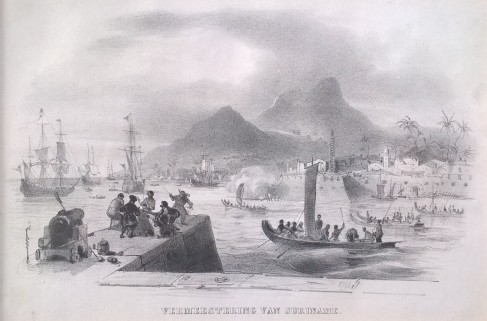
Hoe kon het gebeuren dat één van de rijkste 17e eeuwse planters van Suriname in armoede stierf op een kamertje die hij huurde bij een bakker in Londen? Met de Vrede van Breda in 1667 kwam een einde aan de Tweede Engels-Nederlandse oorlog. Afgesproken werd afgesproken dat de Engelsen Nieuw-Amsterdam (het huidige New York) kregen en dat Nederland Suriname mocht behouden. Kort daarvoor hadden de Zeeuwen onder leiding van Abraham Crijnssen Suriname op de Engelsen veroverd. De vrede had grote gevolgen voor de nog jonge kolonie Suriname.

De vermeestering van Suriname door Abraham Crijnssen (1667)

Zo’n 80 Engelse families (volgens Hartsinck ging het om ‘twaalf honderd Zielen, zo Blanken als Negers’) besloten de kolonie te verlaten. Een andere bron spreekt van 250 blanken, 950 slaven en 31 indiaanse ‘bedienden’(!). Zij kregen de gelegenheid de spullen die zij niet konden meenemen te verkopen aan achterblijvers. Dat waren bijvoorbeeld Nederlanders, Joden (die aanvankelijk geen toestemming kregen te vertrekken) en Engelsen die meer schulden hadden dan bezittingen en daardoor in Suriname moesten blijven. Degenen die Suriname verlieten zochten hun heil in één van de Engelse koloniën Barbados, Antigua of Jamaica.

08.03.2016

Kindstötung in der Sklaverei

Colonial-era fictional and non-fictional descriptions of slave motherhood offer conflicting accounts of the attitudes of slave mothers toward their children. While abolitionists tended to portray slave mothers as wholly selfless, doting, and maternal, pro- writers described slave mothers as negligent and cruel. The debate over the nature of slave motherhood was especially relevant to the Caribbean, where brutal working conditions, disease, and malnutrition impeded slave reproduction. Plantation owners blamed slave women for their failure to reproduce, accusing them of practicing birth control and procuring abortions. In some cases, planters accused slave women of committing infanticide.
It is difficult to ascertain just how often the latter occurred. There is certainly evidence to suggest that Caribbean planters’ allegations of slave women killing their infants were exaggerated.1 On the other hand, “the infant mortality rate from natural causes was undoubtedly high in the Caribbean, but the unusually high death rate within the first week, not satisfactorily explained as caused by tetanus, may signify that women used preparations which effected apparently natural death.”2 One of the more famous stories of slave infanticide in the Caribbean is that of Sabina Park, a Jamaican slave who was brought to trial for killing her young child. Park claimed that she “had worked enough for buckra (master) already and that she would not be plagued to raise the child… to work for white people.”3
The obvious response to slave infanticide is to conceptualize it as an act of desperation, a sad act, or an act of altruism, in the sense that it was intended to save enslaved children from a life of hard labor, degradation, and physical, sexual, and mental abuse.

But what if slave infanticide, in all its horror, was an expression of resistance? To conceptualize it this way places agency back in the hands of the slave women who killed their children, because it assumes that their decision was actively, discursively antagonistic and insurrectionary.
Reactions to slave infanticide varied according to one’s beliefs about the nature of slaves and the justice of slaveholding. According to Christopher Peterson, “for racist ideologues, slave infanticide is further proof of an animality inherent in black motherhood: a propensity to from which white motherhood is exempt. For abolitionists, [it] emerges both as proof of slavery’s evils and of a mother’s love for her children.”4 Indeed, in keeping with the viewpoint Peterson attributes to abolitionists, the obvious response to slave infanticide is to conceptualize it as an act of desperation, a sad act (which it certainly was), or an act of altruism—altruism in the sense that it was intended to save enslaved children from a life of hard labor, degradation, and physical, sexual, and mental abuse. But what if slave infanticide, in all its horror, was an expression of resistance? To conceptualize it this way places agency back in the hands of the slave women who killed their children, because it assumes that their decision was actively, discursively antagonistic and insurrectionary.
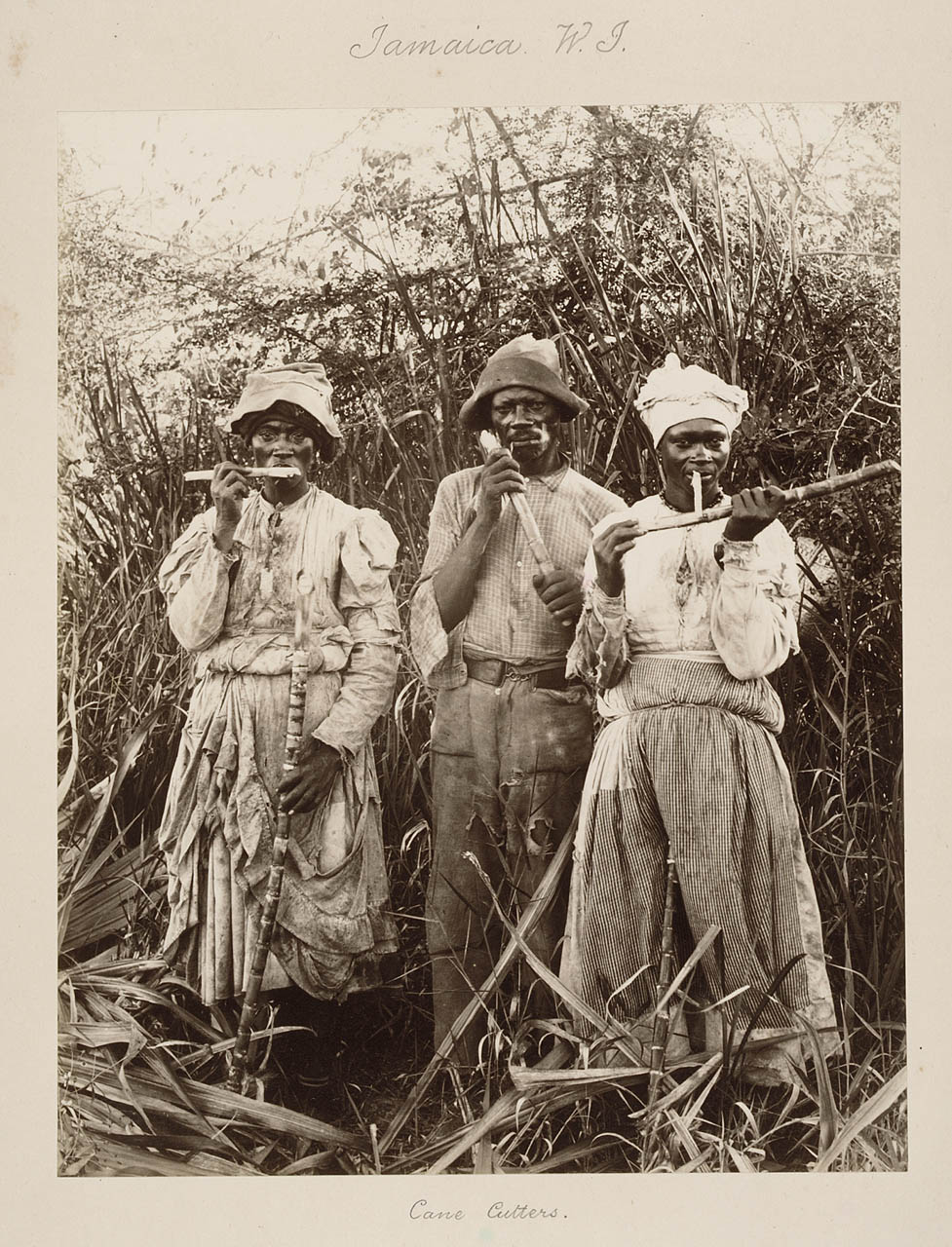
Cane cutters in Jamaica
An image depicting cane cutters in Jamaica after formal slavery was ended, mid-19th century. More than half of the slaves in the region were female.
The extremely grave nature of this subject matter merits an unusually high degree of respect and sensitivity in one’s approach to it. History is not a neutral discipline. Considering infanticide as a form of resistance is important in telling the story of Caribbean slave women as full people, as rational actors who made calculated decisions with rebellion in mind. Drawing on colonial-era accounts of slave motherhood, resistance theory, and recent work on the sociology of slavery, the central aim of this paper is to explore the equation of infanticide with resistance, with a geographical focus on the colonies of Jamaica, Barbados, and Saint-Domingue.5 All of the historical sources cited are from the mid-eighteenth century to 1834, when Britain abolished slavery in its colonies. Sources pertaining to Saint-Domingue are from prior to the slave rebellion of 1791 that culminated in the abolition of slavery in the colony.
Considering infanticide as a form of resistance is important in telling the story of Caribbean slave women as full people, as rational actors who made calculated decisions with rebellion in mind.
Extant accounts of Caribbean slave life are rife with racist assumptions about the supposed negligence and selfishness of black mothers. For example, many plantation owners accused slave women of procuring abortions with the intention of continuing to have promiscuous sex, unhindered by pregnancy.6 White observers such as plantation owners, overseers, and doctors believed that slave women’s alleged promiscuity made them especially prone to venereal disease. They often blamed slave miscarriages on the medicines slave women took (or supposedly took) to treat venereal disease.7 The logical implication of this belief was that if slave women were not so sexually indiscriminate, they would not need to take miscarriage-inducing medicines. Indeed, plantation owners found it more convenient to blame slave women for their failure to produce healthy offspring than to accept responsibility for the deplorable conditions that undoubtedly contributed to complications in pregnancy and childbirth. Physicians in Saint-Domingue accused slave mothers of causing mal de mâchoir (or ‘soreness of the jaw,’ cases of which have been retrospectively diagnosed as tetanus and neonatal tetany) among infants.8 This, of course, functioned to bolster the claim that enslaved women were neglectful, evil, unfit mothers.9 According to the French author of a 1790 pro-slavery pamphlet, they “destroy their own fruit, or they practice infanticide in order to live without moderation.”10
These derogatory cultural images of enslaved mothers are relevant to the analysis of slave infanticide because they colored white people’s perception of slaves’ reproductive habits. It was a difficult task, determining if a documented infanticide case was valid, and not a natural death caused by poor living conditions. As result, there is no clear consensus among historians on the issue. In 1796, a slave named Mary Thomas of the Newton Estate in Barbados was accused of killing her newborn infant. Historian Hilary McD. Beckles describes the event by restating Wood’s claim that Mary Thomas killed her infant out of anger at her white lover, the plantation bookkeeper.11 Beckles does not question Woods in this paraphrased account. Conversely, in her summary of the Mary Thomas case, historian Tara A. Inniss casts doubt on Wood’s accusation of infanticide, adding, “Enslaved midwives were easy targets for blame should the child succumb to illness or sudden death in the first days of life.”12 Inniss and Beckles’ differing interpretations of Wood’s account demonstrate the challenge of discerning fact from fiction in records of infanticide. It is almost impossible to tell if Mary Thomas was in fact guilty of killing her infant.
Jamaican cane cutters, mid 1800s after emancipation
Even those who believe that slave infanticide was common admit that this supposition is based on some speculation. In the words of Barbara Bush, who has written extensively on gender and slavery in the Caribbean, studying Caribbean slave infanticide requires “informed speculation and creative approaches in history.” 13 A perfect example of such a speculative, creative approach lies in James A. Delle’s analysis of birth and death records of the Radnor Plantation in Jamaica. Records from the years of 1822-1825 list eight infant deaths for which the cause of death is unnoted. Delle speculates that some of these were infanticides.14 Bush is one of the more vocal proponents of the argument that slave women frequently practiced infanticide. In an articled titled “Hard Labour: Women, Childbirth and Resistance in British Caribbean Slave Societies,” she notes that Caribbean populations grew significantly after emancipation, even though the standard of living hardly improved in most places. To her, this indicates that the “nature of slavery and the responses of slave women to their bondage must also be considered.”15 Bush notes that slave infanticide occurred in the antebellum United States, where slaves lived under generally better conditions than in the Caribbean. Thus, it was probably also practiced in the Caribbean.16 This statement is supported by the fact that, in general, Caribbean slave populations were more successful than those in the United States in preserving parts of West African cultural traditions. In many traditional West African cultures, newborn babies are not considered fully human until eight days after birth.17 According to Bush, the possibility that slave women committed infanticide through “letting” their young infants die (as opposed to violently killing them) is likely.18

slaves representations


http://scholar.library.miami.edu/slaves/representations/Individual_art_essays/carolines.htm

schiebinger - abtreibungspflanze

17.02.2016

Coromantee

Coromantee oder Coromanti people, auch Coromantins war im karibischen Raum die Bezeichnung für die letzten versklavten Menschen von der Goldküste, dem heutigen Ghana. Aufgrund ihres militärischen Hintergrundes und der gemeinsamen Sprache Akan[1][2] organisierten die Coromantee Dutzende von Sklavenaufständen in Jamaika und anderswo in der Karibik. Ihre harte und rebellische Natur war im 18. Jahrhundert unter weißen Plantagenbesitzern so berüchtigt, dass ein Gesetz vorgeschlagen wurde, um – trotz ihres Rufes als starke Arbeiter – die Einfuhr von Menschen aus der Goldküste zu verbieten.


Karte der Goldküste und des Aschanti-Reiches

Etymologie
Der Name leitet sich ab von der ghanaischen Küstenstadt Kormantse und ist die englische Bezeichnung für Angehörige der Volksgruppe der Akan. Der Name gilt heute als veraltet und wurde und wird ausschließlich in der Karibik verwendet.
Herkunft
Als Coromantee wurden in der Karibik, vor allem auf Jamaika, Sklaven bezeichnet, die von der Goldküste, dem heutigen Ghana, kamen. Die Sklaven stammten von verschiedenen Ethnien der Volksgruppe der Akan ab, wie zum Beispiel den Aschanti, Fante oder Akim. Das Volk der Akan hatte auf Jamaika den größten kulturellen Einfluss. Auch die dort verbreiteten Maroons sind Nachfahren mit kulturellen sowie sprachlichen Wurzeln der Akan.
Geschichte


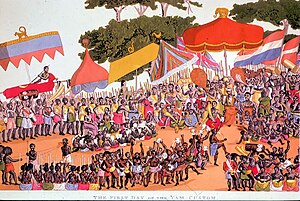
Yam Zeremonie der Ashanti - Gemälde von Thomas Edward Bowdich

10.05.2014

The application of Guerrilla Warfare in Jamaican maroon communities

This post comes from a History and Anthropology student at the University of Birmingham.

Maroon communities, prevalent in the United States, South America and Jamaica, were formed of black slaves who had managed to escape their white owners and build different lives for themselves, whilst continuing to combat the plantocracy system; also known as a ‘slavocracy’, whereby society is ruled by a dominant class of plantation owners. The focus of this essay will lie with the maroons of Jamaica, as they are considered to be the slave society with the greatest number of revolts and successes. The study of maroon guerrilla warfare is vital when attempting to identify their most salient characteristics. To gain a thorough insight into the emergence of and nature of these communities, their offensive and defensive tactics will need closer investigation, as will their Spanish historical links, African collaboration and Patterson’s formula for slave revolts.
With the English colonial takeover of Jamaica in 1655, the Spanish left behind some of their black slaves, who are believed to be the earliest Jamaican maroons and existed in the interior mountains of the island. As a result of maroon settlements tending to cluster in inaccessible, mountainous areas, the English found tracking them extremely difficult . Jamaica had the biggest economy in the West Indies with a regular influx of new slaves and a low degree of ‘creolisation’  leading to a high frequency of slave rebellions and escapees who were able to join the already existing maroons. The historical background of the maroons in Jamaica offered slaves hope of freedom and the possibility of accommodation among those communities if they were going to risk escape. Whilst rebellions and escapes were largely the cause for great increases in maroon numbers, slaves were also captured by maroons during plantation raids . Also, slaves or free blacks sent to fight the maroons sometimes defected; this was of great military value to the maroons as these defected slaves often had arms, as well as knowledge of the plantocracy’s plans . These factors, coupled with the atrocious conditions experienced by the slaves, provide an explanation as to why maroon communities emerged and grew in numbers in the seventeenth and eighteenth century.
The maroons of Jamaica can be divided into two factions; those situated in the west came to be known as the Windwards and those in the east the Leewards.