Colonial-era fictional and non-fictional descriptions of slave
motherhood offer conflicting accounts of the attitudes of slave mothers
toward their children. While abolitionists tended to portray slave
mothers as wholly selfless, doting, and maternal, pro-
slavery
writers described slave mothers as negligent and cruel. The debate over
the nature of slave motherhood was especially relevant to the
Caribbean, where brutal working conditions, disease, and malnutrition
impeded slave reproduction. Plantation owners blamed slave women for
their failure to reproduce, accusing them of practicing birth control
and procuring abortions. In some cases, planters accused slave women of
committing infanticide.
It is difficult to ascertain just how often the latter occurred.
There is certainly evidence to suggest that Caribbean planters’
allegations of slave women killing their infants were exaggerated.
On the other hand, “the infant mortality rate from natural causes was
undoubtedly high in the Caribbean, but the unusually high death rate
within the first week, not satisfactorily explained as caused by
tetanus, may signify that women used preparations which effected
apparently natural death.” One of the
more famous stories of slave infanticide in the Caribbean is that of
Sabina Park, a Jamaican slave who was brought to trial for killing her
young child. Park claimed that she “had worked enough for buckra
(master) already and that she would not be plagued to raise the child…
to work for white people.”
The obvious response to slave infanticide is
to conceptualize it as an act of desperation, a sad act, or an act of
altruism, in the sense that it was intended to save enslaved children
from a life of hard labor, degradation, and physical, sexual, and
mental abuse.
But what if slave infanticide, in all its horror, was an expression of resistance?
To conceptualize it this way places agency back in the hands of the
slave women who killed their children, because it assumes that their
decision was actively, discursively antagonistic and insurrectionary.
Reactions to slave infanticide varied according to one’s beliefs
about the nature of slaves and the justice of slaveholding. According to
Christopher Peterson, “for racist ideologues, slave infanticide is
further proof of an animality inherent in black motherhood: a propensity
to
violence
from which white motherhood is exempt. For abolitionists, [it] emerges
both as proof of slavery’s evils and of a mother’s love for her
children.” Indeed, in keeping with the
viewpoint Peterson attributes to abolitionists, the obvious response to
slave infanticide is to conceptualize it as an act of desperation, a sad
act (which it certainly was), or an act of altruism—altruism in the
sense that it was intended to save enslaved children from a life of hard
labor, degradation, and physical, sexual, and mental abuse. But what if
slave infanticide, in all its horror, was an expression of resistance?
To conceptualize it this way places agency back in the hands of the
slave women who killed their children, because it assumes that their
decision was actively, discursively antagonistic and insurrectionary.
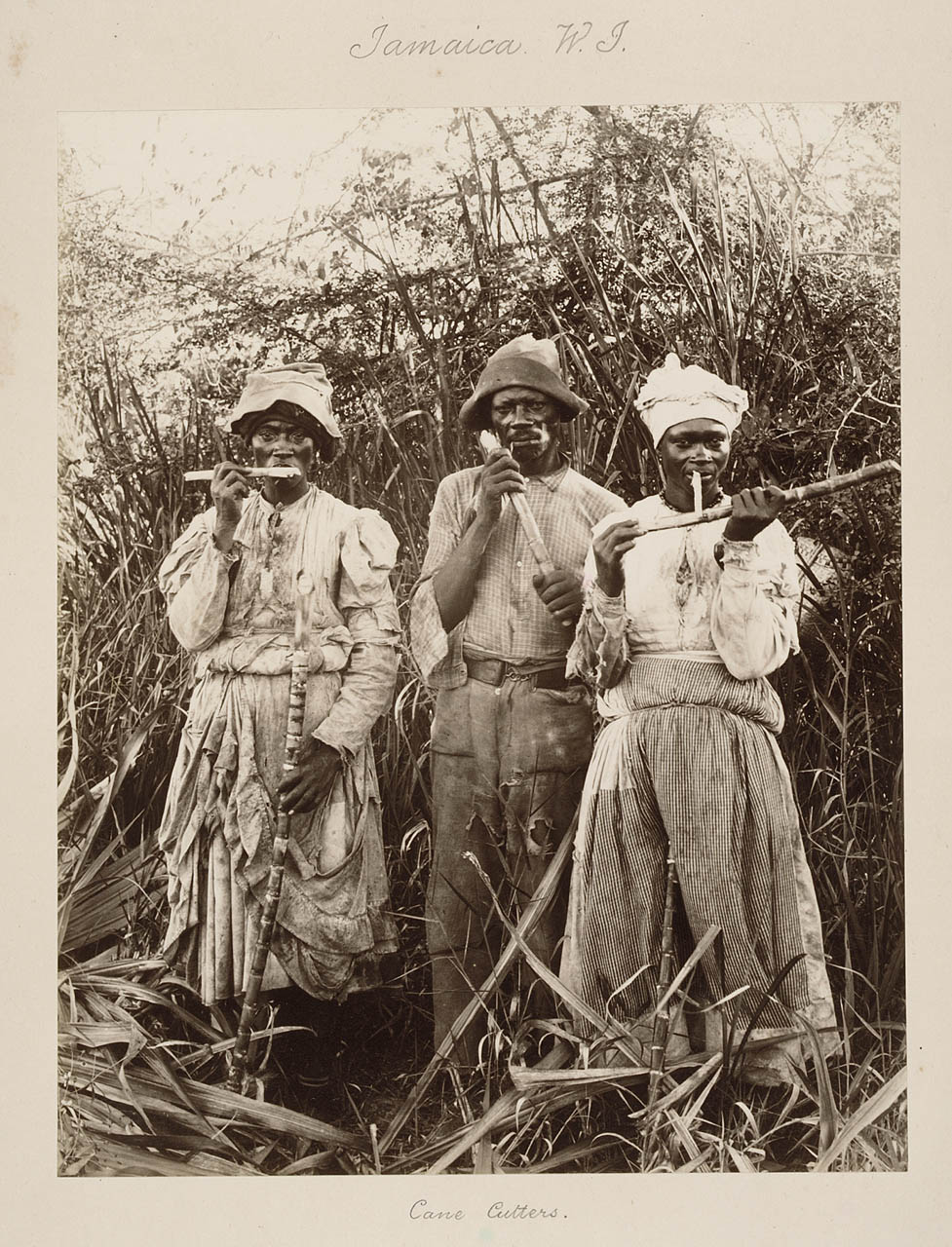
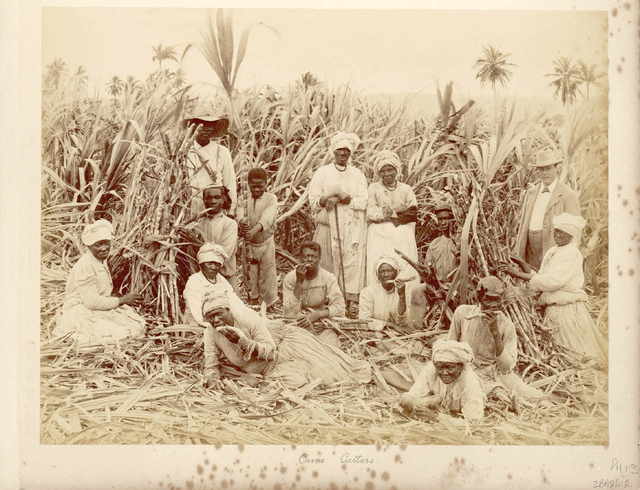 An
image depicting cane cutters in Jamaica after formal slavery was ended,
mid-19th century. More than half of the slaves in the region were
female.
An
image depicting cane cutters in Jamaica after formal slavery was ended,
mid-19th century. More than half of the slaves in the region were
female.
The extremely grave nature of this subject matter merits an unusually
high degree of respect and sensitivity in one’s approach to it. History
is not a neutral discipline. Considering infanticide as a form of
resistance is important in telling the story of Caribbean slave women as
full people, as rational actors who made calculated decisions with
rebellion in mind. Drawing on colonial-era accounts of slave motherhood,
resistance theory, and recent work on the sociology of slavery, the
central aim of this paper is to explore the equation of infanticide with
resistance, with a geographical focus on the colonies of Jamaica,
Barbados, and Saint-Domingue. All of the
historical sources cited are from the mid-eighteenth century to 1834,
when Britain abolished slavery in its colonies. Sources pertaining to
Saint-Domingue are from prior to the slave rebellion of 1791 that
culminated in the abolition of slavery in the colony.
Considering infanticide as a form of
resistance is important in telling the story of Caribbean slave women
as full people, as rational actors who made calculated decisions with
rebellion in mind.
Extant accounts of Caribbean slave life are rife with racist
assumptions about the supposed negligence and selfishness of black
mothers. For example, many plantation owners accused slave women of
procuring abortions with the intention of continuing to have promiscuous
sex, unhindered by pregnancy. White
observers such as plantation owners, overseers, and doctors believed
that slave women’s alleged promiscuity made them especially prone to
venereal disease. They often blamed slave miscarriages on the medicines
slave women took (or supposedly took) to treat venereal disease.
The logical implication of this belief was that if slave women were not
so sexually indiscriminate, they would not need to take
miscarriage-inducing medicines. Indeed, plantation owners found it more
convenient to blame slave women for their failure to produce healthy
offspring than to accept responsibility for the deplorable conditions
that undoubtedly contributed to complications in pregnancy and
childbirth. Physicians in Saint-Domingue accused slave mothers of
causing
mal de mâchoir (or ‘soreness of the jaw,’ cases of which have been retrospectively diagnosed as tetanus and neonatal tetany) among infants. This, of course, functioned to bolster the claim that enslaved women were neglectful, evil, unfit mothers.
According to the French author of a 1790 pro-slavery pamphlet, they
“destroy their own fruit, or they practice infanticide in order to live
without moderation.”
These derogatory cultural images of enslaved mothers are relevant to
the analysis of slave infanticide because they colored white people’s
perception of slaves’ reproductive habits. It was a difficult task,
determining if a documented infanticide case was valid, and not a
natural death caused by poor living conditions. As result, there is no
clear consensus among historians on the issue. In 1796, a slave named
Mary Thomas of the Newton Estate in Barbados was accused of killing her
newborn infant. Historian Hilary McD. Beckles describes the event by
restating Wood’s claim that Mary Thomas killed her infant out of anger
at her white lover, the plantation bookkeeper.
Beckles does not question Woods in this paraphrased account.
Conversely, in her summary of the Mary Thomas case, historian Tara A.
Inniss casts doubt on Wood’s accusation of infanticide, adding,
“Enslaved midwives were easy targets for blame should the child succumb
to illness or sudden death in the first days of life.”
Inniss and Beckles’ differing interpretations of Wood’s account
demonstrate the challenge of discerning fact from fiction in records of
infanticide. It is almost impossible to tell if Mary Thomas was in fact
guilty of killing her infant.
Even those who believe that slave infanticide was common admit that
this supposition is based on some speculation. In the words of Barbara
Bush, who has written extensively on gender and slavery in the
Caribbean, studying Caribbean slave infanticide requires “informed
speculation and creative approaches in history.”
A perfect example of such a speculative, creative approach lies in
James A. Delle’s analysis of birth and death records of the Radnor
Plantation in Jamaica. Records from the years of 1822-1825 list eight
infant deaths for which the cause of death is unnoted. Delle speculates
that some of these were infanticides.
Bush is one of the more vocal proponents of the argument that slave
women frequently practiced infanticide. In an articled titled “Hard
Labour: Women, Childbirth and Resistance in British Caribbean Slave
Societies,” she notes that Caribbean populations grew significantly
after emancipation, even though the standard of living hardly improved
in most places. To her, this indicates that the “nature of slavery and
the responses of slave women to their bondage must also be considered.”
Bush notes that slave infanticide occurred in the antebellum United
States, where slaves lived under generally better conditions than in the
Caribbean. Thus, it was probably also practiced in the Caribbean.
This statement is supported by the fact that, in general, Caribbean
slave populations were more successful than those in the United States
in preserving parts of West African cultural traditions. In many
traditional West African cultures, newborn babies are not considered
fully human until eight days after birth.
According to Bush, the possibility that slave women committed
infanticide through “letting” their young infants die (as opposed to
violently killing them) is likely.


 The earliest known image of a coffeehouse dated to 1674, showing the kind of coffeehouse familiar to Samuel Pepys –
 Catherine mckinley, gallatin ma