27.04.2017

Helvetische Color Line


Im Herbst 2007 erschien ein vielbeachteter Artikel in der britischen Zeitung The Independent, der den Titel „Switzerland: Europe’s Heart of Darkness?“ trug. Er reagierte auf eine Kampagne der Schweizerischen Volkspartei (SVP), die eine Initiative „Für die Ausschaffung krimineller Ausländer“ lanciert hatte. Die Plakate zeigten weisse Schafe, die ein schwarzes Schaf aus dem Territorium der Schweiz kicken. Der Independent übertrug Joseph Conrads berühmte Kritik der europäischen Kolonialherrschaft im Kongo provokativ auf das Land, das sich seit jeher ausserhalb kolonialer Geschichte wähnt. In der Schweiz des 21. Jahrhunderts, so die Pointe des Artikels, herrscht ein öffentlicher Umgang mit dem Erbe der Kolonialzeit vor, der andernorts schon lange als kolonial, rassistisch und politisch inakzeptabel gilt.

Mit der NZZ zurück in die Vergangenheit

"Brownfacing im Schweizer Fernsehen: Victor Giacobbo als Rajiv Prasad", (Quelle SRF)
Brownfacing im Schweizer Fernsehen: Victor Giacobbo als Rajiv Prasad, Quelle: SRF
Interessanterweise nimmt nun die aktuelle Ausgabe von NZZ Geschichte mit ihrer Titelgeschichte „Herr Ständerat im Herzen der Finsternis“ nicht nur Joseph Conrads Titel auf, sondern bestätigt damit auch die Kritik des Independent. Denn der NZZ geht es keineswegs darum, die Effekte des Kolonialismus auf die gegenwärtige Schweiz zu untersuchen. Vielmehr diskreditiert der Verfasser des Hauptartikels Forschungen zur postkolonialen Schweiz, die solchen Fragen seit vielen Jahren nachgehen, in einer Randspalte als „Wettbewerb der nachträglichen Selbstkasteiung“ und verweist dafür nicht zufällig auf zwei Beispiele von nicht-weissen Forschern und Politikern. In der Tat zeigte der Sozialanthropologe Rohit Jain in seiner Analyse von „Rajiv Prasad“, einer von Victor Giacobbo im Schweizer Fernsehen gespielten Comedyfigur, dass diese aus einem Arsenal von kolonialen Stereotypen zusammengesetzt ist. Die Popularität der Figur erklärt er damit, dass sie einem links-liberalen weissen Publikum, das sich selber gerne als anti-rassistisch versteht, die Möglichkeit bietet, mit gutem Gewissen gegen die sogenannte Political Correctness aufzubegehren und auch mal über das Fremde zu lachen. Dadurch würde jedoch, so Jain, die Fremdenfeindlichkeit der Rechten verstärkt. Denn die nicht-weisse Schweiz bleibe sowohl von der Produktion als auch vom Konsum dieses spezifisch weissen Humors ausgeschlossen.

Beim zweiten Fall, den die NZZ Geschichte ins Lächerliche zieht, handelt es sich um die Kritik der beiden Politiker Halua Pinto de Magalhães und Fuat Köçer an der Statue und am Wappenzeichen der sogenannten Mohrenzunft in der Berner Altstadt. Über „Integration“ könne nicht sinnvoll diskutiert werden, so argumentieren sie, solange im öffentlichen Raum weisse Überlegenheit und schwarze Minderwertigkeit inszeniert würden. Die beiden verlangen keinesfalls eine Entfernung der rassistischen Objekte, wie die NZZ Geschichte behauptet. Sie fordern vielmehr eine öffentliche Debatte über den Zusammenhang zwischen kulturellem Rassismus im öffentlichen Raum und dem strukturellen Rassismus, der sich hierzulande nicht nur in der systematischen Untervertretung der Migrationsbevölkerung in politischen Behörden, in Verwaltung, Wissenschaft, Kultur und Medien zeigt, sondern auch in der Banalisierung alltäglicher Rassismuserfahrungen.

Dass ein NZZ-Journalist diese Argumente nicht nachvollziehen kann und will, veranschaulicht das Problem und bestätigt zugleich Einsichten der jüngeren postkolonialen Forschung. In der Schweiz, so die Politologin Noémi Michel, werde die Bedeutung der kolonialen Vergangenheit für die postkoloniale Gegenwart kontinuierlich in Abrede gestellt. Dies habe paradoxerweise zur Folge, dass Individuen, welche die Erfahrung machen, dass ihre Körper, Namen und Biographien kontinuierlich rassifiziert werden, gleichzeitig nicht als legitimiert gelten, in der Öffentlichkeit über Rassismus zu sprechen.

Die ‚color line‘


Zunft zum Mohren, Zunftshaus, Bern: Quelle: flickr.com
In der pauschalen Verwerfung postkolonialer Forschung durch NZZ Geschichte ist offenbar eine nicht-artikulierte, zugleich aber sozial und epistemisch wirksame ‚color line‘ am Werk: Weiss-Sein ist eine unsichtbare oder genauer, unsichtbar-gemachte Kategorie der Gesellschaftsorganisation. Ähnlich wie Männlichkeit (deren Wirkmächtigkeit der kurze Text ebenfalls eindrücklich vor Augen führt; denn namentlich erwähnt werden darin nur Männer, obwohl die Debatte zur postkolonialen Schweiz wesentlich von Forscherinnen initiiert wurde) strukturiert Weiss-Sein die Linien der Zugehörigkeit, der Autorität, der Legitimität und der Opportunität. Konkret hat dies zur Folge, dass die NZZ Geschichte das Thema Schweiz und Kolonialismus auf eine Art lancieren kann, bei der alle sonst gültigen Regeln akademischer und journalistischer Redlichkeit gebrochen werden: Keine einzige beitragende Person gehört zum Feld der Expertinnen und Experten, welche die Geschichte und Gegenwart der Schweiz seit Jahren aus einer Perspektive analysieren, die von nicht-weissen, nicht-westlichen Denkerinnen und Denkern entwickelt wurde, der Perspektive der postkolonialen Theorie. Das Wissen von nicht-weissen Forschenden und solches, das in einer nicht-weissen Theorietradition steht, wird kurzerhand als illegitim oder irrational dargestellt oder schlicht ignoriert.

Diese ‚color line‘ durchzieht auch den Hauptartikel des Heftes, der von Martin Beglinger verfasst wurde. Es geht darin um die Geschichte des grossbürgerlichen Luzerner Politikers Edmund von Schumacher, der um 1900 im Auftrag des belgischen Königs in den Kongo reiste, um die Gräueltaten an der Bevölkerung zu untersuchen. Die Geschichte ist nicht neu. Der Historiker Lukas Vogel hat sie weit reflektierter bereits vor einigen Jahren in einem lesenswerten Artikel erzählt. Beglinger übernimmt zwar einige narrative Elemente und Argumente des Historikers, nicht aber dessen Arbeitsinstrument – die Quellenkritik. So schildert Beglinger die Geschichte einseitig aus der Perspektive seines Helden und übernimmt auch dessen Sprache unkritisch: Die koloniale Rede von „Häuptlingen“ etwa, wie auch Schumachers Auslassungen über den „Kannibalismus“ oder die angebliche Angst der „Eingeborenen“ vor der Kamera, die ihre Seele stehlen würde. In unzähligen Studien wurden solche Mythen als Teil kolonialer Ideologien entlarvt, welche die Sichtweisen, Strategien und Handlungen von kolonisierten Menschen ausblenden und von den vielfältigen Formen der europäischen Gewaltausübung in den Kolonien ablenken.

Das finstere Herz der populären schweizerischen Geschichtskultur

Kurzum: Dieser Artikel fällt Jahrzehnte hinter jeden Forschungsstand zurück und wäre eigentlich nicht der Rede wert, wenn er nicht in einem namhaften Heft erschienen und öffentlich unwidersprochen geblieben wäre. So erlaubt er uns als Phänomen einer Geschichte der Gegenwart einige aufschlussreiche Einsichten ins finstere Herz der populären schweizerischen Geschichtskultur. In der anekdotischen Abhandlung der Kolonialgeschichte lässt sich erstens eine Abwehrhaltung erkennen, die zum Ausdruck bringen will, dass diese für uns heute nicht mehr relevant ist. Damit steht sie dem Projekt einer postkolonialen Forschung diametral entgegen, welche verstehen will, wie wir hier und heute noch vom Kolonialismus gezeichnet sind.

Es ist zweitens eine Geschichte, welche versucht, vom Mythos des schweizerischen Sonderfalls zu retten, was noch zu retten ist. „Wir Nachgeborenen“ sollten „unsere Vorfahren“ nicht vorschnell „verurteilen“, mahnt etwa Redaktionsleiter Peer Teuwsen im Vorwort des Heftes. Entsprechend fällt Beglingers Darstellung seines Helden im Hauptartikel aus: Der grossbürgerliche Luzerner „Ständerat im Herzen der Finsternis“ verkörpert gleichsam die Ehre der Schweiz im kolonialen Kontext. Zwar vertritt er durchaus rassistische Sichtweisen und legt eine irritierende Loyalität gegenüber dem mit brutaler Gewalt herrschenden belgischen König zutage. „Doch was zählt“ ist in den Worten von Redaktionsleiter Teuwsen etwas anderes: Der Schweizer im Kongo habe letztlich „zur Verbesserung der Zustände“ und zum Ende der Gewaltherrschaft beigetragen. Hier erleben wir also die Reinszenierung des ramponierten Mythos der neutralen und humanitären Schweiz auf der Bühne der Kolonialgeschichte, die in Fortführung einer langen imperialen Denktradition ausschliesslich von weissen Akteurinnen und Akteuren bespielt wird. Denn was zurecht an Conrads „Herz der Finsternis“ kritisiert wurde, gilt auch für Beglinger: Die koloniale Geschichte des Kongos erscheint als Auseinandersetzung zwischen weissen (und zumeist männlichen) Europäern. Den kolonisierten Menschen wird dabei lediglich die Rolle von anonymen Statistinnen und Statisten im Hintergrund zugestanden. Ihr Widerstand gegenüber der europäischen Macht wird verschwiegen, und der Übergang vom Gewaltregime des belgischen Königs zur belgischen Staatskolonie als exklusives Werk europäischer Philanthropinnen, Aktivisten und Politiker inszeniert.

Die dritte Beobachtung zu dieser Art der Geschichtsvergegenwärtigung lässt sich anhand des Titelbildes erläutern: Dieses zeigt den Helden der Geschichte – Ständerat Edmund von Schumacher – umrahmt von vier kolonisierten Frauen. Wie sich beim Durchblättern des Heftes zeigt, handelt es sich bei dieser Illustration um eine Montage aus Fotografien aus dem Nachlass von Schumachers. Die zentrale Vorlage ist ein Foto, auf dem der Schweizer einer jungen kongolesischen Frau den Arm um die Schulter legt und auf ihre nackten Brüste blickt. Was auf der Fotografie als eigenartige Mischung von Unbeholfenheit und Lüsternheit des helvetischen Akteurs erscheint, der zugleich die Macht über die Inszenierung innehat, wird in der kolorierten Zeichnung des NZZ Geschichte-Titels in eine Aura staatsmännischer Seriosität umgewandelt: Von Schumacher blickt darauf ernsthaft und besonnen in die Kamera, während die von kolonialer Gewalt gezeichneten Frauen dadurch zu seinen Schützlingen zu mutieren scheinen. Die vielschichtigen Erfahrungen von Rassismus und Sexismus, die sich in den Fotografien aus der Kolonialzeit eingeschrieben haben, sollen derart aus dem Coverbild getilgt werden. Das gespenstische und surreale Szenario, das dabei entsteht, hält auf eindrückliche Weise fest, wie die weisse Seite der helvetischen ‚color line‘ sich gegenwärtig gegen die stetig lauter werdende Kritik der postkolonialen und migrantischen Schweiz zu immunisieren versucht: mit dem Mythos der unschuldigen Schweiz.

Literaturhinweise:
Daniel Kurjaković, Franziska Koch, Lea Pfäffli (Hg.), The Air Will Not Deny You. Zürich im Zeichen einer anderen Globalität, Zürich/Berlin (diaphanes) 2016.
Noémi Michel (im Erscheinen), „Sheepology: The Postcolonial Politics of Raceless Racism in Switzerland“, in: Postcolonial Studies.
Rohit Jain, „Die Comedyfigur Rajiv Prasad in Viktors Spätprogramm - post_koloniales Phantasma und die Krise des ‚Sonderfalls Schweiz‘‘‘, in: Purtschert, Patricia; Lüthi, Barbara; Falk, Francesca (Hg.): Postkoloniale Schweiz. Formen und Folgen eines Kolonialismus ohne Kolonien, Bielefeld 2012, S. 175–200.
Patricia Purtschert, Harald Fischer-Tiné (Hg.), Colonial Switzerland. Rethinking Colonialism from the Margins, London (Palgrave Macmillan) 2015.
Lukas Volgel, „Andenken, Abenteuer, Anklage. Gedanken zu einem Fotoalbum aus dem Kongo 1904/05“, in: Menrath, Manuel (Hg.), Afrika im Blick. Afrikabilder im deutschsprachigen Europa, 1870-1970, Zürich 2012, S. 169–188.
Bernhard C. Schär, „Berns vergessene Kolonialgeschichte“, in: Der Bund, 29.12.2014, S. 19, online: http://bit.ly/1z2Y78A
Paul Vallely, „Switzerland. Europe’s Heart of Darkness?“, in: The Independent, 7.9.2007.

17.04.2017

blackness, mathematics, fabulation: speculation


Posted on September 27, 2014 by keguro

A recent issue of The Black Scholar, edited by Alexander Weheliye, explores the relationship between black studies & black life. As many of the contributors argue, this relationship is about the knowledge structures and practices central to the ongoing problem of how to frame, understand, and engage the world we’ve inherited as modern, the world “modernity made.” We might describe this as the world that made blackness by unmaking black life, the world that created blackness as a speculative form: to be speculated upon and to speculate on its own life-making possibilities. Different kinds of imaginative leaps meet in speculation, and while “speculation” is not one of the key terms of the issue, it assembles and orients many of the articles, especially those by Tavia Nyong’o, Katherine McKittrick, C. Riley Snorton, and Denise Ferreira da Silva. I’m especially interested in articles by Nyong’o and McKittrick, because they press on one of my ongoing questions about what McKittrick terms, “origin stories”: simply, what are the genealogies of blackness? Where do we start? How do we start? And, once we’ve started, how do we proceed?

To answer these questions, McKittrick turns to the black archival presence found in “documents and ledgers”: “the list, the breathless numbers, the absolutely economic, the mathematics of the unliving.” It is a formula-generating mathematics that creates “historic blackness” for the New World—the world modernity made—a history that is, simultaneously, an unhistory (the Negro has no history), an unmaking served by economic attachment: “belongs to, bequeathed to, to be sold to.” As McKittrick writes, “New world blackness arrives through the ordinary, proved, former, certified, nearly worn worn-out archives of ledgers, accounts, price tags, and descriptors of economic worth and financial probability.” The commodity that speaks—this commodity that Marx made unspeakable.

What kind of origin story is this?


The brutalities of transatlantic slavery, summed up in archival histories that give us a bit of (asterisked-violated) blackness, put meaningful demands on our scholarly and activist questions. While the tenets and the lingering histories of slavery and colonialism produced modernity as and with and through blackness, this sense of time- space is interrupted by a more weighty, and seemingly truthful (truthful and truth-telling because iterated as scientific, proven, certified, objective), underside—where black is naturally malignant and therefore worthy of violation; where black is violated because black is naturally violent; where black is naturally unbelievable and is therefore naturally empty and violated; where black is naturally less-than-human and starving to death and violated; where black is naturally dysselected, unsurviving, swallowed up; where black is same and always and dead and dying; where black is complex and difficult and too much to bear and violated. The tolls of death and violence, housed in the archive, affirm black death. The tolls cast black as impossibly human and provide the conditions through which black history is currently told and studied. The death toll becomes the source.

How, given this unmaking work of the numbers archive, can black life, black survival, black being be narrated or imagined from such sources? Or, as McKittrick asks, “How do we ethically engage with mathematical and numerical certainties that compile, affirm, and honor bits and pieces of black death?”

At a historical moment when, to cite Simone Browne, humans are being turned into data, a moment when the logics and practices of the ledger and fungibility have found new opportunities in the bio-cataloguing of human life known as “biometrics”—recall, here, that Nigeria has partnered with Mastercard to issue “new” biometric identification documents—the “bits and pieces” of “black death” return garbed in bio-technological management. The logics and practices that unmade/unmake black life—the “mathematics” of modernity—return to “secure” what can only be the persistent unmaking of black life. As McKittrick puts it more elegantly, “it is challenging to think outside the interlocking data of black erasure, un-freedom, and anti-black violence,” especially as so many claims for justice today depend on assembling data on “black erasure, un-freedom, and anti-black violence.” How might black studies think with the mathematics of black life without reproducing the violent production of blackness as and through mathematics?
What if we trust the lies—she says she was born free—and begin to count it all differently?
—K. McKittrick

McKittrick meets Nyong’o at “the lie,” at the moment when the speculative logic of slavery meets the speculative leap into black life forms. In “Unburdening Representation,” Nyong’o reclaims the “gap” between the two meanings of representation—to depict and to stand for—as a space of “fabulation,” and, more specifically, “Afro-fabulation.” “A fabulist,” argues Nyong’o, “is a teller of tales, but he or she also discloses the powers of the false to create new possibilities.” A “teller of tales,” a storyteller and a liar, one who disrupts “the hostile and constraining conditions” of “emergence into representation.” “Possibility,” for Nyong’o is found at the “seam” or “joint,” the place Brent Edwards terms décalage, between the two forms of representation:


This misalignment of political and artistic representation is exploited by Afro-fabulation, which is thus not properly speaking solely an aesthetic strategy, or a political one, but a tactic for taking up the time and space between them.

“taking up the time and space between them.” One recalls that the archives that produce blackness in the New World deny that those termed black can represent—Phyllis (misspelled last name) cannot be a poet, declares Jefferson, and black figures cannot stand for those who can be citizens: I’m time-sliding to write this—themselves and others. Within the field of representation—within the oscillating meaning of that term—blackness will always have been a negation, an impossibility, what cannot stand “as” and “for” us. (Here, one might think about the African rejection of blackness as “not us.” The impossible chasm of blackness.)

Mining the gap (note the labor metaphor), Afro-fabulation “is always seeking to cobble something together, to produce connections and relations, however much the resultant seams show.” I want to think with Nyong’os metaphors here—I really should call him Tavia, but since I used McKittrick, protocol applies—of “cobbling,” and “connections and relations,” and “seams.” Of the various economies of motion and mobility (cobblers, shoes, the obsession with shoes in Toni Morrison’s A Mercy); and food, the cobbler as an assemblage of excess fruit, a sweetener, a palate cleanser, an act of love; “connections and relations,” the languages of invented kinship, fabulated genealogy, geographical assemblage (Glissant, Brand); and seams, which always lead me to clothing, the gorgeousness of Harryette Mullen’s Trimmings, the labor of the clothed and the unclothed slave body, the joins and joints of black labor, the uneven, the sutured, the knitted, the broken, that which enables “motion.” The seam that shows—the labor that refuses invisibility. The “lie” that refuses the truth-owning of data-production.

Speculation returns again, as that which joins McKittrick’s “mathematics” to Nyong’o’s “fabulation,” as part of the “demonic ground” where narrative does not supplant or unmake mathematics. Instead, the “speculative” becomes part of the asymptotic narration, the gap in representation—the gap in the archive, the gap in the lie, the gap that is the lie—through which and into which black life finds an “origin story” within life-unmaking blackness. Speculation, or the speculative, might be a method that reads into and past the data-affirming archive to see what black life forms might emerge, what acts of making and unmaking, what ways the human might emerge and undo the regime of Man.

Speculation is also a mode of being-present where one is impossible. It is the acts of appearance and disappearance, the haunting and the spook, the resistant object to cite Fred Moten, that inhabits what Christina Sharpe terms being “in the wake.” #staywoke, we say on twitter: remain conscious, aware, inhabit the insomnia that might (this is always speculative) save a black life, give a black life new form.

Learning from McKittrick and Nyong’o, I want to imagine “speculation” as a term central to black life and black studies, foundational to blackness as negation and possibility, a leap across and into the asymptote. 

La Borinquena - Superhero

15.04.2017

BLACK ATLANTIC, QUEER ATLANTIC

Queer Imaginings of the Middle Passage
Omise'eke Natasha Tinsley

What would it mean for both queer and African diaspora studies to theorize that the black Atlantic has always been a queer Atlantic? What new geography—or better, oceanography—of sexual, gendered, transnational, and racial identities might emerge through a queer reading of transoceanic dislocations between Africa and the Caribbean? This article examines canonical African diaspora and queer theoretical texts in dialogue with recently published creative texts that imagine queer relationships between African kidnapees in slave ships' holds. These creative texts, I argue, more expansively theorize conceptual space both to rethink submerged sexual, racial histories and to comment on the intersections between African diaspora and queer experiences in a contemporary era of Haitian refugees, transnational Dominican laborers, and international West Indian “gay” activists. Texts examined include Paul Gilroy's Black Atlantic (1993), Judith Butler's Gender Trouble (1990), Ana-Maurine Lara's Erzulie's Skirt (2006), and Dionne Brand's Map to the Door of No Return (2001).

04.04.2017

Jacqueline Bishop / Jamaica / Quilts / Untold Stories / Women's Art

 Untold Stories – Interview with Jacqueline Bishop – Part 1
September 4, 2016 veerlepoupeye2 Comments

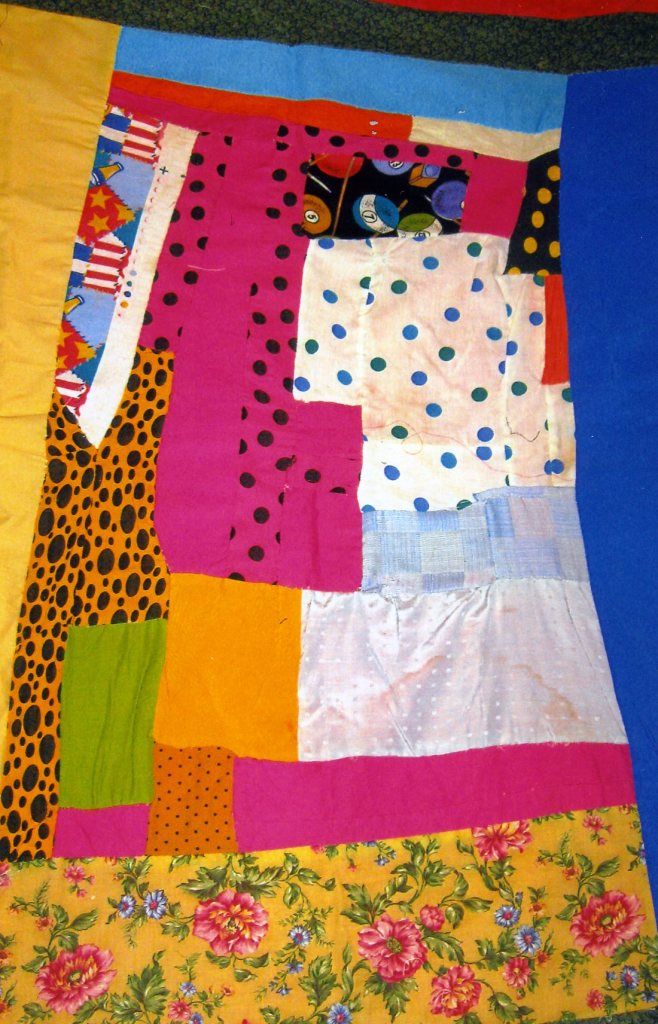
Patchwork by Celeste Walker, great grandmother of Jacqueline Bishop

In November 2015, I conducted an interview with Jacqueline Bishop, coming out of our conversations about the “Explorations IV: Seven Women Artists” exhibition at the National Gallery. That exhibition, among other things, asked why there is so little consideration, in the (art-)historical and material record, for the material creative production of Jamaican women, other than what has been consecrated as “fine art.” And what has been so consecrated is constrained by narrow definitions of art and, closely related to that, a myopic, class-based view of who is an “artist.” This somehow seems to affect women’s creative production more than men’s — almost all the artists who have been recognized as “Intuitives” are men, for instance, in part because they more typically work in media that can be recuperated as “fine art” such as “painting” and “sculpture.” Another reason is that women’s social roles have traditionally been defined differently across the class spectrum, with little space or recognition given to creative expressions of lower class women. This is a very rich, complex and barely explored topic that needs to be explored further and I intend to make other contributions on this blog. Not surprisingly, what should have been a short interview for publication in a newspaper became a lengthy conversation – some fourteen pages of copy in all – that could not be edited down easily. Jacqueline and I have decided to share the interview with you, in two parts – both of them still long for a blog, but we hope that you will find it a rewarding read, which will inspire you to ask further questions and perhaps even to delve into your own family history. Enjoy!

VP: Jacqueline, some time ago we had a conversation about the untold stories in art in Jamaica, particularly with regards to women’s contributions, and your family’s quilt-making history came up. Please tell me about this family tradition and how you became involved?

JB: When I was growing up in Jamaica, I would be sent to the country for the summer holidays. In the country were my great grandparents and my grandmother, as well as numerous aunts, uncles and cousins. I could sleep at one of two houses: I could stay with my great grandparents in Nonsuch or with my grandmother a mile and a half away in Cambridge. This is in the parish of Portland.

In Nonsuch my great grandmother would be sewing together these pieces of cloth to make patchworks, but at the time I did not know it as art. My great grandmother, whose name was Celeste, would just be sewing together these things and using them on beds in her house. I have been conducting oral history interviews with my family members and what I have found out in doing these interviews is that sewing was integral to the women in our family — my grandmother, my great grandmother and such. My grandmother’s sister, Aunt Theresa, tells me that sewing was one skill that was passed down from one generation to another in my family, and even my Uncle Moses tells me that my great grandmother would have him — a boy child — making patchworks and beautiful multi-coloured mats made from small bits of fabric drawn through crocus bag/burlap sack. So I think that patchwork making and mat-making was something that was passed down for generations in my family. Now I have patchworks that my great grandmother made, patchworks from my grandmother, and there are several that I have made in response to these quilts. Altogether there are now 35 quilts from my family, and I feel just so happy to have them. Quilt by Jacqueline Bishop

I can locate the exact moment that I became interested in this family tradition. It was during my junior year in college when I went abroad to live in Paris. In France I started reading the works of, among others, the writer Alice Walker who wrote an essay called “In Search Of Our Mother’s Garden.” In that essay Walker venerated the African American quilts that her mother and other women around her was making in Georgia. She wrote of these quilts as being a vernacular art form that partly answered the question of just what was the art that oppressed African American women had made? For Walker, and eventually for myself too, these quilts were a large part of the answer to that question. Indeed as I read Walker’s essay I was transported back to Nonsuch, to these things that my great grandmother had made. And that was when my interest in the patchworks that my great grandmother had made became very important for me.

In time as I went to graduate school to become an artist I would harken back to these quilts of my great grandmother’s and I would make quilts in conversation with my great grandmother’s patchworks. As I started showcasing these quilts in exhibitions in several countries this provoked questions about my great grandmother that I did not then have answers to. I turned to my grandmother Emma to answer these questions, and eventually she got interested in making patchworks too, as she had grown up with her mother making these things and her mother had shown her how to make these patchworks and that is how I come to have in my possession a collection of patchworks from my great-grandmother and my grandmother. Patchwork by Emma Chin-See – grandmother of Jacqueline Bishop