Superhumanity
February 14, 2017

A club of patriotic French women assemble in a church during the French Revolution, 1973. Photo: Wikimedia Commons.
Perhaps you have been struck by the frequency and regularity with which people find it necessary to state what one might think was the most obvious thing in the world: that they are human beings, or that they would like to live like them.
Here's an example from the front lines of the so-called “refugee crisis” in Europe last March: "'May God take his revenge on them—everyone who did this to us—from whatever country they come from,' said Raife al-Baltajy, a Syrian from near Aleppo, as she waited for a bus with her family. 'May god take his vengeance out on them. Isn't it sinful? Are we animals? Or are we human beings?' She said she had been living in Syria for four years under the shelling, but traveled to Turkey, then to the Greek island of Lesbos, where she took a ferry to the mainland and on to Idomeni."1
Or this claim from another Syrian refugee who spoke out from his new home in the United States: "'I was born as a human and raised as a human. I have been in some situations that made me feel not like a human,' [Refaai Hamo, a civil engineer] said. 'I would like to grab any opportunity I can to prove I am a human being and if I don’t have that opportunity, I refuse to live anywhere I don’t feel like a human.'”2
How do we understand this repeated need of people in situations of displacement, conflict, and injustice, to ask others whether they, the speakers, are in fact human, which is to say, their need "to prove I am a human being"? What is going on when people say this? It seems obvious, but in fact it's one of the most complicated, enigmatic, unstable things that can possibly be said. We should not take its possibility for granted.
That said, people have been saying it, more or less, for a while. Versions of the claim have a long history—think back to Josiah Wedgewood's famous anti-slavery medallion of 1787, featuring a shackled African figure knelt in a plea and bearing the inscription "Am I not a man and a brother?," or to the even more economical signs borne by the Memphis, Tennessee sanitation workers on strike in the spring of 1968, "I am a Man." This rich provenance makes the utterance somehow even more perplexing: haven't we learned this yet? Why do people still need to say this? What accounts for the persistence of this claim?
To begin to understand and appreciate these words, "I am a human being," we need to back up and ask just what sort of speech act is being performed here. I will call it a claim, whether it's formulated as a question ("Am I not ..."), a desire ("we want to live like ..."), a simple declaration or an apparent tautology ("I am a ..."). In each case, the statement makes a claim, and a claim on others.
I would suggest that rights, especially what we call human rights, are better treated as things we claim rather than things we have. This may seem like a minor matter of words but I believe that it has the potential to challenge profoundly the ways we think about and act with the discourse of human rights. It does not weaken the force of these claims to admit that they are only, or just, that, claims; in fact, it might make them stronger by making them less essentialist, dogmatic, sacred, or as Michael Ignatieff once put it, idolatrous.3 I think this can help us appreciate a number of things, including: what it means to say that human rights are being “violated,” the fact that what counts as a right—and who counts as a rights-bearer—can and has varied so dramatically over time and place, the common experience that the would-be universality of rights is so hard to grasp, and the fact that rights language can serve to propel campaigns of domination and not just struggles against injustice.
![]()
Memphis sanitation workers, the majority of them African American, went out on strike on February 12, 1968, demanding recognition for their union, better wages, and safer working conditions after two trash handlers were killed by a malfunctioning garbage truck. As it dragged on through March, with the Memphis mayor refusing to negotiate, the strike gained national attention. As they marched, striking workers carried copies of a poster declaring “I AM A MAN,” a statement that recalled a question abolitionists posed more than 100 years earlier, “Am I not a man and a brother?”
A few years ago, introducing the mammoth photobook The Face of Human Rights, Walter Kalin economically summed up the contemporary status of his topic with this formulation: "Human rights are the product of an historical process which has not yet reached completion."4
Here the modesty of the concession to history is balanced, or even overwhelmed, by the confident faith in a progressive expansion signaled by the little phrase "as yet." The fact of incompletion is paradoxically the sign of more to come.
And yet we could detach this narrative of ongoing accomplishment from its teleology and see in it an important insight about human rights as a thought and practice: in spite, it seems, of their would-be eternality and universality, human rights are structurally incomplete, without fixed limits. This happens not despite this aspiration to universality, but because of it. The universe of their extent is not given in advance, and in fact we could say that the struggle to define its extents—which is in fact the struggle to determine who or what is and is not the subject or bearer of those rights—constitutes the story and the history of human rights. Because rights are a matter of claims, which is to say, disputations, and because those claims require evidence and demand assent, the subjects and the borders of rights are structurally in flux.
The contemporary world offers at least two contradictory answers to the question of how that "process" is coming along.
February 14, 2017
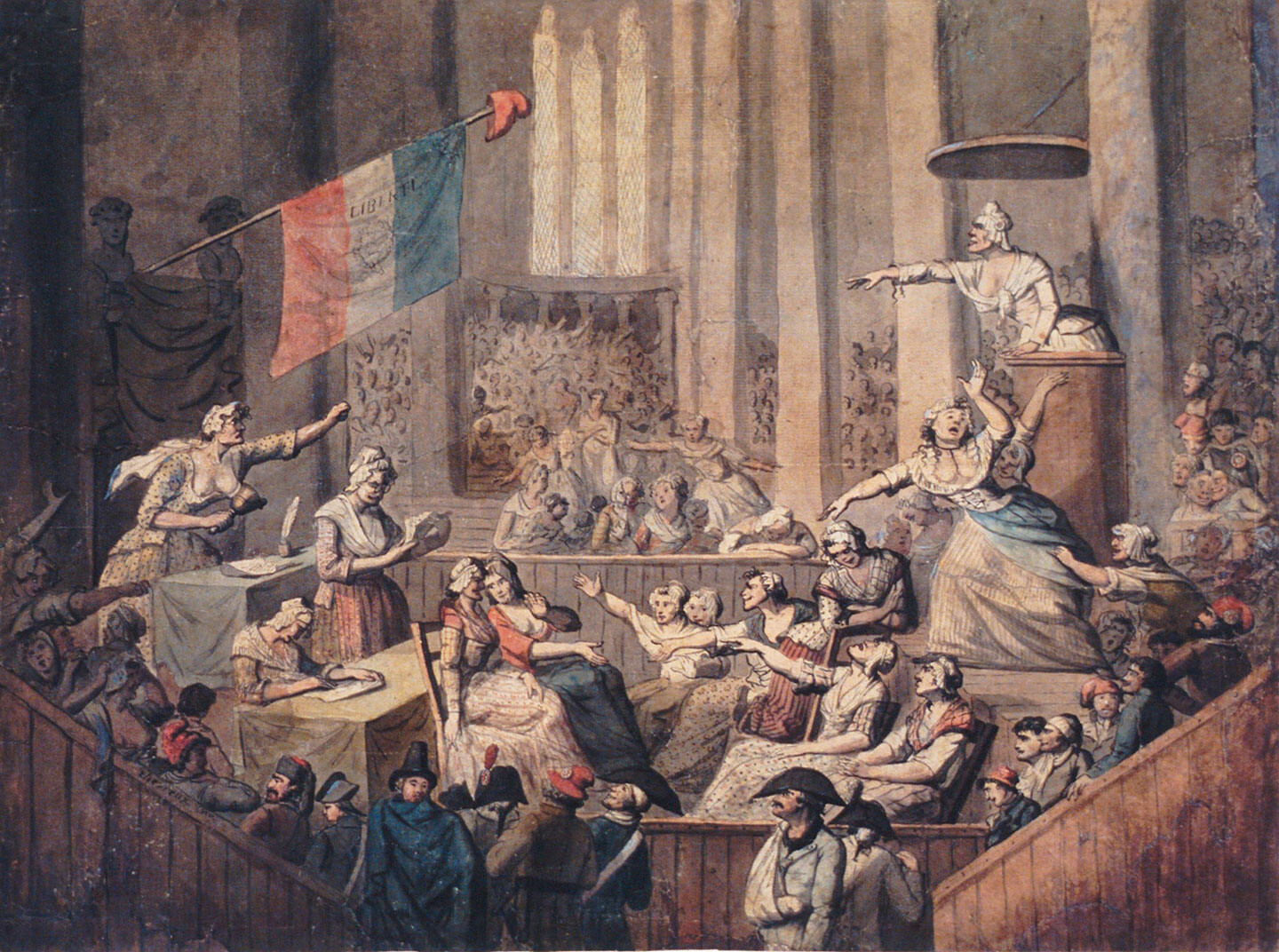
A club of patriotic French women assemble in a church during the French Revolution, 1973. Photo: Wikimedia Commons.
Perhaps you have been struck by the frequency and regularity with which people find it necessary to state what one might think was the most obvious thing in the world: that they are human beings, or that they would like to live like them.
Here's an example from the front lines of the so-called “refugee crisis” in Europe last March: "'May God take his revenge on them—everyone who did this to us—from whatever country they come from,' said Raife al-Baltajy, a Syrian from near Aleppo, as she waited for a bus with her family. 'May god take his vengeance out on them. Isn't it sinful? Are we animals? Or are we human beings?' She said she had been living in Syria for four years under the shelling, but traveled to Turkey, then to the Greek island of Lesbos, where she took a ferry to the mainland and on to Idomeni."1
Or this claim from another Syrian refugee who spoke out from his new home in the United States: "'I was born as a human and raised as a human. I have been in some situations that made me feel not like a human,' [Refaai Hamo, a civil engineer] said. 'I would like to grab any opportunity I can to prove I am a human being and if I don’t have that opportunity, I refuse to live anywhere I don’t feel like a human.'”2
How do we understand this repeated need of people in situations of displacement, conflict, and injustice, to ask others whether they, the speakers, are in fact human, which is to say, their need "to prove I am a human being"? What is going on when people say this? It seems obvious, but in fact it's one of the most complicated, enigmatic, unstable things that can possibly be said. We should not take its possibility for granted.
That said, people have been saying it, more or less, for a while. Versions of the claim have a long history—think back to Josiah Wedgewood's famous anti-slavery medallion of 1787, featuring a shackled African figure knelt in a plea and bearing the inscription "Am I not a man and a brother?," or to the even more economical signs borne by the Memphis, Tennessee sanitation workers on strike in the spring of 1968, "I am a Man." This rich provenance makes the utterance somehow even more perplexing: haven't we learned this yet? Why do people still need to say this? What accounts for the persistence of this claim?
To begin to understand and appreciate these words, "I am a human being," we need to back up and ask just what sort of speech act is being performed here. I will call it a claim, whether it's formulated as a question ("Am I not ..."), a desire ("we want to live like ..."), a simple declaration or an apparent tautology ("I am a ..."). In each case, the statement makes a claim, and a claim on others.
I would suggest that rights, especially what we call human rights, are better treated as things we claim rather than things we have. This may seem like a minor matter of words but I believe that it has the potential to challenge profoundly the ways we think about and act with the discourse of human rights. It does not weaken the force of these claims to admit that they are only, or just, that, claims; in fact, it might make them stronger by making them less essentialist, dogmatic, sacred, or as Michael Ignatieff once put it, idolatrous.3 I think this can help us appreciate a number of things, including: what it means to say that human rights are being “violated,” the fact that what counts as a right—and who counts as a rights-bearer—can and has varied so dramatically over time and place, the common experience that the would-be universality of rights is so hard to grasp, and the fact that rights language can serve to propel campaigns of domination and not just struggles against injustice.
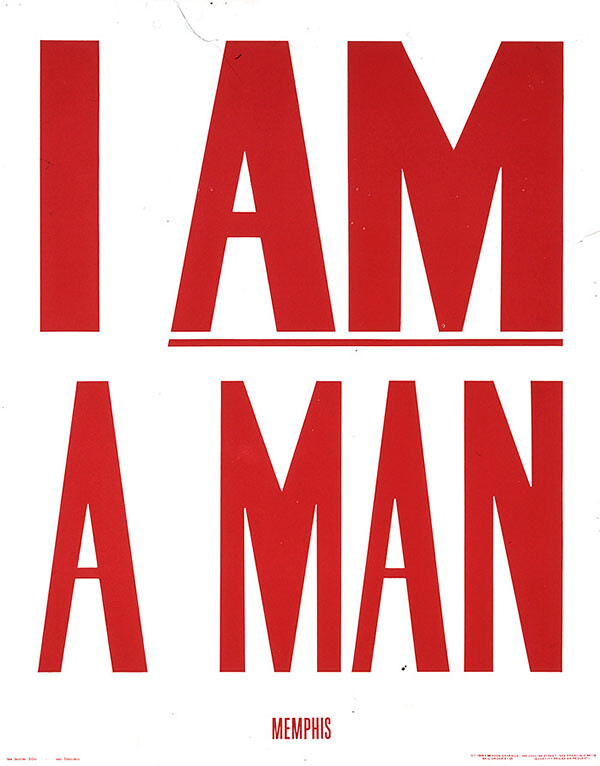
Memphis sanitation workers, the majority of them African American, went out on strike on February 12, 1968, demanding recognition for their union, better wages, and safer working conditions after two trash handlers were killed by a malfunctioning garbage truck. As it dragged on through March, with the Memphis mayor refusing to negotiate, the strike gained national attention. As they marched, striking workers carried copies of a poster declaring “I AM A MAN,” a statement that recalled a question abolitionists posed more than 100 years earlier, “Am I not a man and a brother?”
A few years ago, introducing the mammoth photobook The Face of Human Rights, Walter Kalin economically summed up the contemporary status of his topic with this formulation: "Human rights are the product of an historical process which has not yet reached completion."4
Here the modesty of the concession to history is balanced, or even overwhelmed, by the confident faith in a progressive expansion signaled by the little phrase "as yet." The fact of incompletion is paradoxically the sign of more to come.
And yet we could detach this narrative of ongoing accomplishment from its teleology and see in it an important insight about human rights as a thought and practice: in spite, it seems, of their would-be eternality and universality, human rights are structurally incomplete, without fixed limits. This happens not despite this aspiration to universality, but because of it. The universe of their extent is not given in advance, and in fact we could say that the struggle to define its extents—which is in fact the struggle to determine who or what is and is not the subject or bearer of those rights—constitutes the story and the history of human rights. Because rights are a matter of claims, which is to say, disputations, and because those claims require evidence and demand assent, the subjects and the borders of rights are structurally in flux.
The contemporary world offers at least two contradictory answers to the question of how that "process" is coming along.


