
Emblematical Print on the South Sea Scheme, Year 172, Engraving
Dimensions 22.2 cm × 31.8 cm (8.8 in × 12.5 in)

Hogarthian image of the 1720 "South Sea Bubble" from the mid-19th century, by Edward Matthew Ward, Tate Gallery
Emblematical Print on the South Sea Scheme (also known as The South Sea Scheme) is an early print by William Hogarth, created in 1721 and widely published from 1724. It caricatures the financial speculation, corruption and credulity that caused the South Sea Bubble in England in 1720–1.
The South Sea Company was a British joint stock company founded in 1711. It was granted a monopoly to trade with Spain's South American colonies as part of a treaty during the War of Spanish Succession, in return for the company's assumption of the national debt run up by England during the war. Speculation in the company's stock led to a great economic bubble in 1720, with company's shares rising rapidly in price from around £100 to over £1,000. Many investors were ruined when the bubble burst and the value of stock in the South Sea Company crashed. Political scandal ensued when fraud among the company's directors and corruption of cabinet ministers became clear.
The event triggered several satirical engravings by foreign artists that were widely published in English newspapers, including in particular a version of A Monument Dedicated to Posterity by Bernard Picart adapted by Bernard Baron,[1] which depicted Folly drawing Fortune in a cart while she showered a crowd of hopeful investors with bubbles of air and worthless shreds of paper rather than with the riches for which they hoped. Hogarth's print was created in 1721 as a response to the foreign engravings. The events had personal piquancy for Hogarth, given his father's detention as a debtor in Fleet Prison from 1707–12 and his early death in 1718. The South Sea Scheme is an early essay in engraving by Hogarth, who had set up on his own as a copperplate artist and painter after his apprenticeship with silver engraver Ellis Gamble came to an early end in 1720.
Description
The print shows a London scene, with the Guildhall and its monumental statue of the giant Gog (or Magog) to the left, a classical column based on The Monument to the Great Fire of London to the right, and the dome of St Paul's Cathedral rising behind the buildings in the background. The base of the column bears an inscription which states: "This monument was erected in memory of the destruction of the city by the South Sea in 1720", while foxes fight above.[2] It is no coincidence that in Hogarth's scene the monument, a symbol of the City's greed, dwarfs St Paul's, a symbol of Christian charity.

The Miseries and Misfortunes of War
The centre of the print is occupied by a financial wheel of fortune or merry-go-round ridden by figures representative of the broad section of society taken in by the scheme, including a whore and a clergyman on the left,[3] then a boot black and a hag, and a Scottish nobleman to the right, on a fat-faced horse. The ride is surmounted by a goat and the slogan "Who'l Ride" and surrounded by a jostling crowd below. To the front of the crowd, a short pickpocket rifles through the pockets of a larger gentleman. Paulson identifies the first as a caricature of Alexander Pope, who profited from the South Sea Scheme; and speculates that the other is John Gay, who, refusing to cash in enough of his stock to enable himself to have "a clean shirt and a shoulder of mutton every day for life", lost his investment and all his imagined profits.[4] The image of the wheel is a parody of Jacques Callot's La Pendaison from the series The Miseries and Misfortunes of War, and the crowd has elements taken from his La Roue. Women line a balcony to the upper left, queuing to enter a building surmounted by stag's antlers, under a sign which offers "Raffleing for Husbands with Lottery Fortunes in Here".

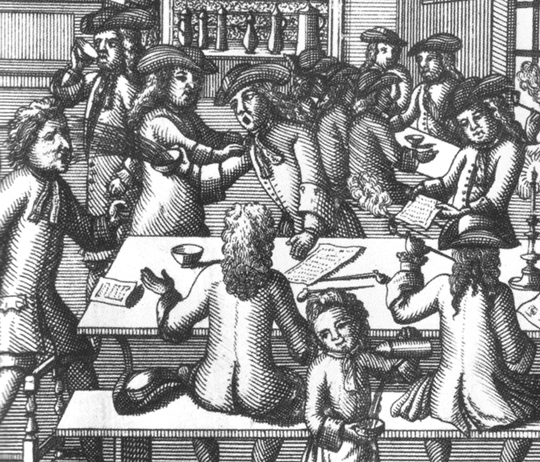
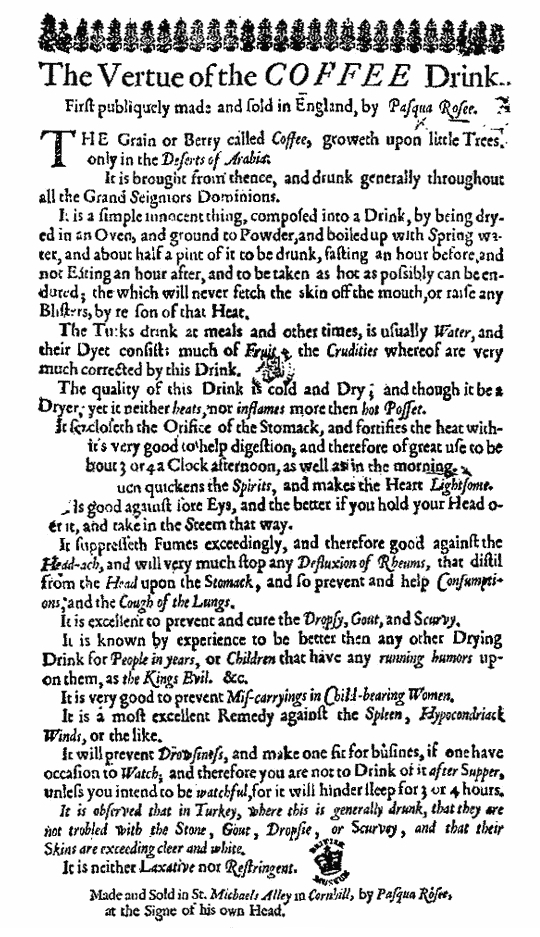
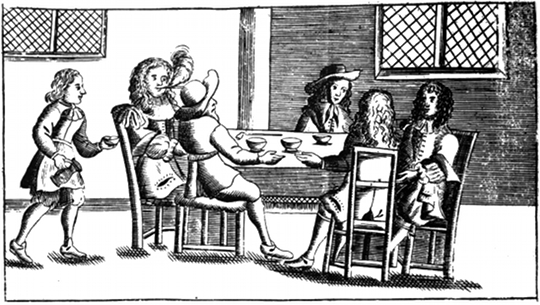 The earliest known image of a coffeehouse dated to 1674, showing the kind of coffeehouse familiar to Samuel Pepys –

