Posts mit dem Label arbeit werden angezeigt. Alle Posts anzeigen

03.09.2017

The Bronx Slave Market (1950)

VIEWPOINT MAGAZINE

Marvel Cooke October 31, 2015
Woolworth’s, E 170th St. between Walton Ave. and Jerome Ave., The Bronx
Introduction

Marvel Cooke, a seasoned African American labor activist and member of the Communist Party, wrote this set of investigative reports for the New York-based radical newspaper The Daily Compass in January 1950. For Cooke, it was a return to a familiar setting: she and Ella Baker, the famous civil rights leader, had co-written a groundbreaking exposé on an earlier iteration of the Bronx Slave Market in 1935 for the NAACP’s journal, The Crisis. Cooke’s analysis here is worth revisiting for several reasons. Not only does this represent an important attempt at conducting a form of workers’ inquiryamong black domestic workers, at that time still a mostly unorganized sector of the working class; she also picks up a line of argument that resonates with other currents of black radicalism (including Claudia Jones, W.E.B. Du Bois, C.L.R. James, and others), tracing the survivals of slavery within the industrializing northern ghetto, where recent black migrants encountered new forms of extra-economic coercion and superexploitation.1 Over the course of four articles, Cooke demonstrates how the set-up of these “slave markets” across New York City, where women stood on sidewalks near department stores seeking offers for a day’s work, engendered isolation (their actual workplaces were always changing, from the Upper East Side to Long Island) and depressed wages through competition (they had practically no bargaining power). In her personal experience as part of the “paper bag brigade,” Cooke details the the grueling nature of the work and the overt racism often encountered, as well as how the informal wage agreement made procuring daily necessities ‒ transportation, food, etc. ‒ a strenuous task. She ends by emphasizing unionization and struggle as the principal means for abolishing these markets once and for all. Even though the Woolworth’s on E 170th St in the Bronx has long been shuttered, Cooke’s reports remain essential material as we continue to think through the connections between migration, racialization, and domestic labor today.

***
“I Was Part of the Bronx Slave Market”
The Daily Compass, January 8th, 1950, pages 1, 15.

I was a slave.

I was part of the “paper bag brigade,” waiting patiently in front of Woolworth’s on 170th St., between Jerome and Walton Aves., for someone to “buy” me for an hour or two, or, if I were lucky, for a day.

That is the Bronx Slave Market, where Negro women wait, in rain or shine, in bitter cold or under broiling sun, to be hired by local housewives looking for bargains in human labor. It has its counterparts in Brighton Beach, Brownsville and other areas of the city.

Born in the last depression, the Slave Markets are products of poverty and desperation. They grow as employment falls. Today they are growing.

They arose after the 1939 crash when thousands of Negro women, who before then had a “corner” on household jobs because they were discriminated against in other employment, found themselves among the army of the unemployed. Either the employer was forced to do her own household chores or she fired the Negro worker to make way for a white worker who had been let out of less menial employment.

The Negro domestic had no place to turn. She took to the streets in search of employment – and the Slave Markets were born.

Their growth was checked slightly in 1941 when Mayor LaGuardia ordered an investigation of charges that Negro women were being exploited by housewives. He opened free hiring halls in The Bronx and other areas where Slave Markets had mushroomed. They were not entirely erased, however, until World War II diverted labor, skilled and unskilled, to the factories.

Today, Slave Markets are starting up again in far-flung sections of the city. As yet, they are pallid replicas of the depression mode: but as unemployment increases, as more and more Negro Women are thrown out of work and there is less and less money earmarked for full-time household workers, the markets threaten to spread as they did in the middle ‘30s, when it was estimated there were 20 to 30 in The Bronx alone.

The housewife in search of cheap labor can easily identify the women of the Slave Market. She can identify them by the dejected droop of their shoulders, or by their work-worn hands, or by the look of bitter resentment on their faces, or because they stand quietly leaning against storefronts or lamp posts waiting for anything – or for nothing at all.

These unprotected workers are easily identified, however, by the paper bag in which they invariably carry their work clothes. It is a sort of badge of their profession. It proclaims their membership in the “paper bag brigade” – these women who can be bought by the hour or by the day at depressed wages. The way the Slave Market operates is a primitive and direct and simple – as simple as selling a pig or a cow in a public market.

The housewife goes to the spot where she knows women in search of domestic work congregate and looks over the prospects. She almost undresses them with her eyes as she measures their strength, to judge how much work they can stand.

If one of them pleases her, the housewife asks what her price is by the hour. Then she beats that price down as low as the worker will permit. Although the workers usually starts out demanding $6 a day and carfare, or $1 an hour and carfare, the price finally agreed upon is pretty low – lower than the wage demanded by public and private agencies, lower than the wage the women of the Slave Market have agreed upon among themselves.
Few Changes

I know because I moved among these women and made friends with them during the late 1930s. I moved among them again several days ago, some ten years later. And I worked on jobs myself to obtain first-hand information.

There is no basic change in the miserable character of the Slave Markets. The change is merely in the rate of pay. Ten years ago, women worked for as little as 25 cents an hour. In 1941, before they left the streets to work in the factories, it was 35 cents. Now it is 75 cents.

This may seem like an improvement. But considering how the prices of milk and bread and meat and coffee have jumped during the past decade, these higher wages means almost no gain at all.

And all of the other evils are still there.

The women of the “paper bag brigade” still stand around in all sorts of weather in order to get a chance to work. They are still forced to do an unspecified amount of work under unspecified conditions, with no guarantee that, at the end of the day, they will receive even the pittance they agreed upon.

They are still humiliated, day after day, by men who frequent the market area and make immoral advanced. Pointing to this shameful fact, civic and social agencies have warned that Slave Market areas could easily degenerate into centers of prostitution.

So they could, were it not for the fact that the women themselves resent and reject these advances. They are looking for an honest day’s work to keep body and soul together.
“Where Men Prowl and Women Prey on Needy Job-Seekers”
The Daily Compass, January 9th, 1950, pages 4, 7.

I was part of the Bronx Slave Market long enough to experience all the viciousness and indignity of a system which forces women to the streets in search of work.

Twice I was hired by the hour at less than the wage asked by the women of the market. Both times I went home mad – mad for all the Negro women down through the ages who have been lashed by the stinging whip of economic oppression.

Once I was approached by a predatory male who made unseemly and unmistakable advances. And I was mad all over again.

My first job netted me absolutely nothing. My employer on the occasion was a slave boss and I quit cold soon after I started.

My second job netted me $3.40 for a full day of the hardest kind of domestic work. My “madam” – that is how the “slaves” describe those who hire them – on this occasion was a gentle Mrs. Simon Legree, who fed me three crackers, a sliver of cream cheese, jelly, and a glass of coffee while she ate a savory stew.

The brush with the man was degrading and unspeakable.

These are the everyday experiences in the Bronx Slave Market and in the markets elsewhere in the city.

***

Leaving Home: Slavery and the Politics of Reproduction

Camille Barbagallo October 31, 2015


In fact, from one point of view, we cannot unravel one female’s narrative from the other’s, cannot decipher one without tripping over the other – Hortense Spillers1

We had driven straight through from Brisbane to Sydney, a nine-hour drive with your foot flat to the floor. We were on our way to a radical student conference, it was the very late 1990s and the WTO protests in Seattle had just hit the national papers. It was a time when some of us had started to get confident in naming the problem, saying it out loud: capitalism. We arrived sweaty, tired and sort of tumbled out of the car and into the front garden of a huge run-down student house in inner Sydney. A woman I had not met before, Natasha was at the front door. Noting my then boyfriend, she spat,

“So, you’re a breeder then.”

Standing there in the harsh morning sunshine, the word breeder did the job it was intended to do: producing a connection between my nineteen year old body, its assumed capacity for biological reproduction, patriarchy and normative heterosexual sex. A little taken back, I mumbled something while looking at my feet and spent the rest of the week thinking about what breeder sex would be like.

Conversation Piece, before a house in Monument Lane, Edgbaston (William Williams, 1780)

This essay offers a critical reflection on the history of reproduction at the intersection of slavery and capitalism in the Anglo-American context.2 In sketching this history I explore the relationship between capitalism, gender and slavery and how the invention of the two separate spheres of production and social reproduction was produced and maintained. What emerges is the highly contradictory nature of the home and family under slavery and that in some instances the household served as an important site of resistance for slave women. Exploring the complexities of the household and family structures under slavery challenges tendencies within feminist theory that assume a universal or “shared” experience of home, motherhood and the domestic sphere.

The problem of where to begin in unraveling the stories of slavery, feminism and reproduction is an interesting one. Particularly if one is not seeking to locate origins or founding moments, but is instead interested in asking how reproduction has come to be the problem that it is today. In the first instance, it is necessary to ask what is at stake in the history of reproduction, in part because the definitions and meaning of reproduction not only vary but also are often experienced in contradictory ways. The inequalities and disparities in how different racialized and gendered subjects experience the labor of making and remaking people under capitalism cannot be ignored and these gaps, silences and spaces of difference have long and complex histories. Considering the overwhelming location of reproduction is in the realm of the natural, the biological and that murky, under-theorized location of home, it is necessary to not only gesture towards what is at stake politically but to do so with the aim of “weaponizing reproduction.” The task is certainly a feminist project, one that takes seriously what it means to denaturalize reproduction, with the desire to grab hold of the problem and transform it.

From the outset it is clear that the story of feminism and reproduction is a complex and at times contradictory one. Of the many valid and necessary critiques of second-wave feminism that have and continue to be made, the notion that the women’s movement in the 1960s and 1970s was anti-mother is certainly a persistent line of attack. It is also a criticism that has been consistently challenged by those who were active in the movement, many of who were young mothers at the time. The idea that feminists were anti-child and anti-mother can in some ways be traced to how uncomfortable the original demand in Britain for “free 24-hour nurseries” made people feel. Critics claimed that the demand signaled women’s desire for “baby dumping.” People were horrified by the supposed unnaturalness of young children being looked after by people other than their mothers at irregular times. That a demand for accessible and affordable childcare could cause such panic tells us something about the organization of gender in post-war industrial economies.

Whilst the charge that second-wave feminist were anti-mother unravels under scrutiny, the family and the post-war family in particular was certainly the object of much feminist criticism and analysis. Shelia Rowbotham writes that the women’s movement erupted “in a literature of complaint which focused on the experiences of the family – both in the sense of life in the household and with kin.”3 It was less mothers and more motherhood that feminist saw as the problem. In a pamphlet entitled Women and the Family, written by three women, each with two kids, the authors write, “our window on the world is looked through with our hands in the sink and we’ve begun to hate the sink and all it implies.”4 Rowbotham continues that it was not that “every woman suddenly became unhappy, but that significant numbers of women felt entitled to a destiny which was not simply domestic.”5Considering that in the late 1960s, nearly 55 percent women in Britain did not work outside of the home, it is unsurprising that for significant numbers of women the family and women’s domestic destiny came to be seen as one of the central sites of female oppression. For many in the movement, women’s liberation meant an escape from the home – “in the home the woman is in the family, and the two are disturbingly synonymous.”6

29.07.2017

The Papin SIsters

Christine and Léa Papin
From Wikipedia, the free encyclopedia


Léa and Christine Papin (left to right)

Christine Papin (8 March 1905 – 18 May 1937) and Léa Papin (15 September 1911 – 1982, or 24 July 2001) were two French sisters, live-in maids, who were convicted of murdering their employer's wife and daughter in Le Mans, France, on 2 February 1933. This incident had a significant influence on French intellectuals Jean Genet, Jean-Paul Sartre and Jacques Lacan, who sought to analyze it, and it was thought of by some as symbolic of class struggle. The case has formed the basis of a number of publications, plays and films as well as essays, spoken word, songs, and artwork.


Christine Papin, stated to be the main domineering influence

Christine and Léa had grown up in villages south of Le Mans. They grew up in an alcoholic household, abused by their father and neglected by their mother. They had an older sister, Emilia, who became a nun. Both of them spent time in institutions as a result of the breakdown of their parents' marriage. As they grew older, they worked as maids in various Le Mans homes, preferring, whenever possible, to work together.

From about 1926, they worked as live-in maids in the home of Monsieur René Lancelin, a retired solicitor, in Le Mans. The family was made up of his wife and adult daughter, who was still living with her parents (another daughter was married). The two maids were extremely quiet and retiring young women, who kept to themselves and appeared to have no interests but each other.

On 2 February 1933, Monsieur Lancelin was supposed to meet his wife and daughter for dinner at the home of a friend. When they did not turn up, he was concerned and went back to their home. He was unable to get into the house because the doors were locked on the inside, but he could see the glow of a candle through the window of the maids' room. He then went to the police and one of them got into the house by climbing over the back wall. Inside, he found the bodies of Madame Lancelin and her daughter. They had both been beaten to the point of being unrecognisable, and one of the daughter's eyes was on the floor nearby. Madame Lancelin's eyes had been gouged out and were found in the folds of the scarf around her neck. The two maids were found in their room upstairs, naked[1] in bed together. They confessed to killing the two women. The weapons used had been a kitchen knife, a hammer, and a pewter pot that had stood at the top of the stairs.

15.02.2017

Love’s Labour’s Cost: The Political Economy of Intimacy

By Emma Dowling / 13 February 2016
On Valentine's Day, Emma Dowling makes a powerful case for thinking about the structure of social relationships rather than simply 'the one'. Her excavation of the political economy of intimacy analyses how the ideology of work has penetrated the affective registers of our social lives, while at the same time, we are paying for capitalism's crisis as financialisation and austerity attack our structures of social reproduction. Drawing on feminist critiques of women's unwaged housework, Dowling assesses the uneven and gendered distribution of emotional labour today. Love's work, therefore, must be challenged and transformed: as our material precarity increases, rejecting precariousness in our love relations would be a start in building affective resistance and with that, other possible worlds of love and care.


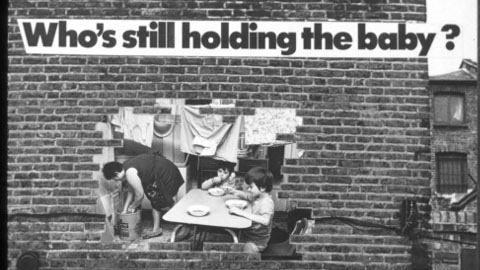
- Hackney Flashers, Who's still holding the baby?, 1978

They say it is love. We say it is unwaged work.

They call it frigidity. We call it absenteeism.

Every miscarriage is a work accident.

So reads a feminist pamphlet calling for Wages for Housework written by Silvia Federici in 1975. “We are all housewives because no matter where we are they can always count on more work from us, more fear on our side to put forward our demands, and less pressure on them for money, since hopefully our minds are directed elsewhere, to that man in our present or our future who will ‘take care of us.’”

Taking care in order to be taken care of. That was the deal of heteronormative love. Underpinning the romantic ideal was the domestic contract between the two parties of the heterosexual couple. Each partner entered into the relationship on the basis of a gendered agreement, a reproductive deal: she would cook, clean, have sex, bear children and care for him, while he was to pay the bills and fulfil his role as care-taker – then he could expect to be taken care of. Since the sexual revolution and tide of social change in the 1960s, feminist and queer struggles challenged the inequality and desirability of this set-up – that women’s housework was seen as the ‘labour of love’ undeserving of remuneration, whereas men’s work outside the home, brought both social agency and power in the home thanks to his wage.

The neoliberal restructuring of the state and the economy alongside the rise of the service industry and the entry of large numbers of women into (often low-)paid work have macerated this reproductive deal. If in a sense the nuclear family arrangement has crashed, it hasn’t so much been undone as it has been fragmented into its constituent parts, with the roles outsourced to different paid and unpaid assistive workers. Migrant cleaners, nannies and au-pairs, sex workers and psychotherapists shatter the middle-class myth of the self-sufficient couple. And it is still women who are doing much of this kind of work. Women, Arlie Hochschild wrote in The Managed Heart in 1984, have been taught to have an instrumentalised relationship to their feelings. It is these abilities that are easily put to work – and nowhere more than in the political economy of intimacy.

23.12.2016

Our Tradition: Black Woman's Manifesto

05 Black Woman’s Manifesto by the Third World Women’s Alliance (1970)


Introduction by Gayle Lynch

Racism and capitalism have trampled the potential of black people in this country and thwarted their self-determination. Initially the physical characteristics of those of African descent were used to fit blacks into the lowest niche in the capitalist hierarchy - that of maintenance. Therefore, black women and men of today do not encourage division by extending physical characteristics to serve as a criterion for a social hierarchy. If the potential of the black woman is seen mainly as a supportive role for the black man, then the black woman becomes an object to be utilized by another human being. Her potential stagnates and she cannot begin to think in terms of self-determination for herself and all black people. It is not right that her existence should be validated only by the existence of the black man.

The black woman is demanding a new set of female definitions and a recognition of herself of a citizen, companion and confidant, not a matriarchal villain or a step stool baby-maker. Role integration advocates the complementary recognition of man and woman, not the competitive recognition of same.[113]

Role integration encourages a broader mental and emotional growth in black women and men as they share the responsibility of working towards liberation. Neither of them should be relegated to a narrow experience in life. Neither of them should have their potentiality for self-determination controlled and predetermined by the opposite sex. That is a type of slavery that will not deliver us as a people. That is a form of bondage which is an integral part of the racist and capitalist system which black women and black men must work to oppose and overthrow.

30.10.2016

Readings from the Slave Narratives


Veröffentlicht am 23.09.2015
Unchained Memories is a 2003 documentary film about the stories of former slaves interviewed during the 1930s as part of the Federal Writers' Project and preserved in the WPA Slave Narrative Collection. This HBO film interpretation directed by Ed Bell and Thomas Lennon is a compilation of slave narratives, narrated by actors, emulating the original conversation with the interviewer. The slave narratives may be the most accurate in terms of the everyday activities of the enslaved, serving as personal memoirs of more than two thousand former slaves. The documentary depicts the emotions of the slaves and what they endured. The "Master" had the opportunity to sell, trade, or kill the enslaved, for retribution should one slave not obey.
Narrated by: Whoopi Goldberg
Sarah Gudger, North Carolina (Vol. 11)— read by LaTanya Richardson
Charley Williams, Oklahoma (Vol. 13) – read by Ruben Santiago-Hudson
Martin Jackson, Texas (Vol. 16) - read by Robert Guillaume
Henry Coleman, South Carolina (Vol. 14) – read byRoscoe Lee Browne
Jennie Proctor, Texas (Vol. 16) – read by Oprah Winfrey
Elizabeth Sparks, Virginia (Vol. 17) – read by Angela Bassett
Rosa Starke, South Carolina (Vol. 14) --
Cato Carter, Texas (Vol. 16) – read by Roger Guenveur Smith
Mary Reynolds, Texas (Vol. 16) – read by Angela Bassett
Rev. Ishrael Massie, Virginia –
Fannie Berry, Virginia – read by CCH Pounder
Mary Estes Peters, Arkansas (Vol. 2) – read by Jasmine Guy
Sarah Ashley, Texas (Vol. 16) – read by LaTanya Richardson
Charles Grandy, Virginia — read by Ruben Santiago-Hudson
William Colbert, Alabama (Vol. 1) – read by Courtney B. Vance
Katie Darling, Texas (Vol. 16) – read by Jasmine Guy Jasmine Guy
Vinnie Brunson, Texas (Vol. 3) – read by Vanessa L. Williams
Fannie Berry, read by CCH Pounder
Jack & Rosa Maddox, Texas (Vol. 7) – read by Ossie Davis and Ruby Dee
Mary Reynolds, Texas (Vol. 16) – read by Angela Bassett
Louisa Adams, North Carolina (Vol. 11) – read by LaTanya Richardson

16.10.2016

Plantations and Unruly Edges: Mushrooms as Companion Species (Anna Tsing)

Plantations were the engine of European expansion. Plantations produced the wealth—and the modus operandi—that allowed Europeans to take over the world. We usually hear about superior technologies and resources; but it was the plantation system that made navies, science, and eventually industrialization possible. Plantations are ordered cropping systems worked by non-owners and arranged for expansion. Plantations deepen domestication, re-intensifying plant dependencies and forcing fertility. Borrowing from state-endorsed cereal agriculture, they invest everything in the superabundance of a single crop. But one ingredient is missing: They remove the love. Instead of the romance connecting people, plants, and places, European planters introduced cultivation through coercion.[xxvi] The plants were exotics; the labor was forced through slavery, indenture, and conquest. Only through extreme order and control could anything flourish in this way; but with hierarchy and managed antagonism in place, enormous profits (and complementary poverties) could be produced. Because plantations have shaped how contemporary agribusiness is organized, we tend to think of such arrangements as the only way to grow crops. But this arrangement had to be naturalized until we learned to take the alienation of people from their crops for granted.


Consider sugar cane, a key participant. No one loves plantation sugar cane. Puerto Rican cane workers go out to “defend themselves” (se defienden) and “do battle” (bregando) with the cane.[xxvii] Yet between the 17th and the 19th centuries, sugar cane plantations produced much of the wealth that fueled European conquest and development. The cane was moved across the warm zones, redefining regions; and so too came owners, managers, and laborers.[xxviii] Slaves were sent from West Africa to the New World. Contracted coolie labor from India and China moved into the Pacific. Peasants were conquered and coerced in the Indies. And in forging a new antagonism to plantation plants, humans changed the very nature of species being. Elites entrenched their sense of autonomy from other species; they were masters not lovers of nonhuman beings, the species Others who came to define human self-making. But for planters this was only possible to the extent that human subspecies were formulated and enforced: Someone had to work the cane. Biology came to signify the difference between free owners and coerced labor. Colored people worked the cane; white people owned and managed it. No racial laws or ideals could stop miscegenation, but they could guarantee that only those of the white race could inherit property. Racial divisions were produced and reproduced in each dowered marriage and inheritance.[xxix]
From the first, fungi were there, ready for niches to fill. Fungi constrained smallholder sugar cane; after it is cut, cane must be processed immediately to avoid fungal fermentation. The huge scale of cane plantations, and their savage labor discipline, are in part a response to fears of fermentation, which inspire on-site, expensive mills—and the desire to keep them running continuously. Yet fungal fermentation turned out to be a gift to the planters. It didn’t take Caribbean planters long to observe that molasses, a byproduct of sugar milling, suited ubiquitous local yeast spores and quickly changed to alcohol. Rum was born, and the deadly but profitable “triangle trades” proffered rum for more African slaves, and thus more sugar production, and thus more distillers and financers in England or New England. Long before sugar became an object and symbol of mass consumption (thus cementing the expectation of species-autonomous publics whose species-unrecognizeable foods mysteriously appeared from afar), fungally fermented rum made plantation sugar profitable—spreading it across the field of European conquest.[xxx]
At the edge of respectability, rum charged sea-faring masculinities in which trade became adventure. Fermentation thus detracted attention from the cruelty of shore-bound domestication, both human and nonhuman.
White women became agents of racial hygiene. By dividing us firmly into races, plantations remade human species being, the practice of being human. Racial separation—depending as it does on marriage and family organization—required additional transformations of gender. In the plantation zones, with their unsettled mixtures of native and foreign, free, bound, and enslaved, wild and tame, disease and plenty, things could so easily go awry. Here white women became responsible for maintaining the boundaries—of homes, families, species, and the white race. Tropical fungi were one small part of their problem; molds and infections could get out of hand. Keeping their homes free of mildew, mosquitoes, and miscegenation, white women in the tropics became models of species and subspecies alienation.[xxxi]


By the late 19th century, discourses of scientific hygiene and eugenics informed white women’s species segregations. Pasteurian germ theory was tested and boosted in the tropics, where white-controlled spaces could be organized as laboratories, with microorganisms stopped at the border of white homes. White women were called to follow their husbands to the tropics to keep things clean.[xxxii] Re-imported to the metropole, such public and private hygiene charged class dichotomies, informing distinctions between those women Ehrenreich and English once contrasted as the “sick” and the “sickening.”[xxxiii] Vulnerable upper class women became the angels of the house; poor women were blamed as the agents of infection. Both received renewed mandates to reproduce. Poor families needed more labor, particularly where child labor kept many adults alive.[xxxiv] Privileged families were charged with the advancement of the race; women must bear its heirs.
The boundaries of the home became the expected boundaries of love. With the fetishization of the home as a space of purity and interdependence, extra-domestic intimacies, whether within or between species, seemed archaic fantasies (the community, the small farmer) or passing affairs (feminism, animal rights). Outside the home, the domain of economic rationality and conflicting individual interests reigned. Moreover, this kind of family fetish reappeared in mid-20th century U.S. mass culture—and once again in our times now—as the United States assumed a global leadership that allowed it to draw from older regimes of colonial culture. Here love is just not expected outside family walls. Within the family, other species can be accepted; pets are models for family devotion. But the model of the loving and beloved pet does not spread love; it holds it tight inside the family.
U.S. publics learn to imagine themselves as compassionate, moral people because they love their children and their pets. They learn that this love makes them “good people”—unlike terrorists, who only hate. They imagine that this love equips them to make decisions for the whole world; it creates a moral hierarchy in which American “goodness” is qualification for global leadership. Other peoples, and other species, are judged by their ability to live up to U.S. standards of domestic intimacy. If they are properly engaged with family love, they may deserve to live. Others risk becoming “collateral damage” in U.S. projects to improve the world; to eliminate them may be unfortunate but not “inhumane.” Under this tutelage, our species being is realigned to stop Others at home’s door.
Given the power and pervasiveness of this biosocial plan, it is amazing that a still-rich diversity of species and populations still exists on earth. But such richness can no longer be taken for granted.

http://tsingmushrooms.blogspot.pt

29.07.2016

Crucial to Influx 3 (2016) by Gerald Machona & Pak Ndjamena Ndjamena,


Crucial to Influx 3 (2016) by Gerald Machona & Pak Ndjamena Ndjamena, is an attempt to disrupt the 55 minute hour scheme used by Cape Town garment factories, where an assembly line of seamstresses was governed by a clock that would run 55 minutes of production and 5 minutes of recess every hour. Rather than rely on a clock to keep time and metronome the two artists have drawn rhythm from a sewing machine to stitch together dance and installation. Thanks to Romatex Home Textiles for kindly hosting the performance (Friday 10 June at 1pm), to Nazmia Leite of the South African Clothing & Textile Workers Union (SACTWU), and to Jade Nair and Dr Siona O'Connell of the Centre for Curating the Archive at the University of Cape Town for the introductions to SACTWU Industria House.


10.06.2016

Slaves of Happiness Island


 By Molly Crabapple August 4, 2014
All illustrations by the author

My message to the head of the Louvre would be to come and see how we are living here," said Tariq,* a carpenter's helper working on construction of the Louvre Abu Dhabi, a $653 million Middle Eastern outpost of the iconic Parisian museum. Set to be completed in 2015, its collection will include a Torah from 19th-century Yemen, Picassos, and Magrittes.
"See our living conditions and think about the promises they made," Tariq told me through a translator.
Last year, in his mid 30s, Tariq left his job at a Pakistani textile mill with dreams of being a crane operator in the Gulf. He showed me his certificate of crane proficiency, pulling the worn piece of paper out of the pocket of his beige salwar kameez. Recruiters promised him a salary of $326 a month—for a $1,776 recruitment fee to be paid in advance. With a cousin guiding him through the process, Tariq flew to Abu Dhabi to work for the Regal Construction company, one of roughly 900 construction outfits that employ foreign workers in the emirate.
But when Tariq arrived, Regal didn't need him. For 24 days, he waited without pay, living in a squalid workers' camp. When work finally materialized, he learned he would make only $176 a month. His boss confiscated his passport so that he couldn't change jobs or leave the country. He sends half his salary back to his family. After 11 months in the Gulf, he still has not paid back the loan he took out to get there.
"How can I stay happy with a salary of $176?" Tariq asked, with an uncomfortable smile.
Tariq is one of dozens of construction workers laboring on Saadiyat Island whom I interviewed this May. He took out his flip phone and snapped a picture of the drawing I'd sketched of him. He had a gentle face that lit up when he talked about cricket. He told me he'd use my drawing as a profile pic on Facebook.
Though it is now only a sunbaked construction site, Saadiyat, a ten-square-mile atoll 500 yards off the coast of Abu Dhabi, will be home to branches of the Louvre, the Guggenheim, and New York University, alongside hotels, shopping, and luxurious homes. It will be a cultural paradise, conjured by the country's vast oil wealth but built on the backs of men who are little more than indentured servants.
While there are no official statistics, there may be as many as 1 million migrant construction workers in the UAE today. Like Tariq, the men I talked to have had their passports confiscated and earn between $150 and $300 a month. They will have to spend years working off debts to recruiters who have gotten them their jobs.

Reports about the conditions of workers in the Gulf have been wide and probing. Articles contrast the glittering skyscrapers they build and the scant wages they receive. In May, the New York Times published a scathing exposé of labor abuses at NYU Abu Dhabi.

But what's often lost in much of the reporting about foreign labor in the United Arab Emirates—and Abu Dhabi specifically—is the agency of the workers themselves. The men I met in the Gulf are brave and ambitious—heroes to their families back home. They dared to chase better prospects and were met with repression instead. In a country where the faintest whisper of dissent can get you deported, more than a hundred strikes have rocked the construction industry in the past three years. While workers may be lied to and forced to live and work in brutal conditions, they also—improbably—are fighting back.

02.01.2016

Can the Subaltern Speak German? And Other Risky Questions Migrant Hybridism versus Subalternity

25 04 07
Nikita Dhawan
The German-speaking discourse distanced itself from postcolonial theory for a long time with the argument that neither Germany nor Austria nor Switzerland were major colonial powers. Only recently, postcolonial theory has received academic attention in the German speaking context through focus on issues like migration, racism, interculturality, and globalisation. Consequently, there is an emerging discussion regarding the consequences of colonialism and postcolonial critique for the German-speaking context. This has given rise to a range of questions like: “Is postcolonial theory relevant and applicable to the German context?”, “Who is the subaltern in Germany and are there subalterns, who speak German?”[1] It has been proposed that migrants in the postcolonial German-speaking context can be understood to be subalterns, who cannot be heard by the hegemonic dominant culture[2]. Migrants are thereby ‘subalternized’ and strategies are explored for bringing to articulation of ‘silenced’ minority voices[3]. Here, the intellectual migrants from ‘subaltern groups’ become the spokesperson for the ‘margins’[4].
The colonial continuity of the politics of migration in the European context or the experiences of racism and discrimination that are part and parcel of a migrant’s everyday life are urgent issues that need to be scandalized. Against this background, the link between postcolonial critique and migration studies is extremely significant. Particularly Edward Said and Homi Bhabha's works focus on these issues. Interestingly Gayatri Spivak takes a different view, whereby she explicitly and repeatedly warns against reducing the question of postcoloniality in general and subalternity in particular to metropolitan spaces. Spivak’s focus on the tricky relation between metropolitan postcolonialism and rural and indigenous subalterns brings to light the risks of an unquestioned celebration of postcolonial critique, especially for those who do not 'directly' benefit from it. Spivak emphasises that she finds migrant activism in the north important and worth supporting, but simultaneously warns that if contemporary neo-colonialism is seen only from the undoubtedly complex and important, but restrictive, perspective or explanatory context of metropolitan internal colonization of the postcolonial migrant, then this risks overshadowing the question of international division of labour. This unfolds a conflict of interest, whereby there is no self-evident 'natural' alliance between migrant activism in the North and the rural and indigenous subaltern in the global south. In my paper, I seek to briefly explore this 'internal critique' within metropolitan postcolonialism, to unfold the dangers of 'discursive colonization' of the subaltern by migrant activism and expose the tricky position of the postcolonial feminist in the face of international division of labour.
As argued elsewhere[5], I propose that the very question of the relevance of postcolonial theory in the German speaking context is redundant in that it overlooks one of the most fundamental premises of postcolonial theory, namely, that not only are countries like Bangladesh and Brazil postcolonial, but even countries like Thailand and Iran, which were never 'formally' colonised, are also deeply informed by processes of colonialism. By virtue of our, what Shalini Randeria calls “entangled histories”, it is impossible to reduce postcolonial analysis to national boundaries, for these boundaries are itself a product of colonial discourses. Thus the mere question, for example, "Can the Subaltern speak German?"[6] neglects the functioning of international division of labour by trying to locate and thereby reduce the question of postcolonial critique in the global north even as the framing of this question once again reinforces methodological nationalism and thereby national boundaries.
Moreover, there is a fatal ‘paradox’ in the notion of ‘migrant-as-subaltern’. Spivak observes that the very definition of the subaltern entails ‘immobility’, whereby the cultural space of subalternity is cut off from the lines of mobility producing the class- and gender-differentiated colonial subject:
"Subalternity is the name I borrow for the space out of any serious touch with the logic of capitalism or socialism. Please do not confuse it with unorganised labour, women as such, the proletarian, the colonized, […] migrant labour, political refugees etc. Nothing useful comes out of this confusion." (Spivak 1995: 115)

28.12.2015

Labor’s Aphasia: Toward Antiblackness as Constitutive to Settler Colonialism

JUNE 10, 2014
tags: antiblackness, fungibility, labor, settler colonialism
by Tiffany King

For the past few weeks a convergence of social media discussions on reparations, Shona Jackson’s book Creole Indigeneity: Between Myth and Nation in the Caribbean, and her recent post “Humanity beyond the Regime of Labor,” as well as my own thinking about Black Studies’ engagement with Conquest have all compelled me to think critically about the issue of Black labor.[1] I would like to take a moment to focus on the conceptual limits of labor as an epistemic frame for thinking about Blackness (as bodies and discourse) and its relationship to settler colonialism. I am particularly concerned about the ways that Black labor may crowd out Black fungibility as a conceptual frame for thinking about Blackness within settler colonial discourses.

While many scholars who understand themselves as humanists have long ago conceded that strict or heavy-handed Marxian (political economic) analyses are generally impoverished and wanting; labor as an analytic persists. Indeed, labor as a discourse, or what Shona Jackson would call a “metaphysics” and “ontoepistemology”—a way of living and a way of articulating this mode of living— still haunts our critical theories (Jackson, 2012, p. 217).[2] This is particularly true as scholars undertake the difficult work of understanding and naming how racialized people are situated within White settler colonial states. Configuring People of Color into the calculus of settler colonial relations is onerous and in fact laborious. It is especially difficult when trying to conceptualize the unique location of Blackness. I commend scholars for taking on this task.

In order to do this cumbersome work, scholars tend to rely on the tried and true rubric of labor. Labor becomes the site and mode of incorporating non-Black and non-Indigenous people into settler colonial relations in White settler nation-states. People of Color scholars often rehearse histories of arrival as populations of coerced labor as a way of explaining their presence, as well as distance or proximity to the category of the Settler. Labor also becomes a liberal discourse that allows immigrants and migrants to narrate the terms of their belonging and citizenship within White settler colonial states. In this way, labor functions as another discourse of inclusion. Recently, Jamilah Martin in response to Ta-Nehisi Coates’ article “The Case for Reparations” made a similar and astute point in her blog post “On Reparations: Resisting Inclusion and Co-optation” that reparations work as a discourse of inclusion within the project of American Democracy within the “U.S. anti-Black settler-imperial state.” While the integrationist project of reparations may be a liberal project of inclusion, it also relies on a “teleology of modern labor” (Jackson 2012, p. 147). It holds out hope for Black inclusion into a human family of laborers/workers. Yet, despite the claim of the Black laborer as “subject”, embedded within the metaphysics of labor, the bill H.R. 40 (otherwise known as the Reparations Bill) has not gained traction.

H.R. 40’s lack of success partially speaks to the inability of Blackness to become fully legible through human categories like the laborer/worker. Further, it evinces the ways that laborer and worker do not explain the ontological state of Blackness. In Red, White and Black, Wilderson attends to the ways that Afropessimists “have gone considerable lengths to show that, point of fact, slavery is and connotes an ontological status for blackness; and that the constituent elements of slavery are not exploitation and alienation but accumulation and fungibility (Wilderson 2010, 14). The “alienation” and “exploitation” that the human worker experiences through labor are contingent conditions resulting from human conflicts.

Many people can and have occupied these temporary and conditional abased human coordinates. White, Asian and South Asian, Latina/o and Middle Eastern indentured and other kinds of laborers have long inhabited White settler territories and nation-states and, as laborers, immigrants and migrants have all helped build the settler nation. Black laboring bodies have even been used to build the settler nation. However, Black labor is just one kind of use within an open, violent and infinite repertoire of practices of making Black flesh fungible.