My rage intensivies because I am not a victim. It bums in my psyche with an intensity that creates clarity.(...) It is the way to freedom for both colonized and colonizer. The mutuality of a subject-to-subject encounter between those individuals who have decolonized their minds makes it possible for black rage to be heard, to be used constructively.“ (bell hooks, 1995, S.18)
22.02.2017

21.02.2017
‘The album is a love letter to men’: meet feminist supergroup Les Amazones d’Afrique

Les Amazones d’Afrique: left to right, Mariam Koné, Nneka, Mouneissa Tandina, Rokia Koné, Mariam Doumbia, Pamela Badjogo, Kandia Kouyaté and Mamani Keïta. Photograph: Tiago Augusto
‘We are sick of seeing women suffer because of violence,” says Pamela Badjogo, Afro-jazz and blues singer. “In the family, in the war zones. We want it to stop.”
Badjogo is a member of the supergroup Les Amazones d’Afrique, an all-female collective of west African musicians campaigning for gender equality. It might seem a worthy premise on which to build a powerful creative expression but their album République Amazone blends ancient rhythms seamlessly over funk and blues with dabs of dub. Tracks are sang intermittently in English, French and Mandinka, and tackle love, oppression and female empowerment. These 12 musicians and singers, among them Grammy-winning Angélique Kidjo, Mariam Doumbia of the legendary duo Amadou and Mariam, and international popstar Nneka, believe music can trigger change and be a weapon to address the systematic disempowerment of women across Africa.

The project itself began with just three Malian singers: Oumou Sangaré, Mamani Keïta and Doumbia. These towering, glamorous presences, well-known on the world music scene, spent time with Valerie Malot (of French music agency 3D Family) in Bamako, the capital of Mali, in 2014. She became their de facto manager. “I saw how beautiful their lives were – with their perfume, fashion, music and divination, and I found myself connecting more and more with them,” says Malot. The conversations they had around gender led to some big realisations. “What we found out was that female repression in the continent and in the world, is something that touches every woman. It’s not a question of colour, or culture. It’s something generic. All women can relate to it.”
While Sangaré (who would decide not to continue working on the project) had experienced polygamy and forced marriage, Keïta had spent many years in Paris struggling as a female musician. After Malot proposed the idea, they decided to come together to help support and raise money for the Panzi Foundation, which has treated more than 85,000 girls and women with gynaecological injuries in the Democratic Republic of Congo, over half of whom were survivors of sexual violence.
15.02.2017
Love’s Labour’s Cost: The Political Economy of Intimacy
By Emma Dowling / 13 February 2016
On Valentine's Day, Emma Dowling makes a powerful case for thinking about the structure of social relationships rather than simply 'the one'. Her excavation of the political economy of intimacy analyses how the ideology of work has penetrated the affective registers of our social lives, while at the same time, we are paying for capitalism's crisis as financialisation and austerity attack our structures of social reproduction. Drawing on feminist critiques of women's unwaged housework, Dowling assesses the uneven and gendered distribution of emotional labour today. Love's work, therefore, must be challenged and transformed: as our material precarity increases, rejecting precariousness in our love relations would be a start in building affective resistance and with that, other possible worlds of love and care.
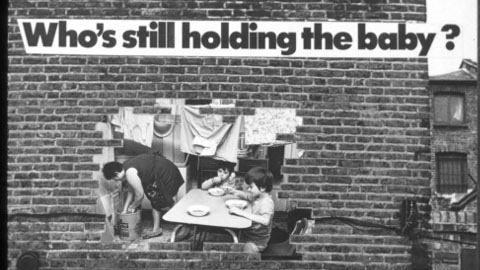
- Hackney Flashers, Who's still holding the baby?, 1978
They say it is love. We say it is unwaged work.
They call it frigidity. We call it absenteeism.
Every miscarriage is a work accident.
So reads a feminist pamphlet calling for Wages for Housework written by Silvia Federici in 1975. “We are all housewives because no matter where we are they can always count on more work from us, more fear on our side to put forward our demands, and less pressure on them for money, since hopefully our minds are directed elsewhere, to that man in our present or our future who will ‘take care of us.’”
Taking care in order to be taken care of. That was the deal of heteronormative love. Underpinning the romantic ideal was the domestic contract between the two parties of the heterosexual couple. Each partner entered into the relationship on the basis of a gendered agreement, a reproductive deal: she would cook, clean, have sex, bear children and care for him, while he was to pay the bills and fulfil his role as care-taker – then he could expect to be taken care of. Since the sexual revolution and tide of social change in the 1960s, feminist and queer struggles challenged the inequality and desirability of this set-up – that women’s housework was seen as the ‘labour of love’ undeserving of remuneration, whereas men’s work outside the home, brought both social agency and power in the home thanks to his wage.
The neoliberal restructuring of the state and the economy alongside the rise of the service industry and the entry of large numbers of women into (often low-)paid work have macerated this reproductive deal. If in a sense the nuclear family arrangement has crashed, it hasn’t so much been undone as it has been fragmented into its constituent parts, with the roles outsourced to different paid and unpaid assistive workers. Migrant cleaners, nannies and au-pairs, sex workers and psychotherapists shatter the middle-class myth of the self-sufficient couple. And it is still women who are doing much of this kind of work. Women, Arlie Hochschild wrote in The Managed Heart in 1984, have been taught to have an instrumentalised relationship to their feelings. It is these abilities that are easily put to work – and nowhere more than in the political economy of intimacy.
On Valentine's Day, Emma Dowling makes a powerful case for thinking about the structure of social relationships rather than simply 'the one'. Her excavation of the political economy of intimacy analyses how the ideology of work has penetrated the affective registers of our social lives, while at the same time, we are paying for capitalism's crisis as financialisation and austerity attack our structures of social reproduction. Drawing on feminist critiques of women's unwaged housework, Dowling assesses the uneven and gendered distribution of emotional labour today. Love's work, therefore, must be challenged and transformed: as our material precarity increases, rejecting precariousness in our love relations would be a start in building affective resistance and with that, other possible worlds of love and care.
- Hackney Flashers, Who's still holding the baby?, 1978
They say it is love. We say it is unwaged work.
They call it frigidity. We call it absenteeism.
Every miscarriage is a work accident.
So reads a feminist pamphlet calling for Wages for Housework written by Silvia Federici in 1975. “We are all housewives because no matter where we are they can always count on more work from us, more fear on our side to put forward our demands, and less pressure on them for money, since hopefully our minds are directed elsewhere, to that man in our present or our future who will ‘take care of us.’”
Taking care in order to be taken care of. That was the deal of heteronormative love. Underpinning the romantic ideal was the domestic contract between the two parties of the heterosexual couple. Each partner entered into the relationship on the basis of a gendered agreement, a reproductive deal: she would cook, clean, have sex, bear children and care for him, while he was to pay the bills and fulfil his role as care-taker – then he could expect to be taken care of. Since the sexual revolution and tide of social change in the 1960s, feminist and queer struggles challenged the inequality and desirability of this set-up – that women’s housework was seen as the ‘labour of love’ undeserving of remuneration, whereas men’s work outside the home, brought both social agency and power in the home thanks to his wage.
The neoliberal restructuring of the state and the economy alongside the rise of the service industry and the entry of large numbers of women into (often low-)paid work have macerated this reproductive deal. If in a sense the nuclear family arrangement has crashed, it hasn’t so much been undone as it has been fragmented into its constituent parts, with the roles outsourced to different paid and unpaid assistive workers. Migrant cleaners, nannies and au-pairs, sex workers and psychotherapists shatter the middle-class myth of the self-sufficient couple. And it is still women who are doing much of this kind of work. Women, Arlie Hochschild wrote in The Managed Heart in 1984, have been taught to have an instrumentalised relationship to their feelings. It is these abilities that are easily put to work – and nowhere more than in the political economy of intimacy.
14.02.2017


Wer war Seidenfaden?
Als im Januar 1827 Gerichtsdiener des Justizamtes Obernkirchen in den verschneiten Wäldern am Bückeberg eine notdürftig verscharrte Leiche entdeckten, nimmt einer der spektakulärsten Fälle der deutschen Kriminal- und Justizgeschichte seinen Lauf. Mehr als 10 Jahre sollte es dauern, bis das Verbrechen gesühnt und die Urteile vollstreckt waren.
Dabei macht nicht die Tat - ein Mord unter Dieben - diesen Fall so außergewöhnlich, sondern die Biographie des Täters.
Johann Heinrich Seidenfaden wurde 1797 in Rolfshagen geboren, und wuchs in einer Zeit auf, deren verbreitete Massenarmut später als „Pauperismus“ in die Geschichtsbücher einging.
Wie sein Komplize Wilhelm Mühlhaus entstammte auch er der sozialen Unterschicht, beide waren uneheliche Söhne hessischer Husaren und machten früh Bekanntschaft mit Verbrechen und Gefängnis.
Aus Angst vor Verrat ermordeten Seidenfaden und Mühlhaus 1825 im Wald bei Obernkirchen ihren Komplizen Wilhelm Faul.
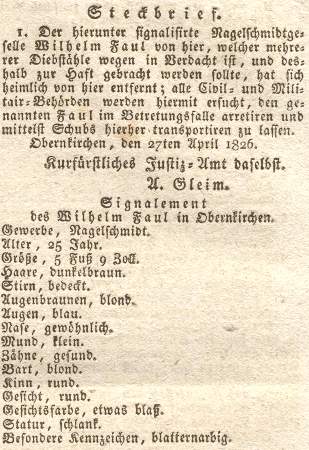
Steckbrief von Wilhelm Faul
(zu der Zeit war er im Bückeberg versteckt)Das Verbrechen wurde wenig später aufgedeckt, es folgte die Inhaftierung und 1831 das Todesurteil durch das Obergericht Rinteln.
Doch während Mühlhaus 1831 auf dem Rintelner Heinekamp vor den Toren der Stadt öffentlich enthauptet wurde, gelang Seidenfaden zuvor die Flucht aus dem Gefängnis und das Untertauchen in den Niederlanden.
Unter dem Namen „Wilhelm Wiggers“ trat er in die Dienste der niederländischen Armee ein, wo er sich im Niederländisch-Belgischen Sezessionskrieg, bewährte. Anschließend beorderte man ihn in die von Aufständen erschütterte südamerikanische Kolonie Surinam für den Wachdienst im Hafen von Paramaribo und die Jagd nach entlaufenen Sklaven.

Uniform eines westindischen Jägers um 1830
Dabei macht nicht die Tat - ein Mord unter Dieben - diesen Fall so außergewöhnlich, sondern die Biographie des Täters.
Johann Heinrich Seidenfaden wurde 1797 in Rolfshagen geboren, und wuchs in einer Zeit auf, deren verbreitete Massenarmut später als „Pauperismus“ in die Geschichtsbücher einging.
Wie sein Komplize Wilhelm Mühlhaus entstammte auch er der sozialen Unterschicht, beide waren uneheliche Söhne hessischer Husaren und machten früh Bekanntschaft mit Verbrechen und Gefängnis.
Aus Angst vor Verrat ermordeten Seidenfaden und Mühlhaus 1825 im Wald bei Obernkirchen ihren Komplizen Wilhelm Faul.
Steckbrief von Wilhelm Faul
(zu der Zeit war er im Bückeberg versteckt)Das Verbrechen wurde wenig später aufgedeckt, es folgte die Inhaftierung und 1831 das Todesurteil durch das Obergericht Rinteln.
Doch während Mühlhaus 1831 auf dem Rintelner Heinekamp vor den Toren der Stadt öffentlich enthauptet wurde, gelang Seidenfaden zuvor die Flucht aus dem Gefängnis und das Untertauchen in den Niederlanden.
Unter dem Namen „Wilhelm Wiggers“ trat er in die Dienste der niederländischen Armee ein, wo er sich im Niederländisch-Belgischen Sezessionskrieg, bewährte. Anschließend beorderte man ihn in die von Aufständen erschütterte südamerikanische Kolonie Surinam für den Wachdienst im Hafen von Paramaribo und die Jagd nach entlaufenen Sklaven.
Uniform eines westindischen Jägers um 1830
e-flux Architecture - Thomas Keenan - Or are we human beings?
Superhumanity
February 14, 2017

A club of patriotic French women assemble in a church during the French Revolution, 1973. Photo: Wikimedia Commons.
Perhaps you have been struck by the frequency and regularity with which people find it necessary to state what one might think was the most obvious thing in the world: that they are human beings, or that they would like to live like them.
Here's an example from the front lines of the so-called “refugee crisis” in Europe last March: "'May God take his revenge on them—everyone who did this to us—from whatever country they come from,' said Raife al-Baltajy, a Syrian from near Aleppo, as she waited for a bus with her family. 'May god take his vengeance out on them. Isn't it sinful? Are we animals? Or are we human beings?' She said she had been living in Syria for four years under the shelling, but traveled to Turkey, then to the Greek island of Lesbos, where she took a ferry to the mainland and on to Idomeni."1
Or this claim from another Syrian refugee who spoke out from his new home in the United States: "'I was born as a human and raised as a human. I have been in some situations that made me feel not like a human,' [Refaai Hamo, a civil engineer] said. 'I would like to grab any opportunity I can to prove I am a human being and if I don’t have that opportunity, I refuse to live anywhere I don’t feel like a human.'”2
How do we understand this repeated need of people in situations of displacement, conflict, and injustice, to ask others whether they, the speakers, are in fact human, which is to say, their need "to prove I am a human being"? What is going on when people say this? It seems obvious, but in fact it's one of the most complicated, enigmatic, unstable things that can possibly be said. We should not take its possibility for granted.
That said, people have been saying it, more or less, for a while. Versions of the claim have a long history—think back to Josiah Wedgewood's famous anti-slavery medallion of 1787, featuring a shackled African figure knelt in a plea and bearing the inscription "Am I not a man and a brother?," or to the even more economical signs borne by the Memphis, Tennessee sanitation workers on strike in the spring of 1968, "I am a Man." This rich provenance makes the utterance somehow even more perplexing: haven't we learned this yet? Why do people still need to say this? What accounts for the persistence of this claim?
To begin to understand and appreciate these words, "I am a human being," we need to back up and ask just what sort of speech act is being performed here. I will call it a claim, whether it's formulated as a question ("Am I not ..."), a desire ("we want to live like ..."), a simple declaration or an apparent tautology ("I am a ..."). In each case, the statement makes a claim, and a claim on others.
I would suggest that rights, especially what we call human rights, are better treated as things we claim rather than things we have. This may seem like a minor matter of words but I believe that it has the potential to challenge profoundly the ways we think about and act with the discourse of human rights. It does not weaken the force of these claims to admit that they are only, or just, that, claims; in fact, it might make them stronger by making them less essentialist, dogmatic, sacred, or as Michael Ignatieff once put it, idolatrous.3 I think this can help us appreciate a number of things, including: what it means to say that human rights are being “violated,” the fact that what counts as a right—and who counts as a rights-bearer—can and has varied so dramatically over time and place, the common experience that the would-be universality of rights is so hard to grasp, and the fact that rights language can serve to propel campaigns of domination and not just struggles against injustice.
![]()
Memphis sanitation workers, the majority of them African American, went out on strike on February 12, 1968, demanding recognition for their union, better wages, and safer working conditions after two trash handlers were killed by a malfunctioning garbage truck. As it dragged on through March, with the Memphis mayor refusing to negotiate, the strike gained national attention. As they marched, striking workers carried copies of a poster declaring “I AM A MAN,” a statement that recalled a question abolitionists posed more than 100 years earlier, “Am I not a man and a brother?”
A few years ago, introducing the mammoth photobook The Face of Human Rights, Walter Kalin economically summed up the contemporary status of his topic with this formulation: "Human rights are the product of an historical process which has not yet reached completion."4
Here the modesty of the concession to history is balanced, or even overwhelmed, by the confident faith in a progressive expansion signaled by the little phrase "as yet." The fact of incompletion is paradoxically the sign of more to come.
And yet we could detach this narrative of ongoing accomplishment from its teleology and see in it an important insight about human rights as a thought and practice: in spite, it seems, of their would-be eternality and universality, human rights are structurally incomplete, without fixed limits. This happens not despite this aspiration to universality, but because of it. The universe of their extent is not given in advance, and in fact we could say that the struggle to define its extents—which is in fact the struggle to determine who or what is and is not the subject or bearer of those rights—constitutes the story and the history of human rights. Because rights are a matter of claims, which is to say, disputations, and because those claims require evidence and demand assent, the subjects and the borders of rights are structurally in flux.
The contemporary world offers at least two contradictory answers to the question of how that "process" is coming along.
February 14, 2017
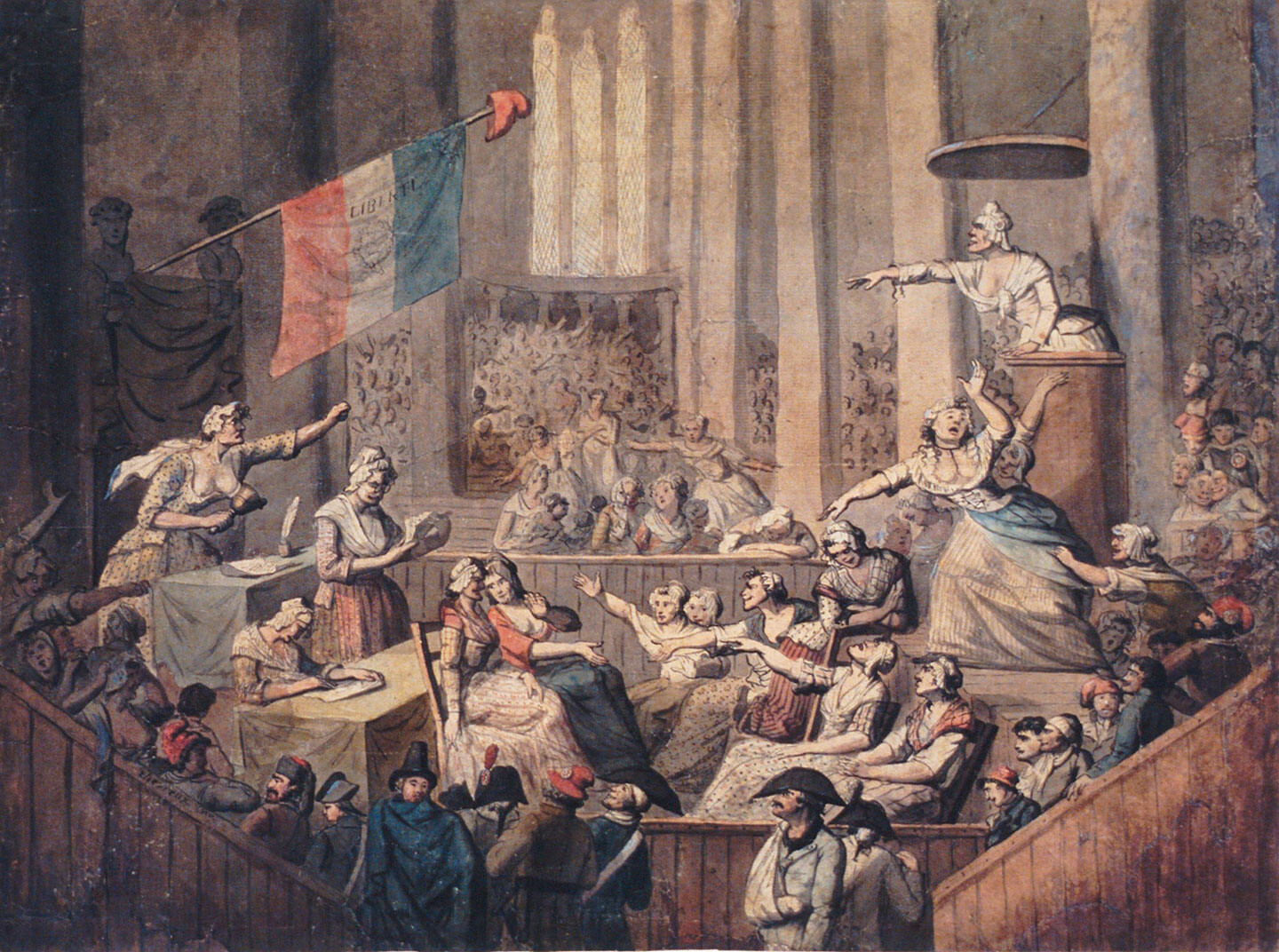
A club of patriotic French women assemble in a church during the French Revolution, 1973. Photo: Wikimedia Commons.
Perhaps you have been struck by the frequency and regularity with which people find it necessary to state what one might think was the most obvious thing in the world: that they are human beings, or that they would like to live like them.
Here's an example from the front lines of the so-called “refugee crisis” in Europe last March: "'May God take his revenge on them—everyone who did this to us—from whatever country they come from,' said Raife al-Baltajy, a Syrian from near Aleppo, as she waited for a bus with her family. 'May god take his vengeance out on them. Isn't it sinful? Are we animals? Or are we human beings?' She said she had been living in Syria for four years under the shelling, but traveled to Turkey, then to the Greek island of Lesbos, where she took a ferry to the mainland and on to Idomeni."1
Or this claim from another Syrian refugee who spoke out from his new home in the United States: "'I was born as a human and raised as a human. I have been in some situations that made me feel not like a human,' [Refaai Hamo, a civil engineer] said. 'I would like to grab any opportunity I can to prove I am a human being and if I don’t have that opportunity, I refuse to live anywhere I don’t feel like a human.'”2
How do we understand this repeated need of people in situations of displacement, conflict, and injustice, to ask others whether they, the speakers, are in fact human, which is to say, their need "to prove I am a human being"? What is going on when people say this? It seems obvious, but in fact it's one of the most complicated, enigmatic, unstable things that can possibly be said. We should not take its possibility for granted.
That said, people have been saying it, more or less, for a while. Versions of the claim have a long history—think back to Josiah Wedgewood's famous anti-slavery medallion of 1787, featuring a shackled African figure knelt in a plea and bearing the inscription "Am I not a man and a brother?," or to the even more economical signs borne by the Memphis, Tennessee sanitation workers on strike in the spring of 1968, "I am a Man." This rich provenance makes the utterance somehow even more perplexing: haven't we learned this yet? Why do people still need to say this? What accounts for the persistence of this claim?
To begin to understand and appreciate these words, "I am a human being," we need to back up and ask just what sort of speech act is being performed here. I will call it a claim, whether it's formulated as a question ("Am I not ..."), a desire ("we want to live like ..."), a simple declaration or an apparent tautology ("I am a ..."). In each case, the statement makes a claim, and a claim on others.
I would suggest that rights, especially what we call human rights, are better treated as things we claim rather than things we have. This may seem like a minor matter of words but I believe that it has the potential to challenge profoundly the ways we think about and act with the discourse of human rights. It does not weaken the force of these claims to admit that they are only, or just, that, claims; in fact, it might make them stronger by making them less essentialist, dogmatic, sacred, or as Michael Ignatieff once put it, idolatrous.3 I think this can help us appreciate a number of things, including: what it means to say that human rights are being “violated,” the fact that what counts as a right—and who counts as a rights-bearer—can and has varied so dramatically over time and place, the common experience that the would-be universality of rights is so hard to grasp, and the fact that rights language can serve to propel campaigns of domination and not just struggles against injustice.
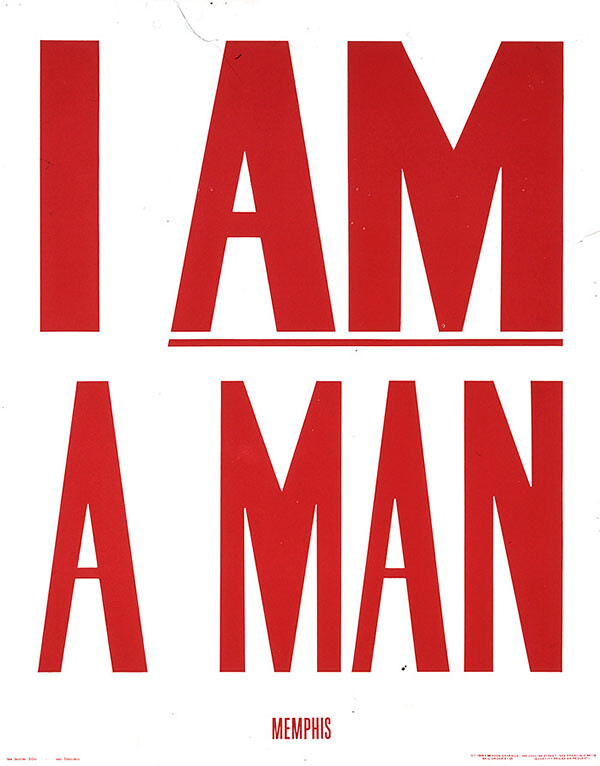
Memphis sanitation workers, the majority of them African American, went out on strike on February 12, 1968, demanding recognition for their union, better wages, and safer working conditions after two trash handlers were killed by a malfunctioning garbage truck. As it dragged on through March, with the Memphis mayor refusing to negotiate, the strike gained national attention. As they marched, striking workers carried copies of a poster declaring “I AM A MAN,” a statement that recalled a question abolitionists posed more than 100 years earlier, “Am I not a man and a brother?”
A few years ago, introducing the mammoth photobook The Face of Human Rights, Walter Kalin economically summed up the contemporary status of his topic with this formulation: "Human rights are the product of an historical process which has not yet reached completion."4
Here the modesty of the concession to history is balanced, or even overwhelmed, by the confident faith in a progressive expansion signaled by the little phrase "as yet." The fact of incompletion is paradoxically the sign of more to come.
And yet we could detach this narrative of ongoing accomplishment from its teleology and see in it an important insight about human rights as a thought and practice: in spite, it seems, of their would-be eternality and universality, human rights are structurally incomplete, without fixed limits. This happens not despite this aspiration to universality, but because of it. The universe of their extent is not given in advance, and in fact we could say that the struggle to define its extents—which is in fact the struggle to determine who or what is and is not the subject or bearer of those rights—constitutes the story and the history of human rights. Because rights are a matter of claims, which is to say, disputations, and because those claims require evidence and demand assent, the subjects and the borders of rights are structurally in flux.
The contemporary world offers at least two contradictory answers to the question of how that "process" is coming along.
A Decorative Cosmology Bridging Heaven and Earth
In her new exhibition, Tamara Gonzales continues to mine our material culture to chart the world all around.
 A view of Tamara Gonzeles’s Ometeotl exhibition (all images by the author for Hyperallergic)
At the heart of Tamara Gonzales‘s new body of work at Klaus von Nichtssagend Gallery is a room of tapestries woven by artisans in the Peruvian towns of Písac and Ayacucho. They are vibrant interpretations of the artist’s drawings and they add yet another layer to the decorative language she continues to mine from the material world around her.
Gonzales is known for incorporating visual culture that has traditionally been more associated with lived culture — lace, graffiti, embroidery, textiles — rather than the world of art galleries. A large functional maraca is propped up by the entrance, which signals the inclusive and non-hierarchal attitude towards influence she celebrates in her work. A large maraca sculpture near the entrance of the exhibition, “Maraca más grande con plumas” (2016)
Past the over-sized maraca, there is a corridor of small drawings dominated by a curvilinear window motif that offers her a compositional frame to puncture, cover, and react to. But even with this structure, the drawings have an experimental energy that pokes and pushes, often jostling forms that resemble easter eggs, stick figures, plants, or the scribblings of a rudimentary language.
Her true subject matter is the material world. She has an indiscriminate appetite for cross-cultural pollination and distills the dissonance of contemporary life into these objects that can seem as jarring as they are soothing.
The title of the exhibition, Ometeotl, refers to a nebulous concept of spirituality that some scholars of Mesoamerican culture dispute, but it is commonly believed to refer to the “creator of all creation” for the Anawak people and a compound of “dual” and “cosmic energy” in the native language of Nahuatl. That ambiguity of the term perfectly reflects the primordial soup that has spawned these works, at once mythic, while relishing their connection to earthly forms.
Looking at her paintings, you can feel unmoored from the boundaries of form as they swim in waves of moody azure, crimson, and the muddy waters of darker hues. The paintings vibrate and ripple in your mind’s eye as they play with proportion — always challenging the relationship of ground and subject — to settle visually like a shaken snow globe. Many of the large paintings, like “Two Moons” (2016), feel contradictory, contrasting the washes of violet paint against the frenzy of patterns that form the sky and ground for a setting Mesoamerican roundel.
The showstoppers, though, are the tapestries. Gonzales’s starry fields and human-like forms are translated into undulating visions of horror vacui. They are her best works yet, offering us a unique synthesis of the world around her but allowing it to develop into these intensely colored objects (she says the women doing the embroidery were given free reign to translate her drawings, based on patterns they normally embroider). The works, which are all untitled and made of alpaca and wool, convey a sense of cosmic cartography. If anything, the embroideries make the paintings seem more conventional, showing how her many bodies of work may overlap but travel in different directions.
The paintings are declarations of the known, the drawings are suggestions of what can be known, while the woven works are proposals for what we may never ever truly know. Tamara Gonzales, “Two Moons” (2016)
 Tamara Gonzales, “I Am the Hummingbird” (2016)
 The room of embroidered works
 Tamara Gonzales’s untitled drawing (2015) and the related untitled tapestry (2016)
Untitled tapestry (2016)
A view of Tamara Gonzeles’s Ometeotl exhibition (all images by the author for Hyperallergic)At the heart of Tamara Gonzales‘s new body of work at Klaus von Nichtssagend Gallery is a room of tapestries woven by artisans in the Peruvian towns of Písac and Ayacucho. They are vibrant interpretations of the artist’s drawings and they add yet another layer to the decorative language she continues to mine from the material world around her.
Gonzales is known for incorporating visual culture that has traditionally been more associated with lived culture — lace, graffiti, embroidery, textiles — rather than the world of art galleries. A large functional maraca is propped up by the entrance, which signals the inclusive and non-hierarchal attitude towards influence she celebrates in her work.
A large maraca sculpture near the entrance of the exhibition, “Maraca más grande con plumas” (2016)Past the over-sized maraca, there is a corridor of small drawings dominated by a curvilinear window motif that offers her a compositional frame to puncture, cover, and react to. But even with this structure, the drawings have an experimental energy that pokes and pushes, often jostling forms that resemble easter eggs, stick figures, plants, or the scribblings of a rudimentary language.
Her true subject matter is the material world. She has an indiscriminate appetite for cross-cultural pollination and distills the dissonance of contemporary life into these objects that can seem as jarring as they are soothing.
The title of the exhibition, Ometeotl, refers to a nebulous concept of spirituality that some scholars of Mesoamerican culture dispute, but it is commonly believed to refer to the “creator of all creation” for the Anawak people and a compound of “dual” and “cosmic energy” in the native language of Nahuatl. That ambiguity of the term perfectly reflects the primordial soup that has spawned these works, at once mythic, while relishing their connection to earthly forms.
Looking at her paintings, you can feel unmoored from the boundaries of form as they swim in waves of moody azure, crimson, and the muddy waters of darker hues. The paintings vibrate and ripple in your mind’s eye as they play with proportion — always challenging the relationship of ground and subject — to settle visually like a shaken snow globe. Many of the large paintings, like “Two Moons” (2016), feel contradictory, contrasting the washes of violet paint against the frenzy of patterns that form the sky and ground for a setting Mesoamerican roundel.
The showstoppers, though, are the tapestries. Gonzales’s starry fields and human-like forms are translated into undulating visions of horror vacui. They are her best works yet, offering us a unique synthesis of the world around her but allowing it to develop into these intensely colored objects (she says the women doing the embroidery were given free reign to translate her drawings, based on patterns they normally embroider). The works, which are all untitled and made of alpaca and wool, convey a sense of cosmic cartography. If anything, the embroideries make the paintings seem more conventional, showing how her many bodies of work may overlap but travel in different directions.
The paintings are declarations of the known, the drawings are suggestions of what can be known, while the woven works are proposals for what we may never ever truly know.
Tamara Gonzales, “Two Moons” (2016)Tamara Gonzales, “I Am the Hummingbird” (2016)The room of embroidered worksTamara Gonzales’s untitled drawing (2015) and the related untitled tapestry (2016)Untitled tapestry (2016)
11.02.2017
2nd Annual Black Feminism, Womanism and the Politics of Women of Colour in Europe
2nd Annual Black Feminism, Womanism and the Politics of Women of Colour in Europe
A One-Day symposium | Amsterdam, 7th October 2017

2nd Annual Black Feminism, Womanism, and the Politics of Women of Colour in Europe
A One-Day Symposium
Saturday, 7th October 2017,
Amsterdam, The Netherlands
In September 2016 in Edinburgh, we welcomed over 100 activists, practitioners, artists and scholars to critically debate contemporary Black feminist and womanist theories and practices in Europe. Our first event demonstrated the possibilities of building solidarity across race, class, gender, sexuality and legal status. However, the symposium also highlighted the inter-generational tensions between veteran and newer activists and scholars about how to build and sustain inclusive and democratic Black feminist spaces for education and action.
For our second symposium, we seek to expand and deepen our debates about the theory and practice of Black feminism and womanism in Europe but also spotlight the very real conflicts between different types of women who identify as Black feminists and womanists. Our aim is to examine how we might build community, collective strategies for survival and a politics for social justice in an unstable European context wracked by a variety of crises linked to austerity measures, racist and xenophobic public discourses about migration and the rise of far right political parties and groups.
We seek activist narratives, academic papers, practice-based reflections and art/music/film contributions related, but not limited, to:
Theorising European Black feminism and womanism
Gendering racial capitalism
Building Black feminist and womanist activist spaces
Black feminism and sex work
Women of colour and the European racial contract
Developing transnational, intersectional and intergenerational coalitions
Queering European Black feminism and womanism
Race, gender and affective relations
Gendering migration experiences
Women of colour and digital diasporas
Black feminism and Black Lives Matter in Europe
Black feminism and trans* women’s rights
Women of colour and anti-fascist resistance
Please send titles and abstracts of no more than 300 words, which include your name, affiliation and contact details to woceuropeconference@gmail.com by Monday 3rd April 2017.
Organising committee
Akwugo Emejulu, University of Warwick
Marly Pierre-Louis, Tracian Miekle, and Lene Hypolite, Amsterdam Black Women’s Meet-Up
A One-Day symposium | Amsterdam, 7th October 2017
2nd Annual Black Feminism, Womanism, and the Politics of Women of Colour in Europe
A One-Day Symposium
Saturday, 7th October 2017,
Amsterdam, The Netherlands
In September 2016 in Edinburgh, we welcomed over 100 activists, practitioners, artists and scholars to critically debate contemporary Black feminist and womanist theories and practices in Europe. Our first event demonstrated the possibilities of building solidarity across race, class, gender, sexuality and legal status. However, the symposium also highlighted the inter-generational tensions between veteran and newer activists and scholars about how to build and sustain inclusive and democratic Black feminist spaces for education and action.
For our second symposium, we seek to expand and deepen our debates about the theory and practice of Black feminism and womanism in Europe but also spotlight the very real conflicts between different types of women who identify as Black feminists and womanists. Our aim is to examine how we might build community, collective strategies for survival and a politics for social justice in an unstable European context wracked by a variety of crises linked to austerity measures, racist and xenophobic public discourses about migration and the rise of far right political parties and groups.
We seek activist narratives, academic papers, practice-based reflections and art/music/film contributions related, but not limited, to:
Theorising European Black feminism and womanism
Gendering racial capitalism
Building Black feminist and womanist activist spaces
Black feminism and sex work
Women of colour and the European racial contract
Developing transnational, intersectional and intergenerational coalitions
Queering European Black feminism and womanism
Race, gender and affective relations
Gendering migration experiences
Women of colour and digital diasporas
Black feminism and Black Lives Matter in Europe
Black feminism and trans* women’s rights
Women of colour and anti-fascist resistance
Please send titles and abstracts of no more than 300 words, which include your name, affiliation and contact details to woceuropeconference@gmail.com by Monday 3rd April 2017.
Organising committee
Akwugo Emejulu, University of Warwick
Marly Pierre-Louis, Tracian Miekle, and Lene Hypolite, Amsterdam Black Women’s Meet-Up

Womanism

Unification is a key cornerstone of Womanist ideology.
Womanism is a social theory based on the racial and gender-based oppression of black women, and other women of marginalized groups. There are varying interpretations of the term "womanist", and efforts to provide a concise and all encompassing definition have only been marginally successful. At its core, womanism hones in on the everyday issues and experiences of both black women and women of marginalized groups, but more importantly, womanism hopes to create an even-leveled environment for all people.[1]
Theory[edit]
Author and poet Alice Walker is credited with coining the term "womanist". From the original introduction of womanism as a social perspective, the term has evolved to envelop varied, and sometimes opposing definitions. Linda Hogan asserts that the term womanist has come to represent a feminist of color, specifically black women, since the Feminist Movement has been experienced by many as intrinsically racist.[2] While feminismcan be alienating to minorities, womanism allows black women to affirm and celebrate their color and culture in a way that feminism does not.[2] In the words of theorists such as Clenora Hudson-Weems and Alicia Boisnier, Black women struggle to identify with traditional feminism, because they do not identify with the issues that feminism typically advocates.[3] Alternatively, Delores Williams, a womanist theologian, associates womanism with the traditions and activism formed from the conditions, events, meanings and values within the African-American community. Williams further asserts that the task of the Womanist theologian is to embody activism by seeking out the voices of the unheard and the experiences of the neglected. She identifies the distinct difference between the experiences of the black woman and the white woman that makes it difficult to identify with feminism. One of the key components of feminism is to end a woman's subjugation to her male counterpart, yet there are other oppressive forces that black women face that takes precedence over the perceived subjugation of the black woman by the black man.[2] This represents an expectation and experience of the black woman as one filled with the quest for knowledge, competence, and authority that surpasses the individual, but encompasses the group.[4] This idea of community rather than individuality is further illustrated by the portrayal of a woman as the embodiment of her environment.[1] In this way womanism does not focus indiscriminately on the experiences of black woman, but desires the reconciliation of all people to their spirituality, their relationships with each other, and their relationship with nature. It characterizes women as willful and capable thereby contrasting the image of a women as subservient and inferior.[5] In doing so, womanism empowers women, and challenges them to break from the traditional definition of womanhood.
10.02.2017
Histoire des Robes , 1990

Annette Messager (French, born 1943) Title:
Histoire des Robes , 1990 Medium: dress and photographs Size: 99 x 156 cm. (39 x 61.4 in.)
06.02.2017
Willem de Rooij: Blue to Black (2013) and Black to Blue (2015)


In particular, two large-scale sublime textiles Blue to Black (2013) and Black to Blue (2015) trace the global legacy of the Dutch colonial project, looking at textile industries in Ghana and Indonesia where one of the two works was produced with the support of the IMA. More recent developments in de Rooij’s work with hand-woven fabrics can be seen in the series of seven stretched textiles shaped as tangrams (a Chinese dissection puzzle). In this body of work from 2015, hand-spun thread in two colours form the warp and weft to create rich monochromes. Also investigating the ambiguous relations between colour and "meaning" is the iconic work Orange, created by de Rijke/de Rooij in 2004 (his collaboration with Jeroen de Rijke, 1994–2006). This series of slides use a single colour to make reference to an expansive range of subjects. Bouquet XVI (2015), is a monumental dried floral arrangement, sourced locally, that reveals the artist’s multilayered and complex approach to materials and concepts, referencing climate, drought, and the still-life tradition so prominent in Dutch art history. In a surreal twist, Farafra (2013), extends the presence of the natural world through sound.
Since 2009, the artist has taken his inspiration from the structural polarity of woven fabric and thus initiated a reflection around contrast and nuance. These weavings aim to generate meaning through the material they are made of, not through external references. For this exhibition, Willem de Rooij presents four handwoven works and a large wax print on cotton.
Rather than a treated surface, like that of a painting, these woven works are created by use of different mixtures of synthetic polyester sewing thread. Conceived as one installation, the five works make use of the same two colors : black and blue.
The monochromatic appearance of the weavings on closer inspection reveals a gradual transition from one shade of colour to another. The colorimetric modulations facilitate constant shifts in the viewer’s perception of the works on show. Taken in their entirety, they embody sameness as well as difference, the individual and the collective.
The weavings presented at the Chantal Crousel Gallery are part of a larger series, for the creation of which Willem de Rooij restrained himself to a limited number of colors and sizes. The titles of the works, often anagrams derived from names of locations or persons connected to the work add to the myriad cross-references between the various works in this series.
Produced especially for this exhibition, the wax print Blue to Black reminds of former colonial trade-routes and the resulting migration patterns between Asia, Africa and Europe.
In the 19th century Dutch colonial trading companies industrialized the traditional Indonesian Batik fabric printing process. While buyers in Indonesia proved resistant to the mechanical produce, new markets opened in West Africa, where the printed fabrics remain popular also today. Blue to Black was produced by the Ghana Textile Printing Company (GTP) in Tema, Ghana. GTP is owned by a Dutch firm even today; in this line of industry, ancient colonial structures are still at work.
Over the last five years, the notion of "referentiality", or the development of strategies to bypass external references became important elements in de Rooij’s work. Throughout his career, the artist has analyzed the conventions of presentation and representation and assesses the tension between sociopolitical and autonomous image production.
About the artist
Willem de Rooij, born 1969 in Beverwijk, the Netherlands, now lives and works in Berlin, Germany. De Rooij studied art history at the University of Amsterdam and art at the Gerrit Rietveld Academie and the Rijksakademie in Amsterdam. He is currently Professor of Fine Art at the Städelschule, Frankfurt am Main and Guest Advisor at the Rijksakademie, Amsterdam. In 2014 he was nominated for the Vincent Award, Gemeentemuseum Den Haag, The Hague. Recent solo exhibitions include: Entitled (2016), MMK Museum für Moderne Kunst, Frankfurt, Germany; The Impassioned No (2015), Le Consortium, Dijon, France; Character Is Fate (2015) Witte de With, Rotterdam, the Netherlands; Index: Riots, Protest, Mourning and Commemoration (2014), Arnolfini, Bristol, UK; Using Walls, Floors and Ceilings(2014), the Jewish Museum, New York, USA; Farafra (2013), Bergen Kunsthall, Bergen, Norway; Untitled (2012) at Kunstverein München, Munich; Crazy Repelled Firelight (2011), Friedrich Petzel Gallery, New York, USA; and Intolerance (2010) at Neue Nationalgalerie, Berlin, Germany.
Abonnieren
Posts (Atom)