Untold Stories – Interview with Jacqueline Bishop – Part 1
September 4, 2016 veerlepoupeye2 Comments
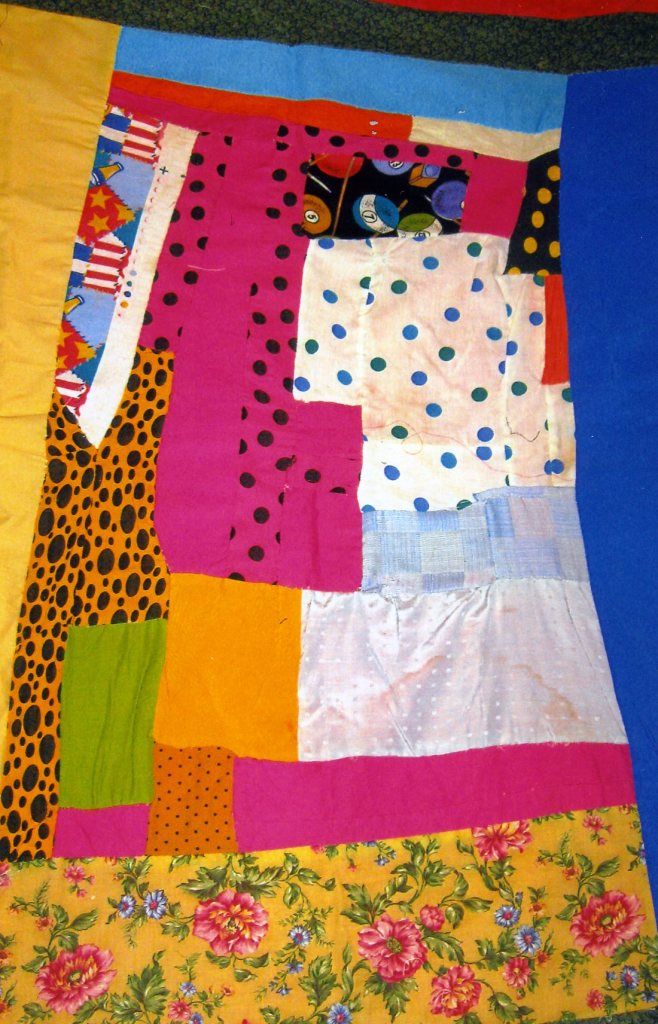
Patchwork by Celeste Walker, great grandmother of Jacqueline Bishop
In November 2015, I conducted an interview with Jacqueline Bishop, coming out of our conversations about the “Explorations IV: Seven Women Artists” exhibition at the National Gallery. That exhibition, among other things, asked why there is so little consideration, in the (art-)historical and material record, for the material creative production of Jamaican women, other than what has been consecrated as “fine art.” And what has been so consecrated is constrained by narrow definitions of art and, closely related to that, a myopic, class-based view of who is an “artist.” This somehow seems to affect women’s creative production more than men’s — almost all the artists who have been recognized as “Intuitives” are men, for instance, in part because they more typically work in media that can be recuperated as “fine art” such as “painting” and “sculpture.” Another reason is that women’s social roles have traditionally been defined differently across the class spectrum, with little space or recognition given to creative expressions of lower class women. This is a very rich, complex and barely explored topic that needs to be explored further and I intend to make other contributions on this blog. Not surprisingly, what should have been a short interview for publication in a newspaper became a lengthy conversation – some fourteen pages of copy in all – that could not be edited down easily. Jacqueline and I have decided to share the interview with you, in two parts – both of them still long for a blog, but we hope that you will find it a rewarding read, which will inspire you to ask further questions and perhaps even to delve into your own family history. Enjoy!
VP: Jacqueline, some time ago we had a conversation about the untold stories in art in Jamaica, particularly with regards to women’s contributions, and your family’s quilt-making history came up. Please tell me about this family tradition and how you became involved?
JB: When I was growing up in Jamaica, I would be sent to the country for the summer holidays. In the country were my great grandparents and my grandmother, as well as numerous aunts, uncles and cousins. I could sleep at one of two houses: I could stay with my great grandparents in Nonsuch or with my grandmother a mile and a half away in Cambridge. This is in the parish of Portland.
In Nonsuch my great grandmother would be sewing together these pieces of cloth to make patchworks, but at the time I did not know it as art. My great grandmother, whose name was Celeste, would just be sewing together these things and using them on beds in her house. I have been conducting oral history interviews with my family members and what I have found out in doing these interviews is that sewing was integral to the women in our family — my grandmother, my great grandmother and such. My grandmother’s sister, Aunt Theresa, tells me that sewing was one skill that was passed down from one generation to another in my family, and even my Uncle Moses tells me that my great grandmother would have him — a boy child — making patchworks and beautiful multi-coloured mats made from small bits of fabric drawn through crocus bag/burlap sack. So I think that patchwork making and mat-making was something that was passed down for generations in my family. Now I have patchworks that my great grandmother made, patchworks from my grandmother, and there are several that I have made in response to these quilts. Altogether there are now 35 quilts from my family, and I feel just so happy to have them. Quilt by Jacqueline Bishop
I can locate the exact moment that I became interested in this family tradition. It was during my junior year in college when I went abroad to live in Paris. In France I started reading the works of, among others, the writer Alice Walker who wrote an essay called “In Search Of Our Mother’s Garden.” In that essay Walker venerated the African American quilts that her mother and other women around her was making in Georgia. She wrote of these quilts as being a vernacular art form that partly answered the question of just what was the art that oppressed African American women had made? For Walker, and eventually for myself too, these quilts were a large part of the answer to that question. Indeed as I read Walker’s essay I was transported back to Nonsuch, to these things that my great grandmother had made. And that was when my interest in the patchworks that my great grandmother had made became very important for me.
In time as I went to graduate school to become an artist I would harken back to these quilts of my great grandmother’s and I would make quilts in conversation with my great grandmother’s patchworks. As I started showcasing these quilts in exhibitions in several countries this provoked questions about my great grandmother that I did not then have answers to. I turned to my grandmother Emma to answer these questions, and eventually she got interested in making patchworks too, as she had grown up with her mother making these things and her mother had shown her how to make these patchworks and that is how I come to have in my possession a collection of patchworks from my great-grandmother and my grandmother. Patchwork by Emma Chin-See – grandmother of Jacqueline Bishop
September 4, 2016 veerlepoupeye2 Comments
Patchwork by Celeste Walker, great grandmother of Jacqueline Bishop
In November 2015, I conducted an interview with Jacqueline Bishop, coming out of our conversations about the “Explorations IV: Seven Women Artists” exhibition at the National Gallery. That exhibition, among other things, asked why there is so little consideration, in the (art-)historical and material record, for the material creative production of Jamaican women, other than what has been consecrated as “fine art.” And what has been so consecrated is constrained by narrow definitions of art and, closely related to that, a myopic, class-based view of who is an “artist.” This somehow seems to affect women’s creative production more than men’s — almost all the artists who have been recognized as “Intuitives” are men, for instance, in part because they more typically work in media that can be recuperated as “fine art” such as “painting” and “sculpture.” Another reason is that women’s social roles have traditionally been defined differently across the class spectrum, with little space or recognition given to creative expressions of lower class women. This is a very rich, complex and barely explored topic that needs to be explored further and I intend to make other contributions on this blog. Not surprisingly, what should have been a short interview for publication in a newspaper became a lengthy conversation – some fourteen pages of copy in all – that could not be edited down easily. Jacqueline and I have decided to share the interview with you, in two parts – both of them still long for a blog, but we hope that you will find it a rewarding read, which will inspire you to ask further questions and perhaps even to delve into your own family history. Enjoy!
VP: Jacqueline, some time ago we had a conversation about the untold stories in art in Jamaica, particularly with regards to women’s contributions, and your family’s quilt-making history came up. Please tell me about this family tradition and how you became involved?
JB: When I was growing up in Jamaica, I would be sent to the country for the summer holidays. In the country were my great grandparents and my grandmother, as well as numerous aunts, uncles and cousins. I could sleep at one of two houses: I could stay with my great grandparents in Nonsuch or with my grandmother a mile and a half away in Cambridge. This is in the parish of Portland.
In Nonsuch my great grandmother would be sewing together these pieces of cloth to make patchworks, but at the time I did not know it as art. My great grandmother, whose name was Celeste, would just be sewing together these things and using them on beds in her house. I have been conducting oral history interviews with my family members and what I have found out in doing these interviews is that sewing was integral to the women in our family — my grandmother, my great grandmother and such. My grandmother’s sister, Aunt Theresa, tells me that sewing was one skill that was passed down from one generation to another in my family, and even my Uncle Moses tells me that my great grandmother would have him — a boy child — making patchworks and beautiful multi-coloured mats made from small bits of fabric drawn through crocus bag/burlap sack. So I think that patchwork making and mat-making was something that was passed down for generations in my family. Now I have patchworks that my great grandmother made, patchworks from my grandmother, and there are several that I have made in response to these quilts. Altogether there are now 35 quilts from my family, and I feel just so happy to have them.
Quilt by Jacqueline Bishop I can locate the exact moment that I became interested in this family tradition. It was during my junior year in college when I went abroad to live in Paris. In France I started reading the works of, among others, the writer Alice Walker who wrote an essay called “In Search Of Our Mother’s Garden.” In that essay Walker venerated the African American quilts that her mother and other women around her was making in Georgia. She wrote of these quilts as being a vernacular art form that partly answered the question of just what was the art that oppressed African American women had made? For Walker, and eventually for myself too, these quilts were a large part of the answer to that question. Indeed as I read Walker’s essay I was transported back to Nonsuch, to these things that my great grandmother had made. And that was when my interest in the patchworks that my great grandmother had made became very important for me.
In time as I went to graduate school to become an artist I would harken back to these quilts of my great grandmother’s and I would make quilts in conversation with my great grandmother’s patchworks. As I started showcasing these quilts in exhibitions in several countries this provoked questions about my great grandmother that I did not then have answers to. I turned to my grandmother Emma to answer these questions, and eventually she got interested in making patchworks too, as she had grown up with her mother making these things and her mother had shown her how to make these patchworks and that is how I come to have in my possession a collection of patchworks from my great-grandmother and my grandmother.
Patchwork by Emma Chin-See – grandmother of Jacqueline Bishop 

