Posts mit dem Label pflanzer werden angezeigt. Alle Posts anzeigen

09.04.2016

Chapter 2: White society.

Boeroes

LIFE IN THE SHADOWS
Slavery and slave culture in Surinam
Wednesday, April 2, 2008
The search for immigrants.
Skewed statistics.

This chapter focuses on the white masters, most of the others on the subservient blacks. It is necessary to understand the former, in order to understand the latter. The white overlords in slave societies were able to lay down the rules much more strictly than any other elite in history. The slaves might oppose the rules, but they were seldom able to change them fundamentally.


From the beginning, Surinam has displayed the characteristics of a plantation colony. One of the main distinguishing traits of such a society was the skewed ratio of black and white, man and woman, slave and free. A severe shortage of white settlers, especially women, was inevitable in these conditions and the authorities were acutely aware of this. In an exploitation colony, there usually was no genuine niche for white yeoman farmers and there were only limited opportunities for artisans and traders, in fact, for all workers not directly involved in plantation agriculture. For impoverished people, living in difficult circumstances but not starving, such a colony provided few prospects. Furthermore, the people in the Low Countries had a negative image of the tropical world in general: they saw it as a white man’s graveyard infested with dangerous subhuman beings. A person had to be extremely desperate, or extremely eager to make a fortune to venture there. Consequently, the push factors for emigration were not very strong in the Netherlands. As Charles Boxer has noted: “although the wages were usually very low and working hours very long, unemployment in the Northern Netherlands was never sufficiently severe to induce industrial and agricultural workers to emigrate on an adequate scale to the overseas possessions of the Dutch East and West India Companies.” However, small as the white minority in Surinam may have been (and it was always too small in the eyes of the men in power), its superior position, although sometimes a bit shaky, was never seriously threatened during the slavery era.

Unfortunately, the collection of statistics in colonial Surinam was very erratic. For most of the earlier years, the number of whites must be projected and finer distinctions cannot be made. For the years 1700 to 1745, however, we have the annual count of Whites and Red and Black Slaves, contained in the archives of the Society of Surinam. The soldiers were omitted from these counts, although they made up nearly half of the white population for most of this period. During the rest of the 18th century, the number of whites remained fairly stationary, although a large part of the plantation owners left. The statistics of the 19th century provide even more problems, because the population was often merely divided into slaves and free people and most of the figures pertained to Paramaribo only. In 1811, the English held the first census in Surinam history, which delivered a much more accurate picture. As a result, the population curve can only be drawn with the greatest hesitation. The most important conclusion nevertheless remains the same: the number of whites in the colony was always so low that they were painfully aware of the vulnerability of their position -and acted accordingly.

The only period during which it was not difficult to attract sufficient settlers to Surinam were the years of the Willoughby-colonization. In Barbados, where sugar production expanded quickly at the time, many white farmers were pushed from their small holdings by more powerful neighbours and indentured servants found no place to settle after the expiration of their contracts. These people were keen to join such a venture. Since they were experienced colonists and had already survived the first dangerous years in a tropical climate, they prospered. In 1665, Surinam counted 4000 inhabitants, of whom 1500 were capable of bearing arms (meaning they were free white men). A terrible epidemic cut their number in half and the departure of most of the English colonists after the Zeelandian occupation left Surinam practically depleted of white settlers. Therefore, the authorities spared no measure to lure new hopefuls.

29.03.2016

Seventeenth-Century Dutch


http://www.hnanews.org/archive/2009/04/brienen.html
Rebecca Parker Brienen, Visions of Savage Paradise: Albert Eckhout, Court Painter in Colonial Dutch Brazil. Amsterdam: Amsterdam University Press, 2006. 288 pp, 17 color, 72 b&w illus. ISBN 978-90-5356-947-4 and 978-90-5356-947-2.

Julie Berger Hochstrasser, Still Life and Trade in the Dutch Golden Age. New Haven and London: Yale University Press, 2007. 320 pp, 69 color, 97 b&w illus. ISBN 978-0-300-10038-9.

Rebecca Parker Brienen's Visions of Savage Paradise: Albert Eckhout, Court Painter in Colonial Dutch Braziland Julie Berger Hochstrasser's Still Life and Trade in the Dutch Golden Age are, in some ways, two sides of the same coin: they examine effects – the visual documentation – of exotic travel and exploration by the Dutch in the seventeenth century. Hochstrasser examines the impact of the Dutch East India Company (VOC from the Dutch initials) trading with India, Indonesia and China, and the Dutch West India Company (WIC) in the Americas, largely in terms of items that were brought back to Europe (sugar, tea, tobacco, etc.) and their subsequent appearance in paintings. Brienen concentrates on the artist Albert Eckhout in Brazil and the role of the West India Company there. (Indeed, Hochstrasser also includes a discussion on Eckhout within the more lengthy discussion of the Dutch Brazilian colony.)

We get a glimpse of the exotic from the very beginning of Brienen's Introduction, in which she proposes that we imagine Eckhout's arrival with the artist Frans Post and the colony's new governor, Johan Maurits in Recife, Brazil, in 1637, and those who may have come to greet the ship: merchants, employees of the WIC, "Portuguese planters, members of the Jewish Community, African slaves, free people of mixed ethnic background and representatives of local indigenous groups" – with squawking flocks of green parrots flying overhead and in view of passion flowers and papayas. The color, sounds and wonders of this world even today, more than 450 years later, are still exotic. Although Brienen's focus is Eckhout, she provides a larger context for this western artist's life and predecessors in Brazil and fields the issue of his "ethnographic art."

Brienen's book should also be considered with the 2004 exhibition catalogue, Albert Eckhout, A Dutch Artist in Brazil (ed. Quentin Buvelot), for the exhibition at the Mauritshuis, The Hague, which covers much the same material and acknowledges Brienen's previous work. The larger format of that catalogue and its many larger and detailed illustrations make it more accessible – but it cannot replace Brienen's book. They cover much the same material but do not entirely agree (the artist's birth year, in fact, is a contentious point – Brienen thinks c. 1607, not c. 1610), and the focus in the exhibition (despite its title) is really on the patron and the WIC.

Brienen discusses possible explanations for Eckhout's extraordinary paintings and the possibility of a pictorial cycle – including eight "ethnographic life-size paintings for a 'princely chamber' for Vrijburg Palace." Later, these and other works (26 in all) would be a gift of the Count Johan Maurits to his cousin Frederick III of Denmark for his kunstkamer (and they remain in Copenhagen today). Other works also went to Louis XIV of France and the Elector of Brandenburg. The wonder of the Brazilian world – its people, flora, vegetation – created a universal desire and one that Maurits could barter for money and title.

Africans and multi-ethnic Brasilianen, Tapuyas and Tupinamba peoples and those called Mulattos and Mameluca of the New World are the subject of Eckhout's stunning life-size paintings. To what degree should we hold Eckhout accountable for a realistic portrait of them? And are these men and women slaves or free? Are they even "noble free" people? The role of African slaves in Brazil and labor for the WIC is integral to her study – as it is critical, with a different slant, for Hochstrasser. But as Brienen points out – and Hochstrasser stresses – this Dutch colony could not have successfully existed without slavery. Over 60,000 African slaves were reportedly laboring in the Dutch-occupied Pernambuco (Brazil) by mid-century. The Dutch Court and the WIC did much to cement relations with the Congo and Angola to assure West African slave trade. From 1634 onwards, the WIC was actively involved in the importation of slaves into the Americas.

This information is also critical to Hochstrasser's theme from the beginning. As commodities (lavishly illustrated) are her central concentration (with chapters on the VOC and the WIC) her subheadings are: cheese, herring, beer (local); grain, lemons (also oranges – via Europe); pepper, porcelain, tea (via VOC); and salt, tobacco, sugar (via WIC). We should not be surprised to see that the subheading slaves as a commodity (via WIC), was a necessary one. In each case, Hochstrasser uses Dutch (and Flemish) still-life painting to show how and when the commodities appeared through trade. In the midst of Chinese porcelain and Turkish carpets, the use of black Africans in painting is likened to the display of a commodity as part of "riches from abroad." She unequivocally states that everyone who even invested in the WIC was involved in the slave trade. One cannot separate one aspect of it from another. The slave trade is not just apparent in the presence of Africans in paintings, but in the presence of other commodities that were only available as a result of slave labor.

Hochstrasser investigates the commodities in depth – as they are seen, as they were traded, where they came from, their mention in diaries, diets, documents, poems, prints, and their relation to Spanish, Portuguese, and English traders' ships. Not only will one not look at still-life the same way – one will not even look at salt the same way! And certainly not sugar (and the spun-sugar sweets in still-life painting), since often it was the sugar production that was the reason for the grueling life of plantation slave labor in Brazil. Although the Dutch did not begin the slave trade, by the 1630s they were well into it. The wealth of the Golden Age, all set before us in pronkstilleven, could not have been available without it.

With Hochstrasser's unraveling of the still lifes and their sources and Brienen's analysis of the role of Eckhout and the WIC in Brazil, we can no longer look at these works and only write about composition. Their work challenges us to change ours.

Frima Fox Hofrichter
Pratt Institute

08.03.2016

Kindstötung in der Sklaverei

Colonial-era fictional and non-fictional descriptions of slave motherhood offer conflicting accounts of the attitudes of slave mothers toward their children. While abolitionists tended to portray slave mothers as wholly selfless, doting, and maternal, pro- writers described slave mothers as negligent and cruel. The debate over the nature of slave motherhood was especially relevant to the Caribbean, where brutal working conditions, disease, and malnutrition impeded slave reproduction. Plantation owners blamed slave women for their failure to reproduce, accusing them of practicing birth control and procuring abortions. In some cases, planters accused slave women of committing infanticide.
It is difficult to ascertain just how often the latter occurred. There is certainly evidence to suggest that Caribbean planters’ allegations of slave women killing their infants were exaggerated.1 On the other hand, “the infant mortality rate from natural causes was undoubtedly high in the Caribbean, but the unusually high death rate within the first week, not satisfactorily explained as caused by tetanus, may signify that women used preparations which effected apparently natural death.”2 One of the more famous stories of slave infanticide in the Caribbean is that of Sabina Park, a Jamaican slave who was brought to trial for killing her young child. Park claimed that she “had worked enough for buckra (master) already and that she would not be plagued to raise the child… to work for white people.”3
The obvious response to slave infanticide is to conceptualize it as an act of desperation, a sad act, or an act of altruism, in the sense that it was intended to save enslaved children from a life of hard labor, degradation, and physical, sexual, and mental abuse.

But what if slave infanticide, in all its horror, was an expression of resistance? To conceptualize it this way places agency back in the hands of the slave women who killed their children, because it assumes that their decision was actively, discursively antagonistic and insurrectionary.
Reactions to slave infanticide varied according to one’s beliefs about the nature of slaves and the justice of slaveholding. According to Christopher Peterson, “for racist ideologues, slave infanticide is further proof of an animality inherent in black motherhood: a propensity to from which white motherhood is exempt. For abolitionists, [it] emerges both as proof of slavery’s evils and of a mother’s love for her children.”4 Indeed, in keeping with the viewpoint Peterson attributes to abolitionists, the obvious response to slave infanticide is to conceptualize it as an act of desperation, a sad act (which it certainly was), or an act of altruism—altruism in the sense that it was intended to save enslaved children from a life of hard labor, degradation, and physical, sexual, and mental abuse. But what if slave infanticide, in all its horror, was an expression of resistance? To conceptualize it this way places agency back in the hands of the slave women who killed their children, because it assumes that their decision was actively, discursively antagonistic and insurrectionary.
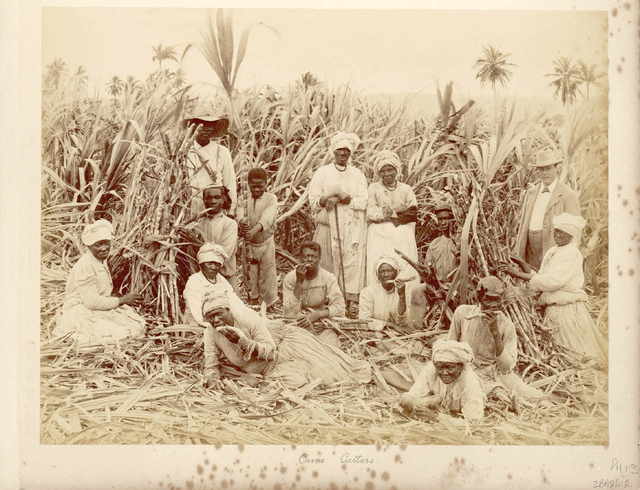
Cane cutters in Jamaica
An image depicting cane cutters in Jamaica after formal slavery was ended, mid-19th century. More than half of the slaves in the region were female.
The extremely grave nature of this subject matter merits an unusually high degree of respect and sensitivity in one’s approach to it. History is not a neutral discipline. Considering infanticide as a form of resistance is important in telling the story of Caribbean slave women as full people, as rational actors who made calculated decisions with rebellion in mind. Drawing on colonial-era accounts of slave motherhood, resistance theory, and recent work on the sociology of slavery, the central aim of this paper is to explore the equation of infanticide with resistance, with a geographical focus on the colonies of Jamaica, Barbados, and Saint-Domingue.5 All of the historical sources cited are from the mid-eighteenth century to 1834, when Britain abolished slavery in its colonies. Sources pertaining to Saint-Domingue are from prior to the slave rebellion of 1791 that culminated in the abolition of slavery in the colony.
Considering infanticide as a form of resistance is important in telling the story of Caribbean slave women as full people, as rational actors who made calculated decisions with rebellion in mind.
Extant accounts of Caribbean slave life are rife with racist assumptions about the supposed negligence and selfishness of black mothers. For example, many plantation owners accused slave women of procuring abortions with the intention of continuing to have promiscuous sex, unhindered by pregnancy.6 White observers such as plantation owners, overseers, and doctors believed that slave women’s alleged promiscuity made them especially prone to venereal disease. They often blamed slave miscarriages on the medicines slave women took (or supposedly took) to treat venereal disease.7 The logical implication of this belief was that if slave women were not so sexually indiscriminate, they would not need to take miscarriage-inducing medicines. Indeed, plantation owners found it more convenient to blame slave women for their failure to produce healthy offspring than to accept responsibility for the deplorable conditions that undoubtedly contributed to complications in pregnancy and childbirth. Physicians in Saint-Domingue accused slave mothers of causing mal de mâchoir (or ‘soreness of the jaw,’ cases of which have been retrospectively diagnosed as tetanus and neonatal tetany) among infants.8 This, of course, functioned to bolster the claim that enslaved women were neglectful, evil, unfit mothers.9 According to the French author of a 1790 pro-slavery pamphlet, they “destroy their own fruit, or they practice infanticide in order to live without moderation.”10
These derogatory cultural images of enslaved mothers are relevant to the analysis of slave infanticide because they colored white people’s perception of slaves’ reproductive habits. It was a difficult task, determining if a documented infanticide case was valid, and not a natural death caused by poor living conditions. As result, there is no clear consensus among historians on the issue. In 1796, a slave named Mary Thomas of the Newton Estate in Barbados was accused of killing her newborn infant. Historian Hilary McD. Beckles describes the event by restating Wood’s claim that Mary Thomas killed her infant out of anger at her white lover, the plantation bookkeeper.11 Beckles does not question Woods in this paraphrased account. Conversely, in her summary of the Mary Thomas case, historian Tara A. Inniss casts doubt on Wood’s accusation of infanticide, adding, “Enslaved midwives were easy targets for blame should the child succumb to illness or sudden death in the first days of life.”12 Inniss and Beckles’ differing interpretations of Wood’s account demonstrate the challenge of discerning fact from fiction in records of infanticide. It is almost impossible to tell if Mary Thomas was in fact guilty of killing her infant.
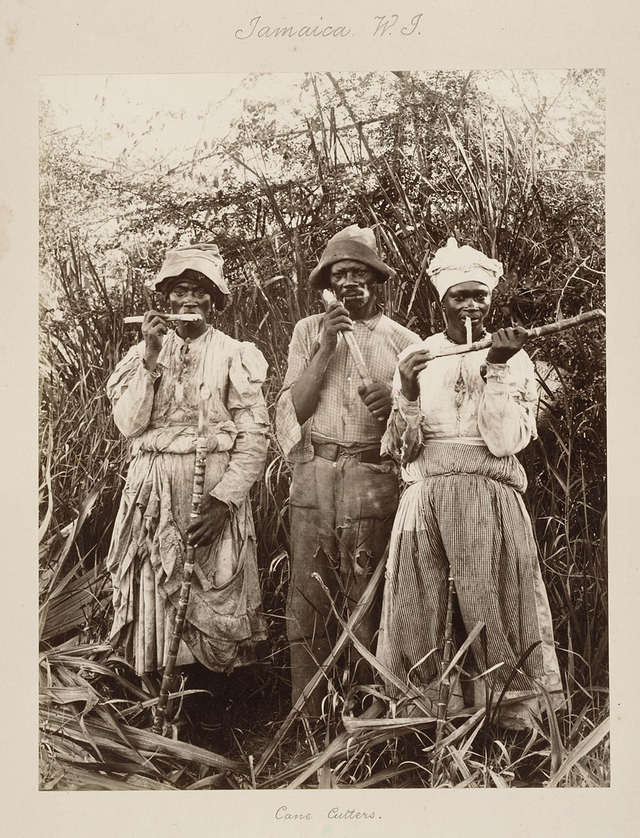
Jamaican cane cutters, mid 1800s after emancipation
Even those who believe that slave infanticide was common admit that this supposition is based on some speculation. In the words of Barbara Bush, who has written extensively on gender and slavery in the Caribbean, studying Caribbean slave infanticide requires “informed speculation and creative approaches in history.” 13 A perfect example of such a speculative, creative approach lies in James A. Delle’s analysis of birth and death records of the Radnor Plantation in Jamaica. Records from the years of 1822-1825 list eight infant deaths for which the cause of death is unnoted. Delle speculates that some of these were infanticides.14 Bush is one of the more vocal proponents of the argument that slave women frequently practiced infanticide. In an articled titled “Hard Labour: Women, Childbirth and Resistance in British Caribbean Slave Societies,” she notes that Caribbean populations grew significantly after emancipation, even though the standard of living hardly improved in most places. To her, this indicates that the “nature of slavery and the responses of slave women to their bondage must also be considered.”15 Bush notes that slave infanticide occurred in the antebellum United States, where slaves lived under generally better conditions than in the Caribbean. Thus, it was probably also practiced in the Caribbean.16 This statement is supported by the fact that, in general, Caribbean slave populations were more successful than those in the United States in preserving parts of West African cultural traditions. In many traditional West African cultures, newborn babies are not considered fully human until eight days after birth.17 According to Bush, the possibility that slave women committed infanticide through “letting” their young infants die (as opposed to violently killing them) is likely.18

slaves representations


http://scholar.library.miami.edu/slaves/representations/Individual_art_essays/carolines.htm

28.12.2015

De planter van Paramaribo

De planter van Paramaribo. Eduard Gerdes (1891).
Posted by Carl Haarnack in 19th century books, Children's Books, Dutch books, German books
≈ Comments Offon De planter van Paramaribo. Eduard Gerdes (1891).

De planter van Paramaribo, in: Agathos, of de wapenrusting Gods. E. Gerdes. Utrecht: J.H. van Peursem, 1891.

De lezers die deze blog al langer volgen herinneren zich misschien nog het stuk over Der pflanzer von Paramaribo (18 december 2011). Dit verhaal vond ik in een verhalenbundel voor de jeugd Aus fernen Welten. Geschichten und Bilder für die Jugend geschrieben (1891). De samensteller van deze bundel was A.H. Fogowitz maar het is zeker dat hij niet de auteur van dit verhaal was. Uit onderzoek weten we dat dit verhaal in ieder geval teruggaat tot 1833. Toen verscheen het in Bohemia: oder Unterhaltungsblätter für gebildete Stände (Nummer 1; no. 76; 25 juni 1833). In 1842 verscheen dit verhaal ook in ’Der Aufmerksame, ein Unterhaltungsblatt’. Hierin wordt gemeld dat dit gebaseerd is op een waar verhaal uit 1786. Verwezen wordt naar een Engels origineel van G.A. Dorn. En in 1872 duikt het verhaal op in een krant in Nieuw-Zeeland onder de titel: Only a nigger. In mijn promotie-onderzoek naar de representatie van Suriname in Duitse literatuur zal ik verder ingaan op de ontstaansgeschiedenis en achtergrond van dit merkwaardige verhaal.


Maar ik kan mij niet bedwingen nu alvast een bijzondere vondst met u te delen. Afgelopen vrijdag kreeg ik op de boekenmarkt op Het Spui in Amsterdam bij de kraam van Antiquariaat De Klikspaan (uit Leiden) een klein papieren boekje met gele omslag in mijn handen gedrukt: Agathos of de Wapenrusting Gods. De antiquaren van De Klikspaan, sinds jaar en dag belangrijke leveranciers van de collectie Buku Bibliotheca Surinamica, kennen mijn interessegebied en ik vermoedde direct iets bijzonders in handen te hebben. Toen ik de auteursnaam E. Gerdes zag staan wist ik dat er een link met Suriname moest zijn. Eduard Gerdes (1821-1898) was geboren in het Duitse Kleef en verhuisde op jonge leeftijd naar Amsterdam. Hij werd opgeleid tot predikant en werkte onder de arme arbeidersgezinnen op Kattenburg en Wittenburg. Dat ligt op een steenworp afstand van de plek waar de Buku collectie zich bevindt. Gerdes behoorde samen met P.J. Andriessen tot de belangrijkste kinderboekenschrijvers van de 19e eeuw. In 1867 verscheen van zijn hand De kanten Zakdoek. Een verhaal uit den ouden tijd. Dit kinderboek dat deels in Suriname speelt is vele malen herdrukt en moet bijzonder beeldbepalend zijn geweest voor vele generaties Nederlandse jeugdigen.

07.07.2015

"Half the story has never been told" Kulturgeschichtliche Aspekte der Sklaverei in Jamaika

von Christof Schmidt

"But if I don't get my desire, then I'll set the plantations on fire"
Gregory Isaacs: Slave Master

"Rationalisierungen hat es (...) auf den verschiedenen Lebensgebieten in höchst verschiedener Art in allen Kulturkreisen gegeben. Charakteristisch für deren kulturgeschichtlichen Unterschied ist erst: welche Sphären und in welcher Richtung sie rationalisiert wurden"
Max Weber: Vorbemerkung zu den "Gesammelten Aufsätzen zur Religionssoziologie"

In der wirkungsmächtigen Tradition des bürgerlichen Humanismus wird die Plantagensklaverei in der Karibik oftmals nicht als historischer Prozeß gedacht, sondern vielmehr als ein Zustand, der diese Gesellschaften gewaltsam vor dem Eindringen der Geschichte abgeschirmt hat. Mit diesem eurozentrischen Begriff der Moderne können die historischen Dynamiken und Determinanten der Sklavereigesellschaften ebenso wenig begriffen werden wie die Prozesse, die in diesen Gesellschaften nach der Sklaverei stattfanden. Das Bild von der Sklaverei als irrationaler Gegenwelt zu dem (bürgerlichen) Konzept der Freiheit war vielmehr die ideologische Grundlage für die Sicherung der Kolonialherrschaft über die Sklaverei hinaus und legitimierte die Expansion des britischen Empires im 19. Jahrhundert im Namen der Freiheit.

Die Sklaverei erlebte ihren Aufschwung in Jamaika im 18. Jahrhundert mit der Ausbreitung des Plantagensystems. Mit dem Beginn des exportorientierten Zuckeranbaus auf großflächigen Plantagen erhöhte sich die Einfuhr afrikanischer Sklaven drastisch[1]. Die Entwicklung dieses Plantagensystems läßt sich grob in zwei Phasen einteilen: Die Aufbau- und Wachstumsphase, in Jamaika ca. zwischen 1730 und 1780, und die Konsolidierungsphase, die bis zur Emanzipation 1833 andauerte. In der ersten Phase waren die Lebensumstände der Sklaven überwiegend katastrophal. Nach dieser Aufbauphase und mit dem Erreichen der Produktionskraft nahm der Anteil der Kreolen an der Sklavenbevölkerung langsam zu und die Kluft zwischen Mortalität und Fertilität und zwischen der Anzahl männlicher und weiblicher Sklaven wurde langsam geringer, was mit den steigenden Sklavenpreisen am Ende des 18. Jahrhunderts und schließlich der Abolition des Sklavenhandels durch die Briten (1807) zunehmend im Interesse der Plantagenbesitzer lag, die in der Regel nicht in Jamaika lebten, sondern als ›absentee landowners‹ mit der ›Westindian Interest‹ eine einflußreiche Lobby in Großbritannien bildeten. Zurück blieben die schlecht bezahlten und mit der Betriebsführung beauftragten weißen Angestellten, die für ihre Brutalität und Inkompetenz von den Abolitionisten, aber auch von vielen Plantagenbesitzer kritisiert wurden, die mit dem Verbot des transatlantischen Sklavenhandels und dem Widerstand der Sklaven, den sie angesichts der Sklavenrevolution in St.-Domingue/Haiti mehr denn je fürchteten, die Zukunft und Rentabilität ihrer Besitzungen in Gefahr sahen. Die sich verändernden Faktoren verlangten nach politischen Maßnahmen, die in die Formierung lokaler Staatlichkeit und verschiedener moderner Institutionen mündeten, ebenso wie nach natürlichem Bevölkerungswachstum, einer geregelten Betriebsführung, technischen Verbesserungen und der Ausbildung von Sklaven für qualifizierte Arbeiten.

Eine enorme Flexibilität des Plantagensystems zeigte sich jedoch vor allem in der Frage der Lebensmittelversorgung. Bereits in den 1720ern verfügte die Mehrheit der Sklaven über eigene Hausgärten (kitchen garden) und Versorgungsfelder (provision ground), die sie über Generationen in Besitz behielten, da sie vererbbar waren, obwohl Sklaven offiziell gar kein Eigentum haben konnten. Die Bereitstellung von Boden für die Sklaven, die 1792 in den ›Consolidated Slave Acts of Jamaica‹ schließlich gesetzlich vorgeschrieben wurde, hatte Vorteile für Sklaven und ihre Herren: Die Sklaven konnten sich ihre Nahrungsversorgung sichern und teilweise sogar Überschüsse produzieren, die Herren hatten dagegen ein kosten- und planungsintensives Problem weniger und konnten mit der Bereitstellung von Boden zudem Fluchten vorbeugen. Normalerweise, d.h. außerhalb der Erntezeit, standen den Sklaven der Sonntag und z.T. der Samstagnachmittag zur freien Verfügung. Zu Beginn des 19. Jahrhunderts wurden den Sklaven alternative Samstage zugestanden, sog. ›Negro days‹, an denen die Sklaven sich um die Bewirtschaftung ihrer Felder kümmern konnten, die, am Rande der Plantage gelegen, zumeist nicht besonders fruchtbar und schwerer zu kultivieren waren. Trotzdem gelang es den Sklaven, vor allem durch die Arbeitsteilung innerhalb von Sklavenfamilien und -haushalten sogar Überschüsse zu erwirtschaften, wobei diese ›domestic groups‹ oftmals nicht an reale Verwandtschaftsverhältnisse gebunden waren und mehrere Haushalte umfassen konnten. 1832 machte der Lebensmittelanbau der Sklaven auf Jamaika, der zunehmend auch die Grundlage für die Ernährung der Freien vor allem in den Städten geworden war, 27% der gesamten landwirtschaftlichen Produktion aus. Einige Sklaven konnten auch Kleinvieh und sogar Rinder in Gemeinschaftsbesitz halten. Es muß jedoch auch erwähnt werden, daß nicht alle Sklaven an dieser internen Ökonomie partizipierten und auch die Größe der Felder z.T. stark variierte.