Ornament-Werden - Weiblichkeit - Frauenarbeit - Sterotypisierung - Textilität - Suriname - Sklaverei - Kotomisi - Plantocrcacy - Repräsentation - Postkolonialismus - Schweiz - Dreieckshandel - Curaçao - Dutch Colonialism - Coolitude - Plantagenökonomie
Posts mit dem Label Ornament werden angezeigt. Alle Posts anzeigen
01.09.2017
18.05.2017
It's a wrap
Labels:
angisa,
blumen,
dekor,
erinnernung,
flowers,
heritage,
Ornament,
souvenirstuch,
Südafrika
24.04.2017
Betty Davis wearing a Kaisik Wong design for her 1974 album They Say I'm Different

Betty Davis wearing a Kaisik Wong design for her 1974 album They Say I'm Different
Labels:
afrofuturism,
betty davis,
black feminism,
electonic music,
fashion,
funk,
hippieculture,
kaisik wong,
miles davis,
Ornament,
vagina
14.02.2017
A Decorative Cosmology Bridging Heaven and Earth
In her new exhibition, Tamara Gonzales continues to mine our material culture to chart the world all around.
A view of Tamara Gonzeles’s Ometeotl exhibition (all images by the author for Hyperallergic)
At the heart of Tamara Gonzales‘s new body of work at Klaus von Nichtssagend Gallery is a room of tapestries woven by artisans in the Peruvian towns of Písac and Ayacucho. They are vibrant interpretations of the artist’s drawings and they add yet another layer to the decorative language she continues to mine from the material world around her.
Gonzales is known for incorporating visual culture that has traditionally been more associated with lived culture — lace, graffiti, embroidery, textiles — rather than the world of art galleries. A large functional maraca is propped up by the entrance, which signals the inclusive and non-hierarchal attitude towards influence she celebrates in her work.
A large maraca sculpture near the entrance of the exhibition, “Maraca más grande con plumas” (2016)
Past the over-sized maraca, there is a corridor of small drawings dominated by a curvilinear window motif that offers her a compositional frame to puncture, cover, and react to. But even with this structure, the drawings have an experimental energy that pokes and pushes, often jostling forms that resemble easter eggs, stick figures, plants, or the scribblings of a rudimentary language.
Her true subject matter is the material world. She has an indiscriminate appetite for cross-cultural pollination and distills the dissonance of contemporary life into these objects that can seem as jarring as they are soothing.
The title of the exhibition, Ometeotl, refers to a nebulous concept of spirituality that some scholars of Mesoamerican culture dispute, but it is commonly believed to refer to the “creator of all creation” for the Anawak people and a compound of “dual” and “cosmic energy” in the native language of Nahuatl. That ambiguity of the term perfectly reflects the primordial soup that has spawned these works, at once mythic, while relishing their connection to earthly forms.
Looking at her paintings, you can feel unmoored from the boundaries of form as they swim in waves of moody azure, crimson, and the muddy waters of darker hues. The paintings vibrate and ripple in your mind’s eye as they play with proportion — always challenging the relationship of ground and subject — to settle visually like a shaken snow globe. Many of the large paintings, like “Two Moons” (2016), feel contradictory, contrasting the washes of violet paint against the frenzy of patterns that form the sky and ground for a setting Mesoamerican roundel.
The showstoppers, though, are the tapestries. Gonzales’s starry fields and human-like forms are translated into undulating visions of horror vacui. They are her best works yet, offering us a unique synthesis of the world around her but allowing it to develop into these intensely colored objects (she says the women doing the embroidery were given free reign to translate her drawings, based on patterns they normally embroider). The works, which are all untitled and made of alpaca and wool, convey a sense of cosmic cartography. If anything, the embroideries make the paintings seem more conventional, showing how her many bodies of work may overlap but travel in different directions.
The paintings are declarations of the known, the drawings are suggestions of what can be known, while the woven works are proposals for what we may never ever truly know.
Tamara Gonzales, “Two Moons” (2016)
Tamara Gonzales, “I Am the Hummingbird” (2016)
The room of embroidered works
Tamara Gonzales’s untitled drawing (2015) and the related untitled tapestry (2016)
Untitled tapestry (2016)
A view of Tamara Gonzeles’s Ometeotl exhibition (all images by the author for Hyperallergic)At the heart of Tamara Gonzales‘s new body of work at Klaus von Nichtssagend Gallery is a room of tapestries woven by artisans in the Peruvian towns of Písac and Ayacucho. They are vibrant interpretations of the artist’s drawings and they add yet another layer to the decorative language she continues to mine from the material world around her.
Gonzales is known for incorporating visual culture that has traditionally been more associated with lived culture — lace, graffiti, embroidery, textiles — rather than the world of art galleries. A large functional maraca is propped up by the entrance, which signals the inclusive and non-hierarchal attitude towards influence she celebrates in her work.
A large maraca sculpture near the entrance of the exhibition, “Maraca más grande con plumas” (2016)Past the over-sized maraca, there is a corridor of small drawings dominated by a curvilinear window motif that offers her a compositional frame to puncture, cover, and react to. But even with this structure, the drawings have an experimental energy that pokes and pushes, often jostling forms that resemble easter eggs, stick figures, plants, or the scribblings of a rudimentary language.
Her true subject matter is the material world. She has an indiscriminate appetite for cross-cultural pollination and distills the dissonance of contemporary life into these objects that can seem as jarring as they are soothing.
The title of the exhibition, Ometeotl, refers to a nebulous concept of spirituality that some scholars of Mesoamerican culture dispute, but it is commonly believed to refer to the “creator of all creation” for the Anawak people and a compound of “dual” and “cosmic energy” in the native language of Nahuatl. That ambiguity of the term perfectly reflects the primordial soup that has spawned these works, at once mythic, while relishing their connection to earthly forms.
Looking at her paintings, you can feel unmoored from the boundaries of form as they swim in waves of moody azure, crimson, and the muddy waters of darker hues. The paintings vibrate and ripple in your mind’s eye as they play with proportion — always challenging the relationship of ground and subject — to settle visually like a shaken snow globe. Many of the large paintings, like “Two Moons” (2016), feel contradictory, contrasting the washes of violet paint against the frenzy of patterns that form the sky and ground for a setting Mesoamerican roundel.
The showstoppers, though, are the tapestries. Gonzales’s starry fields and human-like forms are translated into undulating visions of horror vacui. They are her best works yet, offering us a unique synthesis of the world around her but allowing it to develop into these intensely colored objects (she says the women doing the embroidery were given free reign to translate her drawings, based on patterns they normally embroider). The works, which are all untitled and made of alpaca and wool, convey a sense of cosmic cartography. If anything, the embroideries make the paintings seem more conventional, showing how her many bodies of work may overlap but travel in different directions.
The paintings are declarations of the known, the drawings are suggestions of what can be known, while the woven works are proposals for what we may never ever truly know.
Tamara Gonzales, “Two Moons” (2016)
Tamara Gonzales, “I Am the Hummingbird” (2016)
The room of embroidered works
Tamara Gonzales’s untitled drawing (2015) and the related untitled tapestry (2016)
Untitled tapestry (2016)
Labels:
dekor,
Kosmologie,
kunst,
Ornament,
stickerei,
textilität,
visual culture
05.12.2016
15.11.2016
Variatons of White
Labels:
Black identity,
fotografie,
haare,
hautfarbe,
Kleidung,
mia autio,
Muster,
Ornament,
skin,
textilität,
white gaze
28.04.2016
02.04.2016
01.04.2016
31.03.2016
Lost and Invisible Bodies, Enshrined in Glitter and Bling
by Jillian Steinhauer on March 30, 2016

Installation
view, ‘Ebony G. Patterson: Dead Treez’ at the Museum of Arts and
Design; in foreground: “root and shrubz” (2014), mixed-media jacquard
photo tapestry with embroidery, glitter, toy gun, shoe, lace, glasses,
toys, silk flowers, embellishments (all photos by the author for
Hyperallergic) (click to enlarge)
“In order to force one’s way out of invisibility one has to create a reason to be seen,” says Jamaican artist Ebony G. Patterson.
I walk around the tapestry, which rests on the floor, in an attempt to see its contents more clearly. There are two toy guns covered in floral prints; flowers everywhere, embedded in glitter and sitting atop the surface in silk; a miniature lace skirt; two toy trucks. There is another body, much smaller than the first, represented by a camouflage outfit. This one, like the first, is a body only by virtue of its clothing: shirt, pants, shoes. There is no head to speak of, no arms or flesh.
“There is a challenge being made about seeing and looking. The seeing is what happens on social media, but the looking is what I’m asking you to do,” says Patterson.
What is the relationship between these two sets of clothing without bodies? Am I looking at a mother and her son — or the remains of them? Where were they going? Were the guns only toys? How did the mother’s right shoe — a dazzling boot, a glittering, embroidered articulation of turquoise and white set atop a thick black heel — end up so far from her leg? Whose shoe is the other one — a three-dimensional red and black slipper — that sits near it?
Where are the bodies?

Detail
of Ebony G. Patterson, “wilted rosez” (2014), mixed-media jacquard
tapestry, with embroidery, glitter, caftan, costume jewelry, glass,
eighty black crocheted flowers, embellishments
what you’ll turn up. Quite often, bones,” writes Jamaican poet Olive Senior.
In the other tapestries, it’s the same story. I go looking for bodies but all I find are clothes. Brilliant, beautiful ones, but the bodies they’re meant to hold have vanished. Decomposed, maybe. Broken back down into the thickets of flowers and jewels, objects and ornament that envelop them. I train my eyes to trace the outlines of the blinged-out outfits. I recondition them so that they can see. I don’t see the bodies, but I know they are here.
* * *
On the other side of the space, there are
10 bodies, all made of plastic and covered in floral and arabesque
patterns — dots and stripes, plants and curlicues enveloping both their
outfits and every inch of their fake skin.

Ebony G. Patterson, “Swag Swag Krew” (from the ‘Out and Bad’ series) (2011–14), ten embellished mannequins with custom-made clothing, including an adorned umbrella, alcohol, shoes, costume jewelry, toys, cell phones, silk flowers, cinder blocks, hats, backpacks, accessories, cotton textile–covered plinth (click to enlarge)
Labels:
auflösung,
blingbling,
dekor,
Ebony G. Patterson,
formlosigkeit,
kunst,
Ornament,
Tapete,
teppich,
unsichtbarkeit,
verschmelzung
25.03.2016
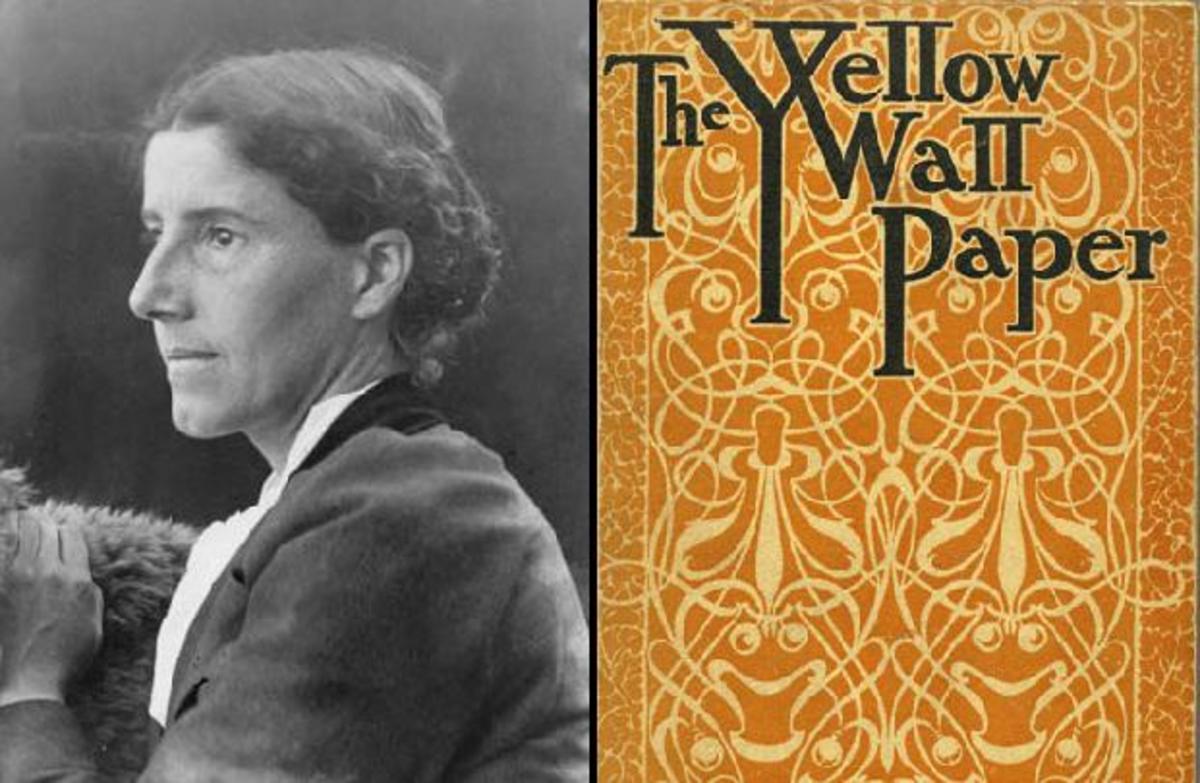
The Yellow Wallpaper
https://www.nlm.nih.gov/literatureofprescription/exhibitionAssets/digitalDocs/The-Yellow-Wall-Paper.pdf
Mental Illness in Literature: Charlotte Perkins
Gilman's "The Yellow Wallpaper Updated on August 8, 2014
Mental Illness in American Literature
Gilman's most famous work, her short story "The Yellow Wallpaper", published in 1892, is about a woman suffering from mental illness after of being confined to a bedroom in the attic of a vacation home by her husband, John, for the sake of her health. She becomes obsessed with the room's repulsive, yet alluring yellow wallpaper. Gilman wrote this story to bring light to women's role in society, explaining that women's lack of autonomy negatively affects their mental, emotional, and physical well-being. She used it as a call to action for readers to recognize the legitimacy and complexity of illness and benefit in therapies for treatment, namely in women, and to overcome sexism in treatment
The narrator explains the embodiment of the authors experience during
her time being treated by Dr. Mitchell's "rest cure". The treatment,
which includes no physical activity, mental stimulation, or hobbies, is
in direct conflict with what the author needs to get well. This drives
her further into madness until she descends beyond the point of getting
better.
Left: Charlotte Perkins Gilman Right: "The Yellow Wallpaper" cover
Labels:
dekor,
feminismus,
haushalt,
hysterie,
körper,
Ornament,
psychose,
unterdrückung,
viktorianisches Zeitalter
14.01.2016
18.06.2015
25.05.2015
05.05.2015
Abonnieren
Posts (Atom)