
Posts mit dem Label Weiblichkeit werden angezeigt. Alle Posts anzeigen
Posts mit dem Label Weiblichkeit werden angezeigt. Alle Posts anzeigen

17.04.2017

26.03.2017


20.03.2017
Venus – The anti-hero Hero
Venus - performance registration from Framer Framed on Vimeo.
Venus
– The anti-hero Hero was an interactive programme that explores the
historically violent imageries surrounding Venus. Who is Venus? Nikki
Minaj? Kim Kardashian? This event is part of the series of public and
discursive events that are curated alongside to the exhibition 'Embodied
Spaces' (2015) by curator Christine Eyene at Framer Framed in
Amsterdam. With contributions by Amal Alhaag, Rehema Chachage, Quinsy
Gario, Carolin Kamya, Shertise Selano, Hodan Warsame and Milone Reigman.
This event concluded the three exploratory reading sessions that were loosely based on three chapters from Suzan-Lori Park’s play Venus and connected to the themes of imagination, language and the body. Park’s play is based on the journey of Saartjie Baartman, a Khoi-San woman taken from South Africa in 1810 and exhibited in London and Paris. The reading of the exoticized body of Saartjie Baartman has influenced the iconography of the black female body in western visual cultures. Venus connects to current conversations on race, gender, sexuality, and voyeurism in the media. From Hottentot Venus to bootylicious – the female body, specifically, the black female body belongs to the spectators. How can we re-interpret and reclaim Venus despite the exploitation?
Venus – The anti-hero Hero was developed in collaboration with
theater director Amal Alhaag, Milone Reigman. Shertise Solano and Ronald
de Graaff created a series of beautiful masks especially for the Venus
performance directed by Milone Reigman. In addition to the exhibition
the masks will be on show in the public spaces of the Tolhuistuin.
Rehema Chachage is based in Tanzania, we had a chance to aks her for a
contribution thanks to the Thami Mnyele Foundation.This event concluded the three exploratory reading sessions that were loosely based on three chapters from Suzan-Lori Park’s play Venus and connected to the themes of imagination, language and the body. Park’s play is based on the journey of Saartjie Baartman, a Khoi-San woman taken from South Africa in 1810 and exhibited in London and Paris. The reading of the exoticized body of Saartjie Baartman has influenced the iconography of the black female body in western visual cultures. Venus connects to current conversations on race, gender, sexuality, and voyeurism in the media. From Hottentot Venus to bootylicious – the female body, specifically, the black female body belongs to the spectators. How can we re-interpret and reclaim Venus despite the exploitation?
Bijna Familie


In het gesprek wordt onder andere ingegaan op het vermengen van feiten/geschiedenis en fictie, een thema dat terugkomt in zowel Ena’s als Karin’s werk, evenals in de lopende tentoonstelling Re(as)sisting Narratives, over het gedeelde koloniale verleden tussen Nederland en Zuid-Afrika. Beide schrijvers zullen dieper ingaan op één werk in de tentoonstelling. Zo zal Ena reageren op het werk van Mary Sibande, dat thematisch aansluit bij haar boek. Sibande’s werk Conversations with Madam CJ Walker (2009) is geinspireerd op meerdere generaties vrouwen in haar familie, die huishoudsters waren en die zij als helden beschouwd.
16.03.2017

12.03.2017
Afrofuturist Artists Craft A Virtual World For Women Of Color
01/18/2017 12:45 pm ET | Updated Jan 23, 2017
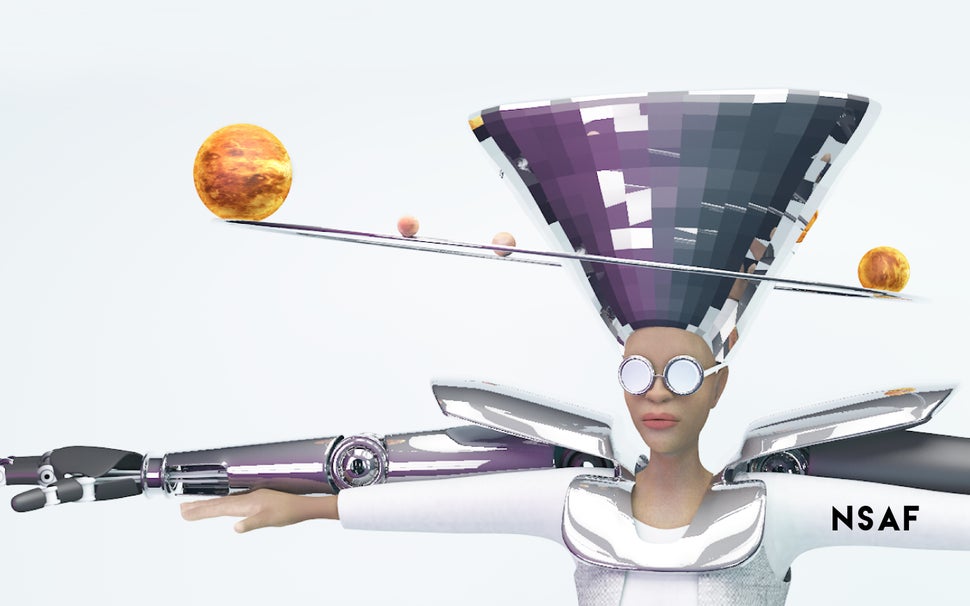
“Neurospeculative AfroFeminism” combines technology and fantasy to expand your imagination and physically optimize your brain.
By Priscilla Frank
HYPHEN-LABS
200
It was the summer of 2016 and molecular and cellular biologist/multidisciplinary artist Ashley Baccus-Clark was gifting herself a day of self-care. The police shootings of Alton Sterling and Philando Castile had left her, like so many black Americans, anguished and weary. She tried to ease her heartache by visiting Storm King, the 500-acre sculpture park in upstate New York where hulking man-made forms dwell among rolling green fields.
Because it was summer, Baccus-Clark packed some sunscreen for the journey. But after applying the milky substance to her face, she was left with a purple residue caked atop her flesh, a subtle reminder that, even with something as mundane as sun protection, people of color are too often disregarded.
“Women of color have to modify products to fit who they are as people,” Baccus-Clark explained in an interview with The Huffington Post at New Inc, an incubator attached to and led by the New Museum. “Why should I have to spend my time and energy worrying about something like sunscreen? There is so much technology designed by POC [people of color] that isn’t made without POC in mind.”
She decided, then, to make some sheer sunscreen herself. And that simple, low-tech solution led to the monumental, virtual reality project “Neurospeculative Afrofeminism,” which will premiere this Friday in the New Frontier section of the Sundance Film Festival.
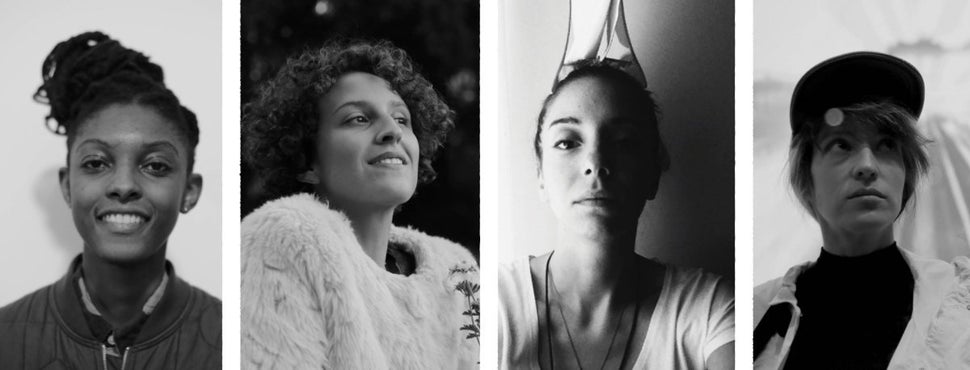
HYPHEN-LABSFrom left: Ashley Baccus-Clark, Carmen Aguilar y Wedge, Ece Tankal, and Nitzan Bartov.
Baccus-Clark is one member of Hyphen-Labs, a team of international women who combine art and technology to represent, protect and honor women of color. The team, who have worked together since 2014, also includes Carmen Aguilar y Wedge,a Mexican-American engineer with Cuban roots; Ece Tankal, an architect, moving image maker and multidisciplinary designer from Turkey; and Nitzan Bartov, an architect, game designer and artist from Israel.
With one foot grounded in contemporary reality and another in an imagined future, Hyphen-Labs renders both physical products and virtual reality narratives that specifically cater to black women. For the physical aspect of “Neurospeculative Afrofeminism,” Hyphen-Labs engineered a variety of speculative beauty products and accessories designed for women of color, manifesting the belief that self-care is more than just a luxury but a means of survival. A sunscreen safe for dark skin was object one.
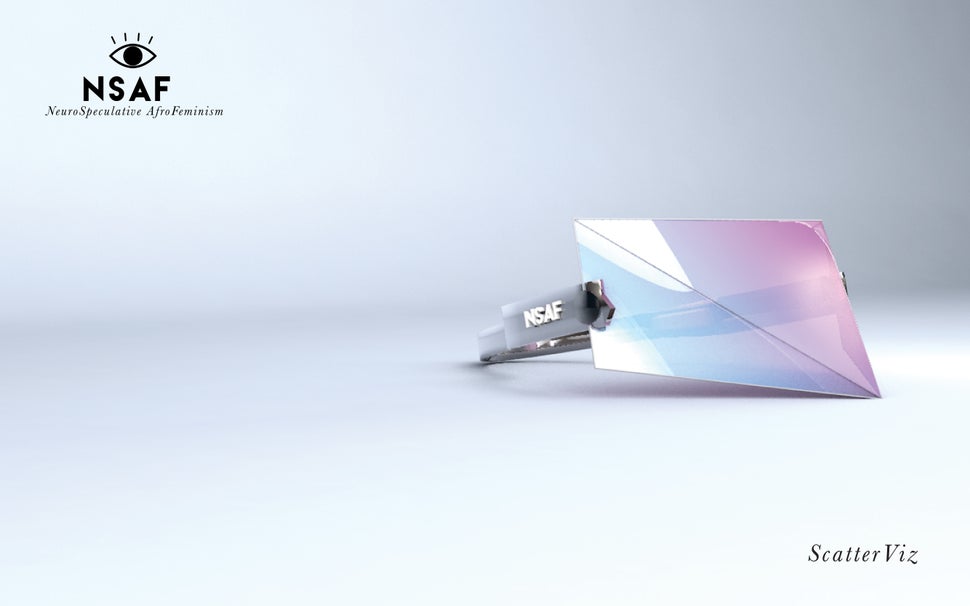
Along with the sunscreen, the artists pioneered the prototype for a visor with a dichroic reflective surface that allows its wearers to see but not be seen. The incandescent head gear, made with cooperation from AB Screenwear, is meant for scenarios where people of color enter a predominately white space. Instead of code-switching ― or shifting their self-presentation in order to blend in ― the visor reflects any antagonistic gazes back at the watcher. The accessory symbolizes, as the artists explain, “that what we fear most is often a reflection of ourselves.”
HYPHEN-LABS
SUBSCRIBE TO & FOLLOW CULTURE SHIFT
Level up. Read THIS and be the most interesting person at your dinner party. Learn more
For their third product, Hyphen-Labs designed a pair of earrings that function as cameras and recording devices, meant to document both micro- and macro-aggressions in a safe and discrete manner. The jewelry, a collaboration with Michelle Cortese, responds to the failure of dashboard cameras and bodycams to accurately capture the ambiguous encounters through which black lives are lost without satisfactory explanation. While phones are often confiscated when they would be most useful, the earrings offer an inconspicuous and, in fact, really cute way to chronicle what POC endure on a daily basis.
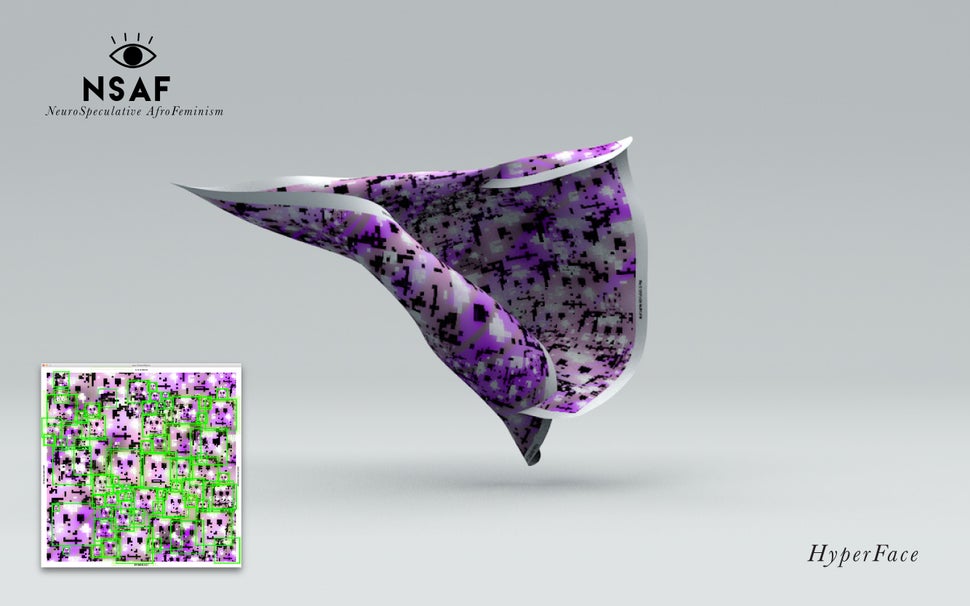
While some of the Hyphen-Labs products help users survey their environment, others are meant to protect them from what the lab has identified as systematic surveillance employed by government officials. Collaborating with privacy artist Adam Harvey, the team created a silk headscarf whose pattern triggers facial recognition software to the point of overwhelming it. If at a protest, for example, hundreds of people wore the scarf, the cameras would be so triggered by the textiles they would shut down.
The idea for the headscarf emerged when Hyphen-Labs’ Ece Tankal, wearing a necklace with an eye pendant, was playing with Snapchat filters, and the app’s facial recognition software mistook Tankal’s necklace for a human eye. She wrapped herself in their carefully designed headscarf during our interview while Carmen tried to Snapchat a picture. The phone bugged out, as little puppy dog filter faces quickly popped up and disappeared all over the scarf’s fabric on the iPhone screen.
HYPHEN-LABS
The artists’ final product is called “The Octavia.” Its technology riffs off high-definition transcranial direct current stimulation (HD-tDCS), a non-invasive brain stimulation technique which uses electrical currents to stimulate regions of the brain. The procedure is currently used to alleviate depression and anxiety in patients, as well as to optimize a user’s mind by augmenting memory to increase creativity and work flow. In Hyphen-Labs’ take, the electrodes are combined with self-cleaning natural hair extensions in order to be weaved into textured or natural hair.
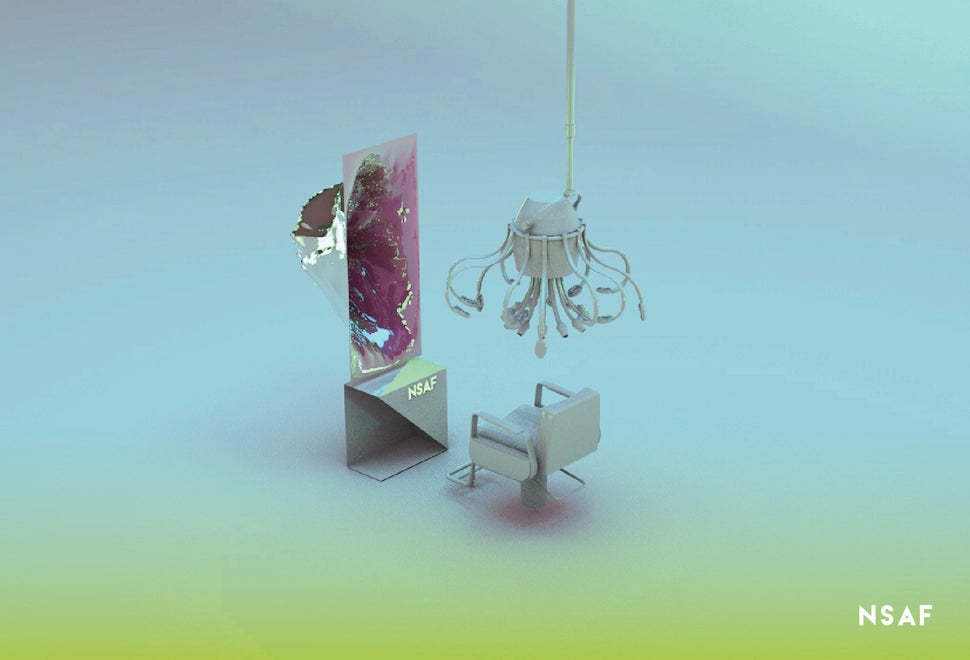
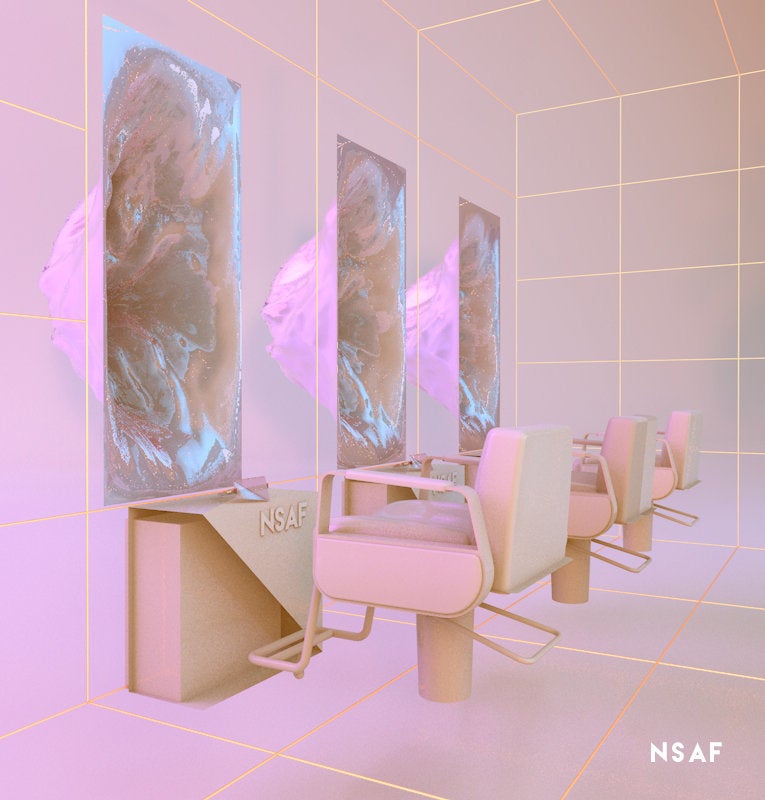
It is this final product that is at the core of the second aspect of “Neurospeculative Afrofeminism,” a virtual reality experience premiering at Sundance’s New Frontier Art festival on Jan. 20. The immersive film takes place at a “Neurocosmetology” lab ― think futuristic hair salon ― owned by a woman named Brooks. The setting alludes to the long history of salons as safe spaces for women of color and fertile ground for political and philosophical discussion.
As the viewer, after putting on your Oculus Rift helmet, you’re plunked into a chair in Brooks’ salon, ready to receive your Octavia electrodes ― aimed to increase your neuroplasticity. Your first view is of yourself in the mirror, as a black woman with long pigtail braids. This, in itself, is a powerful gesture, allowing people of all races and genders to physically see themselves as a woman of color, virtually stepping into the skin of another.
The products from Hyphen-Labs’ line are strewn about the virtual salon setting, confusing the space between real and imagined futures. While Brooks prepares you for your extensions, she chats with Naima, the salon matriarch, their conversation smoothly teetering between topics of ancient tradition and futuristic fantasy.
HYPHEN-LABS
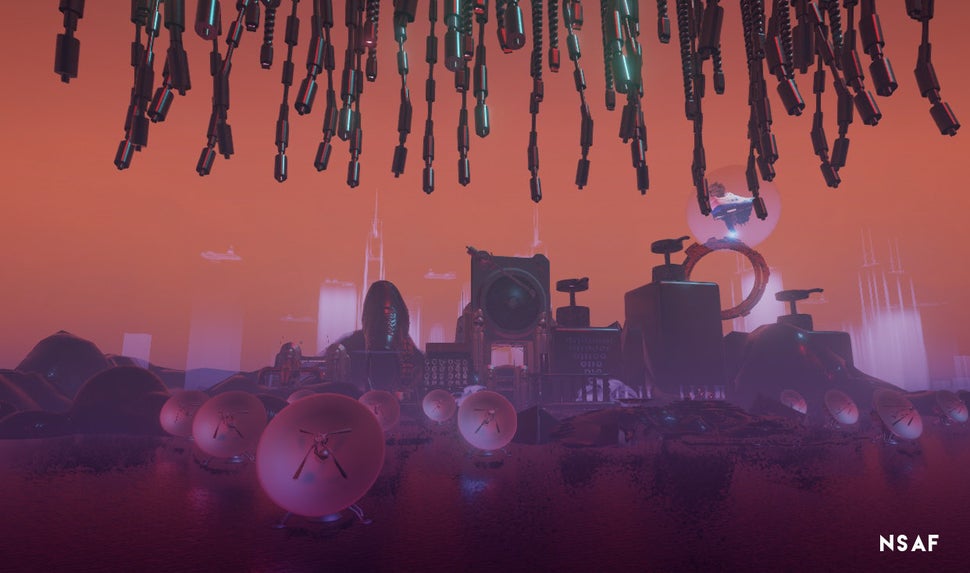
Before Brooks inserts the Octavia, she warns there may be some intense visuals when the electrodes hit. Moments later, you are floating in a 3D hallucinatory dreamscape with mountains made of water and a giant eye hovering in the sky. It’s the kind of fully transportive experience that can only occur in VR, a technology that allows you to float through a dreamed-up world.
Although the viewer doesn’t actually receive Octavia electrode implants during the VR experience, the effect of the 10-minute art piece is intense. Even the simulation of receiving the extensions is palpable. The Hyphen-Labs team intends to examine just how palpable, with plans to eventually conduct anthropological and neuroscientific research on whether or not experiencing the VR piece changes how viewers engage with the world.
“We are afraid of what we don’t know,” Aguilar y Wedge explained to The Huffington Post. “By simulating engagement [with women of color], we are trying to lower fear and prejudice.” Eventually, the women hope to conduct mobile functional magnetic resonance imaging (fMRI) scans on viewers while they encounter the artwork to determine if VR has a measurable effect on the brain.
HYPHEN-LABS
Hyphen-Labs also hopes to use the work to introduce communities to VR who might not otherwise have access to the emergent technology. The artists hope that by seeing familiar characters represented in the work, young women of color will be inspired to pursue science and tech themselves. “Where are all the black women in neuroscience?” Baccus-Clark asked. “As Marian Wright Edelman said, ‘It’s hard to be what you can’t see.’”
The necessity of black representation in film and art have made their way into the public consciousness, belatedly, in the past few years. In both arenas, it’s equally valuable to see people of color both on view and behind the scenes, as actor or image and artist, director, producer, etc. In the realm of VR, there are additional opportunities to identify and empathize with people of color.
“It’s about world building,” Aguilar y Wedge added. “This world is built for black women, but all are welcome.” The technology physically positions viewers in situations they may not otherwise encounter, not only engaging with people of color but feeling like one themselves. Many believe VR has more potential than any other medium to dispel racial bias.
However, the strong emotions VR is known for inducing are not necessarily positive. Many have written about experiencing the “empathy machine” gone haywire, with some narratives provoking anger or hatred in the viewer instead of compassion, yielding the opposite of the intended effect. VR artists like Nonny de la Peña are known for dropping the viewer into gut-wrenching and difficult scenarios, such as domestic assault. But Hyphen-Labs seems less concerned with heated narratives and more with the simple gesture of making visible what often is not, letting the viewer come to her own conclusions.
There are plenty of other prejudices the women of Hyphen-Labs are also out to eliminate. The belief, for example, that beauty products are of lesser import than high science. “They are both things that we value,” Baccus-Clark said. Or that advancements in the physical world are more legitimate than those built in the realm of art or fantasy.
“Neurospeculative Afrofeminism” premieres this weekend at Sundance, overlapping with the presidential inauguration. The artists believe their work offers a potent antidote to the small-minded world approach of the president-elect, although the issues and inequalities Hyphen-Labs addresses plagued American culture long before Donald Trump was in the picture.
For the artists, the inauguration offers a moment to reflect on many of the longstanding prejudices that America has tried to sweep out of sight. Now is the perfect moment to confront the wounds of our country, and finally, truly, begin to heal. In the face of ignorance, bigotry and ego, Hyphen-Labs serves up radical optimism, self-care, education, awareness and acceptance, through objects as mundane as sunscreen and as otherworldly as a hand-crafted alternate reality.
“We want to subvert victimization,” Aguilar y Wedge said. “The only limit is our imagination.”
“Neurospeculative Afrofeminism” will run Friday, Jan. 20, through Friday, Jan. 27, 2017, from 1 to 8 p.m. and Saturday, Jan.28, from 11 a.m. to 3 p.m. at Claim Jumper in Park City, as part of Sundance’s New Frontier Art.
HYPHEN-LABS
Suggest a correction
Priscilla Frank Arts Writer, The Huffington Post


10.02.2017
Histoire des Robes , 1990

Annette Messager (French, born 1943) Title:
Histoire des Robes , 1990 Medium: dress and photographs Size: 99 x 156 cm. (39 x 61.4 in.)
26.01.2017
Fiona Tan: Nellie (2013)


Es ist eben der Wandschrank, in dem Tan die Uraufführung ihres Videos installierte. Das Zimmer befindet sich im Museum Van Loon, das heute die bürgerliche Wohnkultur des Goldenen Zeitalters ausstellt. Das Museum war das Wohn- und Geschäftshaus der Familie Van Loon, die im 18. Jahrhundert als Finanziers von den Handelsbeziehungen zu Batavia profitierten. Dieses Haus, dessen erster Bewohner Ferdinand Bol ausgerechnet ein Schüler Rembrandts war, diente Tan als Drehort. Hier inszenierte sie Nellies ewiges „Dazwischenleben“, ihre Situation, aus der heraus sie nur aus dem Fenster starren, mit Briefen korrespondieren oder in Fieberträume versinken konnte. In einer Sequenz zitiert Tan Jan Vermeers berühmtes, 1657 entstandenes Gemälde Briefleserin am offenen Fenster. Vermeer malte es, als Nellie noch ein kleines Kind war. Bei Tan ist es weniger ein kunstgeschichtliches Zitat als sozialgeschichtliche Information. Nellies Gefängnis ist real: „In Batavia, dem heutigen Jakarta“, sagt Tan, „litt sie wahrscheinlich an Malaria. Sie konnte bestimmt nicht alleine aus dem Haus, um auf den Markt zu gehen und ihre Nachbarschaft zu sehen.“

07.01.2017
Angisa: hoofddoeken uit Suriname
ANGISA: HOOFDDOEKEN AAN HET WOORD
“ Op een dag – ik woonde nog niet zo lang in Nederland – sprak een Surinaamse vrouw mij aan: “Ik kèn u ergens van, zei ze. U lijkt sprekend op mijn vroegere buurvrouw in Paramaribo…mevrouw Dankoor”. “Ik ben mevrouw Isselt”, antwoordde ik maar mijn meisjesnaam is Dankoor”. “Weet u nog” zei de vrouw, “alle dames uit de buurt kwamen bij jullie over de vloer om een mooie angisa te laten maken”.

Surinaamse vrouw met hoofddoek
Aan het woord is Mildred Isselt Dankoor. Wij ontmoetten haar vorige zomer in Turnhout waar haar collectie hoofddoeken onderdeel was van de tentoonstelling Het Geweven Woord. Wat zij toen vertelde over hoofddoeken, maakte ons zo nieuwsgierig dat wij haar gingen opzoeken in Haarlem. Mildred is een rasvertelster. Niet om een kwinkslag verlegen maar tegelijk zeer precies en zeer geloofwaardig. Alleen over haar leeftijd heb ik mijn twijfels. Wil zij – met haar rimpelloos voorhoofd en de gratie van een vrouw van vijftig – ons wijsmaken dat zij bijna 70 is!
Twee domme Surinaamse kinderen
Iemand uit het biotoop van je kinderjaren tegenkomen is fijn. Maar in dit geval was de ontmoeting een ommekeer. Plots realiseerde Mildred zich dat zij van hoofddoeken binden (op het binden van een Oto Baka na), niks afwist, en dàt terwijl er in heel Suriname niemand het haar beter had kunnen aanleren dan destijds haar eigen moeder.”Als je jong bent, heb je daarvoor geen belangstelling. Evenmin als het gros van Surinamers in Suriname trouwens. Maar naarmate je verder van je moederland leeft en wat wijzer wordt met de jaren, ga je de schat aan tradities meer en meer naar waarde schatten”. Mildred besloot de traditie die van mond tot mond overgeleverd wordt en van hand op hand aangeleerd, voor teloorgang te behoeden. Ze belde haar zus in Suriname:”Wij hebben ons niks van moeders kunst eigen gemaakt. Zijn wij niet de domste Surinaamse kinderen?” Beide zussen gingen lesnemen. Bij leraars én bij oudere Surinaamse vrouwen die ‘de knepen van het plooien’ nog beheersten. Vandaag geven Mildred in Nederland en haar zus in Suriname cursus angisabinden.

“ Op een dag – ik woonde nog niet zo lang in Nederland – sprak een Surinaamse vrouw mij aan: “Ik kèn u ergens van, zei ze. U lijkt sprekend op mijn vroegere buurvrouw in Paramaribo…mevrouw Dankoor”. “Ik ben mevrouw Isselt”, antwoordde ik maar mijn meisjesnaam is Dankoor”. “Weet u nog” zei de vrouw, “alle dames uit de buurt kwamen bij jullie over de vloer om een mooie angisa te laten maken”.

Surinaamse vrouw met hoofddoek
Aan het woord is Mildred Isselt Dankoor. Wij ontmoetten haar vorige zomer in Turnhout waar haar collectie hoofddoeken onderdeel was van de tentoonstelling Het Geweven Woord. Wat zij toen vertelde over hoofddoeken, maakte ons zo nieuwsgierig dat wij haar gingen opzoeken in Haarlem. Mildred is een rasvertelster. Niet om een kwinkslag verlegen maar tegelijk zeer precies en zeer geloofwaardig. Alleen over haar leeftijd heb ik mijn twijfels. Wil zij – met haar rimpelloos voorhoofd en de gratie van een vrouw van vijftig – ons wijsmaken dat zij bijna 70 is!
Twee domme Surinaamse kinderen
Iemand uit het biotoop van je kinderjaren tegenkomen is fijn. Maar in dit geval was de ontmoeting een ommekeer. Plots realiseerde Mildred zich dat zij van hoofddoeken binden (op het binden van een Oto Baka na), niks afwist, en dàt terwijl er in heel Suriname niemand het haar beter had kunnen aanleren dan destijds haar eigen moeder.”Als je jong bent, heb je daarvoor geen belangstelling. Evenmin als het gros van Surinamers in Suriname trouwens. Maar naarmate je verder van je moederland leeft en wat wijzer wordt met de jaren, ga je de schat aan tradities meer en meer naar waarde schatten”. Mildred besloot de traditie die van mond tot mond overgeleverd wordt en van hand op hand aangeleerd, voor teloorgang te behoeden. Ze belde haar zus in Suriname:”Wij hebben ons niks van moeders kunst eigen gemaakt. Zijn wij niet de domste Surinaamse kinderen?” Beide zussen gingen lesnemen. Bij leraars én bij oudere Surinaamse vrouwen die ‘de knepen van het plooien’ nog beheersten. Vandaag geven Mildred in Nederland en haar zus in Suriname cursus angisabinden.

04.01.2017
“Le Rêve de la Malinche”

Antonio “El Corcito” Ruiz, “Le Rêve de la Malinche” (1939, oil on masonite, Mexico, Galería de Arte Mexicano (courtesy Galería de Arte Mexicano, © photo INBA/Museo Nacional de Arte)
hyperallergic
18.06.2016
Black Grotesque
Monday, 20 June 2016, 19:30. Lecture: Aliyyah I. Abdur-Rahman.
Black Grotesquerie
Adducing women of color feminism's theories of the flesh and Mikhail Bakhtin’s conception of the grotesque, this talk advances a theory of Black Grotesquerie as an aesthetic mode in the project of textualizing African American life in the catastrophic present. Rather than merely signifying excess, dread, or decay, Black Grotesquerie delineates an expressive practice of contortion, substitution, inversion, corruption. Reading together works by visual artist Wangechi Mutu and author Marci Blackman, this talk illustrates the ways in which Black Grotesquerie reconfigures the terms of contemporary black struggle by rendering the boundary between (black) living and dying porous and negotiable. Black Grotesquerie thus enables African Diaspora cultural producers to imagine new sociopolitical and racial arrangements—even as it registers the impossibility of fully representing black experience, whether in historical time or post-racial futurity.
ICI Lecture Series ERRANS

25.05.2016
The Virtual Is Liminal: An Interview with Claudia Hart

Claudia
Hart, “The Dolls House” (2016), 3D-animated loop with music by Kurt
Hentschlager, 13 mins, on view at Transfer gallery (photo by the author
for Hyperallergic)
Claudia entered the world of 3D simulations technology at a time when there were very few practitioners who saw it as a means to create what I would term “fine art.” In addition to being an important innovator in the field, she has worked as a member of the faculty of the School of the Art Institute of Chicago, teaching and influencing a remarkable cohort of students that has emerged from her classroom to make significant contributions to this new medium. She has helped take a technology that, until recently, was being used primarily for gaming and commercial purposes and subvert its form and content to create hybrid works that are genuinely new — and feminist, to boot.
This interview was conducted on the occasion of her solo exhibition at Transfer gallery, which was founded by Kelani Nichole in 2013 and focuses almost entirely on new-media work. The exhibition, titled The Dolls House, runs through July 2.
* * *
Claudia Hart, “Caress” (2011)
Susan Silas: I wanted to begin with a very
general question. We know that many of the technologies that govern the
internet and new-media applications had their origins in government
research and were often intended for use by the military. Forms of these
technologies made their way into gaming, which has been dominated by
men both as creators and as users and has evolved into a relatively
misogynist environment online. When you decided to learn 3D technology
20 years ago, did you understand that the environment was such a
masculinist one, and were you thinking about usurping it then for a more
feminist project? Or did your project evolve slowly as you began to
work with this new technology? Claudia Hart: In terms of simulations technology, which is my medium, yes, it emerged from the Department of Defense (DoD), and the culture around it was militaristic and astonishingly misogynist. I did not understand that it would be like that and had never experienced that kind of culture. The DoD had developed it for war games and flight simulators. When 9/11 came along, they strategically threw their research to the game industry, relatively small at that time; Pixar and children’s animation was a way bigger industry. But with 9/11, the military shared information with the game industry because they understood that the technology could be expanded there more rapidly.
War games were being produced both by the military and also commercially to cultivate a “war on terror” culture. I could not have predicted the sea change that would occur due to 9/11 when I started in 1997. My reasons for falling in love with computer imaging were purely artistic and theoretical, and had nothing to do with the positioning of virtual media and simulations technologies as both a commercial and military visualization language.

Claudia
Hart, “The Brides” (2010) inkjet print of a virtual model on paper (all
images courtesy the artist unless otherwise noted) (click to enlarge)
SS: One of the first works of yours I saw after you began to work with 3D technology was a single-channel piece titled “Machina.” The image showed a reclining nude, presented in the manner of a classical painting. Her movements were quite slow, her body languid and also voluptuous — not the hard body of contemporary culture nor that of a cartoon character with a tail pipe up her anus. In any case, she was framed to suggest a painting, and her body type was somewhat Rubenesque, yet she had something in common with Manet’s “Olympia” too, in that she made eye contact with the viewer from time to time, a kind of Brechtian device that disrupted the objectification that we associate with female nudes in painting. At that time, it seemed to me, most 3D art (though not all) was engaged in a self-reflexive investigation of the technology, which produced more formal and abstract visual content. How was your work received at the time? Did you get support from others working with the technology?
CH: My involvement with the digital art community began when I visited Ars Electronica with Kurt Hentschlager, the pioneering Austrian media artist who at that time was part of the duo Granular Synthesis. He has since become my husband and has a significant impact on my work. This was in 1995, and it was and still is the premiere venue for experimental digital media art, the festival that awarded the motorcycle babe a prize (I think that genre emerges from the male and misogynist culture of West Coast comix). Most of the more serious artistic work at Ars — aside from that of Granular Synthesis — was very formalistic and, yes, “gadgety,” meaning more concerned with technical invention and research and the visual possibilities that might be engendered for those.
When I was a young artist, my community was the 1990s identity politics generation. We were very content driven in the sense that the strategy was to deconstruct both media and material culture. I was obviously an interloper in that first generation of digital artists.

Claudia Hart, “PhotoMortifications, Heaven” (2008), lambda photographic print
09.04.2016

14.01.2016


21.12.2015
Elisabeth von Samsonow - Die Statue und die Schürzenobjekte
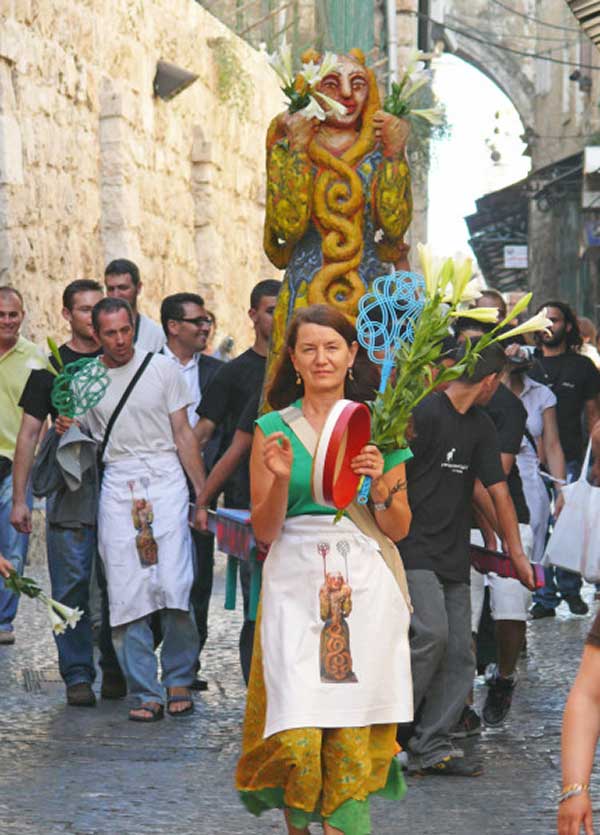
Elisabeth von Samsonow - Die Statue und die Schürzenobjekte
© beide Fotografien E.v.S.
Mary Magdalene's ReImmigration Center, Jerusalem
Wunderbare Reise einer Statue
Zu einer Reise aufbrechen, im Sommer, am besten
dorthin, von woher einem die interessantesten Nachrichten
entgegenkommen. Es wird ein großer Reisekoffer hergestellt, eigentlich
ein Sarkophag oder eine Couchette: ausgepolstert, verziert, mit
Satinbettwäsche in leuchtendem Rot und Gelb. Es gibt auch Kleingepäck,
ein Kosmetiktäschchen, Parfumflakons. Eigentlich handelt es sich im
Falle der Reise meiner Statue um eine „Heimkehr“. Denn wenn man es im
Licht ihrer Geschichte betrachtet, ist Maria Magdalena, geboren in
Magdala am See Genesareth, keine „natürliche Französin“. Auch wenn sie
bei Marseille mit ihrem Schiffchen gelandet ist und dann viele Jahre in
einer Grotte im Massiv La Sainte Baume verbracht hat, schließlich ihre
Gebeine in St. Maximin La Sainte Baume bzw. in Vézélay gelassen haben
soll, war sie vielleicht Frankreichs prominenteste Immigrantin. Die
Geschichten wandern mit den Leuten, Maria Magdalenas Geschichte hatte
von da an ihr Zentrum nicht mehr zwischen See Genesareth und Jerusalem,
sondern in „Europa“. Das Exil Maria Magdalenas entspricht dem Exil des
Weiblichen in der Geschichte. Die Reise nach Jerusalem meiner Statue
dreht diese Geschichte symbolisch um. Gibt ihr eine neue Drehung.
Markiert einen neuen Punkt Null. Von hier aus, von diesem bestimmten Ort
aus an der Stadtmauer Jerusalems zwischen dem Damaskustor und dem
Herodestor, kommt jetzt ein neuer Impuls. An diese Stelle wurde die
Statue in einer feierlichen Prozession getragen, mit Musik begleitet,
von einer Gruppe von Leuten umgeben, die in den Händen weiße Lilien und
Teppichklopfer hielten. Hier, an dieser ausgesuchten Stelle, wurde der
„Sendemasten“ aufgestellt, die Statue, der Apparat, der EchoEmitter, die
Informationskonserve, die unsterbliche Mumie. Eine Heimkehr nach
ungefähr 1956 Jahren (wenn man dem Kalender Glauben schenken will). Eine
späte, aber angemessene Ehrung und Feier.
Die Skulptur, die in der zeitgenössischen
Kunsttheorie auf Grund mangelnder Kriterien und Kategorien ausgelassen
wird, um nicht zu sagen: gesnobbt wird, sie besitzt für solche
Operationen, wie ich sie im Sinn hatte, unüberbietbare Vorteile.
Insofern sie einer transhumanen Chronik angehört (Dendrochronie oder
Geschichte der Bäume) haftet ihrem „Fleisch“ etwas Objektivierendes an.
Der Geschichte der Bäume zuzugehören heißt, reine Genealogie zu sein,
reine Evolution, reine Erdlogik, Aufgehen im Metabolismus. Jede Skulptur
ist im eigentlichen Sinne „Transplantation“, Ortswechsel der Pflanze.
In dieser Transplantation bleibt aber die Pflanze bzw. ihre
Gedächtnisbatterie (der Stamm) innerhalb der Echosphäre der Erde
(biotopisch). Das Lindenholz nimmt die Information und hält sie zurück,
anders und langsamer als Wasser. Holz ist daher der vornehmste Operator
einer Tiefengeschichte, einer longue durée, die menschliches, nicht mehr
nur geologisches (wie beim Stein) Geschichtsformat besitzt. Die
Bedingung der Möglichkeit von Gedächtnis ist die elektromagnetische
Interferenz des Erdfeldes mit ihren „Kleinkörpern“. Der Lindenstamm, der
von uns verschickt und in Jerusalem herumgetragen wurde, wechselt (als
Transpflanze im Transport) das Echofeld und hält seine Maria Magdalena
Information in das Feld hinein (eine Form haben heißt: einen Zweck
haben, griech. Entelechie). Das ergibt eine neue Interferenz, eine neue
Gedächtniskonstellation.
Maria Magdalena taucht auf, um einen neuen
Nullpunkt zu generieren. Die Gedächtniskonstellation zu verändern heißt,
eine neue Geschichte zu erzählen. Die neue Geschichte ist die des
Ausgleichs. Es ist die der Balance zwischen Männlich und Weiblich, nicht
weniger als die Verkündigung der Gleichwertigkeit des Verschiedenen:
zwei Hälften (Teppichklopfer/Lilie), die kybernetisch aufeinander
reagieren. Es gibt auch ein Evangelium der Maria Magdalena. Der
Teppichklopfer, ein unmittelbar an den Haushalt verweisendes Instrument,
steht für das Weibliche, sofern damit Innerliches, Intimes, Häusliches,
Privates gemeint ist. Ein in einer Prozession im öffentlichen Raum
mitgeführter Teppichklopfer ist, wie Lacan sagen würde, nicht an seinem
Ort. Der Teppichklopfer erhebt also eine Forderung, erstens die
Disjunktion zwischen Weiblichkeit und Häuslichkeit und zweitens die
Konjunktion zwischen Weiblichkeit und Öffentlichkeit. Der Teppichklopfer
ist der provisorische Signifikant. Der Teppichklopfer ist meistens als
schöner Knoten ausgebildet, was ihm einen einzigartigen ästhetischen
Reiz gibt. Ferner steht er als Knotendarstellung mit anspruchsvoller
Knotenmathematik in Beziehung.
 Und diese Mathematik verweist natürlich auf eine komplexen
Diagrammatik des Raumes, die unweigerlich sowohl BildhauerInnen wie
ArchitektInnen in ihren Bann zieht wie ein „Traktor“.
Und diese Mathematik verweist natürlich auf eine komplexen
Diagrammatik des Raumes, die unweigerlich sowohl BildhauerInnen wie
ArchitektInnen in ihren Bann zieht wie ein „Traktor“.
Und diese Mathematik verweist natürlich auf eine komplexen
Diagrammatik des Raumes, die unweigerlich sowohl BildhauerInnen wie
ArchitektInnen in ihren Bann zieht wie ein „Traktor“.
Die Form der Statue der Maria Magdalena ist selbst
aus zwei sich ineinander schlingenden langen Linien entwickelt. Die
gesamte Figur wird von sich schlängelnden Linien wie von hölzernen
Oszillogrammen bedeckt. Damit drückt sie ein „Erdwissen“ aus oder die
Technologie des Lebendigen, das sich im Schlängeln der Kräfte und
Informationen, in der Integration des Bipolaren realisiert. Maria
Magdalena verkörpert den idealen Moment, den Drehmoment, der die
Bewegung (wieder) anstößt. Sie wird nicht ohne Grund als Apostola
Apostolorum bezeichnet. Stellvertretend bewegt wieder sie die „weibliche
Angelegenheit“. Jetzt, wo sie wieder zurückgekommen ist und öffentlich
in Jerusalem gezeigt wurde, ist das Exil des Weiblichen beendet.
29.08.2015
Sonia Delaunay's Fabric and Feminism
— April 14, 2015 —
As Tate Modern open their show celebrating Sonia Delaunay, we look at her often-forgotten work within fashion

Wearing the Pierrot-Éclair costume designed by Sonia Delaunay, on the set of René Le Somptier’s film Le P’tit Parigot, 1926 Courtesy of Bibliothèque Nationale de France, Paris
Text Olivia Singer
Sonia Delaunay’s creativity profoundly affected 20th century art, however her work in fashion is often forgotten. In fact, her work with fabrics and clothing design has left a legacy as indelible as that of her Orphist paintings; her lectures on women and fashion were progressive for their time and still resonate today. But, as Tate Modern's Director Chris Dercon recently asserted, "Sonia Delaunay has been less recognised for her contribution to the history of modern art and abstraction than she deserves, marginalised by an account of the history of art that has prioritised male artists and, at times, positioned her work as decorative." As an exhibition celebrating her work opens at Tate Modern, we look at the elements that made her fashion and fabric design so brilliant.

Text Olivia Singer
Sonia Delaunay’s creativity profoundly affected 20th century art, however her work in fashion is often forgotten. In fact, her work with fabrics and clothing design has left a legacy as indelible as that of her Orphist paintings; her lectures on women and fashion were progressive for their time and still resonate today. But, as Tate Modern's Director Chris Dercon recently asserted, "Sonia Delaunay has been less recognised for her contribution to the history of modern art and abstraction than she deserves, marginalised by an account of the history of art that has prioritised male artists and, at times, positioned her work as decorative." As an exhibition celebrating her work opens at Tate Modern, we look at the elements that made her fashion and fabric design so brilliant.
Simultaneous Dresses (Three women, Forms, Colours) 1925 Courtesy of Bibliothèque Kandinsky, Centre de Documentation et de Recherche du Mnam-Cci, Paris
Simultaneous design
The aspect of design for which both Sonia and her artist husband Robert Delaunay are best known is their use of colour, which Sonia described as "the skin of the world." Influenced by the brilliant palettes of the Fauves, but with a complete disinterest in decoration, both she and Robert pioneered the abstraction of Orphism. This was an approach which focused on form, colour and rhythm to communicate, and employed the notion of "simultaneity" – seeing colours as having independent lives aquired when liberated from subject matter or combined with other colours. This attitude was seamlessly incorporated into Sonia Delaunay's work with textiles, where she used exactly the same principles and philosophies of colour study as she did in painting, resulting in work that was simultaneously aesthetically engaging and philosophically utopian.

Simultaneous design
The aspect of design for which both Sonia and her artist husband Robert Delaunay are best known is their use of colour, which Sonia described as "the skin of the world." Influenced by the brilliant palettes of the Fauves, but with a complete disinterest in decoration, both she and Robert pioneered the abstraction of Orphism. This was an approach which focused on form, colour and rhythm to communicate, and employed the notion of "simultaneity" – seeing colours as having independent lives aquired when liberated from subject matter or combined with other colours. This attitude was seamlessly incorporated into Sonia Delaunay's work with textiles, where she used exactly the same principles and philosophies of colour study as she did in painting, resulting in work that was simultaneously aesthetically engaging and philosophically utopian.
Two fashion models in bathing suits, c.1929 Courtesy of Bibliothèque nationale de France, Paris
A feminist freedom
The technical construction of her clothing was designed to suit what Delaunay termed the real-life requirements of women; it allowed one to work, to dance, to play sport. In 1927, during a lecture at the Sorbonne titled The Influence of Painting on the Art of Clothes, she not only explored the rhythmic relationship between colours in her fabrications but also the reasons behind the move towards ready-to-wear during a time where couture was the norm. She explained, “at the present time, fashion is passing through a critical stage which corresponds to a period of revolution. Some time before the first world war it began to free itself from academic couture: it got rid of the corset, the high collar, all those elements of women’s dress demanded by the aesthetic of fashion but which were contrary to hygiene and the freedom of movement.” And, during a time where women were seeing a shift in their roles in the world (it was the year following this lecture that suffrage was extended to all women in Britain), Delaunay’s work in all of its permutations – from painting to fabric design – was an exuberant celebration of liberation.

A feminist freedom
The technical construction of her clothing was designed to suit what Delaunay termed the real-life requirements of women; it allowed one to work, to dance, to play sport. In 1927, during a lecture at the Sorbonne titled The Influence of Painting on the Art of Clothes, she not only explored the rhythmic relationship between colours in her fabrications but also the reasons behind the move towards ready-to-wear during a time where couture was the norm. She explained, “at the present time, fashion is passing through a critical stage which corresponds to a period of revolution. Some time before the first world war it began to free itself from academic couture: it got rid of the corset, the high collar, all those elements of women’s dress demanded by the aesthetic of fashion but which were contrary to hygiene and the freedom of movement.” And, during a time where women were seeing a shift in their roles in the world (it was the year following this lecture that suffrage was extended to all women in Britain), Delaunay’s work in all of its permutations – from painting to fabric design – was an exuberant celebration of liberation.
Two models wearing fur coats designed by Sonia Delaunay, with the car belonging to the journalist Kaplan and painted after one of Sonia Delaunay’s fabrics, International Exposition of Modern Industrial and Decorative Arts, Paris 1925 Courtesy of Bibliothèque nationale de France, Paris
Abonnieren
Posts (Atom)