29.12.2015

Humanity beyond the Regime of Labor: Antiblackness, Indigeneity, and the Legacies of Colonialism in the Caribbean

JUNE 6, 2014
tags: Africa, antiblackness, Caribbean, Indigenous sovereignty, labor
by Shona N. Jackson
https://decolonization.wordpress.com/2014/06/06/humanity-beyond-the-regime-of-labor-antiblackness-indigeneity-and-the-legacies-of-colonialism-in-the-caribbean/

In 1970, the late Caribbean historian Elsa Goveia wrote that what unifies Caribbean society and culture is the subordination of blacks. It is a claim that has been roundly ignored within contemporary political and cultural work that seeks to frame Caribbean cultures in terms of survival, continuity, transformation, and the embrace of blackness. Goveia’s words, however, are as true today as they were then. Blacks were brought in to work on Dutch, French, British and other plantations because they were seen as the absolute lowest point of humanity. They could not be redeemed, even as Gentiles, as the Dominican friar Bartolomé de Las Casas strove to do for Indigenous peoples within the Spanish territories in the 16th century. This anti-blackness became foundational for the societies that ultimately emerged from colonialism.
However, this anti-blackness cannot be understood apart from the subordination of Indigenous peoples in early Empire, under colonialism, and ultimately in postcolonial nationalism throughout the Caribbean. Most writers and theorists tell us that blacks had to be brought into the Caribbean because its Indigenous peoples disappeared or were too weak to work on plantations. This uncritical argument, that the disappearance of Indigenous peoples was the reason for the introduction of black, and later indentured labor, hinders us from seeing how these two causalities are in fact irrevocably yoked.
Hegel illuminated this yoking most clearly by writing that, while Indigenous peoples were a disappearing presence in the New World, blacks were more “susceptible” to European cultures. For Hegel, the acculturation of blacks (made possible by their forced removal from Africa and enslavement in the Americas) was essential for their mobility within the Eurocentric hierarchy of human life, and labor was their route to salvation. When blacks left the plantations and sought political freedom they, significantly, argued that their labor in the colonies (read: greater proximity to European culture and economy) justified the ways in which they articulated their freedom. Specifically, they argued that, through their labor, they had not only transformed the land to produce contemporary societies, economies and cultures but they had transformed themselves into the rightful owners of the colony. This position with regard to work is also very clearly articulated in early post-independence documents put forward by formerly indentured peoples, who claimed that their labor “saved” the colonies after blacks literally left the work behind; thus, they too had a right to both inherit and rule.
Indigenous peoples, on the other hand, were not similarly humanized through labor nor did they transform “terra” into property or state. Thus, they could not claim the product of labor, i.e. the colony and the eventual nation-state that would emerge, to retroactively cement the freedom of the formerly enslaved and indentured. By essentially embracing and transforming the very terms of their subordination – labor for Europeans – blacks affirmed Hegel’s conception that they could only be human by engaging with Western society. They also affirmed Marx’s belief that the rationalization of European forms of labor was the true source of social and individual freedom. For Hegel, Africa was a land of “childhood” that had to be left behind because it was deemed unproductive for European humanity and society. Thus when blacks were forced to labor out of Africa, they could officially begin the work for European humanity and the transformation of global economic systems into fully capitalist ones.
By affirming work as the basis for their humanity, blacks have affirmed European political and social structures, specifically those that they were first the objects of as enslaved peoples and later inherited post slavery. They affirm anti-blackness by valorizing blackness as that which performs labor for European humanity and, thus, for the humanity of the black self. By representing Indigenous peoples as outside of colonial history, as prior to Black history, and as the ultimate ‘other’ to blacks because they can’t be called Creoles – since they could not perform the labor required to become so – blacks preserve anti-blackness in two forms. First, they preserve it in their antagonism to Indigenous peoples, who are literally scripted as the new zero sum of humanity. They are the new “black” that has to be overcome (read: continually enacted death and disappearance) in order for modern blacks to become fully human. Second, they simultaneously preserve the principle of black inferiority which split blackness into what was redeemable through engagement with Europe and what could not be redeemed, that which was always outside and thus had the most potential to threaten this new basis for humanity: modes of sovereign belonging that did not and do not derive from an identity in labor. Blackness thus exists as a bifurcation: that which can be represented within modernity and that which is both prior and an alternate to modernity.
To be anti-black is also to be fundamentally anti-Indigenous. It is a rejection of indigeneity (both in the New World and in Africa) as incompatible with the epistemic terrain of European modernity, its social and political structures, representative frames, and transformative processes. It is a rejection of what blacks were prior to their forced removal from Africa and of what Indigenous peoples still are precisely because they were never fully able to be represented as colonial or postcolonial laborers. It is a rejection of those dimensions of black belonging in the New World that do not comfortably articulate with state power.
I therefore call those of us who are truly committed to decolonization to reject labor as a humanizing basis, as the basis for claims to political and material right. I’m not arguing that black enslaved labor does not matter. It matters profoundly, as do the ways in which Indigenous peoples in the Caribbean and Latin America are made to function as a disenfranchised and impoverished laboring underclass within globalization. However, what I am suggesting is that when labor is turned into the basis for our right to rule we articulate what is fundamentally anti-Indigenous or anti-native in both the old and new worlds. Even anticolonial discourses that deploy blackness as a transracial and transnational term for representation and organizing are insufficient when they are singularly oriented toward labor.

As blacks, as Caribbean peoples, we must reject anti-blackness in all its manifestations. We must recognize that an embrace of the regime of labor is always Hegelian, pro-capitalist (even where it is socialist) and necessarily anti-black and anti-Indigenous. We must seek solidarity with Indigenous peoples, not solely as equal citizens, not solely as Creoles—both of which require them to affirm modes of indigenizing based on labor—but as legitimate prior occupants who do not trace their humanity or their sovereignty through modern forms of coercive labor. We must stop regarding this other and prior basis for humanity as a threat. We must recognize the links between its disavowal and that of poor, disenfranchised blacks, especially those whose bodies are overdetermined by the discourses of criminality.
We must stop using poverty, political disenfranchisement, and denials of sovereignty as weapons against Indigenous peoples. We must stop making returns to Africa—the Africa that is in the Caribbean and outside—that evacuate the continent of anything other than consumable cultural forms. We must reject the mystification of Indigenous relationships to land and recognize the complex and evolving, pre-colonial social and political systems that Indigenous peoples developed and which they seek to restore through claims for sovereignty and land rights. We must recognize the complex spiritual returns to and transformations of Africa in the Caribbean and their potential to offer a new basis for citizenship outside labor, what N. Fadeke Castor calls “spiritual citizenship.” We must find a way to actively engage and writ large the political and social forms Indigenous citizenships and modes of social being can offer. It is ultimately the only way in which we can fully recover the diverse modes of the human from their subordination within the time-space of Eurowestern empire.

________________________________________________

Shona N. Jackson is Associate Professor of English at Texas A&M University. Born in Guyana, she is the author of Creole Indigeneity: Between Myth and Nation in the Caribbean (Minnesota 2012).

28.12.2015

Labor’s Aphasia: Toward Antiblackness as Constitutive to Settler Colonialism

JUNE 10, 2014
tags: antiblackness, fungibility, labor, settler colonialism
by Tiffany King

For the past few weeks a convergence of social media discussions on reparations, Shona Jackson’s book Creole Indigeneity: Between Myth and Nation in the Caribbean, and her recent post “Humanity beyond the Regime of Labor,” as well as my own thinking about Black Studies’ engagement with Conquest have all compelled me to think critically about the issue of Black labor.[1] I would like to take a moment to focus on the conceptual limits of labor as an epistemic frame for thinking about Blackness (as bodies and discourse) and its relationship to settler colonialism. I am particularly concerned about the ways that Black labor may crowd out Black fungibility as a conceptual frame for thinking about Blackness within settler colonial discourses.

While many scholars who understand themselves as humanists have long ago conceded that strict or heavy-handed Marxian (political economic) analyses are generally impoverished and wanting; labor as an analytic persists. Indeed, labor as a discourse, or what Shona Jackson would call a “metaphysics” and “ontoepistemology”—a way of living and a way of articulating this mode of living— still haunts our critical theories (Jackson, 2012, p. 217).[2] This is particularly true as scholars undertake the difficult work of understanding and naming how racialized people are situated within White settler colonial states. Configuring People of Color into the calculus of settler colonial relations is onerous and in fact laborious. It is especially difficult when trying to conceptualize the unique location of Blackness. I commend scholars for taking on this task.

In order to do this cumbersome work, scholars tend to rely on the tried and true rubric of labor. Labor becomes the site and mode of incorporating non-Black and non-Indigenous people into settler colonial relations in White settler nation-states. People of Color scholars often rehearse histories of arrival as populations of coerced labor as a way of explaining their presence, as well as distance or proximity to the category of the Settler. Labor also becomes a liberal discourse that allows immigrants and migrants to narrate the terms of their belonging and citizenship within White settler colonial states. In this way, labor functions as another discourse of inclusion. Recently, Jamilah Martin in response to Ta-Nehisi Coates’ article “The Case for Reparations” made a similar and astute point in her blog post “On Reparations: Resisting Inclusion and Co-optation” that reparations work as a discourse of inclusion within the project of American Democracy within the “U.S. anti-Black settler-imperial state.” While the integrationist project of reparations may be a liberal project of inclusion, it also relies on a “teleology of modern labor” (Jackson 2012, p. 147). It holds out hope for Black inclusion into a human family of laborers/workers. Yet, despite the claim of the Black laborer as “subject”, embedded within the metaphysics of labor, the bill H.R. 40 (otherwise known as the Reparations Bill) has not gained traction.

H.R. 40’s lack of success partially speaks to the inability of Blackness to become fully legible through human categories like the laborer/worker. Further, it evinces the ways that laborer and worker do not explain the ontological state of Blackness. In Red, White and Black, Wilderson attends to the ways that Afropessimists “have gone considerable lengths to show that, point of fact, slavery is and connotes an ontological status for blackness; and that the constituent elements of slavery are not exploitation and alienation but accumulation and fungibility (Wilderson 2010, 14). The “alienation” and “exploitation” that the human worker experiences through labor are contingent conditions resulting from human conflicts.

Many people can and have occupied these temporary and conditional abased human coordinates. White, Asian and South Asian, Latina/o and Middle Eastern indentured and other kinds of laborers have long inhabited White settler territories and nation-states and, as laborers, immigrants and migrants have all helped build the settler nation. Black laboring bodies have even been used to build the settler nation. However, Black labor is just one kind of use within an open, violent and infinite repertoire of practices of making Black flesh fungible.

De planter van Paramaribo

De planter van Paramaribo. Eduard Gerdes (1891).
Posted by Carl Haarnack in 19th century books, Children's Books, Dutch books, German books
≈ Comments Offon De planter van Paramaribo. Eduard Gerdes (1891).

De planter van Paramaribo, in: Agathos, of de wapenrusting Gods. E. Gerdes. Utrecht: J.H. van Peursem, 1891.

De lezers die deze blog al langer volgen herinneren zich misschien nog het stuk over Der pflanzer von Paramaribo (18 december 2011). Dit verhaal vond ik in een verhalenbundel voor de jeugd Aus fernen Welten. Geschichten und Bilder für die Jugend geschrieben (1891). De samensteller van deze bundel was A.H. Fogowitz maar het is zeker dat hij niet de auteur van dit verhaal was. Uit onderzoek weten we dat dit verhaal in ieder geval teruggaat tot 1833. Toen verscheen het in Bohemia: oder Unterhaltungsblätter für gebildete Stände (Nummer 1; no. 76; 25 juni 1833). In 1842 verscheen dit verhaal ook in ’Der Aufmerksame, ein Unterhaltungsblatt’. Hierin wordt gemeld dat dit gebaseerd is op een waar verhaal uit 1786. Verwezen wordt naar een Engels origineel van G.A. Dorn. En in 1872 duikt het verhaal op in een krant in Nieuw-Zeeland onder de titel: Only a nigger. In mijn promotie-onderzoek naar de representatie van Suriname in Duitse literatuur zal ik verder ingaan op de ontstaansgeschiedenis en achtergrond van dit merkwaardige verhaal.


Maar ik kan mij niet bedwingen nu alvast een bijzondere vondst met u te delen. Afgelopen vrijdag kreeg ik op de boekenmarkt op Het Spui in Amsterdam bij de kraam van Antiquariaat De Klikspaan (uit Leiden) een klein papieren boekje met gele omslag in mijn handen gedrukt: Agathos of de Wapenrusting Gods. De antiquaren van De Klikspaan, sinds jaar en dag belangrijke leveranciers van de collectie Buku Bibliotheca Surinamica, kennen mijn interessegebied en ik vermoedde direct iets bijzonders in handen te hebben. Toen ik de auteursnaam E. Gerdes zag staan wist ik dat er een link met Suriname moest zijn. Eduard Gerdes (1821-1898) was geboren in het Duitse Kleef en verhuisde op jonge leeftijd naar Amsterdam. Hij werd opgeleid tot predikant en werkte onder de arme arbeidersgezinnen op Kattenburg en Wittenburg. Dat ligt op een steenworp afstand van de plek waar de Buku collectie zich bevindt. Gerdes behoorde samen met P.J. Andriessen tot de belangrijkste kinderboekenschrijvers van de 19e eeuw. In 1867 verscheen van zijn hand De kanten Zakdoek. Een verhaal uit den ouden tijd. Dit kinderboek dat deels in Suriname speelt is vele malen herdrukt en moet bijzonder beeldbepalend zijn geweest voor vele generaties Nederlandse jeugdigen.

27.12.2015

Nina Katchadourian: "Lavatory Self-Portraits in the Flemish Style" from Seat Assignment


2010 and ongoing
Improvising with materials close at hand, Seat Assignment consists of photographs, video, and digital images all made while in flight using only a camera phone. The project began spontaneously on a flight in March 2010 and is ongoing. At present, over 2500 photographs and video, made on more than 157 different flights to date, constitute the raw material of the project.

While in the lavatory on a domestic flight in March 2010, I spontaneously put a tissue paper toilet cover seat cover over my head and took a picture in the mirror using my cellphone. The image evoked 15th-century Flemish portraiture. I decided to add more images made in this mode and planned to take advantage of a long-haul flight from San Francisco to Auckland, guessing that there were likely to be long periods of time when no one was using the lavatory on the 14-hour flight. I made several forays to the bathroom from my aisle seat, and by the time we landed I had a large group of new photographs entitled Lavatory Self-Portraits in the Flemish Style. I was wearing a thin black scarf that I sometimes hung up on the wall behind me to create the deep black ground that is typical of these portraits. There is no special illumination in use other than the lavatory's own lights and all the images are shot hand-held with the camera phone. At the Dunedin Public Art gallery, the photos were framed in faux-historical frames and hung on a deep red wall reminiscent of the painting galleries in museums like the Metropolitan Museum of Art.


Tropicology, 2010


Performed and exhibited at Nieuw Dakota, 2010, Amsterdam, The Netherlands

I selected four samples of colours, frequently found in photographs I have made in different tropical environments. I realized that certain colours triggered associative memories of my childhood leading to adulthood. These four colours are very specific to the humid and hot tropical ecology. Each of these four colours was printed in the same format.

Another aspect I am interested in is the way architectural structures are realized in tropical zones. My focus was especially on forms of architecture that deal with the essential elements of a warm and humid climate, which are shade, light and air. The architectural structure I made is a collage of different kinds of sheds and terraces to give the feel of openness and experience the flow of breeze. At night the sculpture can be lit which creates the strong contrast of shade that I observed in such places.

During the opening of the exhibition I held up each colour print one at a time, starting from the darkest to the lightest colour, relating to what each colour represented in my memory. Each photographic print was hung after its presentation to the public and the architectural structure was then lowered down to align perfectly with the four photographic prints. The light was switched on as the final act of the performance

26.12.2015

matrifocality


A matrifocal family structure is one where mothers head families and fathers play a less important role in the home and in bringing up children.
"A family or domestic group is matrifocal when it is centred on a woman and her children. In this case the father(s) of these children are intermittently present in the life of the group and occupy a secondary place. The children's mother is not necessarily the wife of one of the children's fathers."[1] In general, according to Laura Hobson Herlihy citing P. Mohammed, women have "high status" if they are "the main wage earners", they "control ... the household economy", and males tend to be absent.[2] The term was coined in 1956.[3] Men's absences are often of long durations.[4]
Alternative terms for 'matrifocal' or 'matrifocality' include matricentric, matripotestal, and women-centered kinship networks.[5]
The matrifocal is distinguished from the matrilocal, the matrilineal, and matriarchy (the last because matrifocality does not imply that women have power in the larger community).
Characteristics and distribution[edit]
According to anthropologist Maurice Godelier, matrifocality is "typical of Afro-Caribbean groups" and some African-American communities.[6] These include families in which a father has a wife and one or more mistresses; in a few cases, a mother may have more than one lover.[6] Matrifocality was also found, according to Rasmussen per Herlihy, among the Tuareg people in northern Africa;[7] by Raymond T. Smith (according to Herlihy), in some Black Caribbean families in British Guyana;[8] according to Herlihy citing other authors, in some Mediterranean communities;[4] and, according to Herlihy quoting Scott, in urban Brazil.[9]

Medicinal Plants of the Guianas (Guyana, Surinam, French Guiana)


The Guianas are embedded high in the green shoulder of northern South America, an area once known as the “Wild Coast.” They are situated just north of the Equator in a configuration with the Amazon River of Brazil to the south and the Orinoco River of  Venezuela to the west. The three Guianas comprise, from west to east, the countries of  Guyana (area: 83,000 square miles; capital: Georgetown), Surinam (area: 63,251 square miles; capital: Paramaribo), and French Guiana (area: 35,135 square miles; capital: Cayenne).
Evidently the earliest physical contact between Europeans and the present-day Guianas occurred in 1500 when the Spanish navigator Vincente Yanez Pinzon, after discovering the Amazon River, sailed northwest and entered the Oyapock River, which is now the eastern boundary of French Guiana. As early as 1503 French colonists attempted to settle the island upon which Cayenne is built. Within the boundaries of today’s Guianas, the land was originally occupied by Amerindians of Carib and Arawak  language-families, and from the late 1500’s onwards was almost interchangeably settled by Spanish, British, Dutch, and French traders, adventurers, agriculturists and colonists. Gradually the land was sorted into areas controlled exclusively by either British, Dutch or French interests. The former British domains became independent on May 26, 1966 as the Cooperative Republic of Guyana, and the former Dutch domains became independent on November 25, 1975 as the Republic of Surinam. French Guiana became an Overseas Department of France in 1946 and is an integral part of France.

Many of the species of tropical medicinal plants utilized at present in the Guianaswere introduced in historical eras, and under circumstances, which seem the distance of auniverse away from the conditions that often prevail today. For a long time the NewWorld itself was only a vague vision. The earliest European acquaintance with tropicalvegetation had actually been the result of Alexander the Great’s invasion of northernIndia in 326 B.C., at which time the banyan tree (Ficus bengalensis) was first observedby the Western eyes of the conqueror’s Greek forces (Stearn, 1976, 1988; Desmond,1992). Information about the wondrous banyan fig tree with its dangling aerial rootsflowed back to Greece and was recorded by the classical Greek scholar Theophrastus.The impressive Indian vegetation was soon largely forgotten by Europe; indeed, theliterature was later sometimes suppressed for being of pagan (non-Christian) origin.The first travelers came to South America primarily in search of gold, spices, and new souls for the Church, for in the 16th century, the divine scheme of the universe was the redemption of sinners in a disobedient world prior to the second coming of Christ.Thus the discoverers, after praying to the Madonna of the Navigators for protection,sailed to bring news of “The Redeemer” to the “misguided” peoples of America.
surinam marriage


The Poinciana


24.12.2015

Why the Rijksmuseum Is Removing Bigoted Terms from Its Artworks’ Titles


Cornelius van Harlaam, “Bathsheba at her toilet” (1594) (all images courtesy the Rijksmuseum)

If you’re browsing the digital collection of Amsterdam’s Rijksmuseum, you might come across a 1594 painting by Cornelisz van Haarlem, “Bathsheba at her Toilet,” picturing “the beautiful Bathsheba” bathing outside the castle of King David. And you might wonder what year it is when you see this jarringly racist phrase in the painting’s description: “Because Bathsheba’s maidservant is black, the subtly erotic painting takes on an exotic tinge.”

It’s just one example of the offensive and dated language that peppers the museum’s descriptions of its artworks. Soon, though, racially charged language — including words like “negro” and “Mohamadden,” a Victorian word for Muslims since it was assumed they followed Mohammad like Christians followed Jesus — will be removed from some 220,000 titles and descriptions in the Rijksmuseum’s online catalogue of images, to be replaced by more neutral terms. The project, called “Adjustment of Colonial Terminology,” is spearheaded by 12 curators in the Rijksmuseum’s history department. It’s been in planning stages for several years, but has only gotten off the ground in the past month.

“The Rijksmuseum thinks it’s very important to give descriptions of our collections in a neutral way, using correct, up-to-date language and from a neutral perspective,” curator Eveline Sint Nicolaas tells Hyperallergic. “We no longer want to make use of terms that reflect a Eurocentric way of looking at people or historic moments, or that are considered discriminatory because the used terms refer to race in a negative way, or contain terms that go back to colonial times. If it’s unnecessary, they will no longer refer to skin color.”


Simon Maris, “Girl Holding a Fan,” from the collection of the Rijksmuseum. Before the museum’s “Adjustment of Colonial Terminology” project, the painting was called “Young Negro Girl.”

The project has been met with plenty of opposition from people who think it’s an example of historical revisionism, censorship, or political correctness gone too far. “Some people are afraid we are ‘whitewashing’ history or throwing away historical information that belongs to the object,” Sint Nicolas says. Those include Sir Nicholas Serota, director of the Tate, who commented on the Rijkmuseum’s decision by saying Tate’s galleries would not be following suit by “censoring” artworks. But “nothing is erased,” Sint Nicolaas says. The Rijksmuseum argues that critics of this project don’t understand its nuances, or the art historical and colonial context that led to such descriptions being written in the first place. The updates simply provide visitors with a neutral lens through which to view historical artworks, instead of the biased lens created by Rijksmuseum administrations of the past.

In most cases, the titles of the artworks in question weren’t even written by artists themselves. When the museum acquired objects without titles, its employees labeled them themselves, often using the racist language of their time. Many of these titles and descriptions changed several times over the years. The painting “Girl holding a fan,” by Simon Maris, for example, came into the museum’s collection without a title. First, it was described as Girl from the Indies, later as Eastern Type, then Young Negro Girl. Now, thanks to the “Adjustment of Colonial Terminology” project, it’s been updated to the more neutral Girl holding a fan.

It’s just one of 132 descriptions including the word “Negro” that have been changed so far. The museum is also changing words like “hottentot,” an offensive Dutch term for the Khoi people of Africa, and “Mohamadden,” a Victorian term for Muslims.

Titles that were given by the artist, or written on the object, are not eliminated in the updates, but instead referred to as “original title” or “title on object,” with a new preferred title next to it. “Adjusted titles and descriptions are always kept in the museum’s registration system, available to everyone,” Sint Nicolaas says. This indicates to viewers that the museum’s current staff isn’t condoning the racist perspective implied by the original title’s language, but rather putting that title in historical context.

“We feel that colonial history and the way we deal with it is a more important topic than ever,” Sint Nicolaas says. “It’s a very complicated project and at the same time a very important project.” This is the first time a European museum has decided to sweepingly change the titles and descriptions of its works, and it remains to be seen whether it will start an “Adjustment of Colonial Terminology” trend or whether those loudly complaining about political correctness will stand their ground.

h/t New York Times

23.12.2015

les saignantes

Lustvoll hebelt Jean-Pierre Bekolo in Les Saignantes (2005) die Gesetze der sogenannten Wirklichkeit aus: Der Film ist ein im Kamerun des Jares 2025 angesiedelter Science-fiction-Erotikthriller mit politischem Hintergrund. Zwei junge Frauen gewinnen darin die sexuelle Gunst der staatstragenden Elite. Doch einer der Führenden stirbt während des Geschlechtsverkehrs. Die Frauen müssen die Leiche loswerden. Die von Jean-Pierre Bekolo eingesetzten Zwischentitel und Jump-Cuts erinnern an Godard, doch auch dieser Verweis ist ein augenzwinkernder.
Als eine „balls-to-the-walls meditation on the meaning and purpose of ‘African’ film“ bezeichnet Jean-Pierre Bekolo seine BFI-Auftragsarbeit Le Complot d‘Aristotle’ (1995). Um den Film zu verstehen, muss man nach Meinung des Kritikers Michael Dembrow mindestens ebenso gut hinhören wie -schauen und dabei besonders auf das Voice-over des Regisseurs achten: „Doch während wir versuchen, alle Teile zusammenzusetzen, dreht sich der Plot um sich selbst, Szenen werden wiederholt, die Charaktere springen umher wie die Schachfiguren und Symbole, die sie darstellen.“
http://www.africavenir.org/de/filmverleih/les-saignantes.html

21.12.2015

Elisabeth von Samsonow - Die Statue und die Schürzenobjekte

portrait
Elisabeth von Samsonow - Die Statue und die Schürzenobjekte
© beide Fotografien E.v.S.
Mary Magdalene's ReImmigration Center, Jerusalem

Wunderbare Reise einer Statue

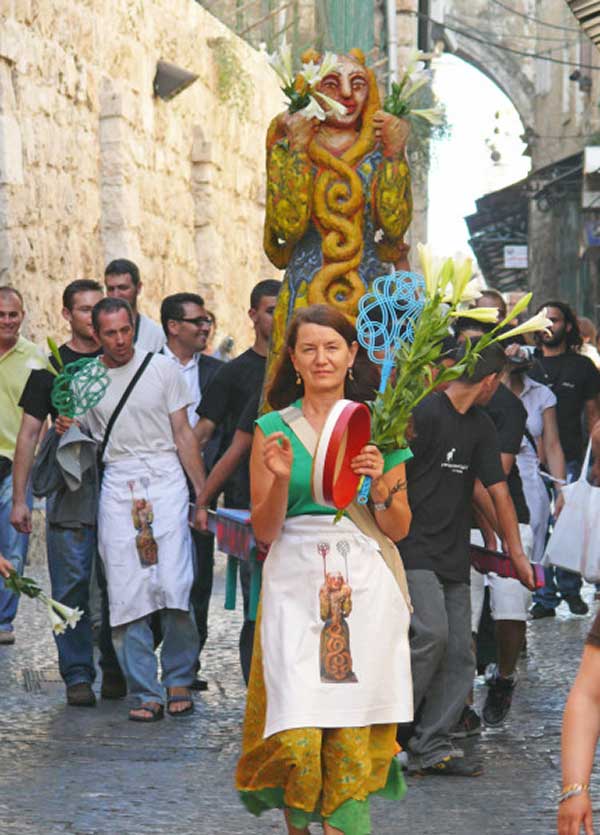
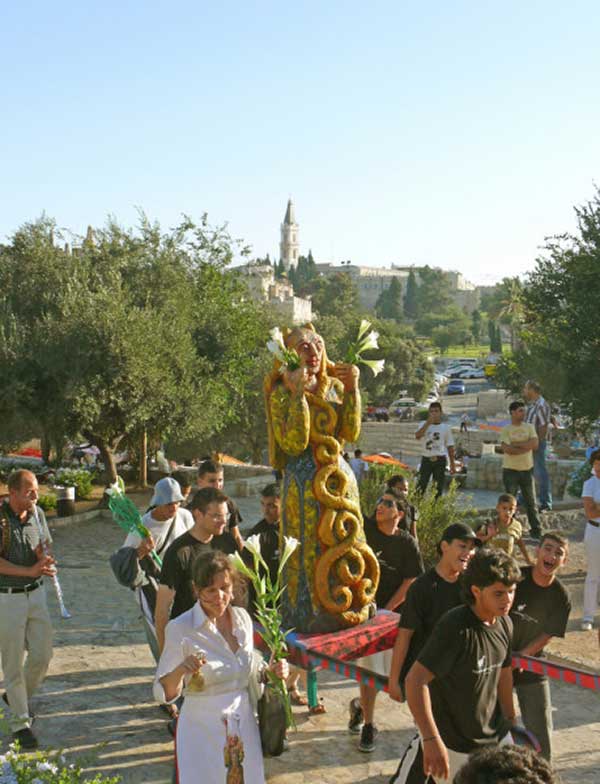
Zu einer Reise aufbrechen, im Sommer, am besten dorthin, von woher einem die interessantesten Nachrichten entgegenkommen. Es wird ein großer Reisekoffer hergestellt, eigentlich ein Sarkophag oder eine Couchette: ausgepolstert, verziert, mit Satinbettwäsche in leuchtendem Rot und Gelb. Es gibt auch Kleingepäck, ein Kosmetiktäschchen, Parfumflakons. Eigentlich handelt es sich im Falle der Reise meiner Statue um eine „Heimkehr“. Denn wenn man es im Licht ihrer Geschichte betrachtet, ist Maria Magdalena, geboren in Magdala am See Genesareth, keine „natürliche Französin“. Auch wenn sie bei Marseille mit ihrem Schiffchen gelandet ist und dann viele Jahre in einer Grotte im Massiv La Sainte Baume verbracht hat, schließlich ihre Gebeine in St. Maximin La Sainte Baume bzw. in Vézélay gelassen haben soll, war sie vielleicht Frankreichs prominenteste Immigrantin. Die Geschichten wandern mit den Leuten, Maria Magdalenas Geschichte hatte von da an ihr Zentrum nicht mehr zwischen See Genesareth und Jerusalem, sondern in „Europa“. Das Exil Maria Magdalenas entspricht dem Exil des Weiblichen in der Geschichte. Die Reise nach Jerusalem meiner Statue dreht diese Geschichte symbolisch um. Gibt ihr eine neue Drehung. Markiert einen neuen Punkt Null. Von hier aus, von diesem bestimmten Ort aus an der Stadtmauer Jerusalems zwischen dem Damaskustor und dem Herodestor, kommt jetzt ein neuer Impuls. An diese Stelle wurde die Statue in einer feierlichen Prozession getragen, mit Musik begleitet, von einer Gruppe von Leuten umgeben, die in den Händen weiße Lilien und Teppichklopfer hielten. Hier, an dieser ausgesuchten Stelle, wurde der „Sendemasten“ aufgestellt, die Statue, der Apparat, der EchoEmitter, die Informationskonserve, die unsterbliche Mumie. Eine Heimkehr nach ungefähr 1956 Jahren (wenn man dem Kalender Glauben schenken will). Eine späte, aber angemessene Ehrung und Feier.
Die Skulptur, die in der zeitgenössischen Kunsttheorie auf Grund mangelnder Kriterien und Kategorien ausgelassen wird, um nicht zu sagen: gesnobbt wird, sie besitzt für solche Operationen, wie ich sie im Sinn hatte, unüberbietbare Vorteile. Insofern sie einer transhumanen Chronik angehört (Dendrochronie oder Geschichte der Bäume) haftet ihrem „Fleisch“ etwas Objektivierendes an. Der Geschichte der Bäume zuzugehören heißt, reine Genealogie zu sein, reine Evolution, reine Erdlogik, Aufgehen im Metabolismus. Jede Skulptur ist im eigentlichen Sinne „Transplantation“, Ortswechsel der Pflanze. In dieser Transplantation bleibt aber die Pflanze bzw. ihre Gedächtnisbatterie (der Stamm) innerhalb der Echosphäre der Erde (biotopisch). Das Lindenholz nimmt die Information und hält sie zurück, anders und langsamer als Wasser. Holz ist daher der vornehmste Operator einer Tiefengeschichte, einer longue durée, die menschliches, nicht mehr nur geologisches (wie beim Stein) Geschichtsformat besitzt. Die Bedingung der Möglichkeit von Gedächtnis ist die elektromagnetische Interferenz des Erdfeldes mit ihren „Kleinkörpern“. Der Lindenstamm, der von uns verschickt und in Jerusalem herumgetragen wurde, wechselt (als Transpflanze im Transport) das Echofeld und hält seine Maria Magdalena Information in das Feld hinein (eine Form haben heißt: einen Zweck haben, griech. Entelechie). Das ergibt eine neue Interferenz, eine neue Gedächtniskonstellation.
Maria Magdalena taucht auf, um einen neuen Nullpunkt zu generieren. Die Gedächtniskonstellation zu verändern heißt, eine neue Geschichte zu erzählen. Die neue Geschichte ist die des Ausgleichs. Es ist die der Balance zwischen Männlich und Weiblich, nicht weniger als die Verkündigung der Gleichwertigkeit des Verschiedenen: zwei Hälften (Teppichklopfer/Lilie), die kybernetisch aufeinander reagieren. Es gibt auch ein Evangelium der Maria Magdalena. Der Teppichklopfer, ein unmittelbar an den Haushalt verweisendes Instrument, steht für das Weibliche, sofern damit Innerliches, Intimes, Häusliches, Privates gemeint ist. Ein in einer Prozession im öffentlichen Raum mitgeführter Teppichklopfer ist, wie Lacan sagen würde, nicht an seinem Ort. Der Teppichklopfer erhebt also eine Forderung, erstens die Disjunktion zwischen Weiblichkeit und Häuslichkeit und zweitens die Konjunktion zwischen Weiblichkeit und Öffentlichkeit. Der Teppichklopfer ist der provisorische Signifikant. Der Teppichklopfer ist meistens als schöner Knoten ausgebildet, was ihm einen einzigartigen ästhetischen Reiz gibt. Ferner steht er als Knotendarstellung mit anspruchsvoller Knotenmathematik in Beziehung. Und diese Mathematik verweist natürlich auf eine komplexen Diagrammatik des Raumes, die unweigerlich sowohl BildhauerInnen wie ArchitektInnen in ihren Bann zieht wie ein „Traktor“.
Die Form der Statue der Maria Magdalena ist selbst aus zwei sich ineinander schlingenden langen Linien entwickelt. Die gesamte Figur wird von sich schlängelnden Linien wie von hölzernen Oszillogrammen bedeckt. Damit drückt sie ein „Erdwissen“ aus oder die Technologie des Lebendigen, das sich im Schlängeln der Kräfte und Informationen, in der Integration des Bipolaren realisiert. Maria Magdalena verkörpert den idealen Moment, den Drehmoment, der die Bewegung (wieder) anstößt. Sie wird nicht ohne Grund als Apostola Apostolorum bezeichnet. Stellvertretend bewegt wieder sie die „weibliche Angelegenheit“. Jetzt, wo sie wieder zurückgekommen ist und öffentlich in Jerusalem gezeigt wurde, ist das Exil des Weiblichen beendet.

Abb.

04.12.2015

Ululation

Eine Ululation ist ein langer, hoher Klang mit schnell schwankender Tonhöhe, eine besondere Art des Heulens. Wer ululiert, bewegt schnell Zunge und Gaumenzäpfchen und singt gleichzeitig einen hohen Ton. Bereits im antiken Griechenland war Ululation als Ausruf der Freude bekannt.Die Gesangstechnik wird bei bestimmten Ritualen verwendet und ist eine Domäne der Frauen.
In arabischen Ländern, wo es Zaghruta genannt wird, wird es häufig als Ausdruck von Freude eingesetzt, vor allem bei Hochzeiten. Traditionelle Lieder mit Elementen der Ululation finden sich beispielsweise auf der 1997 erschienenen CD „Zaghareed“ von Mohsen Subhi. Dort wird die Ululation in den Gesamtkontext der Songs eingebettet. Genauso gebräuchlich ist es bei Beerdigungen von Märtyrern in der islamischen Welt.
Des Weiteren kommt Ululation in Indien vor, sowie in der afrikanischen Musik und stellt häufig ein Ausdrucksmittel religiöser Ekstase dar.
In der Medizin wird mit Ululation ein unartikuliertes, übermäßiges Schreien bei Hysterie und manchen Psychosen bezeichnet.