Posts mit dem Label körper werden angezeigt. Alle Posts anzeigen

12.11.2016

THE COLONIAL ADMINISTRATION OF BODIES AND SPACE


http://the-archipelago.net/2014/08/21/ann-laura-stoler-the-colonial-administration-of-bodies-and-space/

Conversation recorded with Ann Laura Stoler in New York on August 11, 2014

Ann Laura Stoler and I begin this conversation by introducing the political context lexicon (see below) that she co-curates and edits. We then discuss the work she had done around the colonial management of sexuality and reproduction. The existence of the métis (mix-blooded) child in the colony renders more complex the binary distinction between colon citizens and colonial subjects. Biology is nevertheless not merely the only site of recognition for the colonial administration, behavior is also extremely important in the access to citizenship. We examine how space, whether corridor or school, is built to accommodate the administrated behavior of the colony. Finally, Ann gives us a preview of her forthcoming book that attaches a strong importance to the notion of duress and the concepts we need to write new colonial histories of the present.
Ann Laura Stoler is Willy Brandt Distinguished University Professor of Anthropology and Historical Studies at the The New School for Social Research in New York City. She has worked on issues of colonial governance, racial epistemologies, and the sexual politics of empire. Her regional focus has been Southeast Asia. She was a visiting distinguished professor at the École des hautes études and at the École Normale Supérieure in Paris and is recipient of Fulbright, Guggenheim, National Endowment for the Humanities, National Science Foundation and Social Science Research Council fellowships.

07.09.2016

body without organs

The body without organs has been an object of feminist criticism. For Luce Iragaray (Ce Sexe qui n'en est pas un, p.140) the notion is reminiscent of a condition of dispossession of the bodily self. She points out that the emphasis on the machinic, the inorganic, as well as the notions of loss of self, dispersion, and fluidity are all too familiar to women: Is not the body without organs women's own historical condition?
See also Alice Jardine, Gynesis.

16.04.2016

Foreign Bodies

Sanell Aggenbach, Spiniferlictus, 2015, Wood and gold-plated steel, 138 x 45 x 68 cm
Rowan Smith, Hiding White , 2015, Wax, oil paint, fabric and polystyren, 243 x 189 x 29 cm

WHATIFTHEWORLD is pleased to present Foreign Bodies – a group exhibition of new work by Sanell Aggenbach, Julia Rosa Clark, Pierre Fouché, Dan Halter, Mohau Modisakeng, Athi-Patra Ruga, Rowan Smith and Moffat Takadiwa.
In English at least, nations are bound up in the language of bodies. The metaphoric conflation runs through political discourse like connective tissue. We speak of a body politic; a head of state; a healthy democracy and the long arm of the law. A government has a seat and an empire, a heart. Corporealised these abstract political communities are both easier to imagine and closer to home. But that begs the question: whose home, exactly? And equally, crucially, whose body is mapped onto this geopolitical landscape? How we read the bio-logic of belonging informs not only how we experience our citizenship, but its conditions, its scope and its limits.
Collectively the works of Foreign Bodies take the temperature of national belonging. The title plays on two closely-linked interpretations of a “foreign body”, one perhaps more political and one more material (although as these works demonstrate, that distinction is never as clear as it may seem). The first calls to mind the figure of the migrant entering “local” space – a stranger in a strange land – and the second suggests an intruding parasite that triggers an immune reaction in a body made suddenly strange to itself. Each is foreign only inasmuch as they penetrate an already porous frontier, and that frontier is at best merely an idea of difference: the border is, after all, a site where otherness is not just held at bay but actively constructed. Without borders between skin and world, indigenous and foreign, how would we know where “we” end and the rest begins?
Without claiming authoritative or absolute answers, Foreign Bodies engages what is alien to us – biologically, psychologically, socially, personally and politically – and examines how we might better read bodies not our own. More than that, together these artists posit the possibility of reading our own bodies, both fleshy and national, differently.


25.03.2016

The Yellow Wallpaper


https://www.nlm.nih.gov/literatureofprescription/exhibitionAssets/digitalDocs/The-Yellow-Wall-Paper.pdf

Mental Illness in Literature: Charlotte Perkins
Gilman's "The Yellow Wallpaper Updated on August 8, 2014
Mental Illness in American Literature

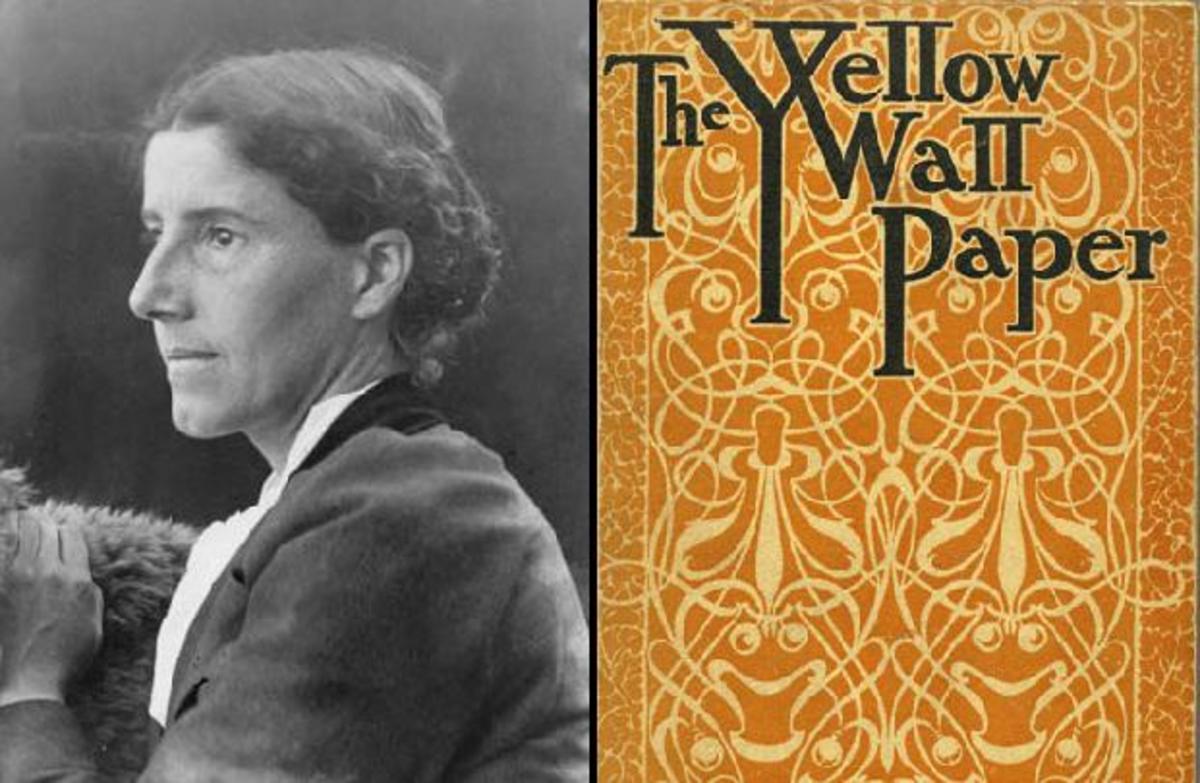
Gilman's most famous work, her short story "The Yellow Wallpaper", published in 1892, is about a woman suffering from mental illness after of being confined to a bedroom in the attic of a vacation home by her husband, John, for the sake of her health. She becomes obsessed with the room's repulsive, yet alluring yellow wallpaper. Gilman wrote this story to bring light to women's role in society, explaining that women's lack of autonomy negatively affects their mental, emotional, and physical well-being. She used it as a call to action for readers to recognize the legitimacy and complexity of illness and benefit in therapies for treatment, namely in women, and to overcome sexism in treatment
The narrator explains the embodiment of the authors experience during her time being treated by Dr. Mitchell's "rest cure". The treatment, which includes no physical activity, mental stimulation, or hobbies, is in direct conflict with what the author needs to get well. This drives her further into madness until she descends beyond the point of getting better.
Left: Charlotte Perkins Gilman     Right: "The Yellow Wallpaper" cover
Left: Charlotte Perkins Gilman Right: "The Yellow Wallpaper" cover

19.03.2014

Merce Cunningham I, 1963


————————————
Andy WARHOL
Merce Cunningham I, 1963
Sérigraphie et peinture aérosol sur toile
90,2 x 69 cm
New York, Mugrabi Collection