Posts mit dem Label feminismus werden angezeigt. Alle Posts anzeigen

03.09.2017

Leaving Home: Slavery and the Politics of Reproduction

Camille Barbagallo October 31, 2015


In fact, from one point of view, we cannot unravel one female’s narrative from the other’s, cannot decipher one without tripping over the other – Hortense Spillers1

We had driven straight through from Brisbane to Sydney, a nine-hour drive with your foot flat to the floor. We were on our way to a radical student conference, it was the very late 1990s and the WTO protests in Seattle had just hit the national papers. It was a time when some of us had started to get confident in naming the problem, saying it out loud: capitalism. We arrived sweaty, tired and sort of tumbled out of the car and into the front garden of a huge run-down student house in inner Sydney. A woman I had not met before, Natasha was at the front door. Noting my then boyfriend, she spat,

“So, you’re a breeder then.”

Standing there in the harsh morning sunshine, the word breeder did the job it was intended to do: producing a connection between my nineteen year old body, its assumed capacity for biological reproduction, patriarchy and normative heterosexual sex. A little taken back, I mumbled something while looking at my feet and spent the rest of the week thinking about what breeder sex would be like.

Conversation Piece, before a house in Monument Lane, Edgbaston (William Williams, 1780)

This essay offers a critical reflection on the history of reproduction at the intersection of slavery and capitalism in the Anglo-American context.2 In sketching this history I explore the relationship between capitalism, gender and slavery and how the invention of the two separate spheres of production and social reproduction was produced and maintained. What emerges is the highly contradictory nature of the home and family under slavery and that in some instances the household served as an important site of resistance for slave women. Exploring the complexities of the household and family structures under slavery challenges tendencies within feminist theory that assume a universal or “shared” experience of home, motherhood and the domestic sphere.

The problem of where to begin in unraveling the stories of slavery, feminism and reproduction is an interesting one. Particularly if one is not seeking to locate origins or founding moments, but is instead interested in asking how reproduction has come to be the problem that it is today. In the first instance, it is necessary to ask what is at stake in the history of reproduction, in part because the definitions and meaning of reproduction not only vary but also are often experienced in contradictory ways. The inequalities and disparities in how different racialized and gendered subjects experience the labor of making and remaking people under capitalism cannot be ignored and these gaps, silences and spaces of difference have long and complex histories. Considering the overwhelming location of reproduction is in the realm of the natural, the biological and that murky, under-theorized location of home, it is necessary to not only gesture towards what is at stake politically but to do so with the aim of “weaponizing reproduction.” The task is certainly a feminist project, one that takes seriously what it means to denaturalize reproduction, with the desire to grab hold of the problem and transform it.

From the outset it is clear that the story of feminism and reproduction is a complex and at times contradictory one. Of the many valid and necessary critiques of second-wave feminism that have and continue to be made, the notion that the women’s movement in the 1960s and 1970s was anti-mother is certainly a persistent line of attack. It is also a criticism that has been consistently challenged by those who were active in the movement, many of who were young mothers at the time. The idea that feminists were anti-child and anti-mother can in some ways be traced to how uncomfortable the original demand in Britain for “free 24-hour nurseries” made people feel. Critics claimed that the demand signaled women’s desire for “baby dumping.” People were horrified by the supposed unnaturalness of young children being looked after by people other than their mothers at irregular times. That a demand for accessible and affordable childcare could cause such panic tells us something about the organization of gender in post-war industrial economies.

Whilst the charge that second-wave feminist were anti-mother unravels under scrutiny, the family and the post-war family in particular was certainly the object of much feminist criticism and analysis. Shelia Rowbotham writes that the women’s movement erupted “in a literature of complaint which focused on the experiences of the family – both in the sense of life in the household and with kin.”3 It was less mothers and more motherhood that feminist saw as the problem. In a pamphlet entitled Women and the Family, written by three women, each with two kids, the authors write, “our window on the world is looked through with our hands in the sink and we’ve begun to hate the sink and all it implies.”4 Rowbotham continues that it was not that “every woman suddenly became unhappy, but that significant numbers of women felt entitled to a destiny which was not simply domestic.”5Considering that in the late 1960s, nearly 55 percent women in Britain did not work outside of the home, it is unsurprising that for significant numbers of women the family and women’s domestic destiny came to be seen as one of the central sites of female oppression. For many in the movement, women’s liberation meant an escape from the home – “in the home the woman is in the family, and the two are disturbingly synonymous.”6

21.07.2017

THE FRAGILITY OF THE WESTERN TRAVELER: TIME TO (UN)PACK THE COLONIAL BAGGAGE


Illustration by Subin Yang

This feature, on the continuing destruction of colonialism through exploitative tourism, is the fourth of our monthly longreads on the topic of Fragility. Every month through December 2017, we’ll publish a new must-read perspective on the subject that we hope you’ll read, share, and make part of your routine.
For now, though, get comfortable and get ready for part four: It’s time to unpack your bags and rethink how you travel the globe.

The first image we’re drawn to is a white man. He is positioned at the center and looking straight at us. To his right stands a Native Hawaiian woman in all her bobblehead glory—the flower in her hair, a burnt orange lei around her neck, and a hula skirt that looks to be made out of leaves. Her bright red lips curl into a subservient smile, her eyes creased in his direction as she adorns the man’s outstretched neck with a lei. To his left is a white woman resting her jaw in a hand, pensively watching the exchange between the man and the Native Hawaiian woman, and, being situated between the two, the man wears a dopey look on his face, as if he’s asking us, ‘How lucky am I?!’ ‘An island surrounded by blue water beckons from a distance and above it reads the words, ALOHA FROM HAWAII.
“In this grotesquerie, the falseness and commercialism fairly scream out from the page,” writes Haunani Kay-Trask in Lovely Hula Hands: Corporate Tourism and the Prostitution of Hawaiian Culture, a takeaway we can apply to the image described above, and really, could be ascribed to the countless images that look just like it, for there is little variation in the marketing of a place like Hawaii. And there exists no other depiction of Native Hawaiian women outside of this static western prototype. “Thus, Hawai’i, like a lovely woman, is there for the taking,” sums Kay-Trask.

THE PROMISE OF WOMEN'S BODIES
The use of women’s bodies—and specifically, the promise of sex—to sell any and everything under the sun has long been the subject of beef between feminists and the advertising world, but what happens when the product being sold is a place? The marketing of women’s bodies, namely, those of color, as destinations to be consumed, lands to be penetrated, or as accessories to the (masculine) tourist experience has remained a largely uncontested norm in travel ads, from vintage depictions of the Hawaiian feminine to the mainstream pimping of Brazilian women’s bodies from brands like Adidas and Kia Motors during the 2014 World Cup. In examining these depictions through an intersectional feminist lens, and factoring in the consequences of such depictions on the lives, lands, and bodies of women of color, we can then decode their lasting message: that mass tourism and colonial occupation are often one and the same, and POC bodies, cultures, and lands are the exotic dominion of the settler. So what does tourism’s dehumanization of women of color tell us about the fragility of the western traveler? What role does patriarchy play in selling place? And what does—or doesn’t—constitute a feminist travel narrative?
Ever since European colonization gave birth to the western travel narrative, the ‘traveler’ has had a tendency to gender the land before him, and even the vessels who bring him to his destination, using cliches of ‘virgin forests’ waiting to be ‘explored’ and ‘wild’ (read: Indigenous) terrain unacquainted with the poke of flag, assigning himself as the active male do-er while the land and its passive people are being done unto. Kay-Trask continues in this vein, writing, “Hawai’i is “she,” the Western image of the Native “female” in all her magical allure. And if luck prevails, some of “her” will rub off on you, the visitor.” Wilderness is then very much a white supremacist concept, a fantasy land void of people and their resistance where the settler can escape to when the travails of civilized life grow too taxing (#FirstWorldProblems amirite). The flowery rendering of ‘exploration’ inherent in the tradition of travel writing, from the Doctrine of Discovery to Anthony Bourdain's Part's Unknown, is all about thinly veiling his insatiable urges to make a place his bitch.
In feminizing place, patriarchy demotes it to the realm of the female, that is, not valued, but valuable, and when we add capitalist imperialism to the mix, she is ceaselessly plundered for her resources by settlers. And in many ways, today’s western traveler is a descendant of the settler. There’s an uncanny resemblance between the way the settler treats the land and how his society treats women of color. To sell a place, that is, to advertise to consumers that it is available for ownership, it first has to be objectified, and since white men in these ads signal action and ownership, the women of color are easily sold with the product. A relic of colonial nostalgia that would get Hemmingway hard, she’s coded as more ‘traditional:’ not yet influenced by the likes of (white) feminism. At a special meeting of Women Ministers of Culture in Iceland, Dr. Annette Pritchard gave a presentation calling this product a “remarkably durable imaginary, which is routinely recycled in the gendered, sexed, and racialized cultural iconographies of the travel industry.” In order to tame women and to tame the wild, he must depict her as tame. In using one to market the other, they “both continue to be framed by colonial myths and fantasies,” she continues, “so that these leisure landscapes are feminised and eroticised” in order to justify occupation. He came, he conquered, but in the context of settler colonialism and tourism, he never left. Like a cheap souvenir, “Hawai’i itself is the female object of degraded and victimized sexual value,” sums Kay-Trask. Considering this, travel media can be understood as the very narrative behind domination dressed up as leisure. But leisure for whom?

PASSPORTS OF ENTITLEMENT
Leisure travel is all about escape and indulgence, which, to the western tourist, can seem rather harmless. But consider the dichotomy between what is being escaped and what is being escaped to. “From the mid-1800s to the 1930s, the acceptance of wild landscapes inhabited by Native peoples as being natural evolved into an idealization of uninhabited landscapes,” writes Carolyn Finney in Black Faces, White Spaces: Reimagining the Relationship of African Americans to the Great Outdoors. It seems that the white settler can not enjoy nature without conquering it or without objectifying the land and relegating the rest to ‘nature’ for ornamental relief. “Implicitly,” she continues, “it is linked to a legacy of Eurocentrism and the linkage of wilderness to whiteness, wherein both become naturalized and universalized.” Heroes of the National Park and Reserve system like John Muir, who was very anti-Black and Native, worked from a place that destruction of ‘nature’ for development was OK, just set a little green aside for us to vacation in. As Kay-Trask clarifies, “Tourists flock to my Native land for escape, but they are escaping into a state of mind while participating in the destruction of a host people in a Native place.”
Likewise, indulgence to the fragile western tourist is deserved, something they are entitled to. Just challenge them on this and you’ll see how fragile they are. (One butthurt bro wrote a whole article in response to my work: “[Amor] rejects the idea that holidays are about fun and freedom.” He has a point, though. I am wholeheartedly anti-fun and GET THAT FREEDOM AWAY FROM ME.) In his lecture at Massey University in New Zealand, Ripping off the Brands: a Rough Guide to Anti-travel, writer Scott Hamilton said, “Travel has become the ‘other’ of work. Because we are often so busy at work, we choose to be indolent on holiday—to switch off cell phones and brains and lie on a beach. We can be selfish and demanding on holiday.”
In travel ads and media, images of women lying on beaches communicate indulgence to the tourist; a report on gender in tourism marketing found that “body shots describe the destination as a place where the tourist can indulge him or herself.” In wanting to be taken care of, the tourist infantilizes himself without considering whether or not his host deserves a break, too. “Every native would like a rest, every native would like a tour,” Jamaica Kincaid expertly explains in A Small Place, “but most natives in the world cannot go anywhere. They are too poor to go anywhere. They are too poor to escape the reality of their lives; and they are too poor to live properly in the place where they live, which is the very place you, the tourist, want to go—so when the natives see you, the tourist, they envy your ability to turn their own banality and boredom into a source of pleasure for yourself.”
Indulging in ‘uninhabited’ landscapes takes on an interesting life when embodied by white women. As Mary Fillmore writes in Women and Tourism: Invisible Hosts, Invisible Guest, “A tourist destination is where men of one class can enjoy the privileges of men of another class, and women can enjoy the privileges of men.” White women, that is. She continues, “Someone else will cook their meals, make their beds, clean their toilets,” but how does that differ from the norm of women of color laboring for white women here in the States? It doesn’t, but for white women, indulgence itself is what constitutes feminism.

HOSTESS WITH THE MOSTEST OPPRESSION
From the wide world of travel writing by white women to the ones in my Twitter mentions responding to my question, “What does a feminist travel narrative look like to you?” there’s a general consensus that feminism is (white) women simply doing whatever they want, including going on vacation. Fillmore advises us to “consider what the tourist seeks” in order to look “at tourism through the feminist lens. The tourist’s desire is usually to be indulged like a child, being free to indulge one’s appetite at will, to play all day” and have someone else (spoiler alert: WOC) clean up the mess. These host communities end up playing the role of the Mother to the infantilized tourist. There’s nothing feminist about taking selfies with Maasai women struggling to hold onto their dignity in the face of exploitative tourist practices—that’s some colonial Mammy shit.
Clearly, this is indicative of white feminism’s shtick of employing the tawdry guise of ‘female empowerment’ to assuage their white guilt. But even when laborers in tourism are conveniently erased from mainstream women-centered travel plots, patriarchy’s prints can still be found all over their reels. Take the (very few) travel-ish films starring women, for example, Eat, Pray, Love, Wild, Aloha, How Stella Got Her Groove Back, Last Holiday, and Under the Tuscan Sun. Cishet romances drive these stories, telling us that women travel to either get over a dude, find a new one, or both. Let’s use Amy Schumer, and her latest movie, Snatched, as an example. After she’s dumped (check) on the eve of an ‘exotic’ getaway (check) to my home country of Ecuador, she takes her mom instead, and they both get hilariously get kidnapped (check) by random natives in the Amazon jungle. Basically, two white women bond over farts while wild men of color prey on their fragile femininity on Indigenous land. In making their disposable film, they’ve rendered my people and place disposable, too.
From the Black Mammy trope to that of the Singapore Girl, Spicy Latina, Pocahontas, and China Doll, women of color are deemed to exist to serve the whims of the white settler, whether that be sexual or domestic. (The current boom in sex tourism by white women to the Caribbean and Africa says enough about the white supremacist hypersexualization of Black boys and men, but I digress.) They’re either depicted as sexless or hypersexual, which, in denying a woman’s agency over her body, are both objectifying. Kay-Trask breaks down the consequences of a western tourist gaze on women’s sexuality, writing that hula dancers are to “behave in a manner that is smutty and salacious rather than in a way that is powerfully erotic. The distance between the smutty and the erotic is precisely the distance between western culture and Hawaiian culture.” Travel media preserves the colonial origins of so many stereotypes about women of color, which Dr. Annette Pritchard elaborates on, saying that they “recycle not only hetero-patriarchal but also ‘colonial’ myths and fantasies, so that gendered and sexed representations of women are used to exoticise and eroticise” the Global South and East. This extends from advertising and into travel writing and TV shows, which “all play a part in mapping the sensual topography of land and skin so that the women and the landscapes of the Caribbean and the South Pacific become analogous.”

BORROWING FROM RAPE CULTURE
Much of the lingo used in travel writing and marketing consistently employ the language of rape culture. In feminizing place, tourism marketing has also sexualized it, showing just how creepy his obsession with owning the Other is. (Colonial dudebros really know how to put the ‘lust’ in ‘wanderlust.’) Let’s start with a brochure from the Jamaica Tourist Board that promises that “tempting sunsets appear as girls with cinnamon-coloured skin walk the beach wearing bikinis the size of butterflies. This is your Eden. Welcome to Negril.” (Italics mine.) One male traveler writes that India “awaits you. She is an indescribable and unforgettable land [where] every whim will be gratified.” (Are these writers or wannabe pimps?) Another male travel writer describes Tahitian women as “dusky, voluptuous village girls” who “tempt tourists” with their “long hair, velvet skin [and] fragrance.” But it’s not just creepy, it’s a marketing ploy. And isn’t that even creepier? Dr. Pritchard writes that the Tahitian women here “represent the enticing and inviting land to be explored, mapped, penetrated and known by the male traveller.” She is a symbol for the brand that is Tahiti vying for the gaze of the tourist, the consumer. Her boss.
Consider the relative ease with which western cis male tourists are able to travel. Travel writing, blogs, and memes overflow with entitled, thoughtless language like, “Spin the globe. Where it lands, that’s where we’ll go,” and “I was not born for one corner; the whole world is my native land.” They generally have more money to spend on travel, more time to take off from work, less responsibilities to family, powerful passports, few barriers to acquiring visas, are not criminalized by the TSA, are less vulnerable to policing and sexual harassment, and besides not having to worry about being treated like a human being wherever they go, are treated like rock star royalty in the developing world, where their dollars triple. And when traveling is a cakewalk to you, feeling entitled to it naturally follows. Travel marketing fuses travel ‘destinations’ and the host women into one brand, so that the tourist is not only entitled to the land by design, but to its women. “In [tourism advertising] we will see that stereotypical gendered, sexed and often racialized images of women are in many cases part of the tourism product itself,” summed Dr. Pritchard. This is part of what makes sex tourism, trafficking, and abuse by western male tourists more rampant and commonplace than any mainstream outlet has given it credit for.


In an industry where women are the face of the product and not the business, where they are over-concentrated but invisibilized, working menial tasks for less pay than men, they are made dangerously vulnerable. Especially as hotel and other travel brand owners are either foreign whites or national elites, and tourism laborers are usually non-unionized, the substantial power differences therein shrink the woman and her rights, making her prey to the potential attacker. A 2003 report from the International Labor Office finds that women in the tourism industry aren’t just vulnerable to male coworkers and bosses, like other sectors, but to their clients, as well. Citing the report, Dr. Pritchard writes, “Factors such as late working hours, service of alcohol, dress codes, racism, negative attitudes towards service staff and the uninhibited, sexualised nature of tourism and tourism promotion contribute to a high-risk environment for women and younger workers, as well as ethnic minority, migrant and part-time workers.” (Italics mine.) In a similar United Kingdom study of graduates in the hospitality industry, 44 percent said they had experienced some type of violence, and 50 percent of those respondents say it was directly due to their gender. “Overall,” the report concludes, “respondents in non-managerial occupations reported customers as the most likely perpetrators.” Not only do many men travel specifically to engage in sex tourism, mostly in majority-POC regions, but they’re also afforded more opportunities to harass or attack women, as they are more likely to be their flight attendants, maids, waitresses, bartenders, and sex workers.

EAT, PRAY, LOOT
But what of the ripple effects of mass tourism on women of color, regardless of the tourist’s gender or intent? A major one is displacement, when gubernatorial or corporate powers (or both) seize local land in favor of resorts, displacing local people and replacing local industries. Studies by Tourism Concern show that “forced displacement and loss of livelihood due to tourism development in” coastal areas historically inhabited by fisherfolk “has caused disenfranchised fishermen to turn to drink, which is often a forerunner to domestic violence against women and children, and even abandonment.”
Overconsumption of resources and environmental degradation are also effects of mass tourism that directly impact women of color. In Invisible Hosts, Invisible Guest, Mary Fillmore writes, “It is a local woman who must pay the price for the tourist’s luxuries.” Inflation follows growing tourist demands for imported items. “It is she who must go farther and farther for smaller and smaller amounts of water, who must carry less over greater distances.” Traveling further for water is known to raise a girl or woman’s exposure to violence. “She is the one who must make do with less in cooking and in washing herself and her children.” The tourism industry is real good at overusing water in places where access to drinkable water is scarce, especially since resort tourism is typically done in developing countries. “Her working day, often already overextended to include paid as well as unpaid work, is lengthened further.” Notice a pattern here?
While it’s no news that women’s’ labor is devalued around the world, especially that of women of color, it is either erased or glamorized as a part of the tourism product. Like a free gift tossed to the bottom of a cereal box, she is molded to attract the attention of swinish boys expecting the product to match its advertisement. “It is as if everywhere we go, we become someone’s private zoo,” wrote Trinh T. Minh-ha in Woman, Native, Other. The thing about women though, and the places they come from, is that neither are static, ageless, or free of resistance. That image was brought to you by colonization, a process that necessitates the devaluing of land and its people by creating a system of difference with which the white man could prop himself up on. And travel media refuses to discard of those stereotypical scenes that carry the vestiges of imperial rule to today, because without them, they wouldn’t have a brand, much less a product to sell.
In an industry that would cease to exist if it weren’t for women of color, “They are among the most useful pawns the industry has to move to the front of the board to attract the Northern male tourist,” writes Fillmore, “depicting them as compliant, submissive, and ultimately accommodating.” But if you tell this to a white travel writer or just a Western traveler, that just as women don’t exist for male consumption, their lands don’t exist for tourist consumption either, their fragile sensibilities will buckle before you. And that’s because he needs to believe that he is propped up by nature and not by design in order to keep Eat, Prey, Looting. Cool story, bro.
Check in next month for the next piece in our series on fragility.

Part 1 | Part 2 | Part 3 | Part 4 | Part 5 | Part 6 | Part 7 | Part 8


Bani Amor is a queer travel writer, photographer and activist from Brooklyn by way of Ecuador who explores diasporic identities, the decolonization of travel culture, and the intersections of race, place and power in their work. They’ve been published in Bitch Magazine and Apogee Journal, among other outlets. They are a three-time VONA/Voices Fellow and have an essay in Brooklyn Boihood’s anthology Outside the XY: Queer Black and Brown Masculinity. Follow them on Twitter @bani_amor.

The fragility series is published each month by Bitch Media, a nonprofit, independent, feminist media organization. Think our work deserves your support? Become a Pollinator and get great benefits—we're talking mugs, a subscription to award-winning Bitch magazine, stickers, and more!

27.06.2017

Werdet Schwarze Frauen*! Plädoyer für ein minoritäres Bewusstsein

Der diesjährige internationale Frauen*tag am 8. März war anders. Bestärkt durch den gigantischen Women’s March in Washington fanden globale Proteste statt, über 30 Länder haben – ausgehend von Initiativen aus Argentinien, Polen und anderen Ländern – an Frauen*streiks teilgenommen. Auch in der Schweiz gab es unzählige grössere und kleinere Aktionen: auf dem Bundesplatz in Bern versammelten sich Menschen zu einem ‚Strick-In‘, Parlamentarier_innen strickten in der Wandelhalle für Gleichstellung, in Zürich wurde die Statue des Reformators Zwingli mit einem Pussyhat zur Ober-Pussy geweiht. Musiker_innen produzierten einen Solidaritäts-Song, die Guerilla-Feminist_innen Aktivistin.ch übersäten die klischierten Spielzeugabteilungen grosser Kaufhäuser mit Protestbotschaften, und unter dem Motto "We Can’t Keep Quiet" formierte sich ein gigantisches Bündnis von Frauen*organisationen und Verbündeten.

Time, 28. Januar 2017; Quelle: time.com
Seit der Wahl von Donald Trump erfahren Frauen*bewegungen weltweit Aufwind, konstituieren sich teilweise neu, weil unzählige Frauen* und Verbündete dazu kommen und realisieren: Frauen*hass und Sexismus sind immer noch weit verbreitet. Was unsere Grossmütter erkämpft haben, ist nicht sattelfest. Und das, was noch erkämpft werden muss, erst recht nicht.
Manchmal sind diejenigen, die seit langem kämpfen, wütend: Warum wacht ihr erst jetzt auf? Wo wart ihr, als alleinerziehende Mütter in Armut versanken und Care-Arbeiterinnen ihre Rechte einforderten? Wo waren die Massen, als Black Lives Matter gegen Polizeigewalt auf die Strasse ging? Als Erdoğan in der Türkei proklamierte, die wichtigste Aufgabe der Frau sei es, Kinder zu gebären? Als in Argentinien jährlich 300 Frauen ermordet wurden? Für viele ist die Welt nicht erst seit Donald Trump unerträglich geworden. Dass es jemanden wie Donald Trump braucht, um grosse Bewegungen zu mobilisieren, ist nicht rühmlich. Gleichwohl macht es Hoffnung, dass jetzt immer mehr Menschen aktiv werden.

Warum heisst es „Women’s March?“


Widerstands-Ikone Princess Leia / Carrie Fischer; Quelle: popsugar.com
Bemerkenswert ist dabei auch, dass so viele Menschen unter dem Label 'Women' protestieren. Das ist nicht selbstverständlich. In der Tradition des 8. März zum Beispiel gab und gibt es zahlreiche Debatten und unterschiedliche Handhabungen zu der Frage, ob Männer den Protesten solidarisch fern bleiben, oder ob sie unter dem Frauen*-Dach teilnehmen sollen. Für beides gab und gibt es gute Gründe. Die aktuelle Dringlichkeit, möglichst breit gegen den reaktionären Backlash zu mobilisieren, hat das Pendel in die Richtung „all Gender“ bewegt. So auch beim bevorstehenden Women’s March am Samstag in Zürich: Marschiert wird zwar unter dem Motto „Women“, teilnehmen können und sollen aber alle. Denn die Proteste richten sich gegen multidimensionale Sexismen sowie auch gegen Rassismus, Homo- und Transphobie, Ausbeutung und soziale Ungleichheit.
Aber warum heisst es dann überhaupt noch „Women“? Bei der Lancierung des Women’s March Zürich kam es zu Diskussionen: Einige forderten, es solle "Equality March" heissen, schliesslich gehe es nicht nur um Frauen*, und man wolle nicht die Männer* abschrecken, das Label Frau* sei nicht inklusiv genug. Es zeigte sich: Wenn Männer* unter dem Frauen*-Dach mitlaufen sollen, ist das offenbar eine Kröte, die viele nicht so leicht schlucken. Dass sie unter "Women*" mitgemeint sind, stösst auf. Schnell geht dabei allerdings vergessen, dass Frauen* und viele andere sich Jahrhunderte lang unter dem Dach "weisser Mann" versammeln mussten. In der so genannten ‚westlichen Welt’ wurde der bürgerliche Mann im Zuge der Moderne zum Standard, von dessen Zentralperspektive aus das Weibliche als anders, als Abweichung und nicht zuletzt Makel markiert war (siehe zum Beispiel die freudsche Vorstellung, die Frau sei durch den Penis-Mangel bestimmt).
Genau genommen bedeutet das: In der Kulturgeschichte der europäischen Moderne existiert das Weibliche für sich genommen nicht, sondern nur im Verhältnis zum Mann (Irigaray). Das rassistische Patriarchat produzierte sich ‚seine Frauen‘ (die ‚gute Mutter‘, züchtige Ehefrau, Heilige oder Hure), deren Funktion die Begründung des Männlichen als Norm war. Aber auch Kategorien wie schwarz, proletarisch, irrational und vieles mehr fingierten als das inferiore "Andere" gegenüber dem weissen, vernünftigen männlichen Subjekt.
Natürlich ist es nicht das Ziel, diese Mechanismen umzukehren. Der phallozentrischen Ordnung kann keine Herrschaft der Frauen* folgen, keine neue Hierarchie. Gleichwohl scheint mir Women’s March eine sinnvolle Bezeichnung, unter dem Frauen*-Dach lässt sich durchaus für eine Welt einstehen, die Freiheit für alle, nicht für wenige ermöglichen soll.

Frau* ist keine feststehende Kategorie

Jedenfalls dann, wenn wir uns auf einen Frauen*-Begriffe verständigen, wie er in vielfältigen Debatten der letzten Jahrzehnte entwickelt wurde: Differenzfeministische, queer-theoretische und postkoloniale Ansätze haben Frau* als einheitliche Kategorie oder Identität zunehmend infrage gestellt. Es wurde deutlich: Frau*sein bedeutet extrem unterschiedliche Dinge, unterschiedliche Erfahrungen und Kontexte. Es kann nicht festgelegt werden, wer oder was Frauen* sind. Wer das festlegen will, bewegt sich in der vorherrschenden patriarchalen Logik, einer Logik, die Kategorien bildet und dadurch wiederum normiert, ausschliesst und hierarchisiert.
Es wurde deshalb vorgeschlagen, Frau* nicht als biologische, nicht als feste Identität, sondern als eine gesellschaftliche und mithin politische Kategorie zu begreifen (genau darauf soll übrigens auch das Sternchen verweisen). Plädiert wurde für einen utopischen Begriff Frau*, der gerade nicht wie im bisherigen Männersystem funktioniert, das heisst keine Kategorie definiert. Frau* sollte vielmehr eine Sehnsucht nach etwas radikal anderem ausdrücken, den Entschluss, die phallozentrische, rassistische, hetero-sexistische Ordnung zu verlassen, sich den vorherrschenden Massstäben zu entziehen.

Tejal Shah: "Between the Waves", Collage, Quelle: catch-fire.com
Entsprechend wurde Frau* nicht mehr als Identität gedacht, sondern als eine Aktivität, ein Prozess, der unterschiedlich ausgefüllt werden kann. Deleuze/Guattari (1972), Luce Irigaray (1974) und andere schlugen bereits in den 1970er Jahren vor, Frau* nicht als ein Zustand, sondern als Werden zu denken, als eine Bewegung hin zu etwas, das erst erfunden werden muss. Etwas, das kontinuierlich im Begriff des Entstehens ist, und niemals abgeschlossen. Frau* wurde zu einem Marker für die Bestrebung, das System von festen und zwangsläufig herrschaftlichen Kategorien zu verlassen und zu unterwandern.
Rosi Braidotti (2006) und andere schlugen vor, die symbolische Inexistenz der Frau* als ein politisches Potential zu nutzen: Während die Bestimmung des Mannes als Massstab extrem begrenzend ist, verkörpert das Minorisierte eine relative Offenheit. Es kann nicht zum Massstab werden, an dem der Rest der Welt bewertet wird. Deleuze und Guattari riefen deshalb zum Minoritär-Werden auf, zum "Frau-Werden, Schwarz-Werden, Tier-Werden": „Becoming woman is the basis of a total critique“.
Das Minorisierte eröffnet einen Raum für politischen Widerstand, gerade weil es nicht feststeht. „Frau-Werden, Tier-Werden, Schwarz-Werden“ ist eine politische Aktivität, die der vorherrschenden binären Ordnung zu entfliehen versucht – ohne schon zu wissen, was das Minoritäre genau ist. „‚Becoming minoritarian‘ is the code name for overturning the logic that legitimates a central norm through hierarchically organized binary oppositions“ (Braidotti 2006).

20.03.2017

Venus – The anti-hero Hero


Venus - performance registration from Framer Framed on Vimeo.

Venus – The anti-hero Hero was an interactive programme that explores the historically violent imageries surrounding Venus. Who is Venus? Nikki Minaj? Kim Kardashian? This event is part of the series of public and discursive events that are curated alongside to the exhibition 'Embodied Spaces' (2015) by curator Christine Eyene at Framer Framed in Amsterdam. With contributions by Amal Alhaag, Rehema Chachage, Quinsy Gario, Carolin Kamya, Shertise Selano, Hodan Warsame and Milone Reigman.
This event concluded the three exploratory reading sessions that were loosely based on three chapters from Suzan-Lori Park’s play Venus and connected to the themes of imagination, language and the body. Park’s play is based on the journey of Saartjie Baartman, a Khoi-San woman taken from South Africa in 1810 and exhibited in London and Paris. The reading of the exoticized body of Saartjie Baartman has influenced the iconography of the black female body in western visual cultures. Venus connects to current conversations on race, gender, sexuality, and voyeurism in the media. From Hottentot Venus to bootylicious – the female body, specifically, the black female body belongs to the spectators. How can we re-interpret and reclaim Venus despite the exploitation?
Venus – The anti-hero Hero was developed in collaboration with theater director Amal Alhaag, Milone Reigman. Shertise Solano and Ronald de Graaff created a series of beautiful masks especially for the Venus performance directed by Milone Reigman. In addition to the exhibition the masks will be on show in the public spaces of the Tolhuistuin. Rehema Chachage is based in Tanzania, we had a chance to aks her for a contribution thanks to the Thami Mnyele Foundation.

Framer Framed


15.02.2017

Love’s Labour’s Cost: The Political Economy of Intimacy

By Emma Dowling / 13 February 2016
On Valentine's Day, Emma Dowling makes a powerful case for thinking about the structure of social relationships rather than simply 'the one'. Her excavation of the political economy of intimacy analyses how the ideology of work has penetrated the affective registers of our social lives, while at the same time, we are paying for capitalism's crisis as financialisation and austerity attack our structures of social reproduction. Drawing on feminist critiques of women's unwaged housework, Dowling assesses the uneven and gendered distribution of emotional labour today. Love's work, therefore, must be challenged and transformed: as our material precarity increases, rejecting precariousness in our love relations would be a start in building affective resistance and with that, other possible worlds of love and care.


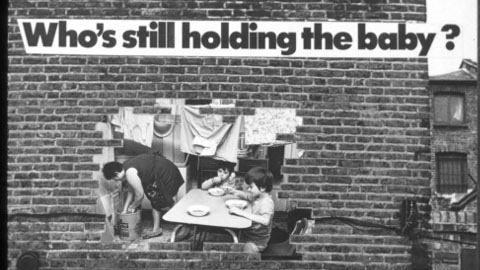
- Hackney Flashers, Who's still holding the baby?, 1978

They say it is love. We say it is unwaged work.

They call it frigidity. We call it absenteeism.

Every miscarriage is a work accident.

So reads a feminist pamphlet calling for Wages for Housework written by Silvia Federici in 1975. “We are all housewives because no matter where we are they can always count on more work from us, more fear on our side to put forward our demands, and less pressure on them for money, since hopefully our minds are directed elsewhere, to that man in our present or our future who will ‘take care of us.’”

Taking care in order to be taken care of. That was the deal of heteronormative love. Underpinning the romantic ideal was the domestic contract between the two parties of the heterosexual couple. Each partner entered into the relationship on the basis of a gendered agreement, a reproductive deal: she would cook, clean, have sex, bear children and care for him, while he was to pay the bills and fulfil his role as care-taker – then he could expect to be taken care of. Since the sexual revolution and tide of social change in the 1960s, feminist and queer struggles challenged the inequality and desirability of this set-up – that women’s housework was seen as the ‘labour of love’ undeserving of remuneration, whereas men’s work outside the home, brought both social agency and power in the home thanks to his wage.

The neoliberal restructuring of the state and the economy alongside the rise of the service industry and the entry of large numbers of women into (often low-)paid work have macerated this reproductive deal. If in a sense the nuclear family arrangement has crashed, it hasn’t so much been undone as it has been fragmented into its constituent parts, with the roles outsourced to different paid and unpaid assistive workers. Migrant cleaners, nannies and au-pairs, sex workers and psychotherapists shatter the middle-class myth of the self-sufficient couple. And it is still women who are doing much of this kind of work. Women, Arlie Hochschild wrote in The Managed Heart in 1984, have been taught to have an instrumentalised relationship to their feelings. It is these abilities that are easily put to work – and nowhere more than in the political economy of intimacy.

11.02.2017

Womanism


Unification is a key cornerstone of Womanist ideology.

Womanism is a social theory based on the racial and gender-based oppression of black women, and other women of marginalized groups. There are varying interpretations of the term "womanist", and efforts to provide a concise and all encompassing definition have only been marginally successful. At its core, womanism hones in on the everyday issues and experiences of both black women and women of marginalized groups, but more importantly, womanism hopes to create an even-leveled environment for all people.[1]

Theory[edit]

Author and poet Alice Walker is credited with coining the term "womanist". From the original introduction of womanism as a social perspective, the term has evolved to envelop varied, and sometimes opposing definitions. Linda Hogan asserts that the term womanist has come to represent a feminist of color, specifically black women, since the Feminist Movement has been experienced by many as intrinsically racist.[2] While feminismcan be alienating to minorities, womanism allows black women to affirm and celebrate their color and culture in a way that feminism does not.[2] In the words of theorists such as Clenora Hudson-Weems and Alicia Boisnier, Black women struggle to identify with traditional feminism, because they do not identify with the issues that feminism typically advocates.[3] Alternatively, Delores Williams, a womanist theologian, associates womanism with the traditions and activism formed from the conditions, events, meanings and values within the African-American community. Williams further asserts that the task of the Womanist theologian is to embody activism by seeking out the voices of the unheard and the experiences of the neglected. She identifies the distinct difference between the experiences of the black woman and the white woman that makes it difficult to identify with feminism. One of the key components of feminism is to end a woman's subjugation to her male counterpart, yet there are other oppressive forces that black women face that takes precedence over the perceived subjugation of the black woman by the black man.[2] This represents an expectation and experience of the black woman as one filled with the quest for knowledge, competence, and authority that surpasses the individual, but encompasses the group.[4] This idea of community rather than individuality is further illustrated by the portrayal of a woman as the embodiment of her environment.[1] In this way womanism does not focus indiscriminately on the experiences of black woman, but desires the reconciliation of all people to their spirituality, their relationships with each other, and their relationship with nature. It characterizes women as willful and capable thereby contrasting the image of a women as subservient and inferior.[5] In doing so, womanism empowers women, and challenges them to break from the traditional definition of womanhood.

02.12.2016

Blood Sweat and Tears,


Installation breaking down past and futures between Peace Activists
Assembling Past and Future is an installation in the project Blood Sweat and Tears, which was conceived especially for the gallery at Körnerpark’s 100 years anniversary and grew out of a collaboration between peace activists and a network of creatives. It is anchored historically in the first International Women’s Peace Congress at The Hague in 1915, during which the participants debated the sociopolitical, economic, and intellectual prerequisites for a future lasting peace and ties together individuals who advocate for a peaceful world.
Through a video installation, the exhibition space became a virtual conference. Historical images and text are overlaid with contemporary statements and portraits, allowing different temporal planes and materials to permeate each other.
The projects’ collaborative approach probes the relationship between the participating individuals and the conditions on site. Most important subjects are nonviolent communication and community. By destabilizing boundaries between the actors, places, and periods of time, the project wants to show a new understanding of history. Boundaries between art and activism are constantly shifting and blurred within this work. Strict categories are suspended within the instillation: past, present and future; reality, fiction and virtual space; community and individual.

The videos take on the formal tactic of the moving portrait. Moving videos of actors performing speeches are overlayed against archival images from peace activists who participated in the conference in the Hague of 1915. These archival images are broken down and dissected within the moving picture plane, while simultaneously different actors reenact suffragette poses and positions.

20.11.2016

NOTES ON A THEORY OF MULTI-RACIAL WHITE SUPREMACIST PATRIARCHY, AKA MRWASP

November 29, 2013 · by Robin James · in critical race theory, feminism, gender, MRWaSP, multi racial white supremacy, neoliberal, patriarchy, Puar, race, resilience, sexton, sheth
Multi-Racial White Supremacist Patriarchy, or MRWaSP, is my term for early 21st-century globalized Western race/gender/sexuality/capitalist hegemony. I put a lower-case “a” in the acronym to both make the acronym something pronounceable to English speakers, and to echo the older acronym WASP (White Anglo-Saxon Protestant). You say it like “Mr. Wasp”–emphasis on the “mister” shows that this is not just about white supremacy, it’s also about patriarchy.
MRWaSP is an upgrade on WASP. As critical theorists of race have been arguing, white supremacy has retooled itself to work more efficiently in and for globalized, neoliberal hegemonies. Not only are exclusion and border-patrolling resource-intensive, they’re also not the most efficient ways of promoting nationalist, capitalist, patriarchal interests. As Jared Sexton argues, contemporary multiculturalism/multiracialism is a “protest less against the genocidal objectives of Anglo white supremacy than the inefficiency of unrestrained violence as the means of its accomplishment” (Amalgamation Schemes, 200). You can extend this argument to patriarchy and other institutionalized forms of identity-based oppression. It is more cost-effective to include some formerly excluded/abjected groups in racial/gender/sexual supremacy, because this inclusion further reinforces both the supremacy of the hyperelites and the precarity of the most unruly groups (those who pose the greatest threat to MRWaSP hegemony). As the always-brilliant philosopher Falguni Sheth explains,more and more men and women of color have been invited into the offices of White Supremacy to share in the destruction of other men and women of color who are vulnerable, disfranchised, and rapidly being eviscerated through the policies of a multi-racial white supremacy…A multiracial white supremacy is a system of power that has invited in—or exploited wherever it could– people of color in order to wage institutional, legal, political assaults on other black, brown, and poor people—at “home” and internationally.
Sheth cites numerous recent examples, including Asian-American former Attorney General John Yu and African-American former Secretary of State/National Security Advisor Condoleza Rice’s central role in establishing and maintaining the US prison facility at Guantanamo Bay. Though installing people of color in positions of real political, economic, and social power may not seem to benefit white supremacy, it actually does; when your racist project appears to be led by a person of color, that obscures the racism. It “promote[s] their claims to be non-racist by using the presence of these [non-white] individuals as cultural symbols to distract many of us” so that what is an “overt racial mission…can be couched as an ostensible hunt for justice.” Putting otherwise privileged people of color at the center of white supremacist institutions obscures the white supremacy (and the imperialism/coloniality), thus allowing it to run all the more efficiently. This inclusion is always conditional and always instrumental–this can’t be emphasized enough. People of color are folded into white supremacy only insofar as this augments white supremacy; the moment this becomes a bad deal for white supremacy, it ends.

Homonationalism, an idea developed by Jasbir Puar, is another type of MRWaSP strategy. The nominal inclusion of formerly abjected groups–here, homosexuals–is used to distinguish between successful, resilient nations and those nations in need of (white) savoirist intervention. “Good” societies recognize that gays and lesbians are normal people, too; “bad” societies cling to primitive homophobic views and traditions. Similar discursive moves also distinguish “good” post-feminist societies and “bad” traditional societies that still overtly oppress women (e.g., through veiling, genital cutting, child marriage, sex work, etc.) Supposedly liberated attitudes about gender, sexuality, and often also race distinguish resilient societies from primitive ones. Sometimes this distinction is used to disaggregate whiteness, generally along the lines of social class. For example, in 2013 World Wrestling Entertainment (WWE) featured a bad guy character (a “heel,” in industry parlance), Jack Swagger, who expressed anti-immigrant, nationalist, and sometimes overtly white supremacist views. The schtick is that these racist views are what qualify him to be a heel: they’re obviously odious to fans, evidence of the character’s vilany. “Good guys” should not harbor the racist, anti-immigrant views espoused by Swagger, and should instead be fully comfortable cheering on Swagger’s Mexican-American nemesis, Alberto del Rio. As neoliberal capitalism restructures the economy and leaves working-class and rural whites in the lurch, framing them as backwards and uneducated makes their increasingly marginal socioeconomic status seem like the result of their individual failings, not the result of broad economic forces. Just as it conditionally and instrumentally includes otherwise privileged people of color within white supremacy, MRWaSP conditionally and instrumentally excludes otherwise underprivileged whites from the privileges to which they are accustomed as white. Similarly, just as it conditionally and instrumentally includes otherwise privileged women, gays and lesbians, and people with disabilities (think about pre-murder-trial Oscar Pistorious, or Temple Grandin’s recent fame), MRWaSP conditionally and instrumentally excludes otherwise underprivileged women, queers, and people with disabilities.

Another way of saying that is: MRWaSP uses resilience to cut the color line–and the gender binary, the line between homonormative and queer, and to differentiate between mainstreamable and non-mainstreamable people with disabilities. By “resilience” I mean a specific neoliberal ideology, not the general sense of surviving in the face of hardship and oppression. Mark Neocleous explains the relationship between resilience discourse and neoliberal ideology here. What I’m calling “resilience discourse” is another way of framing what Naomi Klein calls “shock doctrine” capitalism–it’s the incitement of damage for the purpose of overcoming it (because that overcoming generates surplus value/profit/etc.). I’ve talked a bit about resilience discourse and femininity here and here.

Resilient populations who can overcome their race/class/gender/sexual/immigrant/religious/ damage in socially profitable ways move closer to the center of white supremacist privilege, whereas less resilient, precarious populations move further and further from this center. Resilience deregulates the work of racialization, gendering, sexualization, bodily normalization, and so on; it treats racialization/gendering/sexualization/etc. like a deregulated marketplace. Rather than tying race status directly and primarily to phenotype (visible race), and then regulating on the basis of racial identity (e.g., Jim Crow, apartheid, etc.), resilience frames race as an effect or outcome of one’s response to underlying, background conditions. Similarly, rather than tying gender status directly and primarily to either sex and/or visible gender performance, resilience frames it as an effect or outcome of one’s response to underlying, background conditions. This makes your status seem like the result of your individual choices, a true meritocracy in which the hard-working overcome their damage, but the lazy and sick can or will not. Of course, however, these background conditions are not equal, and they’re definitely controlled by histories of racial exploitation, patriarchy, and so on. It’s harder to bounce back if you’re starting from behind.


It’s not just race that shapes these material and ideological conditions–it’s also cis/heteropatriarchy, capitalism, Eurocentrism, ableism, all of what falls under “kyriarchy”. Because all these -isms shape the background material and ideological conditions in which we all work, those who have the best odds of successfully demonstrating their resilience are the ones who have the most heavily stacked decks. So, bourgeois, cis-gendered, able-bodied people of color are generally the most resilient ones…in no small part because MRWaSP has to make fewer material and ideological compromises to let them in.

15.11.2016

Searching for a Global New Feminism / Feminism as Politics!

 
Installation view, Tanja Ostojić, Misplaced Women? (2009–16), mixed media (all photos by author for Hyperallergic)

Most people know the story by now: Feminism’s first wave came with the suffragettes; the second wave with women’s liberation in the 1970s; and the third wave crashed in with riot grrrls and zinesters. Today, a question is bubbling up of whether or not we’ve reached a new wave, a new era in feminism.
It’s certainly the case that there’s been a popular push across feminist media and arts in the US to spotlight the ongoing and long-overlooked contributions of women of color. And women of color–led efforts are rightly taking center stage of their own accord, in movements such as #BlackLivesMatter and the fight for immigrant rights. We’re also seeing a broader recognition that gender equality goes beyond the male/female binary and requires embracing trans and gender-nonconforming people. Which is to say, there’s a growing understanding at a mass scale that all oppressions are linked.

But even saying the above is tricky if you look at the history. Linear or unifying narratives of progress leave a lot out in the desire to preserve a clear story. While many white feminist leaders of the past had a fairly narrow focus, others, along with womanists, have long been looking at oppressions beyond the patriarchy. In the 1970s, for instance, queer women of color were already articulating an intersectional approach to their political work. In other words, the only new development is that intersectionality has moved into popular discourse. At the same time, the kinds of political battles being fought by women who call themselves feminists in the US today can feel worlds apart — from those fighting for access to CEO positions at Fortune 500 companies or to serve on the front lines in the military to women demanding a higher minimum wage or to be given legal status in their own country. If anything, the feminism of today seems more diffuse, varied, and subject to interpretation (or co-optation) than ever before. And that’s just feminism within the US.

Installation view, Mujeres Públicas, “Untitled” (2003–16), wallpaper and matchboxes

These kinds of complications are precisely why the exhibition Feminism as Politics!, curated by Olga Kopenkina and currently on view at the Pratt Manhattan Gallery, falls short. Comprised of work by 11 artists and collectives, the exhibition is compact, likely a limitation of both the space and the reality of funding feminist-focused projects. Spanning nine countries, the show centers primarily on works by European and Russian artists, but seems to gesture toward a global perspective with works by practitioners in the US, Guatemala, and Argentina. This tiny, scattered taste left me wondering what’s happening in unrepresented countries and why Kopenkina chose the places that she did. Why, for instance, have such a heavy showing from countries that were part of or adjacent to the USSR without focusing exclusively on that region? That might have allowed for a tighter show with a clearer sense of the worlds in which the artists are working.
Kopenkina’s essay doesn’t offer many ways to better understand her choices. She suggests that the artists in the exhibition are all working to “identify possibilities emerging from the ruins of the global status quo” and draws on the work of academics Stefano Harney and Fred Moten to reference an “undercommons,” or an “antipolitics that emerges from the outraged, endangered, indebted population.” But few of the artists seem to be addressing a global status quo or undercommons directly. She also draws on the work of Isabell Lorey and Jack Halbertstam in trying to define the New Feminism that she’s interested in; related conversations can be found in places like Dissent magazine and the Guardian. Yet her writing remains mostly academic and theory-bound, rather than focusing on how these ideas play out in the artwork itself.

All of which gets at the central contradiction of the show. On the one hand, in her essay, Kopenkina seems to argue against the drive to homogenize culture and political movements: “economic and political precarization has become a neoliberal instrument of governance that does not make any absolute separation between center and margin.” On the other hand, she presents this sampler of artworks with few meaningful insights into the unique political climates that gave rise to them, either assuming that the viewer knows this information or will look it up. Whether it’s intentional or not, by not providing context she ends up homogenizing the work to some extent, or at least obscuring its political specificity, which seems to defeat the purpose of the exhibition and clouds a potentially compelling argument about contemporary feminism no longer having a center or cohesive vision.


Installation view, Pauline Boudry/Renate Lorenz, “Toxic” (2012), film, featuring Ginger Brooks Takahashi and Werner Hirsch


This contradiction feels particularly evident in the film work “Toxic” by the Berlin-based duo Pauline Boudry/Renate Lorenz. In the video, artists Ginger Brooks Takahashi and Werner Hirsch perform dryly as a punk and a drag queen, playing reluctant, even antagonistic, parts for the camera. There are references to the work of queer art figures such as Jean Genet and Catherine Opie, as well as Basquiat, in the fantastical and uneasy mug shots and masks that populate much of the film. Watching it unfold without reading anything about it, you can assume that the work was shot somewhere in Europe (it was indeed shot in Paris) and is intended for those who have experience within Western universities, museums, and galleries. Certainly, that is its own specific context, but it is a liberalized one that aims to be highly transportable and legible to any arts audience. In that context, the terms “feminist” or “queer” become generic statements that don’t articulate the actual values or positions of the people laying claim to them. They become totalizing ambiguities to which viewers can ascribe a great deal of assumed meaning, nodding in presumed agreement, while knowing very little about what the people using the terms actually do in the world to assert their politics. Set within this exhibition,”Toxic” feels vague and, because of that, toothless.

28.10.2016

The Curandera of Conquest Gloria Anzaldúa’s Decolonial Remedy


Aztlán: A Journal of Chicano Studies 35:1 Spring 2010 © University of California Regents 135

George Hartley

ABSTRACT: In this essay I argue that the primary role that Gloria Anzaldúa creates for herself as a writer and activist is that of the curandera of conquest, the healer of la herida abierta (the open wound) created by the borders imposed by capitalism, nationalism, imperialism, sexism, homophobia, and racism. After examining Anzaldúa’s Prietita and the Ghost Woman as both an illustration (in content) and an example (in enactment) of her practice as a curandera, I provide a brief overview of curanderismo and key developments in the theories of decolonization within global indigenous studies since the turn of the twenty-first century. I read Anzaldúa’s decolonizing work as a companion to this recent decolonization move within indigenous theory and practice.
In a 1991 interview concerning the Quincentennial celebrations, Gloria Anzaldúa defines her project of “spiritual activism” as a decolonizing countermovement to Euro-American glorifications of both conquests, the Spanish and the Anglo (2000, 177–94). She anchors her rejection of colonialism in what she calls the “New Tribalism,” grounded in her attention to the indigenous roots of mestizaje. Noting that the Conquest was enacted through writing (letters between Columbus and Isabella, chronicles written by the clergy, and, we could add, treaties between the U.S. government and hand-chosen tribal “representatives”), she argues for “reclaiming the agency of reinscribing, taking off their inscriptions and reinscribing ourselves” (189) as a step toward healing of the Earth (193). In this example we see Anzaldúa’s self-definition as a curandera of conquest, a healer of la herida abierta, the open wound created by the borders that neocolonialism has imposed—borders policing class, national, gender, sexual, racial, and religious divisions. Anzaldúa’s healing work in defining mestiza consciousness functions as a necessary precondition for liberation from below and as the embodiment of a concrete, historically embedded alternative to the colonizing Eurocentric rationality of modernity.1

Such healing work involves a diagnosis and a remedy. Anzaldúa situates her diagnosis within her chronicling of Anglo terrorism in the Southwest. The social forces of oppression that she identifies produce the illness: internalized colonialism. Having internalized the perspective of the colonizers, one sees oneself through the colonizers’ eyes and in terms of the colonizers’ values and, then, is rajada: sliced right down the middle by the inner conflict resulting from such internalization. This slice or cut—what Anzaldúa (1987, 67) refers to as la rajadura—manifests as the individual incorporation of the herida abierta of the border. The Chicana’s process of recognizing and purging herself of this internalized alien and constantly self-damning perspective and replacing it with a positive, re-indigenized self-orientation is the primary act of decolonizing that Anzaldúa’s writings make possible. In this way she provides the remedy for the root cause of the many symptoms of colonized selfhood.
I clarify my claim that Anzaldúa is the curandera of conquest first by examining her book Prietita and the Ghost Woman (2001). Next, I lay out the key elements of curanderismo. I provide a brief overview of key developments in the theories of decolonization within global indigenous studies since the turn of the twenty-first century, looking specifically at the work of Maori scholar Linda Tuhiwai Smith and that of two native North American activist-theoreticians, Waziyatawin Angela Wilson and Taiaiake Alfred. Finally, I show how Anzaldúa’s decolonizing work is already operating in terms similar to this recent decolonization move within indigenous theory and practice. As a gesture toward a kind of pan-tribal solidarity, I want to suggest a cross-reading of Anzaldúa within the terms of indigenous decolonization—and the reverse. Such a move might function as a bridgebetween global movements of indigenous decolonization and Anzaldúa’s militant Chicana critique of Spanish and Anglo colonialisms, which in turn raises important issues for cross-border indigenism and for peoples who have been detribalized through ethnic cleansing of various sorts.2

GEORGE HARTLEY, an associate professor in the Department of English and the Latin American Studies Program at Ohio University, is author of The Abyss of Representation: Marxism and the Postmodern Sublime (2003) and Textual Politics and the Language Poets (1989). He is currently writing a book manuscript titled “The Curandera of Conquest: Gloria Anzaldúa’s Decolonizing Consciousness.” He can be contacted at hartleyg@ohio.edu.

13.09.2016

Gens: A Feminist Manifesto for the Study of Capitalism

by Laura Bear, Karen Ho, Anna Tsing and Sylvia Yanagisako
This article is part of the series Generating Capitalism

1. What is Gens?
Our title signals a major redefinition of the multilayered historical meanings of the term gens. Gens began as the Roman concept of a family unit descended from a common male ancestor and was scaled up to social distinctions like aristocratic lineage. It was transformed by Lewis Henry Morgan to found the anthropological study of kinship and reveal the “original” matriarchal origins of community (Trautmann 1992; Feeley-Harnik 2002). Friedrich Engels then drew on Morgan to argue that the patriarchal form of gens led to the end of matriarchal systems. Gens is also, of course, the etymological root of gender, genus, genre, generations, and generate. We find this term broadly helpful because it carries a long history of the appropriation of human and non-human life-forces by social forms. Its varied usage inspires reflection on the depictions of these life-forces that in turn contribute to forms of social inequality. Moreover, it specifically refers to a history of contradictions between male authority and female kinship ties that signals the mix of capture and generativity that characterizes all social power. Finally, by adopting this term, we play with the irony that a patriarchal unit provides the root for the word gender even as we found our approach to capitalism on a more liberating (but hidden) ancestry of feminist analyses of gender, kinship, and race, as well as other forms of epistemological insights garnered from the margins.
Gens is a capacious, flexible term that references our interest in the generative powers of capitalism and the inequalities these powers create. In this sense, we are particularly focused on the generative aspect of the term that is centrally concerned with the means and mechanisms—the very processes of generation—through which systems and socialities are made.
Gens: A collective with feminist ancestry for the study of capitalist inequality.

2. Why a Feminist Manifesto?
It is through a deep engagement with feminist approaches that we recognize the need to challenge the boundedness of the domain of “the economic.” Our alternative approach focuses on the full range of productive powers and practices through which people constitute diverse livelihoods (and from which capitalist inequalities are captured and generated) as they seek to realize the potentialities of resources, money, labor, and investment. We see this conversation as revitalizing feminist substantivist approaches to “the socio-economic” (e.g., Kondo 1990; Mills 1999; Ong 1987; Rosaldo 1980; Strathern 1988; Weiner 1992; Wilson 1999; Wolf 1992). While historically, feminist substantivists recognized that the narrow domaining and disembedding of “market” and “non-market” relations were illusions and used these insights to critique dominant analyses, they did not articulate a more comprehensive approach to capitalism. Redeploying and expanding these tools of analysis not only help us displace other models in which the world of the household, kinship, and “non-capitalist” institutions are radically different in their forms of sociality from the world of the market, but also allow us to develop a “generating capitalism” approach to the inequalities of capitalist social relations.
Feminism challenges the discursive representations of “the economic” as a domain.

21.08.2016

Verschränkungen: Mit Karen Barad den Messvorgang verstehen

Von Joachim Schulz
Philosophie und Physik gehören zusammen. Nicht nur weil sie gemeinsame Wurzeln haben, sondern weil die Physik einen gewissen Anspruch an Objektivität hat, der nicht innerhalb der Physik geklärt werden kann. Schon öfter habe ich hier darüber geschrieben, wie ich Physik verstehe und welche philosophischen Standpunkte ich für nachvollziehbar, welche für eher weit hergeholt halte.
Durch die Bloggerin Khaos.kind bin ich vor einiger Zeit auf eine Philosophin aufmerksam geworden, deren Ideen ich sehr überzeugend finde. Karen Barad zieht aus den Erkenntnissen der Quantenmechanik, also aus dem Vorhandensein von Verschränkung und Unschärfe in Messprozessen, über die Quantenmechanik hinaus anwendbare Lehren. Ihr Programm ist es, eine Erkenntnistheorie zu schaffen, die den Messprozess als Teil wissenschaftlicher Arbeit ernst nimmt ohne in einen Anthropozentrismus abzugleiten, der menschlichem Bewusstsein eine besondere Bedeutung für den Messprozess zuschreibt.
Der Anthropozentrismus im Messprozess führt bei der Interpretation der Quantenmechanik oft zu Problemen. Wenn wir zum Beispiel davon ausgehen, dass das menschliche Bewusstsein und nicht der Messprozess bei der Schrödingerkatze zum Zusammenbruch der Wellenfunktion führt, dann sind wir nicht weit von esoterischem Unfug wie Quantenheilung und Gedankenverschränkung entfernt. (Ich muss nicht erläutern, warum es unnötig ist, Effekte zu erklären, die es nicht gibt…)
Versuchen wir uns aber daran, eine vom Menschen unabhängige Erklärung der Messung zu entwerfen, bekommen wir die Schwierigkeit, dass sich keine Grenzen ziehen lassen. Das eigentliche Problem, auf das Erwin Schrödinger mit seinem Gedankenexperiment aufmerksam machte, ist dass sich keine Grenze zwischen der klassischen Mechanik und der Quantenmechanik angeben lässt. Wenn wir die Überlagerung von Wellenfunktionen im Atom ernst nehmen, gibt es keinen Grund, die Überlagerung von tot und lebendig bei einer Katze abzulehnen.


Das Beugungsbild eines HeNe-Lasers am Einzelspalt entsteht nicht durch Photonen, sondern durch einen komplexen Experimentaufbau.
Karen Barad weist in ihrem Buch Meeting the Universe Halfway: Quantum Physics and the Entanglement of Matter and Meaning einen interessanten Weg aus diesem Dilemma: Probleme dieser Art entstehen erst dadurch, dass wir künstlich Dualismen schaffen. Diese Dualismen stellt Barad infrage. Es ist kein Wunder, dass es Probleme gibt, wenn wir versuchen, die Grenze zwischen Naturvorgang und Experiment, zwischen Natur und Technik, zwischen Apparatur und Beobachtung oder eben zwischen Quantenwelt und klassischer Welt zu finden. Diese Grenzen gibt es a priori gar nicht.
Ob ein Quantenzustand, der in einem Experiment wie ein Teilchen reagiert und in einem anderen wie eine Welle, in Wahrheit Teilchen oder Welle ist, wäre nur eine sinnvolle Frage, wenn der Quantenzustand unabhängig von seiner Messung existieren würde. Es gibt aber keine von Messungen unabhängige Physik. Der Messvorgang ist ein unverzichtbarer Teil des Geschehens und kann im allgemeinen nicht ignoriert werden. Ohne Messung gäbe es vielleicht auch einen Quantenzustand, das wäre aber nicht derselbe, wie der im Experiment.
Barad führt zur Beschreibung dieser Abhängigkeiten den Begriff der Intraaktion im Gegensatz zur Interaktion ein. Es gibt nicht ein Quantenobjekt und einen davon unabhängigen Experimentaufbau, die miteinander wechselwirken also interagieren. Es gibt nur einen Vorgang mit internen Intraaktionen. Dass wir im Doppelspaltexperiment ohne Weginformation die Elektronen als Wellen, mit Weginformation aber als Teilchen messen, liegt nicht daran, dass der Messaufbau die eigentlich unabhängigen Elektronen beeinflusst. Vielmehr haben wir es mit verschiedenen Phänomenen zu tun, die sich grundlegend in ihren Voraussetzungen und Randbedingungen unterscheiden. Dieser Blick auf physikalisches Experimentieren als Gesamtvorgang erscheint mir hilfreich zum Verständnis der Quantenmechanik.

05.05.2016

Feminist fabulation: space/postmodern fiction


Marleen S. Barr
University of Iowa Press, 1992 - 312 Seiten


The surprising and controversial thesis of Feminist Fabulation is unflinching: the postmodern canon has systematically excluded a wide range of important women's writing by dismissing it as genre fiction. Marleen Barr issues an urgent call for a corrective, for the recognition of a new meta- or supergenre of contemporary writing - feminist fabulation - which includes both acclaimed mainstream works and works which today's critics consistently denigrate or ignore. In its investigation of the relationship between women writers and postmodern fiction in terms of outer space and canonical space, Feminist Fabulation is a pioneer vehicle built to explore postmodernism in terms of female literary spaces which have something to do with real-world women. Branding the postmodern canon as a masculinist utopia and a nowhere for feminists, Barr offers the stunning argument that feminist science fiction is not science fiction at all but is really metafiction about patriarchal fiction. Barr's concern is directed every bit as much toward contemporary feminist critics as it is toward patriarchy. Rather than trying to reclaim lost feminist writers of the past, she suggests, feminist criticism should concentrate on reclaiming the present's lost fabulative feminist writers, writers steeped in nonpatriarchal definitions of reality who can guide us into another order of world altogether. Barr offers very specific plans for new structures that will benefit women, feminist theory, postmodern theory, and science fiction theory alike. Feminist fabulation calls for a new understanding which enables the canon to accommodate feminist difference and emphasizes that the literature called "feminist SF" is an importantsite of postmodern feminist difference. Barr forces the reader to rethink the whole country club of postmodernism, not just its membership list - and in so doing provides a discourse of this century worthy of a prominent reading by all scholars, feminists, writers, and literary theorists and critics.

29.03.2016

Silvia Federici, On capitalism, colonialism, women and food politics

From edition 2009 Issue 2

Published: November 3, 2009
An interview with Silvia Federici
Interviewed by Max Haiven
Silvia Federici is a researcher, activist and educator. She was born and raised in Italy but came to the US in 1967 on a scholarship to study Philosophy at the University of Buffalo. Since then, she has taught at several universities in the US and also at the University of Port Harcourt in Nigeria. She is now Emerita Professor at Hofstra University (Long Island, NY) and lives in Brooklyn.
A veteran feminist activist, Federici’s work is informed by and in dialogue with the many struggles which have animated her career. Since the early 1970s Federici was, along with theorists such as Mariarosa Dalla Costa and Selma James, a founder of the International Feminist Collective and an organizer with the famous Wages for Housework campaign. This movement brought together a global alliance of feminist groups to make a revolutionary challenge at the very hinge of capitalist and patriarchal power by demanding economic sovereignty for women engaged in the elemental labour of social reproduction.
Federici has also been a central part of the Midnight Notes Collective and a co-founder of the Committee for Academic Freedom in Africa (CAFA), a support organization for the struggles of students and teachers in Africa against structural adjustment. Between 1991 and 2003 she was a co-editor of the CAFA Bulletin. In 1995, she co-founded the Radical Philosophy Association (RPA) anti-death penalty project.
Her ground-breaking 2004 book Caliban and the Witch: Women, The Body and Primitive Accumulation (Brooklyn: Autonomedia), received critical laudations and was much talked of in both academic and activist circles, supplying as it did a capacious, lucid and historically rigorous picture of the intersections of patriarchy, capitalism, colonialism and violence from the 15th to the 18th century. The book served as a crucial corrective to both Marxist analyses of the period of primitive accumulation which write gender out as well as to the fashionable academic discourse of biopolitics. The latter, Federici argues, has tended, in the work of both Foucault and his followers, to forget the witch trials of the 16th and 17th century. These were part and parcel of the systematic destruction of women’s power over biological and social reproduction and social creativity, a process essential to the enclosure and colonial movements and the scene of the nascence of both capitalism proper and the modern state.
In other work, Federici has addressed themes of enclosure, colonialism, labour, patriarchy and racism in areas as diverse as the advance of capitalist accumulation, international development policy, the labour of “immaterial workers,” the analysis of social movement strategy and anti-colonial struggle.
In this interview Federici shares her thoughts on the relationship between food, agricultural production, women’s work, global capitalist accumulation and struggle around the world.
Max Haiven (MH) for Politics and Culture: Your historical work has focused on the way the process of what Marx called “primitive accumulation”—the way capitalism is created out of the destruction of other ways of life—has relied upon the systematic destruction of women’s power and the “accumulation of divisions” amongst the working class. Can you speak to how this relates to the history of food politics?
Silvia Federici (SF): There is a direct relation between the destruction of the social and economic power of women in the “transition to capitalism” and the politics of food in capitalist society.
In every part of the world, before the advent of capitalism, women played a major role in agricultural production. They had access to land, the use of its resources and control over the crops they cultivated, all of which guaranteed their autonomy and economic independence from men. In Africa, they had their farming and cropping systems, which were the source of a specific female culture, and they were in charge of the selection of seeds, an operation that was crucial to the prosperity of the community and whose knowledge was transmitted through the generations. The same was true of women’s role in Asia and the Americas. In Europe as well, until the late medieval period, women had land-use rights and the use of the “commons”—woods, ponds, grazing grounds—that were an important source of sustenance. In addition to farming with men, they had their gardens where they cultivated vegetables as well as medicinal herbs and plants.
Both in Europe and the regions the Europeans colonized, primitive accumulation and capitalist development changed this situation. With land privatization and the expansion of monetary relations, a deeper division of labor developed in agriculture that separated food production for profit from food production for direct consumption, devalued reproductive work, starting from subsistence farming, and appointed men as the chief agricultural producers, whereas women were relegated to the rank of “helpers,” field hands, or domestic workers.
In colonial Africa, for example, British and French officers systematically favored men with regard to allocations of land, equipment, and training, the mechanization of agriculture being the occasion for a further marginalization of women’s agricultural activities. They also disrupted female farming by forcing women to assist their husband in the cultivation of cash crops, thus altering the power relations between women and men and instigating new conflicts between them. To this day, the colonial system, whereby land titles are given only to men, continues to be the rule for “development agencies” and not in Africa alone.
It must be said that men have been accomplices in this process, not only claiming control over women’s labor, but, in the face of growing land scarcity, conspiring to curtail women’ communal land-use rights (wherever these survived) by rewriting the rules and conditions of belonging to the community.
Despite women’s resistance to their marginalization, and their continuous engagement in subsistence farming and land reclamation struggles, these developments have had a profound effect on food production. As Vandana Shiva so powerfully described in her book Staying Alive [1], with the exclusion of women from access to land and the destruction of their control over food production, a large body of knowledge, practices, techniques that for centuries safeguarded the integrity of the land and the soil and the nutritional value of food has been lost.

25.03.2016

The Yellow Wallpaper


https://www.nlm.nih.gov/literatureofprescription/exhibitionAssets/digitalDocs/The-Yellow-Wall-Paper.pdf

Mental Illness in Literature: Charlotte Perkins
Gilman's "The Yellow Wallpaper Updated on August 8, 2014
Mental Illness in American Literature

Gilman's most famous work, her short story "The Yellow Wallpaper", published in 1892, is about a woman suffering from mental illness after of being confined to a bedroom in the attic of a vacation home by her husband, John, for the sake of her health. She becomes obsessed with the room's repulsive, yet alluring yellow wallpaper. Gilman wrote this story to bring light to women's role in society, explaining that women's lack of autonomy negatively affects their mental, emotional, and physical well-being. She used it as a call to action for readers to recognize the legitimacy and complexity of illness and benefit in therapies for treatment, namely in women, and to overcome sexism in treatment
The narrator explains the embodiment of the authors experience during her time being treated by Dr. Mitchell's "rest cure". The treatment, which includes no physical activity, mental stimulation, or hobbies, is in direct conflict with what the author needs to get well. This drives her further into madness until she descends beyond the point of getting better.
Left: Charlotte Perkins Gilman     Right: "The Yellow Wallpaper" cover
Left: Charlotte Perkins Gilman Right: "The Yellow Wallpaper" cover

06.03.2016

“Nangu umfazi omnyama” – Hier kommt die schwarze Frau! Über neue Protest­be­we­gungen in Südafrika An den Südafrikanischen Universitäten verschaffen sich junge Feministinnen Gehör. Dabei geht es nur vordergründig um die Abschaffung von Studiengebühren.

http://geschichtedergegenwart.ch/nangu-umfazi-omnyama-hier-kommt-die-schwarze-frau-neue-feministische-protestbewegungen-suedafrika/

Derzeit lässt sich in Südafrika etwas Bemer­kens­wertes beobachten, von dem nur wenig in der deutsch­spra­chigen Presse zu lesen ist. Im Kontext der anhal­tenden Proteste der Jugend gegen die Regie­rung und das Establish­ment, und zwar insbe­son­dere von Studie­renden, findet zugleich ein Aufstand junger Frauen statt. Deren Proteste richten sich nicht nur gegen Studi­en­ge­bühren, ein nach wie vor koloniales Bildungs­system und die korrupte herrschende Klasse, sondern gegen das patri­ar­cha­li­sche System insge­samt, was den Sexismus in den eigenen Reihen einschliesst.


#RhodesMustFall-Proteste, Quelle: www.thedailyvox.co.za


A statue of Cecil John Rhodes was removed from Univer­sity Of Cape Town on 9 April 2015 after concerted student protest. Quelle: Tony Carr, flickr.com

So erklärte Mbali Matan­dela letztes Jahr im März in der renom­mierten Wochen­zeit­schrift Mail & Guardian: „When the Rhodes Must Fall movement began UCT feminists quickly called a meeting with its leadership. They were not going to let their voices be drowned out. After the movement’s first meeting, myself and a small group of black, radical feminists decided that we needed to stake our claim in talks about the univer­sity and its insti­tu­tional racism.” Ziel der studen­ti­schen #RhodesMustFall-Bewegung war zunächst die Entfer­nung der Statue von Cecil Rhodes vom Campus der Univer­sity of Cape Town (UCT) als ein Symbol der Koloni­al­ge­schichte und der Apart­heid sowie der fortwäh­renden weissen Dominanz in Südafrika.

Südafrika ist noch immer bis in die feinsten gesell­schaft­li­chen Poren hinein vom Rassismus geprägt, wie sollte es auch anders sein, denn schliess­lich liegt das Ende der Apart­heid noch nicht einmal eine Genera­tion zurück. Dazu kommen, bei aller hausge­machten Misswirt­schaft und Korrup­tion, die Auswir­kungen des globalen Kapita­lismus und das Erbe der Apart­heid auch in wirtschaft­li­cher Hinsicht. So regelten unzäh­lige Gesetze den Zugang zum Arbeits­markt, zu Bildung und Ausbil­dung und privi­le­gierten als weiss klassi­fi­zierte Menschen in jeder Hinsicht. Die neue Regie­rung hatte 1994 keines­wegs ein prospe­rie­rendes Land mit einer gesunden Wirtschaft übernommen, sondern u.a. einen absurd aufge­blähten Staats- und Verwal­tungs­ap­parat, mit Ämtern und Behörden parallel und exklusiv für jede der gesetz­lich festge­legten „Rassen­gruppe“.