Posts mit dem Label frauenrechte werden angezeigt. Alle Posts anzeigen
Posts mit dem Label frauenrechte werden angezeigt. Alle Posts anzeigen
26.03.2017


14.02.2017
e-flux Architecture - Thomas Keenan - Or are we human beings?
Superhumanity
February 14, 2017

A club of patriotic French women assemble in a church during the French Revolution, 1973. Photo: Wikimedia Commons.
Perhaps you have been struck by the frequency and regularity with which people find it necessary to state what one might think was the most obvious thing in the world: that they are human beings, or that they would like to live like them.
Here's an example from the front lines of the so-called “refugee crisis” in Europe last March: "'May God take his revenge on them—everyone who did this to us—from whatever country they come from,' said Raife al-Baltajy, a Syrian from near Aleppo, as she waited for a bus with her family. 'May god take his vengeance out on them. Isn't it sinful? Are we animals? Or are we human beings?' She said she had been living in Syria for four years under the shelling, but traveled to Turkey, then to the Greek island of Lesbos, where she took a ferry to the mainland and on to Idomeni."1
Or this claim from another Syrian refugee who spoke out from his new home in the United States: "'I was born as a human and raised as a human. I have been in some situations that made me feel not like a human,' [Refaai Hamo, a civil engineer] said. 'I would like to grab any opportunity I can to prove I am a human being and if I don’t have that opportunity, I refuse to live anywhere I don’t feel like a human.'”2
How do we understand this repeated need of people in situations of displacement, conflict, and injustice, to ask others whether they, the speakers, are in fact human, which is to say, their need "to prove I am a human being"? What is going on when people say this? It seems obvious, but in fact it's one of the most complicated, enigmatic, unstable things that can possibly be said. We should not take its possibility for granted.
That said, people have been saying it, more or less, for a while. Versions of the claim have a long history—think back to Josiah Wedgewood's famous anti-slavery medallion of 1787, featuring a shackled African figure knelt in a plea and bearing the inscription "Am I not a man and a brother?," or to the even more economical signs borne by the Memphis, Tennessee sanitation workers on strike in the spring of 1968, "I am a Man." This rich provenance makes the utterance somehow even more perplexing: haven't we learned this yet? Why do people still need to say this? What accounts for the persistence of this claim?
To begin to understand and appreciate these words, "I am a human being," we need to back up and ask just what sort of speech act is being performed here. I will call it a claim, whether it's formulated as a question ("Am I not ..."), a desire ("we want to live like ..."), a simple declaration or an apparent tautology ("I am a ..."). In each case, the statement makes a claim, and a claim on others.
I would suggest that rights, especially what we call human rights, are better treated as things we claim rather than things we have. This may seem like a minor matter of words but I believe that it has the potential to challenge profoundly the ways we think about and act with the discourse of human rights. It does not weaken the force of these claims to admit that they are only, or just, that, claims; in fact, it might make them stronger by making them less essentialist, dogmatic, sacred, or as Michael Ignatieff once put it, idolatrous.3 I think this can help us appreciate a number of things, including: what it means to say that human rights are being “violated,” the fact that what counts as a right—and who counts as a rights-bearer—can and has varied so dramatically over time and place, the common experience that the would-be universality of rights is so hard to grasp, and the fact that rights language can serve to propel campaigns of domination and not just struggles against injustice.
![]()
Memphis sanitation workers, the majority of them African American, went out on strike on February 12, 1968, demanding recognition for their union, better wages, and safer working conditions after two trash handlers were killed by a malfunctioning garbage truck. As it dragged on through March, with the Memphis mayor refusing to negotiate, the strike gained national attention. As they marched, striking workers carried copies of a poster declaring “I AM A MAN,” a statement that recalled a question abolitionists posed more than 100 years earlier, “Am I not a man and a brother?”
A few years ago, introducing the mammoth photobook The Face of Human Rights, Walter Kalin economically summed up the contemporary status of his topic with this formulation: "Human rights are the product of an historical process which has not yet reached completion."4
Here the modesty of the concession to history is balanced, or even overwhelmed, by the confident faith in a progressive expansion signaled by the little phrase "as yet." The fact of incompletion is paradoxically the sign of more to come.
And yet we could detach this narrative of ongoing accomplishment from its teleology and see in it an important insight about human rights as a thought and practice: in spite, it seems, of their would-be eternality and universality, human rights are structurally incomplete, without fixed limits. This happens not despite this aspiration to universality, but because of it. The universe of their extent is not given in advance, and in fact we could say that the struggle to define its extents—which is in fact the struggle to determine who or what is and is not the subject or bearer of those rights—constitutes the story and the history of human rights. Because rights are a matter of claims, which is to say, disputations, and because those claims require evidence and demand assent, the subjects and the borders of rights are structurally in flux.
The contemporary world offers at least two contradictory answers to the question of how that "process" is coming along.
February 14, 2017
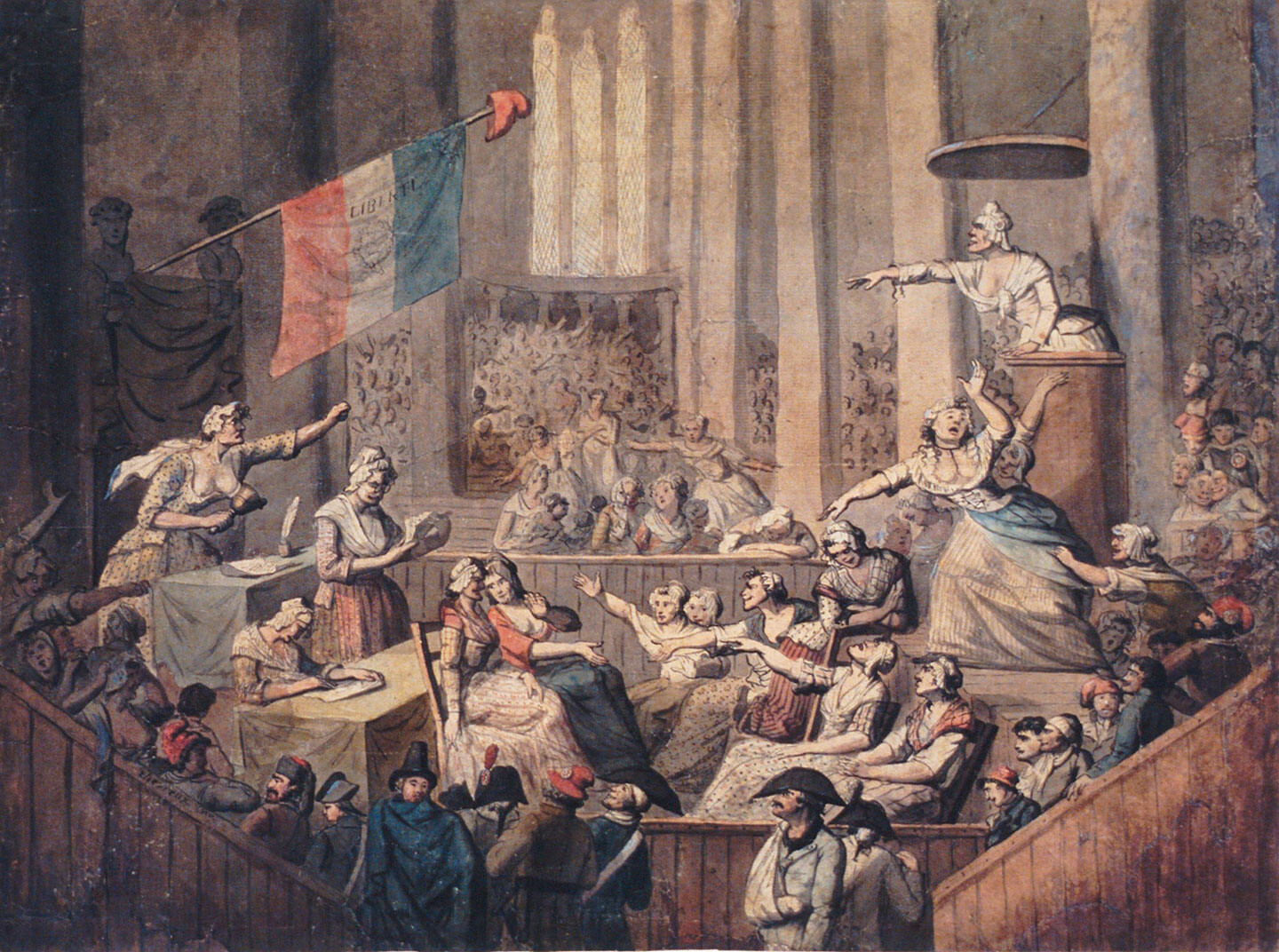
A club of patriotic French women assemble in a church during the French Revolution, 1973. Photo: Wikimedia Commons.
Perhaps you have been struck by the frequency and regularity with which people find it necessary to state what one might think was the most obvious thing in the world: that they are human beings, or that they would like to live like them.
Here's an example from the front lines of the so-called “refugee crisis” in Europe last March: "'May God take his revenge on them—everyone who did this to us—from whatever country they come from,' said Raife al-Baltajy, a Syrian from near Aleppo, as she waited for a bus with her family. 'May god take his vengeance out on them. Isn't it sinful? Are we animals? Or are we human beings?' She said she had been living in Syria for four years under the shelling, but traveled to Turkey, then to the Greek island of Lesbos, where she took a ferry to the mainland and on to Idomeni."1
Or this claim from another Syrian refugee who spoke out from his new home in the United States: "'I was born as a human and raised as a human. I have been in some situations that made me feel not like a human,' [Refaai Hamo, a civil engineer] said. 'I would like to grab any opportunity I can to prove I am a human being and if I don’t have that opportunity, I refuse to live anywhere I don’t feel like a human.'”2
How do we understand this repeated need of people in situations of displacement, conflict, and injustice, to ask others whether they, the speakers, are in fact human, which is to say, their need "to prove I am a human being"? What is going on when people say this? It seems obvious, but in fact it's one of the most complicated, enigmatic, unstable things that can possibly be said. We should not take its possibility for granted.
That said, people have been saying it, more or less, for a while. Versions of the claim have a long history—think back to Josiah Wedgewood's famous anti-slavery medallion of 1787, featuring a shackled African figure knelt in a plea and bearing the inscription "Am I not a man and a brother?," or to the even more economical signs borne by the Memphis, Tennessee sanitation workers on strike in the spring of 1968, "I am a Man." This rich provenance makes the utterance somehow even more perplexing: haven't we learned this yet? Why do people still need to say this? What accounts for the persistence of this claim?
To begin to understand and appreciate these words, "I am a human being," we need to back up and ask just what sort of speech act is being performed here. I will call it a claim, whether it's formulated as a question ("Am I not ..."), a desire ("we want to live like ..."), a simple declaration or an apparent tautology ("I am a ..."). In each case, the statement makes a claim, and a claim on others.
I would suggest that rights, especially what we call human rights, are better treated as things we claim rather than things we have. This may seem like a minor matter of words but I believe that it has the potential to challenge profoundly the ways we think about and act with the discourse of human rights. It does not weaken the force of these claims to admit that they are only, or just, that, claims; in fact, it might make them stronger by making them less essentialist, dogmatic, sacred, or as Michael Ignatieff once put it, idolatrous.3 I think this can help us appreciate a number of things, including: what it means to say that human rights are being “violated,” the fact that what counts as a right—and who counts as a rights-bearer—can and has varied so dramatically over time and place, the common experience that the would-be universality of rights is so hard to grasp, and the fact that rights language can serve to propel campaigns of domination and not just struggles against injustice.
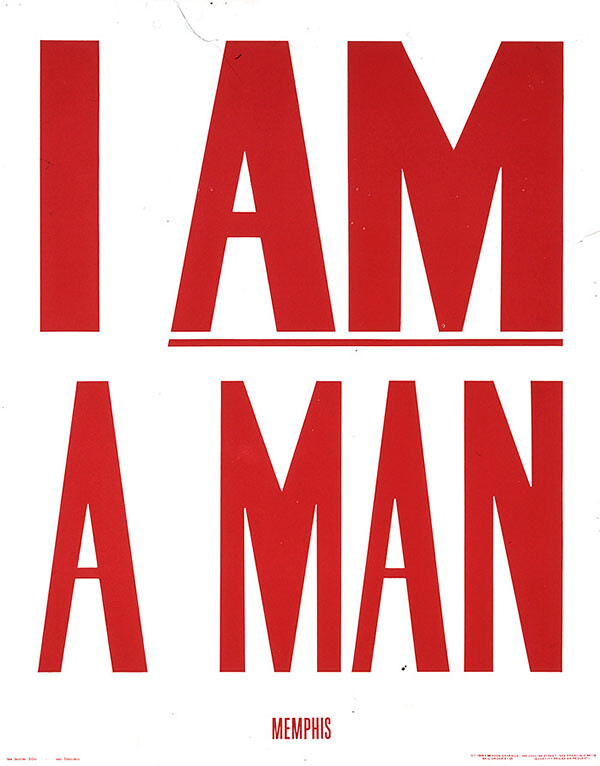
Memphis sanitation workers, the majority of them African American, went out on strike on February 12, 1968, demanding recognition for their union, better wages, and safer working conditions after two trash handlers were killed by a malfunctioning garbage truck. As it dragged on through March, with the Memphis mayor refusing to negotiate, the strike gained national attention. As they marched, striking workers carried copies of a poster declaring “I AM A MAN,” a statement that recalled a question abolitionists posed more than 100 years earlier, “Am I not a man and a brother?”
A few years ago, introducing the mammoth photobook The Face of Human Rights, Walter Kalin economically summed up the contemporary status of his topic with this formulation: "Human rights are the product of an historical process which has not yet reached completion."4
Here the modesty of the concession to history is balanced, or even overwhelmed, by the confident faith in a progressive expansion signaled by the little phrase "as yet." The fact of incompletion is paradoxically the sign of more to come.
And yet we could detach this narrative of ongoing accomplishment from its teleology and see in it an important insight about human rights as a thought and practice: in spite, it seems, of their would-be eternality and universality, human rights are structurally incomplete, without fixed limits. This happens not despite this aspiration to universality, but because of it. The universe of their extent is not given in advance, and in fact we could say that the struggle to define its extents—which is in fact the struggle to determine who or what is and is not the subject or bearer of those rights—constitutes the story and the history of human rights. Because rights are a matter of claims, which is to say, disputations, and because those claims require evidence and demand assent, the subjects and the borders of rights are structurally in flux.
The contemporary world offers at least two contradictory answers to the question of how that "process" is coming along.
11.02.2017
2nd Annual Black Feminism, Womanism and the Politics of Women of Colour in Europe
2nd Annual Black Feminism, Womanism and the Politics of Women of Colour in Europe
A One-Day symposium | Amsterdam, 7th October 2017

2nd Annual Black Feminism, Womanism, and the Politics of Women of Colour in Europe
A One-Day Symposium
Saturday, 7th October 2017,
Amsterdam, The Netherlands
In September 2016 in Edinburgh, we welcomed over 100 activists, practitioners, artists and scholars to critically debate contemporary Black feminist and womanist theories and practices in Europe. Our first event demonstrated the possibilities of building solidarity across race, class, gender, sexuality and legal status. However, the symposium also highlighted the inter-generational tensions between veteran and newer activists and scholars about how to build and sustain inclusive and democratic Black feminist spaces for education and action.
For our second symposium, we seek to expand and deepen our debates about the theory and practice of Black feminism and womanism in Europe but also spotlight the very real conflicts between different types of women who identify as Black feminists and womanists. Our aim is to examine how we might build community, collective strategies for survival and a politics for social justice in an unstable European context wracked by a variety of crises linked to austerity measures, racist and xenophobic public discourses about migration and the rise of far right political parties and groups.
We seek activist narratives, academic papers, practice-based reflections and art/music/film contributions related, but not limited, to:
Theorising European Black feminism and womanism
Gendering racial capitalism
Building Black feminist and womanist activist spaces
Black feminism and sex work
Women of colour and the European racial contract
Developing transnational, intersectional and intergenerational coalitions
Queering European Black feminism and womanism
Race, gender and affective relations
Gendering migration experiences
Women of colour and digital diasporas
Black feminism and Black Lives Matter in Europe
Black feminism and trans* women’s rights
Women of colour and anti-fascist resistance
Please send titles and abstracts of no more than 300 words, which include your name, affiliation and contact details to woceuropeconference@gmail.com by Monday 3rd April 2017.
Organising committee
Akwugo Emejulu, University of Warwick
Marly Pierre-Louis, Tracian Miekle, and Lene Hypolite, Amsterdam Black Women’s Meet-Up
A One-Day symposium | Amsterdam, 7th October 2017
2nd Annual Black Feminism, Womanism, and the Politics of Women of Colour in Europe
A One-Day Symposium
Saturday, 7th October 2017,
Amsterdam, The Netherlands
In September 2016 in Edinburgh, we welcomed over 100 activists, practitioners, artists and scholars to critically debate contemporary Black feminist and womanist theories and practices in Europe. Our first event demonstrated the possibilities of building solidarity across race, class, gender, sexuality and legal status. However, the symposium also highlighted the inter-generational tensions between veteran and newer activists and scholars about how to build and sustain inclusive and democratic Black feminist spaces for education and action.
For our second symposium, we seek to expand and deepen our debates about the theory and practice of Black feminism and womanism in Europe but also spotlight the very real conflicts between different types of women who identify as Black feminists and womanists. Our aim is to examine how we might build community, collective strategies for survival and a politics for social justice in an unstable European context wracked by a variety of crises linked to austerity measures, racist and xenophobic public discourses about migration and the rise of far right political parties and groups.
We seek activist narratives, academic papers, practice-based reflections and art/music/film contributions related, but not limited, to:
Theorising European Black feminism and womanism
Gendering racial capitalism
Building Black feminist and womanist activist spaces
Black feminism and sex work
Women of colour and the European racial contract
Developing transnational, intersectional and intergenerational coalitions
Queering European Black feminism and womanism
Race, gender and affective relations
Gendering migration experiences
Women of colour and digital diasporas
Black feminism and Black Lives Matter in Europe
Black feminism and trans* women’s rights
Women of colour and anti-fascist resistance
Please send titles and abstracts of no more than 300 words, which include your name, affiliation and contact details to woceuropeconference@gmail.com by Monday 3rd April 2017.
Organising committee
Akwugo Emejulu, University of Warwick
Marly Pierre-Louis, Tracian Miekle, and Lene Hypolite, Amsterdam Black Women’s Meet-Up
15.01.2017
The Dutch National Exhibition of Women’s Labor, 1898

In 1898, the year Queen Wilhelmina of the Netherlands was inaugurated, five hundred women organized an enormous public exhibition showcasing women’s contributions to Dutch society as workers in a strikingly broad array of professions. The National Exhibition of Women’s Labor, held in The Hague, was attended by more than ninety thousand visitors. Maria Grever and Berteke Waaldijk consider the exhibition in the international contexts of women’s history, visual culture, and imperialism.
A comprehensive social history, Transforming the Public Sphere describes the planning and construction of the Exhibition of Women’s Labor and the event itself—the sights, the sounds, and the smells—as well as the role of exhibitions in late-nineteenth-century public culture. The authors discuss how the 1898 exhibition displayed the range and variety of women’s economic, intellectual, and artistic roles in Dutch culture, including their participation in such traditionally male professions as engineering, diamond-cutting, and printing and publishing. They examine how people and goods from the Dutch colonies were represented, most notably in an extensive open-air replica of a “Javanese village.” Grever and Waaldijk reveal the tensions the exhibition highlighted: between women of different economic classes; between the goal of equal rights for women and the display of imperial subjects and spoils; and between socialists and feminists, who competed fiercely with one another for working women’s support. Transforming the Public Sphere explores an event that served as the dress rehearsal for advances in women’s public participation during the twentieth century.
02.12.2016
Blood Sweat and Tears,

Assembling Past and Future is an installation in the project Blood Sweat and Tears, which was conceived especially for the gallery at Körnerpark’s 100 years anniversary and grew out of a collaboration between peace activists and a network of creatives. It is anchored historically in the first International Women’s Peace Congress at The Hague in 1915, during which the participants debated the sociopolitical, economic, and intellectual prerequisites for a future lasting peace and ties together individuals who advocate for a peaceful world.
Through a video installation, the exhibition space became a virtual conference. Historical images and text are overlaid with contemporary statements and portraits, allowing different temporal planes and materials to permeate each other.
The projects’ collaborative approach probes the relationship between the participating individuals and the conditions on site. Most important subjects are nonviolent communication and community. By destabilizing boundaries between the actors, places, and periods of time, the project wants to show a new understanding of history. Boundaries between art and activism are constantly shifting and blurred within this work. Strict categories are suspended within the instillation: past, present and future; reality, fiction and virtual space; community and individual.
The videos take on the formal tactic of the moving portrait. Moving videos of actors performing speeches are overlayed against archival images from peace activists who participated in the conference in the Hague of 1915. These archival images are broken down and dissected within the moving picture plane, while simultaneously different actors reenact suffragette poses and positions.
Abonnieren
Posts (Atom)