28.05.2017

Hekates Kräutergarten - ein Hexengarten


Hekates Kräutergarten - ein Hexengarten
Hekate hatte in Kolchis (= Georgien) am Fluss Phasis neben dem Palast des mythischen Königs Aietes, laut Diodor der Vater ihrer beiden Töchter Medea und Circe, einen großen Garten. Dieser war umgeben von einer 9 Klafter (~ 16 m ) hohen, unüberwindlichen Mauer und zusätzlich geschützt durch 7 Basteien und 3 ehernen Toren, die von der Göttin Artemis als Torhüterin und von flammenäugigen Hunden bewacht wurden. Nähern konnte man sich ihm nur durch Erbringen von Weihe- und Reinigungsopfern, wie Wacholderrauch und mit Kräutern gefüllten, rein-schwarzen Hündchen.

Warum der ganze Aufwand? - In diesem geschützten Garten zog Hekate in einer Art Permakultur die ihr wichtigen Pflanzen, die ihr bei Geburten, Erotik, Vergiftungen, Entgiftungen, zur Bewusstseinserweiterung, zur Heilung bei Frauenleiden und Verletzungen dienten und: Die Mitte des Gartens barg auf dem Ast der heiligen Eiche hängend einen großen Schatz, nämlich das von den Argonauten heißbegehrte Goldene Vlies, das zusätzlich bewacht wurde von einem schiffsgroßen, fürchterlichen Drachen. Hier wähnte es sein Besitzer, König Aietes, sicher. Nur Medea und Circe und deren Kusine Artemis, als deren Priesterin Medea fungierte, hatten ungehinderten Zugang zu Hekates Garten, den ersten Apothekergarten!
Wer Hekates duftenden, bunten Kräutergarten nachgestalten möchte, dem seien hier auf wildfind seine Pflanzen aufgezählt, die in interessanter, aber doch mühsamer Arbeit (Gartenarbeit eben ;) eruiert werden konnten.

Fündig wurden wir beim Lesen der Argonautensage in „Hesiods Werke und Orfeus der Argonaut“, Übersetzung J. H. Voss, 1817, S. 192 unten ff . Orfeus schildert darin den Diebstahl des Goldenen Vlieses, das ja streng bewacht im Zentrum von Hekates Garten glänzte und gleiste … Die Argonauten sind in Kolchis gelandet und betreten den Garten der Hekate:

"Hierauf folgt ein Hain im innersten Teil des Verschlosses,
Wo viel frisches Holz aufsteigt mit schattigen Wipfeln,
Lorbeerbäum und Kornellen und schlank erhabene Platanen.
Dort sind auch viel Kräuter, gewölbt um die niederen Wurzeln:
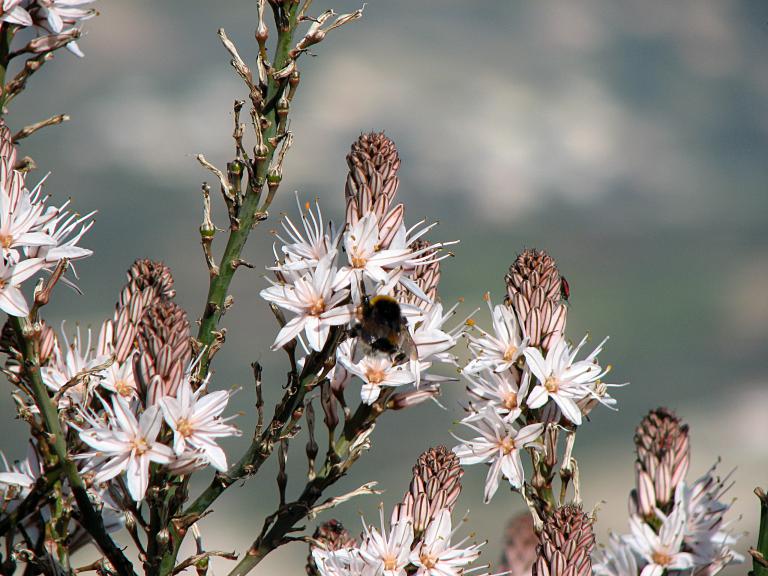
Klymenos, sammt dem edlen Asfodelos, und Adiantos,
Aristeron, zart von Gewächs, und Kypeiron mit Thyron,
Kyklamis, gleich der Viol’, und Erysimon, sammt Horminon,
Stöchas, Paeonia dann, vom Busch Polyknemon umwuchert,
Polion dann, Mandragoras auch, und fahles Diktamnon,
Krokos von süssem Geruch, und Kardamom, neben dem Kemos,
Smilax, dunkler Mohn und niedere Chamaemelon,
Panakes und Alkeja, mit Karpason und Akoniton.
Auch viel andere noch der schädlichen stiegen von Grund auf.
Mitten ragt zu den Wolken ein Eichstamm über die Waldung,
Welcher sich weit ausdehnt, mit laubigen Ästen umdunkelt.
Siehe, daran hängt leuchtend von Gold, an dem langen Gezweig hin
Rings verbreitet, das Vließ; und rasch mit den Augen bewacht es
Jener entsetzliche Drache, das unaussprechliche Scheusal. …"

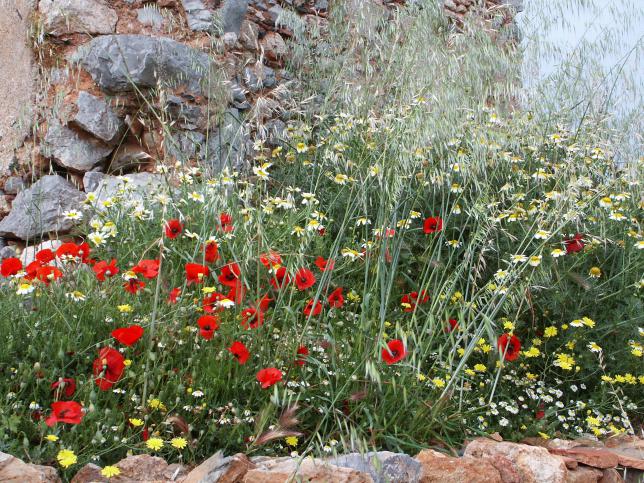
Die aufgezählten Pflanzen sind Pflanzen mit starken pharmazeutischen Wirkungen! Es finden sich darunter Frauenkräuter, Wundkräuter, Kräuter, die aphrodisierend, schmerzstillend, narkotisch, bewusstseinserweiternd oder auch tödlich wirken, und Kräuter, die als Gegengift verwendet wurden.
Sie können mit Pflanzennamen wie Aristeron, Stöchas, Alkeja usw. nicht allzu viel anfangen? Auf den beiden nächsten Seiten finden Sie, eingeteilt in Giftpflanzen und Heilpflanzen der Hekate , die Übersetzungen der Pflanzennamen und dazu passende Fotos!

Pflanzen der Hekate, Teil I

Heilpflanzen der Hekate

Bei der Identifizierung der Pflanzen in Hekates Garten orientierte sich Wildfind an Dr. Johann Heinrich Dierbach, 1833, „Flora Mythologica oder Pflanzenkunde in Bezug auf Mythologie und Symbolik der Griechen und Römer“  und an  Wikipedia.

Zu Hekates Heilpflanzen dürfen auch ihre  Giftpflanzen gezählt werden, sofern sie dem Arzneimittelbuch entsprechend schulmedizinisch oder homöopathisch richtig dosiert und angewendet werden.

Folgende Heilpflanzen, den meisten wird eine aphrodisierende Wirkung nachgesagt, gediehen in Hekates Kräutergarten:

21.05.2017

Suzanne Césaire / Afro-Surrealismus

Suzanne Césaire [Roussi] (11 August 1915 to 16 May 1966) was born in Martinique, and was a French-speaking writer, poet, scholar, post-colonialist, and Surrealist.
In 1936 she married Aimė Cėsaire, with whom she had six children.
Raised and educated in an assimilationist French culture - she met her husband while finishing her education in Paris - Suzanne was a pioneer in the search for an alternative cultural framework to that provided for Martinique by colonial discourse. With her husband, she set up the magazine Tropiques, in an early edition of which she attacked both the aping of traditional French styles of poetry by West Indian writers, and 'The Happy Antilles' view of the island promoted by official French culture. Her poem of 1941, Misère d'une poésie, condemned what she termed "Littérature de hamac. Littérature de sucre et de vanille. Tourisme littéeraire" [Literaure of the hammock, of sugar and vanilla. Literary tourism].[1]
Her encounter with André Breton opened the way for her development of Afro-Surrealism[2] - her use of surrealist concepts to illuminate the colonial dilemma.[3] Her dictum - "La poésie martinique sera cannibale ou ne sera pas" [Cannibal poetry or nothing][4] - pointed the way to a re-capture of the Caribbean roots of her culture, as opposed to a force-fed Europeanism.
While largely overshadowed in her lifetime by her husband and his clear-cut, if theoretical doctrine of Nėgritude,[5] Suzanne's repudiation of simple idealised answers - whether assimilationist, Africanist, or creole - to the ambiguities of the West Indian situation has proved increasingly influential in later postcolonial studies.[6]


---
Afro-Surrealism
From Wikipedia, the free encyclopedia

Afro-Surrealism or Afrosurrealism is a literary and cultural aesthetic that is a response to mainstream surrealism in order to reflect the lived experience of people of color. First coined by Amiri Baraka,[1] this movement focuses on the present day experience of African Americans. Much of Afro-Surrealism is based on the manifesto written by D. Scot Miller, in which he says, "Afro-Surrealism sees that all 'others' who create from their actual, lived experience are surrealist..." Afro-Surrealism can be seen in music, photography, film, the visual arts and poetry. Notable practitioners of Afro-Surrealism include Bob Kaufman, Krista Franklin, Kool Keith, Samuel R. Delany, Roman Bearden and Deana Lawson.

Contents

    1 Influence
    2 Development
    3 Themes
        3.1 The Future-Past
        3.2 The everyday lived experience
        3.3 Haunting
        3.4 Present day realism
    4 Examples of Afrosurrealist Works
        4.1 Zong!, M. NourbSe Philip and Setaey Adamu Boateng
        4.2 Beloved, Toni Morrison
    5 References

Influence

Afro-Surrealism came about after the initial rise in surrealism in the mid-1920s, after André Breton wrote the Surrealist Manifesto. Similar to the mainstream version of surrealism, Afro-Surrealism was not a single movement or style. Rather, it incorporated aspects of the Harlem Renaissance, Négritude and magical realism. Aspects of Afro-Surrealism can be traced to Martiniquan Suzanne Césaire’s discussion of the “revolutionary impetus of surrealism” in the 1940s.[2]

Marvelous Realism, coined by the Haitian novelist Jacques Stephen Alexis, can be seen as a precursor to Afro-Surrealism. In his 1956 essay for Présence Africaine, he wrote, "What, then, is the Marvellous, except the imagery in which a people wraps its experience, reflects its conception of the world and of life, its faith, its hope, its confidence in man, in a great justice, and the explanation which it finds for the forces antagonistic to progress?”[3] In his work, Alexis is seen to have an acute sense of reality that is not dissimilar to traditional surrealism. Suzanne Césaire, a Martinique writer, similarly wrote about the surreality of living away from the Caribbean yet having ties to it.
Development

Afro-Surrealism was coined by Amiri Baraka in his 1988 essay on Black Arts Movement avant-garde writer Henry Dumas.[2] Baraka notes that Dumas is able to write about ancient mysteries that were simultaneously relevant to the present day. This idea that the past resurfaces to haunt the present day is a crucial to Afro-Surrealism.

Cinematographer Arthur Jafa expanded the field of Afro-Surrealism by experimenting with film. Jafa introduces the idea of "the alien familiar," in order to represent the Black experience and its innate surreal characteristics. "I want it to have something that I and my friends call 'the alien familiar.' If a work succeeds in a way or is able to conjure what a Black cinema would be or what this hypothetical manifestation of this particular tradition in the cinematic arena might be, it should be both alien because you’ve never seen anything quite like it, and at the same time, it should be familiar on some level to Black audiences."[4] This focus on the alien aspect of the Black experience, and on Black folk culture, are what separate Afro-Surrealism from magical realism and surrealism.

A Manifesto of Afro-Surreal was written by D. Scot Miller's and was published in 2009.[1] The manifesto delineates Afro-Surrealism from Surrealism and Afro-Futurism. The manifesto also declares the necessity of Afro-Surrealism, especially in San Francisco, California. The manifesto lists ten tenants that Afro-Surrealism follows including how "Afro-Surrealists restore the cult of the past," and how "Afro-Surreal presupposes that beyond this visible world, there is an invisible world striving to manifest, and it is our job to uncover it."
Themes
Deana Lawson, Emily and Daughter, 2002
The Future-Past

[5] Unlike Afro-Futurism which speculates on black possibilities in the future, Afrosurrealism, as Scot describes, is about the present. Rather than speculate on the coming of the four horseman, Afrosurrealists understand that they rode through too long ago. Through Afrosurrealism, artists expose this form of the future past that is "RIGHT NOW." Most Afrosurrealists reject the study of the future pushing themselves to focus on the present, the future that has already past.
The everyday lived experience

Much of Afro-Surrealism is concerned with the everyday life because it is said that there is nothing more surreal than the Black experience. An example of this would be a photo by Deana Lawson called Emily and Daughter. According to Terri Francis, "Afrosurrealism is art with skin on it where the texture of the object tells its story, how it weathered burial below consciousness, and how it emerged somewhat mysteriously from oceans of forgotten memories and discarded keepsakes. This photograph figures Afrosurrealism as bluesy, kinky-spooky."[6]
Haunting

Afro-Surrealism is often described as having a sense of a haunting welcoming. As Francis describes it, there is a sense of disruption from the past in an otherwise ordinary or comfortable situation. An example of Afro-Surrealism seen as haunting can be seen in Toni Morrison's Beloved, in that the dead baby comes back to haunt Sethe.[3] The past resurfacing in the present is key aspect of Afro-Surrealism.
Present day realism

Afro-Surrealist scholar Rochelle Spencer identifies at least three different subgenres of black speculative art, and Spencer argues that Afro-Surrealism is the most present-focus, though it is not devoid of technology and may include allusions to modern technology.[7] According to Francis, the juxtaposition between the old and the present day is what makes Afro-Surrealism so unique. As Francis puts it, "Surrealism here, the Afro-surreal, like the marvelous discussed above, is actually a realism so real, so contrary to the norms of publicized blackness, that it represents a rupture, a radical break from ordinary understanding such that the old feels new—because it was never known."[3] Although this movement is related to Afrofuturism, it is different in that instead of focusing on the future, Afro-Surrealism focuses more on the present day.

Examples of Afrosurrealist Works
Zong!, M. NourbSe Philip and Setaey Adamu Boateng

In [8]Zong!, M. NourbSe Philip crafts a powerful counter-narrative surrounding the events of the Zong massacre. Utilizing the words from the legal decision to build her poetry, Philip rejects the idea of an archival past. Instead Philip looks to the present moment to understand how to read this legal decision and understand the case. Following the footsteps of Toni Morrison’s Beloved, Philip presupposes the notion of a past that is not past allowing these past artifacts to haunt the present moment. Rather than organize the fragments, Philip allows the fragments to tell themselves. This is not to say that Philip gives the fragments voices, but instead gives them space. The space in the poem allows Philip’s audience to hear the silence of these voices, to truly understand the missing narratives form the past and the role that has on the present.

Beloved, Toni Morrison

As mentioned earlier, Toni Morrison’s [9]Beloved remains an important milestone for Afrosurrealists. Here, Morrison imagines a narrative of a slave women grieving the death of her baby daughter, Beloved. With no trace of a past, Beloved reappears of on the steps of 124, confused and looking for her mother. Following this moment, the novel crafts a haunting tale of a woman seeking to understand the sudden reappearance of her daughter and the scars left behind from slavery. In Beloved, Morrison attempts to come to grip with the legacies left by slavery, challenging the notion that these legacies exits only from the past. From the epigraph, “Sixty Million and more,” Morrison presupposes there is no way to count those affected from slavery and additionally, that the number is ever-growing into the present. In her award-winning novel, Morrison expands the idea of the past, attempting to demonstrate the past is ever present and moreover, that the past is RIGHT NOW.
References

D. Scot, Miller. "Call it Afro-Surreal". San Francisco Bay Guarian. Retrieved 8 December 2015.
"Editor's Notes". Black Camera. 5 (1): 1–2. 2013-01-01. ISSN 1947-4237.
Francis, Terri (2013-01-01). "Introduction: The No-Theory Chant of Afrosurrealism". Black Camera. 5 (1): 95–112. ISSN 1947-4237.
Arthur Jafa, “The Notion of Treatment: Black Aesthetics and Film, based on an interview with Peter Hassli and additional discussions with Pearl Bowser,” in Oscar Micheaux and His Circle: African-American Filmmaking and Race Cinema of the Silent Era, ed. Pearl Bowser et al. (Bloomington: Indiana University Press, 2001), 18.
Miller, D. S. "Afrosurreal Manifesto: Black Is the New black—a 21st-Century Manifesto." Black Camera, vol. 5 no. 1, 2013, pp. 113-117. Project MUSE, muse.jhu.edu/article/525948.
Francis, Terri (2013-01-01). "Meditation". Black Camera. 5 (1): 94–94. ISSN 1947-4237.
"Why Black Science Fiction Studies Matter". www.themarysue.com. Retrieved 2015-12-16.
Philip, Marlene Nourbese. Zong! Middletown, Conn.: Wesleyan University Press, 2008. Print.
Morrison, Toni. Beloved: A Novel. New York: Knopf : Distributed by Random House, 1987. Print.
Delgado, Martín Morúa (1856-1910)


Martin Morua Delgado with Daughters Arabella and Vestalina.
Image Courtesy of Manuscripts, Archives and Rare Books Division,
Schomburg Center for Research in Black Culture,
The New York Public Library, Astor, Lenox and Tilden Foundations

Born in 1856, Martín Morúa Delgado gained prominence as an Afro-Cuban writer and Cuba’s first black Senate president after the country’s war for independence against Spanish rule in the 1890s.  Son of an African-slave mother, Ines Delgado, and Spanish father, Francisco Morúa, Martín Morúa Delgado espoused both anti-slavery sentiments and exemplified ideas of success through meritocracy among Afro-Cubans.
Unable to obtain a formal education because of economic demands, Morúa Delgado was thrust into the work force and became a self-taught Cuban.  He became a prolific reader and was fluent in several languages.  Beginning his literary career in 1878, Morúa Delgado published a newspaper, El Pueblo.  Through it, he opposed slavery and sought the integration of blacks into mainstream Cuban society and culture.
In 1880, Delgado left Cuba for Key West, Florida in the United States where he spent the next ten years working as a literary critic and translator and publishing his magazine Revista Popular.  While in the United States he wrote the essays "Duty Calls" and "Cuba and the Colored Race."  While the former is a brief account of Cuba’s social history and call for revolution against the Spanish, the latter focuses on the historical plight of Afro-Cubans and their desire for freedom from slavery.
Upon returning to Cuba, Morúa Delgado published two novels, Sofia and The Unzuazu Family.  Again, he explored issues of the cruelty of slavery and its subsequent psychological impact not just on individual Afro-Cubans but also on Cuban society as a whole.   He focused especially on the complex interpersonal relationships among Cubans, which had been often built on a foundation of mixed-race relationships.
Becoming a major political figure in post-independence Cuba, Morúa Delgado was one of two men of color elected to the country’s constitutional assembly under United States occupation.  In 1901 he became the country’s first elected Afro-Cuban senator (1901).
As part of the Afro-Cuban intellectual/political elite, Delgado symbolized a social mobility that very few black Cubans were able to achieve because of social and legal barriers.  Although a believer in racial equality, Morúa Delgado opposed independent, black civil rights organizations.  Instead he worked through his political party, the Liberal Party, in establishing patronage networks among Afro-Cubans.  As the first black President of the Cuban Senate (1909), Morúa Delgado introduced a bill that banned black political parties because they discriminated against white Cubans.  The Morúa Amendment would later be cited as inciting Cuba’s “Race War of 1912.”  Morúa Delgado would go on to become Minister of Agriculture, passing away in 1910 while serving in that office.
Sources:
Jorge Cantera and Carolina Hospital, A Century of Cuban Writers in Florida: Selected Prose and Poetry (Sarasota: Pineapple Press, Inc., 1996); Aline Helg, “To be Black and to be Cuban: The Dilemma of Afro-Cubans in Post-independence Politics,” in Darien J. Davis, eds., Beyond Slavery: The Multilayered Legacy of Africans in Latin America and the Caribbean (Lanham: Rowman & Littlefield Publishers, Inc., 2007); http://www.historyofcuba.com/history/race/Delgado.htm.
Contributor(s):
Escamilla, Luis
University of Washington
- See more at: http://www.blackpast.org/gah/delgado-martin-morua-1856-1910#sthash.0X0zzdf6.dpuf

Sofía von Martín Morúa Delgado

Delgado, Martín Morúa (1856-1910)

   
Martin Morua Delgado with Daughters Arabella and Vestalina.
Image Courtesy of Manuscripts, Archives and Rare Books Division,
Schomburg Center for Research in Black Culture,
The New York Public Library, Astor, Lenox and Tilden Foundations
Born in 1856, Martín Morúa Delgado gained prominence as an Afro-Cuban writer and Cuba’s first black Senate president after the country’s war for independence against Spanish rule in the 1890s.  Son of an African-slave mother, Ines Delgado, and Spanish father, Francisco Morúa, Martín Morúa Delgado espoused both anti-slavery sentiments and exemplified ideas of success through meritocracy among Afro-Cubans.
Unable to obtain a formal education because of economic demands, Morúa Delgado was thrust into the work force and became a self-taught Cuban.  He became a prolific reader and was fluent in several languages.  Beginning his literary career in 1878, Morúa Delgado published a newspaper, El Pueblo.  Through it, he opposed slavery and sought the integration of blacks into mainstream Cuban society and culture.
In 1880, Delgado left Cuba for Key West, Florida in the United States where he spent the next ten years working as a literary critic and translator and publishing his magazine Revista Popular.  While in the United States he wrote the essays "Duty Calls" and "Cuba and the Colored Race."  While the former is a brief account of Cuba’s social history and call for revolution against the Spanish, the latter focuses on the historical plight of Afro-Cubans and their desire for freedom from slavery.
Upon returning to Cuba, Morúa Delgado published two novels, Sofia and The Unzuazu Family.  Again, he explored issues of the cruelty of slavery and its subsequent psychological impact not just on individual Afro-Cubans but also on Cuban society as a whole.   He focused especially on the complex interpersonal relationships among Cubans, which had been often built on a foundation of mixed-race relationships.
Becoming a major political figure in post-independence Cuba, Morúa Delgado was one of two men of color elected to the country’s constitutional assembly under United States occupation.  In 1901 he became the country’s first elected Afro-Cuban senator (1901).
As part of the Afro-Cuban intellectual/political elite, Delgado symbolized a social mobility that very few black Cubans were able to achieve because of social and legal barriers.  Although a believer in racial equality, Morúa Delgado opposed independent, black civil rights organizations.  Instead he worked through his political party, the Liberal Party, in establishing patronage networks among Afro-Cubans.  As the first black President of the Cuban Senate (1909), Morúa Delgado introduced a bill that banned black political parties because they discriminated against white Cubans.  The Morúa Amendment would later be cited as inciting Cuba’s “Race War of 1912.”  Morúa Delgado would go on to become Minister of Agriculture, passing away in 1910 while serving in that office.
Sources:
Jorge Cantera and Carolina Hospital, A Century of Cuban Writers in Florida: Selected Prose and Poetry (Sarasota: Pineapple Press, Inc., 1996); Aline Helg, “To be Black and to be Cuban: The Dilemma of Afro-Cubans in Post-independence Politics,” in Darien J. Davis, eds., Beyond Slavery: The Multilayered Legacy of Africans in Latin America and the Caribbean (Lanham: Rowman & Littlefield Publishers, Inc., 2007); http://www.historyofcuba.com/history/race/Delgado.htm.
Contributor(s):
Escamilla, Luis
University of Washington
- See more at: http://www.blackpast.org/gah/delgado-martin-morua-1856-1910#sthash.0X0zzdf6.dpuf

„The Rebellion of the Girls: Reflections for an Embodied Decolonization“

Nadia Celis

Die Literaturwissenschaftlerin Nadia Celis hielt im Rahmen des SoCaRe Nachwuchsworkshops am 23.03.2013 einen Keynote-Vortrag mit dem Titel „The Rebellion of the Girls: Reflections for an Embodied Decolonization“. In ihrem Vortrag ging Nadia Celis der Frage nach, wie die karibische Kolonialgeschichte als eine verkörperlichte Erfahrung verstanden werden kann. Widerstand und Körperbewusstsein, so ihre These, müssen in diesem Kontext jenseits eines Butler’Schen Symbolismus zusammengedacht werden.