04.04.2016


The Invisible Man (2015) sculpture and photo series


The Invisible Man by Zina Saro-Wiwa copyThe Invisible Man is a neo-Ogoni mask created by Zina Saro-Wiwa. Inspired by the newer “Ogele style” masquerade masks that have started appearing in Ogoniland in the late 1980s, the mask is one that depicts the men that have disappeared in Zina’s life through death or through their own design. Brother, father, lovers and illusive Ogele dancers feature on the Janus-faced mask. The black and white face representing the sadness of loss, the lined pink face the anger associated with abandonment. Worn by women only.


The Invisible Man: “The Weight of Absence” (2015) Video Triptych
The Invisible Man: “The Weight of Absence” (2015) 6 mins, video triptych, is the first video featuring and inspired by Zina’s Invisible Man mask commissioned by Seattle Art Museum for their Disguise exhibition. The triptych is a response to the detachment inherent in the display of African masks in museums. It is in direct conversation with Disguise’s remit of “bridging the gap between the mask observed in isolation and the masquerade experienced as a catalyst”. The gap, as Saro-Wiwa sees it, is brought about by emotional and cognitive disconnection to African masks and the performance of masquerade. This work and the very creation of Zina’s Invisible Man mask attempts to bring emotional discourse and emotional connectivity to a masquerade practise whose psycho-emotional geographies are diffuse:

“I wanted to create a masquerade “performance” that subverted even Seattle Art Museum’s expectations of what such a performance should look like. I didn’t just want to gather my all-female troupe have them dance with the mask I designed, film the process and say “here you go”.  That might have been radical enough – having an all-female troupe, is subversive in itself – but I wanted to go further and challenge the museum’s ideas of what it means to “perform a masquerade”. I also wanted to challenge masquerade in Nigeria by going within and opening up emotional terrains. Many masks in Ogoni play on fears, talk about farming, make political statements. But I wanted to go to a more emotionally-specific place. The Invisible Man is about me creating a mask I could connect to. So I picked a highly emotional subject that had a particular resonance for me.  This work is about my attempt to map the emotional geography of masquerade, to get it to tell a more intimate story and to see if creating this mask and performance had any carthatic properties. There is a magic in masquerade that I do not understand. But I am attempting to tap into it through this work.”

02.04.2016

New Ceramic Busts Overgrown With Twisted Vines and Colorful Flowers by Jess Riva Cooper


Daphne bei Ovid

Apollo und Daphne (Giovanni Battista Tiepolo, 1743/44, Louvre von Paris)
Als Apollon den Liebesgott Eros als schlechten Schützen verspottete, rächte sich dieser, indem er einen Liebespfeil mit einer goldenen Spitze auf ihn und einen mit bleierner Spitze auf Daphne abschoss. Apollon verliebte sich unsterblich in Daphne, während diese, von einem genau das Gegenteil bewirkenden Pfeil Eros’ getroffen, für jene Liebschaft unempfänglich wurde. Als Apollon Daphne bedrängte, floh sie. Erschöpft von der Verfolgung durch Apollon flehte sie zu ihrem Vater Peneios, dass er ihre – den Apollon reizende – Gestalt wandeln möge. Daraufhin erstarrten ihre Glieder und sie verwandelte sich in einen Lorbeerbaum.

Der Lorbeer war Apollon seither heilig. Zum Gedenken an Daphne trug er einen Lorbeerkranz bzw. eine mit Lorbeer geschmückte Leier.

Ovid: Metamorphosen, Buch 1, Vers 545–556
„Hilf, Vater“, sagt sie, „wenn ihr Flüsse göttliche Macht habt!
Durch Verwandlung verdirb die Gestalt, mit der ich zu sehr gefiel!“
Kaum war die Bitte beendet, befällt schwere Taubheit die Glieder:
Die weichen Brüste werden von zarter Rinde umschlossen,
die Haare werden zu Laub, die Arme wachsen als Äste;
schon wird der flinke Fuß von trägen Wurzeln gehalten,
ein Wipfel verbirgt das Gesicht: Der Glanz allein bleibt ihr.
Phoebus liebt sie gleichwohl. An den Stamm hält er die Rechte
und fühlt noch unter der neuen Rinde die zitternde Brust.
Die Zweige, wie Glieder, mit seinen Armen umschlingend
küsst er das Holz, doch das Holz weicht vor den Küssen zurück.

Susto / Kulturgebundenes Syndrom

Susto, Espanto
Unter Susto versteht man sehr unterschiedliche und meist chronisch werdende Beschwerden, in der Regel nach einem heftigen und oft "übernatürlichen" Schrecken, der zum "Verlust der Seele" führt.
In einigen Fällen werden solch traumatische (seelisch verwundende) Ereignisse gar nicht selber erlebt. Manche erkranken auch, wenn andere, meist nahe Verwandte ein entsprechendes Erschrecken überfällt. Das äußert sich in innerer Unruhe, Anspannung, nervöser Hektik (Fachbegriff: Agitiertheit), in Anorexie (Magersucht), Schlafstörungen, Fieber, Diarrhoe (Durchfall), Verwirrtheit, Apathie (Gefühllosigkeit, Teilnahmslosigkeit), in depressiven Verstimmungen, Rückzug und Isolationsneigung. In manchen Studien vermutet man eine organische Ursache, nämlich eine Hypoglykämie (Unterzuckerung), andere sprechen von unspezifischen organischen Erkrankungen, von Stress und generalisierten Angststörungen auf Grund von psychosozialen Konflikten und vermindertem Selbstwertgefühl. Dieses Leiden findet sich vor allem in Mexiko, Zentral- und Südamerika. Doch auch auf den Philippinen (Lanti), in Indonesien und Malaysia (Latah), bei den Ureinwohnern Australiens (Malgri), in Neu-Guinea (Mogo laya), im Iran (Narahati) und im Amazonasgebiet (Saladera) finden sich ähnliche Phänomene beschrieben. Westliche Klassifikationen würden dies als neurotische Störungen oder undifferenzierte Somatisierungsstörungen bezeichnen.
http://www.psychosoziale-gesundheit.net/psychiatrie/fremdekulturen.html
-----
Susto („Schrecken“ oder „Seelenverlust“)
Eine bei einigen Latinos in den USA, Mexiko, Mittel- und Südamerika vorkommende Volkskrankheit. Susto wird auch espanto, pasmo, tripa ida, perdida del alma oder chibih genannt.
Susto ist eine einem erschreckenden Erlebnis zurückgeschriebene Erkrankung, aufgrund derer die Seele den Körper verläßt und die zu Unglücklich sein und Krankheit führt. An Susto erkrankte Personen erleben oft bedeutsame Spannungen in zentralen sozialen Rollen. Es wird geglaubt, daß Susto in extremen Fällen zum Tode führen kann. Typische Symptome sindAppetitstörungen, unzureichender oder übermäßiger Schlaf, unruhiger Schlaf oder beunruhigende Träume, Gefühle der Trauer, Mangel an Motivation, irgend etwas zu tun, sowie Gefühle geringen Selbstwerts und der Schmutzigkeit. Die somatischen Begleitsymptome von Susto sind Muskelschmerzen, Kopf- und Magenschmerzen sowie Durchfall. Bei der rituellen Heilung wird das Schwergewicht darauf gelegt, die Seele in den Körper zurückzurufen und den Betroffenen zu reinigen, um das geistige und körperliche Gleichgewicht wiederherzustellen. Verschiedene Erlebnisse von Susto können mit einer Major Depression, einer Posttraumatischen Belastungsstörung und Somatoformen Störungen verwandt sein. Ähnliche ätiologische Überzeugungen und Symptomkonstellationen treten in vielen Teilen der Welt auf. Als kulturgebundenes Syndrom (englisch culture-bound syndrome, kurz CBS) werden in der Medizin, Klinischen Psychologie, Medizinethnologie und Ethnomedizin psychische oder somatische Symptome bezeichnet, die auf eine bestimmte (ethnische) Gesellschaft oder Kultur beschränkt sind und bei denen biochemische Ursachen oder Organveränderungen nicht nachweisbar sind. In anderen Kulturen ist das Krankheitsbild unbekannt.  Der Begriff wurde 1994 aufgenommen in das amerikanische Diagnostic and Statistical Manual of Mental Disorders (DSM-IV); im Anhang 1 dieses Werkes ist auch eine Übersicht der häufigsten kulturgebundenen Syndrome verzeichnet.
http://sbpm.web-com-service.de/downloads/Kulturtypische%20Krankheitsbilder.pdf

01.04.2016

Mickalene Thomas. Origin of the Universe 1

Mickalene Thomas. Origin of the Universe 1, 2012; rhinestones, acrylic, and oil on wood panel; 48 x 60 in. Courtesy of the Artist.

Invisible Presence: Bling Memories at the Atlanta Contemporary Art Center

On May 8, 2001, the funeral of William Moore, aka Willie Haggart, was a raucous affair. Abandoning the somber mood of a typical funeral, the ceremony was a giant party at the National Arena in Kingston, Jamaica. Labeling it a “celebrity event,” Donna P. Hope writes that the style of Haggart’s funeral “ruptured the sobriety and mourning associated with traditional funeral rites.”[1] With this, the term bling funeral entered the mainstream, and such ceremonies—and the ruptures they instigate—are the subject of Ebony G. Patterson’s exhibition, Invisible Presence: Bling Memories, at the Atlanta Contemporary Art Center.


Ebony G. Patterson. Invisible Presence: Bling Memories, 2014; installation view, Atlanta Contemporary Art Center, Atlanta, Georgia. Courtesy of the Artist and Atlanta Contemporary Art Center.


The exhibition consists of twenty elaborately decorated coffins mounted on tall wooden poles, objects that originated from a performance conceived by Patterson for the 2014 Carnival in Kingston, Jamaica.[2] On April 27 of that year, Patterson carried fifty ostentatious coffins on poles with the help of local Jamaicans; accompanying them were several dancers and a drum line from the St. Michael’s Steppers community marching band. Evoking a bling funeral, the procession matched the boisterous and celebratory tone of Carnival.

Patterson’s decision to stage the performance during Carnival is a comment on the deep divide between social classes in Jamaica, as the Carnival celebrations are designed for the island’s upper and middle classes. The performance attempts to provide the working poor not only access to the ceremonies but also an unmistakable presence by using the spectacle of bling funerals. In such celebrations, closely linked to the underclass, the dead are remembered through raucous dancing parties featuring erotic costumes and dancehall music.


Ebony G. Patterson. Invisible Presence: Bling Memories, 2014; installation view, Atlanta Contemporary Art Center, Atlanta, Georgia. Courtesy of the Artist and Atlanta Contemporary Art Center.


The elaborately adorned coffins in the exhibition are the only remaining trace of this performance, and they offer insight into the opulent displays of bling funerals. In contrast to typical coffins of black and other somber colors, these coffins feature vivid fabrics with bold patterns, rhinestones, lace, tassels, and plastic foliage, among other materials. The fabric patterns range from bright colors with polka dots to elaborate floral and animal prints. Each coffin features multiple swatches of cloth—usually with a different pattern on each face—and is trimmed with rhinestones and lace.

The construction of the coffins also relates to Jamaica’s working class. Upon close examination, the seams between the fabric swatches are not perfect; on some, strips of ribbon or lace are falling off or running haphazardly through the cloth. Many also show signs of wear, reinforcing the idea that these were integral components of a performance. Such qualities emphasize the handmade aesthetics of the coffins, linking them to the textile industry of Jamaica. While some fabric patterns feature the colors of the nation’s flag—black, green, and yellow—most were chosen for their brilliant designs, linking them culturally to bling funerals rather than a national identity.


Ebony G. Patterson. Invisible Presence: Bling Memories, 2014; installation view, Atlanta Contemporary Art Center, Atlanta, Georgia. Courtesy of the Artist and Atlanta Contemporary Art Center.


The installation of these objects in the exhibition is particularly noteworthy, with twenty of them densely arranged in a relatively small gallery. Viewers are invited to walk among them. The bottom of each coffin is about sixty inches from the ground, forcing the viewer’s gaze upward and restricting one’s ability to see the upper portions of the coffins. The resulting mass resembles the earlier performance; the coffins are not presented didactically as individual objects for visual consumption. Instead, the installation beckons viewers to participate, envisioning themselves as part of the procession during Carnival. Additionally, though each coffin is individually decorated, the dense grouping of the installation prevents any one from being viewed on its own. The show eschews object labels or any other classification system that would denote them as works of art. They simply are what they are: markers of the performance in Kingston.


Ebony G. Patterson. Invisible Presence: Bling Memories, 2014; installation view, Atlanta Contemporary Art Center, Atlanta, Georgia. Courtesy of the Artist and Atlanta Contemporary Art Center.

Writing about bling funerals, Hope asserts that they “temporarily suspend social boundaries and momentarily rotate the distinctions between those defined as heroes and anti-heroes in Jamaican culture.”[3] The blinged-out coffins in this installation demand attention, and they point to a group of people normally operating at the margins of society. Stretching up toward the sky, the coffins on display in the gallery—as well as during the performance—reinforce Patterson’s motivation to dissolve such social barriers, to include Jamaica’s underclass not only in a typically restricted event such as Carnival but also in the larger society.
Invisible Presence: Bling Memories is on view at Atlanta Contemporary Art Center through April 21, 2016.

[1] Donna P. Hope, “From the Stage to the Grave: Exploring Celebrity Funerals in Dancehall Culture,” International Journal of Cultural Studies 13 (3): 260.

[2] The performance was one of several commissions realized during the 2014 Carnival season in conjunction with the exhibition EN MAS’: Carnival and Performance Art of the Caribbean, curated by Claire Tancons and Krista Thompson, organized by and on view at the Contemporary Arts Center New Orleans, March 7–June 7, 2015, and co-organized as a traveling exhibition by Independent Curators International (ICI), New York.

[3] Hope, 265.

A Multisensory Trip to Cuba’s Dark, Sugar-Filled Past

by Debbie Hagan on March 25, 2016

Installation view, 'Alchemy of the Soul: María Magdalena Campos-Pons' at the Peabody Essex Museum (photo by the author for Hyperallergic) (click to enlarge)
Installation view, ‘Alchemy of the Soul: María Magdalena Campos-Pons’ at the Peabody Essex Museum (photo by the author for Hyperallergic) (click to enlarge)
SALEM, Mass. — When Europeans first tasted sugar during the Crusades, they immediately begged for more. However, it wasn’t until Columbus brought sugar cane to the Caribbean to be cultivated that this exotic luxury grew into a hotly traded world commodity, akin to petroleum today. Such sweetness had a price, and Cuba met international demands by bringing enslaved Africans across the Middle Passage and subjecting them to a lifetime of brutal labor. By the mid-19th century, Cuba produced a third of the world’s sugar.
Alchemy of the Soul, Elixir of the Spirits, a large-scale, blown-glass sculptural installation on view at the Peabody Essex Museum, takes visitors on a trip to Cuba to explore its sounds, smells, tastes, and sights, all through this rather dark historical lens. Afro-Cuban artist María Magdalena Campos-Pons created the complex, multipart exhibit with her husband and collaborator, musician and composer Neil Leonard.
Neil Leonard and María Magdalena Campos-Pons (photo by the author for Hyperallergic)
“It is a multilayered experience that combines visual imagery with sound elements that engage the viewer in more than one sensorial experience — more than just look and see and move quickly,” says Campos-Pons, who has been dreaming about this project for 28 years.
Campos-Pons grew up in former slave barracks in Cuba and played in the shadows of what were once sugar cane factories. She’s of Yoruba descent — seven of her grandfathers were enslaved in Nigeria and taken to Cuba between 1838–66 to work the sugar cane.
Visitors begin their journey to Campos-Pons’s Cuba by entering the museum’s freight elevator, loaded with burlap sugar sacks and a vintage record player. The elevator operator cues up a 45 rpm record, from which a lone voice sings in Spanish about the beauty of his country and how proud he is to be from Matanzas, Cuba’s main port. Campos-Pons spent much of her childhood there.
Exhibition entrance, 'Alchemy of the Soul: María Magdalena Campos-Pons' (photo by Kathy Tarantola/PEM, © 2016 Peabody Essex Museum)
Exhibition entrance, ‘Alchemy of the Soul: María Magdalena Campos-Pons’ (photo by Kathy Tarantola/PEM, © 2016 Peabody Essex Museum)
Those who know rumba music, its urgent drumbeats and African roots, will recognize the voice as belonging to Rafael “El Niño” Navarro Pujada: the Frank Sinatra of the form. Leonard recorded him in his home as he reminisced about the docks, where he sang during breaks from loading sugar. Between his sweet, solitary voice and the lumbering motions of the elevator, visitors can imagine a ferry voyage, cresting the waves and heading toward the port city.
“I’ve been working with Cuban musicians since 1986, since before I met Magda,” says Leonard, who wanted to meet and record musicians who’d worked in the ports and sang songs reflecting rumba’s roots. “They let me record them in their homes without the drums, without their producers, just telling their stories and singing songs they learned,” says Leonard. “This sound of the port is a very iconic sound of Cuba. That’s an aspect of the work that is Magda’s entire life. It’s about what I am seeing in the sugar trade, distilling it, and bringing it back to the work.”
Arriving on the third floor, visitors enter an ethereal, multisensory dreamscape made up of six 10- to 12-foot blown-glass sculptures. Glass piping connects the bulbous vessels, so the gallery looks a bit like a science lab. One unit is filled with amber fluid that bubbles, flows, and pools in glass bowls and kicks up the sweet scent of rum. This is a surreal, skeletal landscape — an artistic interpretation of the ruins left by the 1,000 or so sugar and rum factories that once flourished in Cuba.
“The presence of smell and temperature in the room, combined with the moisture of the fountain and the distillery bring together this experiential idea,” says Campos-Pons.
Maria Magdalena Campos-Pons, "Alchemy of the Soul, Elixir for the Spirits" (2015), blown glass, steel, cast resin, silicone, and acrylic, at the Peabody Essex Museum (photo by Peter Vanderwarker, © 2016 Peabody Essex Museum)
María Magdalena Campos-Pons, ‘Alchemy of the Soul, Elixir for the Spirits’ (detail, 2015), blown glass, steel, cast resin, silicone, and acrylic, at the Peabody Essex Museum (photo by Peter Vanderwarker, © 2016 Peabody Essex Museum) (click to enlarge)
At special events, visitors can try quarter-sized slices of sugar cane. In one bite, the juicy liquid explodes in the mouth. That’s it. Then the sweetness is gone and what’s left is a straw-like, tasteless wad that one can’t wait to spit out. The sweetness and bitterness present an uncomfortable dichotomy.
“Sugar is bittersweet,” says Campos-Pons, referring not just to the cane’s taste but also the harshness involved in the harvest. The plant’s razor-sharp leaves slice workers arms and faces, sometimes blinding them.
“What has been beautiful is that the Peabody commissioned this piece, so it really allowed us to be ambitious,” says Campos-Pons. “This idea has been in my mind since 1988. I was just waiting for the proper place and moment.”
Maria Magdalena Campos-Pons, 'Alchemy of the Soul, Elixir for the Spirits' (detail, 2015), blown glass, steel, cast resin, silicone, and acrylic, at the Peabody Essex Museum (photo by Peter Vanderwarker, © 2016 Peabody Essex Museum) (click to enlarge)
María Magdalena Campos-Pons, ‘Alchemy of the Soul, Elixir for the Spirits’ (detail, 2015), blown glass, steel, cast resin, silicone, and acrylic, at the Peabody Essex Museum (photo by Peter Vanderwarker, © 2016 Peabody Essex Museum) (click to enlarge)
The artists worked with two glass factories — one in Boston, the other in San Francisco — to create blown vessels that fit together like Lego parts. “When you’re making a process that is new, there’s not a notebook for it,” says Campos-Pons. “It’s all about taking risks, and you may fail. Glass is fragile. It could break. This is about process. One of the things that I’m excited and happy about is that [the museum] allowed us to go forward with the process and make ourselves vulnerable.”
Leonard digitally manipulated several sources — saxophone, singing voices, and waves — to compose a sound collage that echoes throughout the exhibit. “My concern for the work is that glass is shiny, precious, beautiful, but glass is also cold and Matanzas is not cold,” says the musician. “How can I put something of the warmth, spirit, and rustic quality of Matanzas into the work in the gallery?”
He takes a single note from his saxophone, cuts off the end sound, and digitally manipulates and curves it as one imagines a glassmaker does with molten liquid. “You hear the saxophone after I’ve stopped playing. It’s ringing into space, a reverberation, very much like reflection — like the beauty of Magda’s glasswork, like what you see through the glass and what you see from the shadows on the floor,” says Leonard.
Life also emerges through the songs sung by male and female voices and the sounds of water. They wash back and forth through the installation like a tide.
“One of the things the piece was intended to evoke, which sort of came out intuitively, was how sounds migrated from Africa,” says Leonard. “In Cuba, [the songs] are transformed, some sung in Spanish, some are secular, sacred things that happened in Cuba that didn’t happen in Africa. They migrate like a spirit in one direction.”
In “Agridulce,” one of a couple of performances held in the museum’s atrium in January, Campos-Pons entered the upper bridge above the audience’s heads, wearing a 19th-century slave dress. A machete in hand, she made swift, violent motions as she hacked at a row of sugar cane. Minutes later, she approached the audience and extended her fresh-cut cane: “Try it. It is sweet.”
The crowd pushed forward, gravitating to the artist, wanting see her up close and receive this gift. I felt honored as she paused before me and looked me in the eye. I took the cane, and my heart ached a little, feeling transported back to a 19th plantation, receiving this humble but weighty gift. “I was trying to juxtapose the brutality of that with the taste [of sugar],” says Campos-Pons. “What I say in the performance is, how could anyone find energy to go home and love a close one after 12 hours of this? What love is left over? What energy is left to breastfeed your baby?”
Maria Magdalena Campos-Pons, 'Alchemy of the Soul, Elixir for the Spirits' (detail, 2015), blown glass, steel, cast resin, silicone, and acrylic, at the Peabody Essex Museum (photo by Peter Vanderwarker, © 2016 Peabody Essex Museum)
María Magdalena Campos-Pons, ‘Alchemy of the Soul, Elixir for the Spirits’ (detail, 2015), blown glass, steel, cast resin, silicone, and acrylic, at the Peabody Essex Museum (photo by Peter Vanderwarker, © 2016 Peabody Essex Museum)
Such history may be skimmed over by Cuba travel guides, especially as they’re being updated for a new era of tourism, but those in the know will find traces remaining in the country’s people, culture, and landscape.
“Contemporary art is about daring to make an experiment, daring to try something new, daring to fail, daring to try to go to a place where no one has entered,” says Campos-Pons.
Alchemy of the Soul dares to tell the truth about a beautiful county with a greedy past, desperate to satisfy the world’s craving for sugar.
Alchemy of the Soul: María Magdalena Campos-Pons continues at the Peabody Essex Museum (161 Essex Street, Salem, MA) through April 3. Neil Leonard and Rudresh Mahanthappa will perform an experimental saxophone concert with projected images by Campos-Pons at the Isabella Stewart Gardner Museum (25 Evans Way, Boston) on April 7.

No Flowers in Africa? - The Culture of Flowers


31.03.2016

Lost and Invisible Bodies, Enshrined in Glitter and Bling

by Jillian Steinhauer on March 30, 2016
Installation view, ‘Ebony G. Patterson: Dead Treez’ at the Museum of Arts and Design; in foreground: “root and shrubz” (2014), mixed-media jacquard photo tapestry with embroidery, glitter, toy gun, shoe, lace, glasses, toys, silk flowers, embellishments (all photos by the author for Hyperallergic) (click to enlarge)

Installation view, ‘Ebony G. Patterson: Dead Treez’ at the Museum of Arts and Design; in foreground: “root and shrubz” (2014), mixed-media jacquard photo tapestry with embroidery, glitter, toy gun, shoe, lace, glasses, toys, silk flowers, embellishments (all photos by the author for Hyperallergic) (click to enlarge)

I am struggling to photograph a tapestry. It’s patterned and glittered all over — pink sparkles clashing with red flowers that rub up against three-dimensional objects like toy trucks. My camera and eye don’t know where to focus. The gallery is dark, dramatically lit, but the tapestry is a haze of sparkles and shimmers. I make out a zigzag, a line of fringe cutting its way through the clamor. I train my lens upon it and wait for the image to resolve. As it does, I realize I’m looking at not just a line but a leg. The fringe belongs to a pair of geometric patterned pants. I trace them up to where they meet a gold torso, but the body stops there.
“In order to force one’s way out of invisibility one has to create a reason to be seen,” says Jamaican artist Ebony G. Patterson.
I walk around the tapestry, which rests on the floor, in an attempt to see its contents more clearly. There are two toy guns covered in floral prints; flowers everywhere, embedded in glitter and sitting atop the surface in silk; a miniature lace skirt; two toy trucks. There is another body, much smaller than the first, represented by a camouflage outfit. This one, like the first, is a body only by virtue of its clothing: shirt, pants, shoes. There is no head to speak of, no arms or flesh.
“There is a challenge being made about seeing and looking. The seeing is what happens on social media, but the looking is what I’m asking you to do,” says Patterson.
What is the relationship between these two sets of clothing without bodies? Am I looking at a mother and her son — or the remains of them? Where were they going? Were the guns only toys? How did the mother’s right shoe — a dazzling boot, a glittering, embroidered articulation of turquoise and white set atop a thick black heel — end up so far from her leg? Whose shoe is the other one — a three-dimensional red and black slipper — that sits near it?
Where are the bodies?
Detail of Ebony G. Patterson, “wilted rosez” (2014), mixed-media jacquard tapestry, with embroidery, glitter, caftan, costume jewelry, glass, eighty black crocheted flowers, embellishments
“Gardening in the Tropics, you never know
what you’ll turn up. Quite often, bones,” writes Jamaican poet Olive Senior.
In the other tapestries, it’s the same story. I go looking for bodies but all I find are clothes. Brilliant, beautiful ones, but the bodies they’re meant to hold have vanished. Decomposed, maybe. Broken back down into the thickets of flowers and jewels, objects and ornament that envelop them. I train my eyes to trace the outlines of the blinged-out outfits. I recondition them so that they can see. I don’t see the bodies, but I know they are here.
*   *   *
On the other side of the space, there are 10 bodies, all made of plastic and covered in floral and arabesque patterns — dots and stripes, plants and curlicues enveloping both their outfits and every inch of their fake skin.
DSC08572

Ebony G. Patterson, “Swag Swag Krew” (from the ‘Out and Bad’ series) (2011–14), ten embellished mannequins with custom-made clothing, including an adorned umbrella, alcohol, shoes, costume jewelry, toys, cell phones, silk flowers, cinder blocks, hats, backpacks, accessories, cotton textile–covered plinth (click to enlarge)


29.03.2016

Saidiya Hartman’s use of ‘critical fabulation’

Following on from our seminar discussions, see here for Saidiya Hartman’s use of ‘critical fabulation’ as a reaction to the “violence of the archive” –in which certain lives, histories and memories are systematically excluded from the archive as an operation of power. In brief, critical fabulation is a creative method for re-imagining histories that you cannot find and to re-embody these marginalized accounts (or ‘subjugated knowledge’) through acts of imagination (you can think of Toni Morrison’s Beloved as an example of this). In this method there is also an attention to the very mechanisms and textures of memory and its connections to truth and knowledge.
Like Morrison, Hartman considers (trans)atlantic slavery. Here it what Hartman says about critical fabulation:
Is it possible to exceed or negotiate the constitutive limits of the archive? By advancing …a critical reading of the archive that mimes the figurative dimensions of history, I intended both to tell an impossible story and to amplify the impossibility of its telling. The conditional temporality of “what could have been,” according to Lisa Lowe, “symbolizes aptly the space of a different kind of thinking, a space of productive attention to the scene of loss, a thinking with twofold attention that seeks to encompass at once the positive objects and methods of history and social science and the matters absent, entangled and unavailable by its methods.” …
By playing with and rearranging the basic elements of the story, by re-presenting the
sequence of events in divergent stories and from contested points of view, I have attempted to jeopardize the status of the event, to displace the received or authorized account, and to imagine what might have happened or might have been said or might have been done. By throwing into crisis “what happened when” and by exploiting the “transparency of sources” as fictions of history, I wanted to make visible the production of disposable lives (in the Atlantic slave trade and, as well, in the discipline of history), to describe “the resistance of the object”…
Narrative restraint, the refusal to fill in the gaps and provide closure, is a requirement of this method, as is the imperative to respect black noise—the shrieks, the moans, the non- sense, and the opacity, which are always in excess of legibility and of the law and which hint at and embody aspirations that are wildly utopian, derelict to capitalism, and antithetical to its attendant discourse of Man.
(Hartman, 2008, 11-12)
I hope you can see the connections to counter-memory here. In terms of the final assessment, if any of you are creative writers you can also consider submitting a creative piece of writing too.
Red

The Lost World of the London Coffeehouse

In contrast to today’s rather mundane spawn of coffeehouse chains, the London of the 17th and 18th century was home to an eclectic and thriving coffee drinking scene. Dr Matthew Green explores the halcyon days of the London coffeehouse, a haven for caffeine-fueled debate and innovation which helped to shape the modern world.
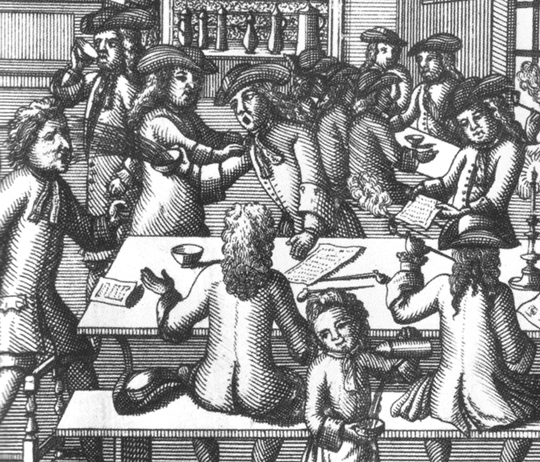
A disagreement about the Cartesian Dream Argument (or similar) turns sour. Note the man throwing coffee in his opponent’s face. From the frontispiece of Ned Ward’s satirical poem Vulgus Brittanicus (1710) and probably more of a flight of fancy than a faithful depiction of coffeehouse practices – Source.

From the tar-caked wharves of Wapping to the gorgeous lamp-lit squares of St James’s and Mayfair, visitors to eighteenth-century London were amazed by an efflorescence of coffeehouses. “In London, there are a great number of coffeehouses”, wrote the Swiss noble César de Saussure in 1726, “…workmen habitually begin the day by going to coffee-rooms to read the latest news.” Nothing was funnier, he smirked, than seeing shoeblacks and other riffraff poring over papers and discussing the latest political affairs. Scottish spy turned travel writer John Macky was similarly captivated in 1714. Sauntering into some of London’s most prestigious establishments in St James’s, Covent Garden and Cornhill, he marvelled at how strangers, whatever their social background or political allegiances, were always welcomed into lively convivial company. They were right to be amazed: early eighteenth-century London boasted more coffeehouses than any other city in the western world, save Constantinople.

London’s coffee craze began in 1652 when Pasqua Rosée, the Greek servant of a coffee-loving British Levant merchant, opened London’s first coffeehouse (or rather, coffee shack) against the stone wall of St Michael’s churchyard in a labyrinth of alleys off Cornhill. Coffee was a smash hit; within a couple of years, Pasqua was selling over 600 dishes of coffee a day to the horror of the local tavern keepers. For anyone who’s ever tried seventeenth-century style coffee, this can come as something of a shock — unless, that is, you like your brew “black as hell, strong as death, sweet as love”, as an old Turkish proverb recommends, and shot through with grit.

It’s not just that our tastebuds have grown more discerning accustomed as we are to silky-smooth Flat Whites; contemporaries found it disgusting too. One early sampler likened it to a “syrup of soot and the essence of old shoes” while others were reminded of oil, ink, soot, mud, damp and shit. Nonetheless, people loved how the “bitter Mohammedan gruel”, as The London Spy described it in 1701, kindled conversations, fired debates, sparked ideas and, as Pasqua himself pointed out in his handbill The Virtue of the Coffee Drink (1652), made one “fit for business” — his stall was a stone’s throw from that great entrepôt of international commerce, the Royal Exchange.
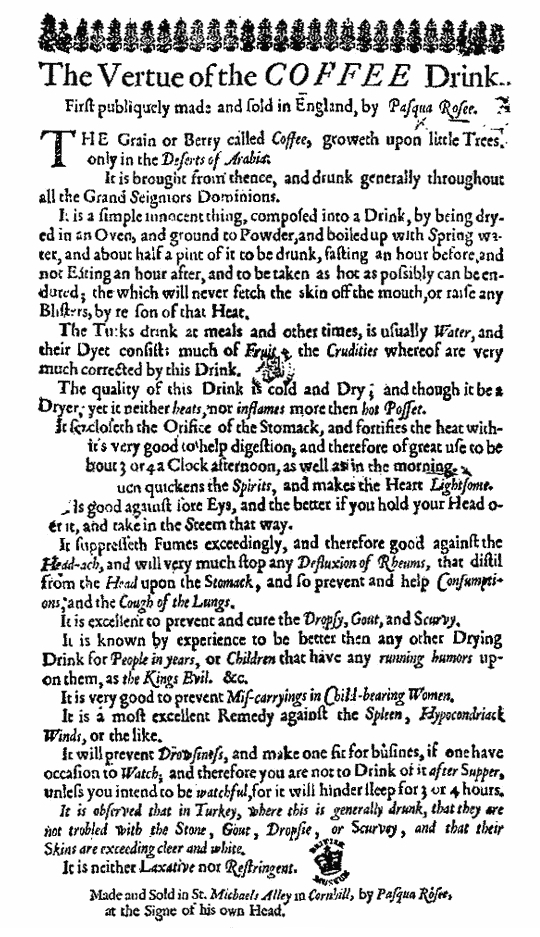
A handbill published in 1652 to promote the launch of Pasqua Rosée’s coffeehouse telling people how to drink coffee and hailing it as the miracle cure for just about every ailment under the sun including dropsy, scurvy, gout, scrofula and even “mis-carryings in childbearing women” – Source.


Remember — until the mid-seventeenth century, most people in England were either slightly — or very — drunk all of the time. Drink London’s fetid river water at your own peril; most people wisely favoured watered-down ale or beer (“small beer”). The arrival of coffee, then, triggered a dawn of sobriety that laid the foundations for truly spectacular economic growth in the decades that followed as people thought clearly for the first time. The stock exchange, insurance industry, and auctioneering: all burst into life in 17th-century coffeehouses — in Jonathan’s, Lloyd’s, and Garraway’s — spawning the credit, security, and markets that facilitated the dramatic expansion of Britain’s network of global trade in Asia, Africa and America.

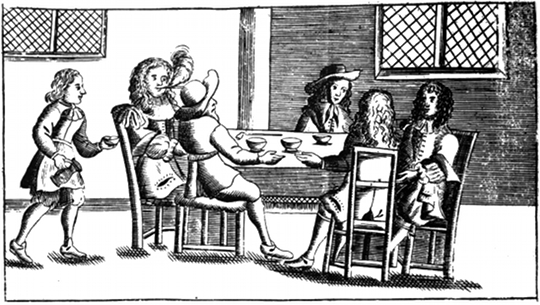
The meteoric success of Pasqua’s shack triggered a coffeehouse boom. By 1656, there was a second coffeehouse at the sign of the rainbow on Fleet Street; by 1663, 82 had sprung up within the crumbling Roman walls, and a cluster further west like Will’s in Covent Garden, a fashionable literary resort where Samuel Pepys found his old college chum John Dryden presiding over “very pleasant and witty discourse” in 1664 and wished he could stay longer — but he had to pick up his wife, who most certainly would not have been welcome. The earliest known image of a coffeehouse dated to 1674, showing the kind of coffeehouse familiar to Samuel Pepys – Source.

No respectable women would have been seen dead in a coffeehouse. It wasn’t long before wives became frustrated at the amount of time their husbands were idling away “deposing princes, settling the bounds of kingdoms, and balancing the power of Europe with great justice and impartiality”, as Richard Steele put it in the Tatler, all from the comfort of a fireside bench. In 1674, years of simmering resentment erupted into the volcano of fury that was the Women’s Petition Against Coffee. The fair sex lambasted the “Excessive use of that Newfangled, Abominable, Heathenish Liquor called COFFEE” which, as they saw it, had reduced their virile industrious men into effeminate, babbling, French layabouts. Retaliation was swift and acerbic in the form of the vulgar Men’s Answer to the Women’s Petition Against Coffee, which claimed it was “base adulterate wine” and “muddy ale” that made men impotent. Coffee, in fact, was the Viagra of the day, making “the erection more vigorous, the ejaculation more full, add[ing] a spiritual ascendency to the sperm”.

saidiya hartman: libidinöse ökonomie

Seventeenth-Century Dutch


http://www.hnanews.org/archive/2009/04/brienen.html
Rebecca Parker Brienen, Visions of Savage Paradise: Albert Eckhout, Court Painter in Colonial Dutch Brazil. Amsterdam: Amsterdam University Press, 2006. 288 pp, 17 color, 72 b&w illus. ISBN 978-90-5356-947-4 and 978-90-5356-947-2.

Julie Berger Hochstrasser, Still Life and Trade in the Dutch Golden Age. New Haven and London: Yale University Press, 2007. 320 pp, 69 color, 97 b&w illus. ISBN 978-0-300-10038-9.

Rebecca Parker Brienen's Visions of Savage Paradise: Albert Eckhout, Court Painter in Colonial Dutch Braziland Julie Berger Hochstrasser's Still Life and Trade in the Dutch Golden Age are, in some ways, two sides of the same coin: they examine effects – the visual documentation – of exotic travel and exploration by the Dutch in the seventeenth century. Hochstrasser examines the impact of the Dutch East India Company (VOC from the Dutch initials) trading with India, Indonesia and China, and the Dutch West India Company (WIC) in the Americas, largely in terms of items that were brought back to Europe (sugar, tea, tobacco, etc.) and their subsequent appearance in paintings. Brienen concentrates on the artist Albert Eckhout in Brazil and the role of the West India Company there. (Indeed, Hochstrasser also includes a discussion on Eckhout within the more lengthy discussion of the Dutch Brazilian colony.)

We get a glimpse of the exotic from the very beginning of Brienen's Introduction, in which she proposes that we imagine Eckhout's arrival with the artist Frans Post and the colony's new governor, Johan Maurits in Recife, Brazil, in 1637, and those who may have come to greet the ship: merchants, employees of the WIC, "Portuguese planters, members of the Jewish Community, African slaves, free people of mixed ethnic background and representatives of local indigenous groups" – with squawking flocks of green parrots flying overhead and in view of passion flowers and papayas. The color, sounds and wonders of this world even today, more than 450 years later, are still exotic. Although Brienen's focus is Eckhout, she provides a larger context for this western artist's life and predecessors in Brazil and fields the issue of his "ethnographic art."

Brienen's book should also be considered with the 2004 exhibition catalogue, Albert Eckhout, A Dutch Artist in Brazil (ed. Quentin Buvelot), for the exhibition at the Mauritshuis, The Hague, which covers much the same material and acknowledges Brienen's previous work. The larger format of that catalogue and its many larger and detailed illustrations make it more accessible – but it cannot replace Brienen's book. They cover much the same material but do not entirely agree (the artist's birth year, in fact, is a contentious point – Brienen thinks c. 1607, not c. 1610), and the focus in the exhibition (despite its title) is really on the patron and the WIC.

Brienen discusses possible explanations for Eckhout's extraordinary paintings and the possibility of a pictorial cycle – including eight "ethnographic life-size paintings for a 'princely chamber' for Vrijburg Palace." Later, these and other works (26 in all) would be a gift of the Count Johan Maurits to his cousin Frederick III of Denmark for his kunstkamer (and they remain in Copenhagen today). Other works also went to Louis XIV of France and the Elector of Brandenburg. The wonder of the Brazilian world – its people, flora, vegetation – created a universal desire and one that Maurits could barter for money and title.

Africans and multi-ethnic Brasilianen, Tapuyas and Tupinamba peoples and those called Mulattos and Mameluca of the New World are the subject of Eckhout's stunning life-size paintings. To what degree should we hold Eckhout accountable for a realistic portrait of them? And are these men and women slaves or free? Are they even "noble free" people? The role of African slaves in Brazil and labor for the WIC is integral to her study – as it is critical, with a different slant, for Hochstrasser. But as Brienen points out – and Hochstrasser stresses – this Dutch colony could not have successfully existed without slavery. Over 60,000 African slaves were reportedly laboring in the Dutch-occupied Pernambuco (Brazil) by mid-century. The Dutch Court and the WIC did much to cement relations with the Congo and Angola to assure West African slave trade. From 1634 onwards, the WIC was actively involved in the importation of slaves into the Americas.

This information is also critical to Hochstrasser's theme from the beginning. As commodities (lavishly illustrated) are her central concentration (with chapters on the VOC and the WIC) her subheadings are: cheese, herring, beer (local); grain, lemons (also oranges – via Europe); pepper, porcelain, tea (via VOC); and salt, tobacco, sugar (via WIC). We should not be surprised to see that the subheading slaves as a commodity (via WIC), was a necessary one. In each case, Hochstrasser uses Dutch (and Flemish) still-life painting to show how and when the commodities appeared through trade. In the midst of Chinese porcelain and Turkish carpets, the use of black Africans in painting is likened to the display of a commodity as part of "riches from abroad." She unequivocally states that everyone who even invested in the WIC was involved in the slave trade. One cannot separate one aspect of it from another. The slave trade is not just apparent in the presence of Africans in paintings, but in the presence of other commodities that were only available as a result of slave labor.

Hochstrasser investigates the commodities in depth – as they are seen, as they were traded, where they came from, their mention in diaries, diets, documents, poems, prints, and their relation to Spanish, Portuguese, and English traders' ships. Not only will one not look at still-life the same way – one will not even look at salt the same way! And certainly not sugar (and the spun-sugar sweets in still-life painting), since often it was the sugar production that was the reason for the grueling life of plantation slave labor in Brazil. Although the Dutch did not begin the slave trade, by the 1630s they were well into it. The wealth of the Golden Age, all set before us in pronkstilleven, could not have been available without it.

With Hochstrasser's unraveling of the still lifes and their sources and Brienen's analysis of the role of Eckhout and the WIC in Brazil, we can no longer look at these works and only write about composition. Their work challenges us to change ours.

Frima Fox Hofrichter
Pratt Institute

Silvia Federici, On capitalism, colonialism, women and food politics

From edition 2009 Issue 2

Published: November 3, 2009
An interview with Silvia Federici
Interviewed by Max Haiven
Silvia Federici is a researcher, activist and educator. She was born and raised in Italy but came to the US in 1967 on a scholarship to study Philosophy at the University of Buffalo. Since then, she has taught at several universities in the US and also at the University of Port Harcourt in Nigeria. She is now Emerita Professor at Hofstra University (Long Island, NY) and lives in Brooklyn.
A veteran feminist activist, Federici’s work is informed by and in dialogue with the many struggles which have animated her career. Since the early 1970s Federici was, along with theorists such as Mariarosa Dalla Costa and Selma James, a founder of the International Feminist Collective and an organizer with the famous Wages for Housework campaign. This movement brought together a global alliance of feminist groups to make a revolutionary challenge at the very hinge of capitalist and patriarchal power by demanding economic sovereignty for women engaged in the elemental labour of social reproduction.
Federici has also been a central part of the Midnight Notes Collective and a co-founder of the Committee for Academic Freedom in Africa (CAFA), a support organization for the struggles of students and teachers in Africa against structural adjustment. Between 1991 and 2003 she was a co-editor of the CAFA Bulletin. In 1995, she co-founded the Radical Philosophy Association (RPA) anti-death penalty project.
Her ground-breaking 2004 book Caliban and the Witch: Women, The Body and Primitive Accumulation (Brooklyn: Autonomedia), received critical laudations and was much talked of in both academic and activist circles, supplying as it did a capacious, lucid and historically rigorous picture of the intersections of patriarchy, capitalism, colonialism and violence from the 15th to the 18th century. The book served as a crucial corrective to both Marxist analyses of the period of primitive accumulation which write gender out as well as to the fashionable academic discourse of biopolitics. The latter, Federici argues, has tended, in the work of both Foucault and his followers, to forget the witch trials of the 16th and 17th century. These were part and parcel of the systematic destruction of women’s power over biological and social reproduction and social creativity, a process essential to the enclosure and colonial movements and the scene of the nascence of both capitalism proper and the modern state.
In other work, Federici has addressed themes of enclosure, colonialism, labour, patriarchy and racism in areas as diverse as the advance of capitalist accumulation, international development policy, the labour of “immaterial workers,” the analysis of social movement strategy and anti-colonial struggle.
In this interview Federici shares her thoughts on the relationship between food, agricultural production, women’s work, global capitalist accumulation and struggle around the world.
Max Haiven (MH) for Politics and Culture: Your historical work has focused on the way the process of what Marx called “primitive accumulation”—the way capitalism is created out of the destruction of other ways of life—has relied upon the systematic destruction of women’s power and the “accumulation of divisions” amongst the working class. Can you speak to how this relates to the history of food politics?
Silvia Federici (SF): There is a direct relation between the destruction of the social and economic power of women in the “transition to capitalism” and the politics of food in capitalist society.
In every part of the world, before the advent of capitalism, women played a major role in agricultural production. They had access to land, the use of its resources and control over the crops they cultivated, all of which guaranteed their autonomy and economic independence from men. In Africa, they had their farming and cropping systems, which were the source of a specific female culture, and they were in charge of the selection of seeds, an operation that was crucial to the prosperity of the community and whose knowledge was transmitted through the generations. The same was true of women’s role in Asia and the Americas. In Europe as well, until the late medieval period, women had land-use rights and the use of the “commons”—woods, ponds, grazing grounds—that were an important source of sustenance. In addition to farming with men, they had their gardens where they cultivated vegetables as well as medicinal herbs and plants.
Both in Europe and the regions the Europeans colonized, primitive accumulation and capitalist development changed this situation. With land privatization and the expansion of monetary relations, a deeper division of labor developed in agriculture that separated food production for profit from food production for direct consumption, devalued reproductive work, starting from subsistence farming, and appointed men as the chief agricultural producers, whereas women were relegated to the rank of “helpers,” field hands, or domestic workers.
In colonial Africa, for example, British and French officers systematically favored men with regard to allocations of land, equipment, and training, the mechanization of agriculture being the occasion for a further marginalization of women’s agricultural activities. They also disrupted female farming by forcing women to assist their husband in the cultivation of cash crops, thus altering the power relations between women and men and instigating new conflicts between them. To this day, the colonial system, whereby land titles are given only to men, continues to be the rule for “development agencies” and not in Africa alone.
It must be said that men have been accomplices in this process, not only claiming control over women’s labor, but, in the face of growing land scarcity, conspiring to curtail women’ communal land-use rights (wherever these survived) by rewriting the rules and conditions of belonging to the community.
Despite women’s resistance to their marginalization, and their continuous engagement in subsistence farming and land reclamation struggles, these developments have had a profound effect on food production. As Vandana Shiva so powerfully described in her book Staying Alive [1], with the exclusion of women from access to land and the destruction of their control over food production, a large body of knowledge, practices, techniques that for centuries safeguarded the integrity of the land and the soil and the nutritional value of food has been lost.

28.03.2016

conflict and skin: the persistence of victorian design in namibian women’s fashion


unspecifiedCatherine mckinley, gallatin ma

MARCH 11TH – MARCH 27TH, 2016


Curatorial Statement

In 1884, present-day Namibia was annexed under German colonial rule as part of what was to become South West Africa. Within a decade, German imperial troops were installed to enforce state rule, provoking formidable resistance by the dominant Herero and Namaqua people. The German army responded with a campaign to remove the groups from their ancestral lands, marking the start of the German-Herero War (1904-1907). By the war’s end, an estimated eighty percent of the population, including Himba and other peoples, had been killed by the Germans. It was the first genocide of the twentieth century and a chilling rehearsal for later Nazi atrocities.
The German-Herero War centered on the enormous profitability of both human bodies and cattle skins. What played out on the “native” body through acts of labor exploitation and racial cleansing also deeply implicated sartorial, social-cultural, and traditional religious values of the Herero and Himba, in particular. The cow, the human body, and God were considered to be one and the same. “Herero-ness” and other clan identities, the sustaining of cattle wealth, and custom were expressed in large measure by a literal embodiment of the cow. Cow ownership, as well as a particular wearing of skins, and a feminine ideal of “walking like a cow,” were set off by sartorial forms that celebrated the cow’s form and bored majesty and its associated dowry wealth.
In Namibia, fashions of the Herero and their closely related clan cousins, the Himba, become monuments to the genocide which has otherwise been almost entirely erased. Both groups—summoning the body of the cow—whether with Western imported cloth and notions, skins, and “nakedness,” express radically different relationships to Victorian colonial legacies. They also express pleasure in Western and contemporary design and form, while marking a decided resistance to colonialism and the violence enacted on women’s bodies through genocide and racial cleansing.
Conflict and Skin exams the politics and colonial legacies of Namibian fashion, particularly as iterations of “national costume” and notions of “indigeneity” —the practice of indigenous culture despite colonial impositions.
How does the legacy of genocide explain the staying power of these radically different but kindred forms? How do they radicalize, vulgarize, and provide distance from the genocide?
Engaging the work of the late award-winning South African photographer Thabiso Sekgala and Ghanaian-American couture designer Mimi Plange’s Herero-inspired collection “Flower in the Desert” (Spring 2012), Conflict and Skin examines contemporary African photography and dressmaking, as well as images and costume from the archive. Through these dresses and fashion, I hope to show the legacy of colonialism and to demonstrate the resistance and trauma of the Herero people.
-Catherine Mckinley

_toMG_2047-2
0025
mckinley-2
mckinley-4
to000004 copy

25.03.2016

IBEJI – TWICE BORN

Twin sculptures of the Yoruba people from the Pavlich collection


December 2015 – June 2016
Exhibition curator: Aleksandra Prodanović Bojović
The Museum of African Art presents the topic of twins in African art and culture with an exhibition of twin statues of the Yoruba people from the Pavlich art collection. These sculptures belong to the twin cult of the Yoruba people, who have the highest twin birth rate in the world. At this multimedia exhibition visitors can learn about the Yoruba beliefs and customs concerning twins, listen to a praise song dedicated to twins, and see an interview with a priest of the Yoruba traditional religion on the importance of twins for the Yoruba.

The Yellow Wallpaper


https://www.nlm.nih.gov/literatureofprescription/exhibitionAssets/digitalDocs/The-Yellow-Wall-Paper.pdf

Mental Illness in Literature: Charlotte Perkins
Gilman's "The Yellow Wallpaper Updated on August 8, 2014
Mental Illness in American Literature

Gilman's most famous work, her short story "The Yellow Wallpaper", published in 1892, is about a woman suffering from mental illness after of being confined to a bedroom in the attic of a vacation home by her husband, John, for the sake of her health. She becomes obsessed with the room's repulsive, yet alluring yellow wallpaper. Gilman wrote this story to bring light to women's role in society, explaining that women's lack of autonomy negatively affects their mental, emotional, and physical well-being. She used it as a call to action for readers to recognize the legitimacy and complexity of illness and benefit in therapies for treatment, namely in women, and to overcome sexism in treatment
The narrator explains the embodiment of the authors experience during her time being treated by Dr. Mitchell's "rest cure". The treatment, which includes no physical activity, mental stimulation, or hobbies, is in direct conflict with what the author needs to get well. This drives her further into madness until she descends beyond the point of getting better.
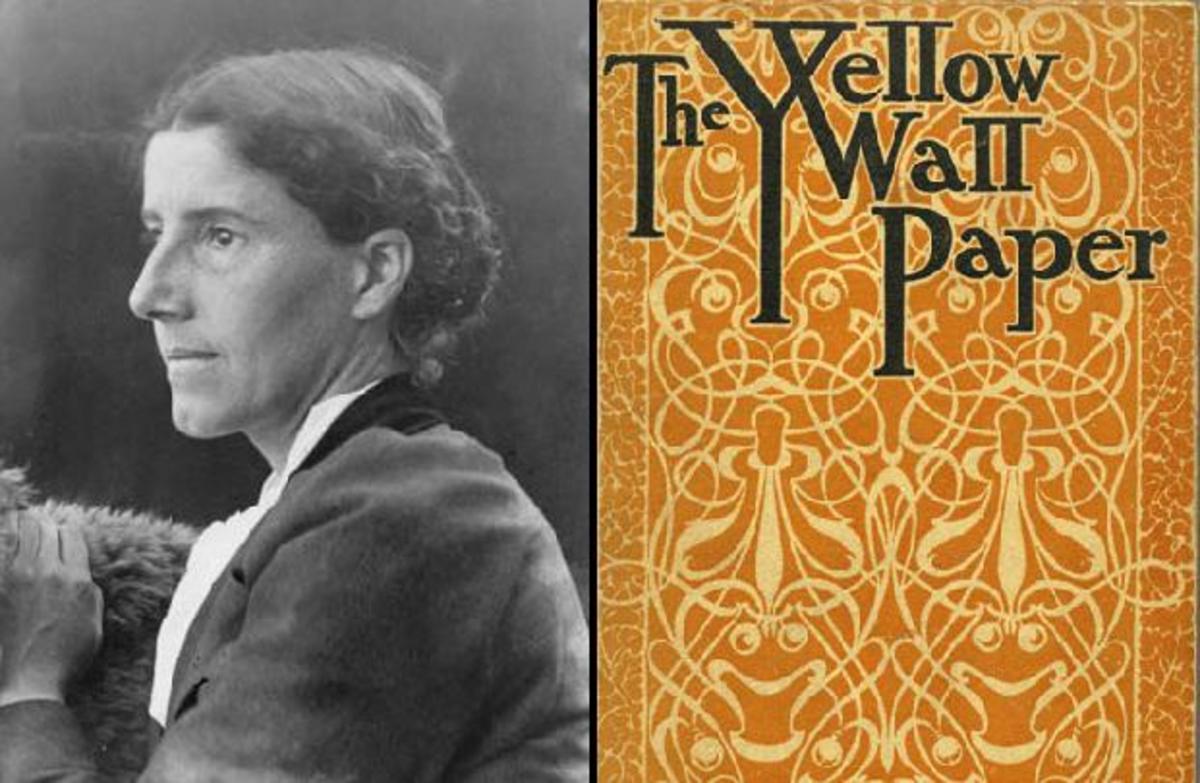
Left: Charlotte Perkins Gilman     Right: "The Yellow Wallpaper" cover
Left: Charlotte Perkins Gilman Right: "The Yellow Wallpaper" cover