by Debbie Hagan on March 25, 2016

SALEM, Mass. — When Europeans first tasted sugar during the Crusades,
they immediately begged for more. However, it wasn’t until Columbus
brought sugar cane to the Caribbean to be cultivated that this exotic
luxury grew into a hotly traded world commodity, akin to petroleum
today. Such sweetness had a price, and Cuba met international demands by
bringing enslaved Africans across the Middle Passage and subjecting
them to a lifetime of brutal labor. By the mid-19th century, Cuba
produced a third of the world’s sugar.
Alchemy of the Soul, Elixir of the Spirits, a large-scale, blown-glass sculptural installation on view at the Peabody Essex Museum, takes visitors on a trip to Cuba to explore its sounds, smells, tastes, and sights, all through this rather dark historical lens. Afro-Cuban artist María Magdalena Campos-Pons created the complex, multipart exhibit with her husband and collaborator, musician and composer Neil Leonard.

“It is a multilayered experience that combines visual imagery with
sound elements that engage the viewer in more than one sensorial
experience — more than just look and see and move quickly,” says
Campos-Pons, who has been dreaming about this project for 28 years.
Campos-Pons grew up in former slave barracks in Cuba and played in the shadows of what were once sugar cane factories. She’s of Yoruba descent — seven of her grandfathers were enslaved in Nigeria and taken to Cuba between 1838–66 to work the sugar cane.
Visitors begin their journey to Campos-Pons’s Cuba by entering the museum’s freight elevator, loaded with burlap sugar sacks and a vintage record player. The elevator operator cues up a 45 rpm record, from which a lone voice sings in Spanish about the beauty of his country and how proud he is to be from Matanzas, Cuba’s main port. Campos-Pons spent much of her childhood there.

Those who know rumba music, its urgent drumbeats and African roots,
will recognize the voice as belonging to Rafael “El Niño” Navarro
Pujada: the Frank Sinatra of the form. Leonard recorded him in his home
as he reminisced about the docks, where he sang during breaks from
loading sugar. Between his sweet, solitary voice and the lumbering
motions of the elevator, visitors can imagine a ferry voyage, cresting
the waves and heading toward the port city.
“I’ve been working with Cuban musicians since 1986, since before I met Magda,” says Leonard, who wanted to meet and record musicians who’d worked in the ports and sang songs reflecting rumba’s roots. “They let me record them in their homes without the drums, without their producers, just telling their stories and singing songs they learned,” says Leonard. “This sound of the port is a very iconic sound of Cuba. That’s an aspect of the work that is Magda’s entire life. It’s about what I am seeing in the sugar trade, distilling it, and bringing it back to the work.”
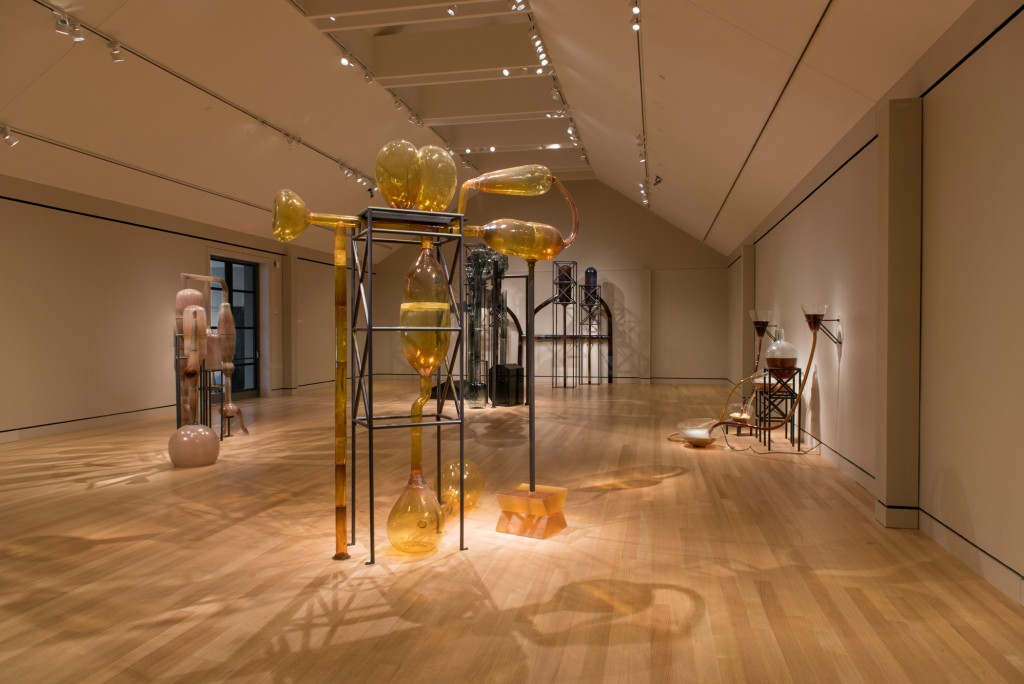
Arriving on the third floor, visitors enter an ethereal, multisensory dreamscape made up of six 10- to 12-foot blown-glass sculptures. Glass piping connects the bulbous vessels, so the gallery looks a bit like a science lab. One unit is filled with amber fluid that bubbles, flows, and pools in glass bowls and kicks up the sweet scent of rum. This is a surreal, skeletal landscape — an artistic interpretation of the ruins left by the 1,000 or so sugar and rum factories that once flourished in Cuba.
“The presence of smell and temperature in the room, combined with the moisture of the fountain and the distillery bring together this experiential idea,” says Campos-Pons.

At special events, visitors can try quarter-sized slices of sugar
cane. In one bite, the juicy liquid explodes in the mouth. That’s it.
Then the sweetness is gone and what’s left is a straw-like, tasteless
wad that one can’t wait to spit out. The sweetness and bitterness
present an uncomfortable dichotomy.
“Sugar is bittersweet,” says Campos-Pons, referring not just to the cane’s taste but also the harshness involved in the harvest. The plant’s razor-sharp leaves slice workers arms and faces, sometimes blinding them.
“What has been beautiful is that the Peabody commissioned this piece, so it really allowed us to be ambitious,” says Campos-Pons. “This idea has been in my mind since 1988. I was just waiting for the proper place and moment.”

The artists worked with two glass factories — one in Boston, the
other in San Francisco — to create blown vessels that fit together like
Lego parts. “When you’re making a process that is new, there’s not a
notebook for it,” says Campos-Pons. “It’s all about taking risks, and
you may fail. Glass is fragile. It could break. This is about process.
One of the things that I’m excited and happy about is that [the museum]
allowed us to go forward with the process and make ourselves
vulnerable.”
Leonard digitally manipulated several sources — saxophone, singing voices, and waves — to compose a sound collage that echoes throughout the exhibit. “My concern for the work is that glass is shiny, precious, beautiful, but glass is also cold and Matanzas is not cold,” says the musician. “How can I put something of the warmth, spirit, and rustic quality of Matanzas into the work in the gallery?”
He takes a single note from his saxophone, cuts off the end sound, and digitally manipulates and curves it as one imagines a glassmaker does with molten liquid. “You hear the saxophone after I’ve stopped playing. It’s ringing into space, a reverberation, very much like reflection — like the beauty of Magda’s glasswork, like what you see through the glass and what you see from the shadows on the floor,” says Leonard.
Life also emerges through the songs sung by male and female voices and the sounds of water. They wash back and forth through the installation like a tide.
“One of the things the piece was intended to evoke, which sort of came out intuitively, was how sounds migrated from Africa,” says Leonard. “In Cuba, [the songs] are transformed, some sung in Spanish, some are secular, sacred things that happened in Cuba that didn’t happen in Africa. They migrate like a spirit in one direction.”
In “Agridulce,” one of a couple of performances held in the museum’s atrium in January, Campos-Pons entered the upper bridge above the audience’s heads, wearing a 19th-century slave dress. A machete in hand, she made swift, violent motions as she hacked at a row of sugar cane. Minutes later, she approached the audience and extended her fresh-cut cane: “Try it. It is sweet.”
The crowd pushed forward, gravitating to the artist, wanting see her up close and receive this gift. I felt honored as she paused before me and looked me in the eye. I took the cane, and my heart ached a little, feeling transported back to a 19th plantation, receiving this humble but weighty gift. “I was trying to juxtapose the brutality of that with the taste [of sugar],” says Campos-Pons. “What I say in the performance is, how could anyone find energy to go home and love a close one after 12 hours of this? What love is left over? What energy is left to breastfeed your baby?”

Such history may be skimmed over by Cuba travel guides, especially as
they’re being updated for a new era of tourism, but those in the know
will find traces remaining in the country’s people, culture, and
landscape.
“Contemporary art is about daring to make an experiment, daring to try something new, daring to fail, daring to try to go to a place where no one has entered,” says Campos-Pons.
Alchemy of the Soul dares to tell the truth about a beautiful county with a greedy past, desperate to satisfy the world’s craving for sugar.
Alchemy of the Soul: María Magdalena Campos-Pons continues at the Peabody Essex Museum (161 Essex Street, Salem, MA) through April 3. Neil Leonard and Rudresh Mahanthappa will perform an experimental saxophone concert with projected images by Campos-Pons at the Isabella Stewart Gardner Museum (25 Evans Way, Boston) on April 7.
---

Maria Magdalena Campos-Pons. Alchemy of the Soul, Elixir for the Spirits, 2015. Peabody Essex Museum. © 2016 Peabody Essex Museum. Photo by Peter Vanderwarker.
A Pan-American Alchemy: María Magdalena Campos-Pons at the PEM 0
By Leah Triplett Harrington on March 3, 2016 Feature, Magazine, Reviews
Born in 1959 in Cuba, María Magdalena Campos-Pons first came to Boston through a MassArt exchange program in 1988. After arriving in Boston, Campos-Pons began bringing a variety of media, including photography, video, and performance, into her painting practice. Campos-Pons’s work, often large-scale and autobiographical, investigates the rich interconnection between Cuba and the United States, of memory and time, and of identity and individuality.
Comprised of an intensely tactile installation, composed of sound, video, photographs, drawings, and glass-blown sculptures, Alchemy of the Soul: Maria Magdalena Campos-Pons, currently on view at the Peabody Essex Museum, is an almost monographic look at Campos-Pons’s work. Produced via collaboration between Campos-Pons and her husband Neil Leonard, Alchemy of the Soul fuses Campos-Pons’s preoccupation with memory with Leonard’s work with sound and musical composition. Curated by PEM deputy director Joshua Basseches, the exhibition, which even explores smell as a trope, is an immersive experience of the particular history of Cuba and the United States.
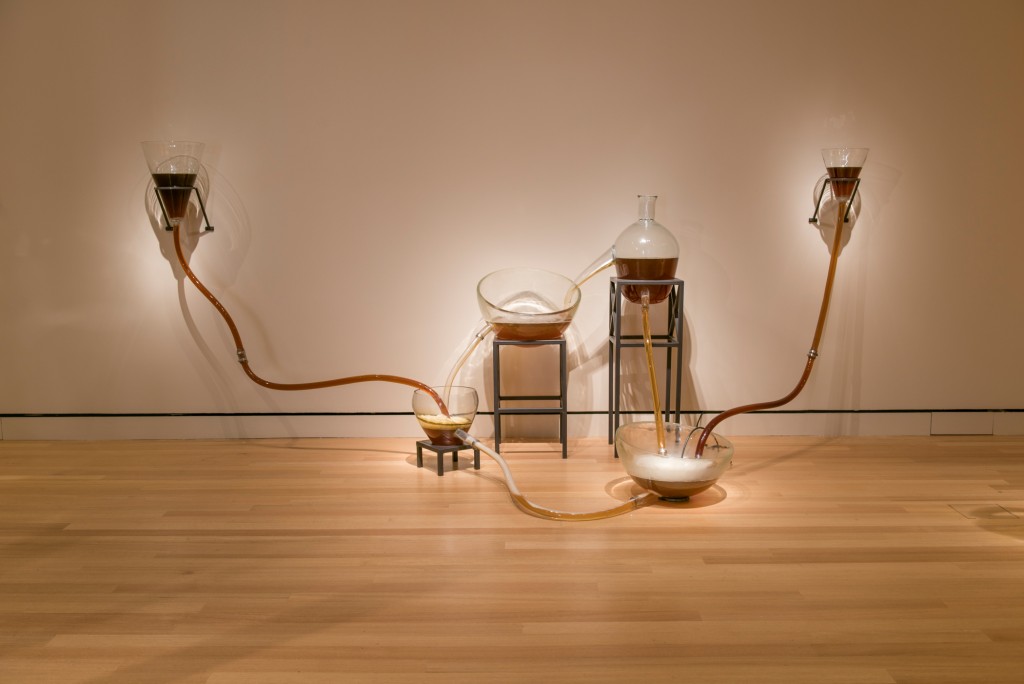
Cuba’s international sugar and rum industry are central thematic concentrations of Alchemy of the Soul. The exhibition, which begins within the museum’s freight elevator, a choice that clearly introduces the idea of labor, is anchored by the installation Alchemy of the Soul, Elixir of the Spirit in the museum’s special exhibition gallery. Though the elevator and corridor outside the gallery are festooned with almost cheesy burlap sugar sack props, the show is gracefully installed to a haunting and transcendent effect. The gallery is dimly lit with a thick, humid atmosphere and a soft trickling sound surrounds the five mammoth glass sculptures that comprise the work. A sweet, unfamiliar smell also pervades the space; this is the scent of sugar being distilled into rum substitute, the liquor that buttressed the Cuban economy until the revolution, and before that, supported the slave trade in the Caribbean and Americas.
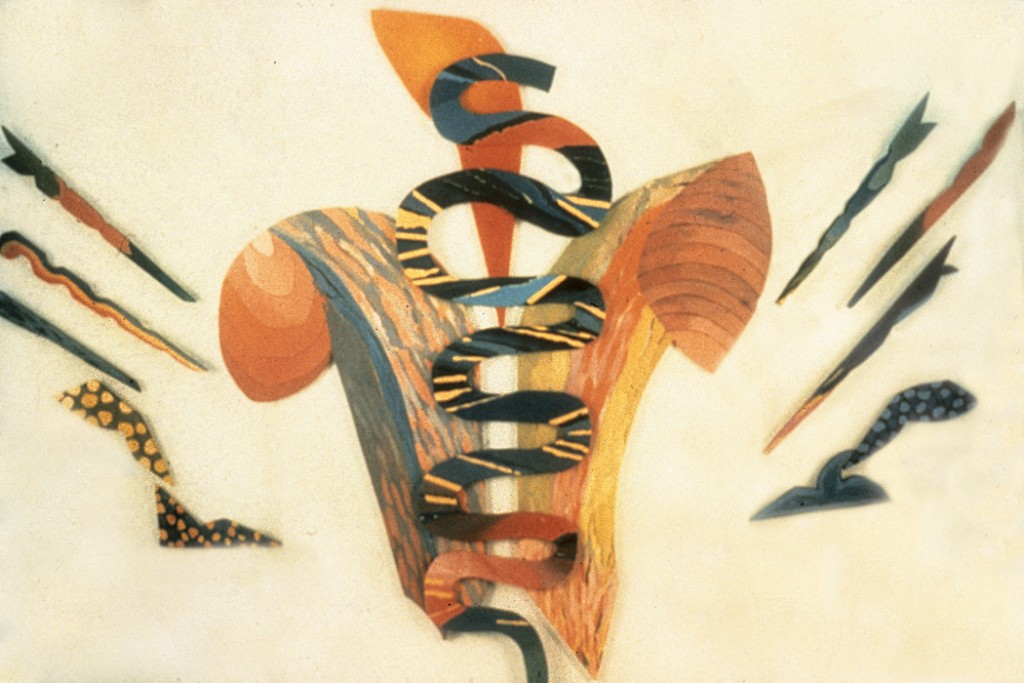
In many ways, Alchemy of the Soul fuses Campos-Pons’s early and current works. Before leaving Cuba for Boston, Campos-Pons’s paintings concentrated on gender inequality and other feminist themes. Two of Campos-Pons paintings from this period, Cinturó de Castidad and Anticonceptivo, are illustrated in a digital catalog, and presage much of Campos-Pons later work. Both works are sculptural, incorporate wood into traditional painting materials, and utilize lightly abstracted forms to depict recognizable forms. “Her experience in Boston led [Campos-Pons] to consider an expanded set of social and political concerns,” writes Basseches in one of his detailed catalog essays included in the digital catalog.
Likewise, Campos-Pons’s time at MassArt as part of a graduate student exchange bore a fruitful involvement with a variety of artistic and aesthetic approaches. With an understanding of painting practices as well as photography, video, sound, and installation, Campos-Pons’s work assumed a global tenor despite her solidly abstract approach. Basseches’s essay explores this new direction, investigating how Castro’s government of the late 1980s and early 1990s—the fall of the Soviet Union as well as participation in the Angolan civil war—infused Campos-Pons’s work from the period with a radical vigor. The painstaking and timely immigration process also introduced a nascent interest in exile, or, as Basseches discusses, double exile.[1] “The result was an increased focus on a set of issues related to dislocation, personal identity, and the black body, particularly the artist’s own body,” Basseches writes.
Sugar is produced from backbreaking labor, and its ubiquitous popularity cultivated a taste for brutal control and economic dominance among the merchants who traded the substance. As some of these merchants lived in Salem, and because the Peabody Essex commissioned this work for the exhibition, Alchemy of the Soul, Elixir of the Spirits offers an especially compelling way in which to search the complex history of labor, trade, currency, politics, and power that connect through the global history of the sugar industry.
Six sculptures, or “sculptural elements,” comprise this work. Each created from hand-blown glass, some colored, some clear, these sculptures are inspired from the relics of decaying mill buildings that populate La Vega, Cuba. These ruinous mill buildings once distilled rum, alloying sugar into the intoxicating drink. The glass sculptures are bulky, seemingly planted into the floor through their steel piping, yet graceful and lithe in their transparency. Glass, like rum, is a blend of natural elements worked into a consumable product, a material that mimics Campos-Pons’s overarching interest in alchemy. Combined with the gallery’s low lights and the trickle of distilling rum, the sculptures become specters of shadow. Their shapes blend anthropomorphism with stark, straight edges of modern industrial design, convoluting these forms into otherworldly, familiar but strange, apparitions.
The pain of exile and double exile dominate Campos-Pons’s work from the 1990s and 2000s. Examples of her work in this period are on view in a gallery across from Alchemy of the Soul, Elixir of the Spirit, accessible via a small bridge. Taking the short walk between galleries, it’s hard not to consider the literal journey that Campos-Pons and other Cuban-Americans have taken to reach the United States, a country so close geographically, yet so distanced ideologically and economically. At the center of this second room is a small blue sculpture from the Alchemy of the Soul, Elixir of the Spirit body of work, surrounded mostly by works on paper. The body is central to this work; physical dissociation reverberates in each, though from what is not exactly clear.
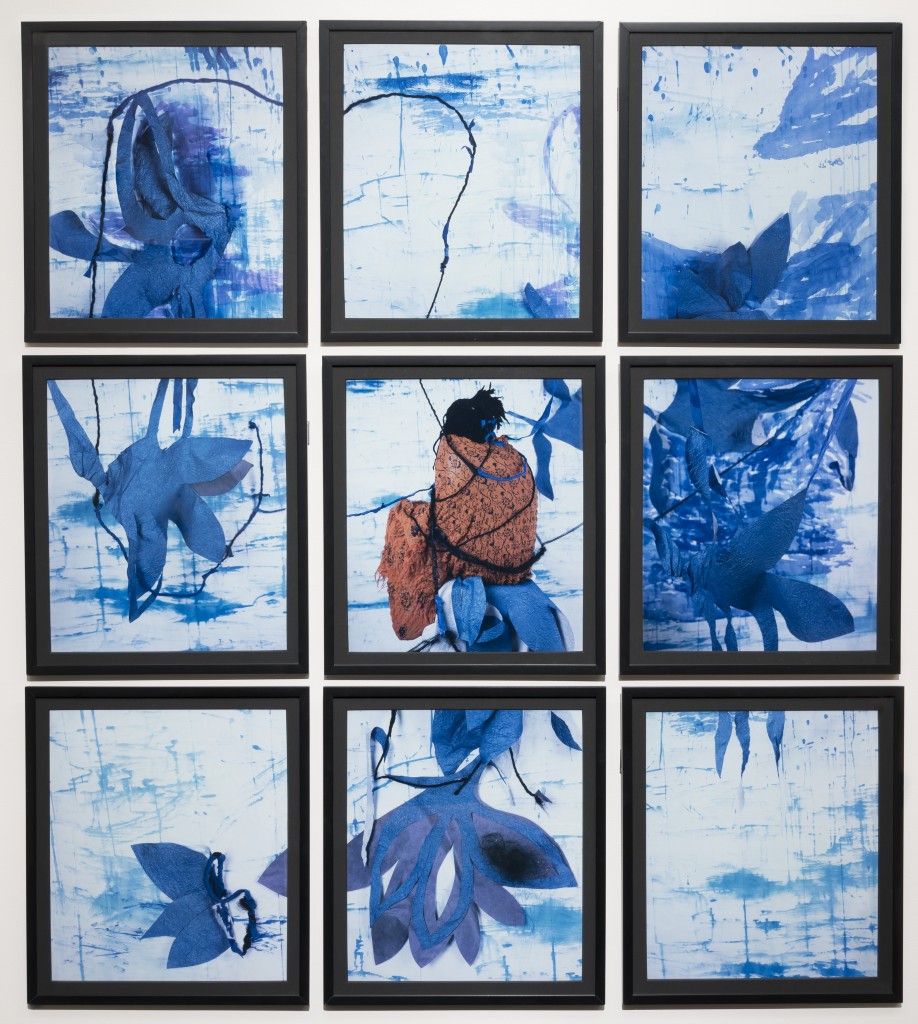
In Blue Refuge (2008), a grid of nine Polaroid photographs, a feminine form sits huddled in orange and tethered to a rope of hair, her back facing us. The roots stretch into the surrounding prints, each mostly blue, the hue oscillating between pure color and floral shapes. The form seems lost in a blue ocean or tundra, which, in conjunction with its title, gives the work political significance. Likewise, in Dreaming of an Island (2008), another grid of nine Polaroid photographs, Campos-Pons presents a seated black woman in the top right photograph looking out at a wooded island of northern New England situated a short distance away. The woman is also turned away from the viewer though her posture is more confident than her counterpart in Blue Refuge. A strand of hair descends from her, stretching into each of the prints below. These works are soft, gentle, and pensive, not overtly political or ideological. Instead of the freshness of exile, here Campos-Pons is focused on memory and how it is shaped by distance.
In many ways, La Vega is another world from that of Campos-Pons’s youth. Alchemy of the Soul allowed Campos-Pons to travel back to La Vega for the first time in thirty years, and the Peabody Essex documented the trip extensively. Campos-Pons created poignant videos from this trip, which play in a darkened corner space of the main gallery. Many more documentary videos are available within the digital publication. In one of these, Campos-Pons is filmed exploring her childhood town. “I’m lost in the town,” she says. “So many things have been transformed here, and so many things, in the same way, stay the same.” Likening this reality to how sugar is concocted into rum, Campos-Pons looks intensely proud for a moment and then looks away in tears. Lived on both sides of the Cold War, Campos-Pons’s work, created through the tensions and drama of that war, is evidence that no matter their differences, the United States and Cuba share an alchemic identity.
Alchemy of the Soul: Maria Magdalena Campos-Pons is on view through April 3.
[1] Basseches writes that “the first exile was the Middle Passage that forcibly relocated Campos-Pons’s Yoruba great-grandparents to Cuba to work as slaves on sugar plantations; the second, the artist’s self-initiated exile to Canada and then to the United States, a move that left her unable to return to Canada for over a decade.” Joshua Basseches, “Leaving Cuba for the North,” Alchemy of the Soul: Maria Magdelena Campos-Pons, http://pem.org/sites/alchemy/leaving_cuba/
Installation
view, ‘Alchemy of the Soul: María Magdalena Campos-Pons’ at the Peabody
Essex Museum (photo by the author for Hyperallergic) (click to enlarge)
Alchemy of the Soul, Elixir of the Spirits, a large-scale, blown-glass sculptural installation on view at the Peabody Essex Museum, takes visitors on a trip to Cuba to explore its sounds, smells, tastes, and sights, all through this rather dark historical lens. Afro-Cuban artist María Magdalena Campos-Pons created the complex, multipart exhibit with her husband and collaborator, musician and composer Neil Leonard.
Neil Leonard and María Magdalena Campos-Pons (photo by the author for Hyperallergic)
Campos-Pons grew up in former slave barracks in Cuba and played in the shadows of what were once sugar cane factories. She’s of Yoruba descent — seven of her grandfathers were enslaved in Nigeria and taken to Cuba between 1838–66 to work the sugar cane.
Visitors begin their journey to Campos-Pons’s Cuba by entering the museum’s freight elevator, loaded with burlap sugar sacks and a vintage record player. The elevator operator cues up a 45 rpm record, from which a lone voice sings in Spanish about the beauty of his country and how proud he is to be from Matanzas, Cuba’s main port. Campos-Pons spent much of her childhood there.
Exhibition
entrance, ‘Alchemy of the Soul: María Magdalena Campos-Pons’ (photo by
Kathy Tarantola/PEM, © 2016 Peabody Essex Museum)
“I’ve been working with Cuban musicians since 1986, since before I met Magda,” says Leonard, who wanted to meet and record musicians who’d worked in the ports and sang songs reflecting rumba’s roots. “They let me record them in their homes without the drums, without their producers, just telling their stories and singing songs they learned,” says Leonard. “This sound of the port is a very iconic sound of Cuba. That’s an aspect of the work that is Magda’s entire life. It’s about what I am seeing in the sugar trade, distilling it, and bringing it back to the work.”
Arriving on the third floor, visitors enter an ethereal, multisensory dreamscape made up of six 10- to 12-foot blown-glass sculptures. Glass piping connects the bulbous vessels, so the gallery looks a bit like a science lab. One unit is filled with amber fluid that bubbles, flows, and pools in glass bowls and kicks up the sweet scent of rum. This is a surreal, skeletal landscape — an artistic interpretation of the ruins left by the 1,000 or so sugar and rum factories that once flourished in Cuba.
“The presence of smell and temperature in the room, combined with the moisture of the fountain and the distillery bring together this experiential idea,” says Campos-Pons.
María
Magdalena Campos-Pons, ‘Alchemy of the Soul, Elixir for the Spirits’
(detail, 2015), blown glass, steel, cast resin, silicone, and acrylic,
at the Peabody Essex Museum (photo by Peter Vanderwarker, © 2016 Peabody
Essex Museum) (click to enlarge)
“Sugar is bittersweet,” says Campos-Pons, referring not just to the cane’s taste but also the harshness involved in the harvest. The plant’s razor-sharp leaves slice workers arms and faces, sometimes blinding them.
“What has been beautiful is that the Peabody commissioned this piece, so it really allowed us to be ambitious,” says Campos-Pons. “This idea has been in my mind since 1988. I was just waiting for the proper place and moment.”
María
Magdalena Campos-Pons, ‘Alchemy of the Soul, Elixir for the Spirits’
(detail, 2015), blown glass, steel, cast resin, silicone, and acrylic,
at the Peabody Essex Museum (photo by Peter Vanderwarker, © 2016 Peabody
Essex Museum) (click to enlarge)
Leonard digitally manipulated several sources — saxophone, singing voices, and waves — to compose a sound collage that echoes throughout the exhibit. “My concern for the work is that glass is shiny, precious, beautiful, but glass is also cold and Matanzas is not cold,” says the musician. “How can I put something of the warmth, spirit, and rustic quality of Matanzas into the work in the gallery?”
He takes a single note from his saxophone, cuts off the end sound, and digitally manipulates and curves it as one imagines a glassmaker does with molten liquid. “You hear the saxophone after I’ve stopped playing. It’s ringing into space, a reverberation, very much like reflection — like the beauty of Magda’s glasswork, like what you see through the glass and what you see from the shadows on the floor,” says Leonard.
Life also emerges through the songs sung by male and female voices and the sounds of water. They wash back and forth through the installation like a tide.
“One of the things the piece was intended to evoke, which sort of came out intuitively, was how sounds migrated from Africa,” says Leonard. “In Cuba, [the songs] are transformed, some sung in Spanish, some are secular, sacred things that happened in Cuba that didn’t happen in Africa. They migrate like a spirit in one direction.”
In “Agridulce,” one of a couple of performances held in the museum’s atrium in January, Campos-Pons entered the upper bridge above the audience’s heads, wearing a 19th-century slave dress. A machete in hand, she made swift, violent motions as she hacked at a row of sugar cane. Minutes later, she approached the audience and extended her fresh-cut cane: “Try it. It is sweet.”
The crowd pushed forward, gravitating to the artist, wanting see her up close and receive this gift. I felt honored as she paused before me and looked me in the eye. I took the cane, and my heart ached a little, feeling transported back to a 19th plantation, receiving this humble but weighty gift. “I was trying to juxtapose the brutality of that with the taste [of sugar],” says Campos-Pons. “What I say in the performance is, how could anyone find energy to go home and love a close one after 12 hours of this? What love is left over? What energy is left to breastfeed your baby?”
María
Magdalena Campos-Pons, ‘Alchemy of the Soul, Elixir for the Spirits’
(detail, 2015), blown glass, steel, cast resin, silicone, and acrylic,
at the Peabody Essex Museum (photo by Peter Vanderwarker, © 2016 Peabody
Essex Museum)
“Contemporary art is about daring to make an experiment, daring to try something new, daring to fail, daring to try to go to a place where no one has entered,” says Campos-Pons.
Alchemy of the Soul dares to tell the truth about a beautiful county with a greedy past, desperate to satisfy the world’s craving for sugar.
Alchemy of the Soul: María Magdalena Campos-Pons continues at the Peabody Essex Museum (161 Essex Street, Salem, MA) through April 3. Neil Leonard and Rudresh Mahanthappa will perform an experimental saxophone concert with projected images by Campos-Pons at the Isabella Stewart Gardner Museum (25 Evans Way, Boston) on April 7.
---

Maria Magdalena Campos-Pons. Alchemy of the Soul, Elixir for the Spirits, 2015. Peabody Essex Museum. © 2016 Peabody Essex Museum. Photo by Peter Vanderwarker.
A Pan-American Alchemy: María Magdalena Campos-Pons at the PEM 0
By Leah Triplett Harrington on March 3, 2016 Feature, Magazine, Reviews
Born in 1959 in Cuba, María Magdalena Campos-Pons first came to Boston through a MassArt exchange program in 1988. After arriving in Boston, Campos-Pons began bringing a variety of media, including photography, video, and performance, into her painting practice. Campos-Pons’s work, often large-scale and autobiographical, investigates the rich interconnection between Cuba and the United States, of memory and time, and of identity and individuality.
Comprised of an intensely tactile installation, composed of sound, video, photographs, drawings, and glass-blown sculptures, Alchemy of the Soul: Maria Magdalena Campos-Pons, currently on view at the Peabody Essex Museum, is an almost monographic look at Campos-Pons’s work. Produced via collaboration between Campos-Pons and her husband Neil Leonard, Alchemy of the Soul fuses Campos-Pons’s preoccupation with memory with Leonard’s work with sound and musical composition. Curated by PEM deputy director Joshua Basseches, the exhibition, which even explores smell as a trope, is an immersive experience of the particular history of Cuba and the United States.
Cuba’s international sugar and rum industry are central thematic concentrations of Alchemy of the Soul. The exhibition, which begins within the museum’s freight elevator, a choice that clearly introduces the idea of labor, is anchored by the installation Alchemy of the Soul, Elixir of the Spirit in the museum’s special exhibition gallery. Though the elevator and corridor outside the gallery are festooned with almost cheesy burlap sugar sack props, the show is gracefully installed to a haunting and transcendent effect. The gallery is dimly lit with a thick, humid atmosphere and a soft trickling sound surrounds the five mammoth glass sculptures that comprise the work. A sweet, unfamiliar smell also pervades the space; this is the scent of sugar being distilled into rum substitute, the liquor that buttressed the Cuban economy until the revolution, and before that, supported the slave trade in the Caribbean and Americas.
In many ways, Alchemy of the Soul fuses Campos-Pons’s early and current works. Before leaving Cuba for Boston, Campos-Pons’s paintings concentrated on gender inequality and other feminist themes. Two of Campos-Pons paintings from this period, Cinturó de Castidad and Anticonceptivo, are illustrated in a digital catalog, and presage much of Campos-Pons later work. Both works are sculptural, incorporate wood into traditional painting materials, and utilize lightly abstracted forms to depict recognizable forms. “Her experience in Boston led [Campos-Pons] to consider an expanded set of social and political concerns,” writes Basseches in one of his detailed catalog essays included in the digital catalog.
Likewise, Campos-Pons’s time at MassArt as part of a graduate student exchange bore a fruitful involvement with a variety of artistic and aesthetic approaches. With an understanding of painting practices as well as photography, video, sound, and installation, Campos-Pons’s work assumed a global tenor despite her solidly abstract approach. Basseches’s essay explores this new direction, investigating how Castro’s government of the late 1980s and early 1990s—the fall of the Soviet Union as well as participation in the Angolan civil war—infused Campos-Pons’s work from the period with a radical vigor. The painstaking and timely immigration process also introduced a nascent interest in exile, or, as Basseches discusses, double exile.[1] “The result was an increased focus on a set of issues related to dislocation, personal identity, and the black body, particularly the artist’s own body,” Basseches writes.
Sugar is produced from backbreaking labor, and its ubiquitous popularity cultivated a taste for brutal control and economic dominance among the merchants who traded the substance. As some of these merchants lived in Salem, and because the Peabody Essex commissioned this work for the exhibition, Alchemy of the Soul, Elixir of the Spirits offers an especially compelling way in which to search the complex history of labor, trade, currency, politics, and power that connect through the global history of the sugar industry.
Six sculptures, or “sculptural elements,” comprise this work. Each created from hand-blown glass, some colored, some clear, these sculptures are inspired from the relics of decaying mill buildings that populate La Vega, Cuba. These ruinous mill buildings once distilled rum, alloying sugar into the intoxicating drink. The glass sculptures are bulky, seemingly planted into the floor through their steel piping, yet graceful and lithe in their transparency. Glass, like rum, is a blend of natural elements worked into a consumable product, a material that mimics Campos-Pons’s overarching interest in alchemy. Combined with the gallery’s low lights and the trickle of distilling rum, the sculptures become specters of shadow. Their shapes blend anthropomorphism with stark, straight edges of modern industrial design, convoluting these forms into otherworldly, familiar but strange, apparitions.
The pain of exile and double exile dominate Campos-Pons’s work from the 1990s and 2000s. Examples of her work in this period are on view in a gallery across from Alchemy of the Soul, Elixir of the Spirit, accessible via a small bridge. Taking the short walk between galleries, it’s hard not to consider the literal journey that Campos-Pons and other Cuban-Americans have taken to reach the United States, a country so close geographically, yet so distanced ideologically and economically. At the center of this second room is a small blue sculpture from the Alchemy of the Soul, Elixir of the Spirit body of work, surrounded mostly by works on paper. The body is central to this work; physical dissociation reverberates in each, though from what is not exactly clear.
In Blue Refuge (2008), a grid of nine Polaroid photographs, a feminine form sits huddled in orange and tethered to a rope of hair, her back facing us. The roots stretch into the surrounding prints, each mostly blue, the hue oscillating between pure color and floral shapes. The form seems lost in a blue ocean or tundra, which, in conjunction with its title, gives the work political significance. Likewise, in Dreaming of an Island (2008), another grid of nine Polaroid photographs, Campos-Pons presents a seated black woman in the top right photograph looking out at a wooded island of northern New England situated a short distance away. The woman is also turned away from the viewer though her posture is more confident than her counterpart in Blue Refuge. A strand of hair descends from her, stretching into each of the prints below. These works are soft, gentle, and pensive, not overtly political or ideological. Instead of the freshness of exile, here Campos-Pons is focused on memory and how it is shaped by distance.
In many ways, La Vega is another world from that of Campos-Pons’s youth. Alchemy of the Soul allowed Campos-Pons to travel back to La Vega for the first time in thirty years, and the Peabody Essex documented the trip extensively. Campos-Pons created poignant videos from this trip, which play in a darkened corner space of the main gallery. Many more documentary videos are available within the digital publication. In one of these, Campos-Pons is filmed exploring her childhood town. “I’m lost in the town,” she says. “So many things have been transformed here, and so many things, in the same way, stay the same.” Likening this reality to how sugar is concocted into rum, Campos-Pons looks intensely proud for a moment and then looks away in tears. Lived on both sides of the Cold War, Campos-Pons’s work, created through the tensions and drama of that war, is evidence that no matter their differences, the United States and Cuba share an alchemic identity.
Alchemy of the Soul: Maria Magdalena Campos-Pons is on view through April 3.
[1] Basseches writes that “the first exile was the Middle Passage that forcibly relocated Campos-Pons’s Yoruba great-grandparents to Cuba to work as slaves on sugar plantations; the second, the artist’s self-initiated exile to Canada and then to the United States, a move that left her unable to return to Canada for over a decade.” Joshua Basseches, “Leaving Cuba for the North,” Alchemy of the Soul: Maria Magdelena Campos-Pons, http://pem.org/sites/alchemy/leaving_cuba/

Keine Kommentare:
Kommentar veröffentlichen