
https://www.nlm.nih.gov/literatureofprescription/exhibitionAssets/digitalDocs/The-Yellow-Wall-Paper.pdf
Mental Illness in Literature: Charlotte Perkins
Gilman's "The Yellow Wallpaper Updated on August 8, 2014
Mental Illness in American Literature
Gilman's most famous work, her short story "The Yellow Wallpaper", published in 1892, is about a woman suffering from mental illness after of being confined to a bedroom in the attic of a vacation home by her husband, John, for the sake of her health. She becomes obsessed with the room's repulsive, yet alluring yellow wallpaper. Gilman wrote this story to bring light to women's role in society, explaining that women's lack of autonomy negatively affects their mental, emotional, and physical well-being. She used it as a call to action for readers to recognize the legitimacy and complexity of illness and benefit in therapies for treatment, namely in women, and to overcome sexism in treatment
The narrator explains the embodiment of the authors experience during
her time being treated by Dr. Mitchell's "rest cure". The treatment,
which includes no physical activity, mental stimulation, or hobbies, is
in direct conflict with what the author needs to get well. This drives
her further into madness until she descends beyond the point of getting
better.
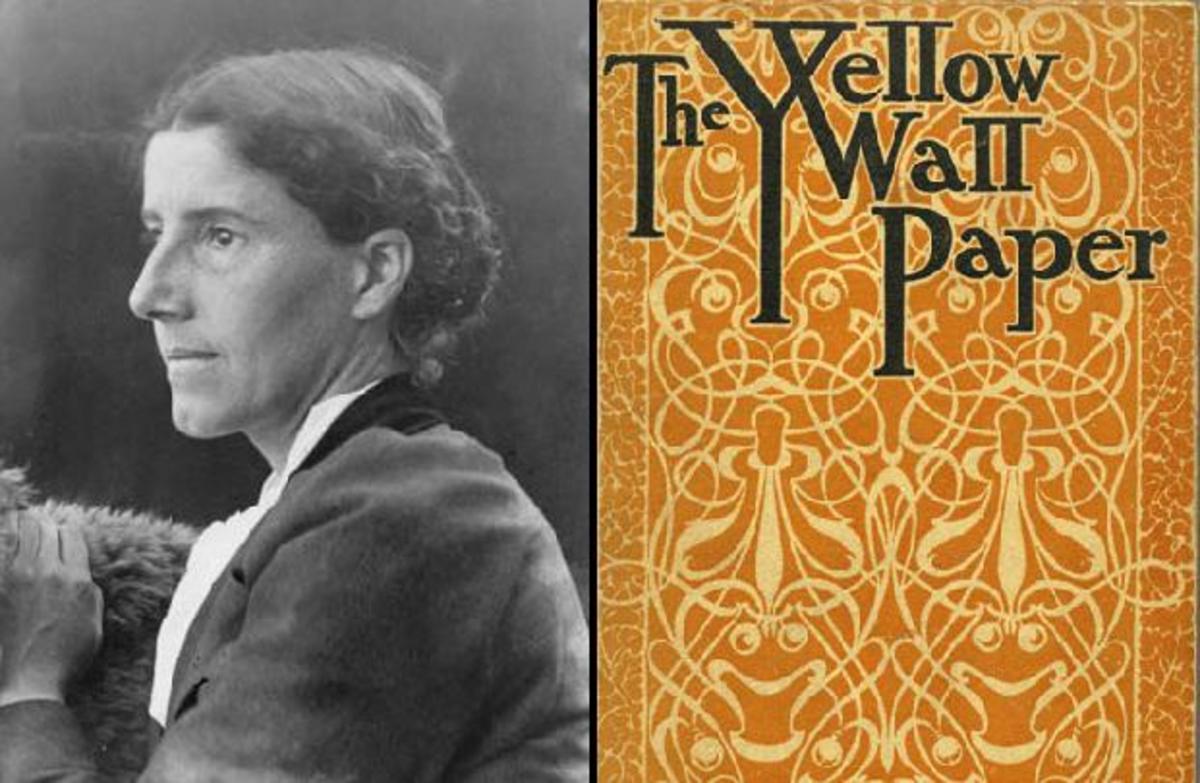
Left: Charlotte Perkins Gilman Right: "The Yellow Wallpaper" cover

More than you Think
Using a psychological approach in her literature, Charlotte Perkins Gilman added complexity to the main character in The Yellow Wallpaper
to show that mental illness is as multifaceted as the individual it
afflicts. She used her writing to expose the negative way mental illness
was perceived in society and literature’s propaganda that falsely
perpetuated these misrepresentations. Gilman used her story to advocate
for a better diagnosis of mental illnesses by recognizing that there is
more than one cause stemming from biological and societal factors.
Slut shaming is not a new idea.
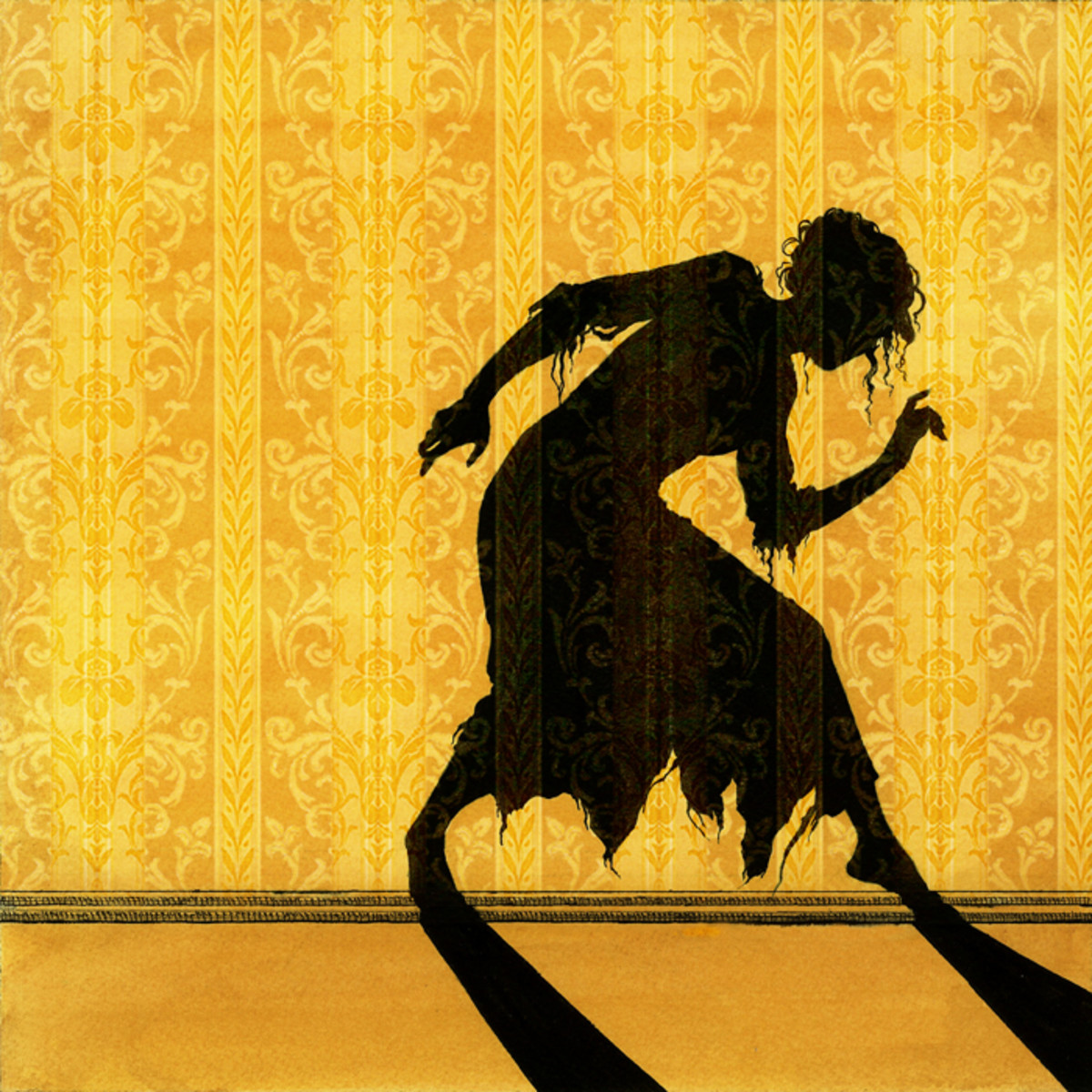
Discredit of Women's Mental Health
The
author was known to direct her literature to criticize the
“…patriarchal culture surrounding her” (Gilman 664) that she believed
degraded women, denying their natural desire for intellectuality and
creativity. This idea spilled into literature, portraying women as
hysteric with little provocation and they did not possess the ability
for autonomy or the need for personal lives. Not only in fiction but by
psychological experts such as Freud, who claimed that women “…were
sexually passive, engaging in sex only because they want children”
(McFatridge) all reinforced this view that women depended on men for all
measures of mental and physical health. The Yellow Wallpaper showed
how a patriarchal society and a male-dominated medical profession
contributed to women's mental illness with misdiagnoses and treatments
that endangered women’s health. Across literature, people with madness
were perceived to be mad for no reason other than their gender and that
psychosis is a disgusting, violent tendency.
One in the Same
Since The Yellow Wallpaper
is fiction based on real life experience, looking at the author and the
main character as one psyche is the most accurate way to understand
Gillman’s motives and characters. Gilman’s conflict between herself and
her societal obligations, as a wife and homebound mother, drove her to
seek what she hoped to be effective management of her difficulties. Her
adverse reactions to Dr. Mitchell’s rest cure qualified her to speak out
against the lack of understanding and treatments of mental disorders as
depicted by the narrator of her short story.
Literature rarely illustrated the causes of mental illness.

Psycosis: A Stereotype in Literature
The
wallpaper’s elements of humor and horror, like a sideshow, perpetuate
the idea that society views mental illness as grotesque. “The narrator
wants to interpret the pattern in the wallpaper, but it is difficult to
comprehend the grotesque” (Hume 483). By the end of the story, the
narrator becomes an animal-like figure gnawing on the bed and peeling
the wallpaper (Gilman 676). Representing the mentally ill in the
nineteenth century, the wallpaper is personified much like a
schizophrenia person: It irritates and provokes study, is lame and
uncertain, and commits suicide by destroying itself with unheard
contradictions. It’s repellent, revolting unclean, sickly, and hated.
(Gilman 667-668). As stated by Paul Corry of mental health charity
Rethink during his interview with BBC, "In the arts it is all too easy
to fall into the stereotype of portraying people with mental health
problems, and in particular schizophrenia, as dangerous and violent.”
(qtd. in Triggle). Marjorie Wallace, chief executive of mental health
charity Sane, explained to BBC that many authors such as Charles
Dickens, Charlotte Bronte, and Shakespeare had all written about
characters that struggled with madness but failed to tackle the reasons
of how they became that way. She suggests that possibly the most
damaging book addressing mental health has been Dr. Jekyll and Mr. Hyde
by Robert Louis Stevenson. She claims that people have, and still,
misunderstand the whole issue and "The idea that some can deliberately
change their personality like that, has made people think they are to
blame" (qtd. in Triggle).
Society or Biology?
Gilman used two approaches in The Yellow Wallpaper to
explain rational reasons for women’s psychosis by presenting biological
and societal factors. Marjorie Wallace specifically points out that in Jane Eyre,
for example, Mrs. Rochester is mad, “…but Bronte never bothers to dig
deeper and tell us why she is like she is and what she is going through”
(qtd. in Triggle). This is where many authors have lacked expertise by
either not experiencing psychosis first hand, or by medical authors who
have explained women’s mental illness as simply a biological
characteristic of the weaker sex with false medical claims that women’s
reproductive systems are to blame for hysteria. The Yellow Wallpaper addresses
the cause of mental illness, thus aiding Gillman in becoming “…a vital
force in the history of reform in the United States” (Gilman 664).
Women in 1800s suffered extreme repression.

Society
By
analyzing the narrator’s position in society as a submissive wife and
woman-child, Gilman presents the social aspect that contributes to
female repression so severe that it could aid in pushing a woman to
hysteria. To perpetuate the idea of a patriarchal society where women
are incapable of any medical understanding, Freud said of Karen Horney, a
psychoanalyst who broke away from Freudian theory; “We shall not be
very greatly surprised if a woman analyst, who has not been sufficiently
convinced of the intensity of her own wish for a penis, also fails to
attach the proper importance to that factor in her patients” (Schultz
& Schultz, 2009). The narrator’s husband, John, laughs at her when
she fancies a haunting in the estate, discrediting her imagination by
saying: “John laughs at me, of course, one expects that in marriage”.
She further accepts a degraded position as her husband “…scoffs openly
at any talk of things not to be felt and seen and put down in figures”
(Gilman 666). The accepted idea of women in society and marriage is one
that can easily create false assumptions of madness by women attempting
to express themselves creatively. Gilman’s idea of marriage and
motherhood represented "weakness and passivity" (Berman, 39).

Source
Biology
Gilman’s
second approach embodies the biological view of her illness. The fact
that Gilman herself recognized that having a child had pushed her into a
depression would point to postpartum psychosis with symptoms of
“…cognitive impairment and grossly disorganized behavior that represent a
complete change from previous functioning…that coincide with tremendous
hormonal shifts after delivery” (Sit). The chemical factors of major
mental illnesses were rarely consulted or even known during the time.
The word hysteria, derived from the Greek word for womb,
implied that this was solely a female affliction. Since many of the
illnesses women experienced were chalked up to being solely “female” in
nature, many psychologists and medical doctors did not see the need to
explore the biological or chemical causes of such illnesses. The
realization that chemicals within the body were the culprit to forms of
hysteria was acknowledged to a degree, but mostly written off as a
gender-related problem with no cure. “Women were more vulnerable to
mental illness because of instability in the female nervous and
reproductive systems” (Showalter). While realizing the fact that the
reproductive system has a hand in hysteria, the true cause was not
sought after. Gilman’s distain for submitting to patriarchal society
sickened her on the outside, but Gillman’s chemical imbalances after
pregnancy could have contributed to her depression. The narrator “…gets
unreasonably angry,” with her husband and attributes her emotions to her
“nervous condition” while experiencing spells of crying throughout her
time of rest (Gilman 667). Tied with recently having a baby, it is
reasonable to believe that a hormonal change has taken place causing
unrest and weakness in the narrator. Unfortunately the possibilities of
hormonal changes were not to be considered during this time. Gilman was a
head of her time, though not a doctor, by understanding that there was
more than one cause to such mental deterioration than simply so-called
female problems.

Defying the Doctor
With
fighting her role of mother and wife, and the whole of the female race
not being considered equal to men, many women who desired to live what
was considered a non-traditional role, sought help and were thrown back
into domestic life by being programmed to think they belong in this
position of domesticity. The rest cure, implemented by Dr. Weir
Mitchell, failed for Gilman and the narrator. Gilman rejected Mitchell's
advice and began writing. She immediately made gains toward recovery.
As Berman suggests in The Unrestful Cure, “Perhaps the rest
cure failed with Gilman because although Mitchell supported the idea of
motherhood, she did not: She was attempting to flee from the domestic
prison of the mother's world—the parasitic world of abject dependency
upon men, the depressing routine of endless drudgery, screaming babies”
(Berman 50). The rest cure locked her into the role of motherhood, which
she naturally detested, and gave her little hope of recovering, since
she realized that the cause of her suffering was in fact marriage and
motherhood.
Feminism
Gilman
suffered greatly from her depression and suffered even more from her
misdiagnoses. Like her narrator, Gilman needed an outlet to effectively
relate her experiences of gender inequality in the treatment of mental
illness. It was a way for her to speak her mind during a time when women
were targets of sexism, censorship, and oppression. Writing was
Gilman’s salvation, while in the short story was the narrator’s cause
for madness. Though the narrator wrote in secret, she was only able to
document her time spent in the nursery turned bedroom in fear of being
caught writing. Unfortunately, the bedroom in which she stayed resembled
more of a jail than a place of comfort or rest for healing with its
hideous, ripping wallpaper, bolted down bed, and bars on the windows.
This description of her quarters indicates her being forcibly locked up
with little option of stimulation and severe isolation with little to no
human contact, as John was away much of the time and he discouraged
visitors. The narrator even expressed interest to have the downstairs
room with roses and floral hangings but her husband denied her desire
“but John would not hear of it”. (Gilman 667) She recognized that
exercise, visitations, a pleasant atmosphere, and some work would help
her heal, and although writing was tiring, she found solace in it. The
narrator writes “…in secret in spite of them” and goes on to say that,
if found out, she would be met “with heavy opposition” (Gilman 666).

Repression and the Creative Mind
Without
creative expression or therapy, many people can struggle when dealing
with difficult emotions as seen in the narrator’s progression into
madness. Since Gilman was only allowed to have “but two hours a day
intellectual life”, was directed to “live as domestic a life as far as
possible,” and to “never touch pen, brush or pencil as long as [she]
lived” (Why I Wrote “The Yellow Wallpaper”) during the rest
cure, the repression forced the narrator to turn her emotions inward in a
self-destructive manner. Being directed to not give into her
imagination, story-telling, and fancies, the narrator was led to believe
that her “nervous condition” would spiral out of control (Gilman 669).
But in reality it was the denial of imagination that caused her madness
and hallucinations. The narrator was not able to “relieve the press of
ideas and rest me”(Gilman 669); which translates to repression of ideas
that would allow her to rest.

Source
Legitimacy and Backlash of the Mentally ill
This
kind of oppression was mandated by the male-controlled society that
Gilman lived in. In her story the narrator was treated like a child who,
in turn, craved to please her doctor husband in order to get well
according to the rest cure.But the narrator starts to realize her lack
of credibility and blatantly points her finger at her husband, blaming
him for her nonexistent recovery stating that “perhaps that is
one reason I do not get well faster”. The narrator suggests that doctors
are not capable of treating her because they are not looking at the
legitimacy of her disease. When the narrator says, “It is so hard to
talk to John about my case, because he is so wise” (Gilman 666 &
672), she was explaining that he would not listen to her about her
illness because of his arrogance in his position as a physician.
The narrator goes on to explain that John, like Dr. Mitchell did not believe that she was sick saying, “You see he does not believe I am sick!” and has only a “temporary nervous depression-a slight hysterical tendency…”(Gilman 666). In turn, the question begged to be answered is: Why would these doctors treat someone they didn’t even think was sick to begin with? Without the understanding of a mentally ill person’s perception of reality, it is not possible to find what may help them. Dr. Mitchell’s rest cure only served to create a lethargic, lazy patient too mentally inept to comprehend what they are going through in a high fat low stimulation regimen
The narrator goes on to explain that John, like Dr. Mitchell did not believe that she was sick saying, “You see he does not believe I am sick!” and has only a “temporary nervous depression-a slight hysterical tendency…”(Gilman 666). In turn, the question begged to be answered is: Why would these doctors treat someone they didn’t even think was sick to begin with? Without the understanding of a mentally ill person’s perception of reality, it is not possible to find what may help them. Dr. Mitchell’s rest cure only served to create a lethargic, lazy patient too mentally inept to comprehend what they are going through in a high fat low stimulation regimen
Causes Treatments, and Testimony
Gilman’s
story brought to light the negative depiction of mental illness, the
possibility of biological and societal causes, and the lack of viable
treatment options by qualified doctors who recognize depression-related
illnesses. She used this story to prove the legitimacy of psychosis with
first hand experiences and to rebuke false medical claims that women’s
reproductive systems are to blame for hysteria. She wrote The Yellow Wallpaper in response to Doctor Mitchell’s poor consideration of treatment for people like herself, suffering from unseen diseases.
Government Resources for Mental Health
- Home | MentalHealth.gov
U.S. government mental health information. This site explains the basics of mental health, myths and facts, treatment options, disorders, symptoms, and how to get mental health help.
Sources
Berman, Jeffrey. "The Unrestful Cure: Charlotte Perkins Gilman and 'The Yellow Wallpaper" In The Talking Cure: LiteraryRepresentations of Psychoanalysis. New York: New York University Press, 1985. Pp. 33-59.
Gilman, Charlotte Perkins. "Why I Wrote 'The Yellow Wallpaper.'." The Captive Imagination: A Casebook on "The Yellow Wallpaper,". Ed. Catherine Golden. New York: Feminist Press at the City University of New York, 1992. 51-53. Rpt. in Short Story Criticism. Ed. Janet Witalec. Vol. 62. Detroit: Gale, 2003. Literature Resource Center. Web. 20 Apr. 2014.
Sit, Dorothy, Anthony J. Rothschild, and Kathrine L. Wisner. "Journal of Women's Health." A Review of Postpartum Psychosis. N.p., 15 May 2006. Web. 15 Apr. 2014.
McFatridge, Kylie. "Freud." Psychological History of Women. N.p., n.d. Web. 20 Apr. 2014.
McMichael, George L., J. S. Leonard, and Shelley Fisher. Fishkin. "The Yellow Wallpaper." Anthology of American Literature. 10th ed. Vol. 2. Boston: Longman, 2011. 664+. Print.
Schultz, D. P. & Schultz, S. E. (2009). Theories of personality. Belmont, CA: Wadsworth.
Triggle, Nick. "Literature's Love Affair With the Mind." BBC News. BBC, 09 Oct. 2005. Web. 14 Apr. 2014.
-----
"The Yellow Wallpaper" (original title: "The Yellow Wall-paper. A Story") is a 6,000-word short story by the American writer Charlotte Perkins Gilman, first published in January 1892 in The New England Magazine.[1] It is regarded as an important early work of American feminist literature, illustrating attitudes in the 19th century toward women's health, both physical and mental.
Presented in the first person, the story is a collection of journal entries written by a woman whose physician husband (John) has rented an old mansion for the summer. Forgoing other rooms in the house, the couple moves into the upstairs nursery. As a form of treatment she is forbidden from working, and is encouraged to eat well and get plenty of exercise and air, so she can recuperate from what he calls a "temporary nervous depression – a slight hysterical tendency", a diagnosis common to women in that period.[2][3] She hides her journal from her husband and his sister the housekeeper, fearful of being reproached for overworking herself. The room's windows are barred to prevent children from climbing through them, and there is a gate across the top of the stairs, though she and her husband have access to the rest of the house and its adjoining estate.
The story depicts the effect of understimulation on the narrator's mental health and her descent into psychosis. With nothing to stimulate her, she becomes obsessed by the pattern and color of the wallpaper. "It is the strangest yellow, that wall-paper! It makes me think of all the yellow things I ever saw – not beautiful ones like buttercups, but old foul, bad yellow things. But there is something else about that paper – the smell! ... The only thing I can think of that it is like is the color of the paper! A yellow smell."[4]
In the end, she imagines there are women creeping around behind the patterns of the wallpaper and comes to believe she is one of them. She locks herself in the room, now the only place she feels safe, refusing to leave when the summer rental is up. "For outside you have to creep on the ground, and everything is green instead of yellow. But here I can creep smoothly on the floor, and my shoulder just fits in that long smooch around the wall, so I cannot lose my way."[5]
The narrator devotes many journal entries to describing the wallpaper in the room – its "yellow" smell, its "breakneck" pattern, the missing patches, and the way it leaves yellow smears on the skin and clothing of anyone who touches it. She describes how the longer one stays in the bedroom, the more the wallpaper appears to mutate, especially in the moonlight. With no stimulus other than the wallpaper, the pattern and designs become increasingly intriguing to the narrator. She soon begins to see a figure in the design, and eventually comes to believe that a woman is creeping on all fours behind the pattern. Believing she must try to free the woman in the wallpaper, the woman begins to strip the remaining paper off the wall.
On the last day of summer, she locks herself in her room to strip the remains of the wallpaper. When John arrives home, she refuses to unlock the door. When he returns with the key, he finds her creeping around the room, circling the walls and touching the wallpaper. She exclaims, "I've got out at last,...in spite of you and Jane", and her husband faints as she continues to circle the room, stepping over his inert body each time she passes.
Gilman used her writing to explore the role of women in America at
the time. She explored issues such as the lack of a life outside the
home and the oppressive forces of the patriarchal society. Through her
work Gilman paved the way for writers such as Alice Walker and Sylvia Plath.[6]
In "The Yellow Wallpaper" Gilman portrays the narrator's insanity as a way to protest the medical and professional oppression against women at the time. While under the impression that husbands and male doctors were acting with their best interests in mind, women were depicted as mentally weak and fragile. At the time women’s rights advocates believed that the outbreak of women being diagnosed as mentally ill was the manifestation of their setbacks regarding the roles they were allowed to play in a male-dominated society. Women were even discouraged from writing, because their writing would ultimately create an identity and become a form of defiance for them. Gilman realized that writing became one of the only forms of existence for women at a time where they had very few rights.[6]
Gilman explained that the idea for the story originated in her own experience as a patient: "the real purpose of the story was to reach Dr. S. Weir Mitchell, and convince him of the error of his ways".[7] She had suffered years of depression and consulted a well-known specialist physician who prescribed a "rest cure" which required her to "live as domestic a life as possible". She was forbidden to touch pen, pencil, or brush, and was allowed only two hours of mental stimulation a day.
After three months and almost desperate, Gilman decided to contravene her diagnosis and started to work again. After realizing how close she had come to complete mental breakdown, she wrote "The Yellow Wallpaper" with additions and exaggerations to illustrate her own misdiagnosis complaint. She sent a copy to Mitchell but never received a response.
She added that "The Yellow Wallpaper" was "not intended to drive people crazy, but to save people from being driven crazy, and it worked". Gilman claimed that many years later she learned that Mitchell had changed his treatment methods, but literary historian Julie Bates Dock has discredited this. Mitchell continued his methods, and as late as 1908 – 16 years after "The Yellow Wallpaper" was published – was interested in creating entire hospitals devoted to the "rest cure" so that his treatments would be more widely accessible.[8]
Feminist critics focus on the degree of Defeat at the end of the story. While some claim the narrator slipped into insanity, others see the ending as a woman's assertion of agency in a marriage in which she felt trapped.[11] The emphasis on reading and writing as gendered practices also illustrated the importance of the wallpaper. If the narrator were allowed neither to write in her journal nor to read, she would begin to "read" the wallpaper until she found the escape she was looking for. Through seeing the women in the wallpaper, the narrator realizes that she could not live her life locked up behind bars. At the end of the story, as her husband laughs on the floor unconscious, she flys over him, symbolically slapping over him. This is interpreted as a draw over her husband, at the expense of her sanity.
Susan S. Lanser in her article "Feminist Criticism ‘The Yellow Wallpaper’, and the Politics of Color in America" praises contemporary feminism and its role in changing the study and the interpretation of literature. The Yellow Wallpaper was one of many books that were lost because of an ideology that determined the works' content to be disturbing or offensive. Critics such as the editor of the Atlantic Monthly rejected the short story because "[he] could not forgive [himself] if [he] made others as miserable as [he] made [himself]." Lanser argues that the same argument of devastation and misery can be said about the work of Edgar Allan Poe, but his work is still printed and studied by academics.[12]
The Yellow Wallpaper provided feminists the tools on how to interpret literature in different ways. Lanser says the short story was a " particularly congenial medium for such a re-vision...because the narrator herself engages in a form of feminist interpretation when she tries to read the paper on her wall".[12] The narrator in the story is trying to find a single meaning in the wallpaper. At first she focuses on contradictory style of the wallpaper: it is "flamboyant" while also "dull", "pronounced" yet also "lame" and "uncertain" (p. 13). She takes into account the patterns and tries to geometrically organize them, but she is further confused. The wallpaper changes colors when it reflects light and emits a distinct odor which Jane cannot recognize (p. 25). At night the narrator is able to see a woman behind bars within the complicated design of the wallpaper. Lanser argues that Jane was able to find "a space of text on which she can locate whatever self-projection".[12] Lanser creates a relationship between the narrator and the reader. Just like the narrator as a reader, when one comes into contact with a confusing and complicated text, one tries to find one single meaning. "How we were taught to read" as Lanser puts it, is why a reader cannot fully comprehend the text.[12] The patriarchal ideology has kept many scholars from being able to interpret and appreciate novels such as "The Yellow Wallpaper". Thanks to feminist criticism "The Yellow Wallpaper" has become a fundamental reading in the standard curriculum. Feminists have made a great contribution to the study of literature but, according to Lanser, are falling short because "we acknowledge the participation of women writers and readers in dominant patterns of thought and social practice then perhaps our own patterns must also be deconstructed if we are to recover meanings still hidden or overlooked.[12]
Martha J. Cutter in her article "The Writer as Doctor: New Models of Medical Discourses in Charlotte Perkins Gilman's Later Fiction" discusses how in many of Charlotte Perkins Gilman's works she addresses this "struggle in which a male-dominated medical establishment attempts to silence women" (Cutter 1). Gilman's works challenge the social construction of women in patriarchal medical discourse by displaying women as "silent, powerless, and passive" who refuse treatment. At the time in which her works take place, between 1840 and 1890, women were exceedingly defined as lesser than—sickly and weak. In this time period it was thought that "hysteria" (a disease stereotypically more common in women) was a result of too much education. It was understood that women who spent time in college or studying were over-stimulating their brains and consequently leading themselves into states of hysteria. In fact, many of the diseases recognized in women were seen as the result of a lack of self-control or self-rule. Different physicians argued that a physician must "assume a tone of authority" and that the idea of a "cured" woman is one who is "subdued, docile, silent, and above all subject to the will and voice of the physician" (Cutter 3). A hysterical woman is one who craves power and in order for her to be treated for her hysteria, she must submit to her physician whose role is to undermine her desires. Often women were prescribed bed rest as a form of treatment, which was meant to "tame" them and basically keep them imprisoned. Treatments such as this were a way of ridding women of rebelliousness and forcing them to conform to social roles. In her works Gilman highlights that the harm caused by these types of treatments for woman i.e. "the rest cure" has to do with the way in which her voice is silenced. Paula Treichler explains "In this story diagnosis 'is powerful and public...It is a male voice that...imposes controls on the female narrator and dictates how she is to perceive and talk about the world.' Diagnosis covertly functions to empower the male physician's voice and disempower the female patient's". The narrator in "The Yellow Wallpaper" is not allowed to participate in her own treatment or diagnosis and is completely forced to succumb to everything in which her doctor and in this particular story, her husband, says. The male voice is the one in which forces controls on the female and decides how she is allowed to perceive and speak about the world around her.
Helen Lefkowitz Horowitz, in her book Wild Unrest: Charlotte Perkins Gilman and the Making of "The Yellow Wall-Paper", concludes that "the story was a cri de coeur against [Gilman's first husband, artist Charles Walter] Stetson and the traditional marriage he had demanded." Gilman was attempting to deflect blame to protect Gilman's daughter Katharine and her step-mother, Gilman's friend Grace Channing.[16]
Anglican Archbishop Peter Carnley used the story as a reference and a metaphor for the situation of women in the church in his sermon at the ordination of the first women priests in Australia on 7 March 1992 in St George's Cathedral, Perth.[17]
Sari Edelstein has argued that The Yellow Wallpaper is an allegory for Gilman's hatred of the emerging yellow journalism. Having created The Forerunner in November 1909, Gilman made it clear she wished the press to be more insightful and not rely upon exaggerated stories and flashy headlines. Gilman was often scandalised in the media and resented the sensationalism of the media. The relationship between the narrator and the wallpaper within the story parallels Gilman's relationship to the press. The narrator describes the wallpaper as having "sprawling flamboyant patterns committing every artistic sin". Edelstein argues that given Gilman’s distaste for the Yellow Press, this can also be seen as a description of tabloid newspapers of the day.[18]
In Paula A. Treichler's article "Escaping the Sentence: Diagnosis and Discourse in 'The Yellow Wallpaper'", she places her focus on the relationship portrayed in the short story between women and writing. Rather than write about the feminist themes which view the wallpaper as something along the lines of "...the 'pattern' which underlies sexual inequality, the external manifestation of neurasthenia, the narrator's unconscious, the narrator's situation within patriarchy," Treichler instead explains that the wallpaper can be a symbol to represent discourse and the fact that the narrator is alienated from the world in which she previously could somewhat express herself. Treichler illustrates that through this discussion of language and writing, in the story Charlotte Perkins Gilman is defying the "...sentence that the structure of patriarchal language imposes." While Treichler accepts the legitimacy of strictly feminist claims, she writes that a closer look at the text suggests that the wallpaper could be interpreted as women's language and discourse, and the woman found in the wallpaper could be the "...representation of women that becomes possible only after women obtain the right to speak." In making this claim, it suggests that the new struggle found within the text is between two forms of writing; one rather old and traditional, and the other new and exciting. This is supported in the fact that John, the narrator's husband, does not like his wife to write anything, which is the reason her journal containing the story is kept a secret and thus is known only by the narrator and reader. A look at the text shows that as the relationship between the narrator and the wallpaper grows stronger, so too does her language in her journal as she begins to increasingly write of her frustration and desperation.[19]
Stetson, Charlotte Perkins (January 1892). "The Yellow Wall-paper. A Story". The New England Magazine 11 (5,).
Gilman 1892, p. 1
Treichler 1984, pp. 61–77
Gilman 1892, p. 11.
Gilman 1892, p. 15.
Quawas, Rula (2006). "A New Woman's Journey Into Insanity: Descent and Return in The Yellow Wallpaper". Journal of the Australasian Universities Modern Language Association (ProQuest Research Library (online, Oct. 2012)): 35+.
Thrailkill 2002, p. 528.
Gilman, Charlotte Perkins (October 1913). "Why I Wrote the Yellow Wallpaper". The Forerunner.
Ford 1985, pp. 309–314.
Thomas 1997.
Hochman, p. 2002, pp. 89–110.
Lanser, Susan (1989). "Feminist Criticism ‘The Yellow Wallpaper’, and the Politics of Color in America" (PDF). Feminist Studies 15 (3): 415–441. doi:10.2307/3177938.
See, for example, Johnson 1989.
Ryan 1988, p. 56.
Lovecraft, H. P. (1927). "Supernatural Horror in Literature". The Recluse (The Recluse Press).
Publishers Weekly. October 4, 2010, p. 38.
Carnley, Peter (2001) pp. 85–92
Sari Edelstein, "Charlotte Perkins Gilman and the Yellow Newspaper" Legacy 24, no. 1 (May 2007): 72–92.
Treichler. "Escaping the Sentence: Diagnosis and Discourse in 'The Yellow Wallpaper'".
"Radio Tales - Horror". Radio Tales. Retrieved 1 September 2015.
"BBC Radio 4 - Fear on Four, The Yellow Wallpaper". BBC. 24 May 2008. Retrieved 1 September 2015.>
"LJ Media Reviews: October 1, 2015". Library Journal Reviews. Retrieved 2016-03-21.
Stenberg, Amandla (Director) (2014). The Yellow Wallpaper.
Ahari, Kourosh (Director) (2016). The Yellow Wallpaper.
"1.5 (The Rules of the Game 2015)". Julia Dogra-Brazell. Retrieved 2016-01-16.
"The Yellow Wallpaper". Rain City Projects.
"Plays: History: 2003". Theater Schmeater.
"Best of the Fringe" award". Seattle Times.
"The Yellow Room (panel discussion)". Charlotte Perkins Gilman Society. May 2010.
"The Yellow Room (panel discussion)". American Literature Association. May 2010.
"Behind the Wallpaper". Rummage Theatre. Dorset, England.
"Eveanne Eason in The Yellow Wallpaper".
"The Yellow Wallpaper". A Company of Players.
"The Yellow Wallpaper". 2014 Hamilton Fringe Festival.
Hurwitt, Robert (16 May 2015). "‘The Yellow Wallpaper’ at Berkeley City Club". San Francisco Chronicle. Retrieved 12 October 2015.
"Stage Premiere of THE YELLOW WALLPAPER Up Next at Central Works, 5/16-6/21". 13 April 2015. Retrieved 12 October 2015.
Edevane, Gillian (3 June 2015). "The Writhing on the Wall". East Bay Express. Retrieved 12 October 2015.
Gilman, Charlotte Perkins. "Why I Wrote 'The Yellow Wallpaper.'." The Captive Imagination: A Casebook on "The Yellow Wallpaper,". Ed. Catherine Golden. New York: Feminist Press at the City University of New York, 1992. 51-53. Rpt. in Short Story Criticism. Ed. Janet Witalec. Vol. 62. Detroit: Gale, 2003. Literature Resource Center. Web. 20 Apr. 2014.
Sit, Dorothy, Anthony J. Rothschild, and Kathrine L. Wisner. "Journal of Women's Health." A Review of Postpartum Psychosis. N.p., 15 May 2006. Web. 15 Apr. 2014.
McFatridge, Kylie. "Freud." Psychological History of Women. N.p., n.d. Web. 20 Apr. 2014.
McMichael, George L., J. S. Leonard, and Shelley Fisher. Fishkin. "The Yellow Wallpaper." Anthology of American Literature. 10th ed. Vol. 2. Boston: Longman, 2011. 664+. Print.
Schultz, D. P. & Schultz, S. E. (2009). Theories of personality. Belmont, CA: Wadsworth.
Triggle, Nick. "Literature's Love Affair With the Mind." BBC News. BBC, 09 Oct. 2005. Web. 14 Apr. 2014.
-----
| "The Yellow Wallpaper" | |
|---|---|

1899 edition cover
|
|
| Author | Charlotte Perkins Gilman |
| Country | United States |
| Language | English |
| Genre(s) | short story, captivity narrative dealing with themes of feminism, women's health and mental illness |
| Publisher | The New England Magazine |
| Publication date | 1892 |
Presented in the first person, the story is a collection of journal entries written by a woman whose physician husband (John) has rented an old mansion for the summer. Forgoing other rooms in the house, the couple moves into the upstairs nursery. As a form of treatment she is forbidden from working, and is encouraged to eat well and get plenty of exercise and air, so she can recuperate from what he calls a "temporary nervous depression – a slight hysterical tendency", a diagnosis common to women in that period.[2][3] She hides her journal from her husband and his sister the housekeeper, fearful of being reproached for overworking herself. The room's windows are barred to prevent children from climbing through them, and there is a gate across the top of the stairs, though she and her husband have access to the rest of the house and its adjoining estate.
The story depicts the effect of understimulation on the narrator's mental health and her descent into psychosis. With nothing to stimulate her, she becomes obsessed by the pattern and color of the wallpaper. "It is the strangest yellow, that wall-paper! It makes me think of all the yellow things I ever saw – not beautiful ones like buttercups, but old foul, bad yellow things. But there is something else about that paper – the smell! ... The only thing I can think of that it is like is the color of the paper! A yellow smell."[4]
In the end, she imagines there are women creeping around behind the patterns of the wallpaper and comes to believe she is one of them. She locks herself in the room, now the only place she feels safe, refusing to leave when the summer rental is up. "For outside you have to creep on the ground, and everything is green instead of yellow. But here I can creep smoothly on the floor, and my shoulder just fits in that long smooch around the wall, so I cannot lose my way."[5]
Contents
Plot synopsis
The story details the descent of a young woman into madness. Her supportive, though misunderstanding husband, John, believes it is in her best interests to go on a rest cure after the birth of their child. The family spends the summer at a colonial mansion that has, in the narrator's words, "something queer about it". She and her husband move into an upstairs room that she assumes was once a nursery, having it serve as their bedroom due to its multitude of windows, which provide the air so needed in her recovery. In addition to the couple, John's sister Jennie is present; she serves as their housekeeper. Like most nurseries at the time the windows are barred, the wallpaper has been torn, and the floor is scratched. The narrator attributes all these to children, as most of the damage is isolated to their reach. Ultimately, though, the reader is left unsure as to the source of the room's damage.The narrator devotes many journal entries to describing the wallpaper in the room – its "yellow" smell, its "breakneck" pattern, the missing patches, and the way it leaves yellow smears on the skin and clothing of anyone who touches it. She describes how the longer one stays in the bedroom, the more the wallpaper appears to mutate, especially in the moonlight. With no stimulus other than the wallpaper, the pattern and designs become increasingly intriguing to the narrator. She soon begins to see a figure in the design, and eventually comes to believe that a woman is creeping on all fours behind the pattern. Believing she must try to free the woman in the wallpaper, the woman begins to strip the remaining paper off the wall.
On the last day of summer, she locks herself in her room to strip the remains of the wallpaper. When John arrives home, she refuses to unlock the door. When he returns with the key, he finds her creeping around the room, circling the walls and touching the wallpaper. She exclaims, "I've got out at last,...in spite of you and Jane", and her husband faints as she continues to circle the room, stepping over his inert body each time she passes.
Interpretation
Gilman's interpretation

Charlotte Perkins Gilman circa 1900
In "The Yellow Wallpaper" Gilman portrays the narrator's insanity as a way to protest the medical and professional oppression against women at the time. While under the impression that husbands and male doctors were acting with their best interests in mind, women were depicted as mentally weak and fragile. At the time women’s rights advocates believed that the outbreak of women being diagnosed as mentally ill was the manifestation of their setbacks regarding the roles they were allowed to play in a male-dominated society. Women were even discouraged from writing, because their writing would ultimately create an identity and become a form of defiance for them. Gilman realized that writing became one of the only forms of existence for women at a time where they had very few rights.[6]
Gilman explained that the idea for the story originated in her own experience as a patient: "the real purpose of the story was to reach Dr. S. Weir Mitchell, and convince him of the error of his ways".[7] She had suffered years of depression and consulted a well-known specialist physician who prescribed a "rest cure" which required her to "live as domestic a life as possible". She was forbidden to touch pen, pencil, or brush, and was allowed only two hours of mental stimulation a day.
After three months and almost desperate, Gilman decided to contravene her diagnosis and started to work again. After realizing how close she had come to complete mental breakdown, she wrote "The Yellow Wallpaper" with additions and exaggerations to illustrate her own misdiagnosis complaint. She sent a copy to Mitchell but never received a response.
She added that "The Yellow Wallpaper" was "not intended to drive people crazy, but to save people from being driven crazy, and it worked". Gilman claimed that many years later she learned that Mitchell had changed his treatment methods, but literary historian Julie Bates Dock has discredited this. Mitchell continued his methods, and as late as 1908 – 16 years after "The Yellow Wallpaper" was published – was interested in creating entire hospitals devoted to the "rest cure" so that his treatments would be more widely accessible.[8]
Feminist interpretation
This story has been interpreted by feminist critics as a condemnation of the androcentric hegemony of the 19th-century medical profession.[9] The narrator's suggestions about her recuperation (that she should work instead of rest, engage with society instead of remaining isolated, attempt to be a mother instead of being separated entirely from her child, etc.) are dismissed out of hand using language that stereotypes her as irrational and, therefore, unqualified to offer ideas about her own condition. This interpretation draws on the concept of the "domestic sphere" that women were held in during this period.[10]Feminist critics focus on the degree of Defeat at the end of the story. While some claim the narrator slipped into insanity, others see the ending as a woman's assertion of agency in a marriage in which she felt trapped.[11] The emphasis on reading and writing as gendered practices also illustrated the importance of the wallpaper. If the narrator were allowed neither to write in her journal nor to read, she would begin to "read" the wallpaper until she found the escape she was looking for. Through seeing the women in the wallpaper, the narrator realizes that she could not live her life locked up behind bars. At the end of the story, as her husband laughs on the floor unconscious, she flys over him, symbolically slapping over him. This is interpreted as a draw over her husband, at the expense of her sanity.
Susan S. Lanser in her article "Feminist Criticism ‘The Yellow Wallpaper’, and the Politics of Color in America" praises contemporary feminism and its role in changing the study and the interpretation of literature. The Yellow Wallpaper was one of many books that were lost because of an ideology that determined the works' content to be disturbing or offensive. Critics such as the editor of the Atlantic Monthly rejected the short story because "[he] could not forgive [himself] if [he] made others as miserable as [he] made [himself]." Lanser argues that the same argument of devastation and misery can be said about the work of Edgar Allan Poe, but his work is still printed and studied by academics.[12]
The Yellow Wallpaper provided feminists the tools on how to interpret literature in different ways. Lanser says the short story was a " particularly congenial medium for such a re-vision...because the narrator herself engages in a form of feminist interpretation when she tries to read the paper on her wall".[12] The narrator in the story is trying to find a single meaning in the wallpaper. At first she focuses on contradictory style of the wallpaper: it is "flamboyant" while also "dull", "pronounced" yet also "lame" and "uncertain" (p. 13). She takes into account the patterns and tries to geometrically organize them, but she is further confused. The wallpaper changes colors when it reflects light and emits a distinct odor which Jane cannot recognize (p. 25). At night the narrator is able to see a woman behind bars within the complicated design of the wallpaper. Lanser argues that Jane was able to find "a space of text on which she can locate whatever self-projection".[12] Lanser creates a relationship between the narrator and the reader. Just like the narrator as a reader, when one comes into contact with a confusing and complicated text, one tries to find one single meaning. "How we were taught to read" as Lanser puts it, is why a reader cannot fully comprehend the text.[12] The patriarchal ideology has kept many scholars from being able to interpret and appreciate novels such as "The Yellow Wallpaper". Thanks to feminist criticism "The Yellow Wallpaper" has become a fundamental reading in the standard curriculum. Feminists have made a great contribution to the study of literature but, according to Lanser, are falling short because "we acknowledge the participation of women writers and readers in dominant patterns of thought and social practice then perhaps our own patterns must also be deconstructed if we are to recover meanings still hidden or overlooked.[12]
Martha J. Cutter in her article "The Writer as Doctor: New Models of Medical Discourses in Charlotte Perkins Gilman's Later Fiction" discusses how in many of Charlotte Perkins Gilman's works she addresses this "struggle in which a male-dominated medical establishment attempts to silence women" (Cutter 1). Gilman's works challenge the social construction of women in patriarchal medical discourse by displaying women as "silent, powerless, and passive" who refuse treatment. At the time in which her works take place, between 1840 and 1890, women were exceedingly defined as lesser than—sickly and weak. In this time period it was thought that "hysteria" (a disease stereotypically more common in women) was a result of too much education. It was understood that women who spent time in college or studying were over-stimulating their brains and consequently leading themselves into states of hysteria. In fact, many of the diseases recognized in women were seen as the result of a lack of self-control or self-rule. Different physicians argued that a physician must "assume a tone of authority" and that the idea of a "cured" woman is one who is "subdued, docile, silent, and above all subject to the will and voice of the physician" (Cutter 3). A hysterical woman is one who craves power and in order for her to be treated for her hysteria, she must submit to her physician whose role is to undermine her desires. Often women were prescribed bed rest as a form of treatment, which was meant to "tame" them and basically keep them imprisoned. Treatments such as this were a way of ridding women of rebelliousness and forcing them to conform to social roles. In her works Gilman highlights that the harm caused by these types of treatments for woman i.e. "the rest cure" has to do with the way in which her voice is silenced. Paula Treichler explains "In this story diagnosis 'is powerful and public...It is a male voice that...imposes controls on the female narrator and dictates how she is to perceive and talk about the world.' Diagnosis covertly functions to empower the male physician's voice and disempower the female patient's". The narrator in "The Yellow Wallpaper" is not allowed to participate in her own treatment or diagnosis and is completely forced to succumb to everything in which her doctor and in this particular story, her husband, says. The male voice is the one in which forces controls on the female and decides how she is allowed to perceive and speak about the world around her.
Other interpretations
"The Yellow Wallpaper" sometimes is referred to as an example of Gothic literature for its treatment of madness and powerlessness.[13] Alan Ryan, for example, introduced the story by writing: "quite apart from its origins [it] is one of the finest, and strongest, tales of horror ever written. It may be a ghost story. Worse yet, it may not."[14] Pioneering horror author H. P. Lovecraft writes in his essay Supernatural Horror in Literature (1927) that "The Yellow Wall Paper rises to a classic level in subtly delineating the madness which crawls over a woman dwelling in the hideously papered room where a madwoman was once confined." [15]Helen Lefkowitz Horowitz, in her book Wild Unrest: Charlotte Perkins Gilman and the Making of "The Yellow Wall-Paper", concludes that "the story was a cri de coeur against [Gilman's first husband, artist Charles Walter] Stetson and the traditional marriage he had demanded." Gilman was attempting to deflect blame to protect Gilman's daughter Katharine and her step-mother, Gilman's friend Grace Channing.[16]
Anglican Archbishop Peter Carnley used the story as a reference and a metaphor for the situation of women in the church in his sermon at the ordination of the first women priests in Australia on 7 March 1992 in St George's Cathedral, Perth.[17]
Sari Edelstein has argued that The Yellow Wallpaper is an allegory for Gilman's hatred of the emerging yellow journalism. Having created The Forerunner in November 1909, Gilman made it clear she wished the press to be more insightful and not rely upon exaggerated stories and flashy headlines. Gilman was often scandalised in the media and resented the sensationalism of the media. The relationship between the narrator and the wallpaper within the story parallels Gilman's relationship to the press. The narrator describes the wallpaper as having "sprawling flamboyant patterns committing every artistic sin". Edelstein argues that given Gilman’s distaste for the Yellow Press, this can also be seen as a description of tabloid newspapers of the day.[18]
In Paula A. Treichler's article "Escaping the Sentence: Diagnosis and Discourse in 'The Yellow Wallpaper'", she places her focus on the relationship portrayed in the short story between women and writing. Rather than write about the feminist themes which view the wallpaper as something along the lines of "...the 'pattern' which underlies sexual inequality, the external manifestation of neurasthenia, the narrator's unconscious, the narrator's situation within patriarchy," Treichler instead explains that the wallpaper can be a symbol to represent discourse and the fact that the narrator is alienated from the world in which she previously could somewhat express herself. Treichler illustrates that through this discussion of language and writing, in the story Charlotte Perkins Gilman is defying the "...sentence that the structure of patriarchal language imposes." While Treichler accepts the legitimacy of strictly feminist claims, she writes that a closer look at the text suggests that the wallpaper could be interpreted as women's language and discourse, and the woman found in the wallpaper could be the "...representation of women that becomes possible only after women obtain the right to speak." In making this claim, it suggests that the new struggle found within the text is between two forms of writing; one rather old and traditional, and the other new and exciting. This is supported in the fact that John, the narrator's husband, does not like his wife to write anything, which is the reason her journal containing the story is kept a secret and thus is known only by the narrator and reader. A look at the text shows that as the relationship between the narrator and the wallpaper grows stronger, so too does her language in her journal as she begins to increasingly write of her frustration and desperation.[19]
Media adaptations
Audio plays
- Agnes Moorehead performed a version twice, in 1948 and 1957, on the radio program Suspense.
- An audio book of "The Yellow Wallpaper" (1997) was produced by Durkin Hayes and read by Winifred Phillips. This Radio Tales version can also be heard on Sonic Theater on XM Radio.[20]
- BBC Radio modified and dramatized the story for the series Fear on Four, starring Anna Massey.[21]
Film
- In 1989, the story was adapted into a film produced by the British Broadcasting Corporation (BBC) for Masterpiece Theatre. It was adapted by Maggie Wadey and directed by John Clive.[citation needed]
- In 2011, the story was loosely adapted into a film by Logan Thomas.[22] The DVD was released in 2015.
- In 2014, Amandla Stenberg directed a short film based on the story.[23]
- In 2016, Kourosh Ahari directed a feature film based on the original story. The adapted screenplay was written by Amy Liz Roberts.[24]
- British artist Julia Dogra-Brazell's short experimental film, The Rules of the Game (2015), also found inspiration in this text.[25]
Television
- Pretty Little Liars uses the original book cover as a wallpaper design in Aria Montgomerys bedroom.
- An episode of The Twilight Zone ("Something in the Walls" (1989)) is a variation on Gilman's story, in which a woman commits herself to a mental institution and insists on plain white walls and no patterns within her hospital room, after having seen faces in the patterns of her bedroom's yellow wallpaper and hearing ominous voices from those faces.
- American Horror Story season 1 references "The Yellow Wallpaper" in the eighth episode.
Theater
- Heather Newman scripted and directed an adaptation of the original short story, as part of the 2003 season at Theater Schmeater, in Seattle, Washington.[26][27] This adaptation won the 2003 Seattle Times "Best of the Fringe" award,[28] and was also produced in 2005 at Tarrant County College by Dr. Judith Gallagher, and directed by Melinda Benton-Muller. In May 2010, Benton-Muller and Dr. Gallagher spoke on a panel about this adaptation at the American Literature Association, with members of the ALA and the Charlotte Perkins Gilman Society.[29][30]
- Rummage Theatre researched, wrote and directed an hour long play called Behind the Wallpaper (first performed at The Bay Theatre in 2014). The play was inspired by "The Yellow Wallpaper", but focuses on exploring postnatal depression and postpartum psychosis in the present day and uses shadow work cast behind wallpaper to represent the "Shadow Woman" which new mother, Julie, sees as part of her psychosis. The play is touring Dorset in 2014/2015.[31]
- A one-woman piece featuring the audience as the figures behind the paper. Eve Eason performed a short adaptation taken directly from the text. It was staged at the Weiner Theater in Memphis in September, 2014. [32]
- A Company of Players presented a stage adaptation of the original short story, written and directed by Kristi Boulton, at the 2014 Hamilton Fringe Festival] in Ontario, Canada. This production was well received by critics and won a "Best of Fringe" award.[33][34]
- Central Works of Berkeley presented a one-woman show consisting of the text of the play recited and performed by Elena Wright and with a TBA-nominated score written and performed by violinist Cybele D'Ambrosio in 2015.[35][36][37]
- Portland, Oregon-based Coho Productions staged an adaptation written by Sue Mach in early 2016, which integrated "expressionistic audio, visual and movement interludes with the haunting literary text." The stage adaptation was co-produced and conceived by Grace Carter, who also portrays the primary character, Charlotte. The play was directed by Philip Cuomo.[38]
References
Bibliography
- Barth, Melissa E. "The Yellow Wallpaper." Masterplots II: Short Stories Series. Frank N. Magill. California: Salem Press Inc., 1996. 4331–4333. 10 vols.
- Carnley, Peter (2001). The Yellow Wallpaper and other sermons HarperCollins, Sydney ISBN 1-86371-799-4
- Ford, Karen (Autumn 1985). ""The Yellow Wallpaper" and Women's Discourse" (PDF). Tulsa Studies in Women's Literature (University of Tulsa) 4 (2): 309–314. JSTOR 463709.
- Gilman, Charlotte Perkins & Phillips, Robert (Editor_ (1989). "The Yellow Wallpaper". The Omnibus of 20th Century Ghost Stories (New York: Carrol and Graf Publishers Inc.).
- Gilman, Charlotte Perkins (1892). The Yellow Wallpaper (1997 ed.). Dover Publications.
- Hochman, Barbara (2002). The Reading Habit and "The Yellow Wallpaper". Duke University Press.
- Johnson, Greg (Fall 1989). "Gilman's Gothic Allegory: Rage and Redemption in The Yellow Wallpaper". Studies in Short Fiction 26 (4): 521–30.
- Ryan, Alan (1988). Haunting Women. New York: Avon Books. ISBN 978-0-380-89881-7.
- Thomas, Deborah. "The Changing Role of Womanhood: From True Woman to New Woman in Charlotte Perkins Gilman's "The Yellow Wallpaper"". Retrieved September 14, 2012.
- Thrailkill, Jane F. (Summer 2002). "Doctoring "The Yellow Wallpaper"". ELH 69 (2): 525–566. doi:10.1353/elh.2002.0019.
- Treichler, Paula A. (1984). "Escaping the Sentence: Diagnosis and Discourse in 'The Yellow Wallpaper'". Tulsa Studies in Women's Literature. pp. 61–75.
- Weinstein, Lee. ""The Yellow Wallpaper: A Supernatural Interpretation." Studies in Weird Fiction 4 (Fall 1988), 23–25.
Further reading
- EDSITEment's lesson plan Charlotte Perkins Gilman's Yellow Wall-Paper
- The Yellow Wallpaper at Project Gutenberg.
- Full Text of The Yellow Wallpaper, retrieved January 22, 2008.
- The full text of "The Yellow Wallpaper" at the CUNY Library
- Books That Grow leveled book
- Gilman, Charlotte Perkins. "Why I wrote The Yellow Wallpaper", The Forerunner, October 1913, accessed November 15, 2009.
- The Yellow Wallpaper, audio, CBS radio, 1948.
- The Yellow Wallpaper at the Internet Movie Database
- The Yellow Wallpaper A 2006 film inspired by the short story that relies on the gothic/horror interpretation.
- Bak, John S. (1994). "Escaping the Jaundiced Eye: Foucauldian Panopticism in Charlotte Perkins Gilman's 'The Yellow Wallpaper'," Studies in Short Fiction 31.1 (Winter 1994), pp. 39–46.
- Crewe, Jonathan (1995). "Queering 'The Yellow Wallpaper'? Charlotte Perkins Gilman and the Politics of Form," Tulsa Studies in Women's Literature 14 (Fall 1995), pp. 273–293.
- Cutter, Martha J. "The Writer as Doctor: New Models of Medical Discourse in Charlotte Perkins Gilman's Later Fictions." Literature and Medicine 20. 2 (Fall 2001): pp. 151–182.
- Gilbert, Sandra and Gubar, Susan (1980). The Madwoman in the Attic. Yale University Press. ISBN 0-300-02596-3
- Golden, Catherine (1989). "The Writing of ‘The Yellow Wallpaper’ A Double Palimpsest," Studies in American Fiction, 17 (Autumn 1989), pp. 193–201.
- Haney-Peritz, Janice. "Monumental Feminism and Literature’s Ancestral House: Another Look at ‘The Yellow Wallpaper," Women’s Studies 12 (1986): 113–128.
- Hume, Beverly A. "Gilman’s ‘Interminable Grotesque’: The Narrator of ‘The Yellow Wallpaper," Studies in Short Fiction 28 (Fall 1991): 477–484.
- Johnson, Greg. "Gilman’s Gothic Allegory: Rage and Redemption in ‘The Yellow Wallpaper.’" Studies in Short Fiction 26 (Fall 1989): 521–530.
- King, Jeannette, and Pam Morris. "On Not Reading Between the Lines: Models of Reading in ‘The Yellow Wallpaper.’" Studies in Short Fiction 26.1 (Winter 1989): 23–32.
- Klotz, Michael. "Two Dickens Rooms in 'The Yellow Wall-Paper'" Notes and Queries (December 2005): 490–1.
- Knight, Denise D. "The Reincarnation of Jane: ‘Through This’ – Gilman’s Companion to ‘The Yellow Wall-paper.’" Women’s Studies 20 (1992): 287–302.
- Lanser, Susan S. "Feminist Criticism, ‘The Yellow Wallpaper,’ and the Politics of Color in America." Feminist Studies 15 (Fall 1989): 415–437.
External links
 Works related to The Yellow Wall Paper at Wikisource
 Media related to The Yellow Wall Paper at Wikimedia Commons

Keine Kommentare:
Kommentar veröffentlichen