06.04.2016

Abjection


Boeroes

Boeroes zijn in Suriname wonende nazaten van Nederlandse boeren (boeroe = boer) die halverwege de 19e eeuw naar Suriname trokken.
In de jaren 40 van de 19e eeuw werd het in Suriname duidelijk dat de afschaffing van de slavernij slechts een kwestie van tijd zou zijn. Er zouden dan anderen nodig zijn om in Suriname de landbouwgronden te bewerken. Drie Nederlandse dominees, A. van den Brandhof, D. Copijn en J.H. Betting, kwamen op het idee om arme boerengezinnen uit de betuwe en de veluwe Gelderland als kolonisten naar Suriname te halen. In 1841 dienden zij bij koning Willem II een plan hiervoor in. De Nederlandse regering ging hiermee akkoord en na een mislukte verkenningsmissie in 1843 (waarna Betting afhaakte omdat hij het project niet haalbaar achtte) kwamen in 1845 de eerste 200 kolonisten aan in Suriname.
De eerste tijd: 1845-1853


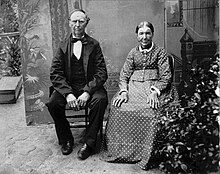
De boerenkolonist Gijsbertus Overeem met zijn vrouw gefotografeerd ter gelegenheid van de 50-jarige aanwezigheid van de boerenkolonisten in Suriname, 1893

Op 20 juni 1845 kwamen de eerste 202 personen aan in Suriname om vervolgens door te reizen over de rivier Saramacca naar de plantage Voorzorg, een voormalige lepra-kolonie waar de te bewerken gronden zouden liggen. De lokale Nederlandse vertegenwoordigers hadden echter niets in het kolonisatie-project gezien, men heeft ze weggestopt zodat de tot slaaf gemaakten niet konden zien dat blanken ook met hun handen arbeidden. De beloofde huizen voor de kolonisten waren dan ook niet gebouwd. Ook andere beloften waren niet waargemaakt: er was geen land ontgonnen, ook was er geen vee en daarnaast was de afwatering niet aangelegd waardoor het land drassig was en nog ongeschikt voor bebouwing. Er stonden slechts wat hutjes van de in 1823 verlaten lepra-kolonie en een negental noodwoningen die nog niet gereed waren. Drinkwater was er ook niet, men moest het brakke rivierwater drinken. De meeste boeren begonnen desondanks vol goede moed maar het duurde niet lang voordat er een tyfus-epidemie uitbrak waar velen aan bezweken. Zij die de tyfus-epidemie overleefd hadden kregen toestemming om de rivier over te steken naar het dorp Groningen. Ondanks de bezwaren van Van den Brandhof trokken de jaren daarna de boeren in kleine groepjes verder, met name in de richting van Paramaribo, en men vestigde zich in dorpjes als Kwatta en Uitvlugt. In Groningen en omstreken was er geen afzetmarkt voor landbouwproducten, een reis naar Paramaribo met een korjaal duurde minimaal twee dagen. De landbouwproducten waren dan niet meer geschikt voor verkoop. Dat was de reden dat men richting Paramaribo trok en in Kwatta en Uitvlugt terechtkwam.
In 1853 kwam er officieel een einde aan het kolonisatieproject. Er waren 398 kolonisten uit Nederland aangekomen en in Suriname nog eens 68 kinderen geboren. Van deze groep waren er op 31 mei 1853, na afloop van de tyfus-epidemie, nog 223 in leven. Van de groep overlevenden keerden er 56 terug naar Nederland en de overgebleven groep van 167 bleef in Suriname achter en vormde de voorouders van de hedendaagse Boeroes.
De Boeroe-families dragen de namen Berkemeijer, Van Brussel, Van Dijk, Van den Eng, Gerbrands, Hoogvliet, Van der Klift, Van Leijden, Loor, Van Meteren, Nellenstein, Overeem, Van Raai, Van Ravenswaay, Rijsdijk, Rozenberg, Stolk, Tammenga, Teunissen, Veldema, Veldhuizen, Veldkamp, Wouters en Zweers. Hun nazaten wonen nu nog in Suriname.
Na 1853


Groep Nederlandse kolonisten op de boerderij van de heer Van Brussel ter gelegenheid van het herdenkingsfeest op 21 juni 1920
Na 1853 verging het de overgebleven boeren beter. Er ontstond langzaam maar zeker een grotere afzetmarkt voor hun producten, al kwam er wel meer concurrentie van Hindoestaanse boeren. Rond 1900 specialiseerde men zich in melkvee. In de crisisjaren stopten velen als boer en vonden werk in andere sectoren, met name bij de overheid. In de decennia na de Tweede Wereldoorlog werden de Boeroes welvarender. Naar schatting leven er nog zo'n 1000 Boeroes in Suriname en 3000 elders.
Bekende boeroes
Een van de bekendste boeroes was de Surinaamse historicus André Loor (1931-2013). Boeroes die een ministersfunctie vervuld hebben zijn Albert van Dijk en Ricardo (Rick) van Ravenswaaij. Directeur der belastingen was de heer C.A. van Dijk.

Tobias Rehberger Hello Africa?


© Tobias Rehberger


Die neue Arbeit des Künstlers Tobias Rehberger spielt mit unseren Vorstellungen von Ursprung und Authentizität. Von Tim Ackermann ZEITmagazin Nr. 9/2016 16. März 2016

Eines der Missverständnisse der Modewelt ist die Vorstellung, dass afrikanische Muster aus Afrika stammen. Die Stoffe, die Frauen auf den Straßen Luandas oder Accras tragen, waren ursprünglich holländische Kopien javanischer Batikstoffe, die Tuchfabrikanten Mitte des 19. Jahrhunderts auf den westafrikanischen Markt warfen. Noch heute werden viele dieser Stoffe in den Niederlanden entwickelt, abgestimmt auf den Geschmack der Kunden in Angola, in Ghana, im Senegal.


© Tobias Rehberger

Das Label "authentisch afrikanisch" hält nicht mehr so einfach. Diese Erfahrung hat auch Daniel Haaksman gemacht. Der Berliner DJ und Produzent berichtet von einer afrikanischen Musikszene, die jung, ungeniert und digital vernetzt ist. Neueste Clubklänge aus Europa mixt sie bei Bedarf mit traditionellen einheimischen Stilen. Von diesem Hybrid-Sound inspiriert, hat Haaksman ein eigenes Album produziert, auf dem er afrikanische Musiker vorstellt. Der Titel African Fabrics verweist natürlich auf die nicht authentischen Stoffmuster. Und auf die vielfältigen Soundverknüpfungen.

African Fabrics ist ebenfalls der Titel der Serie von Kunstwerken, die das ZEITmagazin in diesem Portfolio zum ersten Mal zeigt. Es sind Drucke des Frankfurter Künstlers Tobias Rehberger, eigens geschaffen als Bebilderung zu den Liedern auf Haaksmans Album. Hat man diesen Zusammenhang im Kopf, dann meint man, in Rehbergers Linien eine geometrische Abstraktion der typischen bunten Batikstoffe zu erkennen. Und liegt daneben.

04.04.2016


The Invisible Man (2015) sculpture and photo series


The Invisible Man by Zina Saro-Wiwa copyThe Invisible Man is a neo-Ogoni mask created by Zina Saro-Wiwa. Inspired by the newer “Ogele style” masquerade masks that have started appearing in Ogoniland in the late 1980s, the mask is one that depicts the men that have disappeared in Zina’s life through death or through their own design. Brother, father, lovers and illusive Ogele dancers feature on the Janus-faced mask. The black and white face representing the sadness of loss, the lined pink face the anger associated with abandonment. Worn by women only.


The Invisible Man: “The Weight of Absence” (2015) Video Triptych
The Invisible Man: “The Weight of Absence” (2015) 6 mins, video triptych, is the first video featuring and inspired by Zina’s Invisible Man mask commissioned by Seattle Art Museum for their Disguise exhibition. The triptych is a response to the detachment inherent in the display of African masks in museums. It is in direct conversation with Disguise’s remit of “bridging the gap between the mask observed in isolation and the masquerade experienced as a catalyst”. The gap, as Saro-Wiwa sees it, is brought about by emotional and cognitive disconnection to African masks and the performance of masquerade. This work and the very creation of Zina’s Invisible Man mask attempts to bring emotional discourse and emotional connectivity to a masquerade practise whose psycho-emotional geographies are diffuse:

“I wanted to create a masquerade “performance” that subverted even Seattle Art Museum’s expectations of what such a performance should look like. I didn’t just want to gather my all-female troupe have them dance with the mask I designed, film the process and say “here you go”.  That might have been radical enough – having an all-female troupe, is subversive in itself – but I wanted to go further and challenge the museum’s ideas of what it means to “perform a masquerade”. I also wanted to challenge masquerade in Nigeria by going within and opening up emotional terrains. Many masks in Ogoni play on fears, talk about farming, make political statements. But I wanted to go to a more emotionally-specific place. The Invisible Man is about me creating a mask I could connect to. So I picked a highly emotional subject that had a particular resonance for me.  This work is about my attempt to map the emotional geography of masquerade, to get it to tell a more intimate story and to see if creating this mask and performance had any carthatic properties. There is a magic in masquerade that I do not understand. But I am attempting to tap into it through this work.”

02.04.2016

New Ceramic Busts Overgrown With Twisted Vines and Colorful Flowers by Jess Riva Cooper


Daphne bei Ovid

Apollo und Daphne (Giovanni Battista Tiepolo, 1743/44, Louvre von Paris)
Als Apollon den Liebesgott Eros als schlechten Schützen verspottete, rächte sich dieser, indem er einen Liebespfeil mit einer goldenen Spitze auf ihn und einen mit bleierner Spitze auf Daphne abschoss. Apollon verliebte sich unsterblich in Daphne, während diese, von einem genau das Gegenteil bewirkenden Pfeil Eros’ getroffen, für jene Liebschaft unempfänglich wurde. Als Apollon Daphne bedrängte, floh sie. Erschöpft von der Verfolgung durch Apollon flehte sie zu ihrem Vater Peneios, dass er ihre – den Apollon reizende – Gestalt wandeln möge. Daraufhin erstarrten ihre Glieder und sie verwandelte sich in einen Lorbeerbaum.

Der Lorbeer war Apollon seither heilig. Zum Gedenken an Daphne trug er einen Lorbeerkranz bzw. eine mit Lorbeer geschmückte Leier.

Ovid: Metamorphosen, Buch 1, Vers 545–556
„Hilf, Vater“, sagt sie, „wenn ihr Flüsse göttliche Macht habt!
Durch Verwandlung verdirb die Gestalt, mit der ich zu sehr gefiel!“
Kaum war die Bitte beendet, befällt schwere Taubheit die Glieder:
Die weichen Brüste werden von zarter Rinde umschlossen,
die Haare werden zu Laub, die Arme wachsen als Äste;
schon wird der flinke Fuß von trägen Wurzeln gehalten,
ein Wipfel verbirgt das Gesicht: Der Glanz allein bleibt ihr.
Phoebus liebt sie gleichwohl. An den Stamm hält er die Rechte
und fühlt noch unter der neuen Rinde die zitternde Brust.
Die Zweige, wie Glieder, mit seinen Armen umschlingend
küsst er das Holz, doch das Holz weicht vor den Küssen zurück.

Susto / Kulturgebundenes Syndrom

Susto, Espanto
Unter Susto versteht man sehr unterschiedliche und meist chronisch werdende Beschwerden, in der Regel nach einem heftigen und oft "übernatürlichen" Schrecken, der zum "Verlust der Seele" führt.
In einigen Fällen werden solch traumatische (seelisch verwundende) Ereignisse gar nicht selber erlebt. Manche erkranken auch, wenn andere, meist nahe Verwandte ein entsprechendes Erschrecken überfällt. Das äußert sich in innerer Unruhe, Anspannung, nervöser Hektik (Fachbegriff: Agitiertheit), in Anorexie (Magersucht), Schlafstörungen, Fieber, Diarrhoe (Durchfall), Verwirrtheit, Apathie (Gefühllosigkeit, Teilnahmslosigkeit), in depressiven Verstimmungen, Rückzug und Isolationsneigung. In manchen Studien vermutet man eine organische Ursache, nämlich eine Hypoglykämie (Unterzuckerung), andere sprechen von unspezifischen organischen Erkrankungen, von Stress und generalisierten Angststörungen auf Grund von psychosozialen Konflikten und vermindertem Selbstwertgefühl. Dieses Leiden findet sich vor allem in Mexiko, Zentral- und Südamerika. Doch auch auf den Philippinen (Lanti), in Indonesien und Malaysia (Latah), bei den Ureinwohnern Australiens (Malgri), in Neu-Guinea (Mogo laya), im Iran (Narahati) und im Amazonasgebiet (Saladera) finden sich ähnliche Phänomene beschrieben. Westliche Klassifikationen würden dies als neurotische Störungen oder undifferenzierte Somatisierungsstörungen bezeichnen.
http://www.psychosoziale-gesundheit.net/psychiatrie/fremdekulturen.html
-----
Susto („Schrecken“ oder „Seelenverlust“)
Eine bei einigen Latinos in den USA, Mexiko, Mittel- und Südamerika vorkommende Volkskrankheit. Susto wird auch espanto, pasmo, tripa ida, perdida del alma oder chibih genannt.
Susto ist eine einem erschreckenden Erlebnis zurückgeschriebene Erkrankung, aufgrund derer die Seele den Körper verläßt und die zu Unglücklich sein und Krankheit führt. An Susto erkrankte Personen erleben oft bedeutsame Spannungen in zentralen sozialen Rollen. Es wird geglaubt, daß Susto in extremen Fällen zum Tode führen kann. Typische Symptome sindAppetitstörungen, unzureichender oder übermäßiger Schlaf, unruhiger Schlaf oder beunruhigende Träume, Gefühle der Trauer, Mangel an Motivation, irgend etwas zu tun, sowie Gefühle geringen Selbstwerts und der Schmutzigkeit. Die somatischen Begleitsymptome von Susto sind Muskelschmerzen, Kopf- und Magenschmerzen sowie Durchfall. Bei der rituellen Heilung wird das Schwergewicht darauf gelegt, die Seele in den Körper zurückzurufen und den Betroffenen zu reinigen, um das geistige und körperliche Gleichgewicht wiederherzustellen. Verschiedene Erlebnisse von Susto können mit einer Major Depression, einer Posttraumatischen Belastungsstörung und Somatoformen Störungen verwandt sein. Ähnliche ätiologische Überzeugungen und Symptomkonstellationen treten in vielen Teilen der Welt auf. Als kulturgebundenes Syndrom (englisch culture-bound syndrome, kurz CBS) werden in der Medizin, Klinischen Psychologie, Medizinethnologie und Ethnomedizin psychische oder somatische Symptome bezeichnet, die auf eine bestimmte (ethnische) Gesellschaft oder Kultur beschränkt sind und bei denen biochemische Ursachen oder Organveränderungen nicht nachweisbar sind. In anderen Kulturen ist das Krankheitsbild unbekannt.  Der Begriff wurde 1994 aufgenommen in das amerikanische Diagnostic and Statistical Manual of Mental Disorders (DSM-IV); im Anhang 1 dieses Werkes ist auch eine Übersicht der häufigsten kulturgebundenen Syndrome verzeichnet.
http://sbpm.web-com-service.de/downloads/Kulturtypische%20Krankheitsbilder.pdf

01.04.2016

Mickalene Thomas. Origin of the Universe 1

Mickalene Thomas. Origin of the Universe 1, 2012; rhinestones, acrylic, and oil on wood panel; 48 x 60 in. Courtesy of the Artist.

Invisible Presence: Bling Memories at the Atlanta Contemporary Art Center

On May 8, 2001, the funeral of William Moore, aka Willie Haggart, was a raucous affair. Abandoning the somber mood of a typical funeral, the ceremony was a giant party at the National Arena in Kingston, Jamaica. Labeling it a “celebrity event,” Donna P. Hope writes that the style of Haggart’s funeral “ruptured the sobriety and mourning associated with traditional funeral rites.”[1] With this, the term bling funeral entered the mainstream, and such ceremonies—and the ruptures they instigate—are the subject of Ebony G. Patterson’s exhibition, Invisible Presence: Bling Memories, at the Atlanta Contemporary Art Center.


Ebony G. Patterson. Invisible Presence: Bling Memories, 2014; installation view, Atlanta Contemporary Art Center, Atlanta, Georgia. Courtesy of the Artist and Atlanta Contemporary Art Center.


The exhibition consists of twenty elaborately decorated coffins mounted on tall wooden poles, objects that originated from a performance conceived by Patterson for the 2014 Carnival in Kingston, Jamaica.[2] On April 27 of that year, Patterson carried fifty ostentatious coffins on poles with the help of local Jamaicans; accompanying them were several dancers and a drum line from the St. Michael’s Steppers community marching band. Evoking a bling funeral, the procession matched the boisterous and celebratory tone of Carnival.

Patterson’s decision to stage the performance during Carnival is a comment on the deep divide between social classes in Jamaica, as the Carnival celebrations are designed for the island’s upper and middle classes. The performance attempts to provide the working poor not only access to the ceremonies but also an unmistakable presence by using the spectacle of bling funerals. In such celebrations, closely linked to the underclass, the dead are remembered through raucous dancing parties featuring erotic costumes and dancehall music.


Ebony G. Patterson. Invisible Presence: Bling Memories, 2014; installation view, Atlanta Contemporary Art Center, Atlanta, Georgia. Courtesy of the Artist and Atlanta Contemporary Art Center.


The elaborately adorned coffins in the exhibition are the only remaining trace of this performance, and they offer insight into the opulent displays of bling funerals. In contrast to typical coffins of black and other somber colors, these coffins feature vivid fabrics with bold patterns, rhinestones, lace, tassels, and plastic foliage, among other materials. The fabric patterns range from bright colors with polka dots to elaborate floral and animal prints. Each coffin features multiple swatches of cloth—usually with a different pattern on each face—and is trimmed with rhinestones and lace.

The construction of the coffins also relates to Jamaica’s working class. Upon close examination, the seams between the fabric swatches are not perfect; on some, strips of ribbon or lace are falling off or running haphazardly through the cloth. Many also show signs of wear, reinforcing the idea that these were integral components of a performance. Such qualities emphasize the handmade aesthetics of the coffins, linking them to the textile industry of Jamaica. While some fabric patterns feature the colors of the nation’s flag—black, green, and yellow—most were chosen for their brilliant designs, linking them culturally to bling funerals rather than a national identity.


Ebony G. Patterson. Invisible Presence: Bling Memories, 2014; installation view, Atlanta Contemporary Art Center, Atlanta, Georgia. Courtesy of the Artist and Atlanta Contemporary Art Center.


The installation of these objects in the exhibition is particularly noteworthy, with twenty of them densely arranged in a relatively small gallery. Viewers are invited to walk among them. The bottom of each coffin is about sixty inches from the ground, forcing the viewer’s gaze upward and restricting one’s ability to see the upper portions of the coffins. The resulting mass resembles the earlier performance; the coffins are not presented didactically as individual objects for visual consumption. Instead, the installation beckons viewers to participate, envisioning themselves as part of the procession during Carnival. Additionally, though each coffin is individually decorated, the dense grouping of the installation prevents any one from being viewed on its own. The show eschews object labels or any other classification system that would denote them as works of art. They simply are what they are: markers of the performance in Kingston.


Ebony G. Patterson. Invisible Presence: Bling Memories, 2014; installation view, Atlanta Contemporary Art Center, Atlanta, Georgia. Courtesy of the Artist and Atlanta Contemporary Art Center.

Writing about bling funerals, Hope asserts that they “temporarily suspend social boundaries and momentarily rotate the distinctions between those defined as heroes and anti-heroes in Jamaican culture.”[3] The blinged-out coffins in this installation demand attention, and they point to a group of people normally operating at the margins of society. Stretching up toward the sky, the coffins on display in the gallery—as well as during the performance—reinforce Patterson’s motivation to dissolve such social barriers, to include Jamaica’s underclass not only in a typically restricted event such as Carnival but also in the larger society.
Invisible Presence: Bling Memories is on view at Atlanta Contemporary Art Center through April 21, 2016.

[1] Donna P. Hope, “From the Stage to the Grave: Exploring Celebrity Funerals in Dancehall Culture,” International Journal of Cultural Studies 13 (3): 260.

[2] The performance was one of several commissions realized during the 2014 Carnival season in conjunction with the exhibition EN MAS’: Carnival and Performance Art of the Caribbean, curated by Claire Tancons and Krista Thompson, organized by and on view at the Contemporary Arts Center New Orleans, March 7–June 7, 2015, and co-organized as a traveling exhibition by Independent Curators International (ICI), New York.

[3] Hope, 265.

A Multisensory Trip to Cuba’s Dark, Sugar-Filled Past

by Debbie Hagan on March 25, 2016

Installation view, 'Alchemy of the Soul: María Magdalena Campos-Pons' at the Peabody Essex Museum (photo by the author for Hyperallergic) (click to enlarge)
Installation view, ‘Alchemy of the Soul: María Magdalena Campos-Pons’ at the Peabody Essex Museum (photo by the author for Hyperallergic) (click to enlarge)
SALEM, Mass. — When Europeans first tasted sugar during the Crusades, they immediately begged for more. However, it wasn’t until Columbus brought sugar cane to the Caribbean to be cultivated that this exotic luxury grew into a hotly traded world commodity, akin to petroleum today. Such sweetness had a price, and Cuba met international demands by bringing enslaved Africans across the Middle Passage and subjecting them to a lifetime of brutal labor. By the mid-19th century, Cuba produced a third of the world’s sugar.
Alchemy of the Soul, Elixir of the Spirits, a large-scale, blown-glass sculptural installation on view at the Peabody Essex Museum, takes visitors on a trip to Cuba to explore its sounds, smells, tastes, and sights, all through this rather dark historical lens. Afro-Cuban artist María Magdalena Campos-Pons created the complex, multipart exhibit with her husband and collaborator, musician and composer Neil Leonard.
Neil Leonard and María Magdalena Campos-Pons (photo by the author for Hyperallergic)
“It is a multilayered experience that combines visual imagery with sound elements that engage the viewer in more than one sensorial experience — more than just look and see and move quickly,” says Campos-Pons, who has been dreaming about this project for 28 years.
Campos-Pons grew up in former slave barracks in Cuba and played in the shadows of what were once sugar cane factories. She’s of Yoruba descent — seven of her grandfathers were enslaved in Nigeria and taken to Cuba between 1838–66 to work the sugar cane.
Visitors begin their journey to Campos-Pons’s Cuba by entering the museum’s freight elevator, loaded with burlap sugar sacks and a vintage record player. The elevator operator cues up a 45 rpm record, from which a lone voice sings in Spanish about the beauty of his country and how proud he is to be from Matanzas, Cuba’s main port. Campos-Pons spent much of her childhood there.
Exhibition entrance, 'Alchemy of the Soul: María Magdalena Campos-Pons' (photo by Kathy Tarantola/PEM, © 2016 Peabody Essex Museum)
Exhibition entrance, ‘Alchemy of the Soul: María Magdalena Campos-Pons’ (photo by Kathy Tarantola/PEM, © 2016 Peabody Essex Museum)
Those who know rumba music, its urgent drumbeats and African roots, will recognize the voice as belonging to Rafael “El Niño” Navarro Pujada: the Frank Sinatra of the form. Leonard recorded him in his home as he reminisced about the docks, where he sang during breaks from loading sugar. Between his sweet, solitary voice and the lumbering motions of the elevator, visitors can imagine a ferry voyage, cresting the waves and heading toward the port city.
“I’ve been working with Cuban musicians since 1986, since before I met Magda,” says Leonard, who wanted to meet and record musicians who’d worked in the ports and sang songs reflecting rumba’s roots. “They let me record them in their homes without the drums, without their producers, just telling their stories and singing songs they learned,” says Leonard. “This sound of the port is a very iconic sound of Cuba. That’s an aspect of the work that is Magda’s entire life. It’s about what I am seeing in the sugar trade, distilling it, and bringing it back to the work.”
Arriving on the third floor, visitors enter an ethereal, multisensory dreamscape made up of six 10- to 12-foot blown-glass sculptures. Glass piping connects the bulbous vessels, so the gallery looks a bit like a science lab. One unit is filled with amber fluid that bubbles, flows, and pools in glass bowls and kicks up the sweet scent of rum. This is a surreal, skeletal landscape — an artistic interpretation of the ruins left by the 1,000 or so sugar and rum factories that once flourished in Cuba.
“The presence of smell and temperature in the room, combined with the moisture of the fountain and the distillery bring together this experiential idea,” says Campos-Pons.
Maria Magdalena Campos-Pons, "Alchemy of the Soul, Elixir for the Spirits" (2015), blown glass, steel, cast resin, silicone, and acrylic, at the Peabody Essex Museum (photo by Peter Vanderwarker, © 2016 Peabody Essex Museum)
María Magdalena Campos-Pons, ‘Alchemy of the Soul, Elixir for the Spirits’ (detail, 2015), blown glass, steel, cast resin, silicone, and acrylic, at the Peabody Essex Museum (photo by Peter Vanderwarker, © 2016 Peabody Essex Museum) (click to enlarge)
At special events, visitors can try quarter-sized slices of sugar cane. In one bite, the juicy liquid explodes in the mouth. That’s it. Then the sweetness is gone and what’s left is a straw-like, tasteless wad that one can’t wait to spit out. The sweetness and bitterness present an uncomfortable dichotomy.
“Sugar is bittersweet,” says Campos-Pons, referring not just to the cane’s taste but also the harshness involved in the harvest. The plant’s razor-sharp leaves slice workers arms and faces, sometimes blinding them.
“What has been beautiful is that the Peabody commissioned this piece, so it really allowed us to be ambitious,” says Campos-Pons. “This idea has been in my mind since 1988. I was just waiting for the proper place and moment.”
Maria Magdalena Campos-Pons, 'Alchemy of the Soul, Elixir for the Spirits' (detail, 2015), blown glass, steel, cast resin, silicone, and acrylic, at the Peabody Essex Museum (photo by Peter Vanderwarker, © 2016 Peabody Essex Museum) (click to enlarge)
María Magdalena Campos-Pons, ‘Alchemy of the Soul, Elixir for the Spirits’ (detail, 2015), blown glass, steel, cast resin, silicone, and acrylic, at the Peabody Essex Museum (photo by Peter Vanderwarker, © 2016 Peabody Essex Museum) (click to enlarge)
The artists worked with two glass factories — one in Boston, the other in San Francisco — to create blown vessels that fit together like Lego parts. “When you’re making a process that is new, there’s not a notebook for it,” says Campos-Pons. “It’s all about taking risks, and you may fail. Glass is fragile. It could break. This is about process. One of the things that I’m excited and happy about is that [the museum] allowed us to go forward with the process and make ourselves vulnerable.”
Leonard digitally manipulated several sources — saxophone, singing voices, and waves — to compose a sound collage that echoes throughout the exhibit. “My concern for the work is that glass is shiny, precious, beautiful, but glass is also cold and Matanzas is not cold,” says the musician. “How can I put something of the warmth, spirit, and rustic quality of Matanzas into the work in the gallery?”
He takes a single note from his saxophone, cuts off the end sound, and digitally manipulates and curves it as one imagines a glassmaker does with molten liquid. “You hear the saxophone after I’ve stopped playing. It’s ringing into space, a reverberation, very much like reflection — like the beauty of Magda’s glasswork, like what you see through the glass and what you see from the shadows on the floor,” says Leonard.
Life also emerges through the songs sung by male and female voices and the sounds of water. They wash back and forth through the installation like a tide.
“One of the things the piece was intended to evoke, which sort of came out intuitively, was how sounds migrated from Africa,” says Leonard. “In Cuba, [the songs] are transformed, some sung in Spanish, some are secular, sacred things that happened in Cuba that didn’t happen in Africa. They migrate like a spirit in one direction.”
In “Agridulce,” one of a couple of performances held in the museum’s atrium in January, Campos-Pons entered the upper bridge above the audience’s heads, wearing a 19th-century slave dress. A machete in hand, she made swift, violent motions as she hacked at a row of sugar cane. Minutes later, she approached the audience and extended her fresh-cut cane: “Try it. It is sweet.”
The crowd pushed forward, gravitating to the artist, wanting see her up close and receive this gift. I felt honored as she paused before me and looked me in the eye. I took the cane, and my heart ached a little, feeling transported back to a 19th plantation, receiving this humble but weighty gift. “I was trying to juxtapose the brutality of that with the taste [of sugar],” says Campos-Pons. “What I say in the performance is, how could anyone find energy to go home and love a close one after 12 hours of this? What love is left over? What energy is left to breastfeed your baby?”
Maria Magdalena Campos-Pons, 'Alchemy of the Soul, Elixir for the Spirits' (detail, 2015), blown glass, steel, cast resin, silicone, and acrylic, at the Peabody Essex Museum (photo by Peter Vanderwarker, © 2016 Peabody Essex Museum)
María Magdalena Campos-Pons, ‘Alchemy of the Soul, Elixir for the Spirits’ (detail, 2015), blown glass, steel, cast resin, silicone, and acrylic, at the Peabody Essex Museum (photo by Peter Vanderwarker, © 2016 Peabody Essex Museum)
Such history may be skimmed over by Cuba travel guides, especially as they’re being updated for a new era of tourism, but those in the know will find traces remaining in the country’s people, culture, and landscape.
“Contemporary art is about daring to make an experiment, daring to try something new, daring to fail, daring to try to go to a place where no one has entered,” says Campos-Pons.
Alchemy of the Soul dares to tell the truth about a beautiful county with a greedy past, desperate to satisfy the world’s craving for sugar.
Alchemy of the Soul: María Magdalena Campos-Pons continues at the Peabody Essex Museum (161 Essex Street, Salem, MA) through April 3. Neil Leonard and Rudresh Mahanthappa will perform an experimental saxophone concert with projected images by Campos-Pons at the Isabella Stewart Gardner Museum (25 Evans Way, Boston) on April 7.

No Flowers in Africa? - The Culture of Flowers


31.03.2016

Lost and Invisible Bodies, Enshrined in Glitter and Bling

by Jillian Steinhauer on March 30, 2016
Installation view, ‘Ebony G. Patterson: Dead Treez’ at the Museum of Arts and Design; in foreground: “root and shrubz” (2014), mixed-media jacquard photo tapestry with embroidery, glitter, toy gun, shoe, lace, glasses, toys, silk flowers, embellishments (all photos by the author for Hyperallergic) (click to enlarge)

Installation view, ‘Ebony G. Patterson: Dead Treez’ at the Museum of Arts and Design; in foreground: “root and shrubz” (2014), mixed-media jacquard photo tapestry with embroidery, glitter, toy gun, shoe, lace, glasses, toys, silk flowers, embellishments (all photos by the author for Hyperallergic) (click to enlarge)

I am struggling to photograph a tapestry. It’s patterned and glittered all over — pink sparkles clashing with red flowers that rub up against three-dimensional objects like toy trucks. My camera and eye don’t know where to focus. The gallery is dark, dramatically lit, but the tapestry is a haze of sparkles and shimmers. I make out a zigzag, a line of fringe cutting its way through the clamor. I train my lens upon it and wait for the image to resolve. As it does, I realize I’m looking at not just a line but a leg. The fringe belongs to a pair of geometric patterned pants. I trace them up to where they meet a gold torso, but the body stops there.
“In order to force one’s way out of invisibility one has to create a reason to be seen,” says Jamaican artist Ebony G. Patterson.
I walk around the tapestry, which rests on the floor, in an attempt to see its contents more clearly. There are two toy guns covered in floral prints; flowers everywhere, embedded in glitter and sitting atop the surface in silk; a miniature lace skirt; two toy trucks. There is another body, much smaller than the first, represented by a camouflage outfit. This one, like the first, is a body only by virtue of its clothing: shirt, pants, shoes. There is no head to speak of, no arms or flesh.
“There is a challenge being made about seeing and looking. The seeing is what happens on social media, but the looking is what I’m asking you to do,” says Patterson.
What is the relationship between these two sets of clothing without bodies? Am I looking at a mother and her son — or the remains of them? Where were they going? Were the guns only toys? How did the mother’s right shoe — a dazzling boot, a glittering, embroidered articulation of turquoise and white set atop a thick black heel — end up so far from her leg? Whose shoe is the other one — a three-dimensional red and black slipper — that sits near it?
Where are the bodies?
Detail of Ebony G. Patterson, “wilted rosez” (2014), mixed-media jacquard tapestry, with embroidery, glitter, caftan, costume jewelry, glass, eighty black crocheted flowers, embellishments
“Gardening in the Tropics, you never know
what you’ll turn up. Quite often, bones,” writes Jamaican poet Olive Senior.
In the other tapestries, it’s the same story. I go looking for bodies but all I find are clothes. Brilliant, beautiful ones, but the bodies they’re meant to hold have vanished. Decomposed, maybe. Broken back down into the thickets of flowers and jewels, objects and ornament that envelop them. I train my eyes to trace the outlines of the blinged-out outfits. I recondition them so that they can see. I don’t see the bodies, but I know they are here.
*   *   *
On the other side of the space, there are 10 bodies, all made of plastic and covered in floral and arabesque patterns — dots and stripes, plants and curlicues enveloping both their outfits and every inch of their fake skin.
DSC08572

Ebony G. Patterson, “Swag Swag Krew” (from the ‘Out and Bad’ series) (2011–14), ten embellished mannequins with custom-made clothing, including an adorned umbrella, alcohol, shoes, costume jewelry, toys, cell phones, silk flowers, cinder blocks, hats, backpacks, accessories, cotton textile–covered plinth (click to enlarge)


29.03.2016

Saidiya Hartman’s use of ‘critical fabulation’

Following on from our seminar discussions, see here for Saidiya Hartman’s use of ‘critical fabulation’ as a reaction to the “violence of the archive” –in which certain lives, histories and memories are systematically excluded from the archive as an operation of power. In brief, critical fabulation is a creative method for re-imagining histories that you cannot find and to re-embody these marginalized accounts (or ‘subjugated knowledge’) through acts of imagination (you can think of Toni Morrison’s Beloved as an example of this). In this method there is also an attention to the very mechanisms and textures of memory and its connections to truth and knowledge.
Like Morrison, Hartman considers (trans)atlantic slavery. Here it what Hartman says about critical fabulation:
Is it possible to exceed or negotiate the constitutive limits of the archive? By advancing …a critical reading of the archive that mimes the figurative dimensions of history, I intended both to tell an impossible story and to amplify the impossibility of its telling. The conditional temporality of “what could have been,” according to Lisa Lowe, “symbolizes aptly the space of a different kind of thinking, a space of productive attention to the scene of loss, a thinking with twofold attention that seeks to encompass at once the positive objects and methods of history and social science and the matters absent, entangled and unavailable by its methods.” …
By playing with and rearranging the basic elements of the story, by re-presenting the
sequence of events in divergent stories and from contested points of view, I have attempted to jeopardize the status of the event, to displace the received or authorized account, and to imagine what might have happened or might have been said or might have been done. By throwing into crisis “what happened when” and by exploiting the “transparency of sources” as fictions of history, I wanted to make visible the production of disposable lives (in the Atlantic slave trade and, as well, in the discipline of history), to describe “the resistance of the object”…
Narrative restraint, the refusal to fill in the gaps and provide closure, is a requirement of this method, as is the imperative to respect black noise—the shrieks, the moans, the non- sense, and the opacity, which are always in excess of legibility and of the law and which hint at and embody aspirations that are wildly utopian, derelict to capitalism, and antithetical to its attendant discourse of Man.
(Hartman, 2008, 11-12)
I hope you can see the connections to counter-memory here. In terms of the final assessment, if any of you are creative writers you can also consider submitting a creative piece of writing too.
Red