29.03.2016

The Lost World of the London Coffeehouse

In contrast to today’s rather mundane spawn of coffeehouse chains, the London of the 17th and 18th century was home to an eclectic and thriving coffee drinking scene. Dr Matthew Green explores the halcyon days of the London coffeehouse, a haven for caffeine-fueled debate and innovation which helped to shape the modern world.
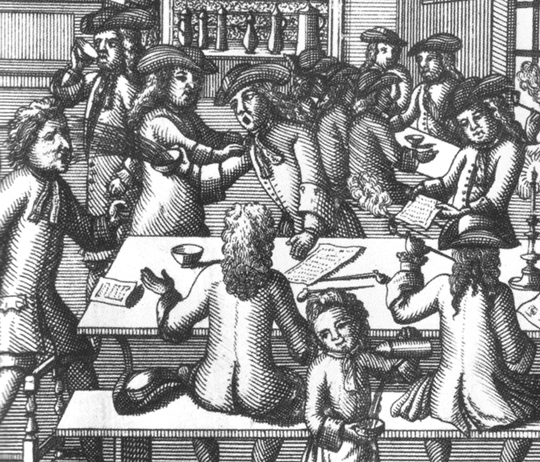
A disagreement about the Cartesian Dream Argument (or similar) turns sour. Note the man throwing coffee in his opponent’s face. From the frontispiece of Ned Ward’s satirical poem Vulgus Brittanicus (1710) and probably more of a flight of fancy than a faithful depiction of coffeehouse practices – Source.

From the tar-caked wharves of Wapping to the gorgeous lamp-lit squares of St James’s and Mayfair, visitors to eighteenth-century London were amazed by an efflorescence of coffeehouses. “In London, there are a great number of coffeehouses”, wrote the Swiss noble César de Saussure in 1726, “…workmen habitually begin the day by going to coffee-rooms to read the latest news.” Nothing was funnier, he smirked, than seeing shoeblacks and other riffraff poring over papers and discussing the latest political affairs. Scottish spy turned travel writer John Macky was similarly captivated in 1714. Sauntering into some of London’s most prestigious establishments in St James’s, Covent Garden and Cornhill, he marvelled at how strangers, whatever their social background or political allegiances, were always welcomed into lively convivial company. They were right to be amazed: early eighteenth-century London boasted more coffeehouses than any other city in the western world, save Constantinople.

London’s coffee craze began in 1652 when Pasqua Rosée, the Greek servant of a coffee-loving British Levant merchant, opened London’s first coffeehouse (or rather, coffee shack) against the stone wall of St Michael’s churchyard in a labyrinth of alleys off Cornhill. Coffee was a smash hit; within a couple of years, Pasqua was selling over 600 dishes of coffee a day to the horror of the local tavern keepers. For anyone who’s ever tried seventeenth-century style coffee, this can come as something of a shock — unless, that is, you like your brew “black as hell, strong as death, sweet as love”, as an old Turkish proverb recommends, and shot through with grit.

It’s not just that our tastebuds have grown more discerning accustomed as we are to silky-smooth Flat Whites; contemporaries found it disgusting too. One early sampler likened it to a “syrup of soot and the essence of old shoes” while others were reminded of oil, ink, soot, mud, damp and shit. Nonetheless, people loved how the “bitter Mohammedan gruel”, as The London Spy described it in 1701, kindled conversations, fired debates, sparked ideas and, as Pasqua himself pointed out in his handbill The Virtue of the Coffee Drink (1652), made one “fit for business” — his stall was a stone’s throw from that great entrepôt of international commerce, the Royal Exchange.
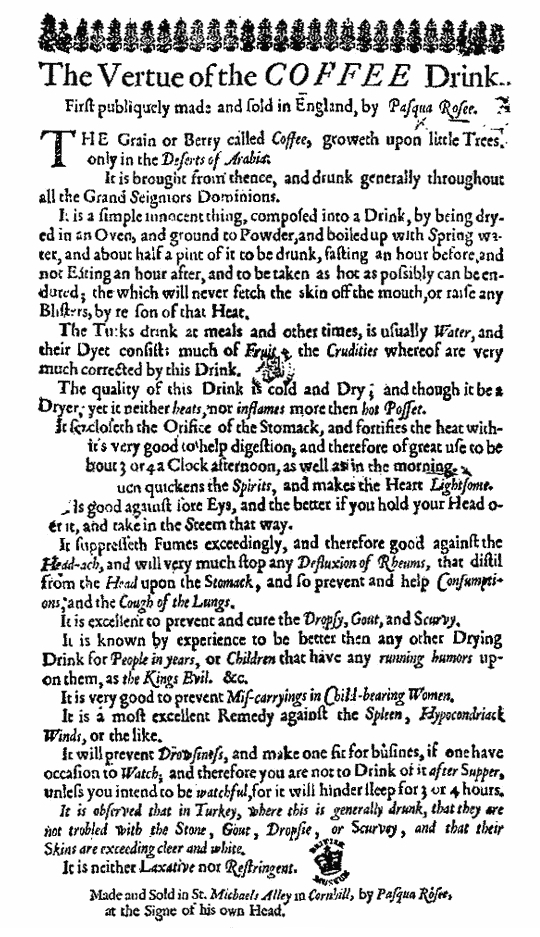
A handbill published in 1652 to promote the launch of Pasqua Rosée’s coffeehouse telling people how to drink coffee and hailing it as the miracle cure for just about every ailment under the sun including dropsy, scurvy, gout, scrofula and even “mis-carryings in childbearing women” – Source.


Remember — until the mid-seventeenth century, most people in England were either slightly — or very — drunk all of the time. Drink London’s fetid river water at your own peril; most people wisely favoured watered-down ale or beer (“small beer”). The arrival of coffee, then, triggered a dawn of sobriety that laid the foundations for truly spectacular economic growth in the decades that followed as people thought clearly for the first time. The stock exchange, insurance industry, and auctioneering: all burst into life in 17th-century coffeehouses — in Jonathan’s, Lloyd’s, and Garraway’s — spawning the credit, security, and markets that facilitated the dramatic expansion of Britain’s network of global trade in Asia, Africa and America.

The meteoric success of Pasqua’s shack triggered a coffeehouse boom. By 1656, there was a second coffeehouse at the sign of the rainbow on Fleet Street; by 1663, 82 had sprung up within the crumbling Roman walls, and a cluster further west like Will’s in Covent Garden, a fashionable literary resort where Samuel Pepys found his old college chum John Dryden presiding over “very pleasant and witty discourse” in 1664 and wished he could stay longer — but he had to pick up his wife, who most certainly would not have been welcome. The earliest known image of a coffeehouse dated to 1674, showing the kind of coffeehouse familiar to Samuel Pepys – Source.
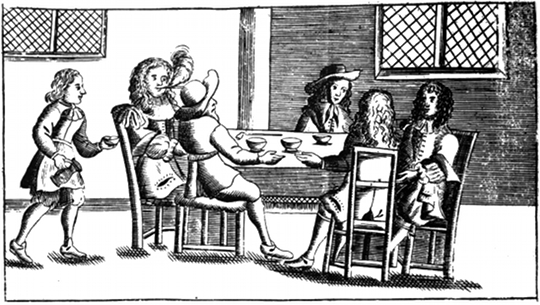
No respectable women would have been seen dead in a coffeehouse. It wasn’t long before wives became frustrated at the amount of time their husbands were idling away “deposing princes, settling the bounds of kingdoms, and balancing the power of Europe with great justice and impartiality”, as Richard Steele put it in the Tatler, all from the comfort of a fireside bench. In 1674, years of simmering resentment erupted into the volcano of fury that was the Women’s Petition Against Coffee. The fair sex lambasted the “Excessive use of that Newfangled, Abominable, Heathenish Liquor called COFFEE” which, as they saw it, had reduced their virile industrious men into effeminate, babbling, French layabouts. Retaliation was swift and acerbic in the form of the vulgar Men’s Answer to the Women’s Petition Against Coffee, which claimed it was “base adulterate wine” and “muddy ale” that made men impotent. Coffee, in fact, was the Viagra of the day, making “the erection more vigorous, the ejaculation more full, add[ing] a spiritual ascendency to the sperm”.

saidiya hartman: libidinöse ökonomie

Seventeenth-Century Dutch


http://www.hnanews.org/archive/2009/04/brienen.html
Rebecca Parker Brienen, Visions of Savage Paradise: Albert Eckhout, Court Painter in Colonial Dutch Brazil. Amsterdam: Amsterdam University Press, 2006. 288 pp, 17 color, 72 b&w illus. ISBN 978-90-5356-947-4 and 978-90-5356-947-2.

Julie Berger Hochstrasser, Still Life and Trade in the Dutch Golden Age. New Haven and London: Yale University Press, 2007. 320 pp, 69 color, 97 b&w illus. ISBN 978-0-300-10038-9.

Rebecca Parker Brienen's Visions of Savage Paradise: Albert Eckhout, Court Painter in Colonial Dutch Braziland Julie Berger Hochstrasser's Still Life and Trade in the Dutch Golden Age are, in some ways, two sides of the same coin: they examine effects – the visual documentation – of exotic travel and exploration by the Dutch in the seventeenth century. Hochstrasser examines the impact of the Dutch East India Company (VOC from the Dutch initials) trading with India, Indonesia and China, and the Dutch West India Company (WIC) in the Americas, largely in terms of items that were brought back to Europe (sugar, tea, tobacco, etc.) and their subsequent appearance in paintings. Brienen concentrates on the artist Albert Eckhout in Brazil and the role of the West India Company there. (Indeed, Hochstrasser also includes a discussion on Eckhout within the more lengthy discussion of the Dutch Brazilian colony.)

We get a glimpse of the exotic from the very beginning of Brienen's Introduction, in which she proposes that we imagine Eckhout's arrival with the artist Frans Post and the colony's new governor, Johan Maurits in Recife, Brazil, in 1637, and those who may have come to greet the ship: merchants, employees of the WIC, "Portuguese planters, members of the Jewish Community, African slaves, free people of mixed ethnic background and representatives of local indigenous groups" – with squawking flocks of green parrots flying overhead and in view of passion flowers and papayas. The color, sounds and wonders of this world even today, more than 450 years later, are still exotic. Although Brienen's focus is Eckhout, she provides a larger context for this western artist's life and predecessors in Brazil and fields the issue of his "ethnographic art."

Brienen's book should also be considered with the 2004 exhibition catalogue, Albert Eckhout, A Dutch Artist in Brazil (ed. Quentin Buvelot), for the exhibition at the Mauritshuis, The Hague, which covers much the same material and acknowledges Brienen's previous work. The larger format of that catalogue and its many larger and detailed illustrations make it more accessible – but it cannot replace Brienen's book. They cover much the same material but do not entirely agree (the artist's birth year, in fact, is a contentious point – Brienen thinks c. 1607, not c. 1610), and the focus in the exhibition (despite its title) is really on the patron and the WIC.

Brienen discusses possible explanations for Eckhout's extraordinary paintings and the possibility of a pictorial cycle – including eight "ethnographic life-size paintings for a 'princely chamber' for Vrijburg Palace." Later, these and other works (26 in all) would be a gift of the Count Johan Maurits to his cousin Frederick III of Denmark for his kunstkamer (and they remain in Copenhagen today). Other works also went to Louis XIV of France and the Elector of Brandenburg. The wonder of the Brazilian world – its people, flora, vegetation – created a universal desire and one that Maurits could barter for money and title.

Africans and multi-ethnic Brasilianen, Tapuyas and Tupinamba peoples and those called Mulattos and Mameluca of the New World are the subject of Eckhout's stunning life-size paintings. To what degree should we hold Eckhout accountable for a realistic portrait of them? And are these men and women slaves or free? Are they even "noble free" people? The role of African slaves in Brazil and labor for the WIC is integral to her study – as it is critical, with a different slant, for Hochstrasser. But as Brienen points out – and Hochstrasser stresses – this Dutch colony could not have successfully existed without slavery. Over 60,000 African slaves were reportedly laboring in the Dutch-occupied Pernambuco (Brazil) by mid-century. The Dutch Court and the WIC did much to cement relations with the Congo and Angola to assure West African slave trade. From 1634 onwards, the WIC was actively involved in the importation of slaves into the Americas.

This information is also critical to Hochstrasser's theme from the beginning. As commodities (lavishly illustrated) are her central concentration (with chapters on the VOC and the WIC) her subheadings are: cheese, herring, beer (local); grain, lemons (also oranges – via Europe); pepper, porcelain, tea (via VOC); and salt, tobacco, sugar (via WIC). We should not be surprised to see that the subheading slaves as a commodity (via WIC), was a necessary one. In each case, Hochstrasser uses Dutch (and Flemish) still-life painting to show how and when the commodities appeared through trade. In the midst of Chinese porcelain and Turkish carpets, the use of black Africans in painting is likened to the display of a commodity as part of "riches from abroad." She unequivocally states that everyone who even invested in the WIC was involved in the slave trade. One cannot separate one aspect of it from another. The slave trade is not just apparent in the presence of Africans in paintings, but in the presence of other commodities that were only available as a result of slave labor.

Hochstrasser investigates the commodities in depth – as they are seen, as they were traded, where they came from, their mention in diaries, diets, documents, poems, prints, and their relation to Spanish, Portuguese, and English traders' ships. Not only will one not look at still-life the same way – one will not even look at salt the same way! And certainly not sugar (and the spun-sugar sweets in still-life painting), since often it was the sugar production that was the reason for the grueling life of plantation slave labor in Brazil. Although the Dutch did not begin the slave trade, by the 1630s they were well into it. The wealth of the Golden Age, all set before us in pronkstilleven, could not have been available without it.

With Hochstrasser's unraveling of the still lifes and their sources and Brienen's analysis of the role of Eckhout and the WIC in Brazil, we can no longer look at these works and only write about composition. Their work challenges us to change ours.

Frima Fox Hofrichter
Pratt Institute

Silvia Federici, On capitalism, colonialism, women and food politics

From edition 2009 Issue 2

Published: November 3, 2009
An interview with Silvia Federici
Interviewed by Max Haiven
Silvia Federici is a researcher, activist and educator. She was born and raised in Italy but came to the US in 1967 on a scholarship to study Philosophy at the University of Buffalo. Since then, she has taught at several universities in the US and also at the University of Port Harcourt in Nigeria. She is now Emerita Professor at Hofstra University (Long Island, NY) and lives in Brooklyn.
A veteran feminist activist, Federici’s work is informed by and in dialogue with the many struggles which have animated her career. Since the early 1970s Federici was, along with theorists such as Mariarosa Dalla Costa and Selma James, a founder of the International Feminist Collective and an organizer with the famous Wages for Housework campaign. This movement brought together a global alliance of feminist groups to make a revolutionary challenge at the very hinge of capitalist and patriarchal power by demanding economic sovereignty for women engaged in the elemental labour of social reproduction.
Federici has also been a central part of the Midnight Notes Collective and a co-founder of the Committee for Academic Freedom in Africa (CAFA), a support organization for the struggles of students and teachers in Africa against structural adjustment. Between 1991 and 2003 she was a co-editor of the CAFA Bulletin. In 1995, she co-founded the Radical Philosophy Association (RPA) anti-death penalty project.
Her ground-breaking 2004 book Caliban and the Witch: Women, The Body and Primitive Accumulation (Brooklyn: Autonomedia), received critical laudations and was much talked of in both academic and activist circles, supplying as it did a capacious, lucid and historically rigorous picture of the intersections of patriarchy, capitalism, colonialism and violence from the 15th to the 18th century. The book served as a crucial corrective to both Marxist analyses of the period of primitive accumulation which write gender out as well as to the fashionable academic discourse of biopolitics. The latter, Federici argues, has tended, in the work of both Foucault and his followers, to forget the witch trials of the 16th and 17th century. These were part and parcel of the systematic destruction of women’s power over biological and social reproduction and social creativity, a process essential to the enclosure and colonial movements and the scene of the nascence of both capitalism proper and the modern state.
In other work, Federici has addressed themes of enclosure, colonialism, labour, patriarchy and racism in areas as diverse as the advance of capitalist accumulation, international development policy, the labour of “immaterial workers,” the analysis of social movement strategy and anti-colonial struggle.
In this interview Federici shares her thoughts on the relationship between food, agricultural production, women’s work, global capitalist accumulation and struggle around the world.
Max Haiven (MH) for Politics and Culture: Your historical work has focused on the way the process of what Marx called “primitive accumulation”—the way capitalism is created out of the destruction of other ways of life—has relied upon the systematic destruction of women’s power and the “accumulation of divisions” amongst the working class. Can you speak to how this relates to the history of food politics?
Silvia Federici (SF): There is a direct relation between the destruction of the social and economic power of women in the “transition to capitalism” and the politics of food in capitalist society.
In every part of the world, before the advent of capitalism, women played a major role in agricultural production. They had access to land, the use of its resources and control over the crops they cultivated, all of which guaranteed their autonomy and economic independence from men. In Africa, they had their farming and cropping systems, which were the source of a specific female culture, and they were in charge of the selection of seeds, an operation that was crucial to the prosperity of the community and whose knowledge was transmitted through the generations. The same was true of women’s role in Asia and the Americas. In Europe as well, until the late medieval period, women had land-use rights and the use of the “commons”—woods, ponds, grazing grounds—that were an important source of sustenance. In addition to farming with men, they had their gardens where they cultivated vegetables as well as medicinal herbs and plants.
Both in Europe and the regions the Europeans colonized, primitive accumulation and capitalist development changed this situation. With land privatization and the expansion of monetary relations, a deeper division of labor developed in agriculture that separated food production for profit from food production for direct consumption, devalued reproductive work, starting from subsistence farming, and appointed men as the chief agricultural producers, whereas women were relegated to the rank of “helpers,” field hands, or domestic workers.
In colonial Africa, for example, British and French officers systematically favored men with regard to allocations of land, equipment, and training, the mechanization of agriculture being the occasion for a further marginalization of women’s agricultural activities. They also disrupted female farming by forcing women to assist their husband in the cultivation of cash crops, thus altering the power relations between women and men and instigating new conflicts between them. To this day, the colonial system, whereby land titles are given only to men, continues to be the rule for “development agencies” and not in Africa alone.
It must be said that men have been accomplices in this process, not only claiming control over women’s labor, but, in the face of growing land scarcity, conspiring to curtail women’ communal land-use rights (wherever these survived) by rewriting the rules and conditions of belonging to the community.
Despite women’s resistance to their marginalization, and their continuous engagement in subsistence farming and land reclamation struggles, these developments have had a profound effect on food production. As Vandana Shiva so powerfully described in her book Staying Alive [1], with the exclusion of women from access to land and the destruction of their control over food production, a large body of knowledge, practices, techniques that for centuries safeguarded the integrity of the land and the soil and the nutritional value of food has been lost.

28.03.2016

conflict and skin: the persistence of victorian design in namibian women’s fashion


unspecifiedCatherine mckinley, gallatin ma

MARCH 11TH – MARCH 27TH, 2016


Curatorial Statement

In 1884, present-day Namibia was annexed under German colonial rule as part of what was to become South West Africa. Within a decade, German imperial troops were installed to enforce state rule, provoking formidable resistance by the dominant Herero and Namaqua people. The German army responded with a campaign to remove the groups from their ancestral lands, marking the start of the German-Herero War (1904-1907). By the war’s end, an estimated eighty percent of the population, including Himba and other peoples, had been killed by the Germans. It was the first genocide of the twentieth century and a chilling rehearsal for later Nazi atrocities.
The German-Herero War centered on the enormous profitability of both human bodies and cattle skins. What played out on the “native” body through acts of labor exploitation and racial cleansing also deeply implicated sartorial, social-cultural, and traditional religious values of the Herero and Himba, in particular. The cow, the human body, and God were considered to be one and the same. “Herero-ness” and other clan identities, the sustaining of cattle wealth, and custom were expressed in large measure by a literal embodiment of the cow. Cow ownership, as well as a particular wearing of skins, and a feminine ideal of “walking like a cow,” were set off by sartorial forms that celebrated the cow’s form and bored majesty and its associated dowry wealth.
In Namibia, fashions of the Herero and their closely related clan cousins, the Himba, become monuments to the genocide which has otherwise been almost entirely erased. Both groups—summoning the body of the cow—whether with Western imported cloth and notions, skins, and “nakedness,” express radically different relationships to Victorian colonial legacies. They also express pleasure in Western and contemporary design and form, while marking a decided resistance to colonialism and the violence enacted on women’s bodies through genocide and racial cleansing.
Conflict and Skin exams the politics and colonial legacies of Namibian fashion, particularly as iterations of “national costume” and notions of “indigeneity” —the practice of indigenous culture despite colonial impositions.
How does the legacy of genocide explain the staying power of these radically different but kindred forms? How do they radicalize, vulgarize, and provide distance from the genocide?
Engaging the work of the late award-winning South African photographer Thabiso Sekgala and Ghanaian-American couture designer Mimi Plange’s Herero-inspired collection “Flower in the Desert” (Spring 2012), Conflict and Skin examines contemporary African photography and dressmaking, as well as images and costume from the archive. Through these dresses and fashion, I hope to show the legacy of colonialism and to demonstrate the resistance and trauma of the Herero people.
-Catherine Mckinley

_toMG_2047-2
0025
mckinley-2
mckinley-4
to000004 copy

25.03.2016

IBEJI – TWICE BORN

Twin sculptures of the Yoruba people from the Pavlich collection


December 2015 – June 2016
Exhibition curator: Aleksandra Prodanović Bojović
The Museum of African Art presents the topic of twins in African art and culture with an exhibition of twin statues of the Yoruba people from the Pavlich art collection. These sculptures belong to the twin cult of the Yoruba people, who have the highest twin birth rate in the world. At this multimedia exhibition visitors can learn about the Yoruba beliefs and customs concerning twins, listen to a praise song dedicated to twins, and see an interview with a priest of the Yoruba traditional religion on the importance of twins for the Yoruba.

The Yellow Wallpaper


https://www.nlm.nih.gov/literatureofprescription/exhibitionAssets/digitalDocs/The-Yellow-Wall-Paper.pdf

Mental Illness in Literature: Charlotte Perkins
Gilman's "The Yellow Wallpaper Updated on August 8, 2014
Mental Illness in American Literature

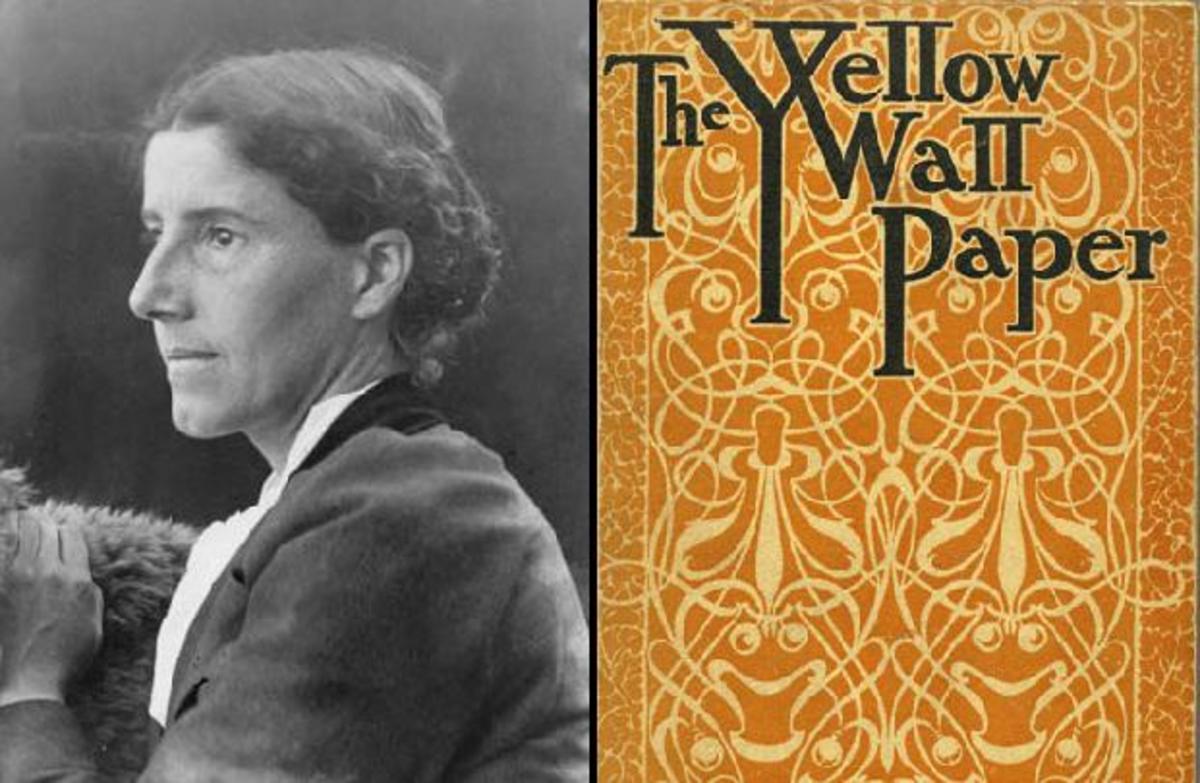
Gilman's most famous work, her short story "The Yellow Wallpaper", published in 1892, is about a woman suffering from mental illness after of being confined to a bedroom in the attic of a vacation home by her husband, John, for the sake of her health. She becomes obsessed with the room's repulsive, yet alluring yellow wallpaper. Gilman wrote this story to bring light to women's role in society, explaining that women's lack of autonomy negatively affects their mental, emotional, and physical well-being. She used it as a call to action for readers to recognize the legitimacy and complexity of illness and benefit in therapies for treatment, namely in women, and to overcome sexism in treatment
The narrator explains the embodiment of the authors experience during her time being treated by Dr. Mitchell's "rest cure". The treatment, which includes no physical activity, mental stimulation, or hobbies, is in direct conflict with what the author needs to get well. This drives her further into madness until she descends beyond the point of getting better.
Left: Charlotte Perkins Gilman     Right: "The Yellow Wallpaper" cover
Left: Charlotte Perkins Gilman Right: "The Yellow Wallpaper" cover

13.03.2016

De prehistorie van de Kaap volgens dominee Borcherds / Het Nederduitsch Zuid-Afrikaansch Tydschrift


[p. 75]

3 De prehistorie van de Kaap volgens dominee Borcherds

Onderweg naar Indië wordt de Oost-Indische ambtenaar Teenstra in 1825 door reumatiek gedwongen om in Kaapstad aan land te gaan.1 Na zijn ontscheping dragen twee slaven hem van de landingssteiger naar een bagage-wagen die hem naar zijn logement brengt. Daar zweeft hij geruime tijd tussen leven en dood, waarbij zelfs krachtige medicijnen - vomatieven, laxatieven, bloedzuigers, verzoete kwik en 's avonds opium - zijn toestand niet kunnen verbeteren. Alleen een kuur in de warme baden van Caledon heeft hem kunnen redden. Hierdoor is hij na zijn terugkeer naar Kaapstad in staat om indrukken van het Kaapstadse leven van 1825 op te doen.
Kaapstad maakte op hem over het algemeen een zeer gunstige indruk. Men at er goed, kleedde zich keurig en er was ook vermaak. Wie vrouwenvlees wilde zien, moest naar de schouwburg. Dankzij het warme klimaat lieten de vrouwelijke bezoekers veel bloot. Een attractie van wereldformaat was de vrijmetselaarsloge ‘De Goede Hoop’. Het gebouw met het alziend oog op de gevel was groots en in de achtertuin van hun loge hadden de heren vrijmetselaars een sociëteit met biljartzalen laten optrekken, die door scheepskapiteins werd geprezen als de beste in zijn soort ter wereld. Over het algemeen maakte Kaapstad op Teenstra nog een sterk Nederlandse indruk:
Niettegenstaande de Kaap-kolonie of volkplanting nu reeds 19 jaren onder het Engelsche Gouvernement behoort, hebben de Hollanders hier toch boven de Engelschen in alles den voorrang; ook noemen zij Holland het Vaderland, en de slaven zeggen niet zelden, als zij Hollanders zien: ‘daar gaan Vaderlanders heen’. (p. 85)
In deze nog steeds sterk ‘Hollandse’ Kaapkolonie was naast een Engels circuit het begin van een Kaaps-Hollands cultureel circuit te vinden. Ook hieraan nam Teenstra deel. Men mag immers aannemen dat hij niet alleen naar de schouwburg ging om decolleté's te bewonderen. Behalve schouwburgbezoeker was Teenstra lezer van het Kaapse Nederduitsch Zuid-Afrikaansch Tydschrift (nzat). De lectuur van een ‘treffend verslag’ van grotten bij Kaap Agulhas, geschreven door de Stellenbossche predikant Meent Borcherds, bracht hem ertoe daarheen een uitstapje te maken tijdens zijn reis door de oostelijke delen van de Kaapkolonie.2

Veranderingen in het Kaapse culturele leven rond 1800

Tijdens het verblijf van Teenstra had de Kaap op cultureel gebied meer te bieden dan in de laatste jaren van het Compagniesbewind. In de zeventien-
[p. 76]
de en de achttiende eeuw werd er wel geschreven in Zuid-Afrika, maar weinig daarvan was volgens contemporaine opvattingen literair. Men schreef teksten, zoals reisjournalen, brieven en dagregisters, die meestal niet voor publicatie bestemd waren. Poëzie werd hoofdzakelijk en hoogstzelden geschreven door passanten die hun werk in Nederland publiceerden.3 Als er al poëzie voor lokaal gebruik werd geschreven, dan bleef de circulatie ervan beperkt tot de familiekring door het ontbreken van een drukpers.4
Een regionaal cultureel leven dat de familiekring te buiten ging, ontstond pas aan het begin van de negentiende eeuw. Dit hangt samen met twee belangrijke ontwikkelingen. Allereerst werden na 1800 instituties opgericht die deelname van een groter publiek aan het culturele leven mogelijk maakten. In 1801 werd de ‘Afrikaansche Schouwburg’ geopend en 5 maart 1803 werd daar door het toneelgezelschap ‘Tot leering en vermaak’ De Papegaay van Kotzebue gespeeld, het eerste (vertaalde) Nederlandse toneelstuk in de Kaapse schouwburg.5 Enkele decennia later, in 1829, is er ook sprake van Nederlandse toneelopvoeringen in Stellenbosch, vijftig kilometer buiten Kaapstad.6 In 1802 werd in Kaapstad een departement van de Maatschappij tot Nut van 't Algemeen gesticht, waarvan vooral de verdiensten op het gebied van onderwijs enige aandacht hebben gekregen in de historiografie.7
Mensen met een donkere huid werden aan het begin van de negentiende eeuw nog niet van dit culturele leven uitgesloten. Het Kaapse departement van de Maatschappij tot Nut van 't Algemeen was bijvoorbeeld gesticht door J.A. Vermaak, bijgenaamd ‘Zwart Vermaak’, een rijke koopman, die voor een kwart van niet-Europese afkomst was.8 Een andere prominente Kapenaar van gemengd bloed was de predikant M.C. Vos. In zijn autobiografie, het Merkwaardig verhaal aangaande het leven en lotgevallen van Michiel Christiaan Vos [...] door hem zelven in den Jare 1819 briefsgewijze aan eenen vriend medegedeeld, verbergt Vos niet dat hij is geboren uit ouders die van ‘Europeesche en Aziatische voorouders afkomstig waren’.9
Voor het literaire leven was een tweede ontwikkeling nog belangrijker dan het ontstaan van culturele instituties: de komst van een drukpers aan het einde van de achttiende eeuw.10 Voor het eerst werd het hierdoor mogelijk teksten lokaal te vervaardigen en te verspreiden. Aanvankelijk waren dit uitsluitend gebruiksteksten, zoals aankondigingen en almanakken. In 1801 werd het eerste literaire werk van iemand uit Zuid-Afrika voor de Zuid-Afrikaanse markt uitgegeven: een niet bewaard gebleven gedicht van de Stellenbossche dominee Meent Borcherds voor een landbouwkundig genootschap. Het tweede literaire product van de Kaapse pers, het leerdicht De Maan van Meent Borcherds, uit 1802-3, is wel bewaard.11
[p. 77]

Het Nederduitsch Zuid-Afrikaansch Tydschrift

Het belangrijkste Nederlandstalige product van de Kaapse pers was echter Het Nederduitsch Zuid-Afrikaansch Tydschrift (nzat), dat ook door Teenstra werd gelezen.12 Het tijdschrift verscheen tweemaandelijks van 1824 tot 1843. In samenwerking met het nzat waren in 1824 ook twee afleveringen van een Engels tijdschrift verschenen, het South African Journal. Voor beide tijdschriften verscheen een gezamenlijke prospectus met de doelstellingen van de uitgave: ‘This Work [...] will be more peculiarly devoted to the moral and intellectual improvement of South Africa, and to the providing of useful information and enlightened entertainment to its provincial inhabitants, whether English or Dutch.’13 In het ‘Programma’ dat staat afgedrukt in de eerste aflevering van het nzat heet het:
Redacteurs koesteren de aangename hoop, dat dit eerste Tydschrift in Zuid-Afrika, niet nutteloos bevonden moge worden in het verspreiden van gezonde kennis en zuivere denkbeelden, en dat hetzelve strekken moge ter bevordering van zedelyke verbetering en maatschappelyk geluk.14
Het nieuwe tijdschrift was ontworpen naar voorbeeld van bestaande Europese tijdschriften. Er moesten echter vooral onderwerpen in aan bod komen die met de ‘kolonie’ te maken hadden, ‘als haren Handel, hare Staatkunde, voortplanting van den Godsdienst’, haar geschiedenis, gecombineerd met ‘mengelschriften over letterkundige, wetenschappelyke, en vooral Godsdienstige onderwerpen’.15 Als gevolg van moeilijkheden met de censuur werd de Engelse editie echter al na minder dan een halfjaar gestaakt, in mei 1824.16 Van het Zuid-Afrikaansch Tydschrift bleef zodoende alleen de ‘Nederduytsch[e]’ reeks voortbestaan.

VOC Gärten

09.03.2016

Auswanderung Schweiz

Für junge Männer war der Eintritt als Söldner in fremde Kriegsdienste bis in das erste Drittel des 19. Jahrhunderts die häufigste Form der Auswanderung. Ab dem 14. Jahrhundert standen die sogenannten Reisläufer im Dienst des Kaisers, der französischen Könige und von italienischen Städten wie z. B. Mailand (→ Schweizer Truppen in fremden Diensten).[96]
Hunger und Armut nach dem Dreissigjährigen Krieg führten zu Ausreisewellen nach Ostpreussen. Zu Beginn des 19. Jahrhunderts führte die kriegsbedingte (→ Napoleonische Kriege) allgemeine Verarmung zu Auswanderungen nach Russland, während in den Hungerjahren 1816–1817 besonders Lateinamerika das Ziel war. Die Landwirtschaftskrisen der 1840er-, 1870er- und 1880er-Jahren, sowie Umstrukturierungsproblemen während der Industrialisierung führten zu Massenauswanderungen in noch nie gekannten Dimensionen nach Übersee, besonders nach Nordamerika und Südamerika. Am Ende des 19. Jahrhunderts war Nordamerika für fast 90 Prozent der Emigranten das Ziel. Zwischen 1851 und 1860 wanderten rund 50'000 Personen nach Übersee aus, in den 1860er- und 1870er-Jahren je 35'000 und zwischen 1881 und 1890 über 90'000. Bis 1930 stabilisierte sich die Zahl der Auswanderer pro Jahrzehnt zwischen 40'000 und 50'000. In einigen Kantonen wurden Arme von den Behörden im grossen Stil zur Auswanderung gedrängt.
Die Auswanderer gründeten in der neuen Welt Kolonien, so entstanden 1803 Nouvelle Vevay in Indiana (heute New Vevay), 1831 New Switzerland in Illinois und 1845 New Glarus in Wisconsin.[97] Der wohl bekannteste Auswanderer war Johann August Sutter. Der als General Sutter bekanntgewordene kalifornische Ländereienbesitzer gründete die Privatkolonie Neu-Helvetien. Auf seinem Land brach 1848 der kalifornische Goldrausch aus.[98]
Gemäss empirischen Daten war die Wanderungsbilanz für das Gebiet der heutigen Schweiz von der zweiten Hälfte des 16. Jahrhunderts bis zum Ende des 19. Jahrhunderts stets negativ.[99]

08.03.2016

Kindstötung in der Sklaverei

Colonial-era fictional and non-fictional descriptions of slave motherhood offer conflicting accounts of the attitudes of slave mothers toward their children. While abolitionists tended to portray slave mothers as wholly selfless, doting, and maternal, pro- writers described slave mothers as negligent and cruel. The debate over the nature of slave motherhood was especially relevant to the Caribbean, where brutal working conditions, disease, and malnutrition impeded slave reproduction. Plantation owners blamed slave women for their failure to reproduce, accusing them of practicing birth control and procuring abortions. In some cases, planters accused slave women of committing infanticide.
It is difficult to ascertain just how often the latter occurred. There is certainly evidence to suggest that Caribbean planters’ allegations of slave women killing their infants were exaggerated.1 On the other hand, “the infant mortality rate from natural causes was undoubtedly high in the Caribbean, but the unusually high death rate within the first week, not satisfactorily explained as caused by tetanus, may signify that women used preparations which effected apparently natural death.”2 One of the more famous stories of slave infanticide in the Caribbean is that of Sabina Park, a Jamaican slave who was brought to trial for killing her young child. Park claimed that she “had worked enough for buckra (master) already and that she would not be plagued to raise the child… to work for white people.”3
The obvious response to slave infanticide is to conceptualize it as an act of desperation, a sad act, or an act of altruism, in the sense that it was intended to save enslaved children from a life of hard labor, degradation, and physical, sexual, and mental abuse.

But what if slave infanticide, in all its horror, was an expression of resistance? To conceptualize it this way places agency back in the hands of the slave women who killed their children, because it assumes that their decision was actively, discursively antagonistic and insurrectionary.
Reactions to slave infanticide varied according to one’s beliefs about the nature of slaves and the justice of slaveholding. According to Christopher Peterson, “for racist ideologues, slave infanticide is further proof of an animality inherent in black motherhood: a propensity to from which white motherhood is exempt. For abolitionists, [it] emerges both as proof of slavery’s evils and of a mother’s love for her children.”4 Indeed, in keeping with the viewpoint Peterson attributes to abolitionists, the obvious response to slave infanticide is to conceptualize it as an act of desperation, a sad act (which it certainly was), or an act of altruism—altruism in the sense that it was intended to save enslaved children from a life of hard labor, degradation, and physical, sexual, and mental abuse. But what if slave infanticide, in all its horror, was an expression of resistance? To conceptualize it this way places agency back in the hands of the slave women who killed their children, because it assumes that their decision was actively, discursively antagonistic and insurrectionary.
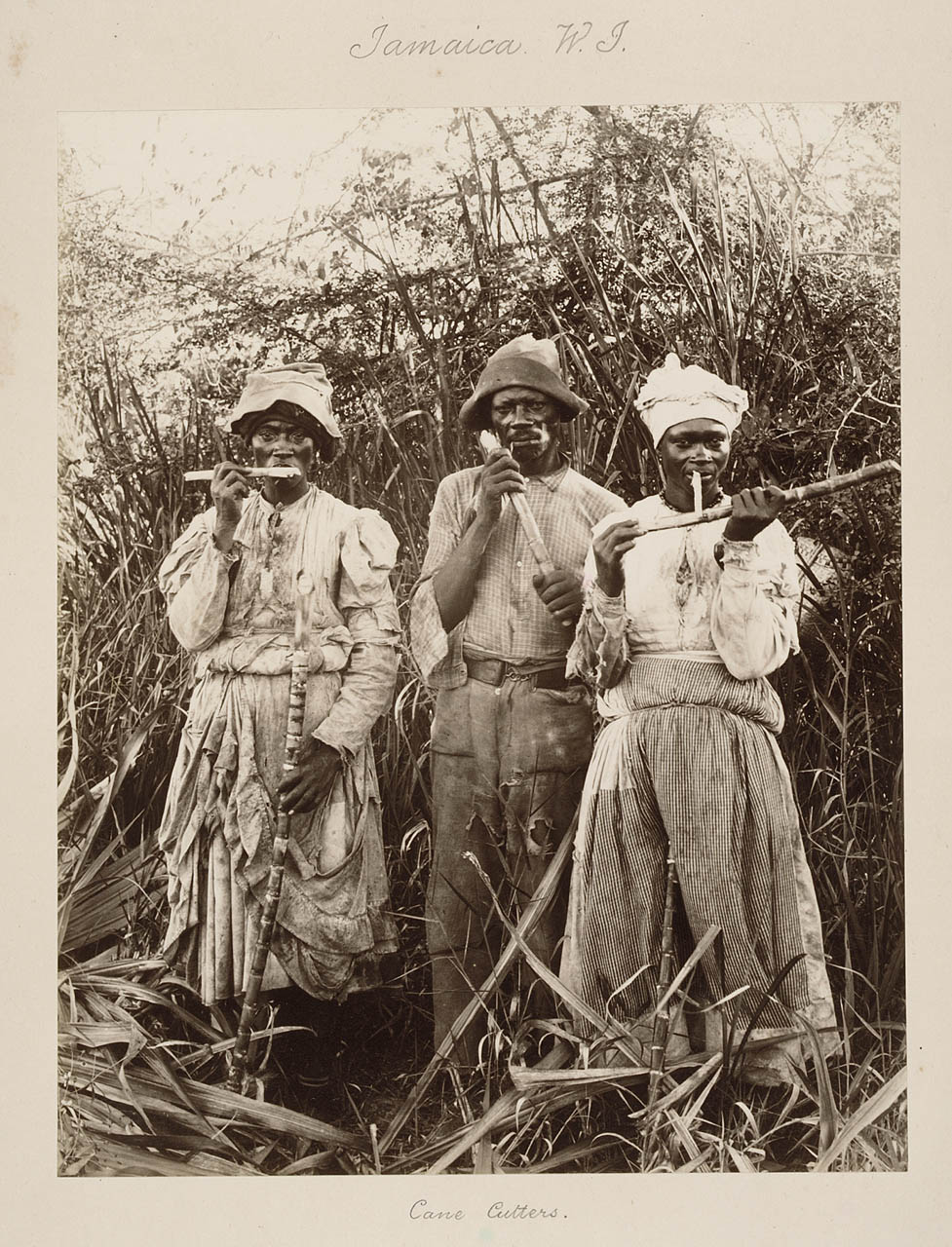
Cane cutters in Jamaica
An image depicting cane cutters in Jamaica after formal slavery was ended, mid-19th century. More than half of the slaves in the region were female.
The extremely grave nature of this subject matter merits an unusually high degree of respect and sensitivity in one’s approach to it. History is not a neutral discipline. Considering infanticide as a form of resistance is important in telling the story of Caribbean slave women as full people, as rational actors who made calculated decisions with rebellion in mind. Drawing on colonial-era accounts of slave motherhood, resistance theory, and recent work on the sociology of slavery, the central aim of this paper is to explore the equation of infanticide with resistance, with a geographical focus on the colonies of Jamaica, Barbados, and Saint-Domingue.5 All of the historical sources cited are from the mid-eighteenth century to 1834, when Britain abolished slavery in its colonies. Sources pertaining to Saint-Domingue are from prior to the slave rebellion of 1791 that culminated in the abolition of slavery in the colony.
Considering infanticide as a form of resistance is important in telling the story of Caribbean slave women as full people, as rational actors who made calculated decisions with rebellion in mind.
Extant accounts of Caribbean slave life are rife with racist assumptions about the supposed negligence and selfishness of black mothers. For example, many plantation owners accused slave women of procuring abortions with the intention of continuing to have promiscuous sex, unhindered by pregnancy.6 White observers such as plantation owners, overseers, and doctors believed that slave women’s alleged promiscuity made them especially prone to venereal disease. They often blamed slave miscarriages on the medicines slave women took (or supposedly took) to treat venereal disease.7 The logical implication of this belief was that if slave women were not so sexually indiscriminate, they would not need to take miscarriage-inducing medicines. Indeed, plantation owners found it more convenient to blame slave women for their failure to produce healthy offspring than to accept responsibility for the deplorable conditions that undoubtedly contributed to complications in pregnancy and childbirth. Physicians in Saint-Domingue accused slave mothers of causing mal de mâchoir (or ‘soreness of the jaw,’ cases of which have been retrospectively diagnosed as tetanus and neonatal tetany) among infants.8 This, of course, functioned to bolster the claim that enslaved women were neglectful, evil, unfit mothers.9 According to the French author of a 1790 pro-slavery pamphlet, they “destroy their own fruit, or they practice infanticide in order to live without moderation.”10
These derogatory cultural images of enslaved mothers are relevant to the analysis of slave infanticide because they colored white people’s perception of slaves’ reproductive habits. It was a difficult task, determining if a documented infanticide case was valid, and not a natural death caused by poor living conditions. As result, there is no clear consensus among historians on the issue. In 1796, a slave named Mary Thomas of the Newton Estate in Barbados was accused of killing her newborn infant. Historian Hilary McD. Beckles describes the event by restating Wood’s claim that Mary Thomas killed her infant out of anger at her white lover, the plantation bookkeeper.11 Beckles does not question Woods in this paraphrased account. Conversely, in her summary of the Mary Thomas case, historian Tara A. Inniss casts doubt on Wood’s accusation of infanticide, adding, “Enslaved midwives were easy targets for blame should the child succumb to illness or sudden death in the first days of life.”12 Inniss and Beckles’ differing interpretations of Wood’s account demonstrate the challenge of discerning fact from fiction in records of infanticide. It is almost impossible to tell if Mary Thomas was in fact guilty of killing her infant.
Jamaican cane cutters, mid 1800s after emancipation
Even those who believe that slave infanticide was common admit that this supposition is based on some speculation. In the words of Barbara Bush, who has written extensively on gender and slavery in the Caribbean, studying Caribbean slave infanticide requires “informed speculation and creative approaches in history.” 13 A perfect example of such a speculative, creative approach lies in James A. Delle’s analysis of birth and death records of the Radnor Plantation in Jamaica. Records from the years of 1822-1825 list eight infant deaths for which the cause of death is unnoted. Delle speculates that some of these were infanticides.14 Bush is one of the more vocal proponents of the argument that slave women frequently practiced infanticide. In an articled titled “Hard Labour: Women, Childbirth and Resistance in British Caribbean Slave Societies,” she notes that Caribbean populations grew significantly after emancipation, even though the standard of living hardly improved in most places. To her, this indicates that the “nature of slavery and the responses of slave women to their bondage must also be considered.”15 Bush notes that slave infanticide occurred in the antebellum United States, where slaves lived under generally better conditions than in the Caribbean. Thus, it was probably also practiced in the Caribbean.16 This statement is supported by the fact that, in general, Caribbean slave populations were more successful than those in the United States in preserving parts of West African cultural traditions. In many traditional West African cultures, newborn babies are not considered fully human until eight days after birth.17 According to Bush, the possibility that slave women committed infanticide through “letting” their young infants die (as opposed to violently killing them) is likely.18

slaves representations


http://scholar.library.miami.edu/slaves/representations/Individual_art_essays/carolines.htm

schiebinger - abtreibungspflanze

06.03.2016

“Nangu umfazi omnyama” – Hier kommt die schwarze Frau! Über neue Protest­be­we­gungen in Südafrika An den Südafrikanischen Universitäten verschaffen sich junge Feministinnen Gehör. Dabei geht es nur vordergründig um die Abschaffung von Studiengebühren.

http://geschichtedergegenwart.ch/nangu-umfazi-omnyama-hier-kommt-die-schwarze-frau-neue-feministische-protestbewegungen-suedafrika/

Derzeit lässt sich in Südafrika etwas Bemer­kens­wertes beobachten, von dem nur wenig in der deutsch­spra­chigen Presse zu lesen ist. Im Kontext der anhal­tenden Proteste der Jugend gegen die Regie­rung und das Establish­ment, und zwar insbe­son­dere von Studie­renden, findet zugleich ein Aufstand junger Frauen statt. Deren Proteste richten sich nicht nur gegen Studi­en­ge­bühren, ein nach wie vor koloniales Bildungs­system und die korrupte herrschende Klasse, sondern gegen das patri­ar­cha­li­sche System insge­samt, was den Sexismus in den eigenen Reihen einschliesst.


#RhodesMustFall-Proteste, Quelle: www.thedailyvox.co.za


A statue of Cecil John Rhodes was removed from Univer­sity Of Cape Town on 9 April 2015 after concerted student protest. Quelle: Tony Carr, flickr.com

So erklärte Mbali Matan­dela letztes Jahr im März in der renom­mierten Wochen­zeit­schrift Mail & Guardian: „When the Rhodes Must Fall movement began UCT feminists quickly called a meeting with its leadership. They were not going to let their voices be drowned out. After the movement’s first meeting, myself and a small group of black, radical feminists decided that we needed to stake our claim in talks about the univer­sity and its insti­tu­tional racism.” Ziel der studen­ti­schen #RhodesMustFall-Bewegung war zunächst die Entfer­nung der Statue von Cecil Rhodes vom Campus der Univer­sity of Cape Town (UCT) als ein Symbol der Koloni­al­ge­schichte und der Apart­heid sowie der fortwäh­renden weissen Dominanz in Südafrika.

Südafrika ist noch immer bis in die feinsten gesell­schaft­li­chen Poren hinein vom Rassismus geprägt, wie sollte es auch anders sein, denn schliess­lich liegt das Ende der Apart­heid noch nicht einmal eine Genera­tion zurück. Dazu kommen, bei aller hausge­machten Misswirt­schaft und Korrup­tion, die Auswir­kungen des globalen Kapita­lismus und das Erbe der Apart­heid auch in wirtschaft­li­cher Hinsicht. So regelten unzäh­lige Gesetze den Zugang zum Arbeits­markt, zu Bildung und Ausbil­dung und privi­le­gierten als weiss klassi­fi­zierte Menschen in jeder Hinsicht. Die neue Regie­rung hatte 1994 keines­wegs ein prospe­rie­rendes Land mit einer gesunden Wirtschaft übernommen, sondern u.a. einen absurd aufge­blähten Staats- und Verwal­tungs­ap­parat, mit Ämtern und Behörden parallel und exklusiv für jede der gesetz­lich festge­legten „Rassen­gruppe“.

Jambo, Abenteuer, Unterhaltung und Wissen aus Kolonie und Übersee


Schwarze deutsche Kolonialsoldaten

http://www.transcript-verlag.de/978-3-8376-1054-3/schwarze-deutsche-kolonialsoldaten

Tansania -Park


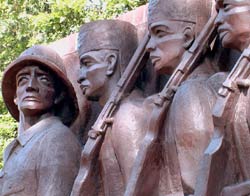
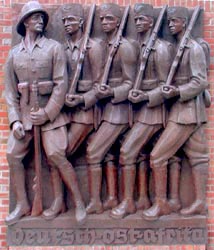
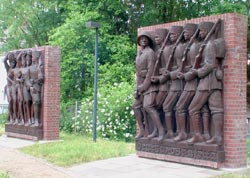
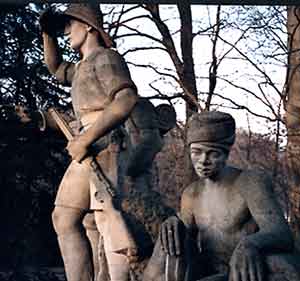
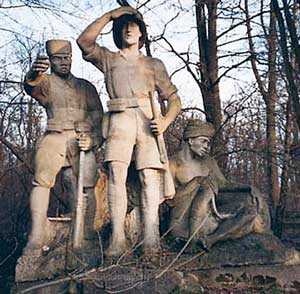
ls angeblichen 'Beitrag zur Völkerverständigung' hat in 2003 der Kulturkreis Jenfeld ein kolonialrevisionistisches Denkmal aus der NS-Zeit restaurieren und wiedererrichten lassen. Auf dem Gelände der ehemaligen Lettow-Vorbeck-Kaserne (benannt nach jenem General und Oberbefehlshaber in 'Deutsch-Ostafrika') wurde in einem sog. 'Tansania-Park' neben einem kolonialen 'Schutztruppen-Ehrenmal' und in Nachbarschaft eines 'Trotha-Hauses' das 'Deutsch-Ostafrika-Kriegerdenkmal' (jetzt offensichtlich umbenannt in 'Askarireliefs') aufgestellt. Vor der Errichtung waren die Reliefs in der Sammlung Peter Tamm zwischengelagert gewesen. Die Baubehörde übernahm die Kosten für Denkmalrestaurierung und Parkgestaltung.

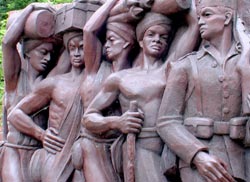
Die Terrakotta-Reliefs stellen fünf afrikanische Askarisoldaten und vier Träger im Dienste der deutschen Kolonialtruppen dar, geführt von einem deutschen Unteroffizier. Sie bringen sowohl kolonialrevisionistische als auch nationalsozialistische Auffassungen von 'Treue' und 'Gehorsam' der Schwarzen Soldaten zum weißen 'Führer' zum Ausdruck - einer der hartnäckigsten Mythen vom 'Kolonialidyll' und zugleich eine vermeintliche Legitimation, die Kolonien zurückzuerobern.

Deutsch-Ostafrikaner-Ehrenmal'


Das 'Deutsch-Ostafrikaner-Ehrenmal', eine safariromantische Darstellung der Kolonialzeit, steht heute versteckt im Park des Restaurants Waldesruh in Hamburg- Aumühle. Ursprünglich sollte das Denkmal in den1930ern in Potsdam errichtet werden, wo es wegen der geringen künstlerischen Qualität jedoch abgelehnt wurde. Dann wurde ein Standort in Düsseldorf in Erwägung gezogen. Im Zweiten Weltkrieg unterblieb die Aufstellung an einem öffentlichen Platz. Paul v. Lettow-Vorbeck (> Stichworte) hat sich persönlich für den jetzigen Standort stark gemacht.

Heinrich Carl Schimmelmann

"Hübscher Neeger-Junge für die gnädige Frau Baronesse". Der aus Dresden stammende Schimmelmann galt als der bedeutendste Sklavenhändler des Dänischen Reichs. Auch belieferte er Adelshäuser mit 'Kammermohren'. Es galt als schick, sich mit exotisch anmutenden Leibeigenen zu 'zieren'. Hier hat sich Schimmelmann selbst abbilden lassen mit den 'Seinigen': einem schwarzen Diener und einem Portrait seiner Frau. Ihm zu Füßen die Weltkugel als Symbol für seine globalen Handelsbeziehungen.

Askari

Tropische Landschaft in Deutsch-Ostafrika von Themistokles von Eckenbrecher, 1896, Darstellung einer kriegerischen Auseinandersetzung zwischen einheimischer Bevölkerung und Kolonialherren, unterstützt durch Askaris

Als Askari (von Swahili für „Soldat“, ursprünglich arab. عسكري ‘askarī, auch in Sprachen wie Türkisch, Persisch und Somali als Lehnwort vorkommend, Plural im Deutschen Askaris[1]) wurden vor allem in Afrika einheimische Soldaten oder Polizisten in den Kolonialtruppen der europäischen Mächte bezeichnet. Die Bezeichnung wurde in den Kolonialtruppen von Italien, Großbritannien, Portugal, Deutschland und Belgien gebraucht. Askaris spielten sowohl bei der Eroberung von Kolonien als auch danach bei der Aufrechterhaltung der Kolonialherrschaft eine wichtige Rolle. In beiden Weltkriegen kämpften sie auch außerhalb ihrer Herkunftsgebiete. In der Schutztruppe für Deutsch-Ostafrika war Askari gleichzeitig die Bezeichnung für den untersten Mannschaftsdienstgrad.


Askaris vor 1910

Im deutschen Sprachraum sind Askaris zuerst durch die Orient-Romane Karl Mays, dann durch die Askaris der Schutztruppe für Deutsch-Ostafrika bekannt geworden. Sie bildeten den Großteil der deutschen Schutztruppe in Deutsch-Ostafrika und trugen im Ersten Weltkrieg die Hauptlast des Kampfes gegen die britischen Truppen.