21.07.2017

THE FRAGILITY OF THE WESTERN TRAVELER: TIME TO (UN)PACK THE COLONIAL BAGGAGE


Illustration by Subin Yang

This feature, on the continuing destruction of colonialism through exploitative tourism, is the fourth of our monthly longreads on the topic of Fragility. Every month through December 2017, we’ll publish a new must-read perspective on the subject that we hope you’ll read, share, and make part of your routine.
For now, though, get comfortable and get ready for part four: It’s time to unpack your bags and rethink how you travel the globe.

The first image we’re drawn to is a white man. He is positioned at the center and looking straight at us. To his right stands a Native Hawaiian woman in all her bobblehead glory—the flower in her hair, a burnt orange lei around her neck, and a hula skirt that looks to be made out of leaves. Her bright red lips curl into a subservient smile, her eyes creased in his direction as she adorns the man’s outstretched neck with a lei. To his left is a white woman resting her jaw in a hand, pensively watching the exchange between the man and the Native Hawaiian woman, and, being situated between the two, the man wears a dopey look on his face, as if he’s asking us, ‘How lucky am I?!’ ‘An island surrounded by blue water beckons from a distance and above it reads the words, ALOHA FROM HAWAII.
“In this grotesquerie, the falseness and commercialism fairly scream out from the page,” writes Haunani Kay-Trask in Lovely Hula Hands: Corporate Tourism and the Prostitution of Hawaiian Culture, a takeaway we can apply to the image described above, and really, could be ascribed to the countless images that look just like it, for there is little variation in the marketing of a place like Hawaii. And there exists no other depiction of Native Hawaiian women outside of this static western prototype. “Thus, Hawai’i, like a lovely woman, is there for the taking,” sums Kay-Trask.

THE PROMISE OF WOMEN'S BODIES
The use of women’s bodies—and specifically, the promise of sex—to sell any and everything under the sun has long been the subject of beef between feminists and the advertising world, but what happens when the product being sold is a place? The marketing of women’s bodies, namely, those of color, as destinations to be consumed, lands to be penetrated, or as accessories to the (masculine) tourist experience has remained a largely uncontested norm in travel ads, from vintage depictions of the Hawaiian feminine to the mainstream pimping of Brazilian women’s bodies from brands like Adidas and Kia Motors during the 2014 World Cup. In examining these depictions through an intersectional feminist lens, and factoring in the consequences of such depictions on the lives, lands, and bodies of women of color, we can then decode their lasting message: that mass tourism and colonial occupation are often one and the same, and POC bodies, cultures, and lands are the exotic dominion of the settler. So what does tourism’s dehumanization of women of color tell us about the fragility of the western traveler? What role does patriarchy play in selling place? And what does—or doesn’t—constitute a feminist travel narrative?
Ever since European colonization gave birth to the western travel narrative, the ‘traveler’ has had a tendency to gender the land before him, and even the vessels who bring him to his destination, using cliches of ‘virgin forests’ waiting to be ‘explored’ and ‘wild’ (read: Indigenous) terrain unacquainted with the poke of flag, assigning himself as the active male do-er while the land and its passive people are being done unto. Kay-Trask continues in this vein, writing, “Hawai’i is “she,” the Western image of the Native “female” in all her magical allure. And if luck prevails, some of “her” will rub off on you, the visitor.” Wilderness is then very much a white supremacist concept, a fantasy land void of people and their resistance where the settler can escape to when the travails of civilized life grow too taxing (#FirstWorldProblems amirite). The flowery rendering of ‘exploration’ inherent in the tradition of travel writing, from the Doctrine of Discovery to Anthony Bourdain's Part's Unknown, is all about thinly veiling his insatiable urges to make a place his bitch.
In feminizing place, patriarchy demotes it to the realm of the female, that is, not valued, but valuable, and when we add capitalist imperialism to the mix, she is ceaselessly plundered for her resources by settlers. And in many ways, today’s western traveler is a descendant of the settler. There’s an uncanny resemblance between the way the settler treats the land and how his society treats women of color. To sell a place, that is, to advertise to consumers that it is available for ownership, it first has to be objectified, and since white men in these ads signal action and ownership, the women of color are easily sold with the product. A relic of colonial nostalgia that would get Hemmingway hard, she’s coded as more ‘traditional:’ not yet influenced by the likes of (white) feminism. At a special meeting of Women Ministers of Culture in Iceland, Dr. Annette Pritchard gave a presentation calling this product a “remarkably durable imaginary, which is routinely recycled in the gendered, sexed, and racialized cultural iconographies of the travel industry.” In order to tame women and to tame the wild, he must depict her as tame. In using one to market the other, they “both continue to be framed by colonial myths and fantasies,” she continues, “so that these leisure landscapes are feminised and eroticised” in order to justify occupation. He came, he conquered, but in the context of settler colonialism and tourism, he never left. Like a cheap souvenir, “Hawai’i itself is the female object of degraded and victimized sexual value,” sums Kay-Trask. Considering this, travel media can be understood as the very narrative behind domination dressed up as leisure. But leisure for whom?

PASSPORTS OF ENTITLEMENT
Leisure travel is all about escape and indulgence, which, to the western tourist, can seem rather harmless. But consider the dichotomy between what is being escaped and what is being escaped to. “From the mid-1800s to the 1930s, the acceptance of wild landscapes inhabited by Native peoples as being natural evolved into an idealization of uninhabited landscapes,” writes Carolyn Finney in Black Faces, White Spaces: Reimagining the Relationship of African Americans to the Great Outdoors. It seems that the white settler can not enjoy nature without conquering it or without objectifying the land and relegating the rest to ‘nature’ for ornamental relief. “Implicitly,” she continues, “it is linked to a legacy of Eurocentrism and the linkage of wilderness to whiteness, wherein both become naturalized and universalized.” Heroes of the National Park and Reserve system like John Muir, who was very anti-Black and Native, worked from a place that destruction of ‘nature’ for development was OK, just set a little green aside for us to vacation in. As Kay-Trask clarifies, “Tourists flock to my Native land for escape, but they are escaping into a state of mind while participating in the destruction of a host people in a Native place.”
Likewise, indulgence to the fragile western tourist is deserved, something they are entitled to. Just challenge them on this and you’ll see how fragile they are. (One butthurt bro wrote a whole article in response to my work: “[Amor] rejects the idea that holidays are about fun and freedom.” He has a point, though. I am wholeheartedly anti-fun and GET THAT FREEDOM AWAY FROM ME.) In his lecture at Massey University in New Zealand, Ripping off the Brands: a Rough Guide to Anti-travel, writer Scott Hamilton said, “Travel has become the ‘other’ of work. Because we are often so busy at work, we choose to be indolent on holiday—to switch off cell phones and brains and lie on a beach. We can be selfish and demanding on holiday.”
In travel ads and media, images of women lying on beaches communicate indulgence to the tourist; a report on gender in tourism marketing found that “body shots describe the destination as a place where the tourist can indulge him or herself.” In wanting to be taken care of, the tourist infantilizes himself without considering whether or not his host deserves a break, too. “Every native would like a rest, every native would like a tour,” Jamaica Kincaid expertly explains in A Small Place, “but most natives in the world cannot go anywhere. They are too poor to go anywhere. They are too poor to escape the reality of their lives; and they are too poor to live properly in the place where they live, which is the very place you, the tourist, want to go—so when the natives see you, the tourist, they envy your ability to turn their own banality and boredom into a source of pleasure for yourself.”
Indulging in ‘uninhabited’ landscapes takes on an interesting life when embodied by white women. As Mary Fillmore writes in Women and Tourism: Invisible Hosts, Invisible Guest, “A tourist destination is where men of one class can enjoy the privileges of men of another class, and women can enjoy the privileges of men.” White women, that is. She continues, “Someone else will cook their meals, make their beds, clean their toilets,” but how does that differ from the norm of women of color laboring for white women here in the States? It doesn’t, but for white women, indulgence itself is what constitutes feminism.

HOSTESS WITH THE MOSTEST OPPRESSION
From the wide world of travel writing by white women to the ones in my Twitter mentions responding to my question, “What does a feminist travel narrative look like to you?” there’s a general consensus that feminism is (white) women simply doing whatever they want, including going on vacation. Fillmore advises us to “consider what the tourist seeks” in order to look “at tourism through the feminist lens. The tourist’s desire is usually to be indulged like a child, being free to indulge one’s appetite at will, to play all day” and have someone else (spoiler alert: WOC) clean up the mess. These host communities end up playing the role of the Mother to the infantilized tourist. There’s nothing feminist about taking selfies with Maasai women struggling to hold onto their dignity in the face of exploitative tourist practices—that’s some colonial Mammy shit.
Clearly, this is indicative of white feminism’s shtick of employing the tawdry guise of ‘female empowerment’ to assuage their white guilt. But even when laborers in tourism are conveniently erased from mainstream women-centered travel plots, patriarchy’s prints can still be found all over their reels. Take the (very few) travel-ish films starring women, for example, Eat, Pray, Love, Wild, Aloha, How Stella Got Her Groove Back, Last Holiday, and Under the Tuscan Sun. Cishet romances drive these stories, telling us that women travel to either get over a dude, find a new one, or both. Let’s use Amy Schumer, and her latest movie, Snatched, as an example. After she’s dumped (check) on the eve of an ‘exotic’ getaway (check) to my home country of Ecuador, she takes her mom instead, and they both get hilariously get kidnapped (check) by random natives in the Amazon jungle. Basically, two white women bond over farts while wild men of color prey on their fragile femininity on Indigenous land. In making their disposable film, they’ve rendered my people and place disposable, too.
From the Black Mammy trope to that of the Singapore Girl, Spicy Latina, Pocahontas, and China Doll, women of color are deemed to exist to serve the whims of the white settler, whether that be sexual or domestic. (The current boom in sex tourism by white women to the Caribbean and Africa says enough about the white supremacist hypersexualization of Black boys and men, but I digress.) They’re either depicted as sexless or hypersexual, which, in denying a woman’s agency over her body, are both objectifying. Kay-Trask breaks down the consequences of a western tourist gaze on women’s sexuality, writing that hula dancers are to “behave in a manner that is smutty and salacious rather than in a way that is powerfully erotic. The distance between the smutty and the erotic is precisely the distance between western culture and Hawaiian culture.” Travel media preserves the colonial origins of so many stereotypes about women of color, which Dr. Annette Pritchard elaborates on, saying that they “recycle not only hetero-patriarchal but also ‘colonial’ myths and fantasies, so that gendered and sexed representations of women are used to exoticise and eroticise” the Global South and East. This extends from advertising and into travel writing and TV shows, which “all play a part in mapping the sensual topography of land and skin so that the women and the landscapes of the Caribbean and the South Pacific become analogous.”

BORROWING FROM RAPE CULTURE
Much of the lingo used in travel writing and marketing consistently employ the language of rape culture. In feminizing place, tourism marketing has also sexualized it, showing just how creepy his obsession with owning the Other is. (Colonial dudebros really know how to put the ‘lust’ in ‘wanderlust.’) Let’s start with a brochure from the Jamaica Tourist Board that promises that “tempting sunsets appear as girls with cinnamon-coloured skin walk the beach wearing bikinis the size of butterflies. This is your Eden. Welcome to Negril.” (Italics mine.) One male traveler writes that India “awaits you. She is an indescribable and unforgettable land [where] every whim will be gratified.” (Are these writers or wannabe pimps?) Another male travel writer describes Tahitian women as “dusky, voluptuous village girls” who “tempt tourists” with their “long hair, velvet skin [and] fragrance.” But it’s not just creepy, it’s a marketing ploy. And isn’t that even creepier? Dr. Pritchard writes that the Tahitian women here “represent the enticing and inviting land to be explored, mapped, penetrated and known by the male traveller.” She is a symbol for the brand that is Tahiti vying for the gaze of the tourist, the consumer. Her boss.
Consider the relative ease with which western cis male tourists are able to travel. Travel writing, blogs, and memes overflow with entitled, thoughtless language like, “Spin the globe. Where it lands, that’s where we’ll go,” and “I was not born for one corner; the whole world is my native land.” They generally have more money to spend on travel, more time to take off from work, less responsibilities to family, powerful passports, few barriers to acquiring visas, are not criminalized by the TSA, are less vulnerable to policing and sexual harassment, and besides not having to worry about being treated like a human being wherever they go, are treated like rock star royalty in the developing world, where their dollars triple. And when traveling is a cakewalk to you, feeling entitled to it naturally follows. Travel marketing fuses travel ‘destinations’ and the host women into one brand, so that the tourist is not only entitled to the land by design, but to its women. “In [tourism advertising] we will see that stereotypical gendered, sexed and often racialized images of women are in many cases part of the tourism product itself,” summed Dr. Pritchard. This is part of what makes sex tourism, trafficking, and abuse by western male tourists more rampant and commonplace than any mainstream outlet has given it credit for.


In an industry where women are the face of the product and not the business, where they are over-concentrated but invisibilized, working menial tasks for less pay than men, they are made dangerously vulnerable. Especially as hotel and other travel brand owners are either foreign whites or national elites, and tourism laborers are usually non-unionized, the substantial power differences therein shrink the woman and her rights, making her prey to the potential attacker. A 2003 report from the International Labor Office finds that women in the tourism industry aren’t just vulnerable to male coworkers and bosses, like other sectors, but to their clients, as well. Citing the report, Dr. Pritchard writes, “Factors such as late working hours, service of alcohol, dress codes, racism, negative attitudes towards service staff and the uninhibited, sexualised nature of tourism and tourism promotion contribute to a high-risk environment for women and younger workers, as well as ethnic minority, migrant and part-time workers.” (Italics mine.) In a similar United Kingdom study of graduates in the hospitality industry, 44 percent said they had experienced some type of violence, and 50 percent of those respondents say it was directly due to their gender. “Overall,” the report concludes, “respondents in non-managerial occupations reported customers as the most likely perpetrators.” Not only do many men travel specifically to engage in sex tourism, mostly in majority-POC regions, but they’re also afforded more opportunities to harass or attack women, as they are more likely to be their flight attendants, maids, waitresses, bartenders, and sex workers.

EAT, PRAY, LOOT
But what of the ripple effects of mass tourism on women of color, regardless of the tourist’s gender or intent? A major one is displacement, when gubernatorial or corporate powers (or both) seize local land in favor of resorts, displacing local people and replacing local industries. Studies by Tourism Concern show that “forced displacement and loss of livelihood due to tourism development in” coastal areas historically inhabited by fisherfolk “has caused disenfranchised fishermen to turn to drink, which is often a forerunner to domestic violence against women and children, and even abandonment.”
Overconsumption of resources and environmental degradation are also effects of mass tourism that directly impact women of color. In Invisible Hosts, Invisible Guest, Mary Fillmore writes, “It is a local woman who must pay the price for the tourist’s luxuries.” Inflation follows growing tourist demands for imported items. “It is she who must go farther and farther for smaller and smaller amounts of water, who must carry less over greater distances.” Traveling further for water is known to raise a girl or woman’s exposure to violence. “She is the one who must make do with less in cooking and in washing herself and her children.” The tourism industry is real good at overusing water in places where access to drinkable water is scarce, especially since resort tourism is typically done in developing countries. “Her working day, often already overextended to include paid as well as unpaid work, is lengthened further.” Notice a pattern here?
While it’s no news that women’s’ labor is devalued around the world, especially that of women of color, it is either erased or glamorized as a part of the tourism product. Like a free gift tossed to the bottom of a cereal box, she is molded to attract the attention of swinish boys expecting the product to match its advertisement. “It is as if everywhere we go, we become someone’s private zoo,” wrote Trinh T. Minh-ha in Woman, Native, Other. The thing about women though, and the places they come from, is that neither are static, ageless, or free of resistance. That image was brought to you by colonization, a process that necessitates the devaluing of land and its people by creating a system of difference with which the white man could prop himself up on. And travel media refuses to discard of those stereotypical scenes that carry the vestiges of imperial rule to today, because without them, they wouldn’t have a brand, much less a product to sell.
In an industry that would cease to exist if it weren’t for women of color, “They are among the most useful pawns the industry has to move to the front of the board to attract the Northern male tourist,” writes Fillmore, “depicting them as compliant, submissive, and ultimately accommodating.” But if you tell this to a white travel writer or just a Western traveler, that just as women don’t exist for male consumption, their lands don’t exist for tourist consumption either, their fragile sensibilities will buckle before you. And that’s because he needs to believe that he is propped up by nature and not by design in order to keep Eat, Prey, Looting. Cool story, bro.
Check in next month for the next piece in our series on fragility.

Part 1 | Part 2 | Part 3 | Part 4 | Part 5 | Part 6 | Part 7 | Part 8


Bani Amor is a queer travel writer, photographer and activist from Brooklyn by way of Ecuador who explores diasporic identities, the decolonization of travel culture, and the intersections of race, place and power in their work. They’ve been published in Bitch Magazine and Apogee Journal, among other outlets. They are a three-time VONA/Voices Fellow and have an essay in Brooklyn Boihood’s anthology Outside the XY: Queer Black and Brown Masculinity. Follow them on Twitter @bani_amor.

The fragility series is published each month by Bitch Media, a nonprofit, independent, feminist media organization. Think our work deserves your support? Become a Pollinator and get great benefits—we're talking mugs, a subscription to award-winning Bitch magazine, stickers, and more!

18.07.2017

All Things to All People?: Thoughts on Liberalism and Imperialism

THE DISORDER OF THINGS
JULY 18, 2017 / GUEST AUTHORS

This is the second post in our book forum on Reordering the World: Essays on Liberalism and Empire. The first post by Duncan can be read here. Dan Gorman is Associate Professor in History and Political Science at the University of Waterloo and Director of the PhD programme in Global Governance at the Balsillie School of International Affairs. He is currently working on a project which assesses the role of the UN as a venue for debates over decolonization from the end of WWII to the early 1960s.

Duncan Bell has packed a career’s worth of work on the intellectual history of Britain and its empire into the last dozen or so years. His recent collection of essays, Reordering the World, considers the intellectual attempts by British liberal thinkers (mostly, though not entirely, Victorians) to reorder the international system through empire, and the means by which they justified and rationalized their ideas. The essays republished in the volume have been updated to account for more recent scholarship and the evolution of Bell’s thought. They are joined by new essays on the “dream machine” of liberal imperial thought and on the Victorian imperial publicist J.R. Seeley, whose book The Expansion of England(1883) is the exemplar of Victorian liberal imperial boosterism. Reordering the World is not just a “scholarly greatest hits”; rather, its finely-grained and astute essays are united within a common field of interpretive focus on what Bell terms the “pathologies and potentialities of empire.” (2)

Despite imperialism’s central role in nineteenth century political discourse and world affairs, as well as its influence on the creation of the discipline of International Relations (IR), it has been conspicuously understudied by political scientists. In a discipline that continues to position the nation-state as its theoretical alpha and omega, an examination of the constitutive role of imperial variables such as race and “civilizational” hierarchies has been left to exceptional studies by scholars such as Robert Vitalis, David Long, and Brian Schmidt whose work seeks to “desegregate” IR and reveal its imperial origins. Yet, as Bell’s essays demonstrate, nineteenth century international relations was in many ways about imperialism, and empire remained (and, in the eyes of scholars such as Jeanne Morefield, remains) a salient category of international politics well into the twentieth century. The “imperial turn” in historical scholarship,[1]meanwhile, has in a rich irony colonized much of the historical discipline over the past several decades. Bell’s scholarship is so rewarding in part because he seeks to identify connections between imperialism and the disciplinary history of international relations.

In our ostensibly post-imperial age, imperialism would seem incompatible with liberalism’s core values of liberty and equality. As Bell’s carefully constructed contextual and summative essays demonstrate, however, liberalism has historically been a protean and reflexive intellectual tradition. While liberal thought on empire was united loosely by imperial imaginaries shaped by hierarchies of “civilization,” a conviction that technological progress was compressing space and time, and a historical sensibility, it was also highly elastic, and capable of containing contradictions (most importantly, concerning race) and hybrid ideas held in common with other intellectual traditions (for instance, liberals’ and socialists’ shared advocacy of strategies of indirect rule after the First World War). Imperium et libertas could thus as easily be complementary forces as mutually exclusive. Bell thus rejects the more canonical approach to the history of liberalism and imperialism adopted in key works by historians such as Uday Mehta, Jennifer Pitts, David Armitage, and Karuna Mantena. While not neglecting the (sometimes misunderstood) role of Mount Rushmore liberals such as John Locke and John Stuart Mill, Bell’s focus is not the archetypical liberal thinkers is whose ideas the wisdom of the age is allegedly distilled, but the public moralists, essayists, and imperial ideologues whose often unsystematic and sometimes contradictory thought informed much of the intellectual cut-and-thrust of Victorian political discourse on imperialism.

Bell highlights two significant themes in Victorian liberal thought on empire: the largely overlooked significance of settler colonialism, and of the white settler colonies, to Victorian ideas of imperial world order; and the historical consciousness of liberal imperial thought. I’ll reflect only on the first theme in this post. Settler colonial studies has continued to grow since many of these essays were first published (see, for instance, Lorenzo Veracini’s Settler Colonialism: A Theoretical Overview and the very active Settler Colonial Studies blog), but it remains the case that imperial history, and especially self-identified “new imperial” histories,” as a generalization, concentrate on India, and to a lesser extent, Africa and the Caribbean. One reason for this is the well-warranted “new imperial” focus on the history of race. With exceptions, the settler colonies are comparatively absent from such work. Instead, the imperial and racial histories of settler colonialism have emerged piecemeal from respective national historical traditions, and only in the last decade or so have historians begun to uncover the material and intellectual connections between them.[2]

What we need are more studies connecting the imperial histories of the settlement colonies with those of the dependent Empire (including India) and of Britain itself. Bell’s essays provide several suggestive avenues for such connective histories, including transnational intellectual histories of “the thought-worlds of the settler empire” (368), that would avoid centrifugal histories of imperial thought that presume ideas of empire emanated from the imperial “centre” and were disseminated to a captive and passive colonial audience. Here settler ideologies regarding indigenous peoples, property, progress, and competing cosmologies are particularly relevant. So, too, is the historical irony that while metropolitan liberals argued in the later nineteenth century for the merits of imperial unity, settler colonial governments pursued various forms of imperial exclusion through restrictive immigration policies.

Unruly Poems that Illuminate White Supremacy in Everyday Life

Poet Nikki Wallschlaeger’s new book Crawlspace discovers the violence embedded in our most familiar structures: mortgages, meals, rooms, houses, family relationships, and language itself.


Nikki Wallschlaeger, Crawlspace (Bloof Books, 2017) (all images courtesy Bloof Books)

The word “mortgage” comes from old French and means, literally, “dead pledge”: an arrangement that “dies” if a promised payment fails. The figure of death is etymologically built in to a very common kind of American debt that belongs to those lucky enough to own property. It’s the death pledge that gives us the right to our homes, the places that nurture and sustain our livelihoods and lives.

Poet Nikki Wallschlaeger is keen on the complex relationship between debt and domestic life. Her new book Crawlspace (Bloof Books, 2017), a series of sonnets that consciously disrupt their own formal limits, discovers the violence embedded in our most familiar structures: mortgages, meals, rooms, houses, family relationships, and language itself. Wallschlaeger’s poems feel timely, as the links between property ownership, alienated labor, and the history of black slavery in the United States (“Greasy gangrene hamburger wrapper of a country,” in her words) become clearer by the day. She deploys a new vocabulary for talking about the legacies of slavery and white supremacy as they manifest in daily life — a vocabulary that is as damning as it is lush, as rich with sound as it is bright with image.

The sonnets in Crawlspace begin in standard, contained 14-line form, and gradually lengthen and widen themselves to fill pages. Like the domestic spaces her language evokes, these pieces become unruly, revealing the mess behind polished exteriors. A whole world emerges as the pages progress, populated by hyperbolized pieces of reality, such as “fresh Klonopin ribbons,” “King Cotton Casseroles,” “unlikable women,” and “drool rot and toxic sprayed tongues.” Wallschlaeger’s sentences flow and twist, moving between description and history: “George Washington’s mouth comin at you/yappin some bullshit about honesty or was/that Abe Lincoln I dunno they start to fade/into the same knockoff appropriated war/bonnet or kente cloth bathing suit worn on/Cinco de Mayo in Daytona on college break.” She warps old truisms, like “it takes a village to raise a/ child in nude-colored handy cuffs.” Throughout these pieces, there’s a pervading sense that language itself is one of the structures that maintains racism, or “misogynoir grimcrack.” In breaking language’s formal rules, Wallschlaeger appears to also break the rules of systemic oppression.

Nikki Wallschlaeger, I Hate Telling You How I Really Feel

Many of the lines in Crawlspaceappear in Wallschlaeger’s I Hate Telling You How I Really Feel, a graphic chapbook published by Bloof Books in 2016. This book presents portraits of Mattel’s “Julia” Barbie doll (produced 1969–70 and modeled after TV star Diahann Carroll), bracketed by meme-style language. It’s a good visual companion to Crawlspace. The poet’s weariness with white male supremacy and female labor comes through perfectly in the wry face of Julia: “I wish you were a beer/ instead of a colorblind mansplainer,” reads one meme. In these pieces, as in Crawlspace, Wallschlaeger hits a delicious pitch somewhere between tragedy and humor; her singular first-person voice persists throughout the work, narrating the energy she draws, like a phoenix, from her own exhaustion.

With Crawlspace, Wallschlaeger enters the tradition of poets and artists who illuminate black female subjectivity — Wanda Coleman, Carrie Mae Weems, Lucille Clifton, Lorna Simpson. The domestic scenes she makes in her poems complicate clichés of who black women in America are “supposed” to be. The fraught splendor of Kara Walker’s “A Subtlety, or the Marvelous Sugar Baby” comes to mind when Wallschlaeger speaks of “Writing under the constraints of your oppressors, whoever they are. / You start to articulate through the gold hippo lick of their loving war.” Hers is a poetry that is attentive to the nefariousness of American debt, that searches out what she as a black woman is owed, and what she is made to pay. She calls out the blood-ties between debt, cruelty, and this place we call home — and she has a great time doing it. Wallschlaeger’s voice is transformative in its capacity to articulate her lived experience. “We, as marked women transform/ ourselves,” she writes. “We are the wood violets & roses stretching in the rain.”

Nikki Wallschlaeger’s Crawlspace is now out from Bloof Books.

13.07.2017

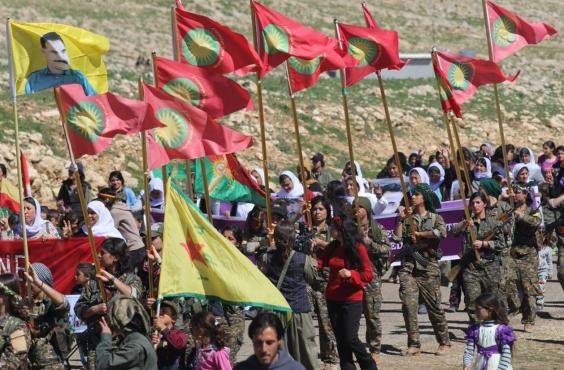
The Kurdish woman building a feminist democracy and fighting Isis at the same time

The leader of the most revolutionary women’s rights movement in the world talks to The Independent about how her ideals have found a home in the middle of the war on Isis
Bethan McKernan Beirut
@mck_beth

 
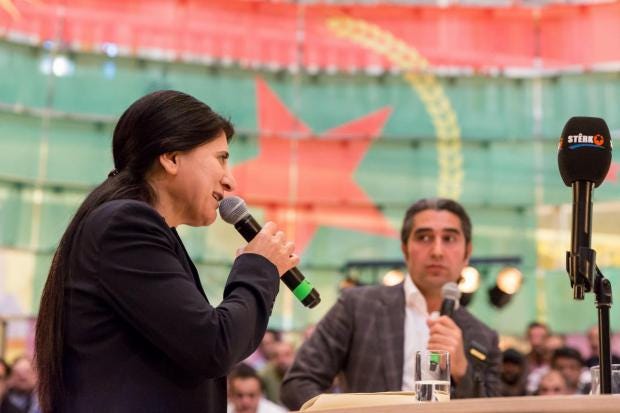
Female co-chair of the Syrian Democratic Union Party in Rojava, Asya Abdullah, addresses the New World Summit in Oslo City Hall on November 26, 2016 Jonas Staal/New World Summit

Asya Abdullah is not a polished politician. She speaks slowly and deliberately in Kurmanji in a tone which suggests she has had to practise her material many times.
But despite the reserved and careful exterior, Abdullah is one of the most radical and effective revolutionaries in the world today.
In the chaos of Syria’s civil war, the country’s Kurdish population has seized the chance to wrest their own destiny from the hands of others.
This is what it feels like to be an ordinary Kurd in Erdogan's Turkey
Syria war: Kurds stand ‘at the crossroads’ of hopes for lasting peace
Syrian Kurds to fight to death to stop Turkey 'invading their land'
Kurdish independence is coming – but the Kurds have to win it

Long marginalised by the Baathist regime in Damascus, after repelling government forces in 2012 Syria’s Kurds have managed to carve out a relatively peaceful and stable new societal order based in Rojava in the north, flourishing despite the presence of enemies such as Isis on all sides.
Abdullah has been a driving force in the battle for Kurdish freedom - but as the female co-chair of the Syrian Democratic Union Party, elected alongside male representative Salih Muslim in 2010, it is her particular role to safeguard women’s liberation.
“The hallmark of a free and democratic life is a free woman,” she said in her keynote speech at the Rojava New World Embassy in Oslo at the end of November.
“Isis would like to reduce women to slaves and body parts. We show them they’re wrong. We can do anything.”

Syria’s Kurds stand at a crossroads in the region’s history
The Rojava experiment is unlike any other. Coalitions between the local Assyrian, Arab and Kurdish populations have created a small society by and large run on the principles of a communal economy, harmony with the environment, and self governance.
It is also hard to conceive just how radically the Kurdish administration has overturned the existing state structures in Syria by putting women’s emancipation at the forefront of the the sociopolitical agenda.
Women in Rojava have equal status in property law, forced and underage marriage has been banned, quotas for women and ethnic groups ensure representation at all levels of politics - and of course, the armed women’s fighting units, known as the YPJ, have played a central role in the liberation of towns such as Kobani and Manbij.
What the Kurds broadly want, despite some infighting and extreme pushback from neighbouring Turkey, is ‘stateless democracy’ - the idea that in a federalised Syria, their autonomy can be maintained on a local level, with a focus on ‘bottom up’ power and little to no interference from the state. 
 

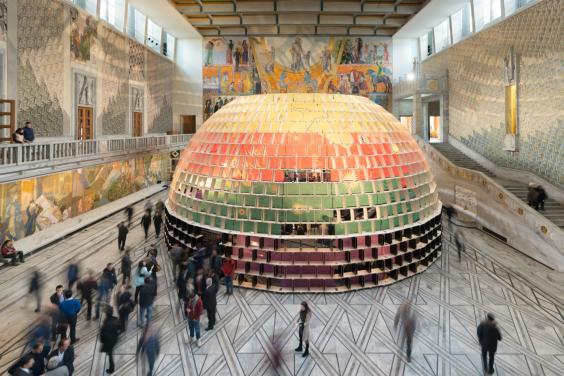
Artist Jonas Staal's temporary Rojava embassy inside Oslo's City Hall (Jonas Staal/New World Summit)

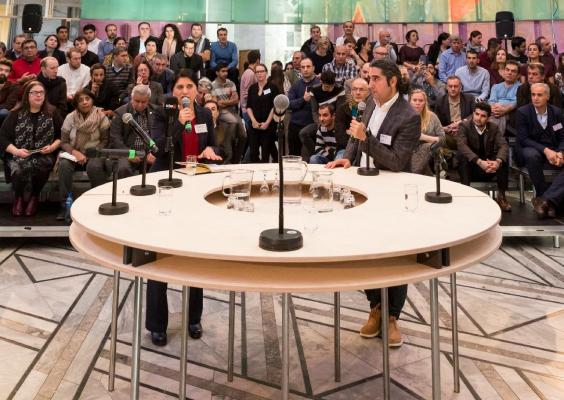
“This is the third way,” Abdullah told The Independent on the sidelines of the New World Embassy sessions. “We have been so busy working and sending representatives to spread the word around the world this is the first time many in the administration have been in the same room in years.”
The delegates were brought together by Dutch artist Jonas Staal as part of his ‘New World Summit’ project, a series designed to create “spaces of assembly that represent a new world and a new democratic ideal in the making.”
Blacklisted or otherwise marginalised independence movements, such as those in Rojava, Somaliland, Catalonia and the Azawad movement in Mali, have been invited to New World Summits to explore what ‘stateless democracy’ means in theory and practice.
Over the course of a weekend around 1,000 observers, democracy activists, politicians and journalists descended on Oslo’s City Hall, home of the Nobel Peace Prize, to see Staal’s temporary Rojava embassy - a circular construction designed to reflect the openness and dynamism of the new world the Kurds are seeking to create. 
 

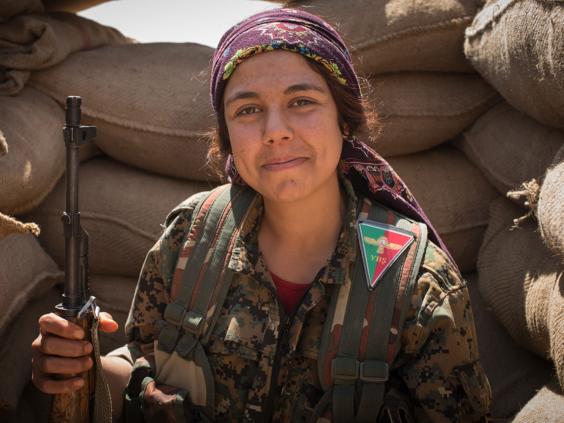
"We never played princesses as little girls," a 30-year-old YPG fighter jokes (Diego Cupolo)

The prevailing consensus on the political left is that the current crises in global democracy - the EU’s inability to combat the refugee crisis, the rise of right wing populism across Europe and the US - show that our post World War II models are failing, Staal says. His work is designed to open up the idea other democratic political models are possible.
“Contemporary parliamentary democracy is in itself not much more than a century old. In that sense, I don’t trust the stability of anything. Our political, economic and environmental crises have brought us to a crossroads,” he said.


“So, we have to ask ourselves: what kind of politics do we truly desire? Defending what we have is no longer enough, we must push forward.”
The war on terror, Staal and his colleagues argue, has emerged as the greatest threat to democracy in the 21st century. “Rojava is democracy with a vengeance,” he said. “The region, historically, has had types of government and statehood thrust upon it with little say in how to govern themselves. Now it is the Kurds and their allies that tell us what a genuine democracy actually looks like.”
It seems unthinkable - “Until you remember that the modern European continent - from the French to the Russian revolution - also emerged out of a revolutionary situation,” he added. 
 

Asya Abdullah, co-chair of the Syrian Kurdish PYD, addresses delegates at the New World Summit Rojava in Oslo

In providing an effective ground force against Isis, the Kurds have completely changed the course of Syria’s war, and their role in the country’s future, whether embattled President Bashar al-Assad stays or goes, is crucial.
Despite this, the Rojava administration has been shut out of all peace talks at the request of Sunni rebel groups. The experiment also faces renewed hostility from Turkey - recently the YPG said a military base near Kobani had been targeted by Turkish artillery fire - and can no longer necessarily count on support from the US now that the incoming Trump administration has signalled it wants to work with Assad to defeat Isis.
Abdullah is stoic, however, about the Rojava experiment’s future.
“Our first responsibility is to protect our sisters, to protect all women. That’s why our revolution is working, why Arab women and Yazidi women join when they see us. You can’t have real change without putting women at the centre,” she said.
Kurdish women, of course, literally fight for their rights - they take on Assad’s army and allied militias, Turkish-backed forces, and Isis. The creation of the YPJ, or women’s fighting units, is a fascinating development in a region where women’s rights are often repressed. 
 

The Sinjar Women’s Units was formed with the help of Kurdish fighters in 2015 to protect the Yazidi community in the wake of attacks by Isis (YBS)

03.07.2017

The Joys and Terrors of an Outsider Artist

While Susan Te Kahurangi King has never consciously worked in or against a fine art tradition, her work is surely original.
Susan Te Kahurangi King, Untitled (1966-67), 7 5/8″ x11″. (All images courtesy of Marlborough Contemporary.)

LONDON – “A certain strangeness,” wrote Walter Pater, “is an element in all true works of art.” The hermetic worlds depicted by many so-called outsider artists can be beautiful in their strangeness, but also suffocating, as if governed by a tyrannical logic. Think of the dizzying perspectives of Martin Ramirez, or the obsessive cartography of Adolf Wölfli. They are like medieval illuminations of private religions.

By contrast, the drawings of Susan Te Kahurangi King (b. 1951) feel closer in spirit to Henry Darger or Bill Traylor, two very different artists in whose work a sense of joy has survived the transition to a realm of private symbolism. At its best, her work is buoyant, varied, and, while often sinister, saturated with pleasure. It rewards extended looking. Its vibrant color gives it a wish-fulfilling aura.
Susan Te Kahurangi King, Untitled, c. 1966-1967 graphite, colored pencil and ink on found paper 10 1/8 x 8 in.

King is severely autistic, and has not spoken since the age of 5. She started to draw very early and has continued for much of her life, stopping around the late 1980s and resuming in 2009. Family members have always encouraged her art. Already well known in her local community in Auckland, New Zealand, only recently has the wider world taken notice of her talent. The illustrator Gary Panter made important efforts to showcase her work in the U.S., and Chris Byrne has put together shows at New York’s Andrew Edlin Gallery (2015) and now London’s Marlborough Contemporary. Both shows have focused mainly on drawings from the 1960s and ’70s.

Her scattered, surging compositions often include figures based on Disney and Warner Brothers characters, while many of the drawings at Marlborough feature the Fanta Man, a character from a soft drink advertisement. (Originally a flat, static icon, she brings him to life, portraying him from many angles.) The way in which the paper surface is treated as a flat expanse to be filled in recalls the look of children’s art. Closer attention reveals a sophisticated ability to manipulate space in original ways. A field of body parts can loom up like a wave, or remind us of a Tiepolo ceiling in which angels are massed at the edges of clouds. The twists and convolutions to which her figures are subjected alter the space around them, denying flatness and creating a dynamic force that energizes the page. Her compositions can be as lush as those of Arshile Gorky, or as subtle as a Jasper Johns. She is always experimenting.
Susan Te Kahurangi King, Untitled (c. 1965-1975), 6 7/8″ x 6 3/8 in.

Alex Katz once defined originality as “a combination of being inside your own head and responding to everything outside… it’s the combination of the two that makes something original.” What’s “outside” might be subject matter, one’s medium, artistic precedents, and culture in general. While it’s probably fair to say that King has never consciously worked in or against a fine art tradition, her work is surely original, and looking at it is a refreshing experience. Is she an “outsider artist”? To acknowledge a tradition, even in order to reject it, might be what makes one an “insider.”

And yet we are all, to some extent, insiders if we speak a shared language. And we are also outsiders, not quite at home in the language we inherit. King might be less at home in verbal language than most, and yet her concerns suggest an interest in the world as much as in the possibilities of her medium. For the psychoanalytic writer Marion Milner, art becomes more than therapy when it demonstrates respect for the independent integrity of its symbols, giving us renewed insight into whatever aspect of the world it pictures. The fact that King’s interests and imagery have overlapped with those of her mainstream contemporaries (whose work she had no way of seeing) is fascinating; her works teaches us something about the peculiar appeal of anthropomorphic cartoon animals.
Susan Te Kahurangi King, Untitled, 1966-67, graphite and coloured pencil on found board, 16 1/4 x 13 in.

Her treatment of various cartoon ducks is a reminder that all communication originates in the body, in its actions and passions, affects that must be cathected onto objects or surrogates if they are to be tamed and integrated. These figures appear riven by nameless forces, twisted this way and that, gesticulating wildly, dismembered, or literally tied up in knots. There’s implicit wisdom in King’s choice of classic cartoon characters as vehicles for pre-linguistic affect, recognition of something in their structure that speaks to the early experience of omnipotence, of the childish or regressive body. When Peter Saul or Markus Lüpertz were drawn to Donald Duck (at the same time as King) they were likely responding to similar qualities. But King foregrounds those qualities exceptionally well. Her use of Donald feels less like an obsessive preoccupation than a fruitful engagement. Her confident line draws attention to the way the brim of his cap echoes the Moebius-like convolutions of his beak; in one drawing the beak is a floating object, symmetrical and self-contained – a beak without a duck.

Besides other visual artists, the most compelling connection for me is with a contemporaneous poem by John Ashbery, in which Popeye “heaves bolts of loving thunder / At his own astonished becoming” (“Farm Implements and Rutabagas in a Landscape,” 1927). What is it about cartoons that might have inspired such startling, masochistic imagery?

Gary Panter believes King’s approach is basically observational, that what she draws is a version of what she actually sees. Maybe she sees these things because her perception is unusually free from the utilitarian demands that filter and focus our ordinary experience. If this evokes Dubuffet’s glamorizing of the raw and unfiltered, I would only add that it’s her use of the limiting schema provided by cartoon imagery that has made that overwhelmingly complex inner activity communicable, or perhaps given it enough structure to be seen. Whether it is a question of autonomous visions which she transfers to the page, or of a creative use of symbols similar to an “ordinary” artistic practice, we can only speculate.
Susan Te Kahurangi King, Untitled (2 Sept 1965), 8 1/4″ x 10 3/4″.

During Tate Modern’s 2013 Global Pop symposium much of the discussion concerned the emergence, during the 20th century, of a worldwide “monoculture,” particularly in the visual field. How has the international dissemination of American iconography from the 20th century onwards threatened local particularities and differences? King’s work, coming from the time and place it does, inevitably looks like a commentary on this phenomenon (no less than, say, the early collages of Scottish Pop artist Eduardo Paolozzi). The insights her work provides could be compared to those of Sergei Eisenstein, who traveled to the United States in 1930, where he met Walt Disney. Eisenstein was immensely enthusiastic about Disney’s creations, which he saw as constituting a modern revival of animism with deep roots in mythical thought. “How much (imaginary!) divine omnipotence there is in all this!” he wrote, “What magic of reconstructing the world according to one’s fantasy and will! … And you see how the drawn magic of a reconstructed world had to arise at the very summit of a society that had completely enslaved nature – namely, America.” Whatever conflicting energies found expression within the popular visual culture of the 20th century, King has embodied them in her turn, and in the process illuminated them for us.


Susan Te Kahurangi King continues at Marlborough Contemporary (6 Albemarle Street, London, UK) through July 1.

02.07.2017

Wiener Festwochen: Magie des Fremden

10.05.2017 | 18:50 |  Johanna Hofleitner (Die Presse - Schaufenster)
Die Festwochen-Ausstellung „The Conundrum of Imagination“ wirft einen ungewohnten Blick auf das Zeitalter der Entdeckungen.
Bild: (c) Beigestellt 
Der Wunsch, die Welt zu entdecken, prägt die Menschheitsgeschichte seit jeher. Was für Reisende die Sehnsucht nach der Ferne ist, wird aus Sicht von Herrschernationen zum Drang, Territorien zu unterwerfen. Die Karthager erkundeten um 500 v. Chr. Westafrika, die Griechen expandierten zwischen 380 und 310 v. Chr. in den östlichen Mittelmeerraum. Unter der Han-Dynas­tie wurde im zweiten Jahrhundert v. Chr. Zentralasien erforscht, die Wikinger stießen von 800 bis 1040 bis
zum amerikanischen Kontinent vor. Im 13. Jahrhundert erkundeten die Polynesier den Pazifik, die Chinesen 100 Jahre später Süd-, Südostasien sowie die Küste Afrikas.
Kolonialismus einst und jetzt. Von Brisanz, weil von aktueller Relevanz sind heute die Entdeckungsreisen der Neuzeit. Verbunden mit Namen wie Kolumbus, Humboldt, Cook, da Gama, Magellan, Vespucci und anderen haben sie die Kolonialisierungen der Neuzeit eingeleitet. Unter dem Titel „The Conundrum of Imagination (Das Rätsel der Imagination)“ greift die Hauptausstellung der Wiener Festwochen dieses „Europäische Zeitalter der Entdeckungen“ auf. 16 Künstlerinnen und Künstler hat Kurator Bonaventure Soh Bejeng Ndikung zusammen mit Kokuratorin Pauline Doutreluingne ausgewählt und mit Arbeiten beauftragt. Sie kommen zum Großteil aus Afrika sowie Mittel- und Zentralamerika – mithin aus Ländern, die selbst Teil der europäischen Kolonialgeschichte waren –, aber auch aus Europa wie Ines Doujak oder Ahmet Öğüt. Schauplätze der Ausstellung sind das Leopold-Museum sowie das Performeum, eine aufgelassene Ziegelhalle der ÖBB in der Nähe des Hauptbahnhofs.
„Die Künstlerinnen und Künstler, die wir eingeladen haben, interessieren uns, weil sie in verschiedenen Medien wie Skulptur, Installation, Zeichnung, Film, Fotografie und Performances sehr starke Bilder kreieren“, sagt Doutreluingne. „Für viele ist Kolonialismus zudem ein Teil ihrer Praxis, weil sie aus Ländern kommen, die kolonialisiert worden sind. In gewisser Weise sind sie also selbst Entdecker, die mit ihrer Kunst in die menschliche Psyche hineingehen und Stereotype aufbrechen.“
Der Venezolaner Marco Montiel-Soto etwa bezeichnet sich selbst als Reisenden. Für seine Kunst bricht er immer wieder zu Expeditionen auf. Für die Festwochen-Ausstellung hat er zwei Wochen in einer Pfahlbausiedlung im Maracaibo-See gelebt. Columbus hatte diese Region einst als „kleines Venedig“ bezeichnet, woraus der Name Venezuela hervorgegangen ist. Von den Spaniern wurde die Region von 1528 bis 1545 den Welsern überlassen, die auf der Suche nach dem Dorado ebendort Neu-Nürnberg gründeten. Aufgrund intensiven Gewittergeschehens hat schließlich die Nasa den Maracaibo-See 2016 zur Hauptstadt des Blitzes erklärt. Montiel-Soto nimmt diese Partikel zum Ausgangspunkt für eine poetische Installation, bestehend aus einer Hütte, Blitzen, Videos und Sound. „Ich reise durch Zeiten und Räume“, sagt er. „Aus den Mythen und Legenden, denen ich auf dieser Reise begegne, schaffe ich eine Fiktion.“
Zahlreiche Reisen durch Mittel- und Südamerika haben Ines Doujaks Interesse an kolonialen Themen geprägt. Kolonialismus ist für sie immer noch allgegenwärtig, „zum Beispiel in der Art, über Refugees zu reden“, wie sie sagt. Thema ihres Collagenzyklus „Skins“ ist der Einsatz von Hautkrankheiten als biologischer Waffe. Dafür hat sie historische Medizinatlanten zerschnitten und die Schnipsel zu Mutantenbildern zusammengefügt. „Ich will mit der Arbeit die spezielle Geschichte dieses Kolonialismus beschreiben“, sagt sie. „Die Haut ist für mich eine Grenze zwischen innen und außen, jede Wunde ist eine Öffnung.“


Geschichtsumkehr. Abraham Oghobase aus Lagos wiederum geht für seinen Lithografiezyklus von einer historischen Fiktion aus
und fragt: „Was wäre, wenn Österreich Nigeria kolonialisiert hätte?“ In mehrschichtigen Bil­dern, die aus transparenten Folien, Fotografien, Details aus Google-Maps sowie Farblagen zusammengesetzt sind, führt er Landschaftsfotografien aus Nigeria mit Detailaufnahmen imposanter Salzburger Barockskulpturen zusammen und konstruiert daraus eine fiktionale historische Realität. „Ich bin neugierig“, sagt er, „mich interessieren das Prozesshafte der Lithografie und die Möglichkeit, mit ihr Geschichten zu erzählen.“

Feminism Must Be Lived: An Interview With Sara Ahmed

Sunday, May 21, 2017 By Jaskiran Dhillon, Truthout | Interview


Sara Ahmed. (Photo: Duke University Press)

What does it mean to be a modern feminist? In her new book, Sara Ahmed shows the connections between theory and practice, the academy and the everyday, home and work. Bitch Magazine says: "Beautifully written and persuasively argued, Living a Feminist Life, is not just an instant classic, but an essential read for intersectional feminists." Order your copy today by making a donation to Truthout!

Sara Ahmed's accessibly written and visionary Living a Feminist Life is a much-needed antidote to the disconnection between feminist thinking and being. The book has emerged against a political backdrop marked by the rise of the Trump regime, a historic Women's March on Washington and International Women's Strike, an increase in the visibility of feminist activism on social media and the rise of celebrity feminists. "Feminism," as Ahmed remarks in the opening pages, "is bringing people into the room." The amplification of feminism, however, also demands that we stop to consider what being a feminist really means. Drawing on decades of experience as a feminist writer, scholar and activist, Ahmed takes us on this critical journey with candor, brilliance and a deep commitment to social transformation. Feminism, Ahmed contends, is not simply about participating in protests and rallies or writing theory in the academy. Nor is it to be understood as a responsibility that waxes and wanes with convenience. It is, above all else, about how to live.

From cover to cover, Ahmed urges us to keep our fists raised high as we move closer to a feminist vision of the future that unfolds in step with the active dismantling of our profoundly unjust and violent present. She reminds us to be intrepid and willful in our political resistance -- to learn from the wisdom and knowledge of warrior women of color whose legacies, histories and experiences are etched on our contemporary path to justice and freedom (these issues have long existed). Ahmed challenges us to embody our feminist politics as a radical ethics of living in the everyday dimensions of our social world, to claim all spaces as political, and to strategically strike down the "brick walls" that blockade and stifle our movements. In short, Living a Feminist Life aims to both awaken and set free the "feminist killjoy" that resides in each of us.

Jaskiran Dhillon: Let's begin with you elaborating on the central theme of the book -- making feminism the practice of everyday life.

Sara Ahmed: I think of feminism as a life question; a question of how we live our lives given that the structures we wish to transform are structures that persist. We have to live with what we wish to transform. As a feminist working in the academy, though, I sensed that what was taught and known as "feminist theory" had become somewhat disconnected from the questions of how to live, and the questions themselves relegated to an earlier outdated style of feminism. I wanted to bring feminist theory, too, back to life -- strengthening the ties between the inventive creation of feminist theory and living a life that sustains it.

To be a feminist is to be a feminist everywhere. Feminism is not a commitment that can be suspended when it is inconvenient. But that does not mean feminists share the same commitments or that it is always clear how that commitment should express itself! Work is part of everyday life. When we live a feminist life we are a feminist at work. Feminism means being attentive to power relations at home and at work, being willing to challenge abuses of power, being willing to support those who are challenging abuses of power. It means being aware of who is doing the work, especially the housework (in institutions, housework is called administration); it means striving to make workloads more equal (including by attending to how they are not); it means becoming attuned to who can access a space because of how it is arranged or inhabited (and who cannot). Feminism is about questioning everything about our shared social world. This is not an imposition. It is an invitation to open up what tends to work by being closed down.

I love the emphasis you place on the role of intergenerational knowledge in shaping feminist living. Who influenced your development as a feminist?

My auntie Gulzar Bano was very important to me. She self-identified as a feminist; she was involved in the women's movement in Pakistan. She believed strongly in what she called woman power. Her particular concern was literacy for girls. She was an inspiration, too, in how she lived her life. Because she did not get married and have children she was able to invest her time and energy in feminist projects of all kinds. She wrote feminist poetry: I cherish the collections in which her poems appeared as well as the books she published. Her words were always animated by her concern with the effects of violence and injustice. I think I learned the importance of writing our politics from her. She also developed a strong support network for women in the wider family; her sisters and nieces. Sometimes she used to call me her daughter; I think she saw us as deeply connected, as if my life was following in some way from hers. I hope so. She was my feminist auntie in all the ways that expression can have meaning. We all need feminist aunties!

27.06.2017

Werdet Schwarze Frauen*! Plädoyer für ein minoritäres Bewusstsein

Der diesjährige internationale Frauen*tag am 8. März war anders. Bestärkt durch den gigantischen Women’s March in Washington fanden globale Proteste statt, über 30 Länder haben – ausgehend von Initiativen aus Argentinien, Polen und anderen Ländern – an Frauen*streiks teilgenommen. Auch in der Schweiz gab es unzählige grössere und kleinere Aktionen: auf dem Bundesplatz in Bern versammelten sich Menschen zu einem ‚Strick-In‘, Parlamentarier_innen strickten in der Wandelhalle für Gleichstellung, in Zürich wurde die Statue des Reformators Zwingli mit einem Pussyhat zur Ober-Pussy geweiht. Musiker_innen produzierten einen Solidaritäts-Song, die Guerilla-Feminist_innen Aktivistin.ch übersäten die klischierten Spielzeugabteilungen grosser Kaufhäuser mit Protestbotschaften, und unter dem Motto "We Can’t Keep Quiet" formierte sich ein gigantisches Bündnis von Frauen*organisationen und Verbündeten.

Time, 28. Januar 2017; Quelle: time.com
Seit der Wahl von Donald Trump erfahren Frauen*bewegungen weltweit Aufwind, konstituieren sich teilweise neu, weil unzählige Frauen* und Verbündete dazu kommen und realisieren: Frauen*hass und Sexismus sind immer noch weit verbreitet. Was unsere Grossmütter erkämpft haben, ist nicht sattelfest. Und das, was noch erkämpft werden muss, erst recht nicht.
Manchmal sind diejenigen, die seit langem kämpfen, wütend: Warum wacht ihr erst jetzt auf? Wo wart ihr, als alleinerziehende Mütter in Armut versanken und Care-Arbeiterinnen ihre Rechte einforderten? Wo waren die Massen, als Black Lives Matter gegen Polizeigewalt auf die Strasse ging? Als Erdoğan in der Türkei proklamierte, die wichtigste Aufgabe der Frau sei es, Kinder zu gebären? Als in Argentinien jährlich 300 Frauen ermordet wurden? Für viele ist die Welt nicht erst seit Donald Trump unerträglich geworden. Dass es jemanden wie Donald Trump braucht, um grosse Bewegungen zu mobilisieren, ist nicht rühmlich. Gleichwohl macht es Hoffnung, dass jetzt immer mehr Menschen aktiv werden.

Warum heisst es „Women’s March?“


Widerstands-Ikone Princess Leia / Carrie Fischer; Quelle: popsugar.com
Bemerkenswert ist dabei auch, dass so viele Menschen unter dem Label 'Women' protestieren. Das ist nicht selbstverständlich. In der Tradition des 8. März zum Beispiel gab und gibt es zahlreiche Debatten und unterschiedliche Handhabungen zu der Frage, ob Männer den Protesten solidarisch fern bleiben, oder ob sie unter dem Frauen*-Dach teilnehmen sollen. Für beides gab und gibt es gute Gründe. Die aktuelle Dringlichkeit, möglichst breit gegen den reaktionären Backlash zu mobilisieren, hat das Pendel in die Richtung „all Gender“ bewegt. So auch beim bevorstehenden Women’s March am Samstag in Zürich: Marschiert wird zwar unter dem Motto „Women“, teilnehmen können und sollen aber alle. Denn die Proteste richten sich gegen multidimensionale Sexismen sowie auch gegen Rassismus, Homo- und Transphobie, Ausbeutung und soziale Ungleichheit.
Aber warum heisst es dann überhaupt noch „Women“? Bei der Lancierung des Women’s March Zürich kam es zu Diskussionen: Einige forderten, es solle "Equality March" heissen, schliesslich gehe es nicht nur um Frauen*, und man wolle nicht die Männer* abschrecken, das Label Frau* sei nicht inklusiv genug. Es zeigte sich: Wenn Männer* unter dem Frauen*-Dach mitlaufen sollen, ist das offenbar eine Kröte, die viele nicht so leicht schlucken. Dass sie unter "Women*" mitgemeint sind, stösst auf. Schnell geht dabei allerdings vergessen, dass Frauen* und viele andere sich Jahrhunderte lang unter dem Dach "weisser Mann" versammeln mussten. In der so genannten ‚westlichen Welt’ wurde der bürgerliche Mann im Zuge der Moderne zum Standard, von dessen Zentralperspektive aus das Weibliche als anders, als Abweichung und nicht zuletzt Makel markiert war (siehe zum Beispiel die freudsche Vorstellung, die Frau sei durch den Penis-Mangel bestimmt).
Genau genommen bedeutet das: In der Kulturgeschichte der europäischen Moderne existiert das Weibliche für sich genommen nicht, sondern nur im Verhältnis zum Mann (Irigaray). Das rassistische Patriarchat produzierte sich ‚seine Frauen‘ (die ‚gute Mutter‘, züchtige Ehefrau, Heilige oder Hure), deren Funktion die Begründung des Männlichen als Norm war. Aber auch Kategorien wie schwarz, proletarisch, irrational und vieles mehr fingierten als das inferiore "Andere" gegenüber dem weissen, vernünftigen männlichen Subjekt.
Natürlich ist es nicht das Ziel, diese Mechanismen umzukehren. Der phallozentrischen Ordnung kann keine Herrschaft der Frauen* folgen, keine neue Hierarchie. Gleichwohl scheint mir Women’s March eine sinnvolle Bezeichnung, unter dem Frauen*-Dach lässt sich durchaus für eine Welt einstehen, die Freiheit für alle, nicht für wenige ermöglichen soll.

Frau* ist keine feststehende Kategorie

Jedenfalls dann, wenn wir uns auf einen Frauen*-Begriffe verständigen, wie er in vielfältigen Debatten der letzten Jahrzehnte entwickelt wurde: Differenzfeministische, queer-theoretische und postkoloniale Ansätze haben Frau* als einheitliche Kategorie oder Identität zunehmend infrage gestellt. Es wurde deutlich: Frau*sein bedeutet extrem unterschiedliche Dinge, unterschiedliche Erfahrungen und Kontexte. Es kann nicht festgelegt werden, wer oder was Frauen* sind. Wer das festlegen will, bewegt sich in der vorherrschenden patriarchalen Logik, einer Logik, die Kategorien bildet und dadurch wiederum normiert, ausschliesst und hierarchisiert.
Es wurde deshalb vorgeschlagen, Frau* nicht als biologische, nicht als feste Identität, sondern als eine gesellschaftliche und mithin politische Kategorie zu begreifen (genau darauf soll übrigens auch das Sternchen verweisen). Plädiert wurde für einen utopischen Begriff Frau*, der gerade nicht wie im bisherigen Männersystem funktioniert, das heisst keine Kategorie definiert. Frau* sollte vielmehr eine Sehnsucht nach etwas radikal anderem ausdrücken, den Entschluss, die phallozentrische, rassistische, hetero-sexistische Ordnung zu verlassen, sich den vorherrschenden Massstäben zu entziehen.

Tejal Shah: "Between the Waves", Collage, Quelle: catch-fire.com
Entsprechend wurde Frau* nicht mehr als Identität gedacht, sondern als eine Aktivität, ein Prozess, der unterschiedlich ausgefüllt werden kann. Deleuze/Guattari (1972), Luce Irigaray (1974) und andere schlugen bereits in den 1970er Jahren vor, Frau* nicht als ein Zustand, sondern als Werden zu denken, als eine Bewegung hin zu etwas, das erst erfunden werden muss. Etwas, das kontinuierlich im Begriff des Entstehens ist, und niemals abgeschlossen. Frau* wurde zu einem Marker für die Bestrebung, das System von festen und zwangsläufig herrschaftlichen Kategorien zu verlassen und zu unterwandern.
Rosi Braidotti (2006) und andere schlugen vor, die symbolische Inexistenz der Frau* als ein politisches Potential zu nutzen: Während die Bestimmung des Mannes als Massstab extrem begrenzend ist, verkörpert das Minorisierte eine relative Offenheit. Es kann nicht zum Massstab werden, an dem der Rest der Welt bewertet wird. Deleuze und Guattari riefen deshalb zum Minoritär-Werden auf, zum "Frau-Werden, Schwarz-Werden, Tier-Werden": „Becoming woman is the basis of a total critique“.
Das Minorisierte eröffnet einen Raum für politischen Widerstand, gerade weil es nicht feststeht. „Frau-Werden, Tier-Werden, Schwarz-Werden“ ist eine politische Aktivität, die der vorherrschenden binären Ordnung zu entfliehen versucht – ohne schon zu wissen, was das Minoritäre genau ist. „‚Becoming minoritarian‘ is the code name for overturning the logic that legitimates a central norm through hierarchically organized binary oppositions“ (Braidotti 2006).

07.06.2017

Post­ko­lo­nia­lis­mus


http://www.schwarzweiss-hd.de/postkolonialismus/

18. Februar 2014 · in Allgemein

Post|ko|lo|ni|a|lis|mus, der; -, [post– Prä­fix + Kolo­nia­lis­mus; zu post­ko­lo­nial Adj.] Die Epo­che nach Auf­lö­sung der Kolo­nien; der kul­tu­relle Zustand einer post­ko­lo­nia­len Gesell­schaft; / kri­ti­sche Aus­ein­an­der­set­zung mit und intel­lek­tu­elle Los­lö­sung von den gesell­schaft­li­chen, ökono­mi­schen, poli­ti­schen Aus­wir­kun­gen des Kolo­nia­lis­mus.
Der Begriff Post­ko­lo­nia­lis­mus bezeich­net eine breit gefasste, nach dem Zusam­men­bruch des euro­päi­schen Impe­ria­lis­mus in den Jahr­zehn­ten nach dem Ende des Zwei­ten Welt­kriegs ein­set­zende intel­lek­tu­elle Strö­mung, in der eman­zi­pa­to­risch und ideo­lo­gie­kri­tisch ori­en­tierte und von Theo­rie­ent­wür­fen der Dis­kurstheo­rie und der Dekon­struk­tion beein­flusste Wis­sen­schaf­fende (oft selbst mit (post-)kolonialen Bio­gra­phien wie Talal Asad, Homi K. Bhabha, Frantz Fanon, Edward Said, Gaya­tri Spi­vak) began­nen, die kom­ple­xen Zusam­men­hänge zwi­schen ökono­mi­scher, mili­tä­ri­scher und poli­ti­scher Kolo­ni­sie­rung außer­eu­ro­päi­scher Gesell­schaf­ten und ihrer aka­de­mi­schen Erfor­schung auf­zu­ar­bei­ten. Mit Post­ko­lo­nia­lis­mus wird inner­halb die­ser Strö­mung dabei zum einen eine his­to­ri­sche Zäsur gesetzt: Die Benen­nung der Gegen­wart als post-, also nach–kolo­nial, betont Kolo­nia­lis­mus und die Befrei­ung von Kolo­nia­lis­mus und die damit zusam­men­hän­gende Grün­dung von Natio­nal­staa­ten aus der Kon­kurs­masse der ehe­ma­li­gen Kolo­nialim­pe­rien als für viele Gesell­schaf­ten im 20. Jahr­hun­dert zen­tra­les poli­ti­sches Ereig­nis. Zum ande­ren drückt Post­ko­lo­nia­lis­mus ein Oppo­si­ti­ons­ver­hält­nis aus: gegen Kolo­nia­lis­mus – und somit die kri­ti­sche Aus­ein­an­der­set­zung mit Rol­len­bil­dern und Macht­struk­tu­ren (ver­stan­den als eine kom­plexe Matrix von Macht und Macht­lo­sig­keit, Zen­trum und Peri­phe­rie, Herr­schen­den und Beherrsch­ten; sowie ökono­mi­sche, kul­tu­relle und poli­ti­sche Bezie­hun­gen zwi­schen Natio­nen, Eth­nien, Kul­tu­ren), die ihren Ursprung im Kolo­nia­lis­mus haben und bis heute fortwirken.

Post­ko­lo­niale Ansätze rich­ten ihren Blick einer­seits auf die Dekon­struk­tion kolo­nia­ler Denk­mus­ter als Recht­fer­ti­gungs­stra­te­gien für die euro­päi­sche Kolo­ni­al­herr­schaft, ande­rer­seits auf die durch den Kolo­nia­lis­mus aus­ge­lös­ten gesell­schaft­li­chen Trans­for­ma­ti­ons­pro­zesse sowohl in den Kolo­nien als auch in den Kolo­ni­al­staa­ten. Der Post­ko­lo­nia­lis­mus zieht seine eman­zi­pa­to­ri­schen Poten­tiale aus der Ein­sicht, dass die Wahr­heits­re­gime der kolo­nia­len Moderne nicht geschlos­sen sind, son­dern insta­bil, hete­ro­gen, in sich wider­sprüch­lich und mehr­deu­tig, was sie öffnet für Subversion[1] und unge­plante Umdeu­tun­gen, wie dies Homi K. Bhabha in sei­nen Arbei­ten zu Hybridität beschreibt. Aus die­sen Über­le­gun­gen und in enger Ver­knüp­fung mit herr­schafts­kri­ti­schen Pro­gram­men wie denen des Post­struk­tu­ra­lis­mus und Femi­nis­mus spei­sen post­ko­lo­niale Ansätze ihre Ver­su­che einer ele­men­ta­ren Desta­bi­li­sie­rung von Gesell­schafts­ord­nun­gen, der Stär­kung alter­na­ti­ver, mar­gi­na­li­sier­ter Posi­tio­nen und der Ent­wick­lung von Per­spek­ti­ven, die west­li­che Domi­nanz in Frage stel­len; d.h. an Wahr­hei­ten, die lange als unan­fecht­bar gal­ten, soll durch post­ko­lo­niale Kri­tik gerüt­telt werden.

Als para­dig­ma­tisch für diese For­men der Kri­tik gilt Edward SAIDs Stu­die Ori­en­ta­lis­mus (1978, dt. Übers. von Liliane Weiss­berg 1981). Von Ansät­zen des lin­gu­is­tic turn über die wirk­lich­keits­kon­sti­tu­ie­ren­den Poten­tiale von Kom­mu­ni­ka­tion und Fou­caults macht– und wahr­heits­kri­ti­schem Begriff des Dis­kur­ses aus­ge­hend, erar­bei­tete Said einen genea­lo­gi­schen Ansatz, der das Den­ken, Spre­chen und Han­deln euro­päi­scher Akteure im Kolo­nia­lis­mus trans­pa­rent machen sollte. Nach Said kann der „Ori­ent“ gewis­ser­ma­ßen als «euro­päi­sche Erfin­dung» gel­ten, die hier ein zen­tra­les Bild des „Ande­ren“ für Europa ent­wirft (SAID 1979: 1). Getra­gen wor­den sei das euro­päi­sche Ori­ent­kon­zept von einer Ideo­lo­gie, die Ori­ent und Okzi­dent als Gegen­satz­paar auf­baute und zur Grund­lage jeder Aus­ein­an­der­set­zung mit außer­eu­ro­päi­schen Gesell­schaf­ten machte. Wäh­rend euro­päi­sche bür­ger­li­che Eli­ten sich selbst als Trä­ger einer moder­nen, also, libe­ra­len, ratio­na­len, gerech­ten, huma­nis­ti­schen, fort­schritt­li­chen, dyna­mi­schen und oft auch säku­la­ren, über­le­ge­nen Zivi­li­sa­tion neu erfan­den und dadurch diese Kräfte inner­halb der euro­päi­schen Staa­ten affir­mier­ten, seien die Bewoh­ner des „Ori­ents“ mehr­heit­lich über Irra­tio­na­li­tät, Zeit­lo­sig­keit, Grau­sam­keit, Deka­denz und Unver­än­der­bar­keit defi­niert wor­den, also über Eigen­schaf­ten, deren Über­win­dung sich das Groß­bür­ger­tum in Europa als Leis­tung zuschrieb. Die west­li­che wis­sen­schaft­li­che Pro­duk­tion über die außer­eu­ro­päi­sche Welt sei immer als Teil eines Wissen-Macht-Regimes zu sehen, das auf einer essen­tia­li­sie­ren­den Pola­ri­sie­rung zwi­schen einem ratio­na­len Ich und einem irra­tio­na­len Ande­ren beruhe. Der irra­tio­nale Andere werde in einem hege­mo­nia­len Dis­kurs auf eine Art reprä­sen­tiert, die ihn sei­ner Selbst­er­klä­rungs– und Deu­tungs­kom­pe­tenz beraubt, diese in den Hän­den des Ori­en­ta­lis­ten mono­po­li­siert und so die beste­hen­den poli­ti­schen, ökono­mi­schen und intel­lek­tu­el­len Asym­me­trien naturalisiert.[2] Diese essen­tia­lis­ti­sche, kul­tu­ra­lis­ti­sche und im Wesent­li­chen ras­sis­ti­sche Alte­ri­sie­rung des „Ori­ents“, wel­che die soziale Rea­li­tät die­ser Gesell­schaf­ten über­schrieb, habe es dem Wes­ten mög­lich gemacht, Auto­ri­tät über den „Ori­ent“ zu legi­ti­mie­ren, Res­sour­cen dafür zu mobi­li­sie­ren und die Hege­mo­nie über ihn durchzusetzen.
Post­ko­lo­niale Ansätze ermög­li­chen auch eine Kri­tik an heu­ti­gen Macht­asym­me­trien, indem sie expli­zit dar­auf hin­wei­sen, wie diese sich aus kolo­nia­len Struk­tu­ren und Netz­wer­ken erst ver­fes­ti­gen und bis heute in poli­ti­schen, wirt­schaft­li­chen und kul­tu­rel­len Bezie­hun­gen über­dau­ern konn­ten. Ein Bei­spiel hier­für ist die Ideo­lo­gie, Bild­spra­che und Pra­xis der soge­nann­ten „Ent­wick­lungs­zu­sam­men­ar­beit“; hier knüp­fen oft nicht nur das Wer­be­ma­te­rial huma­ni­tä­rer Orga­ni­sa­tio­nen und die Medi­en­be­richt­er­stat­tung an eine kolo­niale Bild­me­ta­pho­rik der Hilfs­be­dürf­tig­keit, Kind­lich­keit und Bedro­hung an, son­dern auch huma­ni­täre Pro­jekte, die durch klare Dominanz-Abhängigkeitsverhältnisse cha­rak­te­ri­siert sind. In einer post­ko­lo­nia­len Les­art erschei­nen west­li­che Hilfs­pro­jekte also nicht mehr als Altru­is­mus, son­dern viel­mehr als eine Fort­füh­rung des Kolo­nia­lis­mus mit ande­ren Mit­teln. Der lange kolo­niale Schat­ten zeigt sich auch im „Krieg gegen den Ter­ror“ und den damit ver­bun­de­nen Welt– und Feind­bil­dern, wie Derek Gre­gory in The Colo­nial Pre­sent: Afgha­nis­tan, Palestine, Iraq (2004) her­aus­ar­bei­tet. All die­sen Bei­spie­len lie­gen kon­stru­ierte Wahr­hei­ten kolo­nia­ler Ste­reo­type zu Grunde, die ihre Wirk­macht erst durch stän­dige (Re-)Produktion erlan­gen konn­ten. Genau hier kön­nen post­ko­lo­niale Ansätze anknüp­fen, in dem sie die Kon­stru­iert­heit und Nor­ma­ti­vi­tät, aber auch die Brü­chig­keit solch ver­meint­lich unan­fecht­ba­rer Wahr­hei­ten sicht­bar machen, die hete­ro­gene Viel­falt kul­tu­rel­ler Deu­tun­gen aner­ken­nen und mar­gi­na­li­sierte, alter­na­tive Wis­sens­for­men abseits hege­mo­nia­ler Wahr­hei­ten begrüßen.


[1] Sub­ver­sion bedeu­tet die Bestre­bung, hege­mo­nia­len Ord­nungs­sys­te­men und Dar­stel­lungs­prak­ti­ken des Kolo­nia­lis­mus einen kri­ti­schen Gegen­dis­kurs ent­ge­gen­zu­stel­len, in dem die Deu­tungs­ho­heit über das Eigene zurück­ge­holt und in einem posi­ti­ven Umdeu­tungs­pro­zess ange­eig­net wird. Bei­spiel­haft dafür ist in der post­ko­lo­nia­len Lite­ra­tur das „Writing-back“-Paradigma (vgl. B. Ashcroft/G. Griffiths/H. Tif­fin, The Empire Wri­tes Back) oder Prak­ti­ken des „Rewri­t­ing“, die durch eine Erwei­te­rung der Per­spek­ti­ven, neue Inter­pre­ta­tio­nen der Geschichte und krea­tive Gegen­ver­sio­nen die zen­tra­lis­ti­sche Domi­nanz kolo­nia­ler Dis­kurse aufbrechen.


[2] Ronald Inden fasst die­sen Sach­ver­halt poin­tiert zusam­men: „The know­ledge of the Ori­en­ta­list […] has appro­pria­ted the power to rep­re­sent the Ori­en­tal, to trans­late and explain his (and her) thoughts and acts not only to the Euro­peans and Ame­ri­cans but also to the Ori­en­tals them­sel­ves“ (Inden 1986: 408).


Corinna Ass­mann, Dan­jiel Cube­lic, Diana Grie­sin­ger
Februar 2014

03.06.2017

Lisa Jardine’s discussion of Temptation in the Archives


A. L. Stoler: Along the Archival Grain / Buchrezensionen

Along the Archival Grain. Epistemic Anxieties and Colonial Common Sense
Rezensiert für H-Soz-Kult von  Minu Haschemi Yekani, Department of History and Civilization, European University Institute Florenz


Ereignisse strukturieren nicht selten historiographische Erzählungen. Michel Foucault hat das Ereignis – freilich gegen die klassische Ereignisgeschichte argumentierend – als einschneidende Einzigartigkeit definiert. Es sei durch keine Regierungszeit, keinen Vertrag oder keine Entscheidung markiert, sondern durch nichts weniger als durch „die Umkehrung eines Kräfteverhältnisses, den Sturz einer Macht, die Umfunktionierung einer Sprache und ihre Verwendung gegen die bisherigen Sprecher, die Schwächung, die Vergiftung einer Herrschaft durch sie selbst, das maskierte Auftreten einer anderen Herrschaft.“[1] Ann Laura Stoler verlegt in ihrem neuen Buch „Along the Archival Grain. Epistemic Anxieties and Colonial Common Sense“ – mit und gegen Michel Foucaults Arbeiten – das Ereignis in die (kolonialen) Archive.

Ganz den Dokumenten zur niederländischen Kolonialherrschaft in Indonesien verschrieben, definiert Stoler das archivarische oder „archivalisierte“ Ereignis als „moments that disrupt (if only provisionally) a field of force, that challenge (if only slightly) what can be said and done, that question (if only quietly) ‚epistemic warrant’, that realign the certainties of the probable more than they mark wholesale reversals of direction.“ (S. 51) Mit diesem Fokus ist es ihr Anliegen, auch die Geschichte hinter denjenigen Dokumenten zu beleuchten, die zum Beispiel nie realisierte Pläne diskutieren, Zeugnis von „Nicht-Ereignissen“ (S. 4) geben und damit in der Historiografie selten im Fokus stehen. Mit anderen Worten: Stoler widmet sich marginalisierten Geschichten, der „minor history“. Ihre Spuren, Wirksamkeit und Bedeutung zu belegen, kann als eines der (vielen) Anliegen dieses Buches aufgefasst werden.

Dokumente der Sammlung des niederländischen Kolonialministeriums (1814-1954) aus den Jahren 1830 bis 1930, die im Nationaal Archief, dem ehemaligen Algemenen Rijksarchief, in Den Haag archiviert sind, stellen den Hauptquellenkorpus der meisten Kapitel dar. Nur die langjährige Erfahrung und die genaue Kenntnis dieses Archivs – in Stolers Fall mindestens zwei Dekaden – ermöglichen es, ein solches Buch zu schreiben: Jeder Seite von „Along the Archival Grain“ ist die Virtuosität anzumerken, mit der Stoler die Archivalien liest, vergleicht, nach Lücken forscht, Auslassungen und Durchstreichungen untersucht, die schriftlichen Anordnungen, geheimen Sendschreiben, Rundschreiben, Berichte und persönlichen Briefe gegen das Licht hält, die scheinbar verborgenen „Wasserzeichen“ (S. 8) der Macht lesbar macht und „historische Negative“ (S. 107) entwickelt, wie sie es nennt.

Stolers Fokus richtet sich zudem, dies kennt man bereits aus ihren früheren Arbeiten, auf die Brüchigkeit, welche die Macht von innen heraus bedroht und gleichzeitig stabilisiert. In „Along the Archival Grain“ allerdings geht es weniger als in früheren Arbeiten um Fragen sozialer und kultureller Stratifizierung, als um die im Archiv dokumentierte brüchige (Un-)Einheitlichkeit des kolonialen common sense. Den „archival turn“ (S. 44) aufgreifend, dreht Stoler das (nicht nur) unter Kolonialhistoriker/innen beliebt gewordene Diktum, die Quellen „zwischen den Zeilen und gegen den Strich zu lesen“, um.[2] Stolers Kehrtwende besteht darin, innezuhalten und den Strich zunächst fein säuberlich freizulegen, zu entdecken und mit ihm zu lesen. Dieses Anliegen verbindet sich mit dem Ziel, etablierte Annahmen über Funktion und Funktionsweise der Wissensgenese des kolonialen Staates zu überprüfen und zu überdenken. Stoler verbindet diese Methode mit einem Nachdenken über den Zusammenhang von emotionaler Ökonomie, kolonialer Regierungskunst und dem Archiv, welches – nicht erst seit Jacques Derrida[3] – als Behausung der Macht gilt. Im kolonialen Staat spielte zudem Taxonomisierung eine besonders große Rolle: „The making of colonial categories shares this ambiguous epistemic space. New social objects were the archive’s product as much as subjects of them.“ (S. 43) Das Archiv wird in Stolers Interpretation als eine Sammlung von Aussagen und als ein Depot von Dokumenten verstanden, als ein Ort des Imaginären und der Institutionen, die Geschichte gestalteten. Nicht zuletzt verweise das Archiv auf die emotionale Ökonomie imperialer Projekte, als deren Unterbau sie fungiere. Stoler zweifelt am Konzept eines abgeschlossenen „Wahrheitsregimes“, welches sich in einem vermeintlichen common sense manifestiere: „This shaping of common sense, and the reigning of uncommon sense, together make up the substance of colonial governance and its working epistemologies.“ (S. 38)

Along the Archival Grain / Ann Laura Stoler