18.06.2016

Black Grotesque


Monday, 20 June 2016, 19:30. Lecture: Aliyyah I. Abdur-Rahman.
Black Grotesquerie


Adducing women of color feminism's theories of the flesh and Mikhail Bakhtin’s conception of the grotesque, this talk advances a theory of Black Grotesquerie as an aesthetic mode in the project of textualizing African American life in the catastrophic present. Rather than merely signifying excess, dread, or decay, Black Grotesquerie delineates an expressive practice of contortion, substitution, inversion, corruption. Reading together works by visual artist Wangechi Mutu and author Marci Blackman, this talk illustrates the ways in which Black Grotesquerie reconfigures the terms of contemporary black struggle by rendering the boundary between (black) living and dying porous and negotiable. Black Grotesquerie thus enables African Diaspora cultural producers to imagine new sociopolitical and racial arrangements—even as it registers the impossibility of fully representing black experience, whether in historical time or post-racial futurity.

ICI Lecture Series ERRANS

14.06.2016

topsy-turvy doll

“A controversial homemade doll that’s often found in the South is the “topsy-turvy doll,” The topsy-turvies existed because the slave masters actually didn’t want the slave children to have dolls that looked like themselves, which would give them a sense of empowerment. “When the slave master was gone, the kids would have the black side, but when the slave master was around, they would have the white side

Jezebel


13.06.2016

Das koloniale Missverständnis / Dokumentarfilm


Die koloniale Vergangenheit Deutschlands ist im öffentlichen Diskurs kaum noch präsent. Jean-Marie Ténos eindrucksvoller Dokumentarfilm unternimmt den Versuch, dies zu ändern.

Afrika ist wieder in, zumindest im Kino. Zahlreiche diskursbestimmende Filme der letzten Jahre beschäftigten sich mit dem Kontinent, unter anderem Der ewige Gärtner (The Constant Gardener, 2005), Babel (2006) und Blood Diamond (2006), selbst eine Episode des letzten James-Bond-Abenteuers situierte sich dort. Mit The Last King of Scotland (2006) steht ein weiteres, explizit politisches Werk bereits in den Startlöchern. So unterschiedlich diese Filme ausfallen, eines haben sie doch gemeinsam: Keiner wurde von einem einheimischen Regisseur gedreht. Das afrikanische Kino selbst nimmt auch weiterhin eine äußerst periphere Position ein. Dem kleinen Dokumentarfilm Das koloniale Missverständnis (Le malentendu colonial) des Kameruners Jean-Marie Téno ist es jedoch gelungen, wenigstens einige wenige deutsche Leinwände zu erreichen.

Eine deutsche Karriere: Heinrich Vedder arbeitete lange Jahrzehnte in Namibia als christlicher Missionar. Er erwarb sich Verdienste um die Erforschung der einheimischen Kultur und zahlreicher afrikanischer Sprachen, setzte jedoch den rassistischen Praktiken der Kolonialverwaltung keinen nennenswerten Widerstand entgegen, nicht einmal während des Genozids an den Herero und Nama, dem zwischen 1904 und 1908 über 70.000 Menschen zum Opfer fielen. Wiewohl nie Mitglied der NSDAP, zeigte sich Vedder in zahlreichen Briefen als glühender Anhänger des Nationalsozialismus und war in den fünfziger Jahren Mitglied des südafrikanischen Apartheidsregimes.


Vedders Lebenslauf steht paradigmatisch für den Verlauf der Kolonialgeschichte in Das koloniale Missverständnis. Ténos Werk setzt sich mit dem vielleicht größten blinden Fleck der deutschen Vergangenheit auseinander. Die Beteiligung des Deutschen Reiches an der Eroberung Afrikas Ende des 19. Jahrhunderts ist bis heute wissenschaftlich vergleichsweise wenig aufgearbeitet, vor allem jedoch ist diese Problematik im öffentlichen Bewusstsein kaum präsent, obwohl immer noch Schadensersatzklagen der Nachfahren damals betroffener Volksgruppen gegen deutsche Unternehmen in amerikanischen Gerichten verhandelt werden.

Ténos Werk zeichnet – wie der Titel andeutet – eine Reihe von Missverständnissen nach, die den Blick auf die koloniale Vergangenheit erschweren. Unter anderem präsentiert der Film Fotografien aus den ersten deutschen Konzentrationslagern, die nicht während des Zweiten Weltkriegs, sondern im Zuge des oben erwähnten Genozids errichtet wurden. Bis hin zur Uniformierung der Wächter nehmen diese Bilder einzelne Elemente der Schreckensikonografie vorweg, die bis heute die Darstellung der Ereignisse in den späteren Lagern prägt.

Das grundlegende Anliegen des Films zielt jedoch auf die Tätigkeit der europäischen Kirchen in Afrika. Ausführlich beleuchtet Das koloniale Missverständnis die Rolle der Rheinischen Missionsgesellschaft, die 1828 gegründet wurde und in der afrikanischen Geschichte des 19. und 20. Jahrhunderts eine wichtige Rolle spielte, und der unter anderem auch Vedder seinen Arbeitsplatz verdankte. Téno ist vor allem daran gelegen, die in öffentlichen Auseinandersetzungen präsente Unterscheidung zwischen bösen Kolonialisten und guten Missionaren in Frage zu stellen. In zahlreichen Interviews mit wissenschaftlichen Experten macht sich Téno daran, diese Legende zu dekonstruieren und zeigt auf, wie die Bekehrungsarbeit der Kirchen von Anfang an von der Politik als strategisches Mittel zur Eroberung des Kontinents eingesetzt wurde. Und nicht nur das Beispiel Vedders beweist, dass die Missionare der imperialistischen Ideologie der Kolonialisten oft sehr nahe standen.


Der Film endet mit einem Blick auf die Gegenwart. Das koloniale Missverständnis klagt nicht nur den Unwillen der ehemaligen Kolonialmächte an, die politische Verantwortung für die Folgeschäden zu übernehmen, sondern verweist auch auf eine beängstigende Kontinuität. Téno: „Jahrhunderte sind vergangen, und Afrika ist immer noch Missionsgebiet. Die ‚humanitären Helfer’ haben die Missionare von einst ersetzt. Die Kolonisation hat sich das Gewand der Globalisierung angezogen, und in Afrika ist nichts Neues in Sicht: immer noch ein bisschen mehr Hilfe und immer weniger Gerechtigkeit.“ Ob man sich dieser Diagnose – wie auch einigen anderen, ähnlich kontroversen Thesen des Films – in vollem Umfang anschließen möchte, bleibt jedem selbst überlassen. Ténos Film, der sich bei der Präsentation seiner Argumentation nie manipulativer Techniken bedient, möchte nicht um jeden Preis überzeugen und ist sich der Beschränkungen des eigenen Mediums bewusst.

Ein Dokumentarfilm kann historiografische Arbeit nicht ersetzen. Ténos Ziel besteht weniger darin, innerhalb einer geschichtswissenschaftlichen Diskussion eine Position zu beziehen, als darin, eine – nicht nur in Deutschland – verdrängte Epoche wieder der öffentlichen Diskussion zugänglich zu machen und gleichzeitig auf die zahlreichen Lebenslügen hinzuweisen, die das europäische Selbstverständnis prägen.


10.06.2016

Slaves of Happiness Island


 By Molly Crabapple August 4, 2014
All illustrations by the author

My message to the head of the Louvre would be to come and see how we are living here," said Tariq,* a carpenter's helper working on construction of the Louvre Abu Dhabi, a $653 million Middle Eastern outpost of the iconic Parisian museum. Set to be completed in 2015, its collection will include a Torah from 19th-century Yemen, Picassos, and Magrittes.
"See our living conditions and think about the promises they made," Tariq told me through a translator.
Last year, in his mid 30s, Tariq left his job at a Pakistani textile mill with dreams of being a crane operator in the Gulf. He showed me his certificate of crane proficiency, pulling the worn piece of paper out of the pocket of his beige salwar kameez. Recruiters promised him a salary of $326 a month—for a $1,776 recruitment fee to be paid in advance. With a cousin guiding him through the process, Tariq flew to Abu Dhabi to work for the Regal Construction company, one of roughly 900 construction outfits that employ foreign workers in the emirate.
But when Tariq arrived, Regal didn't need him. For 24 days, he waited without pay, living in a squalid workers' camp. When work finally materialized, he learned he would make only $176 a month. His boss confiscated his passport so that he couldn't change jobs or leave the country. He sends half his salary back to his family. After 11 months in the Gulf, he still has not paid back the loan he took out to get there.
"How can I stay happy with a salary of $176?" Tariq asked, with an uncomfortable smile.
Tariq is one of dozens of construction workers laboring on Saadiyat Island whom I interviewed this May. He took out his flip phone and snapped a picture of the drawing I'd sketched of him. He had a gentle face that lit up when he talked about cricket. He told me he'd use my drawing as a profile pic on Facebook.
Though it is now only a sunbaked construction site, Saadiyat, a ten-square-mile atoll 500 yards off the coast of Abu Dhabi, will be home to branches of the Louvre, the Guggenheim, and New York University, alongside hotels, shopping, and luxurious homes. It will be a cultural paradise, conjured by the country's vast oil wealth but built on the backs of men who are little more than indentured servants.
While there are no official statistics, there may be as many as 1 million migrant construction workers in the UAE today. Like Tariq, the men I talked to have had their passports confiscated and earn between $150 and $300 a month. They will have to spend years working off debts to recruiters who have gotten them their jobs.

Reports about the conditions of workers in the Gulf have been wide and probing. Articles contrast the glittering skyscrapers they build and the scant wages they receive. In May, the New York Times published a scathing exposé of labor abuses at NYU Abu Dhabi.

But what's often lost in much of the reporting about foreign labor in the United Arab Emirates—and Abu Dhabi specifically—is the agency of the workers themselves. The men I met in the Gulf are brave and ambitious—heroes to their families back home. They dared to chase better prospects and were met with repression instead. In a country where the faintest whisper of dissent can get you deported, more than a hundred strikes have rocked the construction industry in the past three years. While workers may be lied to and forced to live and work in brutal conditions, they also—improbably—are fighting back.

25.05.2016

Michael Zeuske: Señora de la Caridad del Cobre


Im Lauf des 17. Jahrhunderts entwickelte sich das Marienheiligtum Nuestra Señora de la Caridad del Cobre bei den 1529 entdeckten Kupferfundstätten des Cerros de Cardenillo in unmittelbarer Nähe Santiagos zum Zentrum der Volksfrömmigkeit in Kuba. Ein tiefwurzelnder Synkretismus entstand seit dem 17. Jahrhundert um die Muttergottes-Figur der Vírgen de la Caridad del Cobre: El Cobre wurde von einem regionalen Ort der Verehrung zur größten Wallfahrtsstätte des Landes. Später vermischten sich die afrikanischen synkretistischen Kulte mit den bald nach der Conquista entstandenen Legenden über Jungfrauenerscheinungen bei den Indios. Sie trugen zum Ruhm der Caridad bei. Da die Masse der Königssklaven von El Cobre zunächst aus Angola und dem Bereich der Congo-Kultur (Bantu) stammte, muss die religiöse Basis dieses Glaubens neben den indigenen Elementen stark von Elementen schon in Afrika synkretisierter Kultegeprägt gewesen sein, die im 20. Jahrhundert unter der Bezeichnung Regla de Palo (oder Regla conga) zusammengefasst worden sind. Seit der zweiten Hälfte des 19. Jahrhunderts drang auch die Religion der Yorubakultur nach Ostkuba vor. Dieser Synkretismus wird heute meist als Santería oder Regla de Ocha bezeichnet. Die Jungfrau von Cobre entspricht in der Regla de Ocha (Santería) Ochún, der Göttin der (sexuellen) Liebe, vervollkommnet also die platonische Liebe der katholischen Jungfrau. Dazu kam aus Osten, aus Haiti, der Vodú und eine lokale Variante des Spiritismus, der Espiritismo de cordón.
Die Marienfigur war der Legende nach im Jahr 1613 bei den Salinen der Bahia de Nipe im Norden Orientes von den drei Juanes, Juan Hoyo, Juan Indio und Juan Moreno, aus dem Meer gefischt worden. Die Legende berichtet, dass sie den drei Juanes in einem Sturm erschienen sei. Die Historikerinnen Olga Portuondo aus Santiago de Cuba und María Elena Díaz haben die historischen Wurzeln dieser Legenden untersucht und festgestellt, dass es sich in Realität um zwei Indios rancheadores, Sklavenjäger (auch: Buscadores), mit Namen Rodrigo und Diego Hoyo und einen zwölfjährigen schwarzen Sklaven mit Namen Juan Moreno gehandelt haben muss.
Die Muttergottes-Figur fand, auch wegen ihres mestizischen Phänotyps zuerst die Verehrung der Indios auf dem Hato de Barajuaga, auf dem Vieh zur Versorgung der Kupferminen gehalten wurde. Dann wurde sie im Hospital der Sklaven in El Cobre, also bei den Kranken und Bedürftigen der untersten Volksklasse, aufgestellt. Erst später erhielt der lokale Kult in Einsiedeleien und schließlich in einer Kirche sein Zentrum. Die Verehrung der Jungfrau wurde zum Symbol der Mischung zwischen Schwarzen und Indios sowie – später – Weißen. Die frühe soziale Basis des Kults war die Gruppe der Königssklaven im Kupfertagebau (Cobreros; meist Congo-Sklaven) in Santiago del Prado. Die Cobreros, deren religiöse Einheit die Vírgen del Cobre zunächst repräsentierte, zogen ihr Selbstbewusstsein als Gemeinschaft (Pueblo) aus dem Kult. Sie verteidigten mit Hilfe der Vírgen ihre Rechte gegenüber der Oligarchie von Santiago de Cuba. Schließlich setzte sich der Kult gegen Ende des 17. Jahrhunderts gegenüber anderen Formen der Volksfrömmigkeit durch. Er wurde von der katholischen Kirche offiziell anerkannt. Eine »Heilige Allianz« zwischen Königssklaven, Marienkult und Kirche entstand. In El Cobre wurde zu Ehren der Caridad eine Kapelle gegründet.[ii]

[i] Thornton, John K., »Religious and Ceremonial Life in the Kongo and Mbundu Areas, 1500–1700«, in: Heywood, Linda (ed.), Central Africans and Cultural Transformations in the American Diaspora, Cambridge: Cambridge University Press, 2002, S. 71–90.

[ii] Portuondo Zúñiga, Olga, La Vírgen de la Caridad del Cobre. Símbolo de Cubanía, Santiago de Cuba: Editorial Oriente, 1995; Díaz, María Elena, The Virgin, the King, and the Royal Slaves of El Cobre: negotiating freedom in Colonial Cuba, 1670–1780, Stanford: Stanford University Press, 2001.

The Virtual Is Liminal: An Interview with Claudia Hart

The Dolls House, 2016 (40' wide 13 minute 3D animated loop with music by Kurt Hentschlager) at Transfer Gallery, Brooklyn photo credit: Susan Silas
Claudia Hart, “The Dolls House” (2016), 3D-animated loop with music by Kurt Hentschlager, 13 mins, on view at Transfer gallery (photo by the author for Hyperallergic)
I first met Claudia Hart in 1995, when she was living in Berlin and I had gone there to do research for a project. A short time after she returned to New York in 1996, we became reacquainted — I think both our professional relationship and our friendship grew out of shared intellectual concerns. Even though our work is realized by quite different means, we both care deeply about content and think about the female body, decay, and historical time.
Claudia entered the world of 3D simulations technology at a time when there were very few practitioners who saw it as a means to create what I would term “fine art.” In addition to being an important innovator in the field, she has worked as a member of the faculty of the School of the Art Institute of Chicago, teaching and influencing a remarkable cohort of students that has emerged from her classroom to make significant contributions to this new medium. She has helped take a technology that, until recently, was being used primarily for gaming and commercial purposes and subvert its form and content to create hybrid works that are genuinely new — and feminist, to boot.
This interview was conducted on the occasion of her solo exhibition at Transfer gallery, which was founded by Kelani Nichole in 2013 and focuses almost entirely on new-media work. The exhibition, titled The Dolls House, runs through July 2.
*   *   *
Claudia Hart, “Caress” (2011)
Susan Silas: I wanted to begin with a very general question. We know that many of the technologies that govern the internet and new-media applications had their origins in government research and were often intended for use by the military. Forms of these technologies made their way into gaming, which has been dominated by men both as creators and as users and has evolved into a relatively misogynist environment online. When you decided to learn 3D technology 20 years ago, did you understand that the environment was such a masculinist one, and were you thinking about usurping it then for a more feminist project? Or did your project evolve slowly as you began to work with this new technology?
Claudia Hart: In terms of simulations technology, which is my medium, yes, it emerged from the Department of Defense (DoD), and the culture around it was militaristic and astonishingly misogynist. I did not understand that it would be like that and had never experienced that kind of culture. The DoD had developed it for war games and flight simulators. When 9/11 came along, they strategically threw their research to the game industry, relatively small at that time; Pixar and children’s animation was a way bigger industry. But with 9/11, the military shared information with the game industry because they understood that the technology could be expanded there more rapidly.
War games were being produced both by the military and also commercially to cultivate a “war on terror” culture. I could not have predicted the sea change that would occur due to 9/11 when I started in 1997. My reasons for falling in love with computer imaging were purely artistic and theoretical, and had nothing to do with the positioning of virtual media and simulations technologies as both a commercial and military visualization language.
The Brides, inkjet print of a virtual model on paper.
Claudia Hart, “The Brides” (2010) inkjet print of a virtual model on paper (all images courtesy the artist unless otherwise noted) (click to enlarge)
I was astonished and, yes, frightened, when a prize-winning 3D artist at the esteemed Ars Electronica media festival in Linz won with an image of a half-naked woman clamped to a motorcycle with the tail pipe emerging from her anus.
SS: One of the first works of yours I saw after you began to work with 3D technology was a single-channel piece titled “Machina.” The image showed a reclining nude, presented in the manner of a classical painting. Her movements were quite slow, her body languid and also voluptuous — not the hard body of contemporary culture nor that of a cartoon character with a tail pipe up her anus. In any case, she was framed to suggest a painting, and her body type was somewhat Rubenesque, yet she had something in common with Manet’s “Olympia” too, in that she made eye contact with the viewer from time to time, a kind of Brechtian device that disrupted the objectification that we associate with female nudes in painting. At that time, it seemed to me, most 3D art (though not all) was engaged in a self-reflexive investigation of the technology, which produced more formal and abstract visual content. How was your work received at the time? Did you get support from others working with the technology?
CH: My involvement with the digital art community began when I visited Ars Electronica with Kurt Hentschlager, the pioneering Austrian media artist who at that time was part of the duo Granular Synthesis. He has since become my husband and has a significant impact on my work. This was in 1995, and it was and still is the premiere venue for experimental digital media art, the festival that awarded the motorcycle babe a prize (I think that genre emerges from the male and misogynist culture of West Coast comix). Most of the more serious artistic work at Ars — aside from that of Granular Synthesis — was very formalistic and, yes, “gadgety,” meaning more concerned with technical invention and research and the visual possibilities that might be engendered for those.
When I was a young artist, my community was the 1990s identity politics generation. We were very content driven in the sense that the strategy was to deconstruct both media and material culture. I was obviously an interloper in that first generation of digital artists.
Heaven, 2008
Claudia Hart, “PhotoMortifications, Heaven” (2008), lambda photographic print

Michael Zeuske: Mestizaje, Igualdad, Independencia, cubania

Vorliegendes Buch kann also nur ein Anfang sein; es ist durchaus nicht sicher, ob wir, wenn wir all diese Sprachen (ihren kulturellen Sinn im Deutschen) anwenden, überhaupt noch zusammenhängend Erzählen können. Oder ob sich dann die Metahistorie der Kultur der Sklaverei in Lebensgeschichten und Erinnerungen der Versklavten auflösen muss und die alten Strukturgeber nur noch wie abgestreifte Häute am Wegesrand liegen. Der Versuch von Stephan Palmié, deutlicher in den kulturellen Konzepten der Versklavten zu sprechen und sie als Teil der Moderne zu begreifen, ist gelungen. Aber die Chronologie einer durchgehenden Narratio ist auf der Strecke geblieben. Ähnliches gilt für das bahnbrechende Buch »Alabis Welt« von Richard Price, das versucht hat, karibisch-surinamische Geschichte aus drei Perspektiven zu erzählen.[i] Die alte Kulturtechnik Geschichte sollte aber auch immer wieder neue Erzählungen mit durchgehenden Chronologien hervorbringen können. Ich denke also, wir sollten vorsichtig sein mit der Proklamation irgend eines »Endes« – und sei es das »Ende der universalen Erzählung«.
Afrikanerinnen und Afrikaner waren bis 1820 die größten Gruppen von zwangsglobalisierten Menschen.[ii] Die zahlreichste Gruppe von ihnen stammte aus dem zentralafrikanischen Kongo-Angola-Gebiet. In ihren Ankunftsgebieten, in unserem Falle auf Kuba und in anderen Gebieten der schwarzen Karibik, wurden sie von dominanten Gruppen der jeweiligen Globalisierung (Kaufleuten, Sklavenhändlern, Funktionären) sozusagen aus den schnellen Instrumenten dieser Globalisierung (Schiffen) abgesetzt. Nun waren sie plötzlich im Lokalen gefesselt, auf den jeweiligen Plantagen unter Kontrolle ihrer Herren und Administratoren, in den Palenques der Cimarrones oder in den Häusern ihrer Herrschaft. Sie blieben aber Akteure. Auch in der Zwangskultur. Von unten her schufen sie, um die kulturellen Kondensationskerne ihrer Religionen und der biologischen Mestizaje, lebenspralle lokale Kulturen. Auf Dauer mussten sich die lokalen Eliten Kubas, wollten sie ihre Träume vom der Schaffung oder Erhaltung des Nationalstaates verwirklichen, um die Loyalität der Träger dieser neuen, und zum Teil sehr punktuellen, afrokubanischen Kulturen bemühen. Zumal diese im Laufe des 19. und 20. Jahrhunderts immer stärker die Identitäten der Karibik und des atlantischen Raumes prägten und prägen.
Auf Kuba war das die Cubanía, das Kubanertum mit seinen beiden Seelen Independencia (Unabhängigkeit) und Igualdad (Gleichheit). Alle Eliten Kubas und der schwarzen Karibik haben somit verborgene Diskurse, Rhetoriken und Gesten entwickeln müssen, welche die afrokubanische Bevölkerungsmehrheit zur Partizipation ermuntern sollten. Zugleich setzten die Eliten rassistische Grenzen und versuchten somit die Kontrolle über Anhänger, Klienteln oder Wähler zu wahren.
Die fundamentale Bedeutung der Partizipation der afrokubanischen Bevölkerungsgruppe zeigt sich an vielen konkreten Ereignissen der kubanischen Geschichte. Das gilt selbst für das revolutionäre Castro-Kuba, das auch als eine neue lokale Gegenwehr gegen die frühe Expansion der USA als neuer Herr der Globalisierung interpretiert werden kann.[iii] Nach 1959 mussten die revolutionären Eliten sehr zeitig die konstruierte Geschichte schwarzen Widerstandes in der Art einer verborgenen Meistererzählung in den Nationalmythos der Castro-Revolution übernehmen (1966). Die Ex-Post-Interpretation der Lebensgeschichte Esteban Montejos durch einen weißen Schriftsteller – deshalb »Erinnerungen aus der Zukunft« – diente in den 60er-Jahren des 20. Jahrhunderts der Integration der Afrokubaner in die neue, die revolutionäre, Erzählung der Nationalgeschichte.[iv] Sprache ist sehr präzise; man muss sie nur entziffern können. Montejo bezeichnet sich selbst nur an sehr weniger Stellen als »Kubaner« (die wichtigste ist die über die Schlacht von Mal Tiempo 1895). Das verweist auf die Bedeutung des Militärischen für die Identität der Afrokubaner und ehemaligen Sklaven als Mitglieder der kubanischen Nation. Hätten die elitären Meistererzählungen Arangos oder José Antonio Sacos (nur »Weiße« sind »Kubaner«) weiterhin Gültigkeit gehabt oder Martí und die nationalen Ideologen die ehemaligen Sklaven nicht in die nationale Meistererzählung »hineingeschrieben« und die Afrokubaner nicht ihren realen Beitrag zum Unabhängigkeitskampf geliefert, hätte Montejo eventuell sein ganzes Leben wirklich als Cimarrón verbringen müssen, oder er hätte sich anpassen müssen, oder er hätte eine »schwarze Revolution« wie in Haiti organisieren müssen, oder, oder –aber das sind schon wieder neue Geschichten.

Köln/Leipzig/Liblar/Havanna 2003-2004
https://www.academia.edu/3639983/Schwarze_Karibik_Sklaven_Sklavereikultur
_und_Emanzipation_Black_Caribbean._Slaves_Culture_of_Slavery_and_Emancipation_

[i] Price, Richard, Alabi's world, Baltimore: Johns Hopkins University Press, 1990 (Johns Hopkins studies in Atlantic history and culture).
[ii] Siehe die Zusammenfassung der globalen Zahlen, in: Emmer, Pieter, »In Search of a System: The Atlantic Economy, 1500–1800«, in: Atlantic history: history of the Atlantic system 1580–1830; papers presented at an international conference, held 28 August – 1 September, 1999, in Hamburg / organized by the Department of History, University of Hamburg, in cooperation with Joachim-Jungius-Gesellschaft der Wissenschaften Hamburg, Pietschmann (ed.), Göttingen: Vandenhoeck und Ruprecht, 2002 (Veröffentlichungen der Joachim Jungius-Gesellschaft für Wissenschaften, Hamburg; 94), S. 169–178, hier S. 173.
[iii] Zeuske, »Rethinking Latin America’s Cycle of 20th-Century Revolutions: Cuba 1959«, Vortrag auf der Konferenz: Rethinking Latin America's Century of Revolutionary Violence, Yale University, New Haven, May 15–17, 2003, Luce Hall (demnächst in: Jahrbuch für Geschichte Lateinamerikas).
[iv] Barnet, Miguel, Biografia de un cimarrón, La Habana: Instituto de Etnología y Folklore, 1966.

22.05.2016

critical fabulation

Here it what Saidiya Hartman says about critical fabulation:
Is it possible to exceed or negotiate the constitutive limits of the archive? By advancing …a critical reading of the archive that mimes the figurative dimensions of history, I intended both to tell an impossible story and to amplify the impossibility of its telling. The conditional temporality of “what could have been,” according to Lisa Lowe, “symbolizes aptly the space of a different kind of thinking, a space of productive attention to the scene of loss, a thinking with twofold attention that seeks to encompass at once the positive objects and methods of history and social science and the matters absent, entangled and unavailable by its methods.” …
By playing with and rearranging the basic elements of the story, by re-presenting the
sequence of events in divergent stories and from contested points of view, I have attempted to jeopardize the status of the event, to displace the received or authorized account, and to imagine what might have happened or might have been said or might have been done. By throwing into crisis “what happened when” and by exploiting the “transparency of sources” as fictions of history, I wanted to make visible the production of disposable lives (in the Atlantic slave trade and, as well, in the discipline of history), to describe “the resistance of the object”…
Narrative restraint, the refusal to fill in the gaps and provide closure, is a requirement of this method, as is the imperative to respect black noise—the shrieks, the moans, the non- sense, and the opacity, which are always in excess of legibility and of the law and which hint at and embody aspirations that are wildly utopian, derelict to capitalism, and antithetical to its attendant discourse of Man.
(Hartman, 2008, 11-12)

21.05.2016

Missions-Reise nach Suriname. Riemer (1801)


Tags
, , , ,
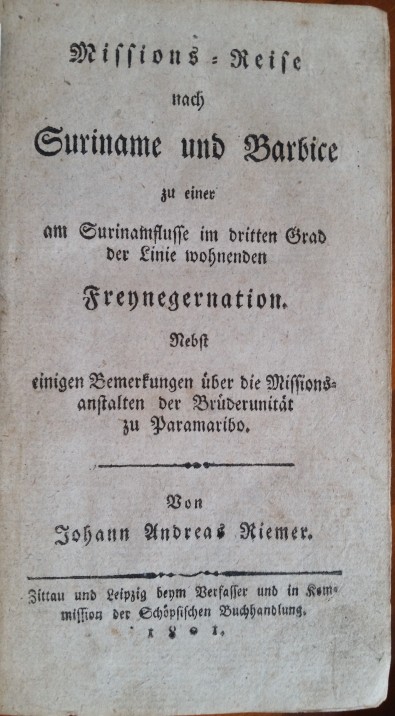
Missions-Reise nach Suriname und Barbice zu einer am Surinamflusse im dritte Grad der Linie wohenden Freinegernation, nebst einigen Bemerkungen über die Missionsanstalten der Brüderunität zu Paranaribo. Johann Andreas Riemer.  Zittau: 1801. 
Johann Andreas Riemer (1750-1786) werd geboren in het plaatsje Wespen, vlak onder Maagdenburg (Duitsland). In 1779 vertrok hij als missionaris van de Evangelische Broeder Gemeente (EBG) via Braunschweig, Hannover en Amsterdam naar Suriname. Eerst woonde hij bij de van de plantages weggelopen slaven, de marrons, in Bambey. Daar bestudeerde hij de taal van deze Saramaccaners. Riemer werkte hier aan zijn Saramaccaans woordenboek en zijn beschrijving van de grammatica van deze taal. Ook hield hij gedurende zijn verblijf in Suriname een dagboek bij. Hij schreef o.a. over de flora en fauna van Suriname maar ook over het leven van de slavenbevolking. Dat vinden wij natuurlijk veel interessanter. Wij weten eigenlijk nog maar weinig van het dagelijks leven in de slavenmaatschappij die Suriname lange tijd was. Maar dankzij reisverhalen van ooggetuigen, zoals deze van Riemer, krijgen we toch een klein inkijkje.
Riemer3
Courage! Masra, Courage! (Meester, wees dapper!). Illustratie uit Missions-Reise nach Surinam (1801)
Riemer beschrijft bijvoorbeeld een groep slaven die net uit Guinea was aangekomen in Paramaribo. De groep werd langzaam door de straten van Paramaribo geleid. Het was alsof het, zo schrijft Riemer, een groep verlaten schapen was; schuchter, bang en meelijwekkend, in afwachting van hun lot. Riemer was in het gezelschap van een aantal EBG missionarissen die een slaaf wilde kopen. Nadat zijn oog op een slaaf is gevallen wordt deze door een arts bekeken en goedgekeurd. Voor fl. 450,- wordt tot koop overgegaan. Riemer is zo geroerd door de blik vol verlangen van de Afrikaan (‘neger’) dat hij het schouwspel niet langer kan aanzien. Daaruit spreekt een zekere empathie uit die Riemer had voor de slaven. Hun lot is volgens hem treurig. De slaven, volgens Riemer door bedrog of valsheid van hun eigen verwanten in slavernij terechtgekomen, zweven tussen hoop en angst. Riemer geeft voorbeelden van verhalen van Afrikanen die man, vrouw, ouders en kinderen verraden en zelfs voor een kleine prijs verkopen zoals een rol tabak of een fles brandewijn. Maar Riemer haast zich om te melden dat slaven graag door de missionarissen gekocht worden omdat deze milder zijn en bescherming bieden. Het merendeel van de kopers van slaven is namelijk ronduit barbaars.
landingsplaats bij Fort Zeelandia Paramaribo k
Landingsplaats bij Fort Zeelandia (Paramaribo)
Riemer vertelt ons ook één en ander over de relaties tussen witte Europeaanse mannen en Afrikaanse vrouwen. Zo bezocht hij de scheepskapitein Kanz. Deze heeft in  Suriname een mulattin vrouw waar hij vier kinderen bij heeft. Zijn kinderen zijn gedoopt, gaan in Europese kleding door het leven en krijgen les van een dominee van de Evangelische kerk. De kapitein vertelt dat hij in Europa ook nog vrouw en kinderen heeft. Dat is, zo geeft hij aan, heel normaal. Ook zijn collega’s doen het net zo omdat zij soms jarenlang gescheiden van hun vrouwen moeten leven. Het is voor hem nobeler om zo te leven dan om hun vrouwen in Europa te bedriegen door vreemd te gaan of jonge meisjes te onteren. Wij weten nu inmiddels wel hoe Europese mannen zich in sexueel opzicht te buiten gingen aan Afrikaanse vouwen of hoe zij in een zg. ‘Surinaams huwelijk’ samenleefden. Maar in de 18e eeuw was het zeker niet gebruikelijk om daar zo open over te schrijven.
In juni 1780 verliet Riemer Suriname weer en keerde terug naar Duitsland. Zijn dagboekaantekeningen vormden de basis voor een boek dat pas vijftien jaar na zijn dood in 1801 verscheen. Riemer werd slechts 36 jaar oud. Zijn boek is uitermate zeldzaam maar boordevol informatie over het leven van alledag in Suriname rond 1780. Eigenlijk zou iedereen die geïnteresseerd is in de geschiedenis van Suriname het moeten lezen. Voor het feit dat u er af en toe misschien een Duits woordenboek bij moet pakken, wordt u rijkelijk beloond.
Carl Haarnack
Zie ook:
Neger-Englische Gramatik
Vier Maanden in Suriname
Natalie Zemon Davis over taal en Riemer

titelblad riemer  k
Titelpagina Mission-Reise nach Suriname

11.05.2016

The Woman Who Found Abstraction Before the Modernists

by Olivia McEwan on May 10, 2016
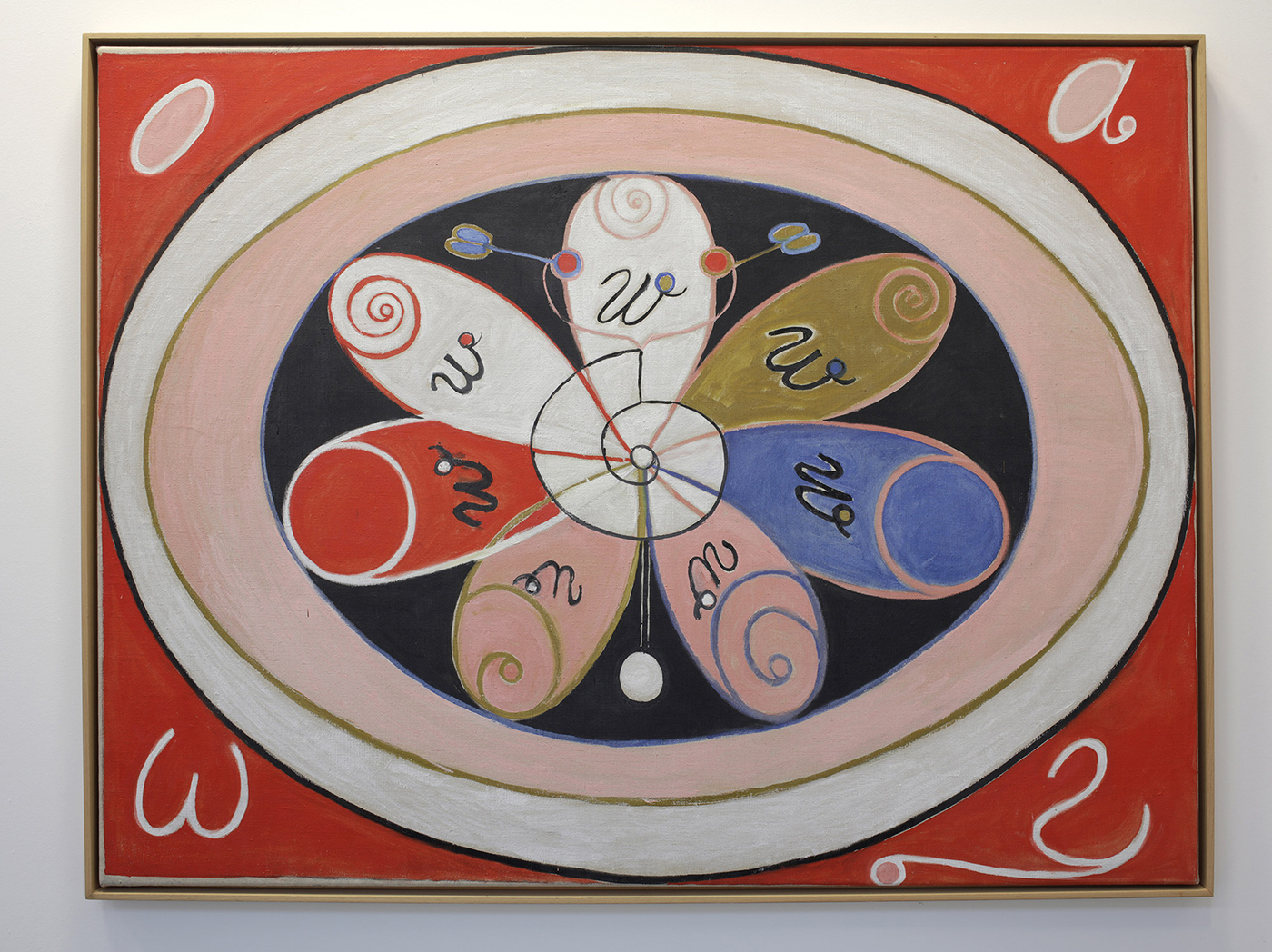


Installation view, ‘Hilma af Klint: Painting the Unseen’ at Serpentine Gallery, London, March 3–May 15, 2016) (image © Jerry Hardman-Jones)

LONDON — The first thought that struck me about the Serpentine Gallery’s exhibition of Swedish artist Hilma af Klint, Painting the Unseen, was: Thank goodness — finally a solo show starring a female artist! And not just any female artist: Hilma af Klint is a brilliant choice. Few people beyond the art world have heard of her, and the work on view here proves that she was such an intriguing individual and artist, this show is so much more than the product of tokenism.

Upon entering, you’re greeted with enormous, geometric murals in flat blocks of color, instantly recognizable as in some way spiritual, even occult. Glance at the date and you see that af Klint effectively ventured into the principles of abstraction well before its more famous exponents (Kandinsky, Mondrian, and Malevich), something the publicity material takes pains to emphasize. Even more fascinating is that the abstract works here were apparently made secretively, withheld from exhibition at her own instruction for 20 years after her death.


Installation view, ‘Hilma af Klint: Painting the Unseen’ at Serpentine Gallery, London, March 3–May 15, 2016) (image © Jerry Hardman-Jones) (click to enlarge)

Af Klint was trained in portrait, landscape, and botanical painting at the Royal Academy of Fine Arts, Stockholm, from 1882 to 1887. From the late 1880s on, however, she rejected these disciplines, joining four other female artists to form the group De Fem (The Five), which conducted weekly séances and engaged with esoteric religious philosophies.

This side of her work — presented here as the primary side, the academic pieces completely discarded — was thus wholly rooted in spiritual concerns. She used painting as a medium (pun intended) through which the secret language of nature, whether cosmic or earthly, could be manifested, as well as early experimentations with automatic drawing. This may be the crux for understanding why her art has for so long been ignored: The level of finish (or distinct lack thereof) evidenced in the works, combined with a penchant for unplanned, experimental sequences including meandering lines and automatic drawing, indicates that the physical paintings, for af Klint, really were planes on which she communicated with immaterial and spiritual forces. They are far removed from the traditional, Western notion of not only representative art, but also, crucially, anti-representational art. In a way, to mention her work in the same breath as any of the Modernist abstraction movements is misleading, undermining real efforts to understand her real purpose.


Installation view, ‘Hilma af Klint: Painting the Unseen’ at Serpentine Gallery, London, March 3–May 15, 2016) (image © Jerry Hardman-Jones) (click to enlarge)

Af Klint’s paintings appear as a series of sequences, in which one visual theme is explored in limited but specific directions, in a surprisingly methodical manner. So the works in Primordial Chaos Group I (Nos. 1 to 25) (1906–7) are restricted to a limited color palette and are of uniform size, as are those in Seven Pointed Star: Evolution (Nos. 1 to 16) (1908). The psychedelic, formless shapes and squiggly brushmarks look like they might have been made by someone in a trance or possessed, which is perhaps exactly the point. Three versions of “Altarpiece” (1915) are more monumental with solidly blocked-out color, exploring chromatic shading combined with the hard, basic geometric shapes of a triangle and circle. These look more like charts, their meaning mysterious and elusive while simultaneously simple and — in their own curious, restrained way — logical. It is staggering to think that these were completed in 1915; viewed in isolation, and without looking at any wall text, you would be hard pressed to place them historically.


Installation view, ‘Hilma af Klint: Painting the Unseen’ at Serpentine Gallery, London, March 3–May 15, 2016) (image © Jerry Hardman-Jones) (click to enlarge)

Most striking are the enormous depictions (if they can be called that) of the stages of life in her The Ten Largest sequence. These jumble together vaguely feminine motifs of eggs, flowers, and swirls in distinctly pastel shades of pink, orange, and blue. Again, the meaning is mysterious and elusive, but here unmistakably fecund. They should be treated not as artworks expressing inner thought or narrative but mystical charts into other planes. They suggest a 20th-century equivalent of the maps and diagrams we see in Medieval manuscripts, created by writers, philosophers, cartographers, and scientists who were trying to make sense of the world around them.


Hilma af Klint, “Group IX/UW, No. 25, The Dove, No. 1” (1915), oil on canvas, 151 × 114.5 cm (courtesy Stiftelsen Hilma af Klints Verk; photo by Moderna Museet/Stockholm)

Presenting her as an undiscovered artist is perhaps the wrong way to consider Hilma af Klint. Much is made of her modernism because we are mistakenly viewing her through the prism of defined art movements. In this light, we may be more critical of perceived shortcomings, like some figurative representations and automatic drawings and texts that appear clunky and awkward. High finish and polished, considered design — the hallmarks of Modernist abstraction — were not her concern in her quest to connect with the spiritual. Instead, she should be admired for what she was: as a wonderfully refreshing and unique presence in art history. Hilma af Klint: Painting the Unseen continues at the Serpentine Gallery (Kensington

05.05.2016

Feminist fabulation: space/postmodern fiction


Marleen S. Barr
University of Iowa Press, 1992 - 312 Seiten


The surprising and controversial thesis of Feminist Fabulation is unflinching: the postmodern canon has systematically excluded a wide range of important women's writing by dismissing it as genre fiction. Marleen Barr issues an urgent call for a corrective, for the recognition of a new meta- or supergenre of contemporary writing - feminist fabulation - which includes both acclaimed mainstream works and works which today's critics consistently denigrate or ignore. In its investigation of the relationship between women writers and postmodern fiction in terms of outer space and canonical space, Feminist Fabulation is a pioneer vehicle built to explore postmodernism in terms of female literary spaces which have something to do with real-world women. Branding the postmodern canon as a masculinist utopia and a nowhere for feminists, Barr offers the stunning argument that feminist science fiction is not science fiction at all but is really metafiction about patriarchal fiction. Barr's concern is directed every bit as much toward contemporary feminist critics as it is toward patriarchy. Rather than trying to reclaim lost feminist writers of the past, she suggests, feminist criticism should concentrate on reclaiming the present's lost fabulative feminist writers, writers steeped in nonpatriarchal definitions of reality who can guide us into another order of world altogether. Barr offers very specific plans for new structures that will benefit women, feminist theory, postmodern theory, and science fiction theory alike. Feminist fabulation calls for a new understanding which enables the canon to accommodate feminist difference and emphasizes that the literature called "feminist SF" is an importantsite of postmodern feminist difference. Barr forces the reader to rethink the whole country club of postmodernism, not just its membership list - and in so doing provides a discourse of this century worthy of a prominent reading by all scholars, feminists, writers, and literary theorists and critics.