

The following article by Michael Vannoy Adams is a presentation delivered at the congress of the International
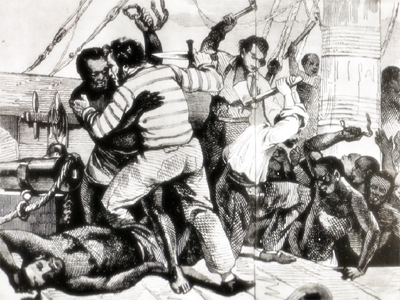
Association for Analytical Psychology in Cape Town, August 15, 2007.
Among all archetypes, the journey is perhaps the most universal. Of
course, there are always variations on themes. There is the external
journey, and there is the internal journey. There are personal journeys,
and there are collective journeys. There is the journey as quest, but
there is also the journey as conquest. There are journeys of heroes,
journeys of villains, journeys of victims, and journeys of survivors.
There are journeys of exploration and journeys of exploitation. Not
every journey is a journey of individuation.There is the journey to Africa — for example, the journeys of Jung to North Africa in 1920 and to East Africa in 1925-26, as well as the journey of Jungians to South Africa in 2007. There is also the journey from Africa. Of journeys from Africa, the most universal is the journey of all humanity from Africa, as the evidence of mitochondrial DNA has conclusively proved, but there is also another journey from Africa, not of all humanity, but the journey of Africans in the transatlantic slave trade — the "night sea journey" of the Middle Passage to the Americas.
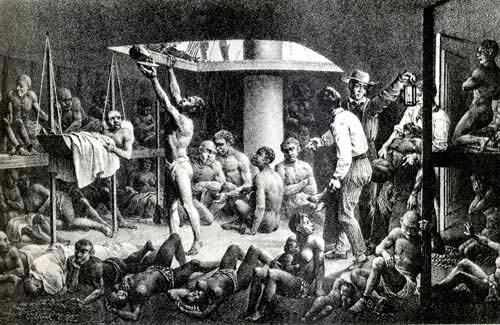
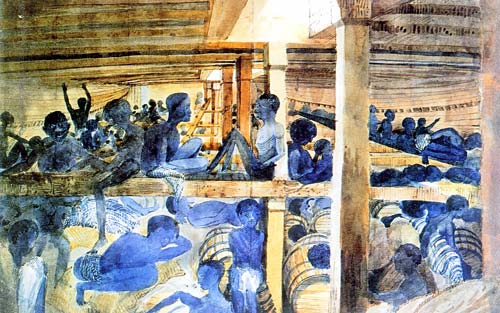
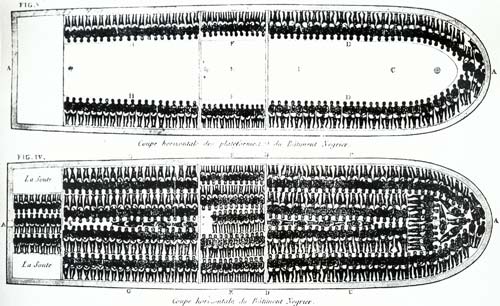
The most notorious image of those ships is the diagram of the Brookes.
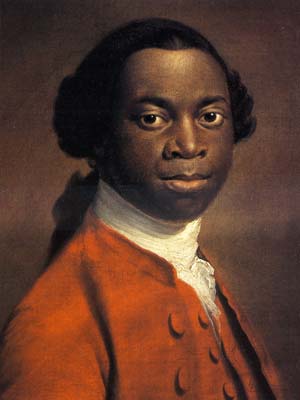
Hardly any personal accounts of the journey exist, but one by Olaudah Equiano describes an initial experience of the ship.
"The psychological impact," Rawley says, "of the Middle Passage upon the involuntary passengers was noted by contemporaries." For example, a doctor reported that one ship had carried 602 slaves, of whom 155, or 25.7%, had died on the journey. He estimated that two-thirds of those deaths had been the result of melancholy. The doctor, Rawley says, "could cure none who had the melancholy" (291). Diagnostically, the trauma of the transatlantic slave trade was an incurable depression.
The archetype of the journey comprises three stages: separation, initiation, and return (Campbell: 30). As a journey, however, the transatlantic slave trade included only two stages: separation and initiation — or separation and trauma. In a sense, of course, every initiation is a trauma, and every trauma is an initiation. Also, every journey is a journey toward an unknown destination for unknown purposes. The slave trade was hardly exceptional in that respect. Every journey is a journey of the ego into the unconscious.
As an initiatory experience, however, the slave trade was an especially traumatic experience. It was a journey with no return. On a beach in Dahomey, there is the "Gate of No Return."
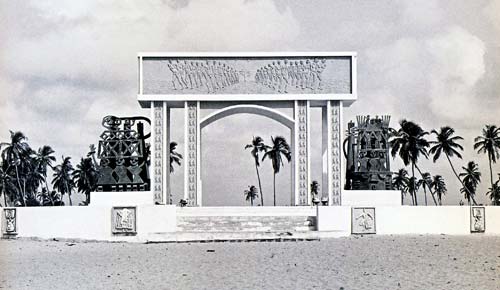
What so depressed Equiano was the realization that "I now saw myself deprived of all chance of returning to my native country" (Gates 1987: 33). The result was often, if not insanity, suicide. The captain of one ship reported that slaves committed suicide because "tis their belief that when they die they return home to their own country and friends again" (Mannix: 117-18). A doctor on another ship also reported that slaves "wished to die on an idea that they should then get back to their own country." The captain of that ship devised an ingenious solution to the problem — to behead the dead in order to prevent any idea of suicide. "The captain in order to obviate this idea," the doctor said, "thought of an expedient viz. to cut off the heads of those who died intimating to them" — that is, to the slaves — "that if determined to go, they must return without heads" (Mannix: 118). From a psychoanalytic perspective, decapitation is dissociation. To return without a head would be to return without spirit — or without psyche. To sever the head from the body was to sever the slave from Africa spiritually or psychically.
Of course, some contemporary descendants of slaves do return to Africa — for example, to Goree Island off the coast of Senegal. This is not just the slave trade, in an ironic reversal, as a tourist trade — a mere exercise in nostalgia or sentimentality. It is a return to the scene of the trauma, as if such a journey might be a curative experience.
Perhaps the most egregiously perverse image of the transatlantic slave trade is the Sable Venus. "Venus" is, of course, the proper name of a goddess, but it is also a generic name, or epithet, for a woman. The most famous "Venus" from Africa is not the Sable Venus but the Hottentot Venus.
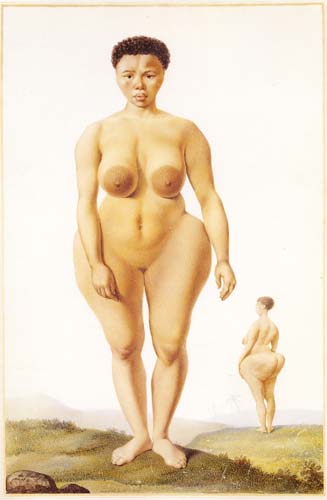
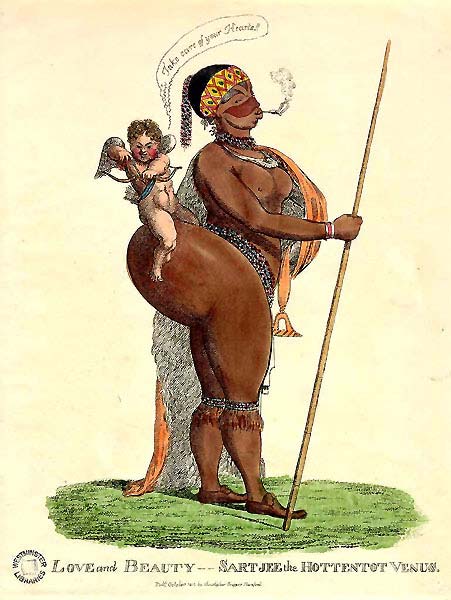
In contrast to the Hottentot Venus, the Sable Venus was not a real woman but an imaginal woman. A book, The History, Civil and Commercial, of the British Colonies in the West Indies, by Bryan Edwards includes a poem, "The Sable Venus: An Ode," by Isaac Teale. The poem compares the Sable Venus to the Venus of Botticelli.
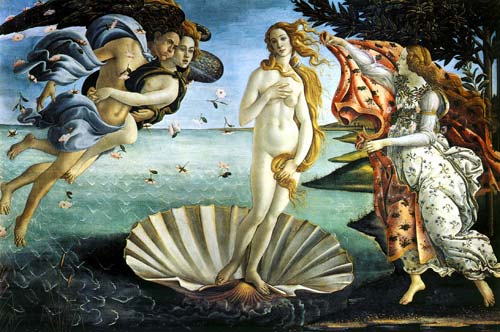
The loveliest limbs her form compose,The second volume of the third edition of the book in 1801 includes both the poem and an image. The image is "The Voyage of the Sable Venus from Angola to the West Indies" by Thomas Stothard, Esquire, of the Royal Academy.
Such as her sister VENUS chose,
In FLORENCE, where she's seen;
Both just alike, except the white,
No difference, no – none at night,
The beauteous dames between. (Edwards: 34-5)
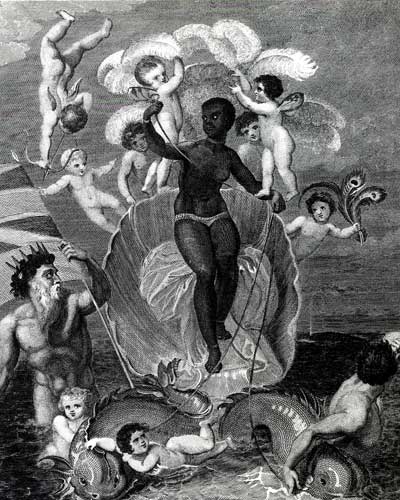
Daniel P. Mannix notes that "a wealth of classical details" embellishes the image (113). In this image, there is no African goddess, and there are no African gods. The goddess and the gods are all Roman – and although the goddess is black, all the gods are white. The image "Romanizes" and "whitens" the slave trade. There are twelve figures in the image. Eleven of the figures are white – only one of the figures is black. The Sable Venus rides on a scallop shell and sits on a velvet throne. In the sky are six cherubs. Two cherubs fan the Sable Venus with ostrich plumes while one cherub holds peacock feathers. In the sea, two dolphins, with two cherubs, pull the scallop shell, while to the right Triton blows a horn. On the left Cupid draws a bow and aims an arrow at Neptune, who holds not a trident but a flag, the Union Jack. The Sable Venus eyes the reins and holds them as she guides the dolphins, as if the journey from Africa to the Americas were entirely voluntary — as if it were not a journey by force but a journey by choice.
The Sable Venus is virtually nude. "Except for bracelets, anklets, and a collar of pearls," Mannix says, "she wears nothing but a narrow embroidered girdle" (112). The obscenity of the image is not the virtual nudity. The perversity of the image is the audacity of the mythological amplification. Roman myth is utterly inappropriate and inapplicable as a parallel to the slave trade. This is not just an incompetent amplification — a comparison for which there is no basis. It is a radically disingenuous amplification. The amplification is a euphemism that represses the enormity of the slave trade and conveniently excuses it.
The image reveals even as it conceals. It is obviously not an image that accurately depicts the psychic reality of black African men and women in the transatlantic slave trade. The value of the image is that it accurately depicts the psychic reality of white European men. The image is not a slave narrative but a master narrative. It is a projection, a cultural imposition that serves a quite specific purpose for white European men. The image is an example of how Africa has provided Europe with an opportunity for what Gates calls "the projection of fantasies from its collective unconscious" (1999: 16-17) — or, more accurately, from its cultural unconscious.
The image is not so much a cultural complex as it is a cultural duplex. It is a duplicitous image, an image that, even as it represses what Hugh Thomas calls the "iniquity" of the slave trade (11), expresses the duplicity of white European men. The image is a certain variety of anima that a certain variety of ego imposes culturally on a scene. It is the exotic, erotic anima of an imperialistic, psychopathic ego. In this image, which is both racist and sexist, the slave is a woman — and not just any woman but a woman no man coerces because she always consents. As a woman, the slave never resists.
The function of the image is aesthetic. The image stylizes an ugly, coercive experience, the slave trade, and revises it into a beautiful, consensual — and sensual — experience. Slavery is lovely. In this stylization and revision, Britain waves the flag, and, like Neptune, rules the waves — and, by Cupid, loves the slave as a woman. The image implies that slaves are like women who, like Venus, just love it. Slaves, however, were not goddesses enthroned on shells. They were women and men, girls and boys, confined on ships. They did not wear bracelets, anklets, and collars of pearls. They wore chains. In the slave trade there were flags — among them, the Union Jack and the Stars and Stripes — but there were no cherubs, dolphins, Triton, Cupid, and Neptune, and there was no Venus. What Marcus Wood calls "the ludicrous panoply of Gods and putti" (54) is not just the use of an image. It is the abuse of an image.
On the journey of the Sable Venus, there are no white men with horrible looks, red faces, and long hair. There are no bad spirits. There are only white gods. There are no black slaves — much less 600 black slaves. There is only one black goddess — and she is not a black African goddess but a black European goddess. The wealth of classical details does not just embellish the image to demonstrate the erudition of the artist. The mythological amplification converts an atrocity into art. It does not just normalize the slave trade. It idealizes it. It is all royally academic. This is not truth and reconciliation. It is lie and rationalization.
References
Campbell, J. (1968). The Hero with a Thousand Faces, Princeton, NJ: Princeton University Press.
Edwards, B. (1801). The History, Civil and Commercial, of the British Colonies in the West Indies, London: John Stockdale, 3rd ed., vol. 2.
Gates, Jr., H.L. (ed.) (1987). The Classic Slave Narratives, New York: Mentor.
Gates, Jr., H.L. (1999). Wonders of the African World, New York: Alfred A. Knopf.
Honour, H. (1989). The Image of the Black in Western Art, Cambridge, MA, and London: Oxford University Press, vol. 4, pt. 1.
Mannix, D.P., with Cowley, M. (1962). Black Cargoes: A History of the Atlantic Slave Trade, 1518-1865, New York: Viking Press.
Rawley, J.A. (1981). The Transatlantic Slave Trade: A History. New York and London: W.W. Norton.
Thomas, H. (1997). The Slave Trade: The Story of the Atlantic Slave Trade: 1440-1870. New York: Simon & Schuster.
Wood, M. (2000). Blind Memory: Visual Representations of Slavery in England and America, 1780-1865. New York: Routledge.

Keine Kommentare:
Kommentar veröffentlichen