Ornament-Werden - Weiblichkeit - Frauenarbeit - Sterotypisierung - Textilität - Suriname - Sklaverei - Kotomisi - Plantocrcacy - Repräsentation - Postkolonialismus - Schweiz - Dreieckshandel - Curaçao - Dutch Colonialism - Coolitude - Plantagenökonomie
26.03.2017
25.03.2017
24.03.2017
Nola Hatterman

© 2009 dbnl / Rosemarie Buikema en Maaike Meijer
Print Cultuur en migratie in Nederland. Kunsten in beweging 1900-1980(2003)–Rosemarie Buikema,
17 april 1953. Nola Hatterman vertrekt naar Suriname en ontwikkelt zich tot leermeesteres van een generatie Surinaams-Nederlandse beeldende kunstenaars.
15 Een artistiek bemiddelaar tussen Nederland en Suriname
Nola Hatterman was in 1953 54 jaar oud en een bekend en politiek geëngageerd Nederlands schilderes. Haar huis, Falckstraat 9 in Amsterdam, was het bruisende centrum van de Surinaamse cultureel-nationalistische beweging Wie Eegie Sanie (Ons Eigen Ding). De geboren en getogen Nederlandse Hatterman voelde zich sterk verbonden met zwarte mensen en hun cultuur. Zij was een actief lid van de in 1919 opgerichte Vereniging Ons Suriname, nam Surinamers veelvuldig als model voor haar schilderijen en kreeg begin jaren vijftig een steeds groter verlangen zich in Suriname te vestigen. Zij voelde zich in Europa artistiek ontworteld. ‘Ik moest naar Suriname’ zei ze later in een interview, ‘ik kon in mijn gevoel niet verder als ik niet naar Suriname zou gaan.’
Aanvankelijk leek het erop of zij door de Sticusa - een Stichting die de ontwikkeling van de Surinaamse en Antilliaanse cultuur wilde bevorderen - als tekenlerares naar Suriname zou worden uitgezonden, maar Sticusa trok zich terug vanwege Hattermans vermeende communisme. Hatterman ging echter toch. Haar dertigjarig verblijf in Suriname werd een groot succes. Zij werd er inderdaad de ‘ambassadrice’ van progressief Nederland in de gekleurde wereld. Zij stichtte er een professionele school voor Beeldende Kunsten die enkele generaties Surinaamse beeldend kunstenaars opleidde. Haar school fungeerde als een unieke ‘contactzone’ tussen Nederlandse en Surinaamse kunst. Veel van Hattermans leerlingen emigreerden in de jaren zestig tot tachtig naar Nederland, om zich in Europa verder te scholen en er zich als kunstenaar te vestigen. Hatterman was hun trait d'union, de luchtbrug die Surinaamse kunstenaars naar Nederland en Europa bracht.
Hatterman was gekant tegen het antropologisch of volkenkundig perspectief waarbinnen ‘zwarte’ kunst in haar tijd vaak werd geplaatst. Zij zag kunst als middel tot zelfherkenning, tot expressie van zwarte trots en antikoloniale bewustwording. Met die opvattingen en met haar eigen kunstwerken heeft Hatterman de Surinaams-Nederlandse kunstgeschiedenis van de twintigste eeuw diepgaand beïnvloed. Zij stimuleerde de ‘négritude’ in de beeldende kunst en heeft als geen ander het culturele isolement van Suriname opengebroken én de Nederlandse cultuur getransnationaliseerd. Na haar dood in 1984 is het contact tussen de Surinaamse en Nederlandse kunstwereld voortgezet door haar leerlingen. De Galerie Nola Hatterman (in Nederland) en het Nola Hatterman Instituut (in Suriname) zetten heden ten dage de door haar ingezette professionaliteit en internationalisering voort.
Wie was deze kleurrijke Nederlandse kunstenares? Hoe kwam zij tot haar radicale ideeën? Hoe kwam haar fascinatie met de gekleurde wereld tot stand en wat bracht haar er in 1953 toe naar Suriname te emigreren en er voorgoed te blijven werken?
‘En je kiest als je schildert uiteraard de modellen die je mooi vindt’
Nola (Hendrika Petronella) Hatterman werd op 12 augustus 1899 in Amsterdam geboren. Van kinds af aan kwam zij in aanraking met Indische mensen, doordat haar vader als boekhouder werkte bij een Indische firma. Als jong meisje zat ze op de lagere school met haar vingers op het topje van haar neus te drukken zodat die plat zou worden. Met haar andere vingers krulde zij haar lippen. Zo bleef ze elke morgen ‘een uur of wat’ zitten in de hoop dat zij haar gezicht zo zou kunnen modelleren dat zij op de Indische kinderen uit haar klas zou gaan lijken, die zij mooi vond en aan wie zij zich vaak zat te ‘vergapen’. Op het gymnasium kwam zij in aanraking met hét zuivere schoonheidsideaal, het Griekse, dat zij als prototype echter ‘beslist niet mooi’ vond. Toen ze vervolgens kennismaakte met de Egyptische cultuur met name met de Nefertete dynastie, ontdekte ze in de Egyptische afbeeldingen de ‘negroïde trekken’ die ze prachtig vond (Niemel en Van Broekhoven 1982).
Aanvankelijk leek Hatterman te kiezen voor een carrière als actrice. Zij speelde enkele jaren bij het Rotterdams Toneel en de Koninklijke Vereniging. Ook acteerde ze in een aantal films, waaronder Majoor Frans, naar de roman van Truitje Bosboom-Toussaint, die op 25 augustus 1916 in première ging. Met Johan Kaart en Lily Bouwmeester speelde zij in Helleveeg (1920) en in Oranje Hein (1925) van Alex Benno. Maar in 1925 koos zij definitief voor het tekenen en schilderen (Ottes 1999). Ze kreeg enkele jaren privé-les van Charles Haak, die verbonden was aan het Instituut voor Kunstnijverheidsonderwijs, de latere Rietveld Academie. Via hem kwam Hatterman in contact met Surinamers die er als schildersmodel wat geld bij probeerden te verdienen. Een van die modellen was prins Kaya, eigenlijk Frans Vroom geheten, met wie ze hecht bevriend raakte. In 1927 verhuisde hij van Paramaribo
[p. 259]
naar Amsterdam en woonde een tijd op de benedenverdieping bij Hatterman in de Falckstraat. Prins Kaya behoorde tot het groepje Surinaamse mannen dat Rudie Kagie beschrijft in zijn boek De eerste neger(1989), zie ook hoofdstuk 5. Ze kwamen als verstekeling met de oceaanstomer Cottica of Peter Stuyvesant en vonden na een aanloopperiode vaak werk in de muziek of iets anders ‘artistieks’.
Zelf was de prins aanvankelijk constructiewerker in de plaatijzerfabriek van Verschuren. Mede als gevolg van zijn vriendschap met Nola Hatterman [...] voelde hij zich al snel in het kunstenaarsmilieu meer op zijn gemak dan in de metaal. Hij was vuurvreter, equilibrist, portier, schildersmodel, figurant bij de film, figurant bij de Sleeswijkrevue, figurant bij het grote toneel. (Kagie 1989)
Een ander schildersmodel voor Hatterman was Jimmy van der Lak, wiens artiestennaam Jimmy Lucky luidde. In 1925 arriveerde hij, 21 jaar oud, per oceaanstomer in Rotterdam. Hij ontpopte zich als bokser die ‘ontzettend vlug op de benen’ was en uitkwam in het weltergewicht maar ‘zo nodig ook doorging voor het middengewicht.’ Na een ongelukkige partij, waarbij hij ‘een geweldig pak slaag’ kreeg, beëindigde hij zijn bokscarrière en ging als kelner werken in The Kit Cat Club:
Ik was een trekpleister van jewelste, de enige zwarte kelner in Nederland. Als ik op straat m'n gezicht liet zien, hielden de mensen me aan. Bussen stopten. De baas wou niet dat ik vrij nam omdat de gasten dan voor niks kwamen. Ik was een attractie. (Kagie 1989)
Labels:
dutch colonialism,
Kunsterziehung,
Künstlerin,
suriname,
vaudeville
23.03.2017
Jae Jarrell’s radical fashions
ca 1968
Jae Jarrell’s radical fashions use the body as a vessel for protest, resistance, and identity. Her love of fashion was influenced by the legacy of her grandfather, who was a tailor, and her uncle, who ran a haberdashery shop, selling fabric and sewing supplies. She went on to study art and clothing design at Bowling Green State University in Ohio, the School of the Art Institute of Chicago, and Howard University in Washington, D.C. In 1968, Jae, her husband Wadsworth Jarrell, and fellow artists Jeff Donaldson, Barbara Jones-Hogu, and Gerald Williams founded the collective AFRICOBRA (which stands for African Commune of Bad Relevant Artists). The group formed in response to a lack of positive representation of African and African American people in media and the arts. Their goal was to produce works that conveyed the pride, power, history, and energy of their communities. They worked to develop a uniquely Black aesthetic, with bright “Cool-ade” colors and a lively sense of rhythm. As a fashion designer, Jae embodied those ideals through clothing. Incorporating diverse elements such as brick walls, graffiti, colorful bandoliers, jazz, Scrabble, and African shields, Jae’s work is a celebration of life and individuality, with a strident “Look good, feel powerful” message.
Jae Jarrell (1935, Cleveland, OH) lives and works in Cleveland Ohio. Her work is held in numerous private collections, and in the permanent collection of the Brooklyn Museum of Art, where her garments were included in the exhibition Witness: Art and Civil Rights in the Sixties (2014). In 2015, Jarrell’s work will be featured in the exhibition The Freedom Principle: Experiments in Art and Music, 1965 to Now at the Museum of Contemporary Art Chicago.
Labels:
africobra,
black art,
Black identity,
bürgerrechtsbewegung,
chicago,
fashion,
Kleidung
20.03.2017
Venus – The anti-hero Hero
Venus - performance registration from Framer Framed on Vimeo.
Venus
– The anti-hero Hero was an interactive programme that explores the
historically violent imageries surrounding Venus. Who is Venus? Nikki
Minaj? Kim Kardashian? This event is part of the series of public and
discursive events that are curated alongside to the exhibition 'Embodied
Spaces' (2015) by curator Christine Eyene at Framer Framed in
Amsterdam. With contributions by Amal Alhaag, Rehema Chachage, Quinsy
Gario, Carolin Kamya, Shertise Selano, Hodan Warsame and Milone Reigman.
This event concluded the three exploratory reading sessions that were loosely based on three chapters from Suzan-Lori Park’s play Venus and connected to the themes of imagination, language and the body. Park’s play is based on the journey of Saartjie Baartman, a Khoi-San woman taken from South Africa in 1810 and exhibited in London and Paris. The reading of the exoticized body of Saartjie Baartman has influenced the iconography of the black female body in western visual cultures. Venus connects to current conversations on race, gender, sexuality, and voyeurism in the media. From Hottentot Venus to bootylicious – the female body, specifically, the black female body belongs to the spectators. How can we re-interpret and reclaim Venus despite the exploitation?
Venus – The anti-hero Hero was developed in collaboration with
theater director Amal Alhaag, Milone Reigman. Shertise Solano and Ronald
de Graaff created a series of beautiful masks especially for the Venus
performance directed by Milone Reigman. In addition to the exhibition
the masks will be on show in the public spaces of the Tolhuistuin.
Rehema Chachage is based in Tanzania, we had a chance to aks her for a
contribution thanks to the Thami Mnyele Foundation.This event concluded the three exploratory reading sessions that were loosely based on three chapters from Suzan-Lori Park’s play Venus and connected to the themes of imagination, language and the body. Park’s play is based on the journey of Saartjie Baartman, a Khoi-San woman taken from South Africa in 1810 and exhibited in London and Paris. The reading of the exoticized body of Saartjie Baartman has influenced the iconography of the black female body in western visual cultures. Venus connects to current conversations on race, gender, sexuality, and voyeurism in the media. From Hottentot Venus to bootylicious – the female body, specifically, the black female body belongs to the spectators. How can we re-interpret and reclaim Venus despite the exploitation?
Labels:
amal alhaag,
black venus,
feminismus,
framer framed,
performance,
venus,
Weiblichkeit
Bijna Familie
In het gesprek wordt onder andere ingegaan op het vermengen van feiten/geschiedenis en fictie, een thema dat terugkomt in zowel Ena’s als Karin’s werk, evenals in de lopende tentoonstelling Re(as)sisting Narratives, over het gedeelde koloniale verleden tussen Nederland en Zuid-Afrika. Beide schrijvers zullen dieper ingaan op één werk in de tentoonstelling. Zo zal Ena reageren op het werk van Mary Sibande, dat thematisch aansluit bij haar boek. Sibande’s werk Conversations with Madam CJ Walker (2009) is geinspireerd op meerdere generaties vrouwen in haar familie, die huishoudsters waren en die zij als helden beschouwd.
Labels:
care politics,
dutch colonialism,
framer framed,
haushalt,
service,
Südafrika,
Weiblichkeit
17.03.2017
Post-Plantation: Lusanga International Research Centre for Art and Economic Inequality
March 17, 2017 


Render of the White Cube in Lusanga. © OMA.

The Repatriation of the White Cube
Launch of the five year-research program of LIRCAEI
April 21–22, 2017
Lusanga International Research Centre for Art and Economic Inequality
Bulungu Territory, Kwilu Province
Democratic Republic of the Congo
www.humanactivities.org
Cercle d’Art des Travailleurs de Plantation Congolaise
Avenue Wagenia 1
Commune de la Gombe
Kinshasa
D.R Congo
Institute for Human Activities
Postbus 17031
1001 JA Amsterdam
The Netherlands
On April 21–22, a quintessential White Cube will be inaugurated on a former Unilever plantation in Lusanga, 650 km southeast of Kinshasa, D.R. Congo. Designed by OMA, this White Cube is a central element of the Lusanga International Research Centre for Art and Economic Inequality (LIRCAEI). Located in the heart of the plantation system and at the crossroads of global inequality and climatological change, the research center aims to become a vector for a social and ecological shift. LIRCAEI is a joint initiative of the plantation workers' cooperative Cercle d'art des travailleurs de plantation congolaise(CATPC) and the Institute for Human Activities (IHA).
The festive and solemn inauguration of the White Cube will mark the launch of the five-year research program of LIRCAEI. In Lusanga, the White Cube will attract both the capital and the visibility needed for plantations workers to buy back land and develop a new economic and ecological model on-site: the post-plantation.
With the establishment of LIRCAEI, the iconic modernist White Cube will be recontextualized in the setting that has historically underwritten its development. In economic terms, plantations have funded not just the building of most European and American infrastructure and industries, but also that of museums and universities. On an ideological level, the violence and brutality unfolding on one side—the plantation zones—has informed and haunted the civility, taste and aesthetics championed at the other: the White Cubes. By colliding these two opposite poles of global value chains with each other, LIRCAEI aims to overcome both the monoculture of the plantation system—that exhausts people and the environment and the sterility of the White Cube—a free haven for critique, love, and singularity, that, more often than not, reaffirms class divides.
To mark the opening of the new research program centered on the definition and implementation of the post-plantation, CATPC is curating an exhibition on the interconnectedness of art, ecology and the economy. CATPC’s newest works will be unveiled alongside contributions by other prominent Congolese and international artists. The exhibition will serve to activate the White Cube and put it in the service of Lusanga's people. The opening weekend will also feature a concert, public discussions, a film program and a ceremony celebrating the repatriation of the White Cube. The recently published monograph dedicated to CATPC’s work, edited by Sternberg Press, will also be presented during that weekend.
The White Cube will include an internet platform that connects its research to plantations and museums worldwide. Plugged into these international networks, the White Cube will transform the former palm oil plantation of Lusanga into a legitimization machine, investigating and relaying the strategies of resistance alongside visions for the future of plantation workers globally. Within five years, LIRCAEI seeks to have designed the blueprint for a new economic model in which art serves as an engine to start inclusive and ecological post-plantations throughout the Congo.
The program will be held in Lingala and French, with assistance for English speakers. Admission is free. A fee will be charged for lodging and meals. Visitors are advised to take contact with the travel coordinator at: office@humanactivities.org
Participating artists include: Sammy Baloji, Djo Bismar, Marlene Dumas, Michel Ekeba, Eleonore Hellio, Carsten Höller, Irene Kanga, Mathieu Kasiama, Jean Katambayi, Jean Kawata, Mananga Kibuila, Huguette Kilembi, Mbuku Kimpala, Mao Kingunza, Thomas Leba, Jeremie Mabiala, Blaise Mandefu, Daniel Manenga, Mega Mingiedi, Emery Mohamba, Daniel Mvuzi, Cedrick Tamasala and Luc Tuymans.
CATPC is published by Sternberg Press and includes texts by Ariella Azoulay, Eva Barois De Caevel, Eléonore Hellio, Ruba Katrib, Alexander Koch, J. A. Koster, Renzo Martens, René Ngongo, Els Roelandt, Charles Sikitele Gize, Charles Tumba and Françoise Vergès, and photos by Léonard Pongo.
OMA is responsible for designing the master plan for the Lusanga International Research Centre for Art and Economic Inequality, including the White Cube. The project is overseen by their managing partner architect David Gianotten. The executive architect is Arsene Ijambo, general secretary of the Association of the Architects of the Congo (SAC).
The opening weekend of LIRCAEI is organized by IHA and CATPC, in partnership with OMA, the Ministry of Arts and Culture of the Democratic Republic of the Congo and KASK - Ghent School of the Arts.
The opening weekend of LIRCAEI is also supported by the Gieskes Strijbis Fund, the Mondriaan Fund, Bralima, Stichting Educatie en Cultuur and the Prince Claus Fund.


Render of the White Cube in Lusanga. © OMA.


The Repatriation of the White Cube
Launch of the five year-research program of LIRCAEI
April 21–22, 2017
Lusanga International Research Centre for Art and Economic Inequality
Bulungu Territory, Kwilu Province
Democratic Republic of the Congo
www.humanactivities.org
Cercle d’Art des Travailleurs de Plantation Congolaise
Avenue Wagenia 1
Commune de la Gombe
Kinshasa
D.R Congo
Institute for Human Activities
Postbus 17031
1001 JA Amsterdam
The Netherlands
On April 21–22, a quintessential White Cube will be inaugurated on a former Unilever plantation in Lusanga, 650 km southeast of Kinshasa, D.R. Congo. Designed by OMA, this White Cube is a central element of the Lusanga International Research Centre for Art and Economic Inequality (LIRCAEI). Located in the heart of the plantation system and at the crossroads of global inequality and climatological change, the research center aims to become a vector for a social and ecological shift. LIRCAEI is a joint initiative of the plantation workers' cooperative Cercle d'art des travailleurs de plantation congolaise(CATPC) and the Institute for Human Activities (IHA).
The festive and solemn inauguration of the White Cube will mark the launch of the five-year research program of LIRCAEI. In Lusanga, the White Cube will attract both the capital and the visibility needed for plantations workers to buy back land and develop a new economic and ecological model on-site: the post-plantation.
With the establishment of LIRCAEI, the iconic modernist White Cube will be recontextualized in the setting that has historically underwritten its development. In economic terms, plantations have funded not just the building of most European and American infrastructure and industries, but also that of museums and universities. On an ideological level, the violence and brutality unfolding on one side—the plantation zones—has informed and haunted the civility, taste and aesthetics championed at the other: the White Cubes. By colliding these two opposite poles of global value chains with each other, LIRCAEI aims to overcome both the monoculture of the plantation system—that exhausts people and the environment and the sterility of the White Cube—a free haven for critique, love, and singularity, that, more often than not, reaffirms class divides.
To mark the opening of the new research program centered on the definition and implementation of the post-plantation, CATPC is curating an exhibition on the interconnectedness of art, ecology and the economy. CATPC’s newest works will be unveiled alongside contributions by other prominent Congolese and international artists. The exhibition will serve to activate the White Cube and put it in the service of Lusanga's people. The opening weekend will also feature a concert, public discussions, a film program and a ceremony celebrating the repatriation of the White Cube. The recently published monograph dedicated to CATPC’s work, edited by Sternberg Press, will also be presented during that weekend.
The White Cube will include an internet platform that connects its research to plantations and museums worldwide. Plugged into these international networks, the White Cube will transform the former palm oil plantation of Lusanga into a legitimization machine, investigating and relaying the strategies of resistance alongside visions for the future of plantation workers globally. Within five years, LIRCAEI seeks to have designed the blueprint for a new economic model in which art serves as an engine to start inclusive and ecological post-plantations throughout the Congo.
The program will be held in Lingala and French, with assistance for English speakers. Admission is free. A fee will be charged for lodging and meals. Visitors are advised to take contact with the travel coordinator at: office@humanactivities.org
Participating artists include: Sammy Baloji, Djo Bismar, Marlene Dumas, Michel Ekeba, Eleonore Hellio, Carsten Höller, Irene Kanga, Mathieu Kasiama, Jean Katambayi, Jean Kawata, Mananga Kibuila, Huguette Kilembi, Mbuku Kimpala, Mao Kingunza, Thomas Leba, Jeremie Mabiala, Blaise Mandefu, Daniel Manenga, Mega Mingiedi, Emery Mohamba, Daniel Mvuzi, Cedrick Tamasala and Luc Tuymans.
CATPC is published by Sternberg Press and includes texts by Ariella Azoulay, Eva Barois De Caevel, Eléonore Hellio, Ruba Katrib, Alexander Koch, J. A. Koster, Renzo Martens, René Ngongo, Els Roelandt, Charles Sikitele Gize, Charles Tumba and Françoise Vergès, and photos by Léonard Pongo.
OMA is responsible for designing the master plan for the Lusanga International Research Centre for Art and Economic Inequality, including the White Cube. The project is overseen by their managing partner architect David Gianotten. The executive architect is Arsene Ijambo, general secretary of the Association of the Architects of the Congo (SAC).
The opening weekend of LIRCAEI is organized by IHA and CATPC, in partnership with OMA, the Ministry of Arts and Culture of the Democratic Republic of the Congo and KASK - Ghent School of the Arts.
The opening weekend of LIRCAEI is also supported by the Gieskes Strijbis Fund, the Mondriaan Fund, Bralima, Stichting Educatie en Cultuur and the Prince Claus Fund.

Labels:
agrarindustrie,
Amsterda,
kongo,
MGO,
modernism,
ökologie,
Ökonomie,
OMA,
plantation,
plantokratie,
post-plantation,
wghite cube
16.03.2017
12.03.2017
False-face computer vision camouflage patterns for Hyphen Labs’ NeuroSpeculative AfroFeminism
HyperFace Camouflage
This is a temporary page. HyperFace launches Jan 16. Sign up for launch notification here
at Sundance Film Festival 2017.

HyperFace OpenCV Prototype ©Adam Harvey
HyperFace is being developed for Hyphen Labs NeuroSpeculative AfroFeminism project at Sundance Film Festival and is a collaboration with Hyphen Labs members Ashley Baccus-Clark, Carmen Aguilar y Wedge, Ece Tankal, Nitzan Bartov, and JB Rubinovitz.
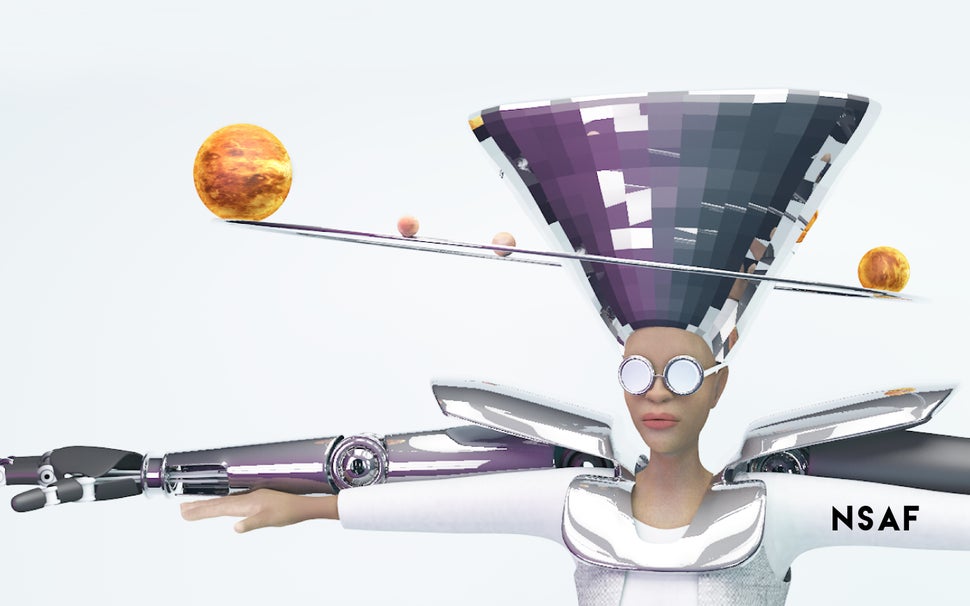
NeuroSpeculative AfroFeminism is a transmedia exploration of black women and the roles they play in technology, society and culture—including speculative products, immersive experiences and neurocognitive impact research. Using fashion, cosmetics and the economy of beauty as entry points, the project illuminates issues of privacy, transparency, identity and perception.
HyperFace is a new kind of camouflage that aims to reduce the confidence score of facial detection and recognition by providing false faces that distract computer vision algorithms. HyperFace development began in 2013 and was first presented at 33c3 in Hamburg, Germany on December 30th, 2016. HyperFace will launch as a textile print at Sundance Film Festival on January 16, 2017.
Together HyperFace and NeuroSpeculative AfroFeminism will explore an Afrocentric countersurveillance aesthetic.
For more information about NeuroSpeculative AfroFeminism visit nsaf.space
How Does HyperFace Work?
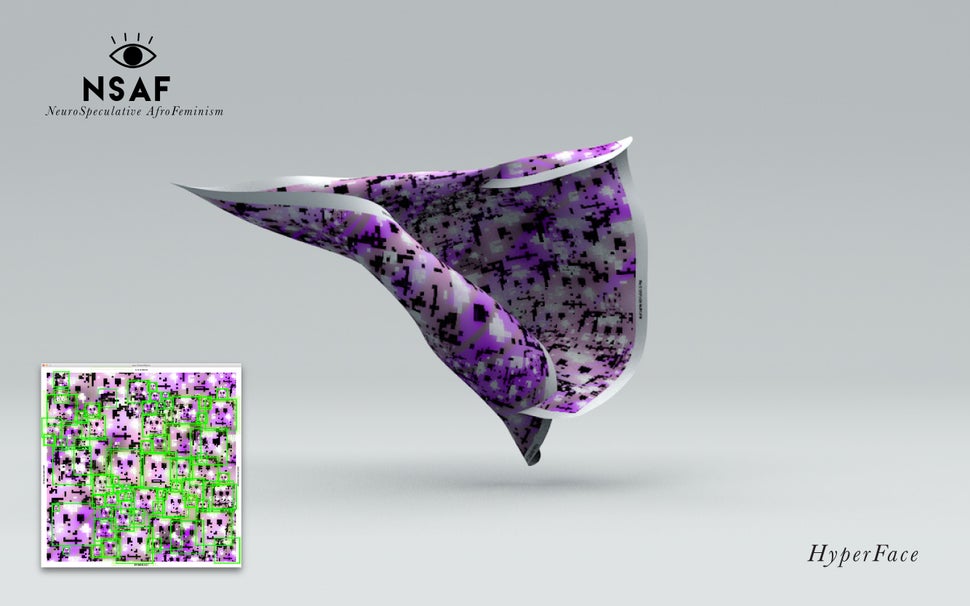
HyperFace works by providing maximally activated false faces based on ideal algorithmic representations of a human face. These maximal activations are targeted for specific algorithms. The prototype above is specific to OpenCV’s default frontalface profile. Other patterns target convolutional nueral networks and HoG/SVM detectors. The technical concept is an extension of earlier work on CV Dazzle. The difference between the two projects is that HyperFace aims to alter the surrounding area (ground) while CV Dazzle targets the facial area (figure). In camouflage, the objective is often to minimize the difference between figure and ground. HyperFace reduces the confidence score of the true face (figure) by redirecting more attention to the nearby false face regions (ground).
Conceptually, HyperFace recognizes that completely concealing a face to facial detection algorithms remains a technical and aesthetic challenge. Instead of seeking computer vision anonymity through minimizing the confidence score of a true face (i.e. CV Dazzle), HyperFace offers a higher confidence score for a nearby false face by exploiting a common algorithmic preference for the highest confidence facial region. In other words, if a computer vision algorithm is expecting a face, give it what it wants.
How Well Does This Work?
The patterns are still under development and are expected to change. Please check back towards the end of January for more information.
Product Photos
Please check back towards the end of January for product photos
Notifications
If you’re interested in purchasing one of the first commercially available HyperFace textiles, please add yourself to my mailing list at Undisclosed.studio
Notes
Designs subject to change
Displayed patterns are prototypes and are currently undergoing testing.
First prototype designed for OpenCV Haarcascade. Future iterations will include patterns for HoG/SVM and CNN detectors
Will not make you invisible
Please credit image as HyperFace Prototype by “Adam Harvey / ahprojects.com”
Please credit scarf rendering prototype as “Rendering by Ece Tankal / hyphen-labs.com”
Not affilliated with the IARPA funded Hyperface algorithm for pose and gender recognition
©2004-2016 Adam R. Harvey. All Rights Reserved.
This is a temporary page. HyperFace launches Jan 16. Sign up for launch notification here
at Sundance Film Festival 2017.

HyperFace OpenCV Prototype ©Adam Harvey
HyperFace is being developed for Hyphen Labs NeuroSpeculative AfroFeminism project at Sundance Film Festival and is a collaboration with Hyphen Labs members Ashley Baccus-Clark, Carmen Aguilar y Wedge, Ece Tankal, Nitzan Bartov, and JB Rubinovitz.
NeuroSpeculative AfroFeminism is a transmedia exploration of black women and the roles they play in technology, society and culture—including speculative products, immersive experiences and neurocognitive impact research. Using fashion, cosmetics and the economy of beauty as entry points, the project illuminates issues of privacy, transparency, identity and perception.
HyperFace is a new kind of camouflage that aims to reduce the confidence score of facial detection and recognition by providing false faces that distract computer vision algorithms. HyperFace development began in 2013 and was first presented at 33c3 in Hamburg, Germany on December 30th, 2016. HyperFace will launch as a textile print at Sundance Film Festival on January 16, 2017.
Together HyperFace and NeuroSpeculative AfroFeminism will explore an Afrocentric countersurveillance aesthetic.
For more information about NeuroSpeculative AfroFeminism visit nsaf.space
How Does HyperFace Work?
HyperFace works by providing maximally activated false faces based on ideal algorithmic representations of a human face. These maximal activations are targeted for specific algorithms. The prototype above is specific to OpenCV’s default frontalface profile. Other patterns target convolutional nueral networks and HoG/SVM detectors. The technical concept is an extension of earlier work on CV Dazzle. The difference between the two projects is that HyperFace aims to alter the surrounding area (ground) while CV Dazzle targets the facial area (figure). In camouflage, the objective is often to minimize the difference between figure and ground. HyperFace reduces the confidence score of the true face (figure) by redirecting more attention to the nearby false face regions (ground).
Conceptually, HyperFace recognizes that completely concealing a face to facial detection algorithms remains a technical and aesthetic challenge. Instead of seeking computer vision anonymity through minimizing the confidence score of a true face (i.e. CV Dazzle), HyperFace offers a higher confidence score for a nearby false face by exploiting a common algorithmic preference for the highest confidence facial region. In other words, if a computer vision algorithm is expecting a face, give it what it wants.
How Well Does This Work?
The patterns are still under development and are expected to change. Please check back towards the end of January for more information.
Product Photos
Please check back towards the end of January for product photos
Notifications
If you’re interested in purchasing one of the first commercially available HyperFace textiles, please add yourself to my mailing list at Undisclosed.studio
Notes
Designs subject to change
Displayed patterns are prototypes and are currently undergoing testing.
First prototype designed for OpenCV Haarcascade. Future iterations will include patterns for HoG/SVM and CNN detectors
Will not make you invisible
Please credit image as HyperFace Prototype by “Adam Harvey / ahprojects.com”
Please credit scarf rendering prototype as “Rendering by Ece Tankal / hyphen-labs.com”
Not affilliated with the IARPA funded Hyperface algorithm for pose and gender recognition
©2004-2016 Adam R. Harvey. All Rights Reserved.
Labels:
afrofeminism,
camouflage,
dazzle,
Pattern,
textile,
visibility
Afrofuturist Artists Craft A Virtual World For Women Of Color
01/18/2017 12:45 pm ET | Updated Jan 23, 2017
“Neurospeculative AfroFeminism” combines technology and fantasy to expand your imagination and physically optimize your brain.
By Priscilla Frank
HYPHEN-LABS
200
It was the summer of 2016 and molecular and cellular biologist/multidisciplinary artist Ashley Baccus-Clark was gifting herself a day of self-care. The police shootings of Alton Sterling and Philando Castile had left her, like so many black Americans, anguished and weary. She tried to ease her heartache by visiting Storm King, the 500-acre sculpture park in upstate New York where hulking man-made forms dwell among rolling green fields.
Because it was summer, Baccus-Clark packed some sunscreen for the journey. But after applying the milky substance to her face, she was left with a purple residue caked atop her flesh, a subtle reminder that, even with something as mundane as sun protection, people of color are too often disregarded.
“Women of color have to modify products to fit who they are as people,” Baccus-Clark explained in an interview with The Huffington Post at New Inc, an incubator attached to and led by the New Museum. “Why should I have to spend my time and energy worrying about something like sunscreen? There is so much technology designed by POC [people of color] that isn’t made without POC in mind.”
She decided, then, to make some sheer sunscreen herself. And that simple, low-tech solution led to the monumental, virtual reality project “Neurospeculative Afrofeminism,” which will premiere this Friday in the New Frontier section of the Sundance Film Festival.
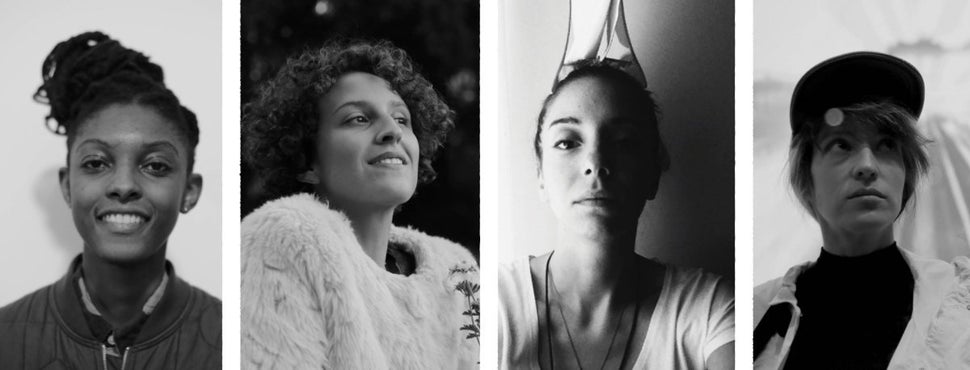
HYPHEN-LABSFrom left: Ashley Baccus-Clark, Carmen Aguilar y Wedge, Ece Tankal, and Nitzan Bartov.
Baccus-Clark is one member of Hyphen-Labs, a team of international women who combine art and technology to represent, protect and honor women of color. The team, who have worked together since 2014, also includes Carmen Aguilar y Wedge,a Mexican-American engineer with Cuban roots; Ece Tankal, an architect, moving image maker and multidisciplinary designer from Turkey; and Nitzan Bartov, an architect, game designer and artist from Israel.
With one foot grounded in contemporary reality and another in an imagined future, Hyphen-Labs renders both physical products and virtual reality narratives that specifically cater to black women. For the physical aspect of “Neurospeculative Afrofeminism,” Hyphen-Labs engineered a variety of speculative beauty products and accessories designed for women of color, manifesting the belief that self-care is more than just a luxury but a means of survival. A sunscreen safe for dark skin was object one.
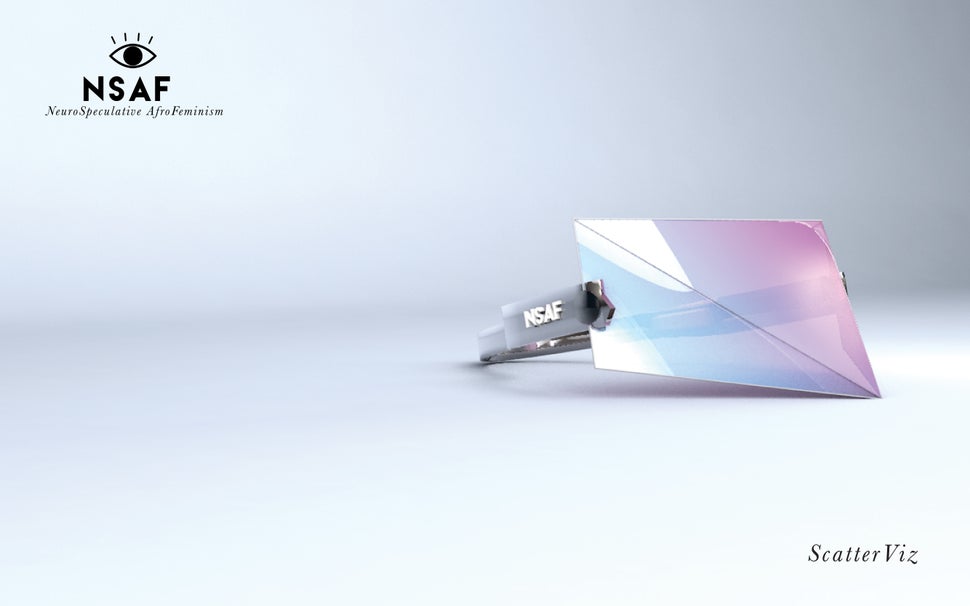
Along with the sunscreen, the artists pioneered the prototype for a visor with a dichroic reflective surface that allows its wearers to see but not be seen. The incandescent head gear, made with cooperation from AB Screenwear, is meant for scenarios where people of color enter a predominately white space. Instead of code-switching ― or shifting their self-presentation in order to blend in ― the visor reflects any antagonistic gazes back at the watcher. The accessory symbolizes, as the artists explain, “that what we fear most is often a reflection of ourselves.”
HYPHEN-LABS
SUBSCRIBE TO & FOLLOW CULTURE SHIFT
Level up. Read THIS and be the most interesting person at your dinner party. Learn more
For their third product, Hyphen-Labs designed a pair of earrings that function as cameras and recording devices, meant to document both micro- and macro-aggressions in a safe and discrete manner. The jewelry, a collaboration with Michelle Cortese, responds to the failure of dashboard cameras and bodycams to accurately capture the ambiguous encounters through which black lives are lost without satisfactory explanation. While phones are often confiscated when they would be most useful, the earrings offer an inconspicuous and, in fact, really cute way to chronicle what POC endure on a daily basis.
While some of the Hyphen-Labs products help users survey their environment, others are meant to protect them from what the lab has identified as systematic surveillance employed by government officials. Collaborating with privacy artist Adam Harvey, the team created a silk headscarf whose pattern triggers facial recognition software to the point of overwhelming it. If at a protest, for example, hundreds of people wore the scarf, the cameras would be so triggered by the textiles they would shut down.
The idea for the headscarf emerged when Hyphen-Labs’ Ece Tankal, wearing a necklace with an eye pendant, was playing with Snapchat filters, and the app’s facial recognition software mistook Tankal’s necklace for a human eye. She wrapped herself in their carefully designed headscarf during our interview while Carmen tried to Snapchat a picture. The phone bugged out, as little puppy dog filter faces quickly popped up and disappeared all over the scarf’s fabric on the iPhone screen.
HYPHEN-LABS
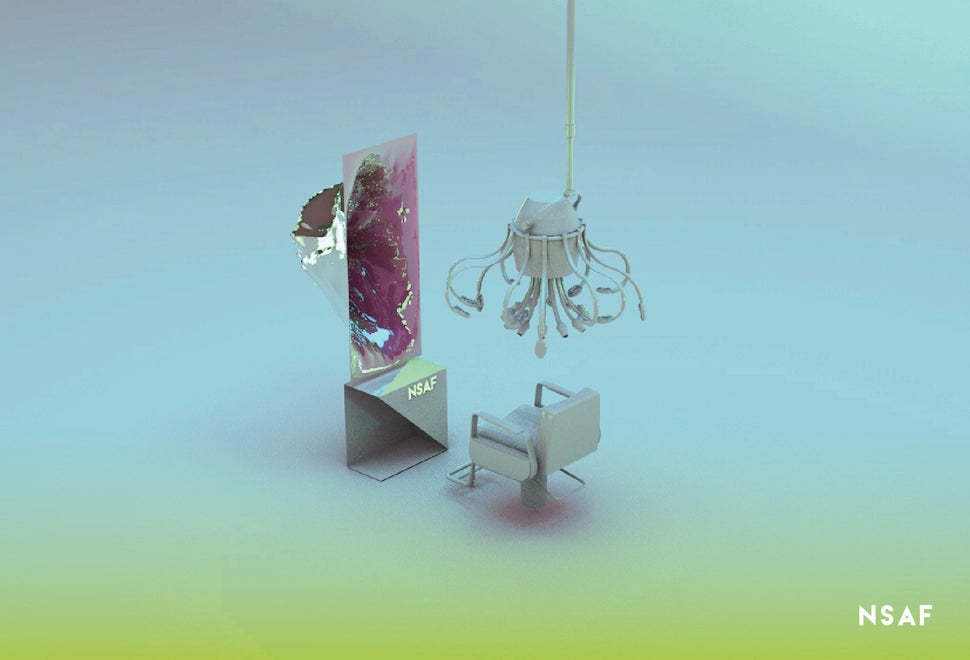
The artists’ final product is called “The Octavia.” Its technology riffs off high-definition transcranial direct current stimulation (HD-tDCS), a non-invasive brain stimulation technique which uses electrical currents to stimulate regions of the brain. The procedure is currently used to alleviate depression and anxiety in patients, as well as to optimize a user’s mind by augmenting memory to increase creativity and work flow. In Hyphen-Labs’ take, the electrodes are combined with self-cleaning natural hair extensions in order to be weaved into textured or natural hair.
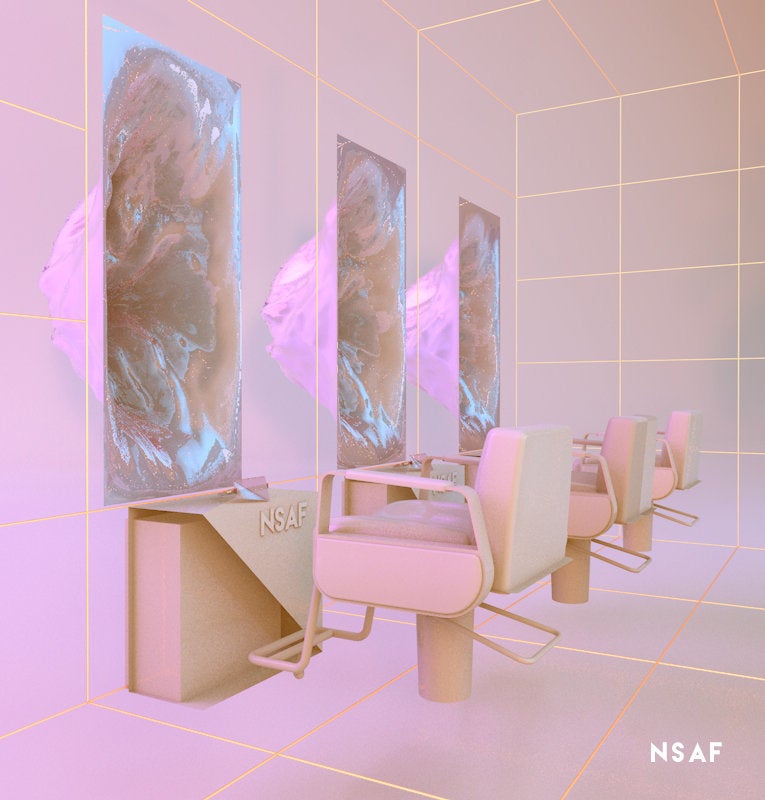
It is this final product that is at the core of the second aspect of “Neurospeculative Afrofeminism,” a virtual reality experience premiering at Sundance’s New Frontier Art festival on Jan. 20. The immersive film takes place at a “Neurocosmetology” lab ― think futuristic hair salon ― owned by a woman named Brooks. The setting alludes to the long history of salons as safe spaces for women of color and fertile ground for political and philosophical discussion.
As the viewer, after putting on your Oculus Rift helmet, you’re plunked into a chair in Brooks’ salon, ready to receive your Octavia electrodes ― aimed to increase your neuroplasticity. Your first view is of yourself in the mirror, as a black woman with long pigtail braids. This, in itself, is a powerful gesture, allowing people of all races and genders to physically see themselves as a woman of color, virtually stepping into the skin of another.
The products from Hyphen-Labs’ line are strewn about the virtual salon setting, confusing the space between real and imagined futures. While Brooks prepares you for your extensions, she chats with Naima, the salon matriarch, their conversation smoothly teetering between topics of ancient tradition and futuristic fantasy.
HYPHEN-LABS
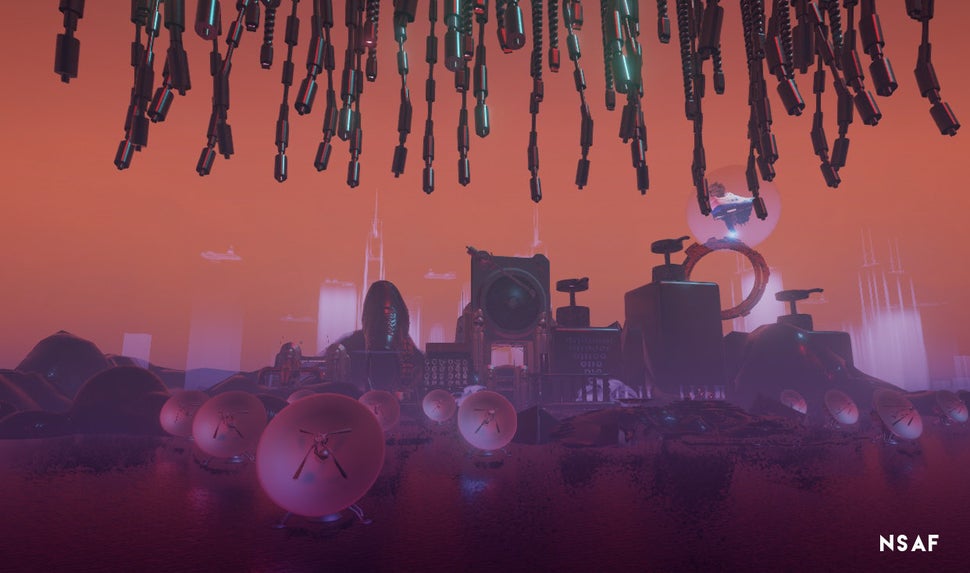
Before Brooks inserts the Octavia, she warns there may be some intense visuals when the electrodes hit. Moments later, you are floating in a 3D hallucinatory dreamscape with mountains made of water and a giant eye hovering in the sky. It’s the kind of fully transportive experience that can only occur in VR, a technology that allows you to float through a dreamed-up world.
Although the viewer doesn’t actually receive Octavia electrode implants during the VR experience, the effect of the 10-minute art piece is intense. Even the simulation of receiving the extensions is palpable. The Hyphen-Labs team intends to examine just how palpable, with plans to eventually conduct anthropological and neuroscientific research on whether or not experiencing the VR piece changes how viewers engage with the world.
“We are afraid of what we don’t know,” Aguilar y Wedge explained to The Huffington Post. “By simulating engagement [with women of color], we are trying to lower fear and prejudice.” Eventually, the women hope to conduct mobile functional magnetic resonance imaging (fMRI) scans on viewers while they encounter the artwork to determine if VR has a measurable effect on the brain.
HYPHEN-LABS
Hyphen-Labs also hopes to use the work to introduce communities to VR who might not otherwise have access to the emergent technology. The artists hope that by seeing familiar characters represented in the work, young women of color will be inspired to pursue science and tech themselves. “Where are all the black women in neuroscience?” Baccus-Clark asked. “As Marian Wright Edelman said, ‘It’s hard to be what you can’t see.’”
The necessity of black representation in film and art have made their way into the public consciousness, belatedly, in the past few years. In both arenas, it’s equally valuable to see people of color both on view and behind the scenes, as actor or image and artist, director, producer, etc. In the realm of VR, there are additional opportunities to identify and empathize with people of color.
“It’s about world building,” Aguilar y Wedge added. “This world is built for black women, but all are welcome.” The technology physically positions viewers in situations they may not otherwise encounter, not only engaging with people of color but feeling like one themselves. Many believe VR has more potential than any other medium to dispel racial bias.
However, the strong emotions VR is known for inducing are not necessarily positive. Many have written about experiencing the “empathy machine” gone haywire, with some narratives provoking anger or hatred in the viewer instead of compassion, yielding the opposite of the intended effect. VR artists like Nonny de la Peña are known for dropping the viewer into gut-wrenching and difficult scenarios, such as domestic assault. But Hyphen-Labs seems less concerned with heated narratives and more with the simple gesture of making visible what often is not, letting the viewer come to her own conclusions.
There are plenty of other prejudices the women of Hyphen-Labs are also out to eliminate. The belief, for example, that beauty products are of lesser import than high science. “They are both things that we value,” Baccus-Clark said. Or that advancements in the physical world are more legitimate than those built in the realm of art or fantasy.
“Neurospeculative Afrofeminism” premieres this weekend at Sundance, overlapping with the presidential inauguration. The artists believe their work offers a potent antidote to the small-minded world approach of the president-elect, although the issues and inequalities Hyphen-Labs addresses plagued American culture long before Donald Trump was in the picture.
For the artists, the inauguration offers a moment to reflect on many of the longstanding prejudices that America has tried to sweep out of sight. Now is the perfect moment to confront the wounds of our country, and finally, truly, begin to heal. In the face of ignorance, bigotry and ego, Hyphen-Labs serves up radical optimism, self-care, education, awareness and acceptance, through objects as mundane as sunscreen and as otherworldly as a hand-crafted alternate reality.
“We want to subvert victimization,” Aguilar y Wedge said. “The only limit is our imagination.”
“Neurospeculative Afrofeminism” will run Friday, Jan. 20, through Friday, Jan. 27, 2017, from 1 to 8 p.m. and Saturday, Jan.28, from 11 a.m. to 3 p.m. at Claim Jumper in Park City, as part of Sundance’s New Frontier Art.
HYPHEN-LABS
Suggest a correction
Priscilla Frank Arts Writer, The Huffington Post
Labels:
afrofeminism,
afrofuturismus,
beauty,
game,
technology,
virtuality,
vr,
Weiblichkeit,
woman
07.03.2017
Abonnieren
Posts (Atom)


